1 Kings 14:17

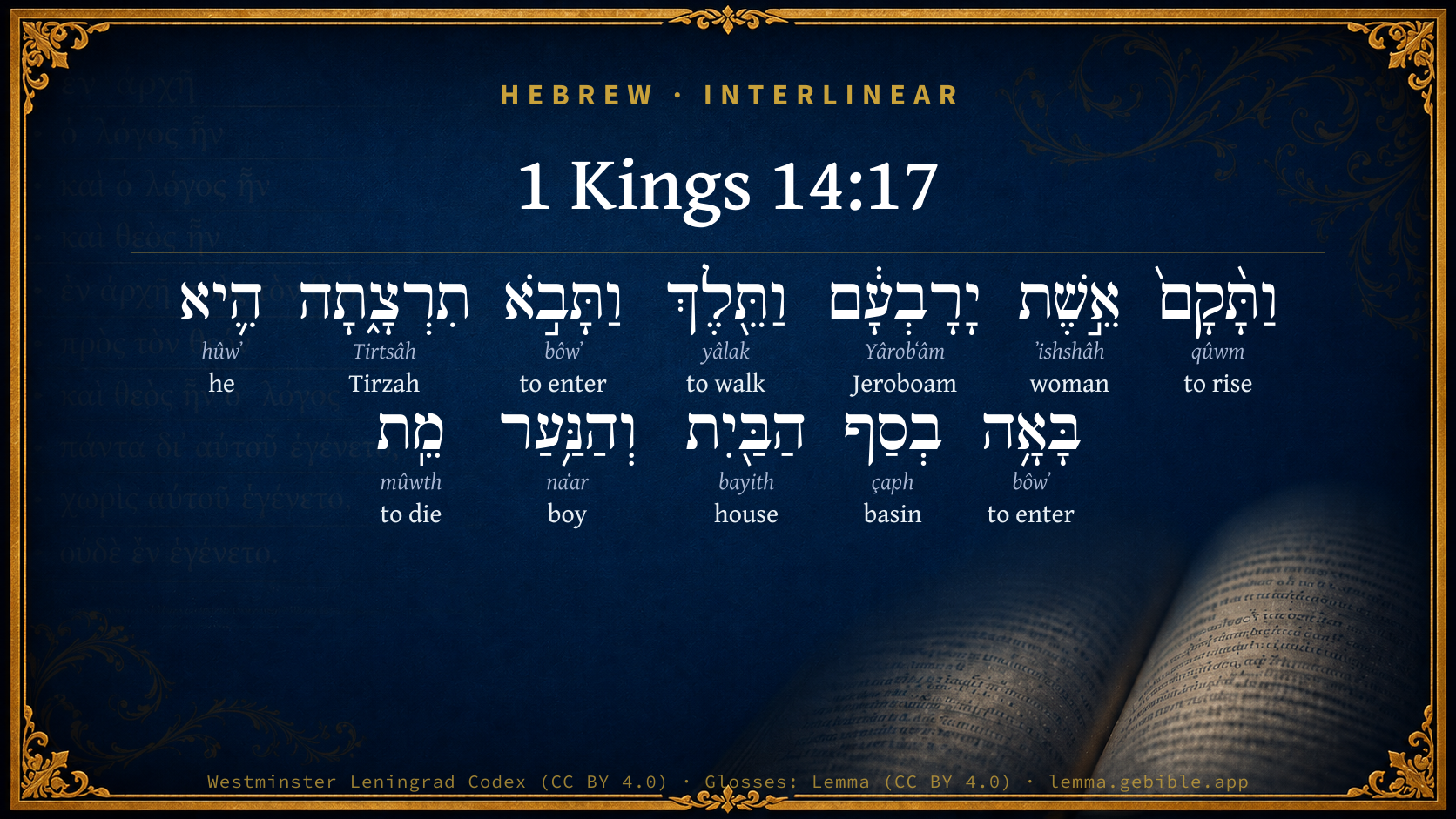
Hebrew (Westminster Leningrad Codex) 1 Kings 14:17 appears in the Hebrew Old Testament. The text above is from the Westminster Leningrad Codex. Each word links to its Strong’s number, a concise gloss, and parsing drawn from the Open Scriptures Hebrew Bible morphology. Click any word for its full Brown-Driver-Briggs (BDB) entry.
Download image
Cite this verse

1 Kings 14:17 (World English Bible). Public Domain. Lemma interlinear Bible study tool, https://lemma.gebible.app/v/1-kings/14/17.

Show BibTeX & RIS
BibTeX
RIS
English Translation
Jeroboam's wife arose, and departed, and came to Tirzah: [and] as she came to the threshold of the house, the child died.
World English Bible · Public Domain
Download a study sheet

One document with this verse’s original text, its word-by-word gloss line, the meaning frame, cross-references with their text, attributed commentary, and full source and license credits — printable, and it pastes into notes with its structure intact.

This verse Autodidact and up

Study sheet (.html) Plain text (.txt)

A passage Seminary Student

Up to 50 verses in one chapter. A passage sheet keeps up to 6 commentary sources and 12 cross-references per verse, in the order this page ranks them, and says so on the sheet whenever that leaves anything out. Ask for a single verse and you get the Autodidact verse sheet above.

Everything on this page stays free to read, with no account — the sheet is a download of what is already on screen, not access to it.

Want to remove ads? Support Godless Engineer
Compare translations 3

The same verse in 3 English versions, stacked beneath the original-language interlinear above. Click any original word for its lexicon entry.

Each is an independent rendering of the whole verse — the interlinear is not word-aligned to these translations.

Highlighted words mark where these versions differ — a whole-verse word diff, not a word-by-word alignment.

  • World English Bible Public Domain
    Jeroboam's wife arose, and departed, and came to Tirzah: [and] as she came to the threshold of the house, the child died.
  • King James Version Public Domain
    And Jeroboam's wife arose, and departed, and came to Tirzah: and when she came to the threshold of the door, the child died;
  • unfoldingWord Literal Text CC BY-SA 4.0
    And the wife of Jeroboam arose and went, and she came to Tirzah. She was entering at the threshold of the house, and the boy died.

unfoldingWord Literal Text — © unfoldingWord, licensed CC BY-SA 4.0. Word-aligned USFM3 via Door43 (git.door43.org/unfoldingWord/en_ult).

Versions to compare (up to 4)

3 of 4 selected

Show all 18 translations

Every available English version of this verse, each an independent rendering of the whole verse.

  • World English Bible Public Domain
    Jeroboam's wife arose, and departed, and came to Tirzah: [and] as she came to the threshold of the house, the child died.
  • Berean Standard Bible Public Domain
    Then Jeroboam’s wife got up and departed for Tirzah, and as soon as she stepped over the threshold of the house, the boy died.
  • Majority Standard Bible Public Domain
    Then Jeroboam’s wife got up and departed for Tirzah, and as soon as she stepped over the threshold of the house, the boy died.
  • King James Version Public Domain
    And Jeroboam's wife arose, and departed, and came to Tirzah: and when she came to the threshold of the door, the child died;
  • American Standard Version (1901) Public Domain
    And Jeroboam's wife arose, and departed, and came to Tirzah: `and' as she came to the threshold of the house, the child died.
  • Revised Version (1885) Public Domain
    And Jeroboam’s wife arose, and departed, and came to Tirzah: and as she came to the threshold of the house, the child died.
  • Geneva Bible (1599) Public Domain
    And Ieroboams wife arose, and departed, and came to Tirzah, and when shee came to the threshold of the house, the yong man dyed,
  • Douay-Rheims (1899) Public Domain
    And the wife of Jeroboam arose, and departed, and came to Thersa: and when she was coming in to the threshold of the house, the child died;
  • Young's Literal Translation Public Domain
    And the wife of Jeroboam riseth, and goeth, and cometh to Tirzah; she hath come in to the threshold of the house, and the youth dieth;
  • Literal Standard Version CC BY-SA 4.0
    And the wife of Jeroboam rises, and goes, and comes to Tirzah; she has come to the threshold of the house, and the youth dies;
  • Unlocked Literal Bible CC BY-SA 4.0
    So Jeroboam's wife arose and left, and came to Tirzah. As she came to the threshold of her house, the child died.
  • unfoldingWord Literal Text CC BY-SA 4.0
    And the wife of Jeroboam arose and went, and she came to Tirzah. She was entering at the threshold of the house, and the boy died.
  • Darby Bible Public Domain
    And Jeroboam's wife arose and departed, and came to Tirzah; when she came to the threshold of the door, the child died.
  • World Messianic Bible Public Domain
    Jeroboam’s wife arose and departed, and came to Tirzah. As she came to the threshold of the house, the child died.
  • Webster's Bible Public Domain
    And Jeroboam's wife arose, and departed, and came to Tirzah: and when she came to the threshhold of the door, the child died;
  • Free Bible Version CC BY-SA 4.0
    Jeroboam's wife got up and left for Tirzah. As soon as she stepped through the doorway of her home, the boy died.
  • Bible in Basic English Public Domain
    Then Jeroboam's wife got up and went away and came to Tirzah; and when she came to the doorway of the house, death came to the child.
  • JPS Tanakh (1917) Public Domain
    And Jeroboam's wife arose, and departed, and came to Tirzah; and as she came to the threshold of the house, the child died.

Literal Standard Version (2020), Covenant Press — licensed CC BY-SA 4.0. Text via the HelloAO Bible API (eBible.org). Unlocked Literal Bible (unfoldingWord) — licensed CC BY-SA 4.0. Text via the HelloAO Bible API (eBible.org). unfoldingWord Literal Text — © unfoldingWord, licensed CC BY-SA 4.0. Word-aligned USFM3 via Door43 (git.door43.org/unfoldingWord/en_ult). Free Bible Version, Dr. Jonathan Gallagher — licensed CC BY-SA 4.0. Text via the HelloAO Bible API (eBible.org).

Word by word

More ways to search: Search by grammar → Find every occurrence → Compare this word →

Practice this passage: Drill this verse → Learn its vocabulary →

תִרְצָ֑תָה
Tirtsâh
H8656
“Tirzah · toward”
Noun, Proper + Suffix, Demonstrative
Part of Speech
Noun
Type
Proper
Full BDB Definition

Origin: from H7521

TWOT: None

Tirzah = "favourable" - one of the 7 daughters of Zelophehad the son of Hepher of the tribe of Manasseh (noun proper feminine) - one of the kingdoms on the west of the Jordan conquered by Joshua and the Israelites (noun proper locative) - a Canaanite city, later capital of the northern kingdom of Israel (noun proper locative)
  1. וַתָּ֨קָם֙ qûwm H6965 “and · to rise” Conjunction + Verb, Qal, Sequential Imperfect, 3rd Person, Feminine, Singular
  2. אֵ֣שֶׁת ʼishshâh H802 “woman of” Noun, Common, Feminine, Singular, Construct
  3. יָרָבְעָ֔ם Yârobʻâm H3379 “Jeroboam” Noun, Proper
  4. וַתֵּ֖לֶךְ yâlak H3212 “and · to walk” Conjunction + Verb, Qal, Sequential Imperfect, 3rd Person, Feminine, Singular
  5. וַתָּבֹ֣א bôwʼ H935 “and · to enter” Conjunction + Verb, Qal, Sequential Imperfect, 3rd Person, Feminine, Singular
  6. הִ֛יא hûwʼ H1931 “he” Pronoun, Personal, 3rd Person, Feminine, Singular
  7. בָּאָ֥ה bôwʼ H935 “entering” Verb, Qal, Participle Active, Feminine, Singular, Absolute
  8. בְסַף çaph H5592 “in/at · basin of” Preposition + Noun, Common, Masculine, Singular, Construct
  9. הַבַּ֖יִת bayith H1004 “the · house” Particle, Definite Article + Noun, Common, Masculine, Singular, Absolute
  10. וְהַנַּ֥עַר naʻar H5288 “and · the · boy” Conjunction + Particle, Definite Article + Noun, Common, Masculine, Singular, Absolute
  11. מֵֽת mûwth H4191 “to die” Verb, Qal, Perfect, 3rd Person, Masculine, Singular

About this verse

These counts appear in no published source. They are computed here, from the morphology-tagged text and Lemma’s own curated glosses. What Lemma adds →

12
words
11
distinct lemmas
Historical
section

Notable vocabulary

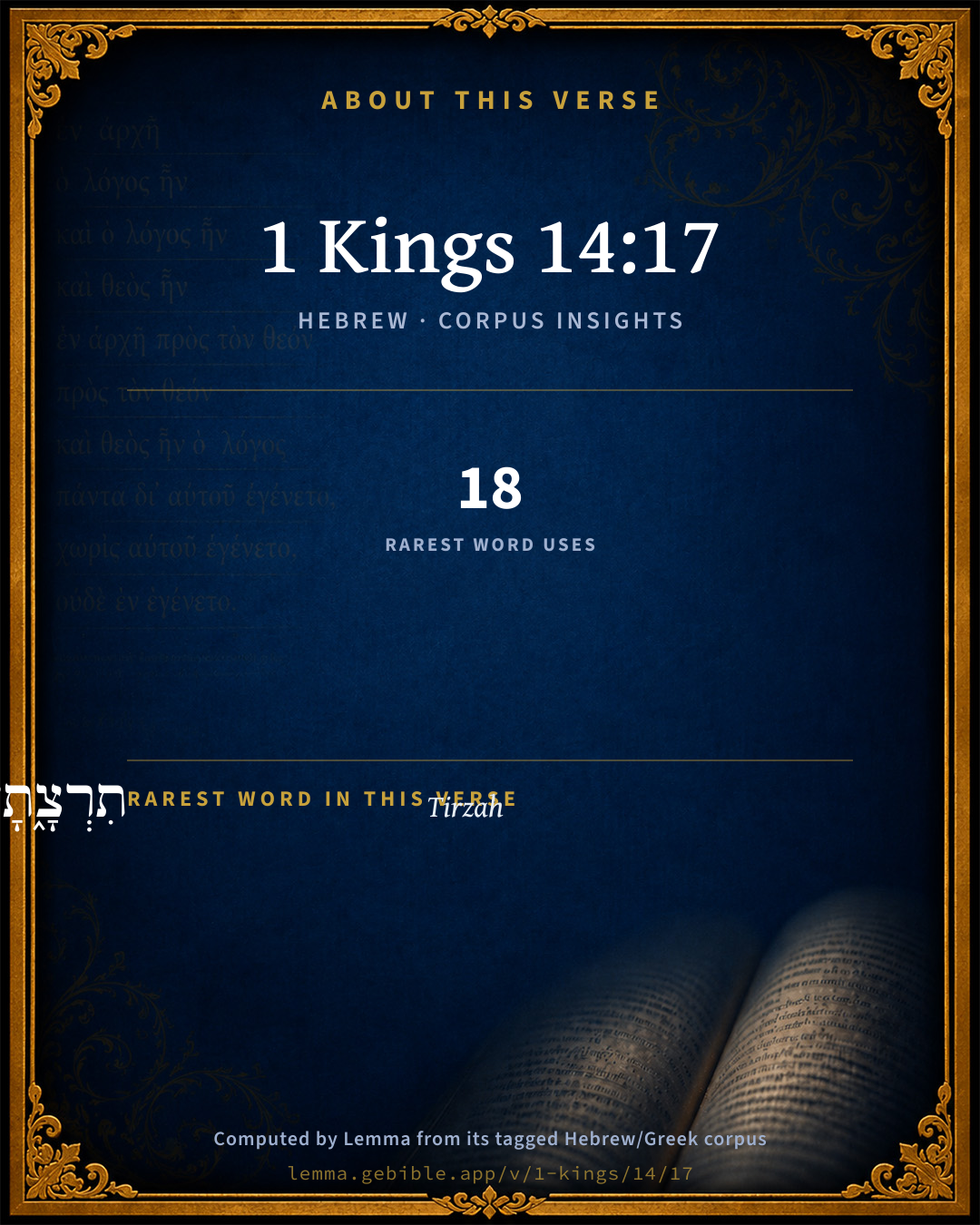
The rarest word here is תִרְצָ֑תָה Tirzah H8656 — appearing just 18 times in the whole Hebrew Bible.

Shared distinctive vocabulary

תִרְצָ֑תָה Tirzah H8656 occurs in 17 verses of the Hebrew Bible. Also found in:

Grammatical profile

  • 5 verbs
  • 6 nouns
  • 1 pronoun

Verb forms

  • וַתָּ֨קָם֙ Qal · Sequential Imperfect
  • וַתֵּ֖לֶךְ Qal · Sequential Imperfect
  • וַתָּבֹ֣א Qal · Sequential Imperfect
  • בָּאָ֥ה Qal · Participle Active
  • מֵֽת Qal · Perfect

Repetition

A word recurs within this verse — often emphatic in Hebrew:

  • וַתָּבֹ֣א to enter H935 ×2

Cross-references

10

Topical passages linked to 1 Kings 14:17 in the Treasury of Scripture Knowledge — connected by theme and wording, ordered by reader-vote popularity; previews shown in the World English Bible.

  • 1 Kings 15:33 In the third year of Asa king of Judah began Baasha the son of Ahijah to reign over all Israel in Tirzah, [and reigned] twenty-four years.
  • 1 Kings 15:21 It happened, when Baasha heard of it, that he left off building Ramah, and lived in Tirzah.
  • 1 Kings 16:15 In the twenty-seventh year of Asa king of Judah did Zimri reign seven days in Tirzah. Now the people were encamped against Gibbethon, which belonged to the Philistines.
  • 1 Kings 16:23 In the thirty-first year of Asa king of Judah began Omri to reign over Israel, [and reigned] twelve years: six years reigned he in Tirzah.
  • Song of Solomon 6:4 You are beautiful, my love, as Tirzah, Lovely as Jerusalem, Awesome as an army with banners.
  • Joshua 12:24 the king of Tirzah, one: all the kings thirty-one.
  • 1 Samuel 2:20–34 Eli blessed Elkanah and his wife, and said, Yahweh give you seed of this woman for the petition which was asked of Yahweh. They went to their own home.
  • 1 Samuel 4:18–20 It happened, when he made mention of the ark of God, that [Eli] fell from off his seat backward by the side of the gate; and his neck broke, and he died: for he was an old man, and heavy. He had judged Israel forty years.
  • 1 Kings 14:12–13 Arise you therefore, get you to your house: [and] when your feet enter into the city, the child shall die.
  • 1 Kings 16:6–9 Baasha slept with his fathers, and was buried in Tirzah; and Elah his son reigned in his place.

Cross-references courtesy of OpenBible.info (CC BY 4.0).

Hebrew and Greek witnesses Masoretic Hebrew ↔ Greek Septuagint

The same verse in the two great witnesses to the Old Testament, shown verse-for-verse.

These are two independent witnesses, not word-aligned to each other, and the Septuagint is shown in lemma (dictionary) form.

Hebrew 1 Kings 14:17 Masoretic · Westminster Leningrad Codex

וַתָּ֨קָם֙ אֵ֣שֶׁת יָרָבְעָ֔ם וַתֵּ֖לֶךְ וַתָּבֹ֣א תִרְצָ֑תָה הִ֛יא בָּאָ֥ה בְסַף הַבַּ֖יִת וְהַנַּ֥עַר מֵֽת

Jeroboam's wife arose, and departed, and came to Tirzah: [and] as she came to the threshold of the house, the child died.

World English Bible · Public Domain

On this verse, The Cambridge Bible for Schools and Colleges discusses the Septuagint’s reading. Read the note in Commentary ↓

Hebrew: Westminster Leningrad Codex (CC BY 4.0). Greek: Septuagint (public domain); English from a public-domain English Septuagint. How the Septuagint differs from the Hebrew →

Targum (Aramaic paraphrase)

1

The Targum is the ancient Jewish Aramaic paraphrase of the Hebrew Scriptures — an interpretive translation, not the Hebrew text itself. Onkelos (literal) and Pseudo-Jonathan (expansive) render the Torah, and Jonathan the Prophets. Coverage is partial: where no permissively-licensed English translation exists for a verse, only the Aramaic is shown. This is verse-level text, not a word-by-word alignment to the Hebrew.

  1. Targum Jonathan Prophets (Joshua–Malachi)
    וְקָמַת אִתַּת יָרָבְעָם וַאֲזַלַת וַאֲתַת לְתִרְצָת הִיא עֲלַת בְּסִיפָא דְבֵיתָא וְדַבְיָא מִית:

    (no public-domain English translation for this verse)

    Targum Jonathan — Aramaic: “Mikraot Gedolot” (public domain). English: “Sefaria Community Translation” (CC0 1.0 (public-domain dedication)); “London "Chaldee Paraphrase," 1871” (public domain). Text via Sefaria.

Commentary

Notes on 1 Kings 14:17 from classic Christian and Jewish commentators (each source and its license shown beneath its notes). The classic Christian expositions comment on the surrounding passage and are grouped to its opening verse, so a note may address several verses; the Jewish commentaries on the Tanakh (Rashi and others) are per-verse, so they appear only where the commentator wrote on this verse.

Lemma curates 59 commentaries, every one of them public domain or Creative Commons licensed, each selected and text-cleaned for this edition rather than reprinted as found. About our sources →

Trapp's Complete Commentary

John Trapp

1Ki 14:17 And Jeroboam’s wife arose, and departed, and came to Tirzah: [and] when she came to the threshold of the door, the child died;

Ver. 17. And came to Tirzah.] A pleasant cry, {Son 6:4} but to her at this time dismal and dolorous: the door also thereof, - whereto when she came, the child died, - like the porta Scelerata in Rome, whereof see Florus, lib. i. cap. 12.

John Trapp, A Commentary or Exposition upon All the Books of the Old and New Testament (1647–1656) — public domain. Text from a community e-Sword module.

Joseph Benson's Commentary

1Ki 14:17. And come to Tirzah — An ancient and royal city, in a pleasant place, where the kings of Israel had a palace, whither Jeroboam was now removed from Shechem, either for his pleasure, or for his son’s recovery, by the healthfulness of the place. When she came to the threshold — Of the king’s house, which probably was upon or by the wall of the city, and near the gate.

Joseph Benson's Commentary on the Old and New Testaments (1811–1818) — public domain. Text from a community e-Sword module.

Tyndale Open Study Notes

Tyndale Open Resources

14:17-18 Tirzah was situated on the road from Shechem to Beth-shan. Noted for its great beauty (Song 6:4), the city was a royal retreat that apparently had become the capital of the northern kingdom (1 Kgs 16:6, 8). • The child died, as Ahijah had predicted.

Tyndale Open Study Notes — © Tyndale Open Resources, licensed CC BY-SA 4.0. Text via the HelloAO Bible API.

Jamieson, Fausset & Brown

Robert Jamieson, A. R. Fausset & David Brown

Tirzah--a place of pre-eminent beauty (Sol 6:4), three hours' travelling east of Samaria, chosen when Israel became a separate kingdom, by the first monarch, and used during three short reigns as a residence of the royal house. The fertile plains and wooded hills in that part of the territory of Ephraim gave an opening to the formation of parks and pleasure-grounds similar to those which were the "paradises" of Assyrian and Persian monarchs [STANLEY]. Its site is occupied by the large village of Taltise [ROBINSON]. As soon as the queen reached the gate of the palace, she received the intelligence that her son was dying, according to the prophet's prediction [Kg1 14:12].

Jamieson, Fausset & Brown — Commentary Critical and Explanatory on the Whole Bible (1871) — public domain (CC PDM 1.0). Text via the HelloAO Bible API.

Ellicott's Commentary for English Readers

(17) Tirzah.—From this incidental notice it would seem that Jeroboam had removed his habitation, temporarily or permanently, to Tirzah, a place renowned for beauty (Son_6:4), and farther from the hostile frontier than Shechem. It seems to have continued as the capital till the foundation of Samaria. Its site is generally identified with a spot now called Tellûzah, about nine miles north-east of Shechem, still in the high ground of Mount Ephraim.

A Bible Commentary for English Readers, edited by Charles John Ellicott (1878–1897) — public domain. Text from a community e-Sword module.

The Cambridge Bible for Schools and Colleges

gen. ed. J. J. S. Perowne

17. and came to Tirzah] This place has not been identified with certainty. It was an ancient city, mentioned first Jos_12:24. Its beauty is celebrated in Son_6:4. Jeroboam, as we see here, made it a royal residence, and it was so used, and by some kings as a place of burial, till Omri built Samaria. It was almost certainly on the west of Jordan, and probably not far from the present Nablous. The LXX. (Alex.) gives εἱς γῆν Σαριρά, on which see 1Ki_12:2 additional note.

to the threshold of the door] The Hebrew (as R.V. gives) has ‘the threshold of the house.’

The Cambridge Bible for Schools and Colleges (gen. ed. J. J. S. Perowne; Cambridge University Press, 1878–1918) — public domain. Text from a community e-Sword module.

John Gill's Exposition

And they buried him,.... In an honourable manner, suitable to his rank and pedigree:

and all Israel mourned for him, according to the word of the Lord, which he spake by the hand of his servant Ahijah the prophet, Kg1 14:13.

John Gill's Exposition of the Whole Bible (1746–1763) — public domain (CC PDM 1.0). Text via the HelloAO Bible API.

Albert Barnes' Notes on the Bible

Jeroboam had by this time removed from Shechem, and established a new capital in Tirzah, one of the old Canaanite towns Jos 12:24 - a town of great reputation for beauty, counted in that respect on a par with Jerusalem Son 6:4. Tirzah is perhaps to be identified with “Telluzah,” a place in the mountains about 9 miles distant from Shechem (Nablous) (or with Teiasir - Conder). It may have been the palatial residence of the kings rather than the actual capital of the country. It remained the capital until Omri built Samaria 1Ki 16:23-24. Toward the close of the kingdom it appears again as the city of Menahem, who murdered Shallum and succeeded him 2Ki 15:14.

The threshold of the door - literally,” the threshold of the house.” Compare the prophecy 1Ki 14:12. The child actually died as she crossed the threshold of the palace. Probably the palace, like that of Sargon at Khorsabad, lay at the outer edge of the town.

Albert Barnes' Notes on the Bible (1834–1885) — public domain. Text from a community e-Sword/MySword module.

Haydock's Catholic Bible Commentary

Thersa. Septuagint inform us that Jeroboam had built this place, which the call Sarira, while he was employed by Solomon. No wonder, therefore, that it is not mentioned by Josue. Its exact situation is not known, though it must have been very delightful, since Solomon compares the spouse to it. (Calmet) --- Where we read sweet, (Canticle of Canticles vi. 3.) Hebrew has, "Thou art beautiful....as Thersa, and comely as Jerusalem." Hither Jeroboam had removed his court from Sichem. (Tirinus) --- Some place Thersa in the tribe of Manasses; (Adrichomius) others, in that of Ephraim. (Bonfrere) --- House. Hebrew, "door," or gate of the city, when the prophet had denounced that the child should die, (ver. 12.) unless the palace was contiguous to the walls. (Haydock)

George Leo Haydock (1774–1849), Haydock's Catholic Family Bible and Commentary, 1859 edition — public domain. Excludes Psalms (Douay-Rheims chapter numbering differs from Protestant) and Deuterocanonical books (Catholic canon only).

Matthew Poole's English Annotations

Tirzah; an ancient and royal city, Jos 12:24, in a pleasant place, Son 6:4, where the kings of Israel had a palace, 1Ki 15:33; 16:6,8,15,23; whither Jeroboam was removed from Shechem, either for his pleasure, or for his son’s recovery, by the healthfulness of the place.

To the threshold of the door, to wit, of the king’s house, which probably was upon or by the wall of the city, and near the gate, which was the place of judicature. See 1Ki 14:12.

Matthew Poole's English Annotations on the Holy Bible (1683–1685) — public domain. Text from a community e-Sword/MySword module.

Whedon's Commentary on the Bible

Daniel D. Whedon

17. Tirzah — This was the royal residence of the kings of Israel until Omri built Samaria and made it the capital of the northern kingdom. Possibly it was Jeroboam’s birthplace, and identical with Zereda of 1Ki_11:26. It was the residence of a Canaanitish king who was conquered by Joshua. See Jos_12:24. It is identified by Dr. Robinson with the modern Tulluzah, about five miles north of Shechem. The modern town “is of some size, and tolerably well built. We saw no remains of antiquity, except a few sepulchral excavations and some cisterns. The place lies in a sightly and commanding position; though the change of royal residence to the still more beautiful and not distant Samaria would be very natural.” — Robinson.

Daniel D. Whedon (gen. ed.), Commentary on the Old and New Testaments (1874–1909) — public domain. Text from a community e-Sword module.

The Pulpit Commentary

And Jeroboam"s wife arose, and departed, and came possibly she lingered for some time on the road, dreading to return to Tirzah Identified by Robinson and Van de Velds (Narrative, 2:334, 335), with Telluzah, or Taluse, a place in the mountains, six miles north of Shechem. See Jos_12:24. Both these writers admit, however, that ifthis is indeed Tirzah, "all traces of royalty have disappeared." "With the exception of a few sepulchral caves, subterranean granaries, wells, and old hewn stones, nothing of ancient Tirzah remains in Taluse." Condor recognizes the name in the modern Teiasir a village near Jezreel, in the Great Plain which "contains the exact letters of the Hebrew word, though the two last radicals are interchanged in position." "The beauty of the position the ancient remains, and the old main road from the place to Shechem seem to agree well with the idea of its having once been a capital" ("Tentwork," p. 57). Some of its "numerous rock-cut sepulchres," he thinks, may be the tombs of the early kings of Israel. It was famed for its beauty (Song of Son_6:4), and for this reason, perhaps, among others (see on ver. 1) was selected by Jeroboam for his residence. It is not certain that it had taken the place of Shechem as the political capital: and when she came the Hebrew is much more graphic. "She came to and the child died" to the threshold of the door Heb. house , the child died. This statement seems at first sight to contradict that of ver. 12, which says the child should die as she entered the city. But the palace may have been on the edge of the city (Rawl.), or the "city" may have been little more than the palace.

Vers. 17-18.

Death and Mourning.

With a heavy heart the queen of Jeroboam moved along the road from Shiloh to Tirzah, and received the salute of death at the threshold of the palace. This sad event was soon followed by a state funeral and by a public mourning. In all this note how

I SORROW TARNISHES HUMAN SPLENDOUR.

1. Survey this palace of Tirzah.

(1) This is not the only palace of Jeroboam. Soon alter his promotion to the crown of Israel we find him building a palace at Shechem. That commemorated the event of his elevation; for there those circumstances occurred which gave rise to it (see ch. 12.)

(2) But this palace did not long satisfy the royal ambition. We find the king presently engaged in building a second at Penuel, in the tribe of Gad, eastward of Jordan. (1Ki_12:25) Those who come suddenly to fortune commonly affect great splendour.

(3) Now we find him occupying a third. This probably was the most magnificent. It is situated in a place famous for its beauty in the days of Solomon (see Song of Son_6:4). From this it had its name (hxrt), which signifies pleasantness. Doubtless the palace was in keeping with the place, for it was preferred as the royal residence until its destruction by fire. (1Ki_16:18)

2. Behold in this paradise a corpse!

(1) Death has smitten Abijah, the best and most promising of the royal family. What a scene of grief when the mother, arrived from Shiloh, entered that chamber! What a dense gloom would rest on the household! In that solemn moment how vain must earthly splendour have appeared!

(2) And does not sorrow still mingle with all earthly scenes! Why, then, should we not rather set our affections upon things above?

(3) Wealth cannot bribe death. The King of Terrors enters the palace of royalty as certainly as he enters the cottage of poverty. To the great this enemy is even more formidable than to the humble, for they have more to leave. The acquisitions of the worldling, therefore, are only giving point and venom to the sting of death.

II IT HAS RELIEFS AND AGGRAVATIONS.

1. The reliefs are the fruits of virtue.

(1) The public mourning would be a solace to the royal family. A king might provide a pompous funeral for his son, but he could not command the heart of the nation to mourn

(2) This public mourning was a tribute to the virtues of the prince (see ver. 13).

(3) There was pure comfort in the reflection that the spirit of the pious youth is away from a world of sin, in the companionship of saints and holy angels.

2. The aggravations are the fruits of sin.

(1) How the grief of Jeroboam must have been embittered by the fact that this bereavement came not as a messenger of mercy to him, but as a visitation of judgment!

(2) How it must have alarmed him to know that it was but the first of a series of judgments destined to issue in the extermination of his house!

(3) The very virtues of the prince first taken, in this view, became an aggravation, for he is removed as too good a prince for so wicked a people, and to make way for the succession of a wicked prince to punish them. J.A.M.

HOMILIES BY J. WAITE Vers. 17, 18.

The Dead Child.

Following the order of events as they appear in the Hebrew text rather than in the Septuagint, we regard this as the first of the calamities that befell the house of Jeroboam, until it became extinct on the death of Nadab, (1Ki_15:29) as the penalty of his transgression in violating the religious unity of the nation. So soon was he made to feel that he was in the grasp of a Power that could not be mocked or trifled with, and against which it was vain for him to rebel The narrative is full of touching interest, and has many points of moral teaching. It illustrates

I THE TENDERNESS OF NATURAL AFFECTION EVEN IN A BAD MAN. We have no reason to doubt that genuine parental feeling prompted both Jeroboam and his wife in their appeal to the prophet. One cannot but sympathize with them in their distress at the fatal sickness of their child. Human nature in its deepest degradation is not altogether lost to the touches of tender emotion. The thrill of parental love may be found in hearts so debased and hardened that nothing else can move them. The most ferocious savage will defend his own, and "barbarous people" are capable of "showing no little kindness" even to strangers (Ac 28) But in many cases there is no real moral worth in these affections and amenities. They can scarcely be called "redeeming qualities." Parental feeling is often little else than an animal instinct. It may exist side by side with the most grovelling passions and the most complete moral obliquity. Jeroboam loved his child, and yet, in proud self-will and impious defiance of the Divine authority, he could secure his own carnal ends at the cost of the utter spiritual degradation of the people.

II THE BLINDNESS OF A SINFUL INFATUATION. The king flies in his distress to the prophet whom he has long slighted and ignored. He sought no counsel from him in the setting up of the golden calves at Dan and Bethel. But now, as if he had himself fulfilled all the conditions of the Divine promise, he thinks to get from the prophet a word to confirm his hope of a "sure house". (1Ki_11:38) Such is the folly of human nature. When the shadow of adversity falls on men they try, with something like a superstitious impulse, to get consolation from religious sources which, in the time of their prosperity, they neglected and despised. But what could Jeroboam expect from the oracle of a God whom he sinned against so grievously but "heavy tidings" respecting his child? He bids his wife "feign herself to be another woman;" but how could he dream that a prophet, who had power to read the future, would not be able to penetrate the false disguise? Thus, when men"s hearts are "set in them to do evil" do they resort to vain subterfuges, and flatter themselves with a delusive hope. Thus do they often rush blindly on their own condemnation and ruin; provoking, and even antedating, the very calamities they have so much cause to dread.

III THE CURSE OF SIN ON THE SACRED RELATIONSHIPS OF LIFE. It is terribly expressive of the hatefulness, in God"s sight, of Jeroboam"s impiety that the very flower and crown of his house should be thus stricken the fairest and the best, the one who seemed likely to justify his name Abijah ("Jehovah is my Father") because already in his young heart there was found "some good thing towards the Lord God of Israel." So is it often in the course of human history. The evil men do comes back to them, not only in divers forms of retribution, but often in the form of penalties that pierce them in the tenderest part. The dearest ties of life are broken. Or they see their own moral deformity reflected in those whom they would fain shield from its bitter consequences. Or their brightest hopes are withered at the root, and that which might have been, and was intended to be, the source of the purest earthly joy becomes the occasion of keenest sorrow.

IV THE BLENDING OF AN ELEMENT OF MERCY WITH GOD"S SEVEREST JUDGMENTS. We see here how the innocent suffer with the guilty. The iniquity of the fathers is visited upon the children. (Exo_20:5) Yet to the child himself, in this instance, it was a gracious visitation.

(1) He was emphatically "taken from the evil to come.

(2) His incipient piety was recognized and crowned by this translation to happier sphere.

(3) It was his special privilege to die a natural and not a violent death the only one of the house of Jeroboam who should "go to the grave in peace." Thus in the darkest Divine judgment there is a gleam, of mercy. There is "light in the cloud." It has a "silver lining." The sufferings of innocent children, and the fact that so large a proportion of the human race die in infancy, are dark mysteries to us. But even here we see the dispensation of an all-wise Love, remembering Him who said, "It is not the will of your Father in heaven that one of these little ones should perish". (Mat_18:14) "Suffer the little children to come unto me, and forbid them not; for of such is the kingdom of God". (Mar_10:14)

W.

The Pulpit Commentary (1880–1919), ed. H.D.M. Spence-Jones & Joseph S. Exell — public domain. Text from a community e-Sword module.

John Wesley's Explanatory Notes

Tirzah - An ancient and royal city, in a pleasant place, where the kings of Israel had a palace, whither Jeroboam was now removed from Shechem, either for his pleasure, or for his son's recovery, by the healthfulness of the place. The threshold - Of the king's house, which probably was upon, or by the wall of the city, and near the gate.

John Wesley, Explanatory Notes Upon the Whole Bible (1754–1765) — public domain. Text via the GEBible commentary corpus.

unfoldingWord translationNotes

Door43 World Missions Community

Tirzah

This is the name of the city where king Jeroboam lived. (See: How to Translate Names)

All Israel buried him and mourned for him

This is a generalization that means the people of Israel buried him and mourned for him. AT: "A great number of the people of Israel were present when people buried him, and the people of Israel mourned for him" (See: Hyperbole and Generalization)

just as it was told to them by the word of Yahweh

This can be stated in active form. AT: "just as Yahweh told them" (See: Active or Passive)

by the word of Yahweh

"by the message of Yahweh" or "in Yahweh's message"

translationWords

threshold

word of God

servant

Ahijah

prophet

unfoldingWord translationNotes — © Distant Shores Media and the Door43 World Missions Community, licensed CC BY-SA 4.0. Source: git.door43.org/Door43/en_tn.

Lesson kit

Teaching starters — assembled from the data on this page, not authored interpretation. Every prompt links to the verse data it draws on. Edit before teaching.

1 Kings, in the Historical, opens this verse with 12 words (11 distinct Hebrew lemmas). Its most distinctive word is Tirtsâh (“Tirzah”). A historical commentator’s framing appears above. Read the whole chapter for the surrounding context.

Discussion questions

  1. What does “Tirzah” (Tirtsâh) contribute to the verse as a whole?
  2. Numbers 26:33 shares the word «Tirzah» with this verse. How do the two illuminate each other?
  3. “to enter” occurs 2× in this one verse. What is the effect of the repetition?
  4. These translations render this verse differently; the difference is in the English rendering, not the original. What questions does that raise?
  5. The verb «וַתָּ֨קָם֙» is Qal Sequential Imperfect. How does its form color the action?
  6. Reading how Trapp's Complete Commentary and Joseph Benson's Commentary read this verse, where do the two commentators agree and where do they part?

Things to notice

Reading settings

Reading text

Shown beneath each verse's original-language words.

Old Testament
Old Testament edition

Read the OT as the Masoretic Hebrew (MT) or the Greek Septuagint (LXX).

English shown for the Greek Septuagint (in the Hebrew ↔ Greek comparison).

Comparing translations? Open the Compare panel on any verse page to stack up to four side by side.