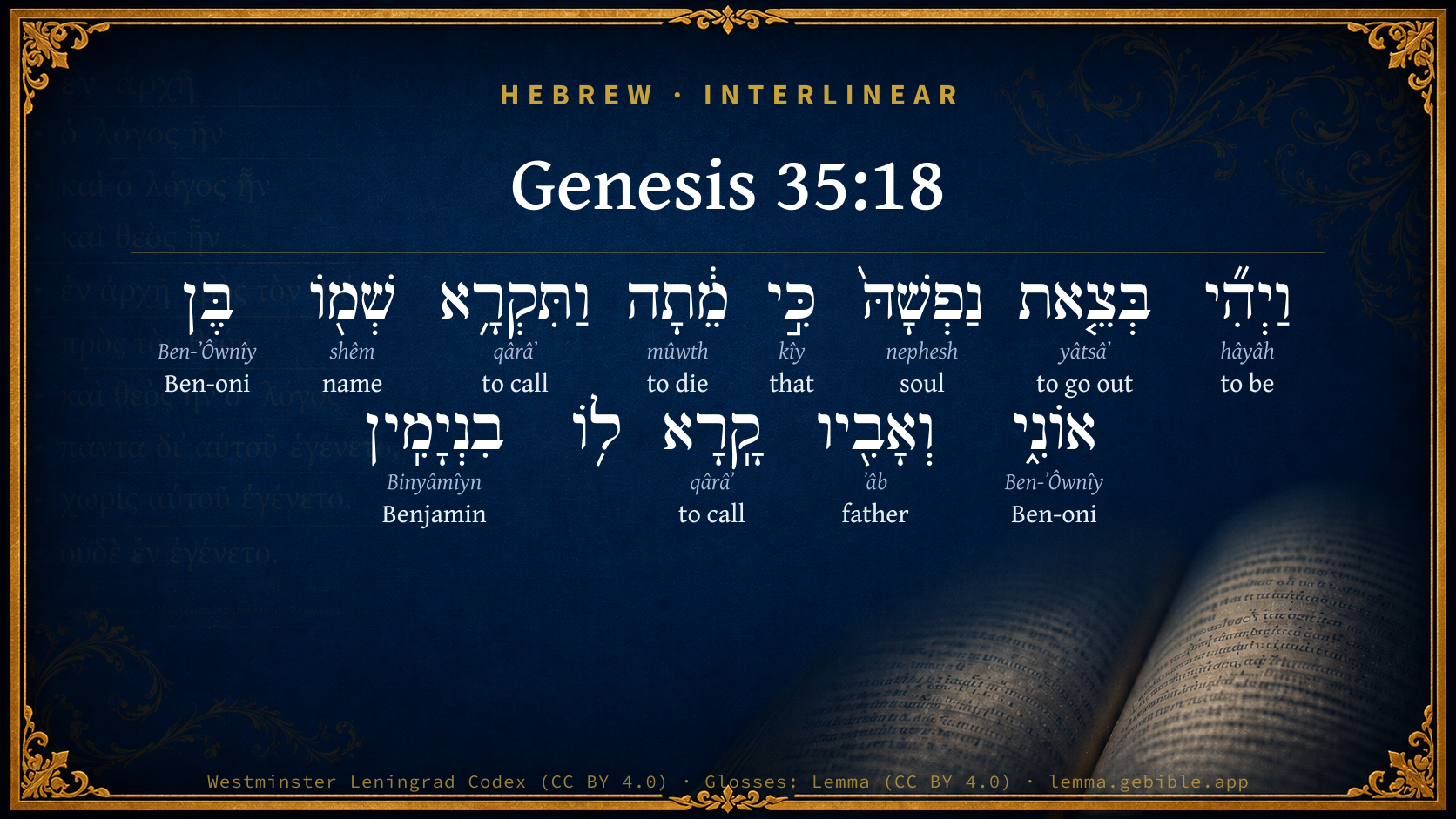
Genesis 35:18

Hebrew (Westminster Leningrad Codex) Genesis 35:18 appears in the Hebrew Old Testament. The text above is from the Westminster Leningrad Codex. Each word links to its Strong’s number, a concise gloss, and parsing drawn from the Open Scriptures Hebrew Bible morphology. Click any word for its full Brown-Driver-Briggs (BDB) entry.
Download image
Cite this verse

Genesis 35:18 (World English Bible). Public Domain. Lemma interlinear Bible study tool, https://lemma.gebible.app/v/genesis/35/18.

Show BibTeX & RIS
BibTeX
RIS
English Translation
It happened, as her soul was departing (for she died), that she named him Ben-oni, but his father named him Benjamin.
World English Bible · Public Domain
Highlights Full analysis ↓
Download a study sheet

One document with this verse’s original text, its word-by-word gloss line, the meaning frame, cross-references with their text, attributed commentary, and full source and license credits — printable, and it pastes into notes with its structure intact.

This verse Autodidact and up

Study sheet (.html) Plain text (.txt)

A passage Seminary Student

Up to 50 verses in one chapter. A passage sheet keeps up to 6 commentary sources and 12 cross-references per verse, in the order this page ranks them, and says so on the sheet whenever that leaves anything out. Ask for a single verse and you get the Autodidact verse sheet above.

Everything on this page stays free to read, with no account — the sheet is a download of what is already on screen, not access to it.

Want to remove ads? Support Godless Engineer
Compare translations 3

The same verse in 3 English versions, stacked beneath the original-language interlinear above. Click any original word for its lexicon entry.

Each is an independent rendering of the whole verse — the interlinear is not word-aligned to these translations.

Highlighted words mark where these versions differ — a whole-verse word diff, not a word-by-word alignment.

  • World English Bible Public Domain
    It happened, as her soul was departing (for she died), that she named him Ben-oni, but his father named him Benjamin.
  • King James Version Public Domain
    And it came to pass, as her soul was in departing, (for she died) that she called his name Benoni: but his father called him Benjamin.
  • unfoldingWord Literal Text CC BY-SA 4.0
    Then it happened as her soul was leaving —for she was dying, then she called his name Ben-oni, but his father called him Benjamin.

unfoldingWord Literal Text — © unfoldingWord, licensed CC BY-SA 4.0. Word-aligned USFM3 via Door43 (git.door43.org/unfoldingWord/en_ult).

Versions to compare (up to 4)

3 of 4 selected

Show all 18 translations

Every available English version of this verse, each an independent rendering of the whole verse.

  • World English Bible Public Domain
    It happened, as her soul was departing (for she died), that she named him Ben-oni, but his father named him Benjamin.
  • Berean Standard Bible Public Domain
    And with her last breath—for she was dying—she named him Ben-oni. But his father called him Benjamin.
  • Majority Standard Bible Public Domain
    And with her last breath—for she was dying—she named him Ben-oni. But his father called him Benjamin.
  • King James Version Public Domain
    And it came to pass, as her soul was in departing, (for she died) that she called his name Benoni: but his father called him Benjamin.
  • American Standard Version (1901) Public Domain
    And it came to pass, as her soul was departing (for she died), that she called his name Ben-oni: but his father called him Benjamin.
  • Revised Version (1885) Public Domain
    And it came to pass, as her soul was in departing (for she died), that she called his name Ben-oni: but his father called him Benjamin.
  • Geneva Bible (1599) Public Domain
    Then as she was about to yeelde vp the Ghost (for she died) she called his name Ben-oni, but his father called him Beniamin.
  • Douay-Rheims (1899) Public Domain
    And when her soul was departing for pain, and death was now at hand, she called the name of her son Benoni, that is, The son of my pain: but his father called him Benjamin, that is, The son of the right hand.
  • Young's Literal Translation Public Domain
    And it cometh to pass in the going out of her soul (for she died), that she calleth his name Ben-Oni; and his father called him Benjamin;
  • Literal Standard Version CC BY-SA 4.0
    And it comes to pass in the going out of her soul (for she died), that she calls his name Ben-Oni; and his father called him Benjamin;
  • Unlocked Literal Bible CC BY-SA 4.0
    As she was dying, with her dying breath she named him Ben-Oni, but his father called him Benjamin.
  • unfoldingWord Literal Text CC BY-SA 4.0
    Then it happened as her soul was leaving —for she was dying, then she called his name Ben-oni, but his father called him Benjamin.
  • Darby Bible Public Domain
    And it came to pass as her soul was departing -- for she died -- that she called his name Benoni; but his father called him Benjamin.
  • World Messianic Bible Public Domain
    As her soul was departing (for she died), she named him Benoni, but his father named him Benjamin.
  • Webster's Bible Public Domain
    And it came to pass as her soul was in departing (for she died) that she called his name Ben-oni: but his father called him Benjamin.
  • Free Bible Version CC BY-SA 4.0
    But she was dying, and with her last breath she named him Benoni. But his father named him Benjamin.
  • Bible in Basic English Public Domain
    And in the hour when her life went from her (for death came to her), she gave the child the name Ben-oni: but his father gave him the name of Benjamin.
  • JPS Tanakh (1917) Public Domain
    And it came to pass, as her soul was in departing — for she died — that she called his name Ben-oni; but his father called him Benjamin.

Literal Standard Version (2020), Covenant Press — licensed CC BY-SA 4.0. Text via the HelloAO Bible API (eBible.org). Unlocked Literal Bible (unfoldingWord) — licensed CC BY-SA 4.0. Text via the HelloAO Bible API (eBible.org). unfoldingWord Literal Text — © unfoldingWord, licensed CC BY-SA 4.0. Word-aligned USFM3 via Door43 (git.door43.org/unfoldingWord/en_ult). Free Bible Version, Dr. Jonathan Gallagher — licensed CC BY-SA 4.0. Text via the HelloAO Bible API (eBible.org).

Word by word

More ways to search: Search by grammar → Find every occurrence → Compare this word →

Practice this passage: Drill this verse → Learn its vocabulary →

בֶּן
Ben-ʼÔwnîy
H1126
“Ben-oni”
Noun, Proper
Part of Speech
Noun
Type
Proper
Full BDB Definition

Origin: from H1121 and H205

TWOT: None

Ben-oni = "son of my sorrow" - the name given to Benjamin by Rachel
  1. וַיְהִ֞י hâyâh H1961 “and · to be” Conjunction + Verb, Qal, Sequential Imperfect, 3rd Person, Masculine, Singular
  2. בְּצֵ֤את yâtsâʼ H3318 “in/at · to go out” Preposition + Verb, Qal, Infinitive Construct
  3. נַפְשָׁהּ֙ nephesh H5315 “soul · her” Noun, Common, Both, Singular, Construct + Suffix, Personal, 3rd Person, Feminine, Singular
  4. כִּ֣י kîy H3588 “that” Conjunction
  5. מֵ֔תָה mûwth H4191 “to die” Verb, Qal, Perfect, 3rd Person, Feminine, Singular
  6. וַתִּקְרָ֥א qârâʼ H7121 “and · to call” Conjunction + Verb, Qal, Sequential Imperfect, 3rd Person, Feminine, Singular
  7. שְׁמ֖וֹ shêm H8034 “name · his” Noun, Common, Masculine, Singular, Construct + Suffix, Personal, 3rd Person, Masculine, Singular
  8. אוֹנִ֑י Ben-ʼÔwnîy H1126 “Ben-oni” Noun, Proper
  9. וְאָבִ֖יו ʼâb H1 “and · father · his” Conjunction + Noun, Common, Masculine, Singular, Construct + Suffix, Personal, 3rd Person, Masculine, Singular
  10. קָֽרָא qârâʼ H7121 “to call” Verb, Qal, Perfect, 3rd Person, Masculine, Singular
  11. בִנְיָמִֽין Binyâmîyn H1144 “Benjamin” Noun, Proper

About this verse

These counts appear in no published source. They are computed here, from the morphology-tagged text and Lemma’s own curated glosses. What Lemma adds →

13
words
10
distinct lemmas
Pentateuch
section

Notable vocabulary

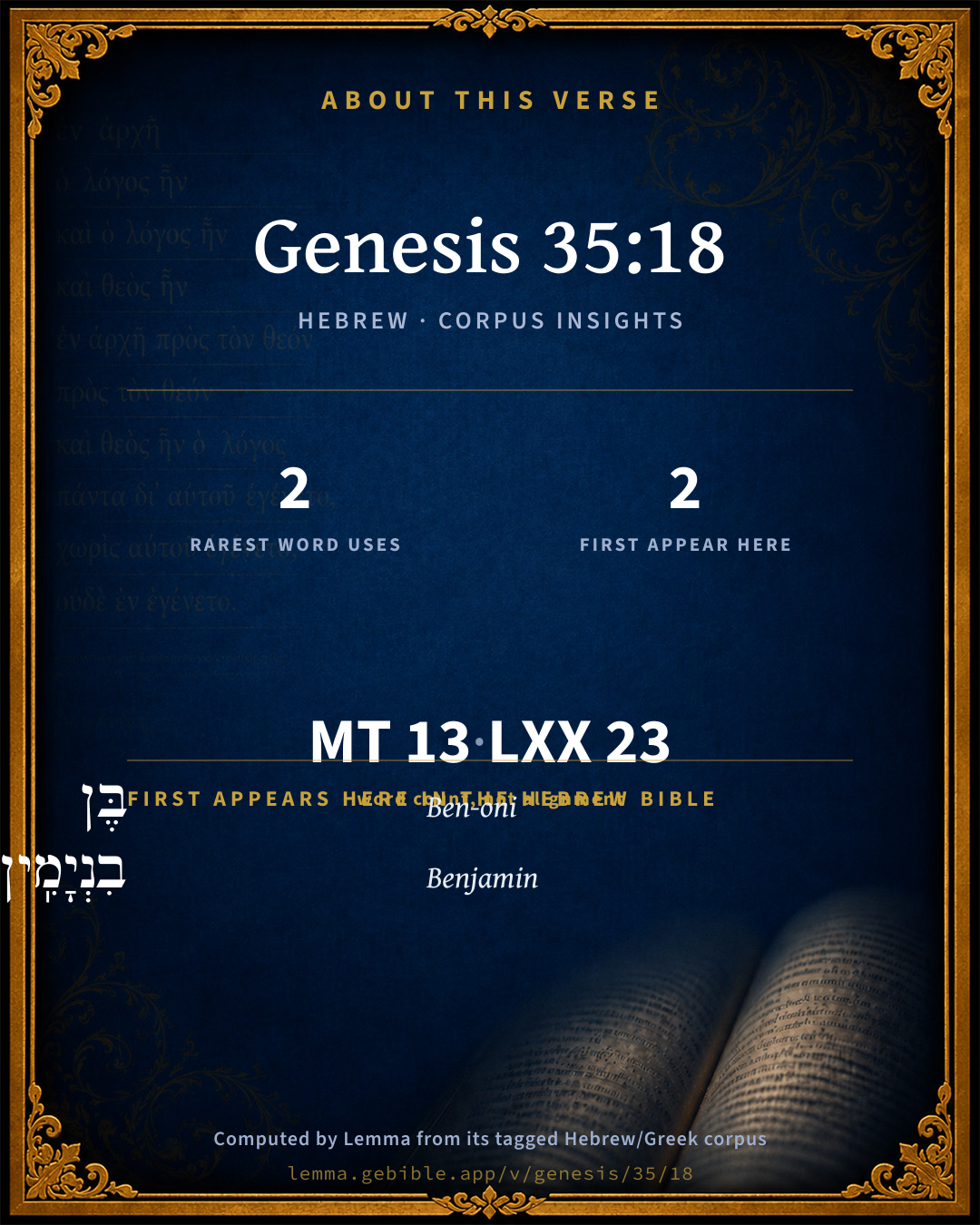
The rarest word here is בֶּן Ben-oni H1126 — appearing just 2 times in the whole Hebrew Bible.

First appearance in Scripture

These words make their first canonical appearance in the Hebrew Bible here:

  • בֶּן Ben-oni H1126
  • בִנְיָמִֽין Benjamin H1144

Grammatical profile

  • 5 verbs
  • 6 nouns
  • 1 preposition
  • 1 conjunction

Verb forms

  • וַיְהִ֞י Qal · Sequential Imperfect
  • בְּצֵ֤את Qal · Infinitive Construct
  • מֵ֔תָה Qal · Perfect
  • וַתִּקְרָ֥א Qal · Sequential Imperfect
  • קָֽרָא Qal · Perfect

Repetition

Words recur within this verse — often emphatic in Hebrew:

  • וַתִּקְרָ֥א to call H7121 ×2
  • בֶּן Ben-oni H1126 ×2

Hebrew & Septuagint length

In English translation the verse runs 21 words from the Hebrew and 32 from the Septuagint (LXX English) — the Septuagint runs noticeably longer here. See the side-by-side →

A rough comparison of the two English renderings, which tokenize alike — not a word-level alignment.

Word counts can differ between the Hebrew and the Greek without any difference in meaning — e.g. the Hebrew direct-object marker אֵת has no separate Greek word, and Greek often adds the article ὁ.

In the original languages it is 13 Hebrew tokens and 23 Greek tokens — but the two are counted differently (Hebrew bundles its prefixes and suffixes into one token; the Greek is in lemma form), so that isn’t a like-for-like length.

Cross-references

14

Topical passages linked to Genesis 35:18 in the Treasury of Scripture Knowledge — connected by theme and wording, ordered by reader-vote popularity; previews shown in the World English Bible.

  • 1 Samuel 4:20–21 About the time of her death the women who stood by her said to her, Don't be afraid; for you have brought forth a son. But she didn't answer, neither did she regard it.
  • 1 Chronicles 4:9 Jabez was more honorable than his brothers: and his mother named him Jabez, saying, Because I bore him with sorrow.
  • Luke 12:20 "But God said to him, 'You foolish one, tonight your soul is required of you. The things which you have prepared--whose will they be?'
  • Luke 23:46 Jesus, crying with a loud voice, said, "Father, into your hands I commit my spirit!" Having said this, he breathed his last.
  • Acts 7:59 They stoned Stephen as he called out, saying, "Lord Jesus, receive my Spirit!"
  • Genesis 30:1 When Rachel saw that she bore Jacob no children, Rachel envied her sister. She said to Jacob, "Give me children, or else I will die."
  • Genesis 42:4 But Jacob didn't send Benjamin, Joseph's brother, with his brothers; for he said, "Lest perhaps harm happen to him."
  • Genesis 42:38 He said, "My son shall not go down with you; for his brother is dead, and he only is left. If harm happens to him by the way in which you go, then you will bring down my gray hairs with sorrow to Sheol."
  • Genesis 43:14 May God Almighty give you mercy before the man, that he may release to you your other brother and Benjamin. If I am bereaved of my children, I am bereaved."
  • Genesis 44:27–31 Your servant, my father, said to us, 'You know that my wife bore me two sons:
  • Exodus 12:7 They shall take some of the blood, and put it on the two side-posts and on the lintel, on the houses in which they shall eat it.
  • Psalms 16:10 For you will not leave my soul in Sheol, Neither will you allow your holy one to see corruption.
  • Psalms 80:17 Let your hand be on the man of your right hand, On the son of man whom you made strong for yourself.
  • Lamentations 2:12 They tell their mothers, Where is grain and wine? When they swoon as the wounded in the streets of the city, When their soul is poured out into their mothers' bosom.

Cross-references courtesy of OpenBible.info (CC BY 4.0).

Hebrew and Greek witnesses Masoretic Hebrew ↔ Greek Septuagint

The same verse in the two great witnesses to the Old Testament, shown verse-for-verse.

Here the Septuagint runs noticeably longer than the Hebrew — LXX2012 (modern English Septuagint) 32 words vs World English Bible 21. A rough length comparison of the two English translations, not a word-level alignment — read both below.

These are two independent witnesses, not word-aligned to each other, and the Septuagint is shown in lemma (dictionary) form.

Hebrew Genesis 35:18 Masoretic · Westminster Leningrad Codex

וַיְהִ֞י בְּצֵ֤את נַפְשָׁהּ֙ כִּ֣י מֵ֔תָה וַתִּקְרָ֥א שְׁמ֖וֹ בֶּן אוֹנִ֑י וְאָבִ֖יו קָֽרָא ל֥וֹ בִנְיָמִֽין

It happened, as her soul was departing (for she died), that she named him Ben-oni, but his father named him Benjamin.

World English Bible · Public Domain

Greek LXX Genesis 35:18 Septuagint · lemma form

γίγνομαι δέ ἐν ὁ ἀποἵημι αὐτός ὁ ψυχή ἀποθνήσκω γάρ καλέω ὁ ὄνομα αὐτός υἱός ὀδύνη ἐγώ ὁ δέ πατήρ καλέω αὐτός βενιαμίν

And it came to pass in her giving up the ghost (for she was dying), that she called his name, The son of my pain; but his father called his name Benjamin.

LXX2012 (modern English Septuagint) · Public Domain

Hebrew: Westminster Leningrad Codex (CC BY 4.0). Greek: Septuagint (public domain); English from LXX2012 (modern English Septuagint) (Public Domain). How the Septuagint differs from the Hebrew →

Targum (Aramaic paraphrase)

2

The Targum is the ancient Jewish Aramaic paraphrase of the Hebrew Scriptures — an interpretive translation, not the Hebrew text itself. Onkelos (literal) and Pseudo-Jonathan (expansive) render the Torah, and Jonathan the Prophets. Coverage is partial: where no permissively-licensed English translation exists for a verse, only the Aramaic is shown. This is verse-level text, not a word-by-word alignment to the Hebrew.

  1. Targum Onkelos Torah (Genesis–Deuteronomy)
    וַהֲוָה בְּמִפַּק נַפְשַׁהּ אֲרֵי מִיתַת (נ''י מַיְתָא) וּקְרַת שְׁמֵהּ בַּר דְוָי וַאֲבוּהִי קְרָא לֵהּ בִּנְיָמִין

    (no public-domain English translation for this verse)

    Targum Onkelos — Aramaic: “Onkelos Genesis” (public domain); “Onkelos Exodus” (public domain); “Onkelos Leviticus” (public domain); “Onkelos Numbers” (public domain); “Onkelos Deuteronomy” (public domain). English: “Sefaria Community Translation” (CC0 1.0 (public-domain dedication)); “J.W. Etheridge. The Targums of Onkelos and Jonathan Ben Uzziel on the Pentateuch. London: Longmans, Green, 1862” (public domain). Text via Sefaria.

  2. Targum Pseudo-Jonathan Torah (Genesis–Deuteronomy)
    וַהֲוָה בְּמֵיפַּק נַפְשָׁהּ אֲרוּם מָטַת עֲלָהּ מוֹתָא וּקְרַת שְׁמֵיהּ בַּר דְווּיִי וְאָבוֹי קְרָא לֵיהּ בִּנְיָמִין

    And it was in the going forth of her soul, for death came upon her, that she called his name The son of my woe: but his father called him Benjamin.

    Targum Pseudo-Jonathan — Aramaic: “Targum Jonathan on Genesis” (public domain); “Targum Jonathan on Exodus” (public domain); “Targum Jonathan on Leviticus” (public domain); “Targum Jonathan on Numbers” (public domain); “Targum Jonathan on Deuteronomy” (public domain). English: “The Targum of Jonathan ben Uzziel, trans. J. W. Etheridge, London, 1862” (public domain). Text via Sefaria.

Commentary

Notes on Genesis 35:18 from classic Christian and Jewish commentators (each source and its license shown beneath its notes). The classic Christian expositions comment on the surrounding passage and are grouped to its opening verse, so a note may address several verses; the Jewish commentaries on the Tanakh (Rashi and others) are per-verse, so they appear only where the commentator wrote on this verse.

Lemma curates 59 commentaries, every one of them public domain or Creative Commons licensed, each selected and text-cleaned for this edition rather than reprinted as found. About our sources →

Trapp's Complete Commentary

John Trapp

Gen 35:18 And it came to pass, as her soul was in departing, (for she died) that she called his name Benoni: but his father called him Benjamin.

Ver. 19. And Rachel died.] We forfeit many favours, by over loving them. Our jealous God will not endure us to idolise any creature. Let them that have wives, or any other thing they hold most dear to themselves, be as if they had none. So love, as to think of loss. {a} Let all outward things hang loose, as an upper garment that we can throw off at pleasure. {1Co 7:29}

{a} Iudaei vitrum ex quo sponsus et sponsa biberunt, confringunt; ut memores sint sponsi fragilitatis humanae.

John Trapp, A Commentary or Exposition upon All the Books of the Old and New Testament (1647–1656) — public domain. Text from a community e-Sword module.

The Biblical Illustrator

Joseph S. Exell

Gen_35:18

Ben-oni

The marks of a Ben-oni

These words were spoken of Rachel, Jacobs wife.

Her youngest child had just been born: she was very sick, and was going to die. The little child was lying by her. She called to see it; she kissed it, and called his name Ben-oni. Ben-oni means, the son of my sorrow. This child was about to occasion the death of his mother, and therefore she gave him this name. She was sorry to leave her husband, her family, and her friends; and this feeling of sorrow led her to call his name Ben-oni. But his father called him Benjamin. Benjamin means, the son of a right hand. Our right hand is a great comfort and blessing to us. What could we do without a right hand? Now, every child that is born into this world will be either a Ben-oni or a Benjamin. There is not much difference between these two names, but there is a great deal of difference between the natures which they represent. Now, the great question for us to consider is, What are the marks of a Ben-oni or of a Benjamin? We shall mention four things which may always be considered as the marks of a Ben-oni; and the opposite of these, of course, will be the marks of a Benjamin.

I. The first mark of a Ben-oui--a child of sorrow--is ILL-TEMPER. Suppose you had to walk four or five miles with a pebble in your shoe; or suppose you had to wear a coat or dress with a pin sticking in it; or suppose you had to lie all night in bed with a porcupine by your side, sticking you with his sharp-pointed quills--what an uncomfortable thing it would be! But none of these things are so uncomfortable as to be connected with an ill-temper. All peevish, cross, ill-natured children are Ben-onies--children of sorrow to their parents and the families where they dwell. There was a rich nobleman in England who had a little daughter named Anne. They were very fond of her; for she was a fine little creature, very lively, and merry, and affectionate, and exceedingly beautiful. But she had a very ill temper. When anything vexed her she would fly into a rage, and turn and strike any one that provoked her. After every fit of anger she would be ashamed and sorry, and resolve never to do so again. But the next time she was provoked it was all forgotten, and she was as angry as ever. When she was between four and five years of age, her mother had a little son, a sweet little tender baby. Annes nurse, who was thoughtless and wicked, loved to tease her, because she was so easily irritated, and so she told her that her father and mother would not care for her now, because all their love and pleasure would be in this little brother, and they would not mind her. Poor Anne burst into a flood of tears, and cried bitterly, saying, You are a naughty woman to say so! Mamma will always love me; I know she will, and Ill go this very moment and ask her. And she ran out of the nursery and hastened to her mothers room. The servant called after her: Come, miss, you neednt go to your mothers room; she wont see you now. Anne burst open the door, but was instantly caught hold of by a strange woman she had never seen before. My dear, said this woman, you cannot see your mother just now; and she was going on to tell that it was because she was very sick, and could not be disturbed. But she was too angry to listen; and she screamed and kicked at the woman, who was obliged to take her by force and carry her back to the nursery. When she put her down she gave the servant a charge not to let her go to her mothers room. This added to her rage. But the thoughtless, wicked servant, instead of trying to soothe and quiet her, burst out into a laugh, and said, I told you that, miss. You see your mamma does not love you now. Then the poor child became mad with fury. She seized a smoothing-iron, and, darting forward, threw it upon the babys head as it lay in the cradle. The child gave one struggle, and breathed no more. Annes mother died that night of grief, Anne grew up in the possession of great riches. She had every outward comfort about her that money could procure; but she was a very unhappy and miserable woman. She was never known to smile. The thought of the terrible consequences of that one outburst of passion pressed upon her like a heavy burden all her days. Ah! what a Ben-oni this girl became! She was a child of sorrow to her parents. Her ill-temper made her so. If you give way to such tempers, my dear young friends, you will certainly be Ben-onies; but if you strive and pray against such feelings, and try to be gentle, kind, and pleasant to those around you, then you will be Benjamins--children of the right hand to your parenta. See, now, how differently such children will act. A gentleman was walking on the Battery, in the city of New York, one day, and, as he passed a little girl who was cheerfully rolling her hoop, he said to her, You are a nice little girl; to which she replied, patting her little brother on the head, And Bobble is a nice little brother too. Here was a good-temper, which would make this dear child a child of the right hand to her parents, and cause her to be loved by all who were about her.

II. The second mark of a Ben-oni is IDLENESS. Idle children love to lie in bed in the morning; they love to do nothing all day, if they can help it, but play. It is a great trouble to get them to study, to read, or to work. Now, idle children always make idle men; for the habits which children form while they are children will surely remain with them when they grow up to be men and women. Now, we are to remember, dear children, that God is busy at all times, and almost everything that God has made is busy. Look at the sun; it is always at work, shining and shining and shining from one Fears end to the other. In the daytime it is shining in our part of the world, and when it is night to us it is shining in the opposite part of the world. And so it is with the moon--always shining in one part of the world or the other. So it is with the sea; its waves are rising, and falling, and rolling, and flowing continually. So it is with the rivers; they are continually running, from the fountains where they spring, on, on to the ocean. And so it is with the little birds, and little fishes, and the bees, and the ants--none of these are idle. A gentleman in England had an estate which was worth over two hundred pounds a year. For a while he kept his farm in his own hands, but at length found himself so much in debt that he was obliged to sell one-half of his place to pay up. The rest he let out to a farmer for several years. Towards the end of that time, the farmer, on coming to pay his rent, asked him whether he would sell his farm. The gentleman was surprised that the farmer should be able to make him an offer for his place. Pray, tell me, said he, how it happens that, while I could not live upon twice as much land, for which I paid no rent, you are regularly paying me about one hundred pounds a year for the farm, and able in a few years to purchase it? The reason is plain, answered the farmer; it lies in the difference between go and come. I do not understand you, said the gentleman. I mean, said the farmer, that you sat still and said, Go; I get up and say Come. You lie in bed, and enjoy your ease; I rise early in the morning, and attend to my business. In other words, this was an industrious man; there was no love of idleness about him, and this led to his success in life.

III. The third mark of a Ben-oni is PRIDE. Some children are proud of their clothes. This is very silly indeed; for the butterflies have much more beautiful clothes than we, and yet they are never proud of their dress. Some children are proud of their families. This also is very silly, for we have all sprung at first from one father. Some children are proud about their houses. This, too, is very silly, for, by-and-by, they will all crumble into the dust, from which they have been taken, while the grave is the one house to which we must all come at last. Proud children feel and think themselves better than others, and are often unwilling to engage in honest and honourable employments. Listen to what I am going to tell you. Chief-Justice Marshall was a great man; but great men are never proud. He was not too proud to wait upon himself. He was in the habit of going to market himself, and carrying home his purchases. Often he would be seen returning at sunrise with poultry in one hand and vegetables in the other. On one of these occasions a fashionable young man from the North, who had removed to Richmond, was swearing violently because he could find no one to carry home his turkey. Judge Marshall stepped up and asked him where he lived. When he heard, he said, That is in my way, and I will take your turkey home for you. When they came to the house the young man inquired, What shall I pay you? Oh, nothing, said the Judge; you are welcome; it was all in the way, and it was no trouble to me. Who is that polite old gentleman who brought home my turkey for me? asked the young man of a by-stander. Oh, said he, that was Judge Marshall, Chief-Justice of the United States. Why did he bring home my turkey? He did it, said the by-stander, to give you a rebuke, and teach you to attend to your own business. True greatness never feels above doing anything that is useful; but especially the truly great man will never feel above helping himself; his own independence of character depends upon his being able to help himself. The great Dr. Franklin, when he first established himself in business in Philadelphia, wheeled home the paper which he purchased for his printing-office upon a wheelbarrow with his own hands.

IV. The fourth and only other mark that we shall speak of is DISOBEDIENCE. There is nothing on which the comfort and happiness of parents and families depend more than on the obedience of children. My dear children, if you want to plant thorns on the pillows of you parents, and plunge daggers into their bosoms, be disobedient. If you want to make them as uncomfortable as they possibly can be in this world, then be disobedient. This is the chief mark of a Ben-oni. I remember reading not long ago of a gentleman in England who had two sons. He was a kind, excellent, pious man, and did everything for the comfort of his children that he thought it right to do. But sometimes the boys were anxious to do things which their parents were not willing that they should do. One Sunday, the eldest boy went to his father and asked permission to take the carriage and go riding in the afternoon, instead of going to church. His father told him he could not, because it would be breaking the Sabbath. The boy was very much displeased because his father would not let him go riding, as some of the boys in the neighbourhood had been allowed by their parents to do. He was so wicked about this that he determined no longer to stay at home, because his father would not let him do just what he wanted. So the next day he persuaded his brother to go with him, and they went down to Portsmouth, a town by the seaside, intending to go to sea. Before going, however, they called on the Rev. Mr. Griffin, to assist them to get a situation on board a man-of-war. This good man, perceiving that they were not accustomed to the mode of life in which they were about to enter, inquired of them their object in going to sea. The eldest boy frankly told him they were going in order to spite their parents! Then he told him the story of what had taken place at home--of his fathers unwillingness to allow him to ride on Sunday--and said he was going to sea in order to make his father feel sorry for refusing to gratify him. The good clergyman tried to show them the guilt and folly of the course they were about to pursue, and to set before them the unavoidable consequences that would result from it. The younger son was impressed by the counsels and advice of the clergyman, and went home; but the elder son resolved to go on in his evil course. Some twelve or fifteen years after this had taken place, this same clergyman was called to the prison in the town of Portsmouth to see a sailor who was condemned to be executed, and who was going to be hung in a few days. When he entered the cell of the prison he saw a wretched, miserable, squalid-looking creature sitting by a table in the cell, who looked up to him as he entered, and said, Do you not remember me, sir? No, said the clergyman; I do not recollect that I ever saw you before. Then the poor man recalled to him the story of the boy who went from home in order to spite his parents. And are you the miserable man, said the clergyman, who did this? Yes, said the poor culprit; I followed out my own plan; I went on the course which I had chosen, contrary to your advice and to my own convictions; I plunged into all sorts of wickedness and sin, and finally became involved in a robbery and murder, for which I am now about to suffer the penalty. And all this in consequence of my disobedience to my parents! The clergyman wrote to the father of this unhappy man, who came to visit his son in his last hours, and who had the unspeakable anguish of standing by and seeing him suffer the penalty of the law, and reap the bitter fruits of his disobedience. What a Ben-oni that son was to his father! Let us look, now, at one or two examples of an opposite character. William Hale was an obedient son. He was spending some time with his mother at the Saratoga Springs, and had become acquainted with a number of boys of his own age there. One day some half-dozen of the children were playing on the piazza, and one of them was heard exclaiming--Oh, yes, thats capital! So we will; come on, now! Wheres William Hale? Come on, Will! We are going to have a ride on the circular railroad. Come with us. Yes, if my mother is willing, said William. I will run and ask her. Ah, ah! so you must run and ask your ma!--great baby-boy!--run along to your ma! Aint you ashamed? I dont ask my mother, said one. Neither do I, said another. Neither do I, said a third. Be a man, Will, and come along, said the first boy, if you dont wish to be called a coward as long as you live; dont you see we are all waiting? William was standing with one foot advanced, and his hand firmly clenched, in the midst of the group. His brow was flushed, his eye was flashing, his lip was compressed, his cheek was changing--all showing how the epithet coward rankled in his bosom. It was doubtful for a moment whether he would have the true bravery to be called a coward rather than to do wrong; but, with a voice trembling with emotion, he replied:--I will not go without I ask my mother; and I am no coward, either. I promised her I would not go from the house without her permission; and I should be a base coward if I were to tell my mother a lie. When Wiliam returned to his mother to ask her permission to go, and told her of what had taken place, she threw her arms around his neck, and exclaimed: God bless you, my dear child, and give you grace always to act in this way. Ah, my dear children, he was a Benjamin--a child of comfort--to his dear mother; and doubtless he grew up to be her support and comfort all her days. After the surrender of Cornwallis, and the victory achieved by the American arms, George Washington, when the war was over, returned in triumph to his mothers home. Everybody was homouring him and praising him as the saviour of his country and the greatest man of the age. When he reached the place of his mothers abode a large concourse of the people had met to greet him and welcome him to his home. In the centre of the assembled crowd stood his mother, and, pushing his way through the crowd around him, he hastened to pay her his respects; and, as she threw her arms around his neck and kissed him, she said to some who were congratulating her upon having so noble a son: George always was an obedient child. He was indeed a Benjamin--a son of comfort--to his mother, and a blessing to the country and to the world; and the spirit of obedience early learned and early practised was that which went to make him what he was. And now, in conclusion, my dear children, let me ask you, Which of these two do you desire to be? Will you be Ben-onies--children of sorrow and grief--to your parents? or will you be Benjamins--children of joy and comfort and blessing--to them? If you would be the latter--Benjamins indeed--then you must watch and strive and pray against all the evils of which we have been speaking. Watch against these four marks of a Ben-oni; watch against ill-temper, watch against idleness, watch against pride, watch against disobedience; and pray God to enable you each to overcome all these evils--to erase these marks of a Ben-oni as they are beginning to fasten themselves on your character, and to earn for yourself the character of a Benjamin indeed. (H. Newton, D. D.)

The Biblical Illustrator, edited by Joseph S. Exell (c. 1880s–1900s) — public domain. Text from a community e-Sword module.

Joseph Benson's Commentary

Gen 35:18. As her soul was departing — בצאת נפשׁה, when her soul was going out, namely, of the body: an argument this of the soul’s immortality, especially if compared with Ecc 12:7; from which places collated, we learn both whence it goes, and whither it goes. She called his name Benoni — The son of my sorrow. Thus, by her own confession, the gaining her desire became her sorrow: a lively instance this of the folly of inordinately desiring any thing temporal: the object obtained generally becomes a source of sorrow to us. But his father called him Benjamin — The son of my right hand. As near, dear, and precious to him as his right hand, which is both more useful and more honourable than the left, Psa 80:17; or, instead of his right hand, the staff, stay, and comfort of his old age. Jacob seems to have given him this name rather than the other, because he would not renew the sorrowful remembrance of his mother’s death every time he called his son by name. It may be observed, that both names were remarkably verified in his posterity; the tribe of Benjamin being remarkably brave and active, and yet involved in more sorrowful disasters than were experienced by any of the other tribes.

Joseph Benson's Commentary on the Old and New Testaments (1811–1818) — public domain. Text from a community e-Sword module.

Tyndale Open Study Notes

Tyndale Open Resources

35:18 Rachel found the name son of my sorrow appropriate to the situation, but Jacob did not want such a sad name for his son, so he changed it to son of my right hand. Jacob thus turned the day of sorrow into a day of hope that gave his son the prospect of success.

Tyndale Open Study Notes — © Tyndale Open Resources, licensed CC BY-SA 4.0. Text via the HelloAO Bible API.

Jamieson, Fausset & Brown

Robert Jamieson, A. R. Fausset & David Brown

She called his name Ben-oni--The dying mother gave this name to her child, significant of her circumstances; but Jacob changed his name into Benjamin. This is thought by some to have been originally Benjamin, "a son of days," that is, of old age. But with its present ending it means "son of the right hand," that is, particularly dear and precious.

Jamieson, Fausset & Brown — Commentary Critical and Explanatory on the Whole Bible (1871) — public domain (CC PDM 1.0). Text via the HelloAO Bible API.

Adam Clarke's Commentary

Verse 18. As her soul was in departing] Is not this a proof that there is an immortal spirit in man, which can exist separate from and independent of the body? Of Rachel's death it is said, בצאת נפשה betseth naphshah, in the going away of her soul; her body did not go away, therefore her soul and body must have been distinct. If her breath only had been in tended, נשמה neshamah or רוח ruach would have rather been used, as the first means breath, the latter breath or spirit indifferently.

She called his name Ben-oni] בן אני the Son of my sorrow or affliction, because of the hard labour she had in bringing him into the world; but his father called him Benjamin, בנימין the son of my right hand, i.e., the son peculiarly dear to me. So man of the right hand, Ps 80:17, signifies one much loved and regarded of God. The Samaritan has Benyamin, the son of days; i.e., the son of his old age, as Judah calls him, Ge 44:20; and Houbigant contends that this is the true reading, and that the Chaldee termination in for im is a corruption. If it be a corruption, it is as old as the days of St. Jerome, who translated the place Benjamin, id est, filius dextrae; Benjamin, that is, the son of the right hand.

Adam Clarke's Commentary on the Bible (1810–1826) — public domain. Text from a community e-Sword/MySword module.

Ellicott's Commentary for English Readers

(18) Ben-oni . . . Benjamin.—Rachel, in her dying moments, names her child the son of my sorrow; for though on has a double meaning, and is translated strength in Gen_49:3, yet, doubtless, her feeling was that the life of her offspring was purchased by her own pain and death. Jacob’s name, “son of the right hand,” was probably given not merely that the child might-bear no ill-omened title, but to mark his sense of the value and preciousness of his last born son. Abravanel well remarks that earthly happiness is never perfect, and that the receiving of Divine revelations made no difference to Jacob’s earthly lot. God had just solemnly appeared to him, and he is on his last journey, within two days’ easy march of Hebron, when he loses the wife whom he so loved. For more than forty years he had been an exile from his home; he was now close to it, but may never welcome there the one for whom he had so deep and lasting an affection.

A Bible Commentary for English Readers, edited by Charles John Ellicott (1878–1897) — public domain. Text from a community e-Sword module.

The Cambridge Bible for Schools and Colleges

gen. ed. J. J. S. Perowne

18. her soul] The nephesh, or “soul,” the vital principle: cf. 1Ki_17:21, “let this child’s soul come unto him again.”

Ben-oni] i.e. the son of my sorrow. Rachel, as she dies, names her son; but the father cannot acquiesce in a name of such sad memories.

Benjamin] i.e. the son of the right hand. Jacob refuses to give his child an ill-omened name. The right hand was regarded as the auspicious side. Cf. Gen_48:13; Gen_48:17-19; 1Ki_2:19; Psa_45:9; Psa_89:13. The tribe of Benjamin occupied the southernmost territory of the sons of Rachel, viz. on the right of Ephraim, facing eastwards. According to Sayce (E.H.H., p. 79) this is the explanation of the name, which then might be rendered “southerner”; and the present story would imply the formation of the tribe after the occupation of Canaan.

The words of Rachel, as she dies, should be compared with the allusion in Jer_31:15. The condensed account in this passage makes no reference to the grief of Jacob; but this is expressed in Gen_48:7 by a pathetic sentence.

The Cambridge Bible for Schools and Colleges (gen. ed. J. J. S. Perowne; Cambridge University Press, 1878–1918) — public domain. Text from a community e-Sword module.

John Gill's Exposition

And Rachel died, and was buried in the way to Ephrath, which is Bethlehem. Hence called Bethlehem Ephratah, Mic 5:2; with great pertinency is Rachel represented as if risen from her grave, and weeping for her children, when the children of Bethlehem, and thereabout, were slain by Herod, she being buried so near that place, Mat 2:16; at what age she died is not said. Polyhistor, out of Demetrius (d), reports, that she died after Jacob had lived with her twenty three years.

(d) Apnd Euseb. Praepar. Evangel. l. 9. c. 21. p. 424.

John Gill's Exposition of the Whole Bible (1746–1763) — public domain (CC PDM 1.0). Text via the HelloAO Bible API.

Haydock's Catholic Bible Commentary

That is. These etymologies are given by St. Jerome. (Du Hamel) --- Right hand, (jemini) as he is often styled in Scripture. Jamin has the same meaning; though it may also signify of the south, with respect to Bethel and Sichem; or of days and old age, chap. xliv. 20. 1. (Calmet) Jacob chooses to give his son a more auspicious name; as the other would have reminded him too sensibly of his loss. (Haydock)

George Leo Haydock (1774–1849), Haydock's Catholic Family Bible and Commentary, 1859 edition — public domain. Excludes Psalms (Douay-Rheims chapter numbering differs from Protestant) and Deuterocanonical books (Catholic canon only).

Matthew Poole's English Annotations

In departing; or, in going out; namely, out of the body, as Psa 146:4, which is an argument of the soul’s immortality, especially if compared with Ecc 12:7. From which places, laid together, we learn the two terms of the journey, whence it goes, and whither it goes.

Benjamin; either as near and dear and precious to him as his right hand, which is both more useful and more honourable than the left; see Psa 80:17; or instead of his right hand, the staff, stay, and comfort of his old age.

Matthew Poole's English Annotations on the Holy Bible (1683–1685) — public domain. Text from a community e-Sword/MySword module.

Whedon's Commentary on the Bible

Daniel D. Whedon

18. Her soul was in departing — Hebrews, in the going out of her soul; an intimation of immortality. The soul is thought of as a conscious entity, passing out into some other state and mode of life.

Benoni… Benjamin — The former name means son of my sorrow; the latter, son of a right hand. To his mother he is a child of woe; to his father, a child of hope.

Daniel D. Whedon (gen. ed.), Commentary on the Old and New Testaments (1874–1909) — public domain. Text from a community e-Sword module.

The Pulpit Commentary

And it came to pass, as her soul was in departing, literally, in the departing of her soul; not into annihilation, but into another (a disembodied) state of existence (vide Gen_25:3) for she died, (a pathetic commentary on Gen_30:1) that she called his name Benoni ("son of my sorrow," as a memorial of her anguish in bearing him, and of her death because of him): but his father called him Benjamin of my right hand;" either "the son of my strength" (Clericus, Rosenm Murphy), or "the son of my happiness or good fortune" (Gesenius, Keil, Kalisch), with allusion to Jacob"s now possessing twelve sons; or as expressive of Jacob"s unwillingness to see a bad omen in the birth of Rachel"s child (Candlish); or "the son of my days," i.e. of my old age (Samaritan), an interpretation which Lunge pasaes with a mere allusion, but which Kalisch justly pronounces not so absurd as is often asserted; (cf. Gen_44:20) or "the son of my affection" (Ainsworth; Gen_50:18)

The Pulpit Commentary (1880–1919), ed. H.D.M. Spence-Jones & Joseph S. Exell — public domain. Text from a community e-Sword module.

John Wesley's Explanatory Notes

Her dying lips calls her new-born soon Benoni, the son of my sorrow. But Jacob because he would not renew the sorrowful remembrance of his mother's death every time he called his son by name, changed his name, and called him Benjamin, the son of my right hand - That is, very dear to me; set on my right hand for a right hand blessing; the support of my age, like the staff in my right hand. Jacob buried her near the place where she died. If the soul be at rest after death, the matter is not great where the body lies. In the place where the tree falls, there let it lie. The Jewish writers say, The death of Deborah and Rachel was to expiate the murder of the Shechemites, occasioned by Dinah, a daughter of the family.

John Wesley, Explanatory Notes Upon the Whole Bible (1754–1765) — public domain. Text via the GEBible commentary corpus.

Scofield Reference Notes

C. I. Scofield

Benjamin

i.e. son of my right hand. Benjamin, "son of sorrow" to his mother, but "son of my right hand" to his father, becomes thus a double type of Christ. As Ben-oni He was the suffering One because of whom a sword pierced His mother’s heart Luk 2:35 as Benjamin, head of the warrior tribe Gen 49:27 firmly joined to Judah the kingly tribe; Gen 49:8-12; 1Ki 12:21 he becomes a type of the victorious One. It is noteworthy that Benjamin was especially honoured among the Gentiles Gen 45:22.

So manifold are the distinctions of Christ that many personal types of Him are needed. Joseph is not complete, Benjamin standing only for Christ the sorrowful One Isa 53:3; Isa 53:4 yet have power on earth. (Cf) (See Scofield "Gen 43:34").

The Scofield Reference Bible (1917 edition), notes by C. I. Scofield — public domain. Text from a community e-Sword module.

Rashi

Rabbi Shlomo Yitzchaki (Rashi)

בן אוני means SON OF MY SORROW (Genesis Rabbah 82:9).

בנימין BENJAMIN — I am of opinion that he was so called because he alone was born in the land of Canaan which is in the South (ימין) as one comes from Aram-Naharaim, as it is said (Numbers 33:40) “in the South, in the Land of Canaan”, and (12:9) “going on still towards the South”. בנימין therefore means בן ימין where ימין has the same meaning as in (Psalms 89:13) “The North and the South (ימין) Thou hast created them”. For this reason the word is here written plene (with a י after the מ).

Another explanation of בנימין is that it means “son of his old days (ימים)”, only that it is written with ן (instead of ם), like (Daniel 12:13) “at the end of days.

Rashi on the Tanakh — English translations: “The Judaica Press complete Tanach with Rashi, translated by A. J. Rosenberg” (CC BY 4.0); “Pentateuch with Rashi's commentary by M. Rosenbaum and A.M. Silbermann, 1929-1934” (public domain); “The Metsudah Tanach series, Lakewood, N.J” (CC BY 4.0); and “The Book of Joshua, Metsudah Publications, 1997” (CC BY 4.0). Text via Sefaria.

Ramban (Nachmanides)

Rabbi Moshe ben Nachman (Ramban / Nachmanides)

‘BEN ONI’ (THE SON OF MY SORROW). I am of the opinion that he was so called because he alone was born in the land of Canaan which lies to the south (yamin) as one comes from Aram-naharaim, just as it is said: In the south, in the land of Canaan; Going on still toward the south. Binyamin thus means a son of the south, just as in the verse: The north ‘v’yamin’ (and the south) Thou hast created them. For this reason the name Binyamin is here written “full” [with a yud after the mem to indicate that the name is derived from the word yamin (south)]. This is Rashi’s language.But I do not understand this claim that the Land of Israel lies to the south of Aram-naharaim for Aram is eastward of the Land of Israel, as it is written, And he came to the land of the children of the east, and it is further written, From Aram Balak bringeth me, the king of Moab from the mountains of the East, and Jacob crossed the Jordan which is to the east of the Land of Israel, and he returned by way of Edom which is south of the Land of Israel. Thus you find that Aram is south-east of the Land of Israel, and the Land of Israel is to its north. However, if Benjamin was born within the border of Bethlehem Ephrathah which is in the land of Judah — as it is written, Bethlehem in Judah, and it is further written, But thou, Bethlehem Ephratha, which art little to be among the thousands of Judah — this was in the south of the Land of Israel, and he was thus born between Beth-el and Bethlehem Ephrath. And if the place was in the hill country of Ephraim, then it is in the north of the Land of Israel, as it is written, Judah shall abide in his border on the south, and the house of Joseph shall abide in their border on the north. And if it was in the portion of Benjamin, it was also not in the south, for it is written, And their border was on the north side., Verse 12. Thus in any case there was no reason to call Benjamin “a son of the south.”The correct interpretation appears to me to be that his mother called him ben oni, and she meant to say, “the son of my mourning,” similar in expression to: bread of ‘onim’ (mourners); I have not eaten thereof ‘b’oni’ (in my mourning). And his father understood the word oni in the sense of “my strength,” similar in expression to: the first-fruits of ‘oni’ (my strength); And to those who have no ‘onim’ (power). And therefore he called him Binyamin, “the son of power” or “the son of strength,” for in the right hand (yamin) there is strength and success, just as it is written: A wise man’s understanding is at his right hand; Thy right hand shall overtake all those that hate thee; The right hand of the Eternal is exalted., 118:16. Jacob wanted to call him by the name his mother had called him, for all his children were called by the names their mothers had called them, and he thus rendered it to good and to strength.Now I have seen in Bereshith Rabbah: “Ben oni, ‘the son of my sorrow.’ And his father called him Benjamin, i.e., in the Sacred Language.” I do not know what this means for it is all the Sacred Language, and so are the names of all his sons in the Sacred Language. However, the Rabbis have alluded to that which I have said, namely, that Jacob rendered the expression so that it signified good.

Ramban (Nachmanides) on the Tanakh — English translation: “Commentary on the Torah by Ramban (Nachmanides). Translated and annotated by Charles B. Chavel. New York, Shilo Pub. House, 1971-1976” (CC BY 4.0). Text via Sefaria.

Radak

Rabbi David Kimhi (Radak)

ויהי בצאת נפשה, while her soul was about to depart from her body,

כי מתה,for she was dying and there was no hope for her, she called him

בן אוני, for I gave birth to him in great pain;

ואביו קרא לו בנימין, meaning “the son of my right hand.” The name suggested that the child is especially beloved seeing that he was born when his father was already advanced in years. We find the word ימין used in the sense of being especially beloved in Psalms 80,18 וכן תהי ידך על איש ימינך, “grant Your help to the man at Your right hand, etc.” The end of the verse על בן אדם אמצת לך, “the one You have adopted as Your own,” spells out this meaning beyond any doubt.

Radak on the Tanakh — English translations: “Sefaria Community Translation” (CC0 1.0 (public-domain dedication)); “Eliyahu Munk, HaChut Hameshulash” (CC BY 4.0); “Rabbi Mike Feuer, Jerusalem Anthology” (CC BY 4.0); and “R. David Kimhi on the first book of Psalms, Translated by R.G. Finch, London, 1919” (public domain). Text via Sefaria.

Lesson kit

Teaching starters — assembled from the data on this page, not authored interpretation. Every prompt links to the verse data it draws on. Edit before teaching.

Genesis, in the Pentateuch, opens this verse with 13 words (10 distinct Hebrew lemmas). Its most distinctive word is Ben-ʼÔwnîy (“Ben-oni”). The Greek Septuagint runs longer here. A historical commentator’s framing appears above. Read the whole chapter for the surrounding context.

Discussion questions

  1. The word Ben-ʼÔwnîy carries the sense “Ben-oni.” How does it shape the verse?
  2. 2 words make their first appearance in Scripture here. What does this debut establish?
  3. How does 1 Samuel 4:20–21, which shares this passage’s theme, read alongside this verse?
  4. What does the repetition of “to call” (2× in this one verse) do in this verse?
  5. The Septuagint runs longer here than the Hebrew. What might account for the difference?
  6. These translations render this verse differently. What is at stake in choosing one wording over another?
  7. «וַיְהִ֞י» is a Qal Sequential Imperfect verb. How does that grammatical form shape the action described?
  8. Compare how Trapp's Complete Commentary and The Biblical Illustrator read this verse. Where do they agree or differ?

Things to notice

Reading settings

Reading text

Shown beneath each verse's original-language words.

Old Testament
Old Testament edition

Read the OT as the Masoretic Hebrew (MT) or the Greek Septuagint (LXX).

English shown for the Greek Septuagint (in the Hebrew ↔ Greek comparison).

Comparing translations? Open the Compare panel on any verse page to stack up to four side by side.