
Deuteronomy 5:25

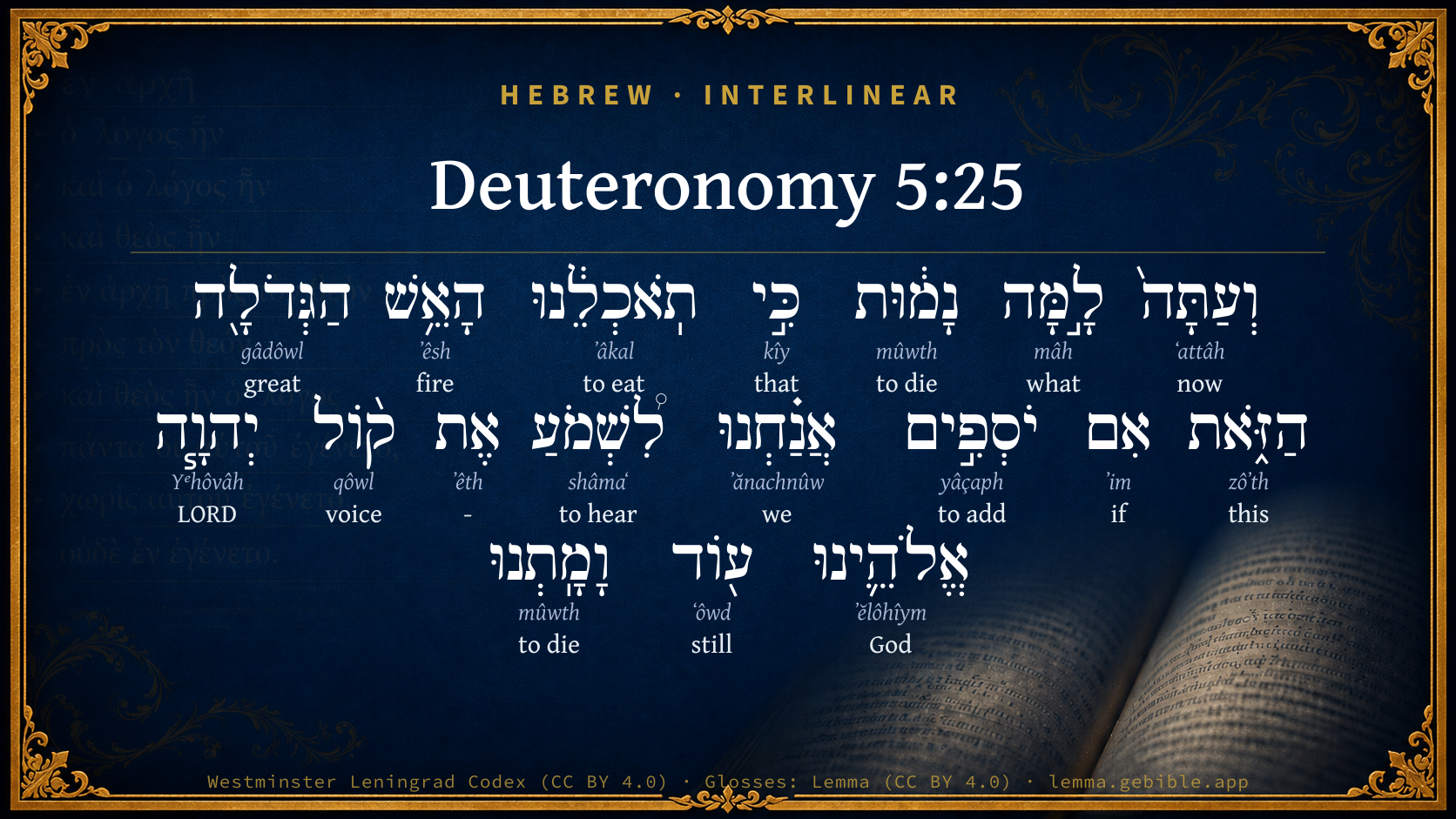
Hebrew (Westminster Leningrad Codex) Deuteronomy 5:25 appears in the Hebrew Old Testament. The text above is from the Westminster Leningrad Codex. Each word links to its Strong’s number, a concise gloss, and parsing drawn from the Open Scriptures Hebrew Bible morphology. Click any word for its full Brown-Driver-Briggs (BDB) entry.
Download image
Cite this verse

Deuteronomy 5:25 (World English Bible). Public Domain. Lemma interlinear Bible study tool, https://lemma.gebible.app/v/deuteronomy/5/25.

Show BibTeX & RIS
BibTeX
RIS
English Translation
Now therefore why should we die? for this great fire will consume us: if we hear the voice of Yahweh our God any more, then we shall die.
World English Bible · Public Domain
Download a study sheet

One document with this verse’s original text, its word-by-word gloss line, the meaning frame, cross-references with their text, attributed commentary, and full source and license credits — printable, and it pastes into notes with its structure intact.

This verse Autodidact and up

Study sheet (.html) Plain text (.txt)

A passage Seminary Student

Up to 50 verses in one chapter. A passage sheet keeps up to 6 commentary sources and 12 cross-references per verse, in the order this page ranks them, and says so on the sheet whenever that leaves anything out. Ask for a single verse and you get the Autodidact verse sheet above.

Everything on this page stays free to read, with no account — the sheet is a download of what is already on screen, not access to it.

Want to remove ads? Support Godless Engineer
Compare translations 3

The same verse in 3 English versions, stacked beneath the original-language interlinear above. Click any original word for its lexicon entry.

Each is an independent rendering of the whole verse — the interlinear is not word-aligned to these translations.

Highlighted words mark where these versions differ — a whole-verse word diff, not a word-by-word alignment.

  • World English Bible Public Domain
    Now therefore why should we die? for this great fire will consume us: if we hear the voice of Yahweh our God any more, then we shall die.
  • King James Version Public Domain
    Now therefore why should we die? for this great fire will consume us: if we hear the voice of the LORD our God any more, then we shall die.
  • unfoldingWord Literal Text CC BY-SA 4.0
    And now, why should we die? For this great fire will consume us if we continue anymore to hear the voice of Yahweh our God, and we will die.

unfoldingWord Literal Text — © unfoldingWord, licensed CC BY-SA 4.0. Word-aligned USFM3 via Door43 (git.door43.org/unfoldingWord/en_ult).

Versions to compare (up to 4)

3 of 4 selected

Show all 18 translations

Every available English version of this verse, each an independent rendering of the whole verse.

  • World English Bible Public Domain
    Now therefore why should we die? for this great fire will consume us: if we hear the voice of Yahweh our God any more, then we shall die.
  • Berean Standard Bible Public Domain
    But now, why should we die? For this great fire will consume us, and we will die, if we hear the voice of the LORD our God any longer.
  • Majority Standard Bible Public Domain
    But now, why should we die? For this great fire will consume us, and we will die, if we hear the voice of the LORD our God any longer.
  • King James Version Public Domain
    Now therefore why should we die? for this great fire will consume us: if we hear the voice of the LORD our God any more, then we shall die.
  • American Standard Version (1901) Public Domain
    Now therefore why should we die? for this great fire will consume us: if we hear the voice of Jehovah our God any more, then we shall die.
  • Revised Version (1885) Public Domain
    Now therefore why should we die? for this great fire will consume us: if we hear the voice of the LORD our God any more, then we shall die.
  • Geneva Bible (1599) Public Domain
    Now therefore, why should we dye? for this great fire wil consume vs: if we heare ye voyce of the Lord our God any more, we shall dye.
  • Douay-Rheims (1899) Public Domain
    Why shall we die therefore, and why shall this exceeding great Are consume us: for if we hear the voice of the Lord our God any more, we shall die.
  • Young's Literal Translation Public Domain
    `And, now, why do we die? for consume us doth this great fire -- if we add to hear the voice of Jehovah our God any more -- then we have died.
  • Literal Standard Version CC BY-SA 4.0
    And now, why do we die? For this great fire consumes us if we add to hear the voice of our God YHWH anymore—then we have died.
  • Unlocked Literal Bible CC BY-SA 4.0
    But why should we die? For this great fire will consume us; if we hear the voice of Yahweh our God any longer, we will die.
  • unfoldingWord Literal Text CC BY-SA 4.0
    And now, why should we die? For this great fire will consume us if we continue anymore to hear the voice of Yahweh our God, and we will die.
  • Darby Bible Public Domain
    And now, why should we die? for this great fire will consume us. If we hear the voice of Jehovah our God any more, we shall die.
  • World Messianic Bible Public Domain
    Now therefore, why should we die? For this great fire will consume us. If we hear the LORD our God’s voice any more, then we shall die.
  • Webster's Bible Public Domain
    Now therefore why should we die? for this great fire will consume us: if we hear the voice of the LORD our God any more, then we shall die.
  • Free Bible Version CC BY-SA 4.0
    But we could still die, couldn't we? This enormous fire is going to burn us up, and we'll die if the Lord our God continues to speak to us.
  • Bible in Basic English Public Domain
    Why then is death to be our fate? For if the voice of the Lord our God comes to us any more, death will overtake us, and we will be burned up in this great fire.
  • JPS Tanakh (1917) Public Domain
    (5-22) Now therefore why should we die? for this great fire will consume us; if we hear the voice of the LORD our God any more, then we shall die.

Literal Standard Version (2020), Covenant Press — licensed CC BY-SA 4.0. Text via the HelloAO Bible API (eBible.org). Unlocked Literal Bible (unfoldingWord) — licensed CC BY-SA 4.0. Text via the HelloAO Bible API (eBible.org). unfoldingWord Literal Text — © unfoldingWord, licensed CC BY-SA 4.0. Word-aligned USFM3 via Door43 (git.door43.org/unfoldingWord/en_ult). Free Bible Version, Dr. Jonathan Gallagher — licensed CC BY-SA 4.0. Text via the HelloAO Bible API (eBible.org).

Word by word

More ways to search: Search by grammar → Find every occurrence → Compare this word →

Practice this passage: Drill this verse → Learn its vocabulary →

אֲנַ֗חְנוּ
ʼănachnûw
H587
“we”
Pronoun, Personal, 1st Person, Common, Plural
Part of Speech
Pronoun
Type
Personal
Person
1st Person
Gender
Common
Number
Plural
Full BDB Definition

Origin: apparently from H595

TWOT: 128

we (first person plural - usually used for emphasis)
  1. וְעַתָּה֙ ʻattâh H6258 “and · now” Conjunction + Adverb
  2. לָ֣מָּה mâh H4100 “to/for · what” Preposition + Particle, Interrogative
  3. נָמ֔וּת mûwth H4191 “to die” Verb, Qal, Imperfect, 1st Person, Common, Plural
  4. כִּ֣י kîy H3588 “that” Conjunction
  5. תֹֽאכְלֵ֔נוּ ʼâkal H398 “to eat · us” Verb, Qal, Imperfect, 3rd Person, Feminine, Singular + Suffix, Personal, 1st Person, Common, Plural
  6. הָאֵ֥שׁ ʼêsh H784 “the · fire” Particle, Definite Article + Noun, Common, Both, Singular, Absolute
  7. הַגְּדֹלָ֖ה gâdôwl H1419 “the · great” Particle, Definite Article + Adjective, Adjective, Feminine, Singular, Absolute
  8. הַזֹּ֑את zôʼth H2063 “the · this” Particle, Definite Article + Pronoun, Demonstrative, Feminine, Singular
  9. אִם ʼim H518 “if” Conjunction
  10. יֹסְפִ֣ים yâçaph H3254 “adding” Verb, Qal, Participle Active, Masculine, Plural, Absolute
  11. לִ֠שְׁמֹעַ shâmaʻ H8085 “to hear” Preposition + Verb, Qal, Infinitive Construct
  12. אֶת ʼêth H853 “-” Particle, Direct Object
  13. ק֨וֹל qôwl H6963 “voice of” Noun, Common, Masculine, Singular, Construct
  14. יְהוָ֧ה Yᵉhôvâh H3068 “LORD” Noun, Proper
  15. אֱלֹהֵ֛ינוּ ʼĕlôhîym H430 “God(s) · our” Noun, Common, Masculine, Plural, Construct + Suffix, Personal, 1st Person, Common, Plural
  16. ע֖וֹד ʻôwd H5750 “still” Adverb
  17. וָמָֽתְנוּ mûwth H4191 “and · to die” Conjunction + Verb, Qal, Sequential Perfect, 1st Person, Common, Plural

About this verse

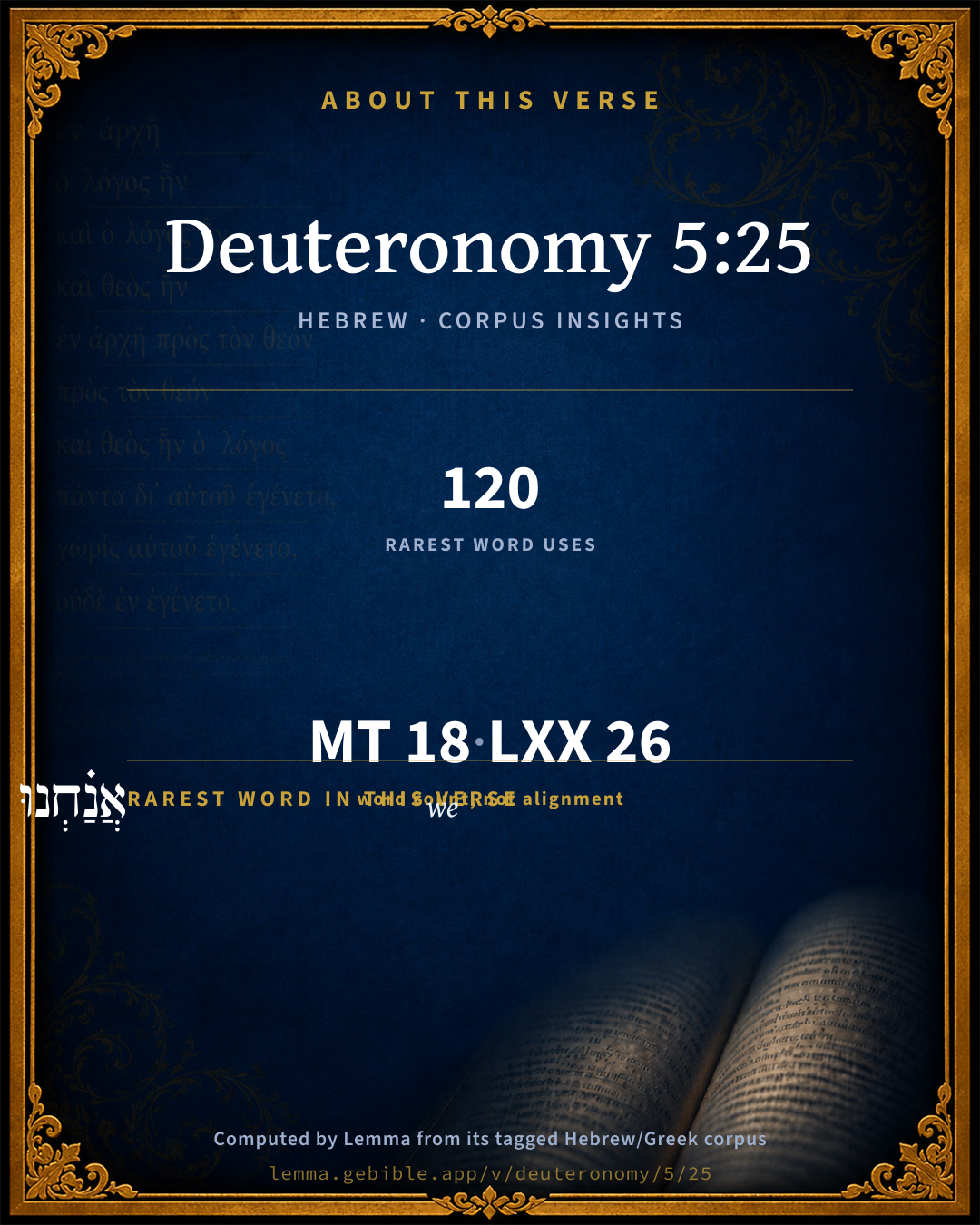
These counts appear in no published source. They are computed here, from the morphology-tagged text and Lemma’s own curated glosses. What Lemma adds →

18
words
17
distinct lemmas
Pentateuch
section

Grammatical profile

  • 5 verbs
  • 4 nouns
  • 1 adjective
  • 2 pronouns
  • 2 conjunctions
  • 2 adverbs
  • 2 particles

Verb forms

  • נָמ֔וּת Qal · Imperfect
  • תֹֽאכְלֵ֔נוּ Qal · Imperfect
  • יֹסְפִ֣ים Qal · Participle Active
  • לִ֠שְׁמֹעַ Qal · Infinitive Construct
  • וָמָֽתְנוּ Qal · Sequential Perfect

Repetition

A word recurs within this verse — often emphatic in Hebrew:

  • נָמ֔וּת to die H4191 ×2

Hebrew & Septuagint length

In English translation the verse runs 28 words from the Hebrew and 30 from the Septuagint (LXX English) — closely comparable.

A rough comparison of the two English renderings, which tokenize alike — not a word-level alignment.

Word counts can differ between the Hebrew and the Greek without any difference in meaning — e.g. the Hebrew direct-object marker אֵת has no separate Greek word, and Greek often adds the article ὁ.

In the original languages it is 18 Hebrew tokens and 26 Greek tokens — but the two are counted differently (Hebrew bundles its prefixes and suffixes into one token; the Greek is in lemma form), so that isn’t a like-for-like length.

Cross-references

6

Topical passages linked to Deuteronomy 5:25 in the Treasury of Scripture Knowledge — connected by theme and wording, ordered by reader-vote popularity; previews shown in the World English Bible.

  • Deuteronomy 18:16 according to all that you desired of Yahweh your God in Horeb in the day of the assembly, saying, Let me not hear again the voice of Yahweh my God, neither let me see this great fire any more, that I not die.
  • Deuteronomy 33:2 He said, Yahweh came from Sinai, Rose from Seir to them; He shined forth from Mount Paran, He came from the ten thousands of holy ones: At his right hand was a fiery law for them.
  • 2 Corinthians 3:7–9 But if the service of death, written engraved on stones, came with glory, so that the children of Israel could not look steadfastly on the face of Moses for the glory of his face; which was passing away:
  • Galatians 3:10 For as many as are of the works of the law are under a curse. For it is written, "Cursed is everyone who doesn't continue in all things that are written in the book of the law, to do them."
  • Galatians 3:21–22 Is the law then against the promises of God? Certainly not! For if there had been a law given which could make alive, most assuredly righteousness would have been of the law.
  • Hebrews 12:29 for our God is a consuming fire.

Cross-references courtesy of OpenBible.info (CC BY 4.0).

Hebrew and Greek witnesses Masoretic Hebrew ↔ Greek Septuagint

The same verse in the two great witnesses to the Old Testament, shown verse-for-verse.

These are two independent witnesses, not word-aligned to each other, and the Septuagint is shown in lemma (dictionary) form.

Hebrew Deuteronomy 5:25 Masoretic · Westminster Leningrad Codex

וְעַתָּה֙ לָ֣מָּה נָמ֔וּת כִּ֣י תֹֽאכְלֵ֔נוּ הָאֵ֥שׁ הַגְּדֹלָ֖ה הַזֹּ֑את אִם יֹסְפִ֣ים אֲנַ֗חְנוּ לִ֠שְׁמֹעַ אֶת ק֨וֹל יְהוָ֧ה אֱלֹהֵ֛ינוּ ע֖וֹד וָמָֽתְנוּ

Now therefore why should we die? for this great fire will consume us: if we hear the voice of Yahweh our God any more, then we shall die.

World English Bible · Public Domain

Greek LXX Deuteronomy 5:25 Septuagint · lemma form

καί νῦν μή ἀποθνήσκω ὅτι ἐκ ἀναἁλίσκω ἐγώ ὁ πῦρ ὁ μέγας οὗτος ἐάν προςτίθημι ἐγώ ἀκούω ὁ φωνή κύριος ὁ θεός ἐγώ ἔτι καί ἀποθνήσκω

And now let us not die, for this great fire will consume us, if we shall hear the voice of the Lord our God any more, and we shall die.

LXX2012 (modern English Septuagint) · Public Domain

Hebrew: Westminster Leningrad Codex (CC BY 4.0). Greek: Septuagint (public domain); English from LXX2012 (modern English Septuagint) (Public Domain). How the Septuagint differs from the Hebrew →

Targum (Aramaic paraphrase)

2

The Targum is the ancient Jewish Aramaic paraphrase of the Hebrew Scriptures — an interpretive translation, not the Hebrew text itself. Onkelos (literal) and Pseudo-Jonathan (expansive) render the Torah, and Jonathan the Prophets. Coverage is partial: where no permissively-licensed English translation exists for a verse, only the Aramaic is shown. This is verse-level text, not a word-by-word alignment to the Hebrew.

  1. Targum Onkelos Torah (Genesis–Deuteronomy)
    וּשְׁמִיעַ קֳדָם יְיָ יָת קָל פִּתְגָמֵיכוֹן בְּמַלָלוּתְכוֹן עִמִי וַאֲמַר יְיָ לִי שְׁמִיעַ קֳדָמַי יָת קָל פִּתְגָמֵי עַמָא הָדֵין דִי מַלִילוּ עִמָךְ אַתְקִינוּ כָּל דִי מַלִילוּ

    (no public-domain English translation for this verse)

    Targum Onkelos — Aramaic: “Onkelos Genesis” (public domain); “Onkelos Exodus” (public domain); “Onkelos Leviticus” (public domain); “Onkelos Numbers” (public domain); “Onkelos Deuteronomy” (public domain). English: “Sefaria Community Translation” (CC0 1.0 (public-domain dedication)); “J.W. Etheridge. The Targums of Onkelos and Jonathan Ben Uzziel on the Pentateuch. London: Longmans, Green, 1862” (public domain). Text via Sefaria.

  2. Targum Pseudo-Jonathan Torah (Genesis–Deuteronomy)
    וּשְׁמַע קֳדָם יְיָ יַת קַל פִּתְגָמֵיכוֹן בְּמַלָּלוּתְכוֹן עִמִּי וַאֲמַר יְיָ לִי שְׁמִיעַ קֳדָמַי יַת קַל פִּתְגָמֵי עַמָא הָדֵין דְּמַלִילוּ עִמָךְ אוֹטִיבוּ כָּל מַה דִּי מַלִּילוּ

    And the voice of your words was heard before the Lord when you spake with me, and the Lord said to me, All the words of this people which they have spoken with thee are heard before Me; all that they have said is good.

    Targum Pseudo-Jonathan — Aramaic: “Targum Jonathan on Genesis” (public domain); “Targum Jonathan on Exodus” (public domain); “Targum Jonathan on Leviticus” (public domain); “Targum Jonathan on Numbers” (public domain); “Targum Jonathan on Deuteronomy” (public domain). English: “The Targum of Jonathan ben Uzziel, trans. J. W. Etheridge, London, 1862” (public domain). Text via Sefaria.

Commentary

Notes on Deuteronomy 5:25 from classic Christian and Jewish commentators (each source and its license shown beneath its notes). The classic Christian expositions comment on the surrounding passage and are grouped to its opening verse, so a note may address several verses; the Jewish commentaries on the Tanakh (Rashi and others) are per-verse, so they appear only where the commentator wrote on this verse.

Lemma curates 59 commentaries, every one of them public domain or Creative Commons licensed, each selected and text-cleaned for this edition rather than reprinted as found. About our sources →

Trapp's Complete Commentary

John Trapp

Deu 5:25 Now therefore why should we die? for this great fire will consume us: if we hear the voice of the LORD our God any more, then we shall die.

Ver. 25. Why should we die?] But why should they fear to die, since thy had seen that day, that God doth talk with man, and he liveth? It is answered, that they looked upon their present safety as a wonder, but feared what would follow upon such an interview, if continued. And indeed it is still the work of the law to scare men, and to drive them to seek for a Mediator.

We shall die.] If God himself should speak to us, and from heaven, his stillest rhetoric would be too loud for us.

John Trapp, A Commentary or Exposition upon All the Books of the Old and New Testament (1647–1656) — public domain. Text from a community e-Sword module.

Joseph Benson's Commentary

Deu 5:25. Why should we die? — For though God hath, for this season, kept us alive, yet we shall never be able to endure any further discourse from him in such a terrible manner, but shall certainly sink under the burden of it.

Joseph Benson's Commentary on the Old and New Testaments (1811–1818) — public domain. Text from a community e-Sword module.

John Gill's Exposition

And the Lord heard the voice of your word, when ye spake unto me,.... Not only in a general way, as he hears and knows all that is spoken by men; for there is not a word on the tongue, formed upon it, and uttered by it, but what is altogether known to him; but in a special and particular manner observed, took notice of, approved, and was well pleased with what these people said:

and the Lord said unto me, I have heard the voice of the words of this people which they have spoken unto thee; not only heard the sound of them, but took notice of the sense and meaning of them, and listened to them with pleasure and delight:

they have well said all that they have spoken; expressing such an awe and reverence of the divine Majesty, desiring to have a mediator between God and them, and purposing and promising to hearken to and obey whatsoever he should command by him.

John Gill's Exposition of the Whole Bible (1746–1763) — public domain (CC PDM 1.0). Text via the HelloAO Bible API.

Haydock's Catholic Bible Commentary

Die. Past experience did not entirely remove from them the fear which was so generally entertained, that the sight of the heavenly beings would prove destructive. So Daniel (chap. x. 17) said on a similar occasion, my breath is stopped. (Haydock)

George Leo Haydock (1774–1849), Haydock's Catholic Family Bible and Commentary, 1859 edition — public domain. Excludes Psalms (Douay-Rheims chapter numbering differs from Protestant) and Deuterocanonical books (Catholic canon only).

Matthew Poole's English Annotations

Why should we die? for though God hath for this season kept us alive to our admiration, yet we shall never be able to endure any further discourse from him in such a terrible manner, but shall certainly sink under the burden of it. Compare Gen 16:13; Jdg 6:22.

Matthew Poole's English Annotations on the Holy Bible (1683–1685) — public domain. Text from a community e-Sword/MySword module.

John Wesley's Explanatory Notes

Why should we die? - For though God hath for this season kept us alive, yet we shall never be able to endure any further discourse from him in such a terrible manner, but shall certainly sink under the burden of it.

John Wesley, Explanatory Notes Upon the Whole Bible (1754–1765) — public domain. Text via the GEBible commentary corpus.

unfoldingWord translationNotes

Door43 World Missions Community

General Information:

Moses continues to remind the Israelites what the Israelites had said to Moses.

But why should we die?

They were afraid that they would die if Yahweh spoke to them. This question can be translated as a statement. AT: "We are afraid that we will die." (See: Rhetorical Question)

For who besides us is there ... have done?

This question can be translated as a statement. AT: "There are no other people besides us ... have done." (See: Rhetorical Question)

all flesh

This represents all people or living things. AT: "all people" or "all living beings" (See: Synecdoche)

translationWords

die

consume

voice

Yahweh

God

flesh

obey

unfoldingWord translationNotes — © Distant Shores Media and the Door43 World Missions Community, licensed CC BY-SA 4.0. Source: git.door43.org/Door43/en_tn.

Lesson kit

Teaching starters — assembled from the data on this page, not authored interpretation. Every prompt links to the verse data it draws on. Edit before teaching.

Deuteronomy, in the Pentateuch, opens this verse with 18 words (17 distinct Hebrew lemmas). Its most distinctive word is ʼănachnûw (“we”). A historical commentator’s framing appears above. Read the whole chapter for the surrounding context.

Discussion questions

  1. The word ʼănachnûw carries the sense “we.” How does it shape the verse?
  2. How does Deuteronomy 18:16, which shares this passage’s theme, read alongside this verse?
  3. What does the repetition of “to die” (2× in this one verse) do in this verse?
  4. These translations render this verse differently. What is at stake in choosing one wording over another?
  5. «נָמ֔וּת» is a Qal Imperfect verb. How does that grammatical form shape the action described?
  6. Compare how Trapp's Complete Commentary and Joseph Benson's Commentary read this verse. Where do they agree or differ?

Things to notice

Reading settings

Reading text

Shown beneath each verse's original-language words.

Old Testament
Old Testament edition

Read the OT as the Masoretic Hebrew (MT) or the Greek Septuagint (LXX).

English shown for the Greek Septuagint (in the Hebrew ↔ Greek comparison).

Comparing translations? Open the Compare panel on any verse page to stack up to four side by side.