
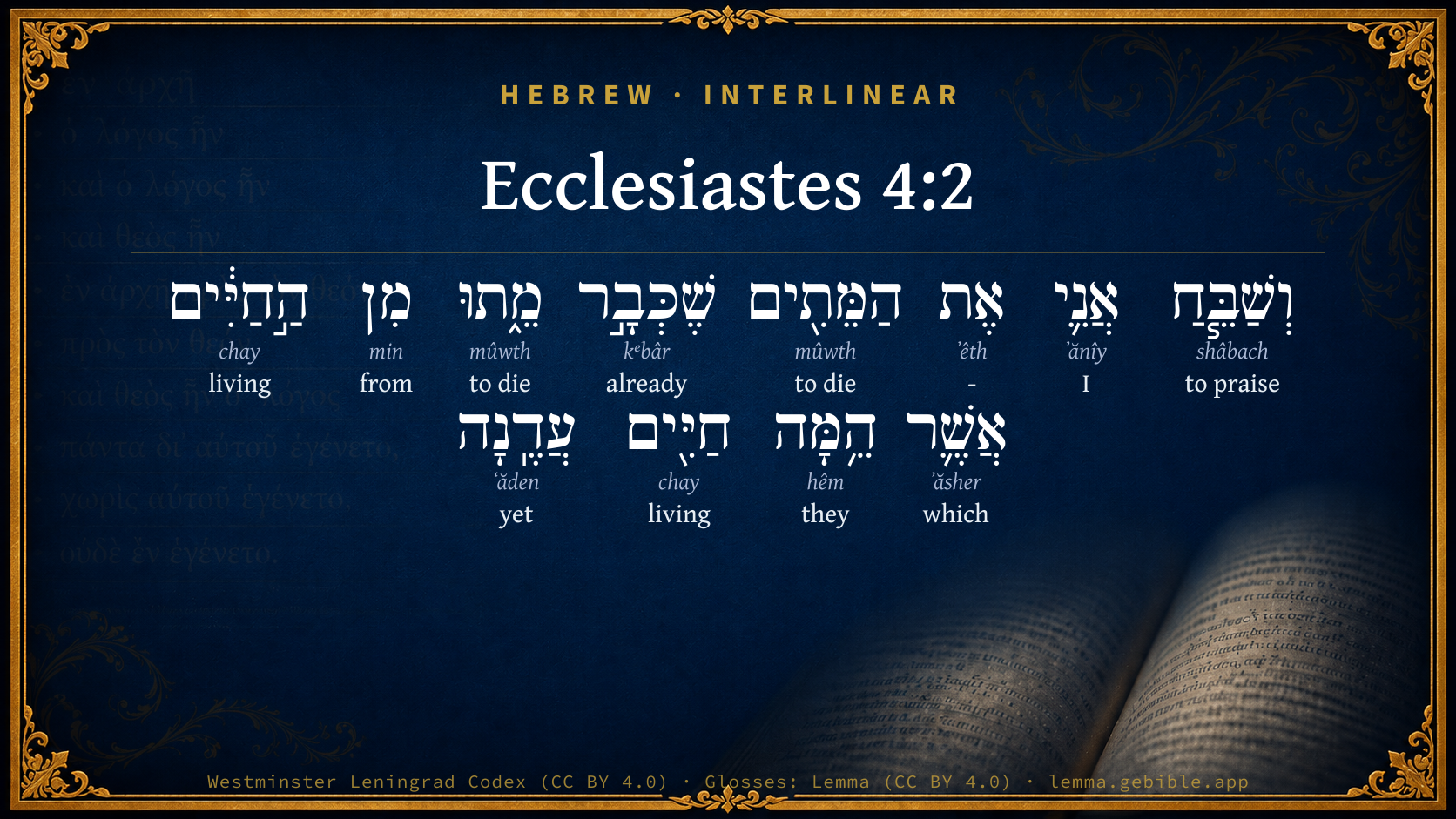
Ecclesiastes 4:2

Hebrew (Westminster Leningrad Codex) Ecclesiastes 4:2 appears in the Hebrew Old Testament. The text above is from the Westminster Leningrad Codex. Each word links to its Strong’s number, a concise gloss, and parsing drawn from the Open Scriptures Hebrew Bible morphology. Click any word for its full Brown-Driver-Briggs (BDB) entry.
Download image
Cite this verse

Ecclesiastes 4:2 (World English Bible). Public Domain. Lemma interlinear Bible study tool, https://lemma.gebible.app/v/ecclesiastes/4/2.

Show BibTeX & RIS
BibTeX
RIS
English Translation
Therefore I praised the dead who have been long dead more than the living who are yet alive.
World English Bible · Public Domain
Highlights
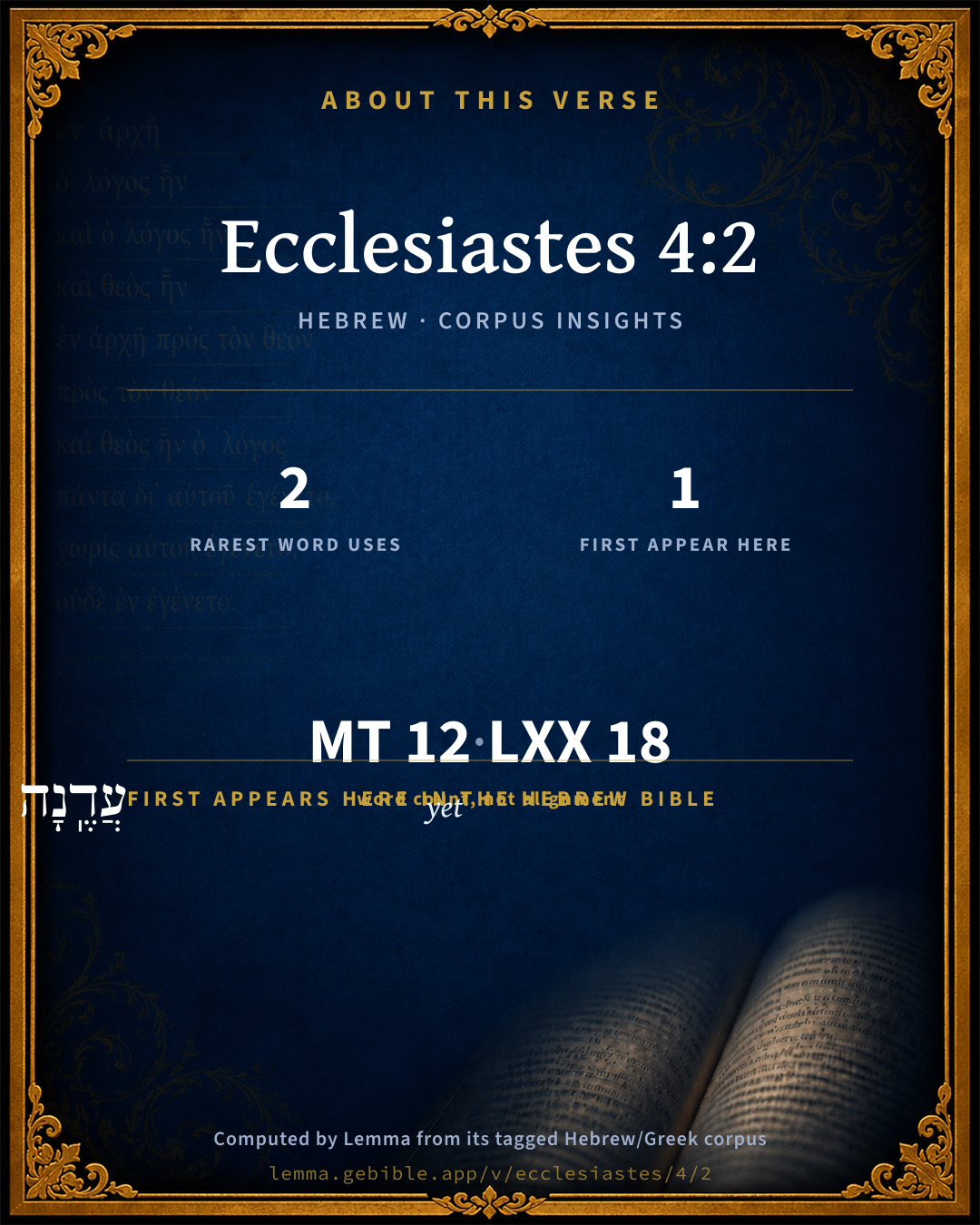
  • 1 first appearance in the Hebrew Bible
Full analysis ↓
Download a study sheet

One document with this verse’s original text, its word-by-word gloss line, the meaning frame, cross-references with their text, attributed commentary, and full source and license credits — printable, and it pastes into notes with its structure intact.

This verse Autodidact and up

Study sheet (.html) Plain text (.txt)

A passage Seminary Student

Up to 50 verses in one chapter. A passage sheet keeps up to 6 commentary sources and 12 cross-references per verse, in the order this page ranks them, and says so on the sheet whenever that leaves anything out. Ask for a single verse and you get the Autodidact verse sheet above.

Everything on this page stays free to read, with no account — the sheet is a download of what is already on screen, not access to it.

Want to remove ads? Support Godless Engineer
Compare translations 3

The same verse in 3 English versions, stacked beneath the original-language interlinear above. Click any original word for its lexicon entry.

Each is an independent rendering of the whole verse — the interlinear is not word-aligned to these translations.

Highlighted words mark where these versions differ — a whole-verse word diff, not a word-by-word alignment.

  • World English Bible Public Domain
    Therefore I praised the dead who have been long dead more than the living who are yet alive.
  • King James Version Public Domain
    Wherefore I praised the dead which are already dead more than the living which are yet alive.
  • unfoldingWord Literal Text CC BY-SA 4.0
    So I praised, I, the dead who have already died more than the living, who, they are still alive.

unfoldingWord Literal Text — © unfoldingWord, licensed CC BY-SA 4.0. Word-aligned USFM3 via Door43 (git.door43.org/unfoldingWord/en_ult).

Versions to compare (up to 4)

3 of 4 selected

Show all 18 translations

Every available English version of this verse, each an independent rendering of the whole verse.

  • World English Bible Public Domain
    Therefore I praised the dead who have been long dead more than the living who are yet alive.
  • Berean Standard Bible Public Domain
    So I admired the dead, who had already died, above the living, who are still alive.
  • Majority Standard Bible Public Domain
    So I admired the dead, who had already died, above the living, who are still alive.
  • King James Version Public Domain
    Wherefore I praised the dead which are already dead more than the living which are yet alive.
  • American Standard Version (1901) Public Domain
    Wherefore I praised the dead that have been long dead more than the living that are yet alive;
  • Revised Version (1885) Public Domain
    Wherefore I praised the dead which are already dead more than the living which are yet alive;
  • Geneva Bible (1599) Public Domain
    Wherefore I praysed the dead which now are dead, aboue the liuing, which are yet aliue.
  • Douay-Rheims (1899) Public Domain
    And I praised the dead rather than the living:
  • Young's Literal Translation Public Domain
    And I am praising the dead who have already died above the living who are yet alive.
  • Literal Standard Version CC BY-SA 4.0
    And I am praising the dead who have already died above the living who are yet alive.
  • Unlocked Literal Bible CC BY-SA 4.0
    So I considered those who are already dead more fortunate than the living, who are still alive.
  • unfoldingWord Literal Text CC BY-SA 4.0
    So I praised, I, the dead who have already died more than the living, who, they are still alive.
  • Darby Bible Public Domain
    Then I praised the dead who are already dead more than the living who are yet alive;
  • World Messianic Bible Public Domain
    Therefore I praised the dead who have been long dead more than the living who are yet alive.
  • Webster's Bible Public Domain
    Wherefore I praised the dead who are already dead more than the living who are yet alive.
  • Free Bible Version CC BY-SA 4.0
    I congratulated those who were already dead, for the dead are better off than those who are still alive and being oppressed.
  • Bible in Basic English Public Domain
    So my praise was for the dead who have gone to their death, more than for the living who still have life.
  • JPS Tanakh (1917) Public Domain
    Wherefore I praised the dead that are already dead more than the living that are yet alive;

Literal Standard Version (2020), Covenant Press — licensed CC BY-SA 4.0. Text via the HelloAO Bible API (eBible.org). Unlocked Literal Bible (unfoldingWord) — licensed CC BY-SA 4.0. Text via the HelloAO Bible API (eBible.org). unfoldingWord Literal Text — © unfoldingWord, licensed CC BY-SA 4.0. Word-aligned USFM3 via Door43 (git.door43.org/unfoldingWord/en_ult). Free Bible Version, Dr. Jonathan Gallagher — licensed CC BY-SA 4.0. Text via the HelloAO Bible API (eBible.org).

Word by word

More ways to search: Search by grammar → Find every occurrence → Compare this word →

Practice this passage: Drill this verse → Learn its vocabulary →

About this verse

These counts appear in no published source. They are computed here, from the morphology-tagged text and Lemma’s own curated glosses. What Lemma adds →

12
words
10
distinct lemmas
Wisdom
section

Notable vocabulary

The rarest word here is עֲדֶֽנָה yet H5728 — appearing just 2 times in the whole Hebrew Bible.

First appearance in Scripture

This word makes its first canonical appearance in the Hebrew Bible here:

  • עֲדֶֽנָה yet H5728

Shared distinctive vocabulary

עֲדֶֽנָה yet H5728 occurs in 2 verses of the Hebrew Bible. Also found in:

Grammatical profile

  • 3 verbs
  • 2 adjectives
  • 2 pronouns
  • 1 preposition
  • 2 adverbs
  • 2 particles

Verb forms

  • וְשַׁבֵּ֧חַ Piel · Infinitive Absolute
  • הַמֵּתִ֖ים Qal · Participle Active
  • מֵ֑תוּ Qal · Perfect

Repetition

Words recur within this verse — often emphatic in Hebrew:

  • הַמֵּתִ֖ים to die H4191 ×2
  • הַ֣חַיִּ֔ים living H2416 ×2

Hebrew & Septuagint length

In English translation the verse runs 18 words from the Hebrew and 21 from the Septuagint (LXX English) — closely comparable.

A rough comparison of the two English renderings, which tokenize alike — not a word-level alignment.

Word counts can differ between the Hebrew and the Greek without any difference in meaning — e.g. the Hebrew direct-object marker אֵת has no separate Greek word, and Greek often adds the article ὁ.

In the original languages it is 12 Hebrew tokens and 18 Greek tokens — but the two are counted differently (Hebrew bundles its prefixes and suffixes into one token; the Greek is in lemma form), so that isn’t a like-for-like length.

Cross-references

3

Topical passages linked to Ecclesiastes 4:2 in the Treasury of Scripture Knowledge — connected by theme and wording, ordered by reader-vote popularity; previews shown in the World English Bible.

  • Job 3:11–26 "Why didn't I die from the womb? Why didn't I give up the spirit when my mother bore me?
  • Ecclesiastes 2:17 So I hated life, because the work that is worked under the sun was grievous to me; for all is vanity and a chasing after wind.
  • Ecclesiastes 9:4–6 For to him who is joined with all the living there is hope; for a living dog is better than a dead lion.

Cross-references courtesy of OpenBible.info (CC BY 4.0).

Hebrew and Greek witnesses Masoretic Hebrew ↔ Greek Septuagint

The same verse in the two great witnesses to the Old Testament, shown verse-for-verse.

These are two independent witnesses, not word-aligned to each other, and the Septuagint is shown in lemma (dictionary) form.

Hebrew Ecclesiastes 4:2 Masoretic · Westminster Leningrad Codex

וְשַׁבֵּ֧חַ אֲנִ֛י אֶת הַמֵּתִ֖ים שֶׁכְּבָ֣ר מֵ֑תוּ מִן הַ֣חַיִּ֔ים אֲשֶׁ֛ר הֵ֥מָּה חַיִּ֖ים עֲדֶֽנָה

Therefore I praised the dead who have been long dead more than the living who are yet alive.

World English Bible · Public Domain

Greek LXX Ecclesiastes 4:2 Septuagint · lemma form

καί ἐπιαἰνέω ἐγώ σύν ὁ θνήσκω ὁ ἤδη ἀποθνήσκω ὑπέρ ὁ ζάω ὅσος αὐτός ζάω ἕως ὁ νῦν

and I praised all the dead that had already died more than the living, as many as are alive until now.

LXX2012 (modern English Septuagint) · Public Domain

On this verse, The Pulpit Commentary discusses the Septuagint’s reading. Read the note in Commentary ↓

Hebrew: Westminster Leningrad Codex (CC BY 4.0). Greek: Septuagint (public domain); English from LXX2012 (modern English Septuagint) (Public Domain). How the Septuagint differs from the Hebrew →

Commentary

Notes on Ecclesiastes 4:2 from classic Christian and Jewish commentators (each source and its license shown beneath its notes). The classic Christian expositions comment on the surrounding passage and are grouped to its opening verse, so a note may address several verses; the Jewish commentaries on the Tanakh (Rashi and others) are per-verse, so they appear only where the commentator wrote on this verse.

Lemma curates 59 commentaries, every one of them public domain or Creative Commons licensed, each selected and text-cleaned for this edition rather than reprinted as found. About our sources →

Trapp's Complete Commentary

John Trapp

Ecc 4:2 Wherefore I praised the dead which are already dead more than the living which are yet alive.

Ver. 2. Wherefore I praised the dead.] Because they are out of the reach of wrong doers; and if dead in the Lord, they have "entered into peace, they do rest in their beds, each one walking in his uprightness." {Isa 57:2} But if otherwise, men had better do anything, suffer anything here than die; since by death, as by a trap door, they enter into those terrors and torments that shall never either mend or end. Men, like silly fishes, see one another caught and jerked out of the pond of life but they see not, alas! the fire and pan into the which they are cast that die in their sins. Oh it had been better, surely, for such if they had never been born, as Christ said of Judas, than thus to be "brought forth to the murderer" {Hos 9:14} - to the old manslayer - to be hurled into hell, there to suffer such things as they shall never be able to avoid or abide.

John Trapp, A Commentary or Exposition upon All the Books of the Old and New Testament (1647–1656) — public domain. Text from a community e-Sword module.

The Biblical Illustrator

Joseph S. Exell

Ecc_4:2

Wherefore I praised the dead which are already dead more than the living which are yet alive.

The applause of the dead regulated, vindicated and improved

Scripture itself sets us an example of applauding the virtues of the departed; but I think that in our funeral sermons, in our obituaries and on our sepulchres, there is much which needs to be regulated.

I. It must be qualified.

1. We are not to praise the dead with indiscriminate eulogy; for there is such a thing as confounding moral distinctions, as smiling alike on vice and virtue.

2. We are not to praise the dead with exaggerated panegyric. For it should never be forgotten, that however the grace of God has formed the subject of it to excellence, he was still the possessor of remaining moral infirmities.

3. We are not to praise the dead in a spirit of discontent with life.

4. We are not to praise the dead in the exercise of gratified envy.

5. We ought not to praise the dead in the spirit of relative pride.

6. In one word--we should not praise the dead without a humble and grateful recollection that all their gifts and virtues proceeded from God. Let the survivor not glory in the erudition, in the riches, in the wealth or virtue of the deceased, but let him glory only in the Lord.

II. This eulogy is to be justified. It may be so by a variety of reasons.

1. There is that of Scripture precedent. It speaks, in high terms, of the distinguished faith of Abraham, the patience of Job, the meekness of Moses, the devotion of the man after Gods own heart, the wisdom of a Solomon, the magnanimity of a Daniel, the fortitude of a Stephen, the humanity of a Dorcas.

2. This procedure may also be sanctioned on the ground of utility. How often does the perusal of the memoirs of eminent persons excite desires in the hearts of survivors to imbibe their sentiments, to catch their spirit, and to imitate their example.

3. The principal grounds on which we are justified in praising the pious dead are connected with themselves, as--

(1) The blessedness of their condition on which they have at once entered.

(2) The developed excellences of their character.

(3) The usefulness of their course.

For much of this as may have been apparent while they were yet alive, much more is very often discerned after their decease. Then are discerned in their diaries and records what were the sacred principles on which they acted, and how they were constrained by the love of Christ to live not unto themselves, but to Him who died for them and rose again. Not till the crisis of death, too, has much of the usefulness of the Christian minister been made apparent.

III. The sentiment in the text is to be improved. If the question be asked--in what way shall I praise departed ministers? I answer--

1. By repenting of the treatment you often showed them while they were alive.

2. By recalling to serious reflection the important subjects of their ministry.

3. By an imitation of the excellencies with which they were clothed.

4. By meditating on your joint responsibility with them at the bar of God.

5. By a devout application to the great Head of the Church to raise up men of similar and surpassing qualifications to carry on the interests of religion in the Church and in the world. (J. Clayton.)

Praising the dead more than the living

I. It is common. We see it in the political, ecclesiastical, and domestic sphere. So it has become a proverb, that the best men must die ever to have their virtues recognized. Why is this?

1. The dead are no longer competitors.

2. Social love buries their defects. In all, the great Father of Love has put a deep fountain of sympathy. Death unseals it, melts it, and causes it to flow forth in such copious streams as drown all the imperfections of the departed.

II. It is immoral.

1. It is not right. Virtue should be recognized and honoured wherever seen; and more so in the duties and struggles of life than in the reminiscenees of departed worth.

2. It is not generous. That husband is mean and despicable who ignores the virtues of a noble wife while living.

3. It is unreal. To praise virtues in a man when dead, which were ever unnoticed when living, is hypocritical. (Homilist.)

The Biblical Illustrator, edited by Joseph S. Exell (c. 1880s–1900s) — public domain. Text from a community e-Sword module.

Joseph Benson's Commentary

Ecc 4:2-3. Wherefore I praised the dead, &c. — I judged them less miserable. For this is certain, that setting aside the future life, which Solomon doth not meddle with in the present debate, and considering the uncertainty, and vanity, and manifold calamities of the present life, a wise man would not account it worth his while to live. Yea, better is he than both they — “Much more desirable than either of these is it not to have come into the world at all; and so to have had no sense of the miseries which the dead have formerly felt, and which the living now undergo.”

Joseph Benson's Commentary on the Old and New Testaments (1811–1818) — public domain. Text from a community e-Sword module.

Tyndale Open Study Notes

Tyndale Open Resources

4:2 Where oppression reigns, the dead are better off than the living. Those who have died are no longer mistreated.

Tyndale Open Study Notes — © Tyndale Open Resources, licensed CC BY-SA 4.0. Text via the HelloAO Bible API.

Geneva Bible (1599)

Geneva Bible translators

Because they are no more subject to these oppressions.

Geneva Bible (1599) marginal notes — public domain. Text via Bolls.life.

Jamieson, Fausset & Brown

Robert Jamieson, A. R. Fausset & David Brown

A profane sentiment if severed from its connection; but just in its bearing on Solomon's scope. If religion were not taken into account (Ecc 3:17, Ecc 3:19), to die as soon as possible would be desirable, so as not to suffer or witness "oppressions"; and still more so, not to be born at all (Ecc 7:1). Job (Job 3:12; Job 21:7), David (Psa 73:3, &c.), Jeremiah (Jer 12:1), Habakkuk (Hab 1:13), all passed through the same perplexity, until they went into the sanctuary, and looked beyond the present to the "judgment" (Psa 73:17; Hab 2:20; Hab 3:17-18). Then they saw the need of delay, before completely punishing the wicked, to give space for repentance, or else for accumulation of wrath (Rom 2:15); and before completely rewarding the godly, to give room for faith and perseverance in tribulation (Psa 92:7-12). Earnests, however, are often even now given, by partial judgments of the future, to assure us, in spite of difficulties, that God governs the earth.

Jamieson, Fausset & Brown — Commentary Critical and Explanatory on the Whole Bible (1871) — public domain (CC PDM 1.0). Text via the HelloAO Bible API.

Adam Clarke's Commentary

Verse 2. Wherefore I praised the dead] I considered those happy who had escaped from the pilgrimage of life to the place where the wicked cease from troubling, and where the weary are at rest.

Adam Clarke's Commentary on the Bible (1810–1826) — public domain. Text from a community e-Sword/MySword module.

Ellicott's Commentary for English Readers

(2) I praised the dead.—Job_3:11; Exo_32:32; 1Ki_19:4; Jer_20:14; Jon_4:3. The word which is translated “yet” in this verse belongs to later Hebrew, and does not occur elsewhere in the Old Testament,

A Bible Commentary for English Readers, edited by Charles John Ellicott (1878–1897) — public domain. Text from a community e-Sword module.

John Gill's Exposition

Wherefore I praised the dead, which are already dead,.... Truly and properly so; not in a figurative sense, as dead sinners, men dead in trespasses and sins; nor carnal professors, that have a name to live, and are dead; nor in a civil sense, such as are in calamity and distress, as the Jews in captivity, or in any affliction, which is sometimes called death: but such who are dead in a literal and natural sense, really and thoroughly dead; not who may and will certainly die, but who are dead already and in their graves, and not all these; not the wicked dead, who are in hell, in everlasting torments; but the righteous dead, who are taken away from the evil to come, and are free from all the oppressions of their enemies, sin, Satan, and the world. The Targum is,

"I praised those that lie down or are asleep, who, behold, are now dead;''

a figure by which death is often expressed, both in the Old and New Testament; sleep being, as the poet (a) says, the image of death; and a great likeness there is between them; Homer (b) calls sleep and death twins. The same paraphrase adds,

"and see not the vengeance which comes upon the world after their death;''

see Isa 57:1. The wise man did not make panegyrics or encomiums on those persons, but he pronounced them happy; he judged them in his own mind to be so; and to be much

more happy

than the living which are yet alive: that live under the oppression of others; that live in this world in trouble until now, as the Targum; of whom it is as much as it can be said that they are alive; they are just alive, and that is all; they are as it were between life and death. This is generally understood as spoken according to human sense, and the judgment of the flesh, without any regard to the glory and happiness of the future state; that the dead must be preferred to the living, when the quiet of the one, and the misery of the other, are observed; and which sense receives confirmation from Ecc 4:3, otherwise it is a great truth, that the righteous dead, who die in Christ and are with him, are much more happy than living saints; since they are freed from sin; are out of the reach of Satan's temptations; are no more liable to darkness and desertions; are freed from all doubts and fears; cease from all their labours, toil, and trouble; and are delivered from all afflictions, persecutions, and oppressions; which is not the case of living saints: and besides, the joys which they possess, the company they are always in, and the work they are employed about, give them infinitely the preference to all on earth; see Rev 14:13.

(a) "Stulte, quid est semnus gelidae nisi mortis imago?" Ovid. Plato in Ciceron. Tuscul. Quaest. l. 1. c. 58. (b) Iliad. 16. v. 672, 682. Vid. Pausan. Laconica, sive l. 3. p. 195.

John Gill's Exposition of the Whole Bible (1746–1763) — public domain (CC PDM 1.0). Text via the HelloAO Bible API.

Matthew Poole's English Annotations

I praised; I judged them more happy, or less miserable; which he seems to deliver not only as the judgment of the flesh, or of the sense, or of men in misery, as this is commonly understood, but as his own judgment. For this is most true and certain, that setting aside the advantage which this life gives him for the concerns of the future life, which Solomon doth not meddle with in the present debate, and considering the uncertainty, and vanity, and manifold vexations of mind, and outward calamities of the present life, a wise man would not account it worth his while to live, and would choose death rather than life. The dead which are already dead; those which are quite dead; who possibly are here opposed to them that, in respect of their deplorable and desperate condition, are even whilst they live called dead men, Isa 26:19, and said to die daily, 1Co 15:31.

The living which are yet alive; which languish under their pressures, of whom we can only say, as we use to speak of dying men, They are alive, and that is all.

Matthew Poole's English Annotations on the Holy Bible (1683–1685) — public domain. Text from a community e-Sword/MySword module.

Whedon's Commentary on the Bible

Daniel D. Whedon

2. I praised the dead — The style of this verse shows that the writer was an eyewitness of much that he names, and felt a most lively emotion in view of it. “There the wicked cease from troubling; and there the weary be at rest.” Job_3:17.

Daniel D. Whedon (gen. ed.), Commentary on the Old and New Testaments (1874–1909) — public domain. Text from a community e-Sword module.

The Pulpit Commentary

In view of these patent wrongs Koheleth loses all enjoyment of life. Wherefore (and) I praised the dead which are already dead; or, who died long ago, and thus have escaped the miseries which they would have had to endure. It must, indeed, have been a bitter experience which elicited such an avowal. To die and be forgotten an Oriental would look upon as the most calamitous of destinies. More than the living which are yet alive. For these have before them the prospect of a long endurance of oppression and suffering (comp. Ecc_7:1; Job_3:13, etc.) The Greek gnome says

Kreisson to mh zhn ejstiwv

Better to die than lead a wretched life.

The Septuagint version is scarcely a rendering of our present text: "Above the living, as many as are living until now.

Vers. 2, 3.

Pessimism.

It would be a mistake to regard this language as expressing the deliberate and final conviction of the author of Ecclesiastes. It represents a mood of his mind, and indeed of many a mind, oppressed by the sorrows, the wrongs, and the perplexities of human life. Pessimism is at the root a philosophy; but its manifestation is in a habit or tendency of the mind, such as may be recognized in many who are altogether strange to speculative thinking. The pessimism of the East anticipated that of modern Europe. Though there is no reason for connecting the morbid state of mind recorded in this Book of Ecclesiastes with the Buddhism of India, both alike bear witness to the despondency which is naturally produced in the mental habit of not a few who are perplexed and discouraged by the untoward circumstances of human life.

I THE UNQUESTIONABLE FACTS UPON WHICH PESSIMISM IS BASED.

1. The unsatisfying nature of the pleasures of life. Men set their hearts upon the attainment of enjoyments, wealth, greatness, etc. When they gain what they seek, the satisfaction expected does not follow. The eye is not satisfied with seeing, nor the ear with hearing. Disappointed and unhappy, the votary of pleasure is "soured" with life itself, and asks, "Who will show us any good?

2. The brevity, uncertainty, and transitoriness of life. Men find that there is no time for the acquirements, the pursuits, the aims, which seem to them essential to their earthly well-being. In many cases life is cut short; but even when it is prolonged, it passes like the swift ships. It excites visions and hopes which in the nature of things cannot be realized.

3. The actual disappointment of plans and the failure of efforts. Men learn the limitations of their powers; they find circumstances too strong for them; all that seemed desirable proves to be beyond their reach.

II THE HABIT OF MIND IN WHICH PESSIMIST CONSISTS.

1. It comes to be a steady conviction that life is not worth living. Is life a boon at ally why should it be prolonged, when it is ever proving itself insufficient for human wants, unsatisfying to human aspirations? The young and hopeful may take a different view, but their illusions will speedily be dispelled. There is nothing so unworthy of appreciation and desire as life.

2. The dead are regarded as more fortunate than the living; and, indeed, it is a misfortune to be born, to come into this earthly life at all. The sooner it"s over, the sooner asleep." Consciousness is grief and misery; they only are blest who are at rest in the painless Nirvana of eternity.

III THE ERRORS INVOLVED IN THE PESSIMISTIC INFERENCE AND CONCLUSION.

1. It is assumed that pleasure is the chief good. A great living philosopher deliberately takes it for granted that the question Is life worth living? is to be decided by the question Does life yield a surplus of agreeable feeling? This being so, it is natural that the disappointed and unhappy should drift into pessimism. But, as a matter of fact, the test is one altogether unjust, and can only be justified, upon the supposition that man is merely a creature that feels. It is the hedonist who is disappointed that becomes the pessimist.

2. There is a higher end for man than pleasure, viz. spiritual cultivation and progress. It is better to grow in the elements of a noble character than to be filled with all manner of delights. Man was made in the likeness of God, and his discipline on earth is to recover and to perfect that likeness.

3. This higher end may in some cases be attained by the hard process of distress and disappointment. This seems to have been lost sight of in the mood which found expression in the language of these verses. Yet experience and reflection alike concur to assure us that it may be good for us to be afflicted. It not infrequently happens that

The soul Gives up a part to take to it the whole.

APPLICATION. As there are times and circumstances in all persons lives which are naturally conducive to pessimistic habits, it behooves us to be, at such times and in such circumstances, especially upon our guard lest we half consciously fall into habits so destructive of real spiritual well-being and usefulness. The conviction that Infinite Wisdom and Righteousness are at the heart of the universe, and not blind unconscious fate and force, is the one preservative; and to this it is the Christian"s privilege to add an affectionate faith in God as the Father of the spirits of all flesh, and the benevolent Author of life and immortal salvation to all who receive his gospel and confide in the mediation of his blessed Son. T.

The Pulpit Commentary (1880–1919), ed. H.D.M. Spence-Jones & Joseph S. Exell — public domain. Text from a community e-Sword module.

John Wesley's Explanatory Notes

I praised - I judged them less miserable. For this is certain, that setting aside the future life, which Solomon doth not meddle with in the present debate; and considering the uncertainty, and vanity, and manifold calamities of the present life, a wise man would not account it worth his while to live.

John Wesley, Explanatory Notes Upon the Whole Bible (1754–1765) — public domain. Text via the GEBible commentary corpus.

Keil & Delitzsch

C. F. Keil & F. Delitzsch

"And I praised the dead who were long ago dead, more than the living who are yet in life; and as happier than both, him who has not yet come into existence, who hath not seen the evil work which is done under the sun." ושׁבּח is hardly thought of as part., like יוּקשׁים = מיקּשׁים, Ecc 9:12; the m of the part. Pih. is not usually thrown away, only מהר, Zep 1:14, is perhaps = ממהר, but for the same reason as בּית־אל, Kg2 2:3, is = בּבית - אל. Thus ושׁבּח, like ונתון, Ecc 8:9, is inf. absol., which is used to continue, in an adverbially subord. manner, the preceding finite with the same subject,

(Note: Also Ch1 5:20, the subject remains virtually the same: et ita quidem ut exaudirentur.)

Gen 41:43; Lev 25:14; Jdg 7:19, etc.; cf. especially Exo 8:11 : "Pharaoh saw ... and hardened (והכבּד) his heart;" just in the same manner as ושׁבּח here connects itself with ושׁ אני וא. Only the annexed designation of the subject is peculiar; the syntactic possibility of this connection is established by Psa 15:5, Job 40:2, and, in the second rank, by Gen 17:10; Eze 5:14. Yet אני might well enough have been omitted had וש אני וא not stood too remote. Regarding עדנה

(Note: Thus punctuated with Segol under Daleth, and ,נ raphatum, in F. H. J. P. Thus also Kimchi in W.B. under עד.)

and עדן. The circumstantial form of the expression: prae vivis qui vivi sunt adhuc, is intentional: they who are as yet living must be witnesses of the manifold and comfortless human miseries.

It is a question whether Ecc 4:3 begins a new clause (lxx, Syr., and Venet.) or not. That את, like the Arab. aiya, sometimes serves to give prominence to the subject, cannot be denied (vid., Bttcher, 516, and Mhlau's remarks thereto). The Mishnic expressions היּום אותו, that day, הארץ אותהּ, that land, and the like (Geiger, 14. 2), presuppose a certain preparation in the older language; and we might, with Weiss (Stud. ueber d. Spr. der Mishna, p. 112), interpret אשׁר את in the sense of אותי אשר, is qui. But the accus. rendering is more natural. Certainly the expression טוב שׁבּח, "to praise," "to pronounce happy," is not used; but to טוב it is natural to suppose וקראתי added. Jerome accordingly translates: et feliciorem utroque judicavi qui necdum natus est. הרע has the double Kametz, as is generally the case, except at Psa 54:7 and Mic 7:3.

(Note: Vid., Heidenheim, Meor Enajim, under Deu 17:7.)

Better than he who is born is the unborn, who does not become conscious of the wicked actions that are done under the sun. A similar thought, with many variations in its expression, is found in Greek writers; see regarding these shrill discordances, which run through all the joy of the beauty and splendour of Hellenic life, my Apologetick, p. 116. Buddhism accordingly gives to nirvna the place of the highest good. That we find Koheleth on the same path (cf. Ecc 6:3; Ecc 7:1), has its reason in this, that so long as the central point of man's existence lies in the present life, and this is not viewed as the fore-court of eternity, there is no enduring consolation to lift us above the miseries of this present world.

Keil & Delitzsch — Biblical Commentary on the Old Testament (1861–1891) — public domain (CC PDM 1.0). Text via the HelloAO Bible API. (Old Testament only.)

unfoldingWord translationNotes

Door43 World Missions Community

the living, who are still alive

The word "living" is a nominal adjective that refers to people who are living. The phrase "those who are still alive" means the same thing as "the living." AT: "the people who are still alive" (See: Parallelism and Nominal Adjectives)

more fortunate than both of them is the one who has not yet lived

"the one who has not yet been born is better off than both of them"

both of them

This refers to those who are dead and to those who are alive. AT: "both those who are dead and those who are living" (See: Assumed Knowledge and Implicit Information)

under the sun

This refers to things that are done on earth. See how you translated this in Ecclesiastes 1:3. AT: "on the earth" (See: Idiom)

translationWords

die

life

evil

unfoldingWord translationNotes — © Distant Shores Media and the Door43 World Missions Community, licensed CC BY-SA 4.0. Source: git.door43.org/Door43/en_tn.

Rashi

Rabbi Shlomo Yitzchaki (Rashi)

who have already died before the evil inclination overwhelmed them to repel them from the Holy One, blessed be He, like the early Patriarchs, for Moses was not answered except through them, and like my father David, for I was not answered with twenty-four praises until I said, (II Chron. 6: 42): “Remember the kind deeds of David Your servant.”

Rashi on the Tanakh — English translations: “The Judaica Press complete Tanach with Rashi, translated by A. J. Rosenberg” (CC BY 4.0); “Pentateuch with Rashi's commentary by M. Rosenbaum and A.M. Silbermann, 1929-1934” (public domain); “The Metsudah Tanach series, Lakewood, N.J” (CC BY 4.0); and “The Book of Joshua, Metsudah Publications, 1997” (CC BY 4.0). Text via Sefaria.

Lesson kit

Teaching starters — assembled from the data on this page, not authored interpretation. Every prompt links to the verse data it draws on. Edit before teaching.

Ecclesiastes, in the Wisdom, opens this verse with 12 words (10 distinct Hebrew lemmas). Its most distinctive word is ʻăden (“yet”). A historical commentator’s framing appears above. Read the whole chapter for the surrounding context.

Discussion questions

  1. How does “yet” (ʻăden) shape what this verse is saying?
  2. The word “yet” first appears here in Scripture. What is being introduced at this debut?
  3. Ecclesiastes 4:3 shares the word «yet» with this verse. How do the two illuminate each other?
  4. “to die” occurs 2× in this one verse. What is the effect of the repetition?
  5. These translations render this verse differently; the difference is in the English rendering, not the original. What questions does that raise?
  6. The verb «וְשַׁבֵּ֧חַ» is Piel Infinitive Absolute. How does its form color the action?
  7. Reading how Trapp's Complete Commentary and The Biblical Illustrator read this verse, where do the two commentators agree and where do they part?

Things to notice

Reading settings

Reading text

Shown beneath each verse's original-language words.

Old Testament
Old Testament edition

Read the OT as the Masoretic Hebrew (MT) or the Greek Septuagint (LXX).

English shown for the Greek Septuagint (in the Hebrew ↔ Greek comparison).

Comparing translations? Open the Compare panel on any verse page to stack up to four side by side.