Leviticus 10:7

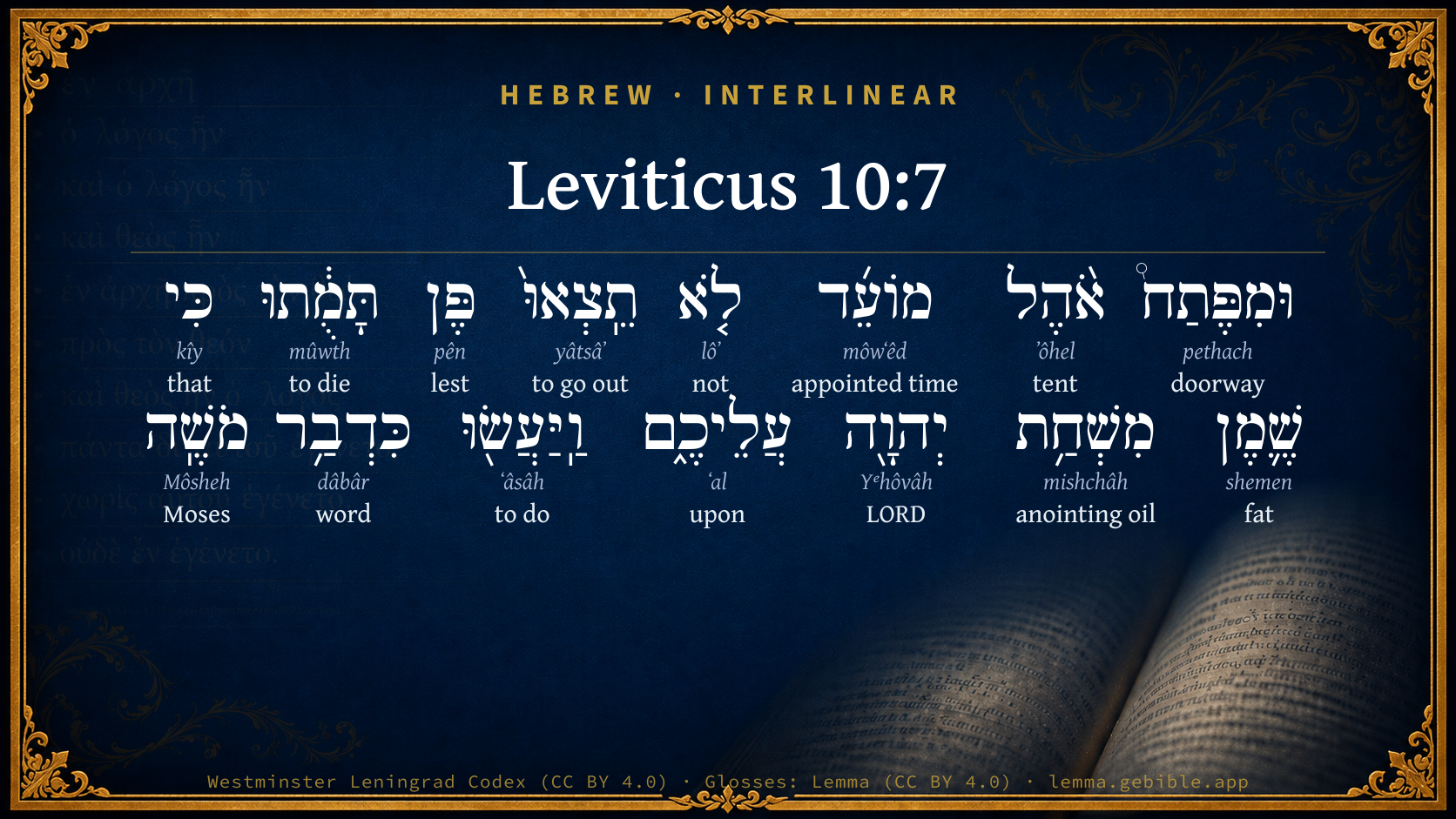
Hebrew (Westminster Leningrad Codex) Leviticus 10:7 appears in the Hebrew Old Testament. The text above is from the Westminster Leningrad Codex. Each word links to its Strong’s number, a concise gloss, and parsing drawn from the Open Scriptures Hebrew Bible morphology. Click any word for its full Brown-Driver-Briggs (BDB) entry.
Download image
Cite this verse

Leviticus 10:7 (World English Bible). Public Domain. Lemma interlinear Bible study tool, https://lemma.gebible.app/v/leviticus/10/7.

Show BibTeX & RIS
BibTeX
RIS
English Translation
You shall not go out from the door of the Tent of Meeting, lest you die; for the anointing oil of Yahweh is on you." They did according to the word of Moses.
World English Bible · Public Domain
Download a study sheet

One document with this verse’s original text, its word-by-word gloss line, the meaning frame, cross-references with their text, attributed commentary, and full source and license credits — printable, and it pastes into notes with its structure intact.

This verse Autodidact and up

Study sheet (.html) Plain text (.txt)

A passage Seminary Student

Up to 50 verses in one chapter. A passage sheet keeps up to 6 commentary sources and 12 cross-references per verse, in the order this page ranks them, and says so on the sheet whenever that leaves anything out. Ask for a single verse and you get the Autodidact verse sheet above.

Everything on this page stays free to read, with no account — the sheet is a download of what is already on screen, not access to it.

Want to remove ads? Support Godless Engineer
Compare translations 3

The same verse in 3 English versions, stacked beneath the original-language interlinear above. Click any original word for its lexicon entry.

Each is an independent rendering of the whole verse — the interlinear is not word-aligned to these translations.

Highlighted words mark where these versions differ — a whole-verse word diff, not a word-by-word alignment.

  • World English Bible Public Domain
    You shall not go out from the door of the Tent of Meeting, lest you die; for the anointing oil of Yahweh is on you." They did according to the word of Moses.
  • King James Version Public Domain
    And ye shall not go out from the door of the tabernacle of the congregation, lest ye die: for the anointing oil of the LORD is upon you. And they did according to the word of Moses.
  • unfoldingWord Literal Text CC BY-SA 4.0
    And from the entrance of the tent of meeting, you shall not go out, lest you die, for the oil of the anointing of Yahweh on you.” And they did according to the word of Moses.

unfoldingWord Literal Text — © unfoldingWord, licensed CC BY-SA 4.0. Word-aligned USFM3 via Door43 (git.door43.org/unfoldingWord/en_ult).

Versions to compare (up to 4)

3 of 4 selected

Show all 18 translations

Every available English version of this verse, each an independent rendering of the whole verse.

  • World English Bible Public Domain
    You shall not go out from the door of the Tent of Meeting, lest you die; for the anointing oil of Yahweh is on you." They did according to the word of Moses.
  • Berean Standard Bible Public Domain
    You shall not go outside the entrance to the Tent of Meeting, or you will die, for the LORD’s anointing oil is on you.” So they did as Moses instructed.
  • Majority Standard Bible Public Domain
    You shall not go outside the entrance to the Tent of Meeting, or you will die, for the LORD’s anointing oil is on you.” So they did as Moses instructed.
  • King James Version Public Domain
    And ye shall not go out from the door of the tabernacle of the congregation, lest ye die: for the anointing oil of the LORD is upon you. And they did according to the word of Moses.
  • American Standard Version (1901) Public Domain
    And ye shall not go out from the door of the tent of meeting, lest ye die; for the anointing oil of Jehovah is upon you. And they did according to the word of Moses.
  • Revised Version (1885) Public Domain
    And ye shall not go out from the door of the tent of meeting, lest ye die: for the anointing oil of the LORD is upon you. And they did according to the word of Moses.
  • Geneva Bible (1599) Public Domain
    And go not yee out from the doore of the Tabernacle of the Congregation, least ye dye: for the anointing oyle of the Lord is vpon you: and they did according to Moses commandement.
  • Douay-Rheims (1899) Public Domain
    But you shall not go out of the door of the tabernacle, otherwise you shall perish, for the oil of the holy unction is on you. And they did all things according to the precept of Moses.
  • Young's Literal Translation Public Domain
    and from the opening of the tent of meeting ye do not go out, lest ye die, for the anointing oil of Jehovah `is' upon you;' and they do according to the word of Moses.
  • Literal Standard Version CC BY-SA 4.0
    and you do not go out from the opening of the Tent of Meeting, lest you die, for the anointing oil of YHWH [is] on you”; and they do according to the word of Moses.
  • Unlocked Literal Bible CC BY-SA 4.0
    You must not go out from the entrance of the tent of meeting, or you will die, for the anointing oil of Yahweh is on you.” So they acted according to Moses' instructions.
  • unfoldingWord Literal Text CC BY-SA 4.0
    And from the entrance of the tent of meeting, you shall not go out, lest you die, for the oil of the anointing of Yahweh on you.” And they did according to the word of Moses.
  • Darby Bible Public Domain
    And ye shall not go out from the entrance of the tent of meeting, lest ye die; for the anointing oil of Jehovah is upon you. And they did according to the word of Moses.
  • World Messianic Bible Public Domain
    You shall not go out from the door of the Tent of Meeting, lest you die; for the anointing oil of the LORD is on you.” They did according to the word of Moses.
  • Webster's Bible Public Domain
    And ye shall not go out from the door of the tabernacle of the congregation, lest ye die: for the anointing oil of the LORD is upon you. And they did according to the word of Moses.
  • Free Bible Version CC BY-SA 4.0
    Don't go outside the entrance to the Tent of Meeting, or you will die, because you have been anointed by the Lord.” They did what Moses said.
  • Bible in Basic English Public Domain
    And do not go out from the door of the Tent of meeting, or death will come to you; for the holy oil of the Lord is on you. And they did as Moses said.
  • JPS Tanakh (1917) Public Domain
    And ye shall not go out from the door of the tent of meeting, lest ye die; for the anointing oil of the LORD is upon you.' And they did according to the word of Moses.

Literal Standard Version (2020), Covenant Press — licensed CC BY-SA 4.0. Text via the HelloAO Bible API (eBible.org). Unlocked Literal Bible (unfoldingWord) — licensed CC BY-SA 4.0. Text via the HelloAO Bible API (eBible.org). unfoldingWord Literal Text — © unfoldingWord, licensed CC BY-SA 4.0. Word-aligned USFM3 via Door43 (git.door43.org/unfoldingWord/en_ult). Free Bible Version, Dr. Jonathan Gallagher — licensed CC BY-SA 4.0. Text via the HelloAO Bible API (eBible.org).

Word by word

More ways to search: Search by grammar → Find every occurrence → Compare this word →

Practice this passage: Drill this verse → Learn its vocabulary →

מִשְׁחַ֥ת
mishchâh
H4888
“anointing oil of”
Noun, Common, Feminine, Singular, Construct
Part of Speech
Noun
Type
Common
Gender
Feminine
Number
Singular
State
Construct
Full BDB Definition

Origin: from H4886

TWOT: 1255a , 1255b

consecrated portion, anointing oil, portion, ointment, anointing portion - ointment (used to consecrate by anointing) - anointing portion
  1. וּמִפֶּתַח֩ pethach H6607 “and · from · doorway of” Conjunction + Preposition + Noun, Common, Masculine, Singular, Construct
  2. אֹ֨הֶל ʼôhel H168 “tent of” Noun, Common, Masculine, Singular, Construct
  3. מוֹעֵ֜ד môwʻêd H4150 “appointed time” Noun, Common, Masculine, Singular, Absolute
  4. לֹ֤א lôʼ H3808 “not” Particle, Negative
  5. תֵֽצְאוּ֙ yâtsâʼ H3318 “to go out” Verb, Qal, Imperfect, 2nd Person, Masculine, Plural
  6. פֶּן pên H6435 “lest” Conjunction
  7. תָּמֻ֔תוּ mûwth H4191 “to die” Verb, Qal, Imperfect, 2nd Person, Masculine, Plural
  8. כִּי kîy H3588 “that” Conjunction
  9. שֶׁ֛מֶן shemen H8081 “fat of” Noun, Common, Masculine, Singular, Construct
  10. יְהוָ֖ה Yᵉhôvâh H3068 “LORD” Noun, Proper
  11. עֲלֵיכֶ֑ם ʻal H5921 “upon · you” Preposition + Suffix, Personal, 2nd Person, Masculine, Plural
  12. וַֽיַּעֲשׂ֖וּ ʻâsâh H6213 “and · to do” Conjunction + Verb, Qal, Sequential Imperfect, 3rd Person, Masculine, Plural
  13. כִּדְבַ֥ר dâbâr H1697 “like/as · word of” Preposition + Noun, Common, Masculine, Singular, Construct
  14. מֹשֶֽׁה Môsheh H4872 “Moses” Noun, Proper

About this verse

These counts appear in no published source. They are computed here, from the morphology-tagged text and Lemma’s own curated glosses. What Lemma adds →

15
words
15
distinct lemmas
Pentateuch
section

Shared distinctive vocabulary

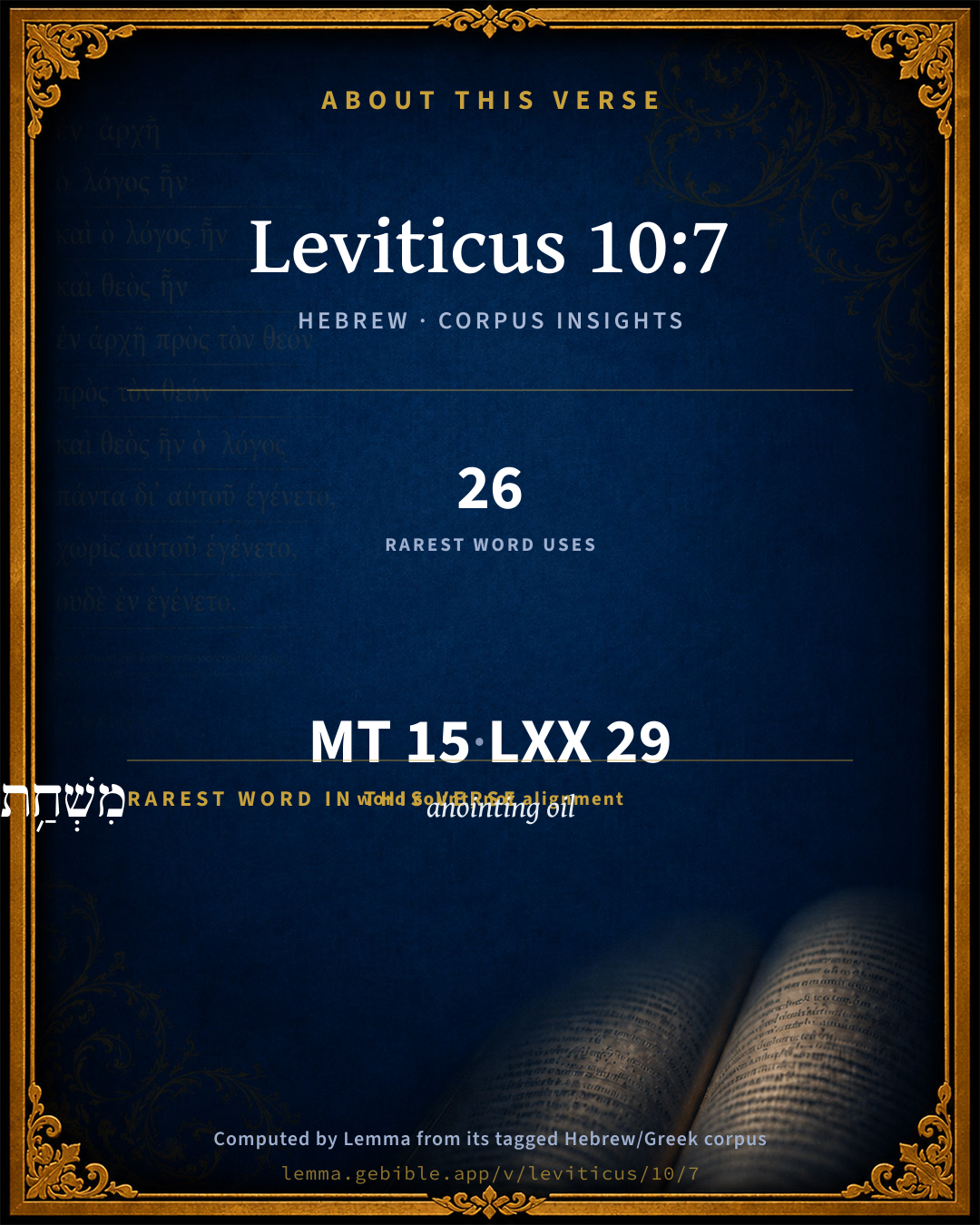
מִשְׁחַ֥ת anointing oil H4888 occurs in 24 verses of the Hebrew Bible. Also found in:

Grammatical profile

  • 3 verbs
  • 8 nouns
  • 1 preposition
  • 2 conjunctions
  • 1 particle

Verb forms

  • תֵֽצְאוּ֙ Qal · Imperfect
  • תָּמֻ֔תוּ Qal · Imperfect
  • וַֽיַּעֲשׂ֖וּ Qal · Sequential Imperfect

Hebrew & Septuagint length

In English translation the verse runs 33 words from the Hebrew and 35 from the Septuagint (LXX English) — closely comparable.

A rough comparison of the two English renderings, which tokenize alike — not a word-level alignment.

Word counts can differ between the Hebrew and the Greek without any difference in meaning — e.g. the Hebrew direct-object marker אֵת has no separate Greek word, and Greek often adds the article ὁ.

In the original languages it is 15 Hebrew tokens and 29 Greek tokens — but the two are counted differently (Hebrew bundles its prefixes and suffixes into one token; the Greek is in lemma form), so that isn’t a like-for-like length.

Cross-references

10

Topical passages linked to Leviticus 10:7 in the Treasury of Scripture Knowledge — connected by theme and wording, ordered by reader-vote popularity; previews shown in the World English Bible.

  • Leviticus 21:12 neither shall he go out of the sanctuary, nor profane the sanctuary of his God; for the crown of the anointing oil of his God is upon him. I am Yahweh.
  • Acts 10:38 even Jesus of Nazareth, how God anointed him with the Holy Spirit and with power, who went about doing good and healing all who were oppressed by the devil, for God was with him.
  • 2 Corinthians 1:21 Now he who establishes us with you in Christ, and anointed us, is God;
  • Leviticus 8:30 Moses took some of the anointing oil, and some of the blood which was on the altar, and sprinkled it on Aaron, on his garments, and on his sons, and on his sons' garments with him, and sanctified Aaron, his garments, and his sons, and his sons' garments with him.
  • Exodus 28:41 You shall put them on Aaron your brother, and on his sons with him, and shall anoint them, and consecrate them, and sanctify them, that they may minister to me in the priest's office.
  • Leviticus 8:12 He poured some of the anointing oil on Aaron's head, and anointed him, to sanctify him.
  • Exodus 30:30 You shall anoint Aaron and his sons, and sanctify them, that they may minister to me in the priest's office.
  • Exodus 40:13–15 You shall put on Aaron the holy garments; and you shall anoint him, and sanctify him, that he may minister to me in the priest's office.
  • Luke 9:60 But Jesus said to him, "Leave the dead to bury their own dead, but you go and announce the Kingdom of God."
  • Matthew 8:21–22 Another of his disciples said to him, "Lord, allow me first to go and bury my father."

Cross-references courtesy of OpenBible.info (CC BY 4.0).

Hebrew and Greek witnesses Masoretic Hebrew ↔ Greek Septuagint

The same verse in the two great witnesses to the Old Testament, shown verse-for-verse.

These are two independent witnesses, not word-aligned to each other, and the Septuagint is shown in lemma (dictionary) form.

Hebrew Leviticus 10:7 Masoretic · Westminster Leningrad Codex

וּמִפֶּתַח֩ אֹ֨הֶל מוֹעֵ֜ד לֹ֤א תֵֽצְאוּ֙ פֶּן תָּמֻ֔תוּ כִּי שֶׁ֛מֶן מִשְׁחַ֥ת יְהוָ֖ה עֲלֵיכֶ֑ם וַֽיַּעֲשׂ֖וּ כִּדְבַ֥ר מֹשֶֽׁה

You shall not go out from the door of the Tent of Meeting, lest you die; for the anointing oil of Yahweh is on you." They did according to the word of Moses.

World English Bible · Public Domain

Greek LXX Leviticus 10:7 Septuagint · lemma form

καί ἀπό ὁ θύρα ὁ σκηνή ὁ μαρτύριον οὐ ἐκἔρχομαι ἵνα μή ἀποθνήσκω ὁ γάρ ἔλαιον ὁ χρῖσις ὁ παρά κύριος ἐπί σύ καί ποιέω κατά ὁ ῥῆμα μωυσῆς

And you⌃ shall not go forth from the door of the tabernacle of witness, that you⌃ die not; for the Lord's anointing oil is upon you: and they did according to the word of Moses.

LXX2012 (modern English Septuagint) · Public Domain

Hebrew: Westminster Leningrad Codex (CC BY 4.0). Greek: Septuagint (public domain); English from LXX2012 (modern English Septuagint) (Public Domain). How the Septuagint differs from the Hebrew →

Targum (Aramaic paraphrase)

2

The Targum is the ancient Jewish Aramaic paraphrase of the Hebrew Scriptures — an interpretive translation, not the Hebrew text itself. Onkelos (literal) and Pseudo-Jonathan (expansive) render the Torah, and Jonathan the Prophets. Coverage is partial: where no permissively-licensed English translation exists for a verse, only the Aramaic is shown. This is verse-level text, not a word-by-word alignment to the Hebrew.

  1. Targum Onkelos Torah (Genesis–Deuteronomy)
    וּמִתְּרַע מַשְׁכַּן זִמְנָא לָא תִפְקוּן דִלְמָא תְמוּתוּן אֲרֵי מְשַׁח רְבוּתָא דַיְיָ עֲלֵיכוֹן וַעֲבָדוּ כְּפִתְגָמָא דְמֹשֶׁה

    (no public-domain English translation for this verse)

    Targum Onkelos — Aramaic: “Onkelos Genesis” (public domain); “Onkelos Exodus” (public domain); “Onkelos Leviticus” (public domain); “Onkelos Numbers” (public domain); “Onkelos Deuteronomy” (public domain). English: “Sefaria Community Translation” (CC0 1.0 (public-domain dedication)); “J.W. Etheridge. The Targums of Onkelos and Jonathan Ben Uzziel on the Pentateuch. London: Longmans, Green, 1862” (public domain). Text via Sefaria.

  2. Targum Pseudo-Jonathan Torah (Genesis–Deuteronomy)
    וּמִתְּרַע מַשְׁכַּן זִמְנָא לָא תִפְקוּן דִלְמָא תְמוּתוּן אֲרוּם מְשַׁח רְבוּתָא דַיְיָ עֲלֵיכוֹן וַעֲבָדוּ הֵי כְפִתְגָמָא דְמשֶׁה

    And from the door of the tabernacle of ordinance go not forth lest you die; for the oil of the Lord's consecration is upon you. And they did according to the word of Mosheh.

    Targum Pseudo-Jonathan — Aramaic: “Targum Jonathan on Genesis” (public domain); “Targum Jonathan on Exodus” (public domain); “Targum Jonathan on Leviticus” (public domain); “Targum Jonathan on Numbers” (public domain); “Targum Jonathan on Deuteronomy” (public domain). English: “The Targum of Jonathan ben Uzziel, trans. J. W. Etheridge, London, 1862” (public domain). Text via Sefaria.

Commentary

Notes on Leviticus 10:7 from classic Christian and Jewish commentators (each source and its license shown beneath its notes). The classic Christian expositions comment on the surrounding passage and are grouped to its opening verse, so a note may address several verses; the Jewish commentaries on the Tanakh (Rashi and others) are per-verse, so they appear only where the commentator wrote on this verse.

Lemma curates 59 commentaries, every one of them public domain or Creative Commons licensed, each selected and text-cleaned for this edition rather than reprinted as found. About our sources →

Trapp's Complete Commentary

John Trapp

Lev 10:7 And ye shall not go out from the door of the tabernacle of the congregation, lest ye die: for the anointing oil of the LORD [is] upon you. And they did according to the word of Moses.

Ver. 7. For the anointing oil of the Lord is upon you.] This is every true Christian’s case, who should therefore carry himself accordingly. There is a το πρεπον, a seemly carriage, belongs to every calling. "You have an unction," &c. {1Jn 2:20}

John Trapp, A Commentary or Exposition upon All the Books of the Old and New Testament (1647–1656) — public domain. Text from a community e-Sword module.

Joseph Benson's Commentary

Lev 10:7. Ye shall not go from the tabernacle — Where at this time they were, because this happened within seven days of their consecration: for the oil of the Lord is upon you — You are devoted and consecrated to the service of God and of his people, which, therefore, it is proper you should prefer before all funeral solemnities, and which must not be omitted out of respect to any person whatsoever. The ministers of religion ought to consider that this law is still binding upon them, as to the spirit and intention of it. They, of all men, ought to be so heavenly-minded, and of such elevated affections, as to maintain an unbroken manly fortitude, amid all the calamities and afflictions, both private and public, which are incident to humanity in its present state. Though religion does not require that they should divest themselves of their passions, yet they ought to be examples to others how to moderate those passions, and keep them within due bounds; especially they must not be so swallowed up in the sorrows of the world as to be incapacitated thereby for discharging their duty to God.

Joseph Benson's Commentary on the Old and New Testaments (1811–1818) — public domain. Text from a community e-Sword module.

Tyndale Open Study Notes

Tyndale Open Resources

10:7 must not leave: Eleazar and Ithamar were not to attend the funeral. • the Lord’s anointing oil: Because they had recently been anointed as priests (see 7:36), they were to avoid any association with the dead.

Tyndale Open Study Notes — © Tyndale Open Resources, licensed CC BY-SA 4.0. Text via the HelloAO Bible API.

Adam Clarke's Commentary

Verse 7. The anointing oil of the Lord is upon you.] They were consecrated to the Divine service, and this required their constant attendance, and most willing and cheerful service.

Adam Clarke's Commentary on the Bible (1810–1826) — public domain. Text from a community e-Sword/MySword module.

Ellicott's Commentary for English Readers

(7) From the door of the tabernacle of the congregation.—Better, away from the entrance of the tent of meeting. (See Lev_1:3.) But Aaron and his sons are not to quit the court of the sanctuary to take part in the burial.

For the anointing of the Lord is upon you.—The reason why they are not to join in the funeral rites is that they had been devoted by this holy unction to the service of God. Earthly relations were, therefore, not to interfere with the duties to God. Hence, it was sin for priests to mourn when they ministered before the Lord. (See Lev_21:10-12.) This law was strictly observed during the second Temple. When an officiating priest heard of the death of a relative, he did not quit the sanctuary, lest it should appear that he had greater love for the dead person than for the living God.

A Bible Commentary for English Readers, edited by Charles John Ellicott (1878–1897) — public domain. Text from a community e-Sword module.

The Cambridge Bible for Schools and Colleges

gen. ed. J. J. S. Perowne

7. for the anointing oil of the Lord is upon you] The commands of this verse do not necessarily imply that the seven days of consecration (Lev_8:33) are not yet ended, for a similar statement is applied in Lev_21:12 to the high priest at all times.

(4) Wine and strong drink forbidden (8, 9)

Aaron is the direct recipient of God’s commands here and in Num_18:1; Num_18:8; Num_18:20 only. Elsewhere they are given ‘unto Moses and unto Aaron’ or ‘unto Moses, saying, Speak unto Aaron.’

According to an old tradition, Nadab and Abihu offered strange fire when under the influence of wine. The close connexion of this prohibition with the record of their transgression is probably the basis of this tradition. In many ancient cults wine was forbidden to priests and other officials. Cp. Eze_44:21.

The Cambridge Bible for Schools and Colleges (gen. ed. J. J. S. Perowne; Cambridge University Press, 1878–1918) — public domain. Text from a community e-Sword module.

John Gill's Exposition

And ye shall not go out from the door of the tabernacle of the congregation, lest ye die,.... That is, they were not to relinquish the service of the sanctuary, on the account of the death of these relations of theirs, and through grief for it, but go on in it; not Aaron on account of his children, nor his sons on account of their brethren: from hence, says Ben Gersom, we learn, that whatsoever priest leaves his service, and goes out of the sanctuary, is guilty of death: some think the seven days of consecration were not quite over, during which time Aaron and his sons were obliged to continue there, on pain of death, Lev 8:33 but it is pretty plain those days were over, and that it was the day after the consecration was finished; see Lev 9:1 and See Gill on Lev 10:2 wherefore this respects their continuance in the tabernacle on the day the above affair happened, and they were obliged to continue in and go through the service of the day, notwithstanding that:

for the anointing oil of the Lord is upon you; a learned man (o) infers from hence, that this affair happened within the days of consecration, they being every day afresh anointed with oil, at least had it, with the blood of the sacrifices, sprinkled on them, on their garments, taking it in the strict sense, for the oil being still upon them; whereas it seems only to signify, that inasmuch as they were consecrated with oil to the priest's office, they were under obligation to continue and perform their service without being let or hindered by what had happened:

and they did according to the word of Moses; they showed no tokens of mourning on account of the dead, and did not offer to go out of the tabernacle and leave their service.

(o) Clayton's Chronology of the Hebrew Bible, p. 353.

John Gill's Exposition of the Whole Bible (1746–1763) — public domain (CC PDM 1.0). Text via the HelloAO Bible API.

Haydock's Catholic Bible Commentary

On you. So that you cannot now join in the funeral, as there are so few anointed. (Haydock) --- On other occasions, priests are allowed to mourn, chap. xxi.

George Leo Haydock (1774–1849), Haydock's Catholic Family Bible and Commentary, 1859 edition — public domain. Excludes Psalms (Douay-Rheims chapter numbering differs from Protestant) and Deuterocanonical books (Catholic canon only).

Matthew Poole's English Annotations

Ye shall not go out from the door of the tabernacle, where at this time they were, either because this happened within seven days of their consecration; see Lev 8:35; or because they were longer detained there about some other holy ministrations. Though the former may seem more probable, because the meat-offering here mentioned, Lev 10:12, and the sin-offering, Lev 10:16, were part of the consecration-offerings. The anointing oil of the Lord is upon you. You are persons consecrated peculiarly to God’s service, which therefore it is just and reasonable you should prefer before all funeral solemnities.

Matthew Poole's English Annotations on the Holy Bible (1683–1685) — public domain. Text from a community e-Sword/MySword module.

Whedon's Commentary on the Bible

Daniel D. Whedon

7. Ye shall not go out — Primarily this relates to going forth to funerals. See Lev_21:10-12, notes. This prohibition must not be considered as absolute. They were not to come in contact with secular affairs by abandoning the service of the tabernacle. Lest ye die — By some supernatural interposition. Many a Christian minister has suffered spiritual death by voluntarily going forth from the tabernacle to enter upon secular matters with the anointing oil of the Lord upon him. See Lev_8:10; Lev_8:30, notes.

Daniel D. Whedon (gen. ed.), Commentary on the Old and New Testaments (1874–1909) — public domain. Text from a community e-Sword module.

The Pulpit Commentary

The priests are not to be taken away from their duties at the door of the tabernacle, that is, the court in front of the tabernacle, even for the sake of burying their dead. They had now been in the court for eight days continuously, and they had to remain there until, in the fulfillment of their public function, they had eaten the sacrificial meal. Cf. Mat_8:21, Mat_8:22, "Lord, suffer me first to go and bury my father. But Jesus said unto him, Follow me." God"s service comes before all things.

The Pulpit Commentary (1880–1919), ed. H.D.M. Spence-Jones & Joseph S. Exell — public domain. Text from a community e-Sword module.

John Wesley's Explanatory Notes

Ye shall not go from the tabernacle - Where at this time they were, because this happened within seven days of their consecration. The oil of the Lord is upon you - You are persons consecrated peculiarly to God's service, which therefore it is just you should prefer before all funeral solemnities.

John Wesley, Explanatory Notes Upon the Whole Bible (1754–1765) — public domain. Text via the GEBible commentary corpus.

Keil & Delitzsch

C. F. Keil & F. Delitzsch

The latter were not to go away from the door (the entrance or court of the tabernacle), sc., to take part in the burial of the dead, lest they should die, for the anointing oil of Jehovah was upon them. The anointing oil was the symbol of the Spirit of God, which is a Spirit of life, and therefore has nothing in common with death, but rather conquers death, and sin, which is the source of death (cf. Lev 21:12).

Keil & Delitzsch — Biblical Commentary on the Old Testament (1861–1891) — public domain (CC PDM 1.0). Text via the HelloAO Bible API. (Old Testament only.)

Lesson kit

Teaching starters — assembled from the data on this page, not authored interpretation. Every prompt links to the verse data it draws on. Edit before teaching.

Leviticus, in the Pentateuch, opens this verse with 15 words (15 distinct Hebrew lemmas). Its most distinctive word is mishchâh (“anointing oil”). A historical commentator’s framing appears above. Read the whole chapter for the surrounding context.

Discussion questions

  1. How does “anointing oil” (mishchâh) shape what this verse is saying?
  2. Exodus 25:6 shares the word «anointing oil» with this verse. How do the two illuminate each other?
  3. The translations on this page render this verse differently — a whole-verse word diff, not a word-by-word alignment. What might account for the different wordings?
  4. The verb «תֵֽצְאוּ֙» is Qal Imperfect. How does its form color the action?
  5. Reading how Trapp's Complete Commentary and Joseph Benson's Commentary read this verse, where do the two commentators agree and where do they part?

Things to notice

Reading settings

Reading text

Shown beneath each verse's original-language words.

Old Testament
Old Testament edition

Read the OT as the Masoretic Hebrew (MT) or the Greek Septuagint (LXX).

English shown for the Greek Septuagint (in the Hebrew ↔ Greek comparison).

Comparing translations? Open the Compare panel on any verse page to stack up to four side by side.