
Numbers 18:3

Hebrew (Westminster Leningrad Codex) Numbers 18:3 appears in the Hebrew Old Testament. The text above is from the Westminster Leningrad Codex. Each word links to its Strong’s number, a concise gloss, and parsing drawn from the Open Scriptures Hebrew Bible morphology. Click any word for its full Brown-Driver-Briggs (BDB) entry.
Download image
Cite this verse

Numbers 18:3 (World English Bible). Public Domain. Lemma interlinear Bible study tool, https://lemma.gebible.app/v/numbers/18/3.

Show BibTeX & RIS
BibTeX
RIS
English Translation
They shall keep your charge, and the charge of all the Tent: only they shall not come near to the vessels of the sanctuary and to the altar, that they not die, neither they, nor you.
World English Bible · Public Domain
Download a study sheet

One document with this verse’s original text, its word-by-word gloss line, the meaning frame, cross-references with their text, attributed commentary, and full source and license credits — printable, and it pastes into notes with its structure intact.

This verse Autodidact and up

Study sheet (.html) Plain text (.txt)

A passage Seminary Student

Up to 50 verses in one chapter. A passage sheet keeps up to 6 commentary sources and 12 cross-references per verse, in the order this page ranks them, and says so on the sheet whenever that leaves anything out. Ask for a single verse and you get the Autodidact verse sheet above.

Everything on this page stays free to read, with no account — the sheet is a download of what is already on screen, not access to it.

Want to remove ads? Support Godless Engineer
Compare translations 3

The same verse in 3 English versions, stacked beneath the original-language interlinear above. Click any original word for its lexicon entry.

Each is an independent rendering of the whole verse — the interlinear is not word-aligned to these translations.

Highlighted words mark where these versions differ — a whole-verse word diff, not a word-by-word alignment.

  • World English Bible Public Domain
    They shall keep your charge, and the charge of all the Tent: only they shall not come near to the vessels of the sanctuary and to the altar, that they not die, neither they, nor you.
  • King James Version Public Domain
    And they shall keep thy charge, and the charge of all the tabernacle: only they shall not come nigh the vessels of the sanctuary and the altar, that neither they, nor ye also, die.
  • unfoldingWord Literal Text CC BY-SA 4.0
    And they shall keep your keeping and the keeping of all the tent. Only to the vessels of the holy place and to the altar they shall not come near, so they will not die, both they and you.

unfoldingWord Literal Text — © unfoldingWord, licensed CC BY-SA 4.0. Word-aligned USFM3 via Door43 (git.door43.org/unfoldingWord/en_ult).

Versions to compare (up to 4)

3 of 4 selected

Show all 18 translations

Every available English version of this verse, each an independent rendering of the whole verse.

  • World English Bible Public Domain
    They shall keep your charge, and the charge of all the Tent: only they shall not come near to the vessels of the sanctuary and to the altar, that they not die, neither they, nor you.
  • Berean Standard Bible Public Domain
    And they shall attend to your duties and to all the duties of the Tent; but they must not come near to the furnishings of the sanctuary or the altar, or both they and you will die.
  • Majority Standard Bible Public Domain
    And they shall attend to your duties and to all the duties of the Tent; but they must not come near to the furnishings of the sanctuary or the altar, or both they and you will die.
  • King James Version Public Domain
    And they shall keep thy charge, and the charge of all the tabernacle: only they shall not come nigh the vessels of the sanctuary and the altar, that neither they, nor ye also, die.
  • American Standard Version (1901) Public Domain
    And they shall keep thy charge, and the charge of all the Tent: only they shall not come nigh unto the vessels of the sanctuary and unto the altar, that they die not, neither they, nor ye.
  • Revised Version (1885) Public Domain
    And they shall keep thy charge, and the charge of all the Tent: only they shall not come nigh unto the vessels of the sanctuary and unto the altar, that they die not, neither they, nor ye.
  • Geneva Bible (1599) Public Domain
    And they shall keepe thy charge, euen the charge of all the Tabernacle: but they shall not come neere the instruments of the Sanctuary, nor to the altar, lest they die, both they and you:
  • Douay-Rheims (1899) Public Domain
    And the Levites shall watch to do thy commands, and about all the works of the tabernacle: only they shall not come nigh the vessels of the sanctuary nor the altar, lest both they die, and you also perish with them.
  • Young's Literal Translation Public Domain
    `And they have kept thy charge, and the charge of all the tent; only, unto the vessels of the sanctuary and unto the altar they do not come near, and they die not, either they or you;
  • Literal Standard Version CC BY-SA 4.0
    And they have kept your charge, and the charge of all the tent; only, they do not come near to the vessels of the holy place and to the altar, and they do not die, either they or you;
  • Unlocked Literal Bible CC BY-SA 4.0
    They must serve you and the whole tent. However, they must not come near to anything in the holy place or connected with the altar, or they and also you will die.
  • unfoldingWord Literal Text CC BY-SA 4.0
    And they shall keep your keeping and the keeping of all the tent. Only to the vessels of the holy place and to the altar they shall not come near, so they will not die, both they and you.
  • Darby Bible Public Domain
    And they shall keep thy charge, and the charge of the whole tent: only they shall not come near to the vessels of the sanctuary and to the altar, that they may not die, and you as well as they.
  • World Messianic Bible Public Domain
    They shall keep your commands and the duty of the whole Tent; only they shall not come near to the vessels of the sanctuary and to the altar, that they not die, neither they nor you.
  • Webster's Bible Public Domain
    And they shall keep thy charge, and the charge of all the tabernacle: only they shall not come nigh the vessels of the sanctuary and the altar, that neither they, nor ye also, die.
  • Free Bible Version CC BY-SA 4.0
    They will take care of your responsibilities and those relating to the Tent, but they must not come too close to the sacred objects of the sanctuary or the altar, otherwise they will die, and you will too.
  • Bible in Basic English Public Domain
    They are to do your orders and be responsible for the work of the Tent; but they may not come near the vessels of the holy place or the altar, so that death may not overtake them or you.
  • JPS Tanakh (1917) Public Domain
    And they shall keep thy charge, and the charge of all the Tent; only they shall not come nigh unto the holy furniture and unto the altar, that they die not, neither they, nor ye.

Literal Standard Version (2020), Covenant Press — licensed CC BY-SA 4.0. Text via the HelloAO Bible API (eBible.org). Unlocked Literal Bible (unfoldingWord) — licensed CC BY-SA 4.0. Text via the HelloAO Bible API (eBible.org). unfoldingWord Literal Text — © unfoldingWord, licensed CC BY-SA 4.0. Word-aligned USFM3 via Door43 (git.door43.org/unfoldingWord/en_ult). Free Bible Version, Dr. Jonathan Gallagher — licensed CC BY-SA 4.0. Text via the HelloAO Bible API (eBible.org).

Word by word

More ways to search: Search by grammar → Find every occurrence → Compare this word →

Practice this passage: Drill this verse → Learn its vocabulary →

מִֽשְׁמַרְתְּךָ֔
mishmereth
H4931
“guard · your”
Noun, Common, Feminine, Singular, Construct + Suffix, Personal, 2nd Person, Masculine, Singular
Part of Speech
Noun
Type
Common
Gender
Feminine
Number
Singular
State
Construct
Full BDB Definition

Origin: from H4929

TWOT: 2414g

guard, charge, function, obligation, service, watch - guard, watch, house of detention or confinement - keeping, preserving - charge, injunction - office, function (ceremonial)
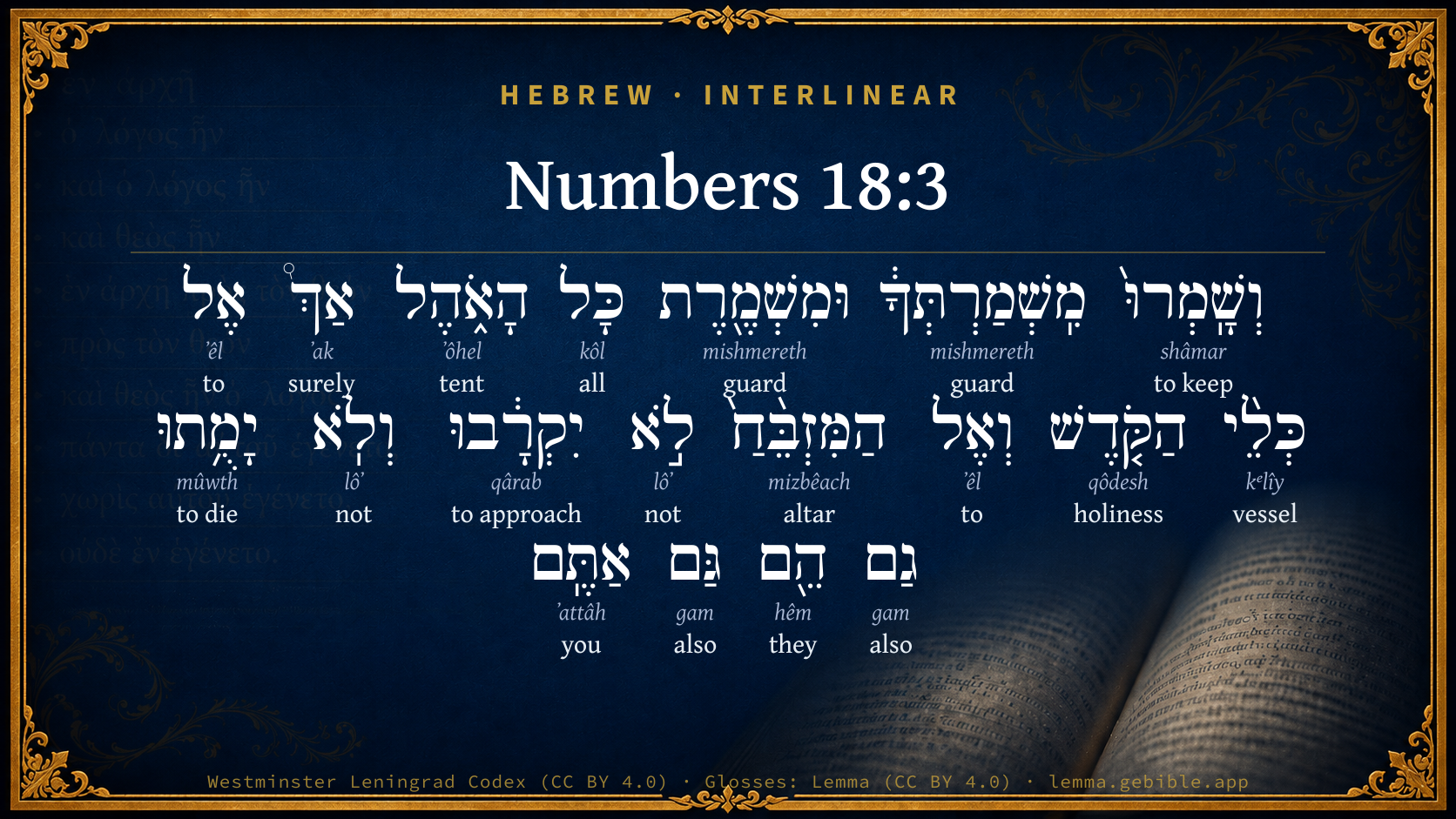
  1. וְשָֽׁמְרוּ֙ shâmar H8104 “and · to keep” Conjunction + Verb, Qal, Sequential Perfect, 3rd Person, Common, Plural
  2. וּמִשְׁמֶ֖רֶת mishmereth H4931 “and · guard of” Conjunction + Noun, Common, Feminine, Singular, Construct
  3. כָּל kôl H3605 “all of” Noun, Common, Masculine, Singular, Construct
  4. הָאֹ֑הֶל ʼôhel H168 “the · tent” Particle, Definite Article + Noun, Common, Masculine, Singular, Absolute
  5. אַךְ֩ ʼak H389 “surely” Particle, Accusative
  6. אֶל ʼêl H413 “to” Preposition
  7. כְּלֵ֨י kᵉlîy H3627 “vessels of” Noun, Common, Masculine, Plural, Construct
  8. הַקֹּ֤דֶשׁ qôdesh H6944 “the · holiness” Particle, Definite Article + Noun, Common, Masculine, Singular, Absolute
  9. וְאֶל ʼêl H413 “and · to” Conjunction + Preposition
  10. הַמִּזְבֵּ֨חַ֙ mizbêach H4196 “the · altar” Particle, Definite Article + Noun, Common, Masculine, Singular, Absolute
  11. לֹ֣א lôʼ H3808 “not” Particle, Negative
  12. יִקְרָ֔בוּ qârab H7126 “to approach” Verb, Qal, Imperfect, 3rd Person, Masculine, Plural
  13. וְלֹֽא lôʼ H3808 “and · not” Conjunction + Particle, Negative
  14. יָמֻ֥תוּ mûwth H4191 “to die” Verb, Qal, Imperfect, 3rd Person, Masculine, Plural
  15. גַם gam H1571 “also” Adverb
  16. הֵ֖ם hêm H1992 “they” Pronoun, Personal, 3rd Person, Masculine, Plural
  17. גַּם gam H1571 “also” Particle, Accusative
  18. אַתֶּֽם ʼattâh H859 “you” Pronoun, Personal, 2nd Person, Masculine, Plural

About this verse

These counts appear in no published source. They are computed here, from the morphology-tagged text and Lemma’s own curated glosses. What Lemma adds →

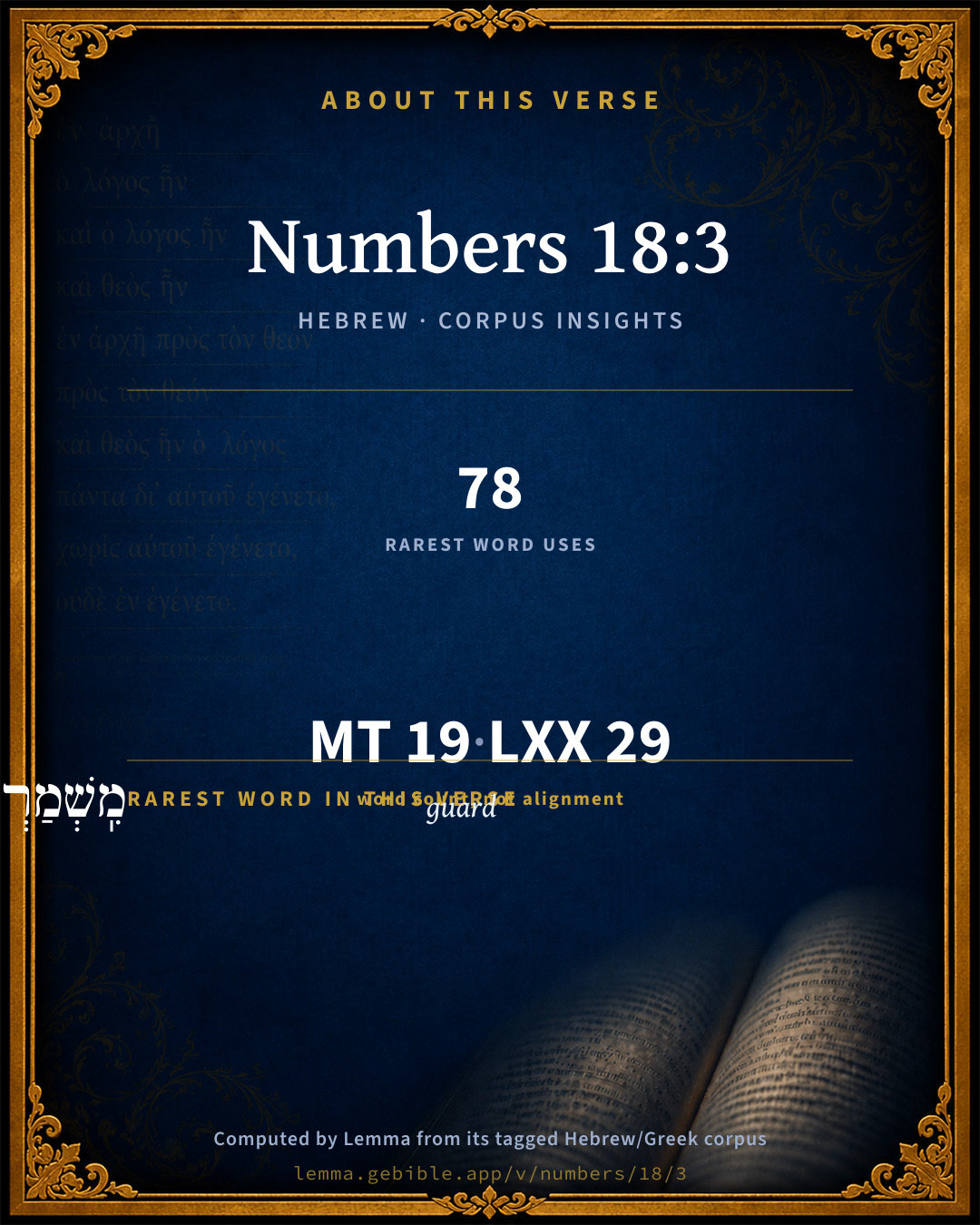
19
words
15
distinct lemmas
Pentateuch
section

Grammatical profile

  • 3 verbs
  • 7 nouns
  • 2 pronouns
  • 2 prepositions
  • 1 adverb
  • 4 particles

Verb forms

  • וְשָֽׁמְרוּ֙ Qal · Sequential Perfect
  • יִקְרָ֔בוּ Qal · Imperfect
  • יָמֻ֥תוּ Qal · Imperfect

Repetition

Words recur within this verse — often emphatic in Hebrew:

  • מִֽשְׁמַרְתְּךָ֔ guard H4931 ×2
  • גַם also H1571 ×2
  • אֶל to H413 ×2
  • לֹ֣א not H3808 ×2

Hebrew & Septuagint length

In English translation the verse runs 36 words from the Hebrew and 31 from the Septuagint (LXX English) — closely comparable.

A rough comparison of the two English renderings, which tokenize alike — not a word-level alignment.

Word counts can differ between the Hebrew and the Greek without any difference in meaning — e.g. the Hebrew direct-object marker אֵת has no separate Greek word, and Greek often adds the article ὁ.

In the original languages it is 19 Hebrew tokens and 29 Greek tokens — but the two are counted differently (Hebrew bundles its prefixes and suffixes into one token; the Greek is in lemma form), so that isn’t a like-for-like length.

Cross-references

8

Topical passages linked to Numbers 18:3 in the Treasury of Scripture Knowledge — connected by theme and wording, ordered by reader-vote popularity; previews shown in the World English Bible.

  • Numbers 4:15 "When Aaron and his sons have finished covering the sanctuary, and all the furniture of the sanctuary, as the camp moves forward; after that, the sons of Kohath shall come to carry it: but they shall not touch the sanctuary, lest they die. These things are the burden of the sons of Kohath in the Tent of Meeting.
  • Numbers 3:25 The charge of the sons of Gershon in the Tent of Meeting shall be the tabernacle, and the tent, its covering, and the screen for the door of the Tent of Meeting,
  • Numbers 3:31 Their charge shall be the ark, the table, the lamp stand, the altars, the vessels of the sanctuary with which they minister, and the screen, and all its service.
  • Numbers 3:36 The appointed charge of the sons of Merari shall be the tabernacle's boards, its bars, its pillars, its sockets, all its instruments, all its service,
  • Numbers 4:19–20 but thus do to them, that they may live, and not die, when they approach to the most holy things: Aaron and his sons shall go in, and appoint them everyone to his service and to his burden;
  • Numbers 16:40 to be a memorial to the children of Israel, to the end that no stranger, who isn't of the seed of Aaron, comes near to burn incense before Yahweh; that he not be as Korah, and as his company: as Yahweh spoke to him by Moses.
  • Numbers 1:51 When the tabernacle is to move, the Levites shall take it down; and when the tabernacle is to be set up, the Levites shall set it up. The stranger who comes near shall be put to death.
  • Numbers 18:7 You and your sons with you shall keep your priesthood for everything of the altar, and for that within the veil; and you shall serve: I give you the priesthood as a service of gift: and the stranger who comes near shall be put to death.

Cross-references courtesy of OpenBible.info (CC BY 4.0).

Hebrew and Greek witnesses Masoretic Hebrew ↔ Greek Septuagint

The same verse in the two great witnesses to the Old Testament, shown verse-for-verse.

These are two independent witnesses, not word-aligned to each other, and the Septuagint is shown in lemma (dictionary) form.

Hebrew Numbers 18:3 Masoretic · Westminster Leningrad Codex

וְשָֽׁמְרוּ֙ מִֽשְׁמַרְתְּךָ֔ וּמִשְׁמֶ֖רֶת כָּל הָאֹ֑הֶל אַךְ֩ אֶל כְּלֵ֨י הַקֹּ֤דֶשׁ וְאֶל הַמִּזְבֵּ֨חַ֙ לֹ֣א יִקְרָ֔בוּ וְלֹֽא יָמֻ֥תוּ גַם הֵ֖ם גַּם אַתֶּֽם

They shall keep your charge, and the charge of all the Tent: only they shall not come near to the vessels of the sanctuary and to the altar, that they not die, neither they, nor you.

World English Bible · Public Domain

Greek LXX Numbers 18:3 Septuagint · lemma form

καί φυλάσσω ὁ φυλακή σύ καί ὁ φυλακή ὁ σκηνή πλήν πρός ὁ σκεῦος ὁ ἅγιος καί πρός ὁ θυσιαστήριον οὐ προςἔρχομαι καί οὐ ἀποθνήσκω καί οὗτος καί σύ

And they shall keep your charges, and the charges of the tabernacle; only they shall not approach the holy vessels and the altar, so both they and you shall not die.

LXX2012 (modern English Septuagint) · Public Domain

Hebrew: Westminster Leningrad Codex (CC BY 4.0). Greek: Septuagint (public domain); English from LXX2012 (modern English Septuagint) (Public Domain). How the Septuagint differs from the Hebrew →

Targum (Aramaic paraphrase)

2

The Targum is the ancient Jewish Aramaic paraphrase of the Hebrew Scriptures — an interpretive translation, not the Hebrew text itself. Onkelos (literal) and Pseudo-Jonathan (expansive) render the Torah, and Jonathan the Prophets. Coverage is partial: where no permissively-licensed English translation exists for a verse, only the Aramaic is shown. This is verse-level text, not a word-by-word alignment to the Hebrew.

  1. Targum Onkelos Torah (Genesis–Deuteronomy)
    וְיִטְרוּן מַטַרְתָּךְ וּמַטְרַת כָּל מַשְׁכְּנָא בְּרַם לְמָנֵי קוּדְשָׁא וּלְמַדְבְּחָא לָא יִקְרְבוּן וְלָא יְמוּתוּן אַף אִינוּן אַף אַתּוּן

    (no public-domain English translation for this verse)

    Targum Onkelos — Aramaic: “Onkelos Genesis” (public domain); “Onkelos Exodus” (public domain); “Onkelos Leviticus” (public domain); “Onkelos Numbers” (public domain); “Onkelos Deuteronomy” (public domain). English: “Sefaria Community Translation” (CC0 1.0 (public-domain dedication)); “J.W. Etheridge. The Targums of Onkelos and Jonathan Ben Uzziel on the Pentateuch. London: Longmans, Green, 1862” (public domain). Text via Sefaria.

  2. Targum Pseudo-Jonathan Torah (Genesis–Deuteronomy)
    וְיִטְרוּן מַטַרְתָּךְ וּמַטְרַת כָּל מַשְׁכְּנָא בְּרַם לְמָאנֵי קוּדְשָׁא וּלְמַדְבְּחָא לָא יִקְרְבוּן וְלָא יְמוּתוּן אוּף הִינוּן אוּף אַתּוּן

    And they shall keep thy charge, and have charge of all the tabernacle; yet to the vessels of the sanctuary and to the altar they are not to come near, lest both they and you die.

    Targum Pseudo-Jonathan — Aramaic: “Targum Jonathan on Genesis” (public domain); “Targum Jonathan on Exodus” (public domain); “Targum Jonathan on Leviticus” (public domain); “Targum Jonathan on Numbers” (public domain); “Targum Jonathan on Deuteronomy” (public domain). English: “The Targum of Jonathan ben Uzziel, trans. J. W. Etheridge, London, 1862” (public domain). Text via Sefaria.

Commentary

Notes on Numbers 18:3 from classic Christian and Jewish commentators (each source and its license shown beneath its notes). The classic Christian expositions comment on the surrounding passage and are grouped to its opening verse, so a note may address several verses; the Jewish commentaries on the Tanakh (Rashi and others) are per-verse, so they appear only where the commentator wrote on this verse.

Lemma curates 59 commentaries, every one of them public domain or Creative Commons licensed, each selected and text-cleaned for this edition rather than reprinted as found. About our sources →

Trapp's Complete Commentary

John Trapp

Num 18:3 And they shall keep thy charge, and the charge of all the tabernacle: only they shall not come nigh the vessels of the sanctuary and the altar, that neither they, nor ye also, die.

Ver. 3. And you also die.] For your ‘other men’s sins’ which you have not prevented or prohibited. Qui non, cum potest, prohibet, iubet.

John Trapp, A Commentary or Exposition upon All the Books of the Old and New Testament (1647–1656) — public domain. Text from a community e-Sword module.

Tyndale Open Study Notes

Tyndale Open Resources

18:3-4 all their assigned duties: See 1:47-53; 3:5-38; 4:1-33. • they must be careful: The Levites could go near only when the sacred objects were covered for transport.

Tyndale Open Study Notes — © Tyndale Open Resources, licensed CC BY-SA 4.0. Text via the HelloAO Bible API.

Geneva Bible (1599)

Geneva Bible translators

That is, the things which are committed to thee, or, which thou dost enjoin them.

Geneva Bible (1599) marginal notes — public domain. Text via Bolls.life.

The Cambridge Bible for Schools and Colleges

gen. ed. J. J. S. Perowne

3. keep thy charge, &c.] see on Num_3:7.

the vessels] The Heb. word is capable of wider use than the Engl. ‘vessel’; it includes all the sacred utensils and furniture.

For the prohibition to come into contact with the sacred things cf. Num_4:15.

neither they, nor ye] they, for breaking the law, and ye for permitting it.

The Cambridge Bible for Schools and Colleges (gen. ed. J. J. S. Perowne; Cambridge University Press, 1878–1918) — public domain. Text from a community e-Sword module.

John Gill's Exposition

And they shall keep thy charge, and the charge of all the tabernacle,.... That is, the Levites, whatever Aaron and his sons, the priests, should charge them to do, or commit to their care and charge, that they should observe; as to watch and keep out all unfit persons, to take down and set up the tabernacle when needful, &c.

only they shall not come nigh the vessels of the sanctuary; as the ark and mercy seat in the holy of holies, the shewbread table, and candlestick in the holy place; wherefore when these were removed from place to place in journeying, they were covered, that they might not touch them as they carried them:

and the altar; both of incense and burnt offering, on neither of which might they offer:

that neither they nor you also die: the priests for suffering them to meddle with things that did not belong to them, and the Levites for intruding themselves.

John Gill's Exposition of the Whole Bible (1746–1763) — public domain (CC PDM 1.0). Text via the HelloAO Bible API.

Matthew Poole's English Annotations

Thy charge, i.e. that which thou shalt command them and commit unto them.

Of all the tabernacle, i.e. of the boards and hangings and utensils of the tabernacle, to take them down, and carry them, and set them up again.

The vessels, which therefore were to be covered by the priests before the Levites might meddle with them.

They, nor ye, they for presuming to touch them, and you for your negligence in not covering them well, or not looking to them.

Matthew Poole's English Annotations on the Holy Bible (1683–1685) — public domain. Text from a community e-Sword/MySword module.

The Pulpit Commentary

They shall keep thy charge, &c. ; See on Num_3:7, Num_3:8. That neither they, nor ye also, die. This warning does not seem to refer to the danger of the Kohathites seeing the sacred things, (Num_4:15) but of the other Levites coming near them; the further warning, "nor ye also," is added because if the carelessness or profanity of the priest led to sacrilege and death in the case of the Levite, it would be laid to his charge. (cf. Num_4:18)

The Pulpit Commentary (1880–1919), ed. H.D.M. Spence-Jones & Joseph S. Exell — public domain. Text from a community e-Sword module.

John Wesley's Explanatory Notes

They charge - That is, that which thou shalt command them and commit unto them.

John Wesley, Explanatory Notes Upon the Whole Bible (1754–1765) — public domain. Text via the GEBible commentary corpus.

unfoldingWord translationNotes

Door43 World Missions Community

Connecting Statement:

Yahweh continues speaking to Aaron.

They must serve you ... They must join you

"They" refers to members of the tribe of Levi; the word "you" is singular and refers to Aaron. (See: Forms of You)

or they and also you will die

Here "they" refers to any member of the tribe of Levi who comes "near to anything in the sanctuary;" the word "you" is plural and refers to both Aaron and the rest of the Levites who are serving in approved roles. (See: Pronouns)

not come near you. You must take responsibility

Here "you" is plural and refers to both Aaron and the rest of the Levites. (See: Forms of You)

so that my anger does not come on the people of Israel again

Possible meanings are 1) this represents God being extremely angry with his people. AT: "so that I do not become very angry with the people of Israel again" or 2) this represents God punishing them because of his anger. AT: "so that I do not punish the people of Israel again" (See: Metonymy)

translationWords

altar

die

tent of meeting

works

alien

anger

people group

Israel

unfoldingWord translationNotes — © Distant Shores Media and the Door43 World Missions Community, licensed CC BY-SA 4.0. Source: git.door43.org/Door43/en_tn.

Lesson kit

Teaching starters — assembled from the data on this page, not authored interpretation. Every prompt links to the verse data it draws on. Edit before teaching.

Numbers, in the Pentateuch, opens this verse with 19 words (15 distinct Hebrew lemmas). Its most distinctive word is mishmereth (“guard”). A historical commentator’s framing appears above. Read the whole chapter for the surrounding context.

Discussion questions

  1. What does “guard” (mishmereth) contribute to the verse as a whole?
  2. Numbers 4:15 shares this passage’s theme. How do the two illuminate each other?
  3. “guard” occurs 2× in this one verse. What is the effect of the repetition?
  4. The translations on this page render this verse differently — a whole-verse word diff, not a word-by-word alignment. What might account for the different wordings?
  5. The verb «וְשָֽׁמְרוּ֙» is Qal Sequential Perfect. How does its form color the action?
  6. Reading how Trapp's Complete Commentary and Tyndale Open Study Notes read this verse, where do the two commentators agree and where do they part?

Things to notice

Reading settings

Reading text

Shown beneath each verse's original-language words.

Old Testament
Old Testament edition

Read the OT as the Masoretic Hebrew (MT) or the Greek Septuagint (LXX).

English shown for the Greek Septuagint (in the Hebrew ↔ Greek comparison).

Comparing translations? Open the Compare panel on any verse page to stack up to four side by side.