Exodus 9:6

Hebrew (Westminster Leningrad Codex) Exodus 9:6 appears in the Hebrew Old Testament. The text above is from the Westminster Leningrad Codex. Each word links to its Strong’s number, a concise gloss, and parsing drawn from the Open Scriptures Hebrew Bible morphology. Click any word for its full Brown-Driver-Briggs (BDB) entry.
Download image
Cite this verse

Exodus 9:6 (World English Bible). Public Domain. Lemma interlinear Bible study tool, https://lemma.gebible.app/v/exodus/9/6.

Show BibTeX & RIS
BibTeX
RIS
English Translation
Yahweh did that thing on the next day; and all the cattle of Egypt died, but of the cattle of the children of Israel, not one died.
World English Bible · Public Domain
Download a study sheet

One document with this verse’s original text, its word-by-word gloss line, the meaning frame, cross-references with their text, attributed commentary, and full source and license credits — printable, and it pastes into notes with its structure intact.

This verse Autodidact and up

Study sheet (.html) Plain text (.txt)

A passage Seminary Student

Up to 50 verses in one chapter. A passage sheet keeps up to 6 commentary sources and 12 cross-references per verse, in the order this page ranks them, and says so on the sheet whenever that leaves anything out. Ask for a single verse and you get the Autodidact verse sheet above.

Everything on this page stays free to read, with no account — the sheet is a download of what is already on screen, not access to it.

Want to remove ads? Support Godless Engineer
Compare translations 3

The same verse in 3 English versions, stacked beneath the original-language interlinear above. Click any original word for its lexicon entry.

Each is an independent rendering of the whole verse — the interlinear is not word-aligned to these translations.

Highlighted words mark where these versions differ — a whole-verse word diff, not a word-by-word alignment.

  • World English Bible Public Domain
    Yahweh did that thing on the next day; and all the cattle of Egypt died, but of the cattle of the children of Israel, not one died.
  • King James Version Public Domain
    And the LORD did that thing on the morrow, and all the cattle of Egypt died: but of the cattle of the children of Israel died not one.
  • unfoldingWord Literal Text CC BY-SA 4.0
    And Yahweh did this thing the next day, and all of the livestock of Egypt died. But from the livestock of the sons of Israel not one died.

unfoldingWord Literal Text — © unfoldingWord, licensed CC BY-SA 4.0. Word-aligned USFM3 via Door43 (git.door43.org/unfoldingWord/en_ult).

Versions to compare (up to 4)

3 of 4 selected

Show all 18 translations

Every available English version of this verse, each an independent rendering of the whole verse.

  • World English Bible Public Domain
    Yahweh did that thing on the next day; and all the cattle of Egypt died, but of the cattle of the children of Israel, not one died.
  • Berean Standard Bible Public Domain
    And the next day the LORD did just that. All the livestock of the Egyptians died, but not one animal belonging to the Israelites died.
  • Majority Standard Bible Public Domain
    And the next day the LORD did just that. All the livestock of the Egyptians died, but not one animal belonging to the Israelites died.
  • King James Version Public Domain
    And the LORD did that thing on the morrow, and all the cattle of Egypt died: but of the cattle of the children of Israel died not one.
  • American Standard Version (1901) Public Domain
    And Jehovah did that thing on the morrow; and all the cattle of Egypt died; but of the cattle of the children of Israel died not one.
  • Revised Version (1885) Public Domain
    And the LORD did that thing on the morrow, and all the cattle of Egypt died: but of the cattle of the children of Israel died not one.
  • Geneva Bible (1599) Public Domain
    So the Lord did this thing on the morow, and all the cattel of Egypt dyed: but of the cattell of the children of Israel dyed not one.
  • Douay-Rheims (1899) Public Domain
    The Lord therefore did this thing the next day: and all the beasts of the Egyptians died, but of the beasts of the children of Israel there died not one.
  • Young's Literal Translation Public Domain
    And Jehovah doth this thing on the morrow, and all the cattle of Egypt die, and of the cattle of the sons of Israel not one hath died;
  • Literal Standard Version CC BY-SA 4.0
    And YHWH does this thing on the next day, and all the livestock of Egypt die, and of the livestock of the sons of Israel not one has died;
  • Unlocked Literal Bible CC BY-SA 4.0
    Yahweh did this the next day: All the cattle of Egypt died, but none of the Israelites' animals died, not one animal.
  • unfoldingWord Literal Text CC BY-SA 4.0
    And Yahweh did this thing the next day, and all of the livestock of Egypt died. But from the livestock of the sons of Israel not one died.
  • Darby Bible Public Domain
    And Jehovah did this thing on the following day, and all the cattle of Egypt died; but of the cattle of the children of Israel died not one.
  • World Messianic Bible Public Domain
    The LORD did that thing on the next day; and all the livestock of Egypt died, but of the livestock of the children of Israel, not one died.
  • Webster's Bible Public Domain
    And the LORD did that thing on the morrow, and all the cattle of Egypt died: but of the cattle of the children of Israel died not one.
  • Free Bible Version CC BY-SA 4.0
    The following day the Lord did what he had said. All the Egyptians' livestock died, but not a single animal belonging to the Israelites died.
  • Bible in Basic English Public Domain
    And on the day after, the Lord did as he had said, causing the death of all the cattle of Egypt, but there was no loss of any of the cattle of Israel.
  • JPS Tanakh (1917) Public Domain
    And the LORD did that thing on the morrow, and all the cattle of Egypt died; but of the cattle of the children of Israel died not one.

Literal Standard Version (2020), Covenant Press — licensed CC BY-SA 4.0. Text via the HelloAO Bible API (eBible.org). Unlocked Literal Bible (unfoldingWord) — licensed CC BY-SA 4.0. Text via the HelloAO Bible API (eBible.org). unfoldingWord Literal Text — © unfoldingWord, licensed CC BY-SA 4.0. Word-aligned USFM3 via Door43 (git.door43.org/unfoldingWord/en_ult). Free Bible Version, Dr. Jonathan Gallagher — licensed CC BY-SA 4.0. Text via the HelloAO Bible API (eBible.org).

Word by word

More ways to search: Search by grammar → Find every occurrence → Compare this word →

Practice this passage: Drill this verse → Learn its vocabulary →

מִֽמָּחֳרָ֔ת
mochŏrâth
H4283
“from · morrow”
Preposition + Noun, Common, Feminine, Singular, Absolute
Part of Speech
Preposition + Noun
Type
Common
Gender
Feminine
Number
Singular
State
Absolute
Full BDB Definition

Origin: from the same as H4279

TWOT: 1185b

the morrow, the day after
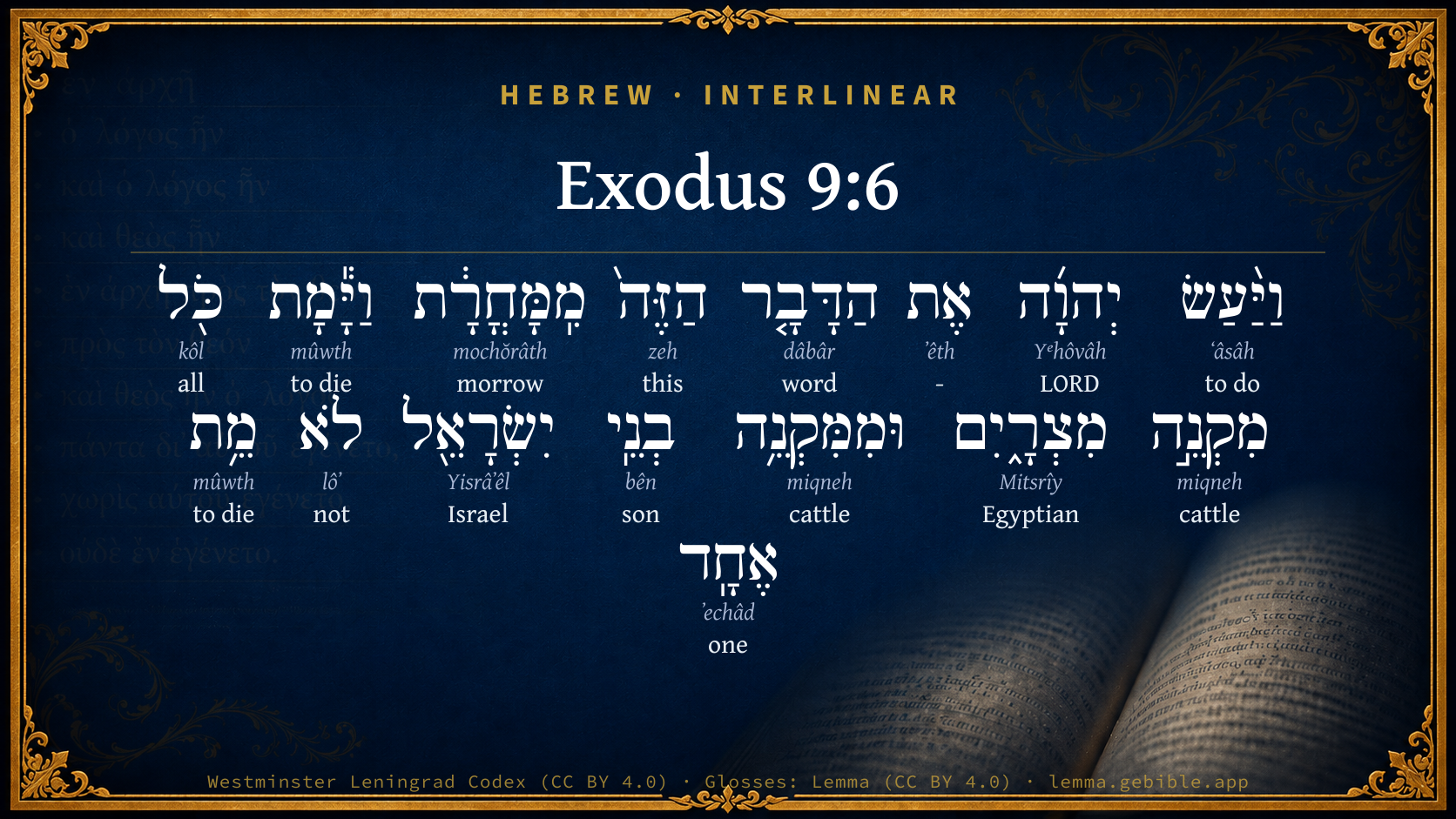
  1. וַיַּ֨עַשׂ ʻâsâh H6213 “and · to do” Conjunction + Verb, Qal, Sequential Imperfect, 3rd Person, Masculine, Singular
  2. יְהוָ֜ה Yᵉhôvâh H3068 “LORD” Noun, Proper
  3. אֶת ʼêth H853 “-” Particle, Direct Object
  4. הַדָּבָ֤ר dâbâr H1697 “the · word” Particle, Definite Article + Noun, Common, Masculine, Singular, Absolute
  5. הַזֶּה֙ zeh H2088 “the · this” Particle, Definite Article + Pronoun, Demonstrative, Masculine, Singular
  6. וַיָּ֕מָת mûwth H4191 “and · to die” Conjunction + Verb, Qal, Sequential Imperfect, 3rd Person, Masculine, Singular
  7. כֹּ֖ל kôl H3605 “all of” Noun, Common, Masculine, Singular, Construct
  8. מִקְנֵ֣ה miqneh H4735 “cattle of” Noun, Common, Masculine, Singular, Construct
  9. מִצְרָ֑יִם Mitsrîy H4713 “Egyptian” Noun, Proper
  10. וּמִמִּקְנֵ֥ה miqneh H4735 “and · from · cattle of” Conjunction + Preposition + Noun, Common, Masculine, Singular, Construct
  11. בְנֵֽי bên H1121 “sons of” Noun, Common, Masculine, Plural, Construct
  12. יִשְׂרָאֵ֖ל Yisrâʼêl H3478 “Israel” Noun, Proper
  13. לֹא lôʼ H3808 “not” Particle, Negative
  14. מֵ֥ת mûwth H4191 “to die” Verb, Qal, Perfect, 3rd Person, Masculine, Singular
  15. אֶחָֽד ʼechâd H259 “one” Adjective, Cardinal number, Masculine, Singular, Absolute

About this verse

These counts appear in no published source. They are computed here, from the morphology-tagged text and Lemma’s own curated glosses. What Lemma adds →

16
words
14
distinct lemmas
Pentateuch
section

Shared distinctive vocabulary

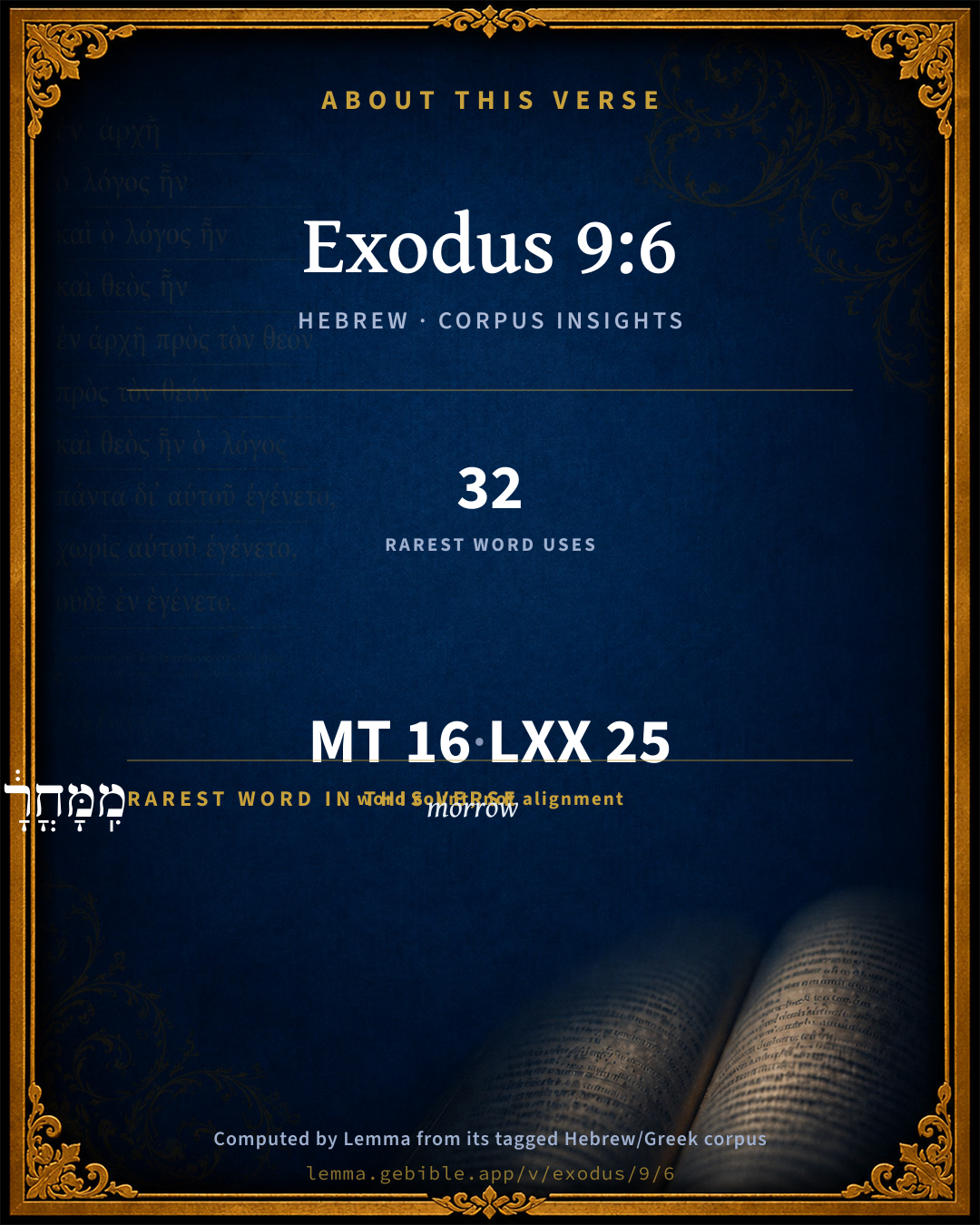
מִֽמָּחֳרָ֔ת morrow H4283 occurs in 32 verses of the Hebrew Bible. Also found in:

Grammatical profile

  • 3 verbs
  • 9 nouns
  • 1 adjective
  • 1 pronoun
  • 2 particles

Verb forms

  • וַיַּ֨עַשׂ Qal · Sequential Imperfect
  • וַיָּ֕מָת Qal · Sequential Imperfect
  • מֵ֥ת Qal · Perfect

Repetition

Words recur within this verse — often emphatic in Hebrew:

  • וַיָּ֕מָת to die H4191 ×2
  • מִקְנֵ֣ה cattle H4735 ×2

Hebrew & Septuagint length

In English translation the verse runs 27 words from the Hebrew and 31 from the Septuagint (LXX English) — closely comparable.

A rough comparison of the two English renderings, which tokenize alike — not a word-level alignment.

Word counts can differ between the Hebrew and the Greek without any difference in meaning — e.g. the Hebrew direct-object marker אֵת has no separate Greek word, and Greek often adds the article ὁ.

In the original languages it is 16 Hebrew tokens and 25 Greek tokens — but the two are counted differently (Hebrew bundles its prefixes and suffixes into one token; the Greek is in lemma form), so that isn’t a like-for-like length.

Cross-references

4

Topical passages linked to Exodus 9:6 in the Treasury of Scripture Knowledge — connected by theme and wording, ordered by reader-vote popularity; previews shown in the World English Bible.

  • Psalms 78:48 He gave over their cattle also to the hail, And their flocks to hot thunderbolts.
  • Exodus 9:25 The hail struck throughout all the land of Egypt all that was in the field, both man and animal; and the hail struck every herb of the field, and broke every tree of the field.
  • Psalms 78:50 He made a path for his anger. He didn't spare their soul from death, But gave their life over to the pestilence,
  • Exodus 9:19–20 Now therefore command that all of your cattle and all that you have in the field be brought into shelter. Every man and animal that is found in the field, and isn't brought home, the hail shall come down on them, and they shall die."'"

Cross-references courtesy of OpenBible.info (CC BY 4.0).

Hebrew and Greek witnesses Masoretic Hebrew ↔ Greek Septuagint

The same verse in the two great witnesses to the Old Testament, shown verse-for-verse.

These are two independent witnesses, not word-aligned to each other, and the Septuagint is shown in lemma (dictionary) form.

Hebrew Exodus 9:6 Masoretic · Westminster Leningrad Codex

וַיַּ֨עַשׂ יְהוָ֜ה אֶת הַדָּבָ֤ר הַזֶּה֙ מִֽמָּחֳרָ֔ת וַיָּ֕מָת כֹּ֖ל מִקְנֵ֣ה מִצְרָ֑יִם וּמִמִּקְנֵ֥ה בְנֵֽי יִשְׂרָאֵ֖ל לֹא מֵ֥ת אֶחָֽד

Yahweh did that thing on the next day; and all the cattle of Egypt died, but of the cattle of the children of Israel, not one died.

World English Bible · Public Domain

Greek LXX Exodus 9:6 Septuagint · lemma form

καί ποιέω κύριος ὁ ῥῆμα οὗτος ὁ ἐπαύριον καί τελευτάω πᾶς ὁ κτῆνος ὁ αἰγύπτιος ἀπό δέ ὁ κτῆνος ὁ υἱός ἰσραήλ οὐ τελευτάω οὐδείς

And the Lord did this thing on the next day, and all the cattle of the Egyptians died, but of the cattle of the children of Israel there died not one.

LXX2012 (modern English Septuagint) · Public Domain

Hebrew: Westminster Leningrad Codex (CC BY 4.0). Greek: Septuagint (public domain); English from LXX2012 (modern English Septuagint) (Public Domain). How the Septuagint differs from the Hebrew →

Targum (Aramaic paraphrase)

2

The Targum is the ancient Jewish Aramaic paraphrase of the Hebrew Scriptures — an interpretive translation, not the Hebrew text itself. Onkelos (literal) and Pseudo-Jonathan (expansive) render the Torah, and Jonathan the Prophets. Coverage is partial: where no permissively-licensed English translation exists for a verse, only the Aramaic is shown. This is verse-level text, not a word-by-word alignment to the Hebrew.

  1. Targum Onkelos Torah (Genesis–Deuteronomy)
    וַעֲבַד יְיָ יָת פִּתְגָמָא הָדֵין בְּיוֹמָא דְבַתְרוֹהִי וּמִית כֹּל בְּעִירָא דְמִצְרָיִם וּמִבְּעִירָא דִבְנֵי יִשְׂרָאֵל לָא מִית חָד:

    (no public-domain English translation for this verse)

    Targum Onkelos — Aramaic: “Onkelos Genesis” (public domain); “Onkelos Exodus” (public domain); “Onkelos Leviticus” (public domain); “Onkelos Numbers” (public domain); “Onkelos Deuteronomy” (public domain). English: “Sefaria Community Translation” (CC0 1.0 (public-domain dedication)); “J.W. Etheridge. The Targums of Onkelos and Jonathan Ben Uzziel on the Pentateuch. London: Longmans, Green, 1862” (public domain). Text via Sefaria.

  2. Targum Pseudo-Jonathan Torah (Genesis–Deuteronomy)
    וַעֲבַד יְיָ יַת פִּתְגָמָא הָדֵין לְיוֹם חֲרָן וּמִית כָּל בְּעִירָא דְמִצְרָאֵי וּמִבְּעִירָא דִבְנֵי יִשְרָאֵל לָא מִית חָד

    And the Lord did that thing the day after, and all the cattle of the Mizraee died; but of the cattle of the sons of Israel died not one.

    Targum Pseudo-Jonathan — Aramaic: “Targum Jonathan on Genesis” (public domain); “Targum Jonathan on Exodus” (public domain); “Targum Jonathan on Leviticus” (public domain); “Targum Jonathan on Numbers” (public domain); “Targum Jonathan on Deuteronomy” (public domain). English: “The Targum of Jonathan ben Uzziel, trans. J. W. Etheridge, London, 1862” (public domain). Text via Sefaria.

Commentary

Notes on Exodus 9:6 from classic Christian and Jewish commentators (each source and its license shown beneath its notes). The classic Christian expositions comment on the surrounding passage and are grouped to its opening verse, so a note may address several verses; the Jewish commentaries on the Tanakh (Rashi and others) are per-verse, so they appear only where the commentator wrote on this verse.

Lemma curates 59 commentaries, every one of them public domain or Creative Commons licensed, each selected and text-cleaned for this edition rather than reprinted as found. About our sources →

Adam Clarke's Commentary

Verse 6. All the cattle of Egypt died] That is, All the cattle that did die belonged to the Egyptians, but not one died that belonged to the Israelites, Ex 9:4; Ex 9:6. That the whole stock of cattle belonging to the Egyptians did not die we have the fullest proof, because there were cattle both to be killed and saved alive in the ensuing plague, Ex 9:19-25. By this judgment the Egyptians must see the vanity of the whole of their national worship, when they found the animals which they not only held sacred but deified, slain without distinction among the common herd, by a pestilence sent from the hand of Jehovah. One might naturally suppose that after this the animal worship of the Egyptians could never more maintain its ground.

Adam Clarke's Commentary on the Bible (1810–1826) — public domain. Text from a community e-Sword/MySword module.

Trapp's Complete Commentary

John Trapp

Exo 9:6 And the LORD did that thing on the morrow, and all the cattle of Egypt died: but of the cattle of the children of Israel died not one.

Ver. 6. And all the cattle.] That is, A great sort of them, not all. {a} {Exo 9:19; Exo 9:25} And this was the fifth of those ten plagues, a number of perfection; to note that God therein did most perfectly administer and execute his judgments.

{a} Non universaliter, sed communiter.

John Trapp, A Commentary or Exposition upon All the Books of the Old and New Testament (1647–1656) — public domain. Text from a community e-Sword module.

Joseph Benson's Commentary

Exo 9:6. All the cattle of Egypt died — All that were in the field, Exo 9:3; or a great number of every kind, so that the Egyptians saw that even the animals which they worshipped as gods could not save themselves. Bishop Warburton, in his Divine Legation of Moses, has given it as his opinion, that, in the early ages, the deities of Egypt were described by hieroglyphics or emblems, in which the pictures or images of beasts, birds, plants, reptiles, and every species of the animal or vegetable creation, were used as symbols or representations of their gods; and that, in process of time, the living animals, or real plants, thus represented, began to be deemed sacred, on account of this circumstance: and he thinks that the animals or plants themselves were not really worshipped till after the time of Moses. We know, however, that the Israelites learned in Egypt to make a god of a calf, from which it seems evident that that animal was worshipped there. But if the bishop’s opinion be right, and animals were not worshipped so early as the time of Moses, they certainly were held in great veneration, as symbols of their gods, and the subjecting them to a pestilence was, in effect, opposing and warring against the deities whom they represented. Not one of the cattle of the Israelites died — The gracious care of God is not only over the persons of those that fear him, but over all that belongs to them. Whatever the poorest Israelite possessed, the Lord was the protector of it, while all that belonged to the king and people of Egypt was exposed to the destructive ravages of those plagues with which divine justice saw fit to punish their idolatries and oppressions of his people. But doth God take care of oxen? Yes, he doth; his providence extends itself to the meanest of his creatures.

Joseph Benson's Commentary on the Old and New Testaments (1811–1818) — public domain. Text from a community e-Sword module.

Jamieson, Fausset & Brown

Robert Jamieson, A. R. Fausset & David Brown

all the cattle of Egypt died--not absolutely every beast, for we find (Exo 9:19, Exo 9:21) that there were still some left; but a great many died of each herd--the mortality was frequent and widespread. The adaptation of this judgment consisted in Egyptians venerating the more useful animals such as the ox, the cow, and the ram; in all parts of the country temples were reared and divine honors paid to these domesticated beasts, and thus while the pestilence caused a great loss in money, it also struck a heavy blow at their superstition.

Jamieson, Fausset & Brown — Commentary Critical and Explanatory on the Whole Bible (1871) — public domain (CC PDM 1.0). Text via the HelloAO Bible API.

The Cambridge Bible for Schools and Colleges

gen. ed. J. J. S. Perowne

6. all the cattle] unless there is a real inconsistency in the narrative, the ‘all’ must not be pressed, but understood (as often in Heb.) merely to denote such a large number that those which remain may be disregarded (Keil); for cattle belonging to the Egyptians are mentioned afterwards, vv. 19–21, also Exo_11:5; Exo_12:29; Exo_13:15.

The Cambridge Bible for Schools and Colleges (gen. ed. J. J. S. Perowne; Cambridge University Press, 1878–1918) — public domain. Text from a community e-Sword module.

John Gill's Exposition

And the Lord did that thing on the morrow,.... Brought a murrain, or a pestilential disease on the cattle. This, according to Bishop Usher, was on the second day of the seventh month, which afterwards became the first month, the month Abib, which answers to part of March and part of April, and seems to be about the seventeenth of March:

and all the cattle of Egypt died; not all absolutely, for we read of some afterwards, Exo 9:9 but all that were in the field, Exo 9:3 and it may be not strictly all of them, but the greatest part of them, as Aben Ezra interprets it; some, and a great many of all sorts, in which limited sense the word "all" is frequently used in Scripture:

but of the cattle of the children of Israel died not one; at least of the murrain, or by the hand of God, and perhaps not otherwise, which was very wonderful, since such a disorder is usually catching and spreading.

John Gill's Exposition of the Whole Bible (1746–1763) — public domain (CC PDM 1.0). Text via the HelloAO Bible API.

Albert Barnes' Notes on the Bible

All the cattle - i. e. which were left in the field; compare Exo 9:19-21.

Albert Barnes' Notes on the Bible (1834–1885) — public domain. Text from a community e-Sword/MySword module.

Haydock's Catholic Bible Commentary

All the beasts. That is, many of all kinds. (Challoner) --- So it is said, (Jeremias ix. 26,) all the nations are uncircumcised, though some few observed the rite of circumcision with the Jews. (Haydock)

George Leo Haydock (1774–1849), Haydock's Catholic Family Bible and Commentary, 1859 edition — public domain. Excludes Psalms (Douay-Rheims chapter numbering differs from Protestant) and Deuterocanonical books (Catholic canon only).

Matthew Poole's English Annotations

All the cattle; either of all sorts, or a very great number of them, as the word all is frequently used; or rather, all that were in the field, as it is expressly limited, Exo 9:3, but not all absolutely, as appears from Exo 9:9,19,25; 14:23.

Matthew Poole's English Annotations on the Holy Bible (1683–1685) — public domain. Text from a community e-Sword/MySword module.

Whedon's Commentary on the Bible

Daniel D. Whedon

6. And all the cattle of Egypt died — Here the universal term all is not used in its absolute sense, as meaning each and every one, but it means simply very many. We find that there were other cattle left to be smitten by the boils, (Exo_9:10,) and still others to be killed by the hail. Exo_9:25. A like usage is seen in the description of the plague of the locusts, (Exo_10:12,) which are said to have eaten up all that the hail… left, and yet the hail smote every herb and brake every tree. Exo_9:25. The Hebrew idiom often thus uses universal terms in a general sense. See Act_2:5; Col_1:23.

There are several instances on record of a similar murrain in Egypt. Lepsius and Poole describe such an infliction which they witnessed in 1842, and a similar one occurred in 1853, resembling the cattle disease which prevailed so extensively throughout America in 1872. But the occurrence of the plague according to definite prediction, and the sparing of the cattle of the Israelites, were the miraculous marks of this visitation.

This was, as yet, the heaviest infliction; for as the Egyptian wealth largely consisted in cattle, their means of support were now in a great degree destroyed. Jehovah shows these idolaters that he holds their supplies of food and clothing in his hands. Yet their crops, and many of their cattle, were yet left.

Daniel D. Whedon (gen. ed.), Commentary on the Old and New Testaments (1874–1909) — public domain. Text from a community e-Sword module.

John Wesley's Explanatory Notes

All the cattle died - All that were in the field. The creature is made subject to vanity by the sin of man, being liable, according to its capacity, both to serve his wickedness, and to share in his punishment. The Egyptians worshipped their cattle; it was among them that the Israelites learned to make a God of a calf; in that therefore this plague meets with them. But not one of the cattle of the Israelites died - Doth God take care for oxen? Yes, he doth, his providence extends itself to the meanest of his creatures.

John Wesley, Explanatory Notes Upon the Whole Bible (1754–1765) — public domain. Text via the GEBible commentary corpus.

Keil & Delitzsch

C. F. Keil & F. Delitzsch

In the words "all the cattle of the Egyptians died," all is not to be taken in an absolute sense, but according to popular usage, as denoting such a quantity, that what remained was nothing in comparison; and, according to Exo 9:3, it must be entirely restricted to the cattle in the field. For, according to Exo 9:9 and Exo 9:19, much of the cattle of the Egyptians still remained even after this murrain, though it extended to all kinds of cattle, horses, asses, camels, oxen, and sheep, and differed in this respect from natural murrains.

Keil & Delitzsch — Biblical Commentary on the Old Testament (1861–1891) — public domain (CC PDM 1.0). Text via the HelloAO Bible API. (Old Testament only.)

Lesson kit

Teaching starters — assembled from the data on this page, not authored interpretation. Every prompt links to the verse data it draws on. Edit before teaching.

Exodus, in the Pentateuch, opens this verse with 16 words (14 distinct Hebrew lemmas). Its most distinctive word is mochŏrâth (“morrow”). A historical commentator’s framing appears above. Read the whole chapter for the surrounding context.

Discussion questions

  1. The word mochŏrâth carries the sense “morrow.” How does it shape the verse?
  2. How does Genesis 19:34, which shares the word «morrow», read alongside this verse?
  3. What does the repetition of “to die” (2× in this one verse) do in this verse?
  4. These translations render this verse differently. What is at stake in choosing one wording over another?
  5. «וַיַּ֨עַשׂ» is a Qal Sequential Imperfect verb. How does that grammatical form shape the action described?
  6. Compare how Adam Clarke's Commentary and Trapp's Complete Commentary read this verse. Where do they agree or differ?

Things to notice

Reading settings

Reading text

Shown beneath each verse's original-language words.

Old Testament
Old Testament edition

Read the OT as the Masoretic Hebrew (MT) or the Greek Septuagint (LXX).

English shown for the Greek Septuagint (in the Hebrew ↔ Greek comparison).

Comparing translations? Open the Compare panel on any verse page to stack up to four side by side.