
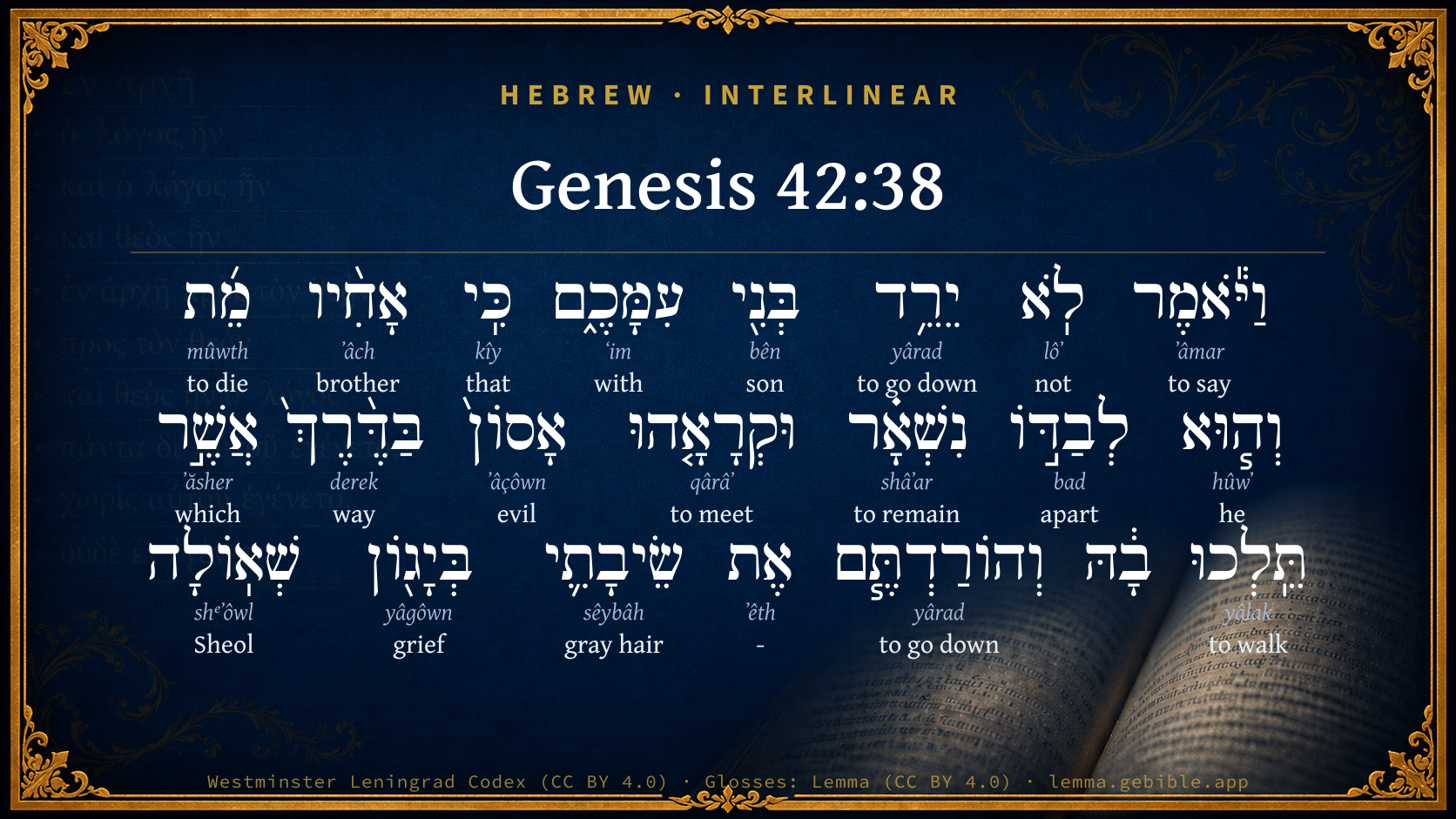
Genesis 42:38

Hebrew (Westminster Leningrad Codex) Genesis 42:38 appears in the Hebrew Old Testament. The text above is from the Westminster Leningrad Codex. Each word links to its Strong’s number, a concise gloss, and parsing drawn from the Open Scriptures Hebrew Bible morphology. Click any word for its full Brown-Driver-Briggs (BDB) entry.
Download image
Cite this verse

Genesis 42:38 (World English Bible). Public Domain. Lemma interlinear Bible study tool, https://lemma.gebible.app/v/genesis/42/38.

Show BibTeX & RIS
BibTeX
RIS
English Translation
He said, "My son shall not go down with you; for his brother is dead, and he only is left. If harm happens to him by the way in which you go, then you will bring down my gray hairs with sorrow to Sheol."
World English Bible · Public Domain
Highlights
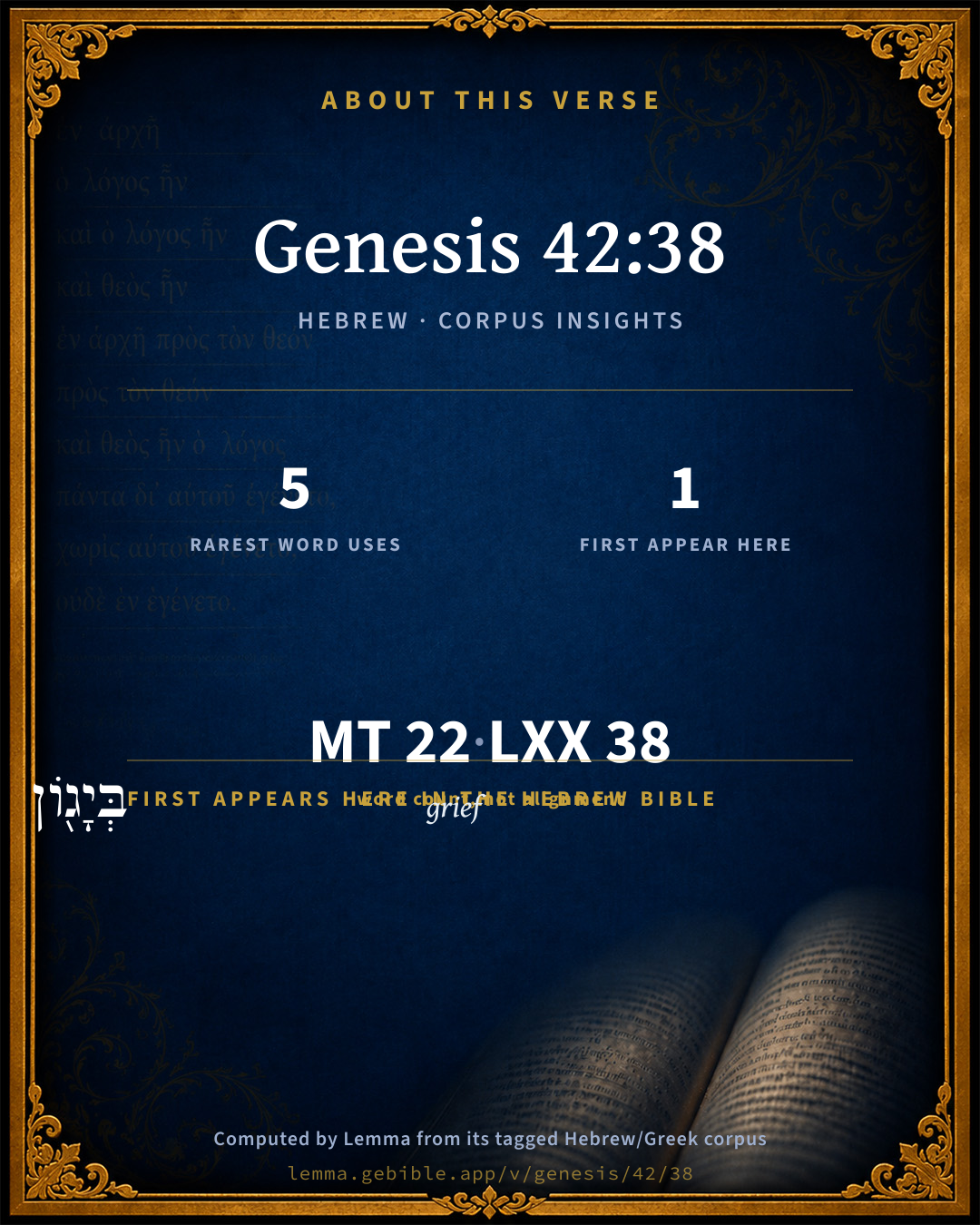
  • 1 first appearance in the Hebrew Bible
Full analysis ↓
Download a study sheet

One document with this verse’s original text, its word-by-word gloss line, the meaning frame, cross-references with their text, attributed commentary, and full source and license credits — printable, and it pastes into notes with its structure intact.

This verse Autodidact and up

Study sheet (.html) Plain text (.txt)

A passage Seminary Student

Up to 50 verses in one chapter. A passage sheet keeps up to 6 commentary sources and 12 cross-references per verse, in the order this page ranks them, and says so on the sheet whenever that leaves anything out. Ask for a single verse and you get the Autodidact verse sheet above.

Everything on this page stays free to read, with no account — the sheet is a download of what is already on screen, not access to it.

Want to remove ads? Support Godless Engineer
Compare translations 3

The same verse in 3 English versions, stacked beneath the original-language interlinear above. Click any original word for its lexicon entry.

Each is an independent rendering of the whole verse — the interlinear is not word-aligned to these translations.

Highlighted words mark where these versions differ — a whole-verse word diff, not a word-by-word alignment.

  • World English Bible Public Domain
    He said, "My son shall not go down with you; for his brother is dead, and he only is left. If harm happens to him by the way in which you go, then you will bring down my gray hairs with sorrow to Sheol."
  • King James Version Public Domain
    And he said, My son shall not go down with you; for his brother is dead, and he is left alone: if mischief befall him by the way in the which ye go, then shall ye bring down my gray hairs with sorrow to the grave.
  • unfoldingWord Literal Text CC BY-SA 4.0
    But he said, “My son will not go down with you, because his brother is dead, and he alone is left. And harm were to meet him on the road that you are going on, then you would bring my gray head down in sorrow to Sheol!”

unfoldingWord Literal Text — © unfoldingWord, licensed CC BY-SA 4.0. Word-aligned USFM3 via Door43 (git.door43.org/unfoldingWord/en_ult).

Versions to compare (up to 4)

3 of 4 selected

Show all 18 translations

Every available English version of this verse, each an independent rendering of the whole verse.

  • World English Bible Public Domain
    He said, "My son shall not go down with you; for his brother is dead, and he only is left. If harm happens to him by the way in which you go, then you will bring down my gray hairs with sorrow to Sheol."
  • Berean Standard Bible Public Domain
    But Jacob replied, “My son will not go down there with you, for his brother is dead, and he alone is left. If any harm comes to him on your journey, you will bring my gray hair down to Sheol in sorrow.”
  • Majority Standard Bible Public Domain
    But Jacob replied, “My son will not go down there with you, for his brother is dead, and he alone is left. If any harm comes to him on your journey, you will bring my gray hair down to Sheol in sorrow.”
  • King James Version Public Domain
    And he said, My son shall not go down with you; for his brother is dead, and he is left alone: if mischief befall him by the way in the which ye go, then shall ye bring down my gray hairs with sorrow to the grave.
  • American Standard Version (1901) Public Domain
    And he said, My son shall not go down with you; for his brother is dead, and he only is left: if harm befall him by the way in which ye go, then will ye bring down my gray hairs with sorrow to Sheol.
  • Revised Version (1885) Public Domain
    And he said, My son shall not go down with you; for his brother is dead, and he only is left: if mischief befall him by the way in the which ye go, then shall ye bring down my gray hairs with sorrow to the grave.
  • Geneva Bible (1599) Public Domain
    But he said, My sonne shall not go downe with you: for his brother is dead, and he is left alone: if death come vnto him by the way which ye goe, then ye shall bring my gray head with sorow vnto the graue.
  • Douay-Rheims (1899) Public Domain
    But he said: My son shall not go down with you: his brother is dead, and he is left alone: if any mischief befall him in the land to which you go, you will bring down my gray hairs with sorrow to hell.
  • Young's Literal Translation Public Domain
    and he saith, `My son doth not go down with you, for his brother `is' dead, and he by himself is left; when mischief hath met him in the way in which ye go, then ye have brought down my grey hairs in sorrow to sheol.'
  • Literal Standard Version CC BY-SA 4.0
    and he says, “My son does not go down with you, for his brother [is] dead, and he by himself is left; when harm has met him in the way in which you go, then you have brought down my grey hairs in sorrow to Sheol.”
  • Unlocked Literal Bible CC BY-SA 4.0
    Jacob said, “My son will not go down with you. For his brother is dead and he alone is left. If harm comes to him on the road in which you go, then you will bring down my gray hair with sorrow to Sheol.”
  • unfoldingWord Literal Text CC BY-SA 4.0
    But he said, “My son will not go down with you, because his brother is dead, and he alone is left. And harm were to meet him on the road that you are going on, then you would bring my gray head down in sorrow to Sheol!”
  • Darby Bible Public Domain
    But he said, My son shall not go down with you, for his brother is dead, and he alone is left; and if mischief should befall him by the way in which ye go, then would ye bring down my grey hairs with sorrow to Sheol.
  • World Messianic Bible Public Domain
    He said, “My son shall not go down with you; for his brother is dead, and he only is left. If harm happens to him along the way in which you go, then you will bring down my gray hairs with sorrow to Sheol.”
  • Webster's Bible Public Domain
    And he said, My son shall not go down with you; for his brother is dead, and he is left alone: if mischief shall befall him by the way in which ye go, then will ye bring down my gray hairs with sorrow to the grave.
  • Free Bible Version CC BY-SA 4.0
    “My son won't go there with you!” Jacob declared. “His brother is dead, and he's the only one I have left. If anything bad happens to him on the journey you're planning, you'll send this old man to his grave in grief.”
  • Bible in Basic English Public Domain
    And he said, I will not let my son go down with you; for his brother is dead and he is all I have: if evil overtakes him on the journey, then through you will my grey head go down to the underworld in sorrow.
  • JPS Tanakh (1917) Public Domain
    And he said: 'My son shall not go down with you; for his brother is dead, and he only is left; if harm befall him by the way in which ye go, then will ye bring down my gray hairs with sorrow to the grave.

Literal Standard Version (2020), Covenant Press — licensed CC BY-SA 4.0. Text via the HelloAO Bible API (eBible.org). Unlocked Literal Bible (unfoldingWord) — licensed CC BY-SA 4.0. Text via the HelloAO Bible API (eBible.org). unfoldingWord Literal Text — © unfoldingWord, licensed CC BY-SA 4.0. Word-aligned USFM3 via Door43 (git.door43.org/unfoldingWord/en_ult). Free Bible Version, Dr. Jonathan Gallagher — licensed CC BY-SA 4.0. Text via the HelloAO Bible API (eBible.org).

Word by word

More ways to search: Search by grammar → Find every occurrence → Compare this word →

Practice this passage: Drill this verse → Learn its vocabulary →

אָסוֹן֙
ʼâçôwn
H611
“evil”
Noun, Common, Masculine, Singular, Absolute
Part of Speech
Noun
Type
Common
Gender
Masculine
Number
Singular
State
Absolute
Full BDB Definition

Origin: of uncertain derivation

TWOT: 138a

evil, mischief, harm, hurt
  1. וַיֹּ֕אמֶר ʼâmar H559 “and · to say” Conjunction + Verb, Qal, Sequential Imperfect, 3rd Person, Masculine, Singular
  2. לֹֽא lôʼ H3808 “not” Particle, Negative
  3. יֵרֵ֥ד yârad H3381 “to go down” Verb, Qal, Imperfect, 3rd Person, Masculine, Singular
  4. בְּנִ֖י bên H1121 “son · my” Noun, Common, Masculine, Singular, Construct + Suffix, Personal, 1st Person, Common, Singular
  5. עִמָּכֶ֑ם ʻim H5973 “with · you” Preposition + Suffix, Personal, 2nd Person, Masculine, Plural
  6. כִּֽי kîy H3588 “that” Conjunction
  7. אָחִ֨יו ʼâch H251 “brother · his” Noun, Common, Masculine, Singular, Construct + Suffix, Personal, 3rd Person, Masculine, Singular
  8. מֵ֜ת mûwth H4191 “to die” Verb, Qal, Perfect, 3rd Person, Masculine, Singular
  9. וְה֧וּא hûwʼ H1931 “and · he” Conjunction + Pronoun, Personal, 3rd Person, Masculine, Singular
  10. לְבַדּ֣וֹ bad H905 “to/for · apart · his” Preposition + Noun, Common, Masculine, Singular, Construct + Suffix, Personal, 3rd Person, Masculine, Singular
  11. נִשְׁאָ֗ר shâʼar H7604 “remaining” Verb, Niphal, Participle Active, Masculine, Singular, Absolute
  12. וּקְרָאָ֤הוּ qârâʼ H7122 “and · to meet · him” Conjunction + Verb, Qal, Perfect, 3rd Person, Masculine, Singular + Suffix, Personal, 3rd Person, Masculine, Singular
  13. בַּדֶּ֨רֶךְ֙ derek H1870 “in/at the · way” Preposition, Determined + Noun, Common, Both, Singular, Absolute
  14. אֲשֶׁ֣ר ʼăsher H834 “which” Particle, Relative
  15. תֵּֽלְכוּ yâlak H3212 “to walk” Verb, Qal, Imperfect, 2nd Person, Masculine, Plural
  16. וְהוֹרַדְתֶּ֧ם yârad H3381 “and · to go down” Conjunction + Verb, Hiphil, Sequential Perfect, 2nd Person, Masculine, Plural
  17. אֶת ʼêth H853 “-” Particle, Direct Object
  18. שֵׂיבָתִ֛י sêybâh H7872 “gray hair · my” Noun, Common, Feminine, Singular, Construct + Suffix, Personal, 1st Person, Common, Singular
  19. בְּיָג֖וֹן yâgôwn H3015 “in/at · grief” Preposition + Noun, Common, Masculine, Singular, Absolute
  20. שְׁאֽוֹלָה shᵉʼôwl H7585 “Sheol · toward” Noun, Proper + Suffix, Demonstrative

About this verse

These counts appear in no published source. They are computed here, from the morphology-tagged text and Lemma’s own curated glosses. What Lemma adds →

22
words
20
distinct lemmas
Pentateuch
section

Notable vocabulary

The rarest word here is אָסוֹן֙ evil H611 — appearing just 5 times in the whole Hebrew Bible.

First appearance in Scripture

This word makes its first canonical appearance in the Hebrew Bible here:

  • בְּיָג֖וֹן grief H3015

Shared distinctive vocabulary

אָסוֹן֙ evil H611 occurs in 5 verses of the Hebrew Bible. Also found in:

Grammatical profile

  • 7 verbs
  • 8 nouns
  • 1 pronoun
  • 2 prepositions
  • 1 conjunction
  • 3 particles

Verb forms

  • וַיֹּ֕אמֶר Qal · Sequential Imperfect
  • יֵרֵ֥ד Qal · Imperfect
  • מֵ֜ת Qal · Perfect
  • נִשְׁאָ֗ר Niphal · Participle Active
  • וּקְרָאָ֤הוּ Qal · Perfect
  • תֵּֽלְכוּ Qal · Imperfect
  • וְהוֹרַדְתֶּ֧ם Hiphil · Sequential Perfect

Repetition

A word recurs within this verse — often emphatic in Hebrew:

  • יֵרֵ֥ד to go down H3381 ×2

Hebrew & Septuagint length

In English translation the verse runs 44 words from the Hebrew and 52 from the Septuagint (LXX English) — closely comparable.

A rough comparison of the two English renderings, which tokenize alike — not a word-level alignment.

Word counts can differ between the Hebrew and the Greek without any difference in meaning — e.g. the Hebrew direct-object marker אֵת has no separate Greek word, and Greek often adds the article ὁ.

In the original languages it is 22 Hebrew tokens and 38 Greek tokens — but the two are counted differently (Hebrew bundles its prefixes and suffixes into one token; the Greek is in lemma form), so that isn’t a like-for-like length.

Cross-references

15

Topical passages linked to Genesis 42:38 in the Treasury of Scripture Knowledge — connected by theme and wording, ordered by reader-vote popularity; previews shown in the World English Bible.

  • Genesis 37:35 All his sons and all his daughters rose up to comfort him; but he refused to be comforted. He said, "For I will go down to Sheol to my son mourning." His father wept for him.
  • Genesis 37:33 He recognized it, and said, "It is my son's coat. An evil animal has devoured him. Joseph is without doubt torn in pieces."
  • Genesis 42:4 But Jacob didn't send Benjamin, Joseph's brother, with his brothers; for he said, "Lest perhaps harm happen to him."
  • Genesis 42:13 They said, "We, your servants, are twelve brothers, the sons of one man in the land of Canaan; and, behold, the youngest is this day with our father, and one is no more."
  • Genesis 35:16–18 They traveled from Bethel. There was still some distance to come to Ephrath, and Rachel travailed. She had hard labor.
  • Genesis 30:22–24 God remembered Rachel, and God listened to her, and opened her womb.
  • Genesis 44:20 We said to my lord, 'We have a father, an old man, and a child of his old age, a little one; and his brother is dead, and he alone is left of his mother; and his father loves him.'
  • Genesis 44:27–34 Your servant, my father, said to us, 'You know that my wife bore me two sons:
  • 1 Kings 2:6 Do therefore according to your wisdom, and don't let his gray head go down to Sheol in peace.
  • Psalms 71:18 Yes, even when I am old and gray-haired, God, don't forsake me, Until I have declared your strength to the next generation, Your might to everyone who is to come.
  • Psalms 90:10 The days of our years are seventy, Or even by reason of strength eighty years; Yet their pride is but labor and sorrow, For it passes quickly, and we fly away.
  • Ecclesiastes 1:14 I have seen all the works that are done under the sun; and, behold, all is vanity and a chasing after wind.
  • Ecclesiastes 2:26 For to the man who pleases him, God gives wisdom, knowledge, and joy; but to the sinner he gives travail, to gather and to heap up, that he may give to him who pleases God. This also is vanity and a chasing after wind.
  • Isaiah 38:10 I said, In the noontide of my days I shall go into the gates of Sheol: I am deprived of the residue of my years.
  • Isaiah 46:4 and even to old age I am he, and even to gray hairs will I carry you. I have made, and I will bear; yes, I will carry, and will deliver.

Cross-references courtesy of OpenBible.info (CC BY 4.0).

Hebrew and Greek witnesses Masoretic Hebrew ↔ Greek Septuagint

The same verse in the two great witnesses to the Old Testament, shown verse-for-verse.

These are two independent witnesses, not word-aligned to each other, and the Septuagint is shown in lemma (dictionary) form.

Hebrew Genesis 42:38 Masoretic · Westminster Leningrad Codex

וַיֹּ֕אמֶר לֹֽא יֵרֵ֥ד בְּנִ֖י עִמָּכֶ֑ם כִּֽי אָחִ֨יו מֵ֜ת וְה֧וּא לְבַדּ֣וֹ נִשְׁאָ֗ר וּקְרָאָ֤הוּ אָסוֹן֙ בַּדֶּ֨רֶךְ֙ אֲשֶׁ֣ר תֵּֽלְכוּ בָ֔הּ וְהוֹרַדְתֶּ֧ם אֶת שֵׂיבָתִ֛י בְּיָג֖וֹן שְׁאֽוֹלָה

He said, "My son shall not go down with you; for his brother is dead, and he only is left. If harm happens to him by the way in which you go, then you will bring down my gray hairs with sorrow to Sheol."

World English Bible · Public Domain

Greek LXX Genesis 42:38 Septuagint · lemma form

ὁ δέ εἶπον οὐ καταβαίνω ὁ υἱός ἐγώ μετά σύ ὅτι ὁ ἀδελφός αὐτός ἀποθνήσκω καί αὐτός μόνος καταλείπω καί συνβαίνω αὐτός μαλακίζομαι ἐν ὁ ὁδός ὅς ἄν πορεύομαι καί καταἄγω ἐγώ ὁ γῆρας μετά λύπη εἰς ᾅδης

But he said, My son shall not go down with you, because his brother is dead, and he only has been left; and suppose it shall come to pass that he is afflicted by the way by which you⌃ go, then you⌃ shall bring down my old age with sorrow to Hades.

LXX2012 (modern English Septuagint) · Public Domain

Hebrew: Westminster Leningrad Codex (CC BY 4.0). Greek: Septuagint (public domain); English from LXX2012 (modern English Septuagint) (Public Domain). How the Septuagint differs from the Hebrew →

Targum (Aramaic paraphrase)

2

The Targum is the ancient Jewish Aramaic paraphrase of the Hebrew Scriptures — an interpretive translation, not the Hebrew text itself. Onkelos (literal) and Pseudo-Jonathan (expansive) render the Torah, and Jonathan the Prophets. Coverage is partial: where no permissively-licensed English translation exists for a verse, only the Aramaic is shown. This is verse-level text, not a word-by-word alignment to the Hebrew.

  1. Targum Onkelos Torah (Genesis–Deuteronomy)
    וַאֲמַר לָא יֵחוּת בְּרִי עִמְּכוֹן אֲרֵי אָחוּהִי מִית וְהוּא בִּלְחוֹדוֹהִי אִשְׁתָּאַר וִיעַרְעִנֵּהּ מוֹתָא בְּאָרְחָא דִּי תְהָכוּן בַּהּ וְתַחֲתוּן יָת שִׂיבְתִי בְּדָווֹנָא לִשְׁאוֹל

    (no public-domain English translation for this verse)

    Targum Onkelos — Aramaic: “Onkelos Genesis” (public domain); “Onkelos Exodus” (public domain); “Onkelos Leviticus” (public domain); “Onkelos Numbers” (public domain); “Onkelos Deuteronomy” (public domain). English: “Sefaria Community Translation” (CC0 1.0 (public-domain dedication)); “J.W. Etheridge. The Targums of Onkelos and Jonathan Ben Uzziel on the Pentateuch. London: Longmans, Green, 1862” (public domain). Text via Sefaria.

  2. Targum Pseudo-Jonathan Torah (Genesis–Deuteronomy)
    וַאֲמַר לָא יֵיחוּת בְּרִי עִמְכוֹן אֲרֵי אָחוֹי מִית וְהוּא בִּלְחוֹדוֹי אִשְׁתַּיֵיר מִן אִמֵיהּ וִיאַרְעִינֵיהּ מוֹתָא בְּאָרְחָא דְתַהֲכוּן בָּהּ וְתַחֲתוֹן יַת סֵיבָתִי בְּדָווּי לְבֵי קְבוּרְתָּא

    But he said, My son shall not go down with you; for his brother is dead, and he alone remains of his mother; and if death should befall him in the way that you go, you will bring down my age with mourning to the grave.

    Targum Pseudo-Jonathan — Aramaic: “Targum Jonathan on Genesis” (public domain); “Targum Jonathan on Exodus” (public domain); “Targum Jonathan on Leviticus” (public domain); “Targum Jonathan on Numbers” (public domain); “Targum Jonathan on Deuteronomy” (public domain). English: “The Targum of Jonathan ben Uzziel, trans. J. W. Etheridge, London, 1862” (public domain). Text via Sefaria.

Commentary

Notes on Genesis 42:38 from classic Christian and Jewish commentators (each source and its license shown beneath its notes). The classic Christian expositions comment on the surrounding passage and are grouped to its opening verse, so a note may address several verses; the Jewish commentaries on the Tanakh (Rashi and others) are per-verse, so they appear only where the commentator wrote on this verse.

Lemma curates 59 commentaries, every one of them public domain or Creative Commons licensed, each selected and text-cleaned for this edition rather than reprinted as found. About our sources →

Trapp's Complete Commentary

John Trapp

Gen 42:38 And he said, My son shall not go down with you; for his brother is dead, and he is left alone: if mischief befall him by the way in the which ye go, then shall ye bring down my gray hairs with sorrow to the grave.

Ver. 38. Then shall ye bring down my gray hairs, &c.] To the state of the dead; not to hell, or Limbus Patrum. Many of the ancients erroneously held that men’s souls were not judged till the last day; nor rewarded or punished, but reserved in some secret receptacles unto the general judgment. Bellarmine would hence prove Purgatory. {a} Luther also seems to approve of that figment of the fathers; for in his notes upon this text, he will have "Sheol" here translated "the grave," to be an underground receptacle of all souls, where they rest and sleep till the coming of Christ. But gray hairs descend not farther than the grave. And Luther somewhere entreats his readers, that if they find anything in his books that smelleth of the old cask, they should consider he was not only a man, but some time had been a poor monk, &c.

{a} Bell., De Purg., lib. i.

John Trapp, A Commentary or Exposition upon All the Books of the Old and New Testament (1647–1656) — public domain. Text from a community e-Sword module.

The Biblical Illustrator

Joseph S. Exell

Gen_42:38

Bring down my gray hairs with sorrow

Graceless children

Some graceless children despise their fathers and their mothers when they are old, and when their grey hairs claim reverence or compassion.

If we must bow before the man of hoary hairs, although he is a stranger, what reverence do we owe to our own parents, when the respect due to age is added to the claims of parental relation! Those children that load the grey heads of their parents with crushing sorrows, are worse than common murderers. Yet, let not parents, by their own frowardness, kill themselves with grief, and load their children with the blame due to themselves. The aged ought to remember that their infirmities may dispose them to make their burdens heavier than God or men have made them. And when we torment ourselves we are too ready to transfer our own folly to the account of others. (G. Lawson, D. D.)

A faithless exclamation

Why should Jacob die with grief, if Benjamin should be lost? Is Benjamin his God, his life, his exceeding joy? The Lord liveth, and blessed be the Rock of Israel. He is the Rock of ages. God had made desolate all Jobs company, and his hope had He removed like a tree; but Job knew that his Redeemer lived. All flesh is grass, and all the goodliness thereof is as the flower of the field; but the Word of the Lord shall stand for ever. And whilst the Word stands, those whose trust is placed on it are safe. They may, through the prevalence of unbelief, and of earthly affections, speak unadvisedly with their lips; hut the Lord will make them sensible of their folly, and enable them to commit their affairs into His hand, and to east all their cares upon Him who cares for all His people. We shall soon hear Jacob saying, If I am bereaved of my children, I am bereaved; and on his death-bed he says, I have waited for Thy salvation, O Lord! (G. Lawson, D. D.)

.

The Biblical Illustrator, edited by Joseph S. Exell (c. 1880s–1900s) — public domain. Text from a community e-Sword module.

Joseph Benson's Commentary

Gen 42:38. My son shall not go down with you — Nothing can be more tender than this verse: it melts us while we read it, and is so expressive that it sets the venerable old patriarch full before our eyes. His brother is dead, and he is left alone — He plainly intimates a distrust of them, remembering that he never saw Joseph since he had been with them; therefore Benjamin should not go with them.

Joseph Benson's Commentary on the Old and New Testaments (1811–1818) — public domain. Text from a community e-Sword module.

Tyndale Open Study Notes

Tyndale Open Resources

42:38 Jacob was resolute in his favoritism toward Rachel’s remaining son. Benjamin would not go to Egypt even if it meant that Leah’s son Simeon never returned. Jacob’s grief apparently weighed heavily on the brothers’ conscience (44:18-34).

Tyndale Open Study Notes — © Tyndale Open Resources, licensed CC BY-SA 4.0. Text via the HelloAO Bible API.

Adam Clarke's Commentary

Verse 38. He is left alone] That is, Benjamin is the only remaining son of Rachel; for he supposed Joseph, who was the other son, to be dead.

Shall ye bring down my gray hairs with sorrow] Here he keeps up the idea of the oppressive burden mentioned Ge 42:36, to which every occurrence was adding an additional weight, so that he felt it impossible to support it any longer.

The following observations of Dr. Dodd on this verse are very appropriate and judicious: "Nothing can be more tender and picturesque than the words of the venerable patriarch. Full of affection for his beloved Rachel, he cannot think of parting with Benjamin, the only remaining pledge of that love, now Joseph, as he supposes, is no more. We seem to behold the gray-headed, venerable father pleading with his sons, the beloved Benjamin standing by his side, impatient sorrow in their countenances, and in his all the bleeding anxiety of paternal love. It will be difficult to find in any author, ancient or modern, a more exquisite picture."

1. THERE is one doctrine relative to the economy of Divine Providence little heeded among men; I mean the doctrine of restitution. When a man has done wrong to his neighbour, though, on his repentance, and faith in our Lord Jesus, God forgives him his sin, yet he requires him to make restitution to the person injured, if it lie in the compass of his power. If he do not, God will take care to exact it in the course of his providence. Such respect has he for the dictates of infinite justice that nothing of this kind shall pass unnoticed. Several instances of this have already occurred in this history, and we shall see several more. No man should expect mercy at the hand of God who, having wronged his neighbour, refuses, when he has it in his power, to make restitution. Were he to weep tears of blood, both the justice and mercy of God would shut out his prayer, if he made not his neighbour amends for the injury he may have done him. The mercy of God, through the blood of the cross, can alone pardon his guilt; but no dishonest man can expect this; and he is a dishonest man who illegally holds the property of another in his hand. The unnatural brethren who sold their brother are now about to be captivated themselves; and the binder himself is bound in his turn: and though a kind Providence permits not the evil to fall upon them, yet, while apprehending it, they feel all its reality, conscience supplying the lack of prison, jailer, and bonds.

2. The ways of Providence are often to us dark and perplexed, so that we are ready to imagine that good can never result from what appears to us to be directly contrary to our interest; and we are often tempted to think that those very providential dealings of God, which have for their object our present and eternal welfare, are rather proofs of his displeasure, or evidences of his vindictive judgment. All these things are against me, said poor desponding Jacob; whereas, instead of being against him, all these things were for him; and by all these means was the merciful God working for the preservation of himself and his family, and the fulfillment of his ancient promise, that the posterity of Abraham should be as the stars of heaven for multitude. How strange is it that our faith, after so many evidences of his goodness, should still be so weak; and that our opinion of him should be so imperfect, that we can never trust in him but while he is under our own eye! If we see him producing good, we can believe that he is doing so, and this is all. If we believe not, he abides faithful; but our unbelief must make our own way extremely perplexing and difficult.

Adam Clarke's Commentary on the Bible (1810–1826) — public domain. Text from a community e-Sword/MySword module.

John Calvin's Commentaries

38. My son shall not go down with you. Again we see, as in a lively picture, with what sorrow holy Jacob had been oppressed. He sees his whole family famishing: he would rather be torn away from life than from his son: whence we gather that he was not iron-hearted: but his patience is the more deserving of praise, because he contended with the infirmity of the flesh, and did not sink under it. And although Moses does not give a rhetorical amplification to his language, we nevertheless easily perceive that he was overcome with excessive grief, when he thus complained to his sons, You are too cruel to your father, in taking away from me a third son, after I have been plundered of first one and then another.

John Calvin's Commentaries (1540-1563) — public domain. Text from the Calvin Translation Society English edition (1840s-50s) via the Christian Classics Ethereal Library (ccel.org). Calvin's coverage is partial (roughly two-thirds of the Bible); uncommented books and verses are honest gaps, never fabricated. The 19th-century editor's footnotes and remarks are omitted so the notes are faithfully Calvin's own voice.

Ellicott's Commentary for English Readers

(38) Then shall ye bring down my gray hairs with sorrow to the grave.—Heb., to Sheol (See Note on Gen_37:35). Jacob, both here and in Gen_47:9, speaks as one on whom sorrow had pressed very heavily. Always of a timid and affection Ate disposition, he looks onward now without hope, and sees in the future only dangers and ill-fortune. Probably by this time he had lost Leah as well as Rachel, but the blow that had struck him utterly down had evidently been the loss of Joseph, in whom Rachel had still seemed to live on for him. And therefore now he clung the more warmly to Benjamin, and it is plain that the father’s deep sorrow for the loss of the petted son had softened the hearts of his brethren. They have no grudge against Benjamin because he has taken Joseph’s place, but rather seem to share in their father’s feelings, and their hearts were in accordance with what Judah says in Gen_44:18-34, that any personal suffering would be cheerfully borne by them, rather than to have to undergo the sight of the repetition of such grief as they previously had themselves inflicted.

A Bible Commentary for English Readers, edited by Charles John Ellicott (1878–1897) — public domain. Text from a community e-Sword module.

The Cambridge Bible for Schools and Colleges

gen. ed. J. J. S. Perowne

38. he only is left] i.e. of the sons of Rachel.

mischief] Cf. Gen_42:4; Exo_21:22-23.

bring down my gray hairs, &c.] See note on Gen_37:35; cf. Gen_44:31. Jacob’s prediction in these passages is probably intended to heighten the contrast presented by the dignity and happiness of his end as recorded in chaps. 48–50.

the grave] Heb. Sheol. See ch. Gen_37:35.

The Cambridge Bible for Schools and Colleges (gen. ed. J. J. S. Perowne; Cambridge University Press, 1878–1918) — public domain. Text from a community e-Sword module.

Haydock's Catholic Bible Commentary

Alone: the son of my beloved Rachel. (Haydock) --- To hell. That is, to that place where the souls then remained, as above, chap. xxxvii. ver. 35, (Challoner) though with respect to his grey hairs, and body, it may signify the grave. (Haydock)

George Leo Haydock (1774–1849), Haydock's Catholic Family Bible and Commentary, 1859 edition — public domain. Excludes Psalms (Douay-Rheims chapter numbering differs from Protestant) and Deuterocanonical books (Catholic canon only).

Matthew Poole's English Annotations

He is left alone, to wit of his mother, my dear Rachel.

Matthew Poole's English Annotations on the Holy Bible (1683–1685) — public domain. Text from a community e-Sword/MySword module.

Whedon's Commentary on the Bible

Daniel D. Whedon

38. Sorrow to the grave — Comp. Gen_37:35.

Daniel D. Whedon (gen. ed.), Commentary on the Old and New Testaments (1874–1909) — public domain. Text from a community e-Sword module.

The Pulpit Commentary

And he (i.e. Jacob) said, My son shall not go down with you; not because he could not trust Reuben after the sin described in Gen_35:22 (Wordsworth) or because he could not assent to Reuben"s proposal (Ainsworth), but because of what is next statedfor his brother (i.e. by the same mother, viz., Joseph) is dead (cf. ver. 13; 37:33; 44:28), and he is left alone:i.e. he alone (of Rachel"s children) is left as a survivorif mischief befall him (literally, and mischief shall befall him) by the way in the which ye go, then shall ye (literally, and ye shall) bring down my gray hairs with sorrow to the grave Sheol (cf. Gen_37:35)

The Pulpit Commentary (1880–1919), ed. H.D.M. Spence-Jones & Joseph S. Exell — public domain. Text from a community e-Sword module.

John Wesley's Explanatory Notes

My son shall not go down with you - He plainly intimates a distrust of them, remembering that he never saw Joseph since he had been with them; therefore Benjamin shall not go with you.

John Wesley, Explanatory Notes Upon the Whole Bible (1754–1765) — public domain. Text via the GEBible commentary corpus.

Scofield Reference Notes

C. I. Scofield

grave

Heb. "Sheol," (See Scofield "Hab 2:5").

The Scofield Reference Bible (1917 edition), notes by C. I. Scofield — public domain. Text from a community e-Sword module.

Rashi

Rabbi Shlomo Yitzchaki (Rashi)

לא ירד בני עמכם MY SON SHALL NOT GO DOWN WITH YOU — He did not accept Reuben’s offer. He said, “What a fool is this oldest son of mine! He suggests that I should kill his sons. Are they his only and not mine also?” (Genesis Rabbah 91:9)

Rashi on the Tanakh — English translations: “The Judaica Press complete Tanach with Rashi, translated by A. J. Rosenberg” (CC BY 4.0); “Pentateuch with Rashi's commentary by M. Rosenbaum and A.M. Silbermann, 1929-1934” (public domain); “The Metsudah Tanach series, Lakewood, N.J” (CC BY 4.0); and “The Book of Joshua, Metsudah Publications, 1997” (CC BY 4.0). Text via Sefaria.

Sforno

Rabbi Ovadia Sforno

My son. Yaakov refers to Binyamin in this way because he was the only son left from his primary wife [Rochel].

Sforno on the Tanakh — English translation: “Yalkut, Sifsei Chachomim Chumash, Metsudah Publications, 2009” (CC BY 4.0). Text via Sefaria.

Radak

Rabbi David Kimhi (Radak)

כי אחיו מת, not a statement of fact but an assumption. Yaakov reasoned that if Joseph were alive he would have heard from him at some time during the over twenty years that he had been missing.

Radak on the Tanakh — English translations: “Sefaria Community Translation” (CC0 1.0 (public-domain dedication)); “Eliyahu Munk, HaChut Hameshulash” (CC BY 4.0); “Rabbi Mike Feuer, Jerusalem Anthology” (CC BY 4.0); and “R. David Kimhi on the first book of Psalms, Translated by R.G. Finch, London, 1919” (public domain). Text via Sefaria.

Lesson kit

Teaching starters — assembled from the data on this page, not authored interpretation. Every prompt links to the verse data it draws on. Edit before teaching.

Genesis, in the Pentateuch, opens this verse with 22 words (20 distinct Hebrew lemmas). Its most distinctive word is ʼâçôwn (“evil”). A historical commentator’s framing appears above. Read the whole chapter for the surrounding context.

Discussion questions

  1. The word ʼâçôwn carries the sense “evil.” How does it shape the verse?
  2. This is the first place “grief” appears in Scripture (first appears here). What does its debut here establish?
  3. How does Genesis 42:4, which shares the word «evil», read alongside this verse?
  4. What does the repetition of “to go down” (2× in this one verse) do in this verse?
  5. These translations render this verse differently. What is at stake in choosing one wording over another?
  6. «וַיֹּ֕אמֶר» is a Qal Sequential Imperfect verb. How does that grammatical form shape the action described?
  7. Compare how Trapp's Complete Commentary and The Biblical Illustrator read this verse. Where do they agree or differ?

Things to notice

Reading settings

Reading text

Shown beneath each verse's original-language words.

Old Testament
Old Testament edition

Read the OT as the Masoretic Hebrew (MT) or the Greek Septuagint (LXX).

English shown for the Greek Septuagint (in the Hebrew ↔ Greek comparison).

Comparing translations? Open the Compare panel on any verse page to stack up to four side by side.