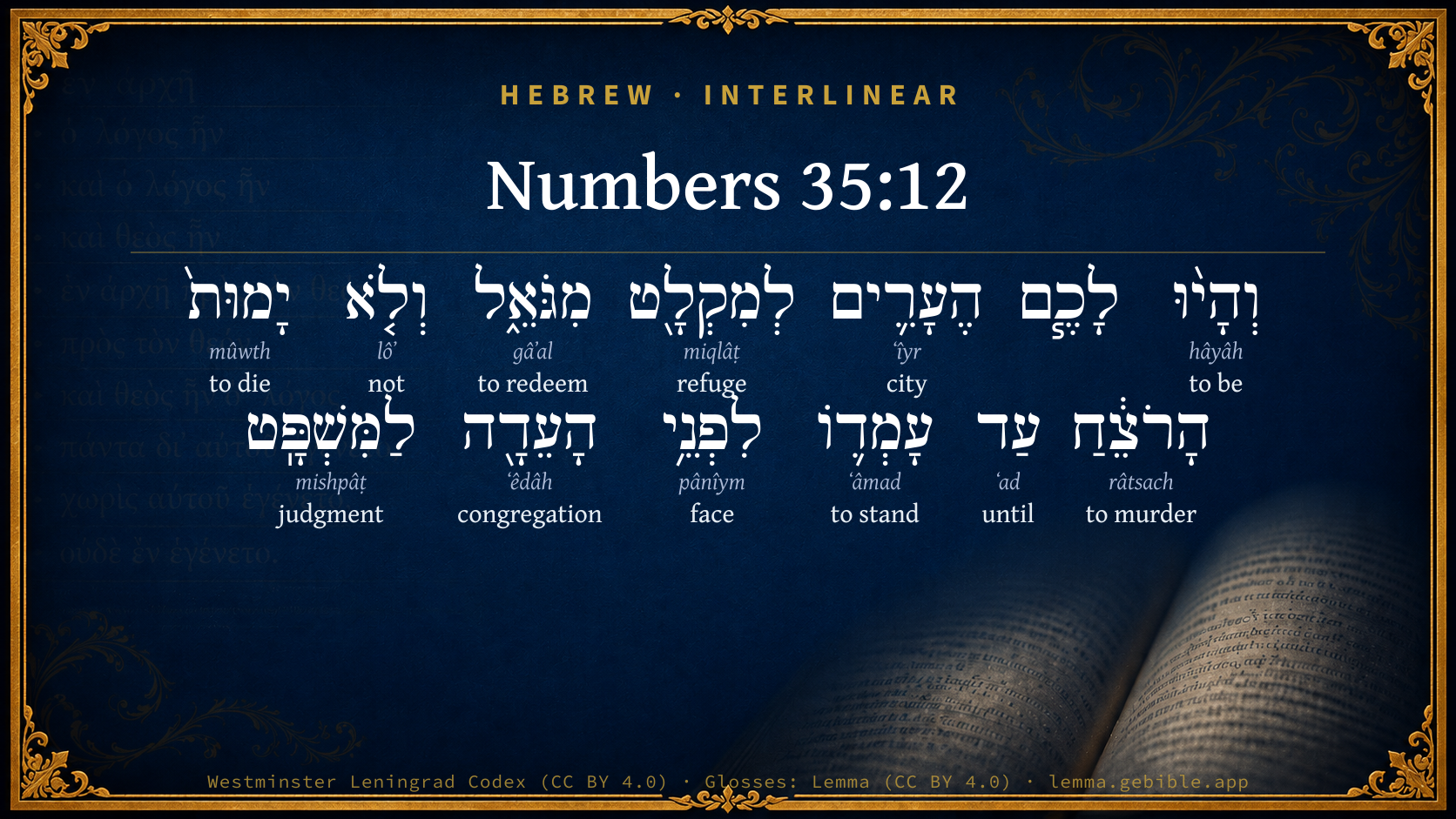
Numbers 35:12

Hebrew (Westminster Leningrad Codex) Numbers 35:12 appears in the Hebrew Old Testament. The text above is from the Westminster Leningrad Codex. Each word links to its Strong’s number, a concise gloss, and parsing drawn from the Open Scriptures Hebrew Bible morphology. Click any word for its full Brown-Driver-Briggs (BDB) entry.
Download image
Cite this verse

Numbers 35:12 (World English Bible). Public Domain. Lemma interlinear Bible study tool, https://lemma.gebible.app/v/numbers/35/12.

Show BibTeX & RIS
BibTeX
RIS
English Translation
The cities shall be to you for refuge from the avenger, that the manslayer not die, until he stands before the congregation for judgment.
World English Bible · Public Domain
Download a study sheet

One document with this verse’s original text, its word-by-word gloss line, the meaning frame, cross-references with their text, attributed commentary, and full source and license credits — printable, and it pastes into notes with its structure intact.

This verse Autodidact and up

Study sheet (.html) Plain text (.txt)

A passage Seminary Student

Up to 50 verses in one chapter. A passage sheet keeps up to 6 commentary sources and 12 cross-references per verse, in the order this page ranks them, and says so on the sheet whenever that leaves anything out. Ask for a single verse and you get the Autodidact verse sheet above.

Everything on this page stays free to read, with no account — the sheet is a download of what is already on screen, not access to it.

Want to remove ads? Support Godless Engineer
Compare translations 3

The same verse in 3 English versions, stacked beneath the original-language interlinear above. Click any original word for its lexicon entry.

Each is an independent rendering of the whole verse — the interlinear is not word-aligned to these translations.

Highlighted words mark where these versions differ — a whole-verse word diff, not a word-by-word alignment.

  • World English Bible Public Domain
    The cities shall be to you for refuge from the avenger, that the manslayer not die, until he stands before the congregation for judgment.
  • King James Version Public Domain
    And they shall be unto you cities for refuge from the avenger; that the manslayer die not, until he stand before the congregation in judgment.
  • unfoldingWord Literal Text CC BY-SA 4.0
    And the cities will be for you for refuge from the avenger, and the one who kills will not die until he stands before the face of the congregation for the judgment.

unfoldingWord Literal Text — © unfoldingWord, licensed CC BY-SA 4.0. Word-aligned USFM3 via Door43 (git.door43.org/unfoldingWord/en_ult).

Versions to compare (up to 4)

3 of 4 selected

Show all 18 translations

Every available English version of this verse, each an independent rendering of the whole verse.

  • World English Bible Public Domain
    The cities shall be to you for refuge from the avenger, that the manslayer not die, until he stands before the congregation for judgment.
  • Berean Standard Bible Public Domain
    You are to have these cities as a refuge from the avenger, so that the manslayer will not die until he stands trial before the assembly.
  • Majority Standard Bible Public Domain
    You are to have these cities as a refuge from the avenger, so that the manslayer will not die until he stands trial before the assembly.
  • King James Version Public Domain
    And they shall be unto you cities for refuge from the avenger; that the manslayer die not, until he stand before the congregation in judgment.
  • American Standard Version (1901) Public Domain
    And the cities shall be unto you for refuge from the avenger, that the manslayer die not, until he stand before the congregation for judgment.
  • Revised Version (1885) Public Domain
    And the cities shall be unto you for refuge from the avenger; that the manslayer die not, until he stand before the congregation for judgment.
  • Geneva Bible (1599) Public Domain
    And these cities shalbe for you a refuge from the auenger, that he which killeth, die not, vntill he stand before the Congregation in iudgement.
  • Douay-Rheims (1899) Public Domain
    And when the fugitive shall be in them, the kinsman of him that is slain may not have power to kill him, until he stand before the multitude, and his cause be judged.
  • Young's Literal Translation Public Domain
    and the cities have been to you for a refuge from the redeemer, and the man-slayer doth not die till his standing before the company for judgment.
  • Literal Standard Version CC BY-SA 4.0
    and the cities have been for a refuge to you from the redeemer, and the manslayer does not die until his standing before the congregation for judgment.
  • Unlocked Literal Bible CC BY-SA 4.0
    These cities must be your refuge from the avenger, so that the accused man will not be killed without first standing trial before the community.
  • unfoldingWord Literal Text CC BY-SA 4.0
    And the cities will be for you for refuge from the avenger, and the one who kills will not die until he stands before the face of the congregation for the judgment.
  • Darby Bible Public Domain
    And ye shall have these cities for refuge from the avenger; that the manslayer die not, until he have stood before the assembly in judgment.
  • World Messianic Bible Public Domain
    The cities shall be for your refuge from the avenger, that the man slayer not die until he stands before the congregation for judgment.
  • Webster's Bible Public Domain
    And they shall be to you cities for refuge from the avenger; that the man-slayer may not die, until he stands before the congregation in judgment.
  • Free Bible Version CC BY-SA 4.0
    These towns will be for you places of sanctuary from those seeking revenge, so that the killer will not die until they are tried in court.
  • Bible in Basic English Public Domain
    In these towns you may be safe from him who has the right of punishment; so that death may not overtake the taker of life till he has been judged by the meeting of the people.
  • JPS Tanakh (1917) Public Domain
    And the cities shall be unto you for refuge from the avenger, that the manslayer die not, until he stand before the congregation for judgment.

Literal Standard Version (2020), Covenant Press — licensed CC BY-SA 4.0. Text via the HelloAO Bible API (eBible.org). Unlocked Literal Bible (unfoldingWord) — licensed CC BY-SA 4.0. Text via the HelloAO Bible API (eBible.org). unfoldingWord Literal Text — © unfoldingWord, licensed CC BY-SA 4.0. Word-aligned USFM3 via Door43 (git.door43.org/unfoldingWord/en_ult). Free Bible Version, Dr. Jonathan Gallagher — licensed CC BY-SA 4.0. Text via the HelloAO Bible API (eBible.org).

Word by word

More ways to search: Search by grammar → Find every occurrence → Compare this word →

Practice this passage: Drill this verse → Learn its vocabulary →

לְמִקְלָ֖ט
miqlâṭ
H4733
“to/for · refuge”
Preposition + Noun, Common, Masculine, Singular, Absolute
Part of Speech
Preposition + Noun
Type
Common
Gender
Masculine
Number
Singular
State
Absolute
Full BDB Definition

Origin: from H7038 in the sense of taking in

TWOT: 2026a

refuge, asylum
  1. וְהָי֨וּ hâyâh H1961 “and · to be” Conjunction + Verb, Qal, Sequential Perfect, 3rd Person, Common, Plural
  2. הֶעָרִ֛ים ʻîyr H5892 “the · cities” Particle, Definite Article + Noun, Common, Feminine, Plural, Absolute
  3. מִגֹּאֵ֑ל gâʼal H1350 “from · redeeming” Preposition + Verb, Qal, Participle Active, Masculine, Singular, Absolute
  4. וְלֹ֤א lôʼ H3808 “and · not” Conjunction + Particle, Negative
  5. יָמוּת֙ mûwth H4191 “to die” Verb, Qal, Imperfect, 3rd Person, Masculine, Singular
  6. הָרֹצֵ֔חַ râtsach H7523 “the · murdering” Particle, Definite Article + Verb, Qal, Participle Active, Masculine, Singular, Absolute
  7. עַד ʻad H5704 “until” Preposition
  8. עָמְד֛וֹ ʻâmad H5975 “to stand · him” Verb, Qal, Infinitive Construct + Suffix, Personal, 3rd Person, Masculine, Singular
  9. לִפְנֵ֥י pânîym H6440 “to/for · face(s) of” Preposition + Noun, Common, Both, Plural, Construct
  10. הָעֵדָ֖ה ʻêdâh H5712 “the · congregation” Particle, Definite Article + Noun, Common, Feminine, Singular, Absolute
  11. לַמִּשְׁפָּֽט mishpâṭ H4941 “to/for the · judgment” Preposition, Determined + Noun, Common, Masculine, Singular, Absolute

About this verse

These counts appear in no published source. They are computed here, from the morphology-tagged text and Lemma’s own curated glosses. What Lemma adds →

13
words
12
distinct lemmas
Pentateuch
section

Notable vocabulary

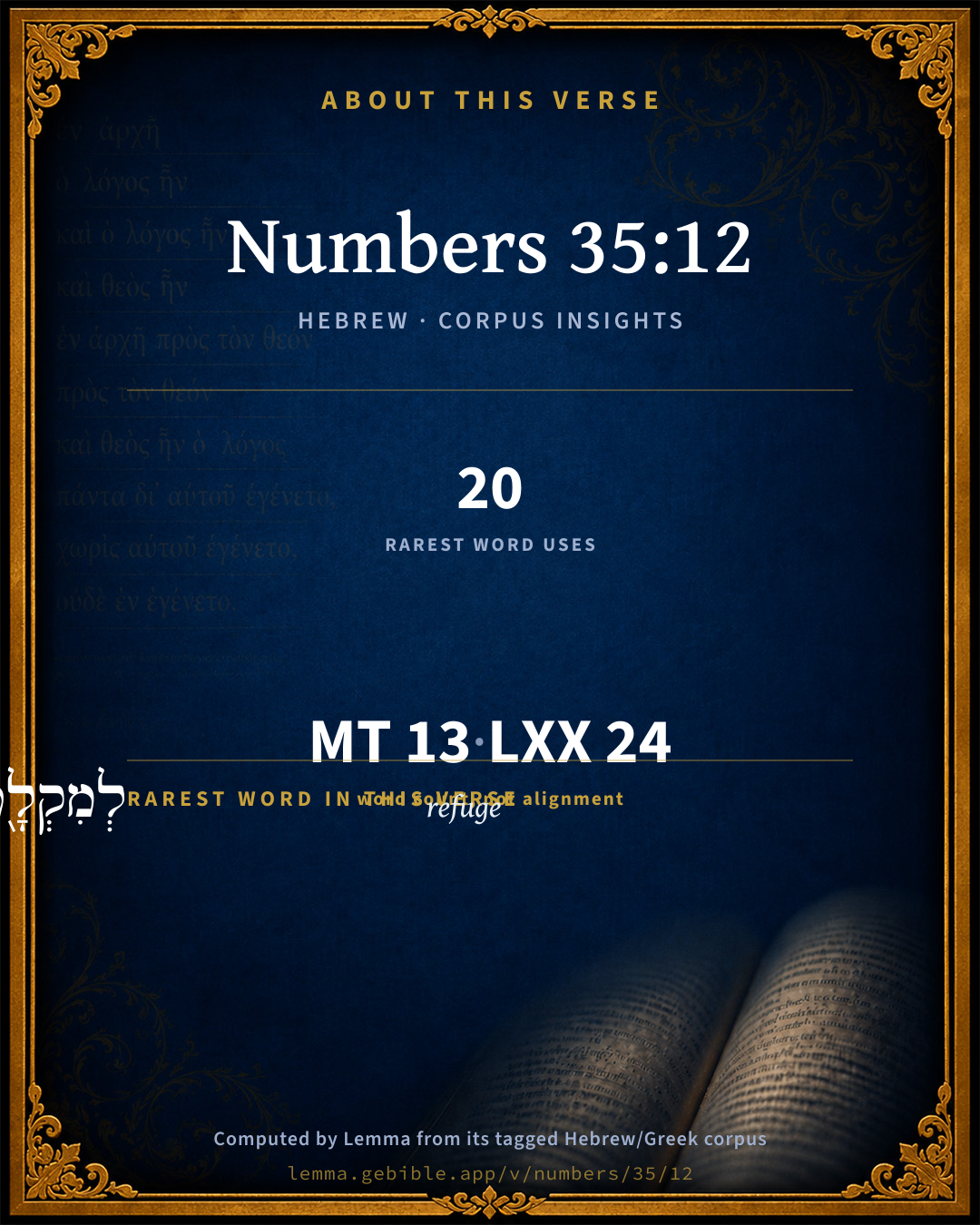
The rarest word here is לְמִקְלָ֖ט refuge H4733 — appearing just 20 times in the whole Hebrew Bible.

Shared distinctive vocabulary

לְמִקְלָ֖ט refuge H4733 occurs in 20 verses of the Hebrew Bible. Also found in:

Grammatical profile

  • 5 verbs
  • 5 nouns
  • 2 prepositions
  • 1 particle

Verb forms

  • וְהָי֨וּ Qal · Sequential Perfect
  • מִגֹּאֵ֑ל Qal · Participle Active
  • יָמוּת֙ Qal · Imperfect
  • הָרֹצֵ֔חַ Qal · Participle Active
  • עָמְד֛וֹ Qal · Infinitive Construct

Hebrew & Septuagint length

In English translation the verse runs 24 words from the Hebrew and 29 from the Septuagint (LXX English) — closely comparable.

A rough comparison of the two English renderings, which tokenize alike — not a word-level alignment.

Word counts can differ between the Hebrew and the Greek without any difference in meaning — e.g. the Hebrew direct-object marker אֵת has no separate Greek word, and Greek often adds the article ὁ.

In the original languages it is 13 Hebrew tokens and 24 Greek tokens — but the two are counted differently (Hebrew bundles its prefixes and suffixes into one token; the Greek is in lemma form), so that isn’t a like-for-like length.

Cross-references

7

Topical passages linked to Numbers 35:12 in the Treasury of Scripture Knowledge — connected by theme and wording, ordered by reader-vote popularity; previews shown in the World English Bible.

  • Deuteronomy 19:6 lest the avenger of blood pursue the manslayer, while his heart is hot, and overtake him, because the way is long, and strike him mortally; whereas he was not worthy of death, inasmuch as he didn't hate him in time past.
  • Joshua 20:3–6 that the manslayer who kills any person unwittingly [and] unawares may flee there: and they shall be to you for a refuge from the avenger of blood.
  • Joshua 20:9 These were the appointed cities for all the children of Israel, and for the stranger who sojourns among them, that whoever kills any person unwittingly might flee there, and not die by the hand of the avenger of blood, until he stood before the congregation.
  • 2 Samuel 14:7 Behold, the whole family is risen against your handmaid, and they say, Deliver him who struck his brother, that we may kill him for the life of his brother whom he killed, and so destroy the heir also. Thus will they quench my coal which is left, and will leave to my husband neither name nor remainder on the surface of the earth.
  • Numbers 35:19 The avenger of blood shall himself put the murderer to death: when he meets him, he shall put him to death.
  • Numbers 35:24–27 then the congregation shall judge between the striker and the avenger of blood according to these ordinances;
  • Deuteronomy 19:11–12 But if any man hate his neighbor, and lie in wait for him, and rise up against him, and strike him mortally so that he dies, and he flee into one of these cities;

Cross-references courtesy of OpenBible.info (CC BY 4.0).

Hebrew and Greek witnesses Masoretic Hebrew ↔ Greek Septuagint

The same verse in the two great witnesses to the Old Testament, shown verse-for-verse.

These are two independent witnesses, not word-aligned to each other, and the Septuagint is shown in lemma (dictionary) form.

Hebrew Numbers 35:12 Masoretic · Westminster Leningrad Codex

וְהָי֨וּ לָכֶ֧ם הֶעָרִ֛ים לְמִקְלָ֖ט מִגֹּאֵ֑ל וְלֹ֤א יָמוּת֙ הָרֹצֵ֔חַ עַד עָמְד֛וֹ לִפְנֵ֥י הָעֵדָ֖ה לַמִּשְׁפָּֽט

The cities shall be to you for refuge from the avenger, that the manslayer not die, until he stands before the congregation for judgment.

World English Bible · Public Domain

Greek LXX Numbers 35:12 Septuagint · lemma form

καί εἰμί ὁ πόλις σύ φυγαδευτήριον ἀπό ἀγχιστεύω ὁ αἷμα καί οὐ μή ἀποθνήσκω ὁ φονεύω ἕως ἄν ἵστημι ἔναντι ὁ συναγωγή εἰς κρίσις

And the cities shall be to you places of refuge from the avenger of blood, and the slayer shall not die until he stands before the congregation for judgment.

LXX2012 (modern English Septuagint) · Public Domain

On this verse, The Cambridge Bible for Schools and Colleges discusses the Septuagint’s reading. Read the note in Commentary ↓

Hebrew: Westminster Leningrad Codex (CC BY 4.0). Greek: Septuagint (public domain); English from LXX2012 (modern English Septuagint) (Public Domain). How the Septuagint differs from the Hebrew →

Targum (Aramaic paraphrase)

2

The Targum is the ancient Jewish Aramaic paraphrase of the Hebrew Scriptures — an interpretive translation, not the Hebrew text itself. Onkelos (literal) and Pseudo-Jonathan (expansive) render the Torah, and Jonathan the Prophets. Coverage is partial: where no permissively-licensed English translation exists for a verse, only the Aramaic is shown. This is verse-level text, not a word-by-word alignment to the Hebrew.

  1. Targum Onkelos Torah (Genesis–Deuteronomy)
    וִיהוֹן לְכוֹן קִרְוַיָא לְשֵׁזָבָא מִגָאֵל דְמָא וְלָא יְמוּת קָטוֹלָא עַד דְיֵקוּם קֳדָם כְּנִשְׁתָּא לְדִינָא

    (no public-domain English translation for this verse)

    Targum Onkelos — Aramaic: “Onkelos Genesis” (public domain); “Onkelos Exodus” (public domain); “Onkelos Leviticus” (public domain); “Onkelos Numbers” (public domain); “Onkelos Deuteronomy” (public domain). English: “Sefaria Community Translation” (CC0 1.0 (public-domain dedication)); “J.W. Etheridge. The Targums of Onkelos and Jonathan Ben Uzziel on the Pentateuch. London: Longmans, Green, 1862” (public domain). Text via Sefaria.

  2. Targum Pseudo-Jonathan Torah (Genesis–Deuteronomy)
    וִיהוֹן לְכוֹן קִרְוַיָא לְמִקְלַט קָטוֹלָא מִן תְּבַע אַדְמָא וְלָא יְמוּת קָטוֹלָא עַד דְיֵיקוּם קֳדָם כְּנִשְׁתָּא לְדִינָא

    And they shall be to you for cities of refuge for the manslayer from the avenger of blood, that the man may not be put to death till he shall have stood before the congregation for judgment.

    Targum Pseudo-Jonathan — Aramaic: “Targum Jonathan on Genesis” (public domain); “Targum Jonathan on Exodus” (public domain); “Targum Jonathan on Leviticus” (public domain); “Targum Jonathan on Numbers” (public domain); “Targum Jonathan on Deuteronomy” (public domain). English: “The Targum of Jonathan ben Uzziel, trans. J. W. Etheridge, London, 1862” (public domain). Text via Sefaria.

Commentary

Notes on Numbers 35:12 from classic Christian and Jewish commentators (each source and its license shown beneath its notes). The classic Christian expositions comment on the surrounding passage and are grouped to its opening verse, so a note may address several verses; the Jewish commentaries on the Tanakh (Rashi and others) are per-verse, so they appear only where the commentator wrote on this verse.

Lemma curates 59 commentaries, every one of them public domain or Creative Commons licensed, each selected and text-cleaned for this edition rather than reprinted as found. About our sources →

Joseph Benson's Commentary

Num 35:12. From the avenger — Hebrew, from the redeemer, or, from the next kinsman; to whom, by the law, belonged the right of redemption of the lands of, and vindication of the injury done to, the person deceased. Die not — Be not killed by the avenger meeting him in some other place. Before the congregation — Before the judges or elders who were appointed in every city for the decision of criminal causes, who were to examine, and that publicly before the people, whether the murder was wilful or casual.

Joseph Benson's Commentary on the Old and New Testaments (1811–1818) — public domain. Text from a community e-Sword module.

Tyndale Open Study Notes

Tyndale Open Resources

35:12 protection from a dead person’s relatives who want to avenge the death: Justice was enacted through vengeance at the hand of a designated avenger, usually a relative.

Tyndale Open Study Notes — © Tyndale Open Resources, licensed CC BY-SA 4.0. Text via the HelloAO Bible API.

Geneva Bible (1599)

Geneva Bible translators

Meaning, from the next of the kindred, who ought to pursue the cause.

Geneva Bible (1599) marginal notes — public domain. Text via Bolls.life.

Adam Clarke's Commentary

Verse 12. Until he stand before the congregation in judgment.] So one of these cities was not a perpetual asylum; It was only a pro tempore refuge, till the case could be fairly examined by the magistrates in the presence of the people, or the elders their representatives; and this was done in the city or place where he had done the murder, Jos 20:4; Jos 20:6. If he was found worthy of death, they delivered him to the avenger that he might be slain, De 19:12; if not, they sent him back to the city of refuge, where he remained till the death of the high priest, Nu 35:25. Before the cities of refuge were appointed, the altar appears to have been a sanctuary for those who had killed a person unwittingly; see on Ex 21:13; Ex 21:14.

Adam Clarke's Commentary on the Bible (1810–1826) — public domain. Text from a community e-Sword/MySword module.

Ellicott's Commentary for English Readers

(12) And they shall be unto you cities for refuge . . . —Better, And the cities shall be unto you for refuge (or, as a place of refuge) from the avenger, that the manslayer may not die until he stand before the congregation for judgment. The avenger (Heb., goel) was the near kinsman whose office it was to redeem the person or inheritance of his kinsman, if that kinsman was reduced by poverty to sell himself into slavery, or to sell his inheritance; and also to avenge his blood in the event of his being slain. (See Lev_25:25-55, and Notes.) The law of the goel, as contained in this chapter, served to keep in check the excited passions of the near relations of the man who had been slain, and to secure for him a fair and impartial trial. The duties which devolved upon the congregation are stated in Num_35:24-25. Christ, as our “Redeemer” (Heb., goel), ever lives (Job_19:25). He has redeemed the persons and the inheritance of His people by His death; and He will in the last great day, ransom them from the power of the grave, and redeem them from death (Hos_13:4, where the cognate verb to goel occurs), and will avenge their blood on them that dwell on the earth (Rev_6:10).

A Bible Commentary for English Readers, edited by Charles John Ellicott (1878–1897) — public domain. Text from a community e-Sword module.

The Cambridge Bible for Schools and Colleges

gen. ed. J. J. S. Perowne

12. the avenger] Heb. gô’çl, the nearest representative of the family of the slain man. Perhaps (with LXX. ) we should read ‘the avenger of blood,’ as in Num_35:19; Num_35:21. On the gô’çl and his duties see n. on Num_35:8.

the congregation] It is not clearly stated that this means the congregation of the manslayer’s city; and the word ‘çdah elsewhere in P denotes the whole community of Israel. But in Num_35:25 (see note there) the words ‘restore him to his city of refuge’ imply that the ‘congregation’ have taken him to some other place for judgement, which would more probably be his own city than any other; and in Deu_19:12 the judges in the case of murder are ‘the elders of his city.’

The Cambridge Bible for Schools and Colleges (gen. ed. J. J. S. Perowne; Cambridge University Press, 1878–1918) — public domain. Text from a community e-Sword module.

John Gill's Exposition

And they shall be unto you cities of refuge from the avenger,.... Or near kinsman; for as the right of redemption of an estate that was mortgaged belonged to such an one, so of revenging the blood of any one that was killed:

that the manslayer die not; by the hand of the avenger, who in the heat of his passion would, could he come at him, fall upon him, and slay him, to avenge the death of his relation on him:

until he stand before the congregation in judgment; before the court of judicature, to be examined, tried, and judged, whether the murder was committed knowingly and willingly, or whether through mistake and at unawares: this was done either before the court of judicature in the city of refuge, who took cognizance of such cases directly, that they might know whom to harbour and protect, and whom not; or before the court in the place where the act was committed: interpreters are divided about this; and Calmet (l) is of opinion that he was examined in both courts, first more strictly in the city of refuge, and then more slightly in the place where it was done, which is not improbable; however, this seems manifest from Num 35:25, that the court where it was committed had power to fetch him from the city of refuge, and set him before them, and examine into the case; and, if an innocent person, restored him to the city of refuge, whither he had fled.

(l) Dictionary, on the word "Refuge".

John Gill's Exposition of the Whole Bible (1746–1763) — public domain (CC PDM 1.0). Text via the HelloAO Bible API.

Albert Barnes' Notes on the Bible

The avenger - Hebrew גאל gā'al, a term of which the original import is uncertain. The very obscurity of its etymology testifies to the antiquity of the office which it denotes. That office rested on the principle of Gen 9:6, “whoso sheddeth man’s blood, by man shall his blood be shed.” The unwritten code of the East conceded to the nearest kinsman of a murdered man the right of avenging the blood that had been shed. Such rude justice necessarily involved grave evils. It gave no opportunity to the person charged with crime of establishing is innocence; it recognized no distinction between murder, manslaughter, and accidental homicide; it perpetuated family blood-feuds, the avenger of blood being liable to be treated in his turn as a murderer by the kinsman of the man whom he had slain. These grievances could not be removed as long as there was no central government, but they might be mitigated; and to do this was the object of the institution in the text (compare Exo 21:13).

Among the Arab tribes, who are under the control of no central authority, the practice of blood-revenge subsists in full force to the present day.

The congregation - i. e. local court, consisting of the elders of the city Jos 20:4.

Albert Barnes' Notes on the Bible (1834–1885) — public domain. Text from a community e-Sword/MySword module.

Haydock's Catholic Bible Commentary

Kinsman, the nearest relation, who was called the revenger of blood, (ver. 25, 27.; Haydock) or the redeemer, because it was his duty to see that justice was done to the deceased. When the person, who had involuntarily committed murder, arrived at the city, he was to make his appearance before the judges of it, and, if they thought his account satisfactory, they admitted him, but upon condition that he should take his trial before the judges and the people of that country where the murder had taken place, (ver. 25., and Josue xx. 4, 9.; Tirinus) though some think that the judges of the city of refuge, passed sentence. (Masius; &c.) --- If it proved favourable, he was bound to remain in the city till the death of the high priest, otherwise the relations might kill him as an outlaw; as they might also if he was declared guilty. In case the murder were voluntary, the judges of the place where it was committed set to demand the criminal, Deuteronomy xix. 11.

George Leo Haydock (1774–1849), Haydock's Catholic Family Bible and Commentary, 1859 edition — public domain. Excludes Psalms (Douay-Rheims chapter numbering differs from Protestant) and Deuterocanonical books (Catholic canon only).

Matthew Poole's English Annotations

The avenger, to wit, of the party slain, or, of blood, as it is fully expressed below, Num 35:19,25; Heb. from the redeemer, or, from the next kinsman, to whom by the law belonged the right of redemption of the lands of, and vindication of the injury done to the person deceased.

Die not, i.e. be not killed by the avenger meeting him in some other place.

Before the congregation, i.e. before the society or convention of judges or elders, who were appointed in every city for the decision of criminal causes, who were twenty-three, who were to examine the matter, and that publicly before the people, whether the murder was wilful or casual.

Quest. In what city was this cause to be tried?

Answ. Some say in the city of refuge, others say in the city in or near which the fact was committed. It seems to me it was done in both, at first in the city of refuge, as is manifest in Jos 20:4; but if that trial and sentence did not satisfy the avenger of blood, it was fully and finally determined in the other city, as is sufficiently evident both by comparing this place with Num 35:25; Jos 20:6, and from the usual and most reasonable course of justice, which is that facts should be examined, as far as may be, in or near the places where they were committed, and where the witnesses and evidences were at hand. In judgment, or, for judgment, i. e. to receive sentence there according to the nature of the fact.

Matthew Poole's English Annotations on the Holy Bible (1683–1685) — public domain. Text from a community e-Sword/MySword module.

Whedon's Commentary on the Bible

Daniel D. Whedon

12. Avenger — Joshua adds, “of blood.” See note cited above. The goel, redeemer, is “that particular relative whose special duty it was to restore the violated family integrity, who had to redeem not only landed property that had been alienated from the family, or a member of the family who had fallen into servitude, (Lev_25:25-47,) but also the blood that had been taken away from the family by murder.” — Oehler.

Until he stand before the congregation — The refugee, on his arrival at the city of refuge, made his plea to the elders of the city, who protected him till he was sent for. See note on Jos_20:6. The cities of refuge were not designed to screen a real murderer from being put to death, but merely to secure a fair judicial investigation.

Daniel D. Whedon (gen. ed.), Commentary on the Old and New Testaments (1874–1909) — public domain. Text from a community e-Sword module.

The Pulpit Commentary

From the avenger. Hebrew, laegO. Septuagint, o agcisteuwn to aima . In all other passages (twelve in number) where the word occurs in this sense it is qualified by the addition "of blood." Standing by itself, it is everywhere else translated "kinsman," or (more properly) "redeemer," and is constantly applied in that sense to God our Saviour. (Job_19:25 Isa_63:16 &c.); The two ideas, however, which seem to us so distinct, and even so opposed, are in their origin one. To the men of the primitive age, when public justice was not, and when might was right, the only protector was one who could and would avenge them of their wrongs, and by avenging prevent their repetition. This champion of the injured individual, or rather family, for rights and wrongs were thought of as belonging to families rather than to individuals, was their goel, who had their peace, their safety, above all, their honour, in his charge. For no sentiments spring up quicker, and none exercise a more tyrannous sway, than the sentiment of honour, which in its various and often strangely distorted forms has always perhaps outweighed all other considerations in the minds of men. Now the earliest form in which the sentiment of honour asserted itself was in the blood-feud. If one member of a family was slain, an intolerable shame and sense of contumely rested upon the family until blood had been avenged by blood, until "satisfaction" had been done by the death of the manslayer. He who freed the family from this intolerable pain and humiliation who enabled it to hold up its head, and to breathe freely once more was the goel; and in the natural order of things he was the nearest "kinsman" of the slain who could and would take the duty upon him. To these natural feelings was added in many cases a religious sentiment which regarded homicide as a sin against the higher Powers for which they too demanded the blood of the guilty. Such was the feeling among the Greeks, and probably among the Egyptians, while among the Hebrews it could plead Divine sanction, given in the most comprehensive terms: "Your blood of your lives will I require, at the hand of every beast will I require it; and at the hand of man; ... whoso sheddeth man"s blood, by man shall his blood be shed". (Gen_9:5, Gen_9:6) The moral difficulties of this proclamation need not here be considered; it is enough to take note that the Divine law itself recognized the duty as well as the lawfulness of private blood-revenge when public justice could not be depended on. The goel, therefore, was not merely the natural champion of his family, nor only the deliverer who satisfied the imperious demands of an artificial code of honour; he was a minister of God, in whose patient efforts to hunt down his victim the thirst for vengeance was to some extent at least superseded by, or rather transmuted into, the longing to glorify God. (compare the difficult case of Rev_6:10) It was not merely human feelings of great reach and tenacity which were outraged by the immunity of the manslayer; it was still more the justice of God which received a grievous wound. Just because, however, God had made the cause of the slain man his own, and had sanctioned the avenging mission of the goel, he could therefore regulate the course of vengeance so as to make it run as even as possible with true justice. It was not indeed possible to distinguish ab initio between the homicide which deserved and that which did not deserve capital punishment. Such distinction, difficult under any circumstances, was impossible when vengeance was in private hands. But while the goel could not be restrained from immediate pursuit unhindered by investigation or compunction (lest his whole usefulness be paralyzed), the manslayer might have opportunity to escape, and to be sheltered under the Divine mercy until he could establish (if that were possible) his innocence. No better instance can be found of the way in which the King of Israel adopted the sentiments and institutions of a semi-barbarous age, added to them the sanctions of religion, and so modified them as to secure the maximum of practical good consistent with the social state and moral feelings of the people. No doubt many an individual was overtaken and slain by the goel who did. not deserve to die according to our ideas; but where perfection was unattainable, this error was far less dangerous to that age than the opposite error of diminishing the sanctity of human life and the awfulness of Divine justice. The congregation. Hebrew, hde. This word is used frequently from Exo_12:3 to the end of this chapter, and again in Joshua and the last two chapters of Judges. It is not found in Deuteronomy, nor often in the later books. In every case apparently eydah signifies the whole nation as gathered together, e.g., as represented by all who had an acknowledged right to appear, for of course 600, 000 men could not gather together in any one place. The force of the word may be understood by reference to its use in Jud_1:20:1 21:10, 13, 16. Another word (lhq) is also used, less frequently in Leviticus and Numbers, but more frequently in the later books, for the general assembly of the people of Israel. No distinction of meaning can be drawn between the two words, and it cannot, therefore, be maintained that the "congregation" of this verse means the local elders of Jos_20:4. The regulations there laid down are not inconsistent with the present law, but are quite independent of it. They refer to a preliminary hearing of the case as stated by the fugitive alone in order to determine his right to shelter in the mean time; which right, if accorded, was without prejudice to the future judgment of the "congregation" on the whole facts of the case (see below on verse 25).

The Pulpit Commentary (1880–1919), ed. H.D.M. Spence-Jones & Joseph S. Exell — public domain. Text from a community e-Sword module.

John Wesley's Explanatory Notes

From the avenger - Hebrew. from the redeemer, or, from the next kinsman, to whom by the law belonged the right of redemption of the lands of; and vindication of the injury done to, the person deceased. Die not - Be not killed by the avenger meeting him in some other place. Before the congregation - Before the Judges or elders who were appointed in every city for the decision of criminal causes, who were to examine, and that publickly before the people, whether the murder was wilful or casual.

John Wesley, Explanatory Notes Upon the Whole Bible (1754–1765) — public domain. Text via the GEBible commentary corpus.

Keil & Delitzsch

C. F. Keil & F. Delitzsch

These towns were to serve for a refuge from the avenger of blood, that the manslayer might not die before he had taken his trial in the presence of the congregation. The number of cities was fixed at six, three on the other side of the Jordan, and three on this side in the land of Canaan, to which both the children of Israel, and also the foreigners and settlers who were dwelling among them, might flee. In Deu 19:2., Moses advises the congregation to prepare (הכין) the way to these cities, and to divide the territory of the land which Jehovah would give them into three parts (שׁלּשׁ), i.e., to set apart a free city in every third of the land, that every manslayer might flee thither, i.e., might be able to reach the free city without being detained by length of distance or badness of road, lest, as is added in Deu 19:6, the avenger of blood pursue the slayer while his heart is hot (יחם, imperf. Kal of חמם), and overtake him because the way is long, and slay him (נפשׁ הכּה, as in Gen 37:21), whereas he was not worthy of death (i.e., there was no just ground for putting him to death), "because he had not done it out of hatred." The three cities of refuge on the other side were selected by Moses himself (Deu 4:41-43); the three in Canaan were not appointed till the land was distributed among the nine tribes and a half (Jos 20:7). Levitical or priests' towns were selected for all six, not only because it was to the priests and Levites that they would first of all look for an administration of justice (Schultz on Deu 19:3), but also on the ground that these cities were the property of Jehovah, in a higher sense than the rest of the land, and for this reason answered the idea of cities of refuge, where the manslayer, when once received, was placed under the protection of divine grace, better than any other places possibly could.

The establishment of cities of refuge presupposed the custom and right of revenge. The custom itself goes back to the very earliest times of the human race (Gen 4:15, Gen 4:24; Gen 27:45); it prevailed among the Israelites, as well as the other nations of antiquity, and still continues among the Arabs in unlimited force (cf. Niebuhr, Arab. pp. 32ff.; Burckhardt, Beduinen, 119, 251ff.). "Revenge of blood prevailed almost everywhere, so long as there was no national life generated, or it was still in the first stages of its development; and consequently the expiation of any personal violation of justice was left to private revenge, and more especially to family zeal" (Oehler in Herzog's B. Cycl., where the proofs may be seen). The warrant for this was the principle of retribution, the jus talionis, which lay at the foundation of the divine order of the world in general, and the Mosaic law in particular, and which was sanctioned by God, so far as murder was concerned, even in the time of Noah, by the command, "Whoso sheddeth man's blood," etc. (Gen 9:5-6). This warrant, however, or rather obligation to avenge murder, was subordinated to the essential principle of the theocracy, under the Mosaic law. Whilst God Himself would avenge the blood that was shed, not only upon men, but upon animals also (Gen 9:5), and commanded blood-revenge, He withdrew the execution of it from subjective caprice, and restricted it to cases of premeditated slaying or murder, by appointing cities of refuge, which were to protect the manslayer from the avenger, until he took his trial before the congregation. גּאל, redeemer, is "that particular relative whose special duty it was to restore the violated family integrity, who had to redeem not only landed property that had been alienated from the family (Lev 25:25.), or a member of the family that had fallen into slavery (Lev 25:47.), but also the blood that had been taken away from the family by murder" (Oehler). In the latter respect he was called הדּם גּאל, (Num 35:19, Num 35:21, Num 35:24.; Deu 19:6, Deu 19:12). From Sa2 14:7, we may see that it was the duty of the whole family to take care that blood-revenge was carried out. The performance of the duty itself, however, was probably regulated by the closeness of the relationship, and corresponded to the duty of redeeming from bondage (Lev 25:49), and to the right of inheritance (Num 27:8.). What standing before the congregation was to consist of, is defined more fully in what follows (Num 35:24, Num 35:25). If we compare with this Jos 20:4., the manslayer, who fled from the avenger of blood into a free city, was to stand before the gates of the city, and state his cause before the elders. They were then to receive him into the city, and give him a place that he might dwell among them, and were not to deliver him up to the avenger of blood till he had stood before the congregation for judgment. Consequently, if the slayer of a man presented himself with the request to be received, the elders of the free city had to make a provisional inquiry into his case, to decide whether they should grant him protection in the city; and then if the avenger of blood appeared, they were not to deliver up the person whom they had received, but to hand him over, on the charge of the avenger of blood, to the congregation to whom he belonged, or among whom the act had taken place, that they might investigate the case, and judge whether the deed itself was wilful or accidental.

Keil & Delitzsch — Biblical Commentary on the Old Testament (1861–1891) — public domain (CC PDM 1.0). Text via the HelloAO Bible API. (Old Testament only.)

Scofield Reference Notes

C. I. Scofield

avenger

Heb. "goel," Redemp. (Kinsman type). (See Scofield "Isa 59:20").

The Scofield Reference Bible (1917 edition), notes by C. I. Scofield — public domain. Text from a community e-Sword module.

unfoldingWord translationNotes

Door43 World Missions Community

the avenger

This refers to a close relative that seeks vengeance by killing the accused man.

so that the accused man will not be killed without first standing trial before the community

This can be stated in active form. AT: "so that no one will kill the accused man before the community is able to judge him in court" (See: Active or Passive)

translationWords

refuge

avenge

unfoldingWord translationNotes — © Distant Shores Media and the Door43 World Missions Community, licensed CC BY-SA 4.0. Source: git.door43.org/Door43/en_tn.

Rashi

Rabbi Shlomo Yitzchaki (Rashi)

מגאל — [AND THE CITIES SHALL BE UNTO YOU AS A REFUGE] מגאל — i.e. as a refuge on account of the avenger of blood, — he who is the near relative of the murdered man.

Rashi on the Tanakh — English translations: “The Judaica Press complete Tanach with Rashi, translated by A. J. Rosenberg” (CC BY 4.0); “Pentateuch with Rashi's commentary by M. Rosenbaum and A.M. Silbermann, 1929-1934” (public domain); “The Metsudah Tanach series, Lakewood, N.J” (CC BY 4.0); and “The Book of Joshua, Metsudah Publications, 1997” (CC BY 4.0). Text via Sefaria.

Lesson kit

Teaching starters — assembled from the data on this page, not authored interpretation. Every prompt links to the verse data it draws on. Edit before teaching.

Numbers, in the Pentateuch, opens this verse with 13 words (12 distinct Hebrew lemmas). Its most distinctive word is miqlâṭ (“refuge”). A historical commentator’s framing appears above. Read the whole chapter for the surrounding context.

Discussion questions

  1. What does “refuge” (miqlâṭ) contribute to the verse as a whole?
  2. How does Numbers 35:6, which shares the word «refuge», read alongside this verse?
  3. These translations render this verse differently; the difference is in the English rendering, not the original. What questions does that raise?
  4. «וְהָי֨וּ» is a Qal Sequential Perfect verb. How does that grammatical form shape the action described?
  5. Compare how Joseph Benson's Commentary and Tyndale Open Study Notes read this verse. Where do they agree or differ?

Things to notice

Reading settings

Reading text

Shown beneath each verse's original-language words.

Old Testament
Old Testament edition

Read the OT as the Masoretic Hebrew (MT) or the Greek Septuagint (LXX).

English shown for the Greek Septuagint (in the Hebrew ↔ Greek comparison).

Comparing translations? Open the Compare panel on any verse page to stack up to four side by side.