Leviticus 20:9

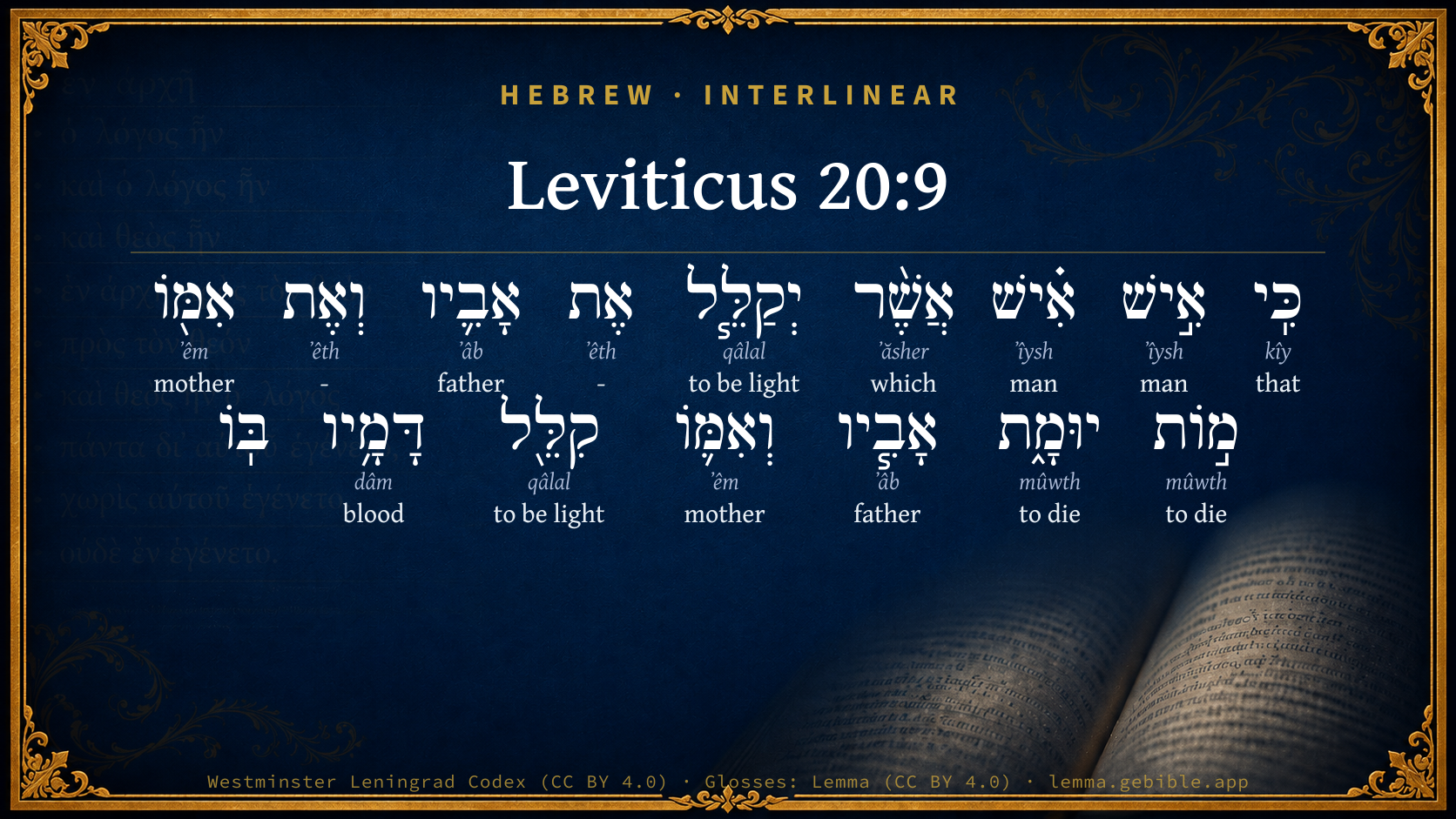
Hebrew (Westminster Leningrad Codex) Leviticus 20:9 appears in the Hebrew Old Testament. The text above is from the Westminster Leningrad Codex. Each word links to its Strong’s number, a concise gloss, and parsing drawn from the Open Scriptures Hebrew Bible morphology. Click any word for its full Brown-Driver-Briggs (BDB) entry.
Download image
Cite this verse

Leviticus 20:9 (World English Bible). Public Domain. Lemma interlinear Bible study tool, https://lemma.gebible.app/v/leviticus/20/9.

Show BibTeX & RIS
BibTeX
RIS
English Translation
"'For everyone who curses his father or his mother shall surely be put to death: he has cursed his father or his mother; his blood shall be upon him.
World English Bible · Public Domain
Download a study sheet

One document with this verse’s original text, its word-by-word gloss line, the meaning frame, cross-references with their text, attributed commentary, and full source and license credits — printable, and it pastes into notes with its structure intact.

This verse Autodidact and up

Study sheet (.html) Plain text (.txt)

A passage Seminary Student

Up to 50 verses in one chapter. A passage sheet keeps up to 6 commentary sources and 12 cross-references per verse, in the order this page ranks them, and says so on the sheet whenever that leaves anything out. Ask for a single verse and you get the Autodidact verse sheet above.

Everything on this page stays free to read, with no account — the sheet is a download of what is already on screen, not access to it.

Want to remove ads? Support Godless Engineer
Compare translations 3

The same verse in 3 English versions, stacked beneath the original-language interlinear above. Click any original word for its lexicon entry.

Each is an independent rendering of the whole verse — the interlinear is not word-aligned to these translations.

Highlighted words mark where these versions differ — a whole-verse word diff, not a word-by-word alignment.

  • World English Bible Public Domain
    "'For everyone who curses his father or his mother shall surely be put to death: he has cursed his father or his mother; his blood shall be upon him.
  • King James Version Public Domain
    For every one that curseth his father or his mother shall be surely put to death: he hath cursed his father or his mother; his blood shall be upon him.
  • unfoldingWord Literal Text CC BY-SA 4.0
    When a man, a man who curses his father or his mother, dying—he shall be executed. His father and his mother he has cursed; his blood on him.

unfoldingWord Literal Text — © unfoldingWord, licensed CC BY-SA 4.0. Word-aligned USFM3 via Door43 (git.door43.org/unfoldingWord/en_ult).

Versions to compare (up to 4)

3 of 4 selected

Show all 18 translations

Every available English version of this verse, each an independent rendering of the whole verse.

  • World English Bible Public Domain
    "'For everyone who curses his father or his mother shall surely be put to death: he has cursed his father or his mother; his blood shall be upon him.
  • Berean Standard Bible Public Domain
    If anyone curses his father or mother, he must be put to death. He has cursed his father or mother; his blood shall be upon him.
  • Majority Standard Bible Public Domain
    If anyone curses his father or mother, he must be put to death. He has cursed his father or mother; his blood shall be upon him.
  • King James Version Public Domain
    For every one that curseth his father or his mother shall be surely put to death: he hath cursed his father or his mother; his blood shall be upon him.
  • American Standard Version (1901) Public Domain
    For every one that curseth his father or his mother shall surely be put to death: he hath cursed his father or his mother; his blood shall be upon him.
  • Revised Version (1885) Public Domain
    For every one that curseth his father or his mother shall surely be put to death: he hath cursed his father or his mother; his blood shall be upon him.
  • Geneva Bible (1599) Public Domain
    If there be any that curseth his father or his mother, he shall die the death: seeing hee hath cursed his father and his mother, his blood shalbe vpon him.
  • Douay-Rheims (1899) Public Domain
    He that curseth his father, or mother, dying let him die: he hath cursed his father, and mother, let his blood be upon him.
  • Young's Literal Translation Public Domain
    `For any man who revileth his father and his mother is certainly put to death; his father and his mother he hath reviled: his blood `is' on him.
  • Literal Standard Version CC BY-SA 4.0
    For any man who reviles his father and his mother is certainly put to death; he has reviled his father and his mother: his blood [is] on him.
  • Unlocked Literal Bible CC BY-SA 4.0
    Everyone who curses his father or his mother must surely be put to death. He has cursed his father or his mother, so he is guilty and deserves to die.
  • unfoldingWord Literal Text CC BY-SA 4.0
    When a man, a man who curses his father or his mother, dying—he shall be executed. His father and his mother he has cursed; his blood on him.
  • Darby Bible Public Domain
    Whatever man revileth his father and his mother shall certainly be put to death: he hath reviled his father and his mother; his blood is upon him.
  • World Messianic Bible Public Domain
    “‘For everyone who curses his father or his mother shall surely be put to death. He has cursed his father or his mother. His blood shall be upon himself.
  • Webster's Bible Public Domain
    For every one that curseth his father or his mother, shall surely be put to death: he hath cursed his father or his mother; his blood shall be upon him.
  • Free Bible Version CC BY-SA 4.0
    Anyone who curses their father or mother must be executed. They have cursed their father or mother; they bear the responsibility for their punishment.
  • Bible in Basic English Public Domain
    Every man cursing his father or his mother is certainly to be put to death; because of his curse on his father or his mother, his blood will be on him.
  • JPS Tanakh (1917) Public Domain
    For whatsoever man there be that curseth his father or his mother shall surely be put to death; he hath cursed his father or his mother; his blood shall be upon him.

Literal Standard Version (2020), Covenant Press — licensed CC BY-SA 4.0. Text via the HelloAO Bible API (eBible.org). Unlocked Literal Bible (unfoldingWord) — licensed CC BY-SA 4.0. Text via the HelloAO Bible API (eBible.org). unfoldingWord Literal Text — © unfoldingWord, licensed CC BY-SA 4.0. Word-aligned USFM3 via Door43 (git.door43.org/unfoldingWord/en_ult). Free Bible Version, Dr. Jonathan Gallagher — licensed CC BY-SA 4.0. Text via the HelloAO Bible API (eBible.org).

Word by word

More ways to search: Search by grammar → Find every occurrence → Compare this word →

Practice this passage: Drill this verse → Learn its vocabulary →

יְקַלֵּ֧ל
qâlal
H7043
“to be light”
Verb, Piel, Imperfect, 3rd Person, Masculine, Singular
Part of Speech
Verb
Stem
Piel
Form
Imperfect
Person
3rd Person
Gender
Masculine
Number
Singular
Full BDB Definition

Origin: a primitive root

TWOT: 2028

to be slight, be swift, be trifling, be of little account, be light - (Qal) - to be slight, be abated (of water) - to be swift - to be trifling, be of little account - (Niphal) - to be swift, show oneself swift - to appear trifling, be too trifling, be insignificant - to be lightly esteemed - (Piel) - to make despicable - to curse - (Pual) to be cursed - (Hiphil) - to make light, lighten - to treat with contempt, bring contempt or dishonour - (Pilpel) - to shake - to whet - (Hithpalpel) to shake oneself, be moved to and fro
  1. כִּֽי kîy H3588 “that” Conjunction
  2. אִ֣ישׁ ʼîysh H376 “man” Noun, Common, Masculine, Singular, Absolute
  3. אִ֗ישׁ ʼîysh H376 “man” Noun, Common, Masculine, Singular, Absolute
  4. אֲשֶׁ֨ר ʼăsher H834 “which” Particle, Relative
  5. אֶת ʼêth H853 “-” Particle, Direct Object
  6. אָבִ֛יו ʼâb H1 “father · his” Noun, Common, Masculine, Singular, Construct + Suffix, Personal, 3rd Person, Masculine, Singular
  7. וְאֶת ʼêth H853 “and · -” Conjunction + Particle, Direct Object
  8. אִמּ֖וֹ ʼêm H517 “mother · his” Noun, Common, Feminine, Singular, Construct + Suffix, Personal, 3rd Person, Masculine, Singular
  9. מ֣וֹת mûwth H4191 “to die” Verb, Qal, Infinitive Absolute
  10. יוּמָ֑ת mûwth H4191 “to die” Verb, Hophal, Imperfect, 3rd Person, Masculine, Singular
  11. אָבִ֧יו ʼâb H1 “father · his” Noun, Common, Masculine, Singular, Construct + Suffix, Personal, 3rd Person, Masculine, Singular
  12. וְאִמּ֛וֹ ʼêm H517 “and · mother · his” Conjunction + Noun, Common, Feminine, Singular, Construct + Suffix, Personal, 3rd Person, Masculine, Singular
  13. קִלֵּ֖ל qâlal H7043 “to be light” Verb, Piel, Perfect, 3rd Person, Masculine, Singular
  14. דָּמָ֥יו dâm H1818 “blood · his” Noun, Common, Masculine, Plural, Construct + Suffix, Personal, 3rd Person, Masculine, Singular

About this verse

These counts appear in no published source. They are computed here, from the morphology-tagged text and Lemma’s own curated glosses. What Lemma adds →

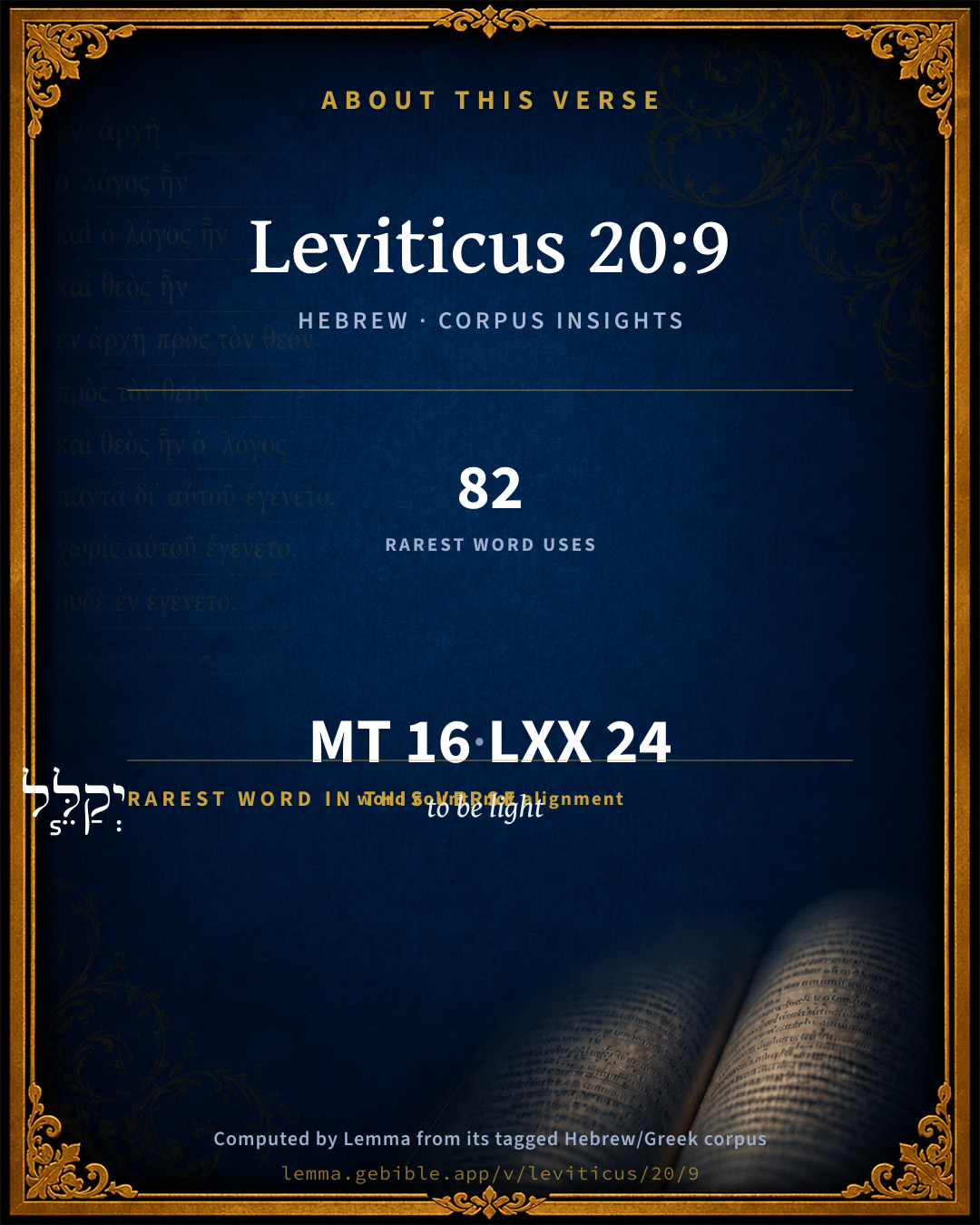
16
words
9
distinct lemmas
Pentateuch
section

Grammatical profile

  • 4 verbs
  • 7 nouns
  • 1 preposition
  • 1 conjunction
  • 3 particles

Verb forms

  • יְקַלֵּ֧ל Piel · Imperfect
  • מ֣וֹת Qal · Infinitive Absolute
  • יוּמָ֑ת Hophal · Imperfect
  • קִלֵּ֖ל Piel · Perfect

Repetition

Words recur within this verse — often emphatic in Hebrew:

  • אִ֣ישׁ man H376 ×2
  • יְקַלֵּ֧ל to be light H7043 ×2
  • אָבִ֛יו father H1 ×2
  • אִמּ֖וֹ mother H517 ×2
  • מ֣וֹת to die H4191 ×2

Hebrew & Septuagint length

In English translation the verse runs 29 words from the Hebrew and 32 from the Septuagint (LXX English) — closely comparable.

A rough comparison of the two English renderings, which tokenize alike — not a word-level alignment.

Word counts can differ between the Hebrew and the Greek without any difference in meaning — e.g. the Hebrew direct-object marker אֵת has no separate Greek word, and Greek often adds the article ὁ.

In the original languages it is 16 Hebrew tokens and 24 Greek tokens — but the two are counted differently (Hebrew bundles its prefixes and suffixes into one token; the Greek is in lemma form), so that isn’t a like-for-like length.

Cross-references

11

Topical passages linked to Leviticus 20:9 in the Treasury of Scripture Knowledge — connected by theme and wording, ordered by reader-vote popularity; previews shown in the World English Bible.

  • Exodus 21:17 "Anyone who curses his father or his mother shall surely be put to death.
  • Mark 7:10 For Moses said, 'Honor your father and your mother;' and, 'He who speaks evil of father or mother, let him be put to death.'
  • Deuteronomy 27:16 Cursed be he who sets light by his father or his mother. All the people shall say, Amen.
  • Matthew 15:4 For God commanded, 'Honor your father and your mother,' and, 'He who speaks evil of father or mother, let him be put to death.'
  • Proverbs 20:20 Whoever curses his father or his mother, His lamp shall be put out in blackness of darkness.
  • Proverbs 30:17 The eye that mocks at his father, And scorns obedience to his mother: The ravens of the valley shall pick it out, The young eagles shall eat it.
  • 2 Samuel 1:16 David said to him, Your blood be on your head; for your mouth has testified against you, saying, I have slain Yahweh's anointed.
  • Proverbs 30:11 There is a generation that curses their father, And doesn't bless their mother.
  • Judges 9:24 that the violence done to the seventy sons of Jerubbaal might come, and that their blood might be laid on Abimelech their brother, who killed them, and on the men of Shechem, who strengthened his hands to kill his brothers.
  • Leviticus 20:11–13 The man who lies with his father's wife has uncovered his father's nakedness: both of them shall surely be put to death; their blood shall be upon them.
  • Matthew 27:25 All the people answered, "May his blood be on us, and on our children!"

Cross-references courtesy of OpenBible.info (CC BY 4.0).

Hebrew and Greek witnesses Masoretic Hebrew ↔ Greek Septuagint

The same verse in the two great witnesses to the Old Testament, shown verse-for-verse.

These are two independent witnesses, not word-aligned to each other, and the Septuagint is shown in lemma (dictionary) form.

Hebrew Leviticus 20:9 Masoretic · Westminster Leningrad Codex

כִּֽי אִ֣ישׁ אִ֗ישׁ אֲשֶׁ֨ר יְקַלֵּ֧ל אֶת אָבִ֛יו וְאֶת אִמּ֖וֹ מ֣וֹת יוּמָ֑ת אָבִ֧יו וְאִמּ֛וֹ קִלֵּ֖ל דָּמָ֥יו בּֽוֹ

"'For everyone who curses his father or his mother shall surely be put to death: he has cursed his father or his mother; his blood shall be upon him.

World English Bible · Public Domain

Greek LXX Leviticus 20:9 Septuagint · lemma form

ἄνθρωπος ἄνθρωπος ὅς ἄν κακῶς εἶπον ὁ πατήρ αὐτός ἤ ὁ μήτηρ αὐτός θάνατος θανατόω πατήρ αὐτός ἤ μήτηρ αὐτός κακῶς εἶπον ἔνοχος εἰμί

Every man who shall speak evil of his father or of his mother, let him die the death; has he spoken evil of his father or his mother? he shall be guilty.

LXX2012 (modern English Septuagint) · Public Domain

Hebrew: Westminster Leningrad Codex (CC BY 4.0). Greek: Septuagint (public domain); English from LXX2012 (modern English Septuagint) (Public Domain). How the Septuagint differs from the Hebrew →

Targum (Aramaic paraphrase)

2

The Targum is the ancient Jewish Aramaic paraphrase of the Hebrew Scriptures — an interpretive translation, not the Hebrew text itself. Onkelos (literal) and Pseudo-Jonathan (expansive) render the Torah, and Jonathan the Prophets. Coverage is partial: where no permissively-licensed English translation exists for a verse, only the Aramaic is shown. This is verse-level text, not a word-by-word alignment to the Hebrew.

  1. Targum Onkelos Torah (Genesis–Deuteronomy)
    אֲרֵי גְבַר גְבַר דִי יְלוּט יָת אֲבוּהִי וְיָת אִמֵהּ אִתְקְטָּלָא יִתְקְטֵל אֲבוּהִי וְאִמֵהּ לַטּ קְטָלָא חַיָב

    (no public-domain English translation for this verse)

    Targum Onkelos — Aramaic: “Onkelos Genesis” (public domain); “Onkelos Exodus” (public domain); “Onkelos Leviticus” (public domain); “Onkelos Numbers” (public domain); “Onkelos Deuteronomy” (public domain). English: “Sefaria Community Translation” (CC0 1.0 (public-domain dedication)); “J.W. Etheridge. The Targums of Onkelos and Jonathan Ben Uzziel on the Pentateuch. London: Longmans, Green, 1862” (public domain). Text via Sefaria.

  2. Targum Pseudo-Jonathan Torah (Genesis–Deuteronomy)
    אֲרוּם גְבַר טְלֵי וּגְבַר סִיב דְיֵילוּט יַת אָבוֹי וְיַת אִמֵיהּ בִּשְׁמָא מְפָרֵשׁ אִתְקְטָלָא יִתְקְטֵיל בְּאַטְלוּת אַבְנִין מְטוֹל דְאָבוֹי וְאִמֵיהּ לָט קְטָלָא חַיָיב

    For the young man or the old man who curseth his father or his mother by the revealed Name, shall be verily put to death by the casting of stones; because he hath cursed his father or his mother, he is guilty of death.

    Targum Pseudo-Jonathan — Aramaic: “Targum Jonathan on Genesis” (public domain); “Targum Jonathan on Exodus” (public domain); “Targum Jonathan on Leviticus” (public domain); “Targum Jonathan on Numbers” (public domain); “Targum Jonathan on Deuteronomy” (public domain). English: “The Targum of Jonathan ben Uzziel, trans. J. W. Etheridge, London, 1862” (public domain). Text via Sefaria.

Commentary

Notes on Leviticus 20:9 from classic Christian and Jewish commentators (each source and its license shown beneath its notes). The classic Christian expositions comment on the surrounding passage and are grouped to its opening verse, so a note may address several verses; the Jewish commentaries on the Tanakh (Rashi and others) are per-verse, so they appear only where the commentator wrote on this verse.

Lemma curates 59 commentaries, every one of them public domain or Creative Commons licensed, each selected and text-cleaned for this edition rather than reprinted as found. About our sources →

Trapp's Complete Commentary

John Trapp

Lev 20:9 For every one that curseth his father or his mother shall be surely put to death: he hath cursed his father or his mother; his blood [shall be] upon him.

Ver. 9. For every one that curseth.] {See Trapp on "Mat 15:4"} {See Trapp on "Exo 21:17"}

John Trapp, A Commentary or Exposition upon All the Books of the Old and New Testament (1647–1656) — public domain. Text from a community e-Sword module.

Joseph Benson's Commentary

Lev 20:9. Curseth — This is not here meant of every perverse expression, but of bitter reproaches or imprecations. His blood shall be upon him — He is guilty of his own death: he deserves to die for so unnatural a crime.

Joseph Benson's Commentary on the Old and New Testaments (1811–1818) — public domain. Text from a community e-Sword module.

Tyndale Open Study Notes

Tyndale Open Resources

20:9-27 Because pagan worship affected ethics, the regulations for families follow immediately after those dealing with pagan religious practices. To some extent, the laws of this section replicate those of 18:6-30, which precede the section dealing with proper expressions of holiness (19:1-37). These were all related issues, as the proper worship of God led to proper conduct toward other people, while improper worship of God led to moral violations.

20:9 The Hebrew word for dishonors means “to make light of, treat with contempt,” and is traditionally translated “curse,” in the sense of calling someone a vulgar or profane name. Parental authority was given by God, not chosen by the child (see Exod 20:12; Deut 21:18-21).

Tyndale Open Study Notes — © Tyndale Open Resources, licensed CC BY-SA 4.0. Text via the HelloAO Bible API.

Geneva Bible (1599)

Geneva Bible translators

He is worthy to die.

Geneva Bible (1599) marginal notes — public domain. Text via Bolls.life.

Adam Clarke's Commentary

Verse 9. Curseth his father or his mother] See Clarke on Ge 48:12, and "Ex 20:12". He who conscientiously keeps the fifth commandment can be in no danger of this judgment. The term יקלל yekallel signifies, not only to curse, but to speak of a person contemptuously and disrespectfully, to make light of; so that all speeches which have a tendency to lessen our parents in the eyes of others, or to render their judgment, piety, c., suspected and contemptible, may be here included though the act of cursing, or of treating the parent with injurious and opprobrious language, is that which is particularly intended.

Adam Clarke's Commentary on the Bible (1810–1826) — public domain. Text from a community e-Sword/MySword module.

Ellicott's Commentary for English Readers

(9) For every one that curseth his father.—Though the administrators of the Law during the second Temple have laid down the most minute regulation with regard to filial obedience (see Lev_19:3), and though nothing can exceed the tenderness with which they instilled into the hearts of children the Biblical precepts on this subject (Exo_20:12), yet they enacted that the child only incurred the penalty of death when he used the ineffable name God when cursing his parent, who was either alive or dead, and that if he used an attribute of the Deity, such as Almighty, the Merciful, &c, he was simply to be beaten with stripes. This will account for the rendering of this passage in the ancient Chaldee Version, “who curseth his father or his mother by the inexpressible name,” i.e., Jehovah.

A Bible Commentary for English Readers, edited by Charles John Ellicott (1878–1897) — public domain. Text from a community e-Sword module.

The Cambridge Bible for Schools and Colleges

gen. ed. J. J. S. Perowne

9. The penalty of death is here assigned for cursing a parent, as in Exo_21:17. In both places Targ. Ps-Jon. gives the traditional interpretation that when the sacred Name is mentioned in connexion with the cursing, the penalty of death is incurred. The words ‘his (their) blood shall be upon him (them)’ occur in this ch. and in Eze_18:13; Eze_33:5; cp. Jos_2:19; Eze_33:4.

The Cambridge Bible for Schools and Colleges (gen. ed. J. J. S. Perowne; Cambridge University Press, 1878–1918) — public domain. Text from a community e-Sword module.

John Gill's Exposition

For everyone that curseth his father or his mother,.... Here begins the account of the penalties annexed to the several laws in the preceding chapter; and that respecting the fear and honour of parents being the first, Lev 19:3, is here begun with:

shall surely be put to death; the Targum of Jonathan adds,"by casting of stones,''stoning being the punishment of such transgressors:

he hath cursed his father or his mother: to do either is his sin, and a capital crime it is:

his blood shall be upon him: he shall be guilty of death, be condemned unto it, and punished with it, namely, by stoning; for, as Jarchi observes, wherever it is, "his blood shall be on him", or "their blood shall be on them", it is to be understood of stoning.

John Gill's Exposition of the Whole Bible (1746–1763) — public domain (CC PDM 1.0). Text via the HelloAO Bible API.

Haydock's Catholic Bible Commentary

Die. The Rabbins say, by being strangled, when nothing farther is added: but if the following addition be made, stoning is understood. But their authority is not of much weight, and is contradicted, ver. 2. Stoning was the most usual method of putting to death in the days of Moses, and is commonly meant; or perhaps the judges might determine the mode of execution. --- Upon him. He deserves to die. He can blame no other. See Matthew xvii. 25. (Calmet) --- For greater infamy, the person to be stoned or hung, was stripped of his clothes. (Tirinus) --- The punishment of lapidation (ver. 2) seems to be designed for the following times, as it was for adultery, Deuteronomy xxii. 24. (Menochius) (John. viii. 5.)

George Leo Haydock (1774–1849), Haydock's Catholic Family Bible and Commentary, 1859 edition — public domain. Excludes Psalms (Douay-Rheims chapter numbering differs from Protestant) and Deuterocanonical books (Catholic canon only).

Matthew Poole's English Annotations

For, or, surely, as that particle, chi, is oft used, as Job 8:6; 20:20. So there needs no dispute about the connexion, or what this is a reason of. Curseth; which is not meant of every perverse expression, but of bitter reproaches or imprecations. Or his mother; Heb. and put for or, as hath been noted before.

His blood shall be upon him; he is guilty of his own death; he deserves to die for so unnatural a crime.

Matthew Poole's English Annotations on the Holy Bible (1683–1685) — public domain. Text from a community e-Sword/MySword module.

Whedon's Commentary on the Bible

Daniel D. Whedon

9. Curseth his father — The Hebrew includes contemptuous or disrespectful words, as well as cursing. But it is not probable that petulant words in a momentary passion were sufficient to constitute a capital crime, but the defiant and repeated vilification of the parents and the rejection of their authority.

His blood… upon him — This law phrase, recurring so often in the Scriptures, is first found here. It signifies that capital punishment worthily falls upon him who wilfully violates God’s law.

Breach of the reverence due to parents is punished in just the same way as offences against the reverence due to God.

Daniel D. Whedon (gen. ed.), Commentary on the Old and New Testaments (1874–1909) — public domain. Text from a community e-Sword module.

The Pulpit Commentary

See above, the note on Lev_19:14, which shows how God"s word is made of none effect by man"s traditions. God says that a man who curseth his father or his mother shall be surely put to death. Human authority, incontrovertible throughout a great part of Christendom, declares that in most cases it is no grave sin.

Just as the negative law, "Thou shalt do no murder," involves the positive law, "Thou shalt love thy neighbour," so the law forbidding to curse a father or a mother contains within it the law of reverential submission to parents and to all in authority.

The unforgiven.

"His blood shall be upon him;" "their blood shall be upon them" (verses 13, 16, 27). These words have a deeper significance than a mere repetition of the sentence, "He shall be put to death." They signify this: his sin cannot be forgiven him. It was the blood of the animal that "made atonement for the soul". (Lev_17:11) It was the shed blood, therefore, that was associated, in thought, with the penalty due to sin. And when the legislator said.

"His Mood shall be upon him," he meant his penalty shall rest upon him it shall not be borne and taken away by the blood of the substituted victim. In other words, "He shall bear his iniquity," or the penalty of his iniquity, himself. (see Lev_7:18) There have always been, and there will always be, in the world "the unforgiven;" men, like Cain, who bear about them the brand of an unpardonable offense; sons and daughters who have erred and have not been taken back into parental love; criminals that have lost the place in society which they have no hope of regaining; forlorn wretches that have so sinned against their conscience that they cannot forgive themselves, and have abandoned themselves to a terrible despair. But what of the Divine forgiveness or refusal to forgive? We are taught

I THAT PROVISION WAS MADE IN THE LAW FOR THE PARDON OF MANY OFFENSES. This was the end of all the sin and trespass offerings, and on the Day of Atonement "all the iniquities of the children of Israel, and all their transgressions" were "borne away" into the uninhabited land, into the wilderness of oblivion. (Lev_16:21, Lev_16:22)

II THAT UNDER THE LAW THERE WERE OFFENSES WHICH COULD NOT BE THUS ATONED, AND WERE NOT FORGIVEN. Those who wrought shameful acts of idolatry or immorality could bring no oblation to the altar; they could look for no mercy; no blood of atonement was availing; their "blood was upon them;" they died before the Lord.

III THAT, UNDER THE GOSPEL, MERCY IS OFFERED FOR THE WORST TRANSGRESSORS IF THERE BE PENITENCE AND FAITH. The one "unpardonable sin" (Mar_3:29) is either

(1) a sin which was possible in the days of the Incarnation and is absolutely beyond commission now, or

(2) consists in that hardening of the heart against the Spirit"s influence which results in final impenitence. But where there is repentance toward God and faith in our Lord Jesus Christ, there is an open gate into the kingdom of God"s mercy, into eternal life. No heinousness of offense, no multiplicity of transgressions, bars the way. "By him all that believe are justified from all things, from which they could not be justified by the Law of Moses". (Act_13:39)

IV THAT MANY SOULS, THOUGH WALKING IN THE LIGHT OF THE GOSPEL, ARE CONTENT TO RANK AMONG THE UNFORGIVEN. In the light, in the full sunshine of privilege and opportunity, there are thousands of men who do not find, because they will not seek, the mercy and the friendship of God. They live unforgiven; "their blood is upon them." They go through life

(1) with an oppressive sense of condemnation upon them;

(2) excluding themselves from purest spiritual blessedness; (Psa_32:1, Psa_32:2)

(3) voluntarily unfitted for the highest service man can render his brother.

V THAT THE IMPENITENT PASS INTO THE FUTURE WITH UNFORGIVEN SIN UPON THEIR SOUL. How terrible to pass beyond the line which bounds the period of probation with our "blood upon us;" to pass on

(1) to condemnation and reproach at the bar of God,

(2) to exile from the heavenly city,

(3) to the retribution which the justice of God must inflict!

Go, in the day of grace, to the "Lamb of God, which taketh away the sin of the world," through whom there is "remission of sins". C. (Luk_24:47)

The Pulpit Commentary (1880–1919), ed. H.D.M. Spence-Jones & Joseph S. Exell — public domain. Text from a community e-Sword module.

John Wesley's Explanatory Notes

Curseth - This is not here meant of every perverse expression, but of bitter reproaches or imprecations. His blood shall be upon him - He is guilty of his own death: he deserves to die for so unnatural a crime.

John Wesley, Explanatory Notes Upon the Whole Bible (1754–1765) — public domain. Text via the GEBible commentary corpus.

Keil & Delitzsch

C. F. Keil & F. Delitzsch

Whoever cursed father or mother was to be punished with death (Lev 19:3); "His blood would be upon him." The cursing of parents was a capital crime (see at Lev 17:4, and for the plural דּמיו Exo 22:1 and Gen 4:10), which was to return upon the doer of it, according to Gen 9:6. The same punishment was to be inflicted upon adultery (Lev 20:10, cf. Lev 18:20), carnal intercourse with a father's wife (Lev 20:11, cf. Lev 18:7-8) or with a daughter-in-law (Lev 20:12, cf. Lev 18:17), sodomy (Lev 20:13, cf. Lev 18:22), sexual intercourse with a mother and her daughter, in which case the punishment was to be heightened by the burning of the criminals when put to death (Lev 20:14, cf. Lev 18:17), lying with a beast (Lev 20:15, Lev 20:16, cf. Lev 18:23), sexual intercourse with a half-sister (Lev 20:17, cf. Lev 18:9 and Lev 18:11), and lying with a menstruous woman (Lev 20:18, cf. Lev 18:19). The punishment of death, which was to be inflicted in all these cases upon both the criminals, and also upon the beast that had been abused (Lev 20:15, Lev 20:16), was to be by stoning, according to Lev 20:2, Lev 20:27, and Deu 22:21.; and by the burning (Lev 20:14) we are not to understand death by fire, or burning alive, but, as we may clearly see from Jos 7:15 and Jos 7:25, burning the corpse after death. This was also the case in Lev 21:9 and Gen 38:24.

Keil & Delitzsch — Biblical Commentary on the Old Testament (1861–1891) — public domain (CC PDM 1.0). Text via the HelloAO Bible API. (Old Testament only.)

Rashi

Rabbi Shlomo Yitzchaki (Rashi)

אביו ואמו קלל HE HATH CURSED HIS FATHER OR HIS MOTHER — These apparently redundant words are intended to include as subject to the death penalty one who curses his parents after their death (Sanhedrin 85b).

דמיו בו HIS BLOOD IS UPON HIM — This implies execution by stoning; similarly wherever the expressions דמיו בו or דמיהם בם occur. We learn this Halachic rule from the case of אוב and ידעוני of whom Scripture expressly states, (v. 27) [“they shall surely be put to death], they shall overwhelm them with stones, their blood is upon them (דמיהם בם)” (Sifra, Kedoshim, Chapter 10 7; cf. Sanhedrin 54a; Keritot 5a). But according to the literal sense of the passage it means the same as the expression דמו בראשו (Joshua 2:19): “[whosoever shall go out of the doors of thy house into the street his blood shall be upon his own head] (דמו בראשו)” where the meaning is: No one deserves punishment on account of his death except himself, for he brought it upon himself that he should be killed (i. e. it was his own fault).

Rashi on the Tanakh — English translations: “The Judaica Press complete Tanach with Rashi, translated by A. J. Rosenberg” (CC BY 4.0); “Pentateuch with Rashi's commentary by M. Rosenbaum and A.M. Silbermann, 1929-1934” (public domain); “The Metsudah Tanach series, Lakewood, N.J” (CC BY 4.0); and “The Book of Joshua, Metsudah Publications, 1997” (CC BY 4.0). Text via Sefaria.

Ramban (Nachmanides)

Rabbi Moshe ben Nachman (Ramban / Nachmanides)

FOR WHATSOEVER MAN THERE BE THAT CURSETH HIS FATHER OR HIS MOTHER. The meaning thereof is that it refers back to the beginning of the section where He stated, Ye shall fear every man his mother, and his father, and He now states here, for whatsoever man there be that does not obey [this commandment] and curseth his father, or his mother, he shall surely be put to death, and by way of the Truth, [the mystic teachings of the Cabala], this verse is here stated because He had said [above], Sanctify yourselves therefore, and by ye holy; for I am the Eternal your G-d, and I am the Eternal Who sanctify you, meaning that it is the Glorious Name Who sanctifies us, for He is our Father, and our Redeemer from everlasting, and it is His Name; therefore he who curses those who participated in his formation, is liable to death. This is the reason for the law [of the punishment] of the adulterer and adulteress, [in the following verse], which He placed near here before [the law of] all forbidden relations [mentioned further on in this section]. I have already alluded to this above. Now Scripture mentions here some of the forbidden relations in order to make [one who has intercourse with them] liable to death, these being a man’s wife, a father’s wife, a daughter-in-law, a male, a woman and her mother, and the same law applies to a woman and her daughter and her daughter’s daughter, for He mentioned here only some of the relations of a wife, but the same punishment applies to all those mentioned there in the admonition. And surely this applies all the more so to one’s own relatives, such as his son’s daughter and his daughter’s daughter mentioned there, Verse 10. and needless to say, his [own] daughter. On all these matters there are also Rabbinical interpretations to establish their punishment. Similarly He mentioned here the punishment of death for lying with a beast. He mentioned excision again in the case of a menstruant [although this has already been included in a general statement above, 18:29], in order to declare him liable for mere sexual contact without completion of the act, this being the sense of the expression, he hath bared her fountain. Similarly [He has stated] in the case of a mother’s sister and a father’s sister, for he hath bared his near kin. He mentioned an uncle’s wife and also a brother’s wife, in order to declare them liable to [the punishment of] dying childless, whether he had no children at the time when he commits the sin, or he did have [in which case none will survive him]. But the excision mentioned in the case of one’s sister is redundant [being included in the general statement above, 18:29], and has therefore been interpreted by our Rabbis: “Why was excision specified in the case of a sister etc.” In line with the plain meaning of Scripture [excision was specified in the case of a sister] in order that Scripture should add [that it will be done] in the sight of the children of their people, meaning to state that their soul will perish in youth in such a way that people will see, understand and realize that the hand of the Eternal hath done this, and that the Holy One of Israel has decreed it.The meaning of the expression he shall bear his iniquity, is that this sin will cleave to him from that time onwards, his deeds will not prosper, and the curse shall lie upon him, for G-d will strike him with sore sicknesses until He will destroy him with excision, something similar to what the Rabbis have said: “A sign of [this type of] sin is one affected with dropsy.” It was not necessary for Scripture to mention the other people who are liable to excision, such as one’s mother and a wife’s sister, Verse 18. because all that is needed to be stated about them we have already derived from those mentioned [here in this section].

Ramban (Nachmanides) on the Tanakh — English translation: “Commentary on the Torah by Ramban (Nachmanides). Translated and annotated by Charles B. Chavel. New York, Shilo Pub. House, 1971-1976” (CC BY 4.0). Text via Sefaria.

Lesson kit

Teaching starters — assembled from the data on this page, not authored interpretation. Every prompt links to the verse data it draws on. Edit before teaching.

Leviticus, in the Pentateuch, opens this verse with 16 words (9 distinct Hebrew lemmas). Its most distinctive word is qâlal (“to be light”). A historical commentator’s framing appears above. Read the whole chapter for the surrounding context.

Discussion questions

  1. The word qâlal carries the sense “to be light.” How does it shape the verse?
  2. How does Exodus 21:17, which shares this passage’s theme, read alongside this verse?
  3. What does the repetition of “man” (2× in this one verse) do in this verse?
  4. These translations render this verse differently. What is at stake in choosing one wording over another?
  5. «יְקַלֵּ֧ל» is a Piel Imperfect verb. How does that grammatical form shape the action described?
  6. Compare how Trapp's Complete Commentary and Joseph Benson's Commentary read this verse. Where do they agree or differ?

Things to notice

Reading settings

Reading text

Shown beneath each verse's original-language words.

Old Testament
Old Testament edition

Read the OT as the Masoretic Hebrew (MT) or the Greek Septuagint (LXX).

English shown for the Greek Septuagint (in the Hebrew ↔ Greek comparison).

Comparing translations? Open the Compare panel on any verse page to stack up to four side by side.