
Numbers 19:13

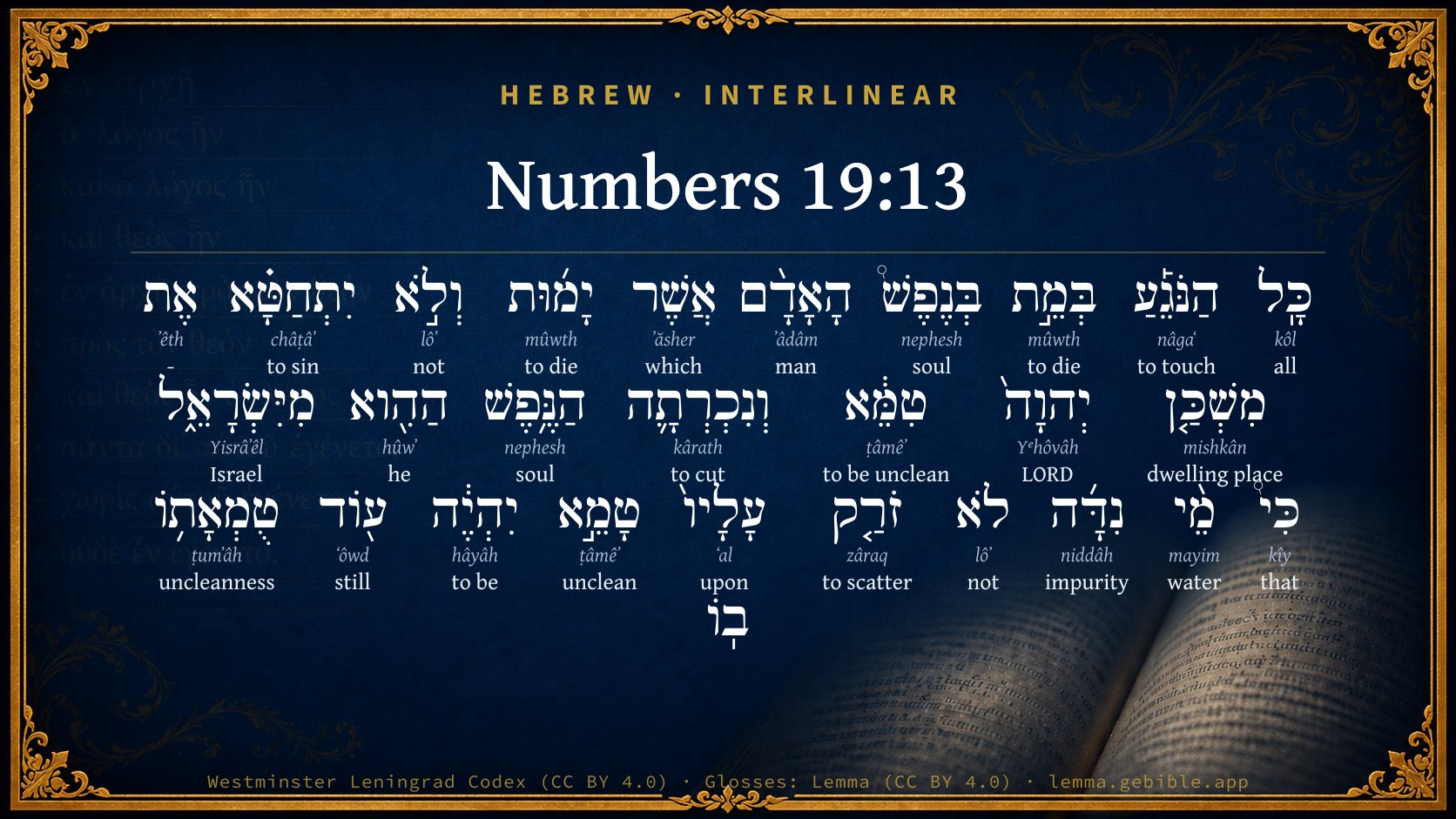
Hebrew (Westminster Leningrad Codex) Numbers 19:13 appears in the Hebrew Old Testament. The text above is from the Westminster Leningrad Codex. Each word links to its Strong’s number, a concise gloss, and parsing drawn from the Open Scriptures Hebrew Bible morphology. Click any word for its full Brown-Driver-Briggs (BDB) entry.
Download image
Cite this verse

Numbers 19:13 (World English Bible). Public Domain. Lemma interlinear Bible study tool, https://lemma.gebible.app/v/numbers/19/13.

Show BibTeX & RIS
BibTeX
RIS
English Translation
Whoever touches a dead person, the body of a man who has died, and doesn't purifies himself, defiles the tent of Yahweh; and that soul shall be cut off from Israel: because the water for impurity was not sprinkled on him, he shall be unclean; his uncleanness is yet on him.
World English Bible · Public Domain
Download a study sheet

One document with this verse’s original text, its word-by-word gloss line, the meaning frame, cross-references with their text, attributed commentary, and full source and license credits — printable, and it pastes into notes with its structure intact.

This verse Autodidact and up

Study sheet (.html) Plain text (.txt)

A passage Seminary Student

Up to 50 verses in one chapter. A passage sheet keeps up to 6 commentary sources and 12 cross-references per verse, in the order this page ranks them, and says so on the sheet whenever that leaves anything out. Ask for a single verse and you get the Autodidact verse sheet above.

Everything on this page stays free to read, with no account — the sheet is a download of what is already on screen, not access to it.

Want to remove ads? Support Godless Engineer
Compare translations 3

The same verse in 3 English versions, stacked beneath the original-language interlinear above. Click any original word for its lexicon entry.

Each is an independent rendering of the whole verse — the interlinear is not word-aligned to these translations.

Highlighted words mark where these versions differ — a whole-verse word diff, not a word-by-word alignment.

  • World English Bible Public Domain
    Whoever touches a dead person, the body of a man who has died, and doesn't purifies himself, defiles the tent of Yahweh; and that soul shall be cut off from Israel: because the water for impurity was not sprinkled on him, he shall be unclean; his uncleanness is yet on him.
  • King James Version Public Domain
    Whosoever toucheth the dead body of any man that is dead, and purifieth not himself, defileth the tabernacle of the LORD; and that soul shall be cut off from Israel: because the water of separation was not sprinkled upon him, he shall be unclean; his uncleanness is yet upon him.
  • unfoldingWord Literal Text CC BY-SA 4.0
    Anyone touching a dead the soul of the man who dies, and does not purify himself, he has made the Dwelling of Yahweh unclean. And that soul shall be cut off from Israel, for the water of impurity was not sprinkled on him. He will be unclean; his uncleanness still on him.

unfoldingWord Literal Text — © unfoldingWord, licensed CC BY-SA 4.0. Word-aligned USFM3 via Door43 (git.door43.org/unfoldingWord/en_ult).

Versions to compare (up to 4)

3 of 4 selected

Show all 18 translations

Every available English version of this verse, each an independent rendering of the whole verse.

  • World English Bible Public Domain
    Whoever touches a dead person, the body of a man who has died, and doesn't purifies himself, defiles the tent of Yahweh; and that soul shall be cut off from Israel: because the water for impurity was not sprinkled on him, he shall be unclean; his uncleanness is yet on him.
  • Berean Standard Bible Public Domain
    Anyone who touches a human corpse and fails to purify himself defiles the tabernacle of the LORD. That person must be cut off from Israel. He remains unclean, because the water of purification has not been sprinkled on him, and his uncleanness is still on him.
  • Majority Standard Bible Public Domain
    Anyone who touches a human corpse and fails to purify himself defiles the tabernacle of the LORD. That person must be cut off from Israel. He remains unclean, because the water of purification has not been sprinkled on him, and his uncleanness is still on him.
  • King James Version Public Domain
    Whosoever toucheth the dead body of any man that is dead, and purifieth not himself, defileth the tabernacle of the LORD; and that soul shall be cut off from Israel: because the water of separation was not sprinkled upon him, he shall be unclean; his uncleanness is yet upon him.
  • American Standard Version (1901) Public Domain
    Whosoever toucheth a dead person, the body of a man that hath died, and purifieth not himself, defileth the tabernacle of Jehovah; and that soul shall be cut off from Israel: because the water for impurity was not sprinkled upon him, he shall be unclean; his uncleanness is yet upon him.
  • Revised Version (1885) Public Domain
    Whosoever toucheth the dead body of any man that is dead, and purifieth not himself, defileth the tabernacle of the LORD; and that soul shall be cut off from Israel: because the water of separation was not sprinkled upon him, he shall be unclean; his uncleanness is yet upon him.
  • Geneva Bible (1599) Public Domain
    Whosoeuer toucheth ye corps of any man that is dead, and purgeth not himselfe, defileth the Tabernacle of the Lord, and that person shall be cut off from Israel, because the sprinkling water was not sprinkled vpon him: he shall be vncleane, and his vncleannesse shall remaine still vpon him.
  • Douay-Rheims (1899) Public Domain
    Every one that toucheth the corpse of a man, and is not sprinkled with mixture, shall profane the tabernacle of the Lord, and shall perish out of Israel: because he was not sprinkled with the water of expiation, he shall be unclean, and his uncleanness shall remain upon him.
  • Young's Literal Translation Public Domain
    Any one who is coming against the dead, against the body of man who dieth, and cleanseth not himself -- the tabernacle of Jehovah he hath defiled, and that person hath been cut off from Israel, for water of separation is not sprinkled upon him; he is unclean; his uncleanness `is' still upon him.
  • Literal Standard Version CC BY-SA 4.0
    Anyone who is coming against the dead, against the body of man who dies, and does not cleanse himself, he has defiled the Dwelling Place of YHWH, and that person has been cut off from Israel, for water of separation is not sprinkled on him; he is unclean; his uncleanness [is] still on him.
  • Unlocked Literal Bible CC BY-SA 4.0
    Whoever touches a dead person, the body of a man who has died, and does not purify himself—this person defiles Yahweh's tabernacle. That person must be cut off from Israel because the water for impurity was not sprinkled on him. He will remain unclean; his uncleanness will remain on him.
  • unfoldingWord Literal Text CC BY-SA 4.0
    Anyone touching a dead the soul of the man who dies, and does not purify himself, he has made the Dwelling of Yahweh unclean. And that soul shall be cut off from Israel, for the water of impurity was not sprinkled on him. He will be unclean; his uncleanness still on him.
  • Darby Bible Public Domain
    Whoever toucheth a dead person, the dead body of a man that is dead, and purifieth not himself, defileth the tabernacle of Jehovah; and that soul shall be cut off from Israel; for the water of separation was not sprinkled upon him: he shall be unclean; his uncleanness is yet upon him.
  • World Messianic Bible Public Domain
    Whoever touches a dead person, the body of a man who has died, and doesn’t purify himself, defiles the LORD’s tabernacle; and that soul shall be cut off from Israel; because the water for impurity was not sprinkled on him, he shall be unclean. His uncleanness is yet on him.
  • Webster's Bible Public Domain
    Whoever toucheth the dead body of any man that is dead, and purifieth not himself, defileth the tabernacle of the LORD; and that soul shall be cut off from Israel: because the water of separation was not sprinkled upon him, he shall be unclean; his uncleanness is yet upon him.
  • Free Bible Version CC BY-SA 4.0
    If you touch a dead body and don't purify yourself, you make the Tabernacle of the Lord unclean and must be expelled from Israel. You are still unclean because the water of purification hasn't been sprinkled on you, and your uncleanness remains.
  • Bible in Basic English Public Domain
    Anyone touching the body of a dead man without making himself clean in this way, makes the House of the Lord unclean; and that man will be cut off from Israel: because the water was not put on him, he will be unclean; his unclean condition is unchanged.
  • JPS Tanakh (1917) Public Domain
    Whosoever toucheth the dead, even the body of any man that is dead, and purifieth not himself — he hath defiled the tabernacle of the LORD — that soul shall be cut off from Israel; because the water of sprinkling was not dashed against him, he shall be unclean; his uncleanness is yet upon him.

Literal Standard Version (2020), Covenant Press — licensed CC BY-SA 4.0. Text via the HelloAO Bible API (eBible.org). Unlocked Literal Bible (unfoldingWord) — licensed CC BY-SA 4.0. Text via the HelloAO Bible API (eBible.org). unfoldingWord Literal Text — © unfoldingWord, licensed CC BY-SA 4.0. Word-aligned USFM3 via Door43 (git.door43.org/unfoldingWord/en_ult). Free Bible Version, Dr. Jonathan Gallagher — licensed CC BY-SA 4.0. Text via the HelloAO Bible API (eBible.org).

Word by word

More ways to search: Search by grammar → Find every occurrence → Compare this word →

Practice this passage: Drill this verse → Learn its vocabulary →

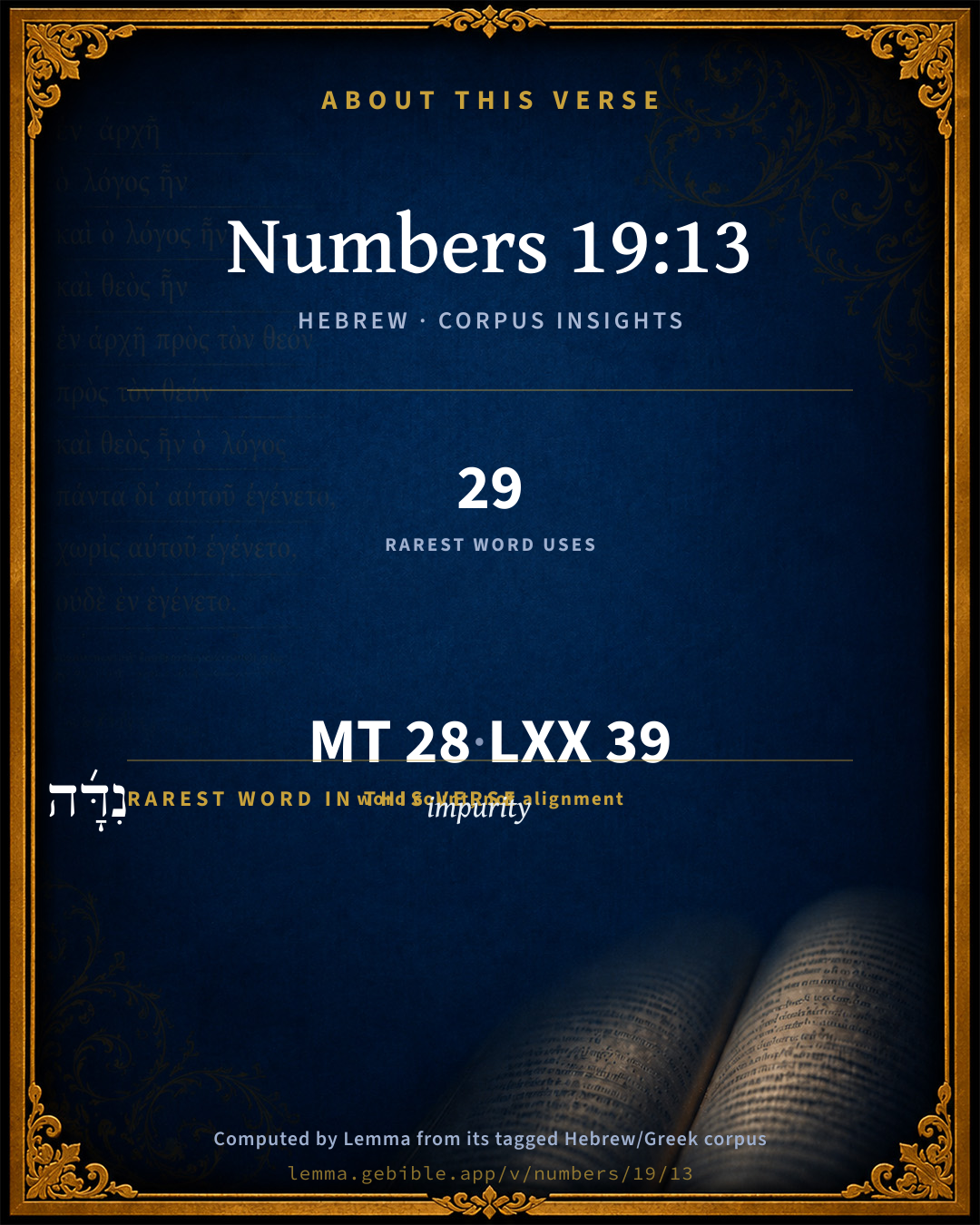
נִדָּ֜ה
niddâh
H5079
“impurity”
Noun, Common, Feminine, Singular, Absolute
Part of Speech
Noun
Type
Common
Gender
Feminine
Number
Singular
State
Absolute
Full BDB Definition

Origin: from H5074

TWOT: 1302a

impurity, filthiness, menstruous, set apart - impurity - of ceremonial impurity - of menstruation - impure thing (figuratively) - of idolatry, immorality
  1. כָּֽל kôl H3605 “all of” Noun, Common, Masculine, Singular, Construct
  2. הַנֹּגֵ֡עַ nâgaʻ H5060 “the · touching” Particle, Definite Article + Verb, Qal, Participle Active, Masculine, Singular, Absolute
  3. בְּמֵ֣ת mûwth H4191 “in/at · dying” Preposition + Verb, Qal, Participle Active, Masculine, Singular, Absolute
  4. בְּנֶפֶשׁ֩ nephesh H5315 “in/at · soul of” Preposition + Noun, Common, Both, Singular, Construct
  5. הָאָדָ֨ם ʼâdâm H120 “the · man” Particle, Definite Article + Noun, Common, Masculine, Singular, Absolute
  6. אֲשֶׁר ʼăsher H834 “which” Particle, Relative
  7. יָמ֜וּת mûwth H4191 “to die” Verb, Qal, Imperfect, 3rd Person, Masculine, Singular
  8. וְלֹ֣א lôʼ H3808 “and · not” Conjunction + Particle, Negative
  9. יִתְחַטָּ֗א châṭâʼ H2398 “to sin” Verb, Hithpael, Imperfect, 3rd Person, Masculine, Singular
  10. אֶת ʼêth H853 “-” Particle, Direct Object
  11. מִשְׁכַּ֤ן mishkân H4908 “dwelling place of” Noun, Common, Masculine, Singular, Construct
  12. יְהוָה֙ Yᵉhôvâh H3068 “LORD” Noun, Proper
  13. טִמֵּ֔א ṭâmêʼ H2930 “to be unclean” Verb, Piel, Perfect, 3rd Person, Masculine, Singular
  14. וְנִכְרְתָ֛ה kârath H3772 “and · to cut” Conjunction + Verb, Niphal, Sequential Perfect, 3rd Person, Feminine, Singular
  15. הַנֶּ֥פֶשׁ nephesh H5315 “the · soul” Particle, Definite Article + Noun, Common, Both, Singular, Absolute
  16. הַהִ֖וא hûwʼ H1931 “the · he” Particle, Definite Article + Pronoun, Personal, 3rd Person, Feminine, Singular
  17. מִיִּשְׂרָאֵ֑ל Yisrâʼêl H3478 “from · Israel” Preposition + Noun, Proper
  18. כִּי֩ kîy H3588 “that” Conjunction
  19. מֵ֨י mayim H4325 “water(s) of” Noun, Common, Masculine, Plural, Construct
  20. לֹא lôʼ H3808 “not” Particle, Negative
  21. זֹרַ֤ק zâraq H2236 “to scatter” Verb, Qal Passive, Perfect, 3rd Person, Masculine, Singular
  22. עָלָיו֙ ʻal H5921 “upon · him” Preposition + Suffix, Personal, 3rd Person, Masculine, Singular
  23. טָמֵ֣א ṭâmêʼ H2931 “unclean” Adjective, Adjective, Masculine, Singular, Absolute
  24. יִהְיֶ֔ה hâyâh H1961 “to be” Verb, Qal, Imperfect, 3rd Person, Masculine, Singular
  25. ע֖וֹד ʻôwd H5750 “still” Adverb
  26. טֻמְאָת֥וֹ ṭumʼâh H2932 “uncleanness · his” Noun, Common, Feminine, Singular, Construct + Suffix, Personal, 3rd Person, Masculine, Singular

About this verse

These counts appear in no published source. They are computed here, from the morphology-tagged text and Lemma’s own curated glosses. What Lemma adds →

28
words
24
distinct lemmas
Pentateuch
section

Shared distinctive vocabulary

נִדָּ֜ה impurity H5079 occurs in 24 verses of the Hebrew Bible. Also found in:

Grammatical profile

  • 8 verbs
  • 10 nouns
  • 1 adjective
  • 1 pronoun
  • 2 prepositions
  • 1 conjunction
  • 1 adverb
  • 4 particles

Verb forms

  • הַנֹּגֵ֡עַ Qal · Participle Active
  • בְּמֵ֣ת Qal · Participle Active
  • יָמ֜וּת Qal · Imperfect
  • יִתְחַטָּ֗א Hithpael · Imperfect
  • טִמֵּ֔א Piel · Perfect
  • וְנִכְרְתָ֛ה Niphal · Sequential Perfect
  • זֹרַ֤ק Qal Passive · Perfect
  • יִהְיֶ֔ה Qal · Imperfect

Repetition

Words recur within this verse — often emphatic in Hebrew:

  • בְּמֵ֣ת to die H4191 ×2
  • בְּנֶפֶשׁ֩ soul H5315 ×2
  • וְלֹ֣א not H3808 ×2

Hebrew & Septuagint length

In English translation the verse runs 51 words from the Hebrew and 59 from the Septuagint (LXX English) — closely comparable.

A rough comparison of the two English renderings, which tokenize alike — not a word-level alignment.

Word counts can differ between the Hebrew and the Greek without any difference in meaning — e.g. the Hebrew direct-object marker אֵת has no separate Greek word, and Greek often adds the article ὁ.

In the original languages it is 28 Hebrew tokens and 39 Greek tokens — but the two are counted differently (Hebrew bundles its prefixes and suffixes into one token; the Greek is in lemma form), so that isn’t a like-for-like length.

Cross-references

19

Topical passages linked to Numbers 19:13 in the Treasury of Scripture Knowledge — connected by theme and wording, ordered by reader-vote popularity; previews shown in the World English Bible.

  • Leviticus 15:31 "'Thus you shall separate the children of Israel from their uncleanness, so they will not die in their uncleanness, when they defile my tabernacle that is in their midst.'"
  • Leviticus 22:3 Tell them, 'If anyone of all your seed throughout your generations approaches the holy things, which the children of Israel make holy to Yahweh, having his uncleanness on him, that soul shall be cut off from before me. I am Yahweh.
  • Leviticus 7:20 but the soul who eats of the flesh of the sacrifice of peace offerings, that belongs to Yahweh, having his uncleanness on him, that soul shall be cut off from his people.
  • Leviticus 5:3 "'Or if he touches the uncleanness of man, whatever his uncleanness is with which he is unclean, and it is hidden from him; when he knows of it, then he shall be guilty.
  • Leviticus 5:6 and he shall bring his trespass offering to Yahweh for his sin which he has sinned, a female from the flock, a lamb or a goat, for a sin offering; and the priest shall make atonement for him concerning his sin.
  • Leviticus 5:17 "If anyone sins, and does any of the things which Yahweh has commanded not to be done; though he didn't know it, yet he is guilty, and shall bear his iniquity.
  • Leviticus 20:3 I also will set my face against that person, and will cut him off from among his people because he has given of his seed to Molech, to defile my sanctuary, and to profane my holy name.
  • Numbers 8:7 Thus shall you do to them, to cleanse them: sprinkle the water of cleansing on them, let them shave their whole bodies with a razor, and let them wash their clothes, and cleanse themselves.
  • Numbers 15:30 But the soul who does anything with a high hand, whether he is home-born or a foreigner, the same blasphemes Yahweh; and that soul shall be cut off from among his people.
  • Numbers 19:9 A man who is clean shall gather up the ashes of the heifer, and lay them up outside of the camp in a clean place; and it shall be kept for the congregation of the children of Israel for a water for impurity: it is a sin-offering.
  • Numbers 19:18 and a clean person shall take hyssop, and dip it in the water, and sprinkle it on the tent, and on all the vessels, and on the persons who were there, and on him who touched the bone, or the slain, or the dead, or the grave:
  • Numbers 19:20 But the man who shall be unclean, and shall not purify himself, that soul shall be cut off from the midst of the assembly, because he has defiled the sanctuary of Yahweh: the water for impurity has not been sprinkled on him; he is unclean.
  • Proverbs 14:32 The wicked is brought down in his calamity, But in death, the righteous has a refuge.
  • John 8:24 I said therefore to you that you will die in your sins; for unless you believe that I am he, you will die in your sins."
  • Hebrews 2:2–3 For if the word spoken through angels proved steadfast, and every transgression and disobedience received a just recompense;
  • Hebrews 10:29 How much worse punishment, do you think, will he be judged worthy of, who has trodden under foot the Son of God, and has counted the blood of the covenant with which he was sanctified an unholy thing, and has insulted the Spirit of grace?
  • Revelation 21:8 But for the cowardly, unbelieving, sinners, abominable, murderers, sexually immoral, sorcerers, idolaters, and all liars, their part is in the lake that burns with fire and sulfur, which is the second death."
  • Revelation 22:11 He who acts unjustly, let him act unjustly still. He who is filthy, let him be filthy still. He who is righteous, let him do righteousness still. He who is holy, let him be holy still."
  • Revelation 22:15 Outside are the dogs, the sorcerers, the sexually immoral, the murderers, the idolaters, and everyone who loves and practices falsehood.

Cross-references courtesy of OpenBible.info (CC BY 4.0).

Hebrew and Greek witnesses Masoretic Hebrew ↔ Greek Septuagint

The same verse in the two great witnesses to the Old Testament, shown verse-for-verse.

These are two independent witnesses, not word-aligned to each other, and the Septuagint is shown in lemma (dictionary) form.

Hebrew Numbers 19:13 Masoretic · Westminster Leningrad Codex

כָּֽל הַנֹּגֵ֡עַ בְּמֵ֣ת בְּנֶפֶשׁ֩ הָאָדָ֨ם אֲשֶׁר יָמ֜וּת וְלֹ֣א יִתְחַטָּ֗א אֶת מִשְׁכַּ֤ן יְהוָה֙ טִמֵּ֔א וְנִכְרְתָ֛ה הַנֶּ֥פֶשׁ הַהִ֖וא מִיִּשְׂרָאֵ֑ל כִּי֩ מֵ֨י נִדָּ֜ה לֹא זֹרַ֤ק עָלָיו֙ טָמֵ֣א יִהְיֶ֔ה ע֖וֹד טֻמְאָת֥וֹ בֽוֹ

Whoever touches a dead person, the body of a man who has died, and doesn't purifies himself, defiles the tent of Yahweh; and that soul shall be cut off from Israel: because the water for impurity was not sprinkled on him, he shall be unclean; his uncleanness is yet on him.

World English Bible · Public Domain

Greek LXX Numbers 19:13 Septuagint · lemma form

πᾶς ὁ ἅπτομαι ὁ θνήσκω ἀπό ψυχή ἄνθρωπος ἐάν ἀποθνήσκω καί μή ἀποἁγνίζω ὁ σκηνή κύριος μιαίνω ἐκτρίβω ὁ ψυχή ἐκεῖνος ἐκ ἰσραήλ ὅτι ὕδωρ ῥαντισμός οὐ περιῥαντίζω ἐπί αὐτός ἀκάθαρτος εἰμί ἔτι ὁ ἀκαθαρσία αὐτός ἐν αὐτός εἰμί

Every one that touches the carcass of the person of a man, if he should have died, and the other not have been purified, has defiled the tabernacle of the Lord: that soul shall be cut off from Israel, because the water of sprinkling has not been sprinkled upon him; he is unclean; his uncleanness is yet upon him.

LXX2012 (modern English Septuagint) · Public Domain

Hebrew: Westminster Leningrad Codex (CC BY 4.0). Greek: Septuagint (public domain); English from LXX2012 (modern English Septuagint) (Public Domain). How the Septuagint differs from the Hebrew →

Targum (Aramaic paraphrase)

2

The Targum is the ancient Jewish Aramaic paraphrase of the Hebrew Scriptures — an interpretive translation, not the Hebrew text itself. Onkelos (literal) and Pseudo-Jonathan (expansive) render the Torah, and Jonathan the Prophets. Coverage is partial: where no permissively-licensed English translation exists for a verse, only the Aramaic is shown. This is verse-level text, not a word-by-word alignment to the Hebrew.

  1. Targum Onkelos Torah (Genesis–Deuteronomy)
    כָּלּ דְיִקְרַבּ בְּמִיתָא בְּנַפְשָׁא דֶאֱנָשָׁא דִי יְמוּת וְלָא יַדֵי עֲלוֹהִי יָת מַשְׁכְּנָא דַיְיָ סָאֵב וְיִשְׁתֵּצֵי אֱנָשָׁא הַהוּא מִיִשְׂרָאֵל אֲרֵי מֵי אַדָיוּתָא לָא אִזְדְרִיקוּ עֲלוֹהִי מְסָאָב יְהֵי עוֹד סְאוֹבְתֵּיהּ בֵּיהּ

    (no public-domain English translation for this verse)

    Targum Onkelos — Aramaic: “Onkelos Genesis” (public domain); “Onkelos Exodus” (public domain); “Onkelos Leviticus” (public domain); “Onkelos Numbers” (public domain); “Onkelos Deuteronomy” (public domain). English: “Sefaria Community Translation” (CC0 1.0 (public-domain dedication)); “J.W. Etheridge. The Targums of Onkelos and Jonathan Ben Uzziel on the Pentateuch. London: Longmans, Green, 1862” (public domain). Text via Sefaria.

  2. Targum Pseudo-Jonathan Torah (Genesis–Deuteronomy)
    כָּל דִי יִקְרַב בִּשְׁכִיבָא וּבְוַולְדָא בַּר תִּשְׁעָא יַרְחִין בְּגוּשְׁמֵיהּ וּבִדְמֵיהּ דְיֵימִית וְלָא יַדֵי עֲלוֹי יַת מַשְׁכְּנָא דַיְיָ סָאִיב וְיִשְׁתֵּיצֵי בַּר נְשָׁא הַהוּא מִיִשְרָאֵל אֲרוּם מוֹי אַדְיוּתָא לָא אִזְדְרִיקוּ עֲלוֹי מְסָאָב הוּא תּוּב סוּבְתֵּיהּ בֵּיהּ עַד דְיַדֵי וִיהַדֵר וְיַדֵי וְיִטְבּוֹל בְּרַמְשָׁא שְׁבִיעָאָה

    Whoever hath touched the body of a dead man, or of a child nine months old, either the body or the blood, and will not sprinkle himself, he hath defiled the tabernacle of the Lord, and that man shall be cut off from Israel; forasmuch as the water of sprinkling is not sprinkled upon him, he is unclean, his uncleanness is yet on him, until he shall sprinkle himself; yet may he sprinkle and make ablution on the seventh evening.

    Targum Pseudo-Jonathan — Aramaic: “Targum Jonathan on Genesis” (public domain); “Targum Jonathan on Exodus” (public domain); “Targum Jonathan on Leviticus” (public domain); “Targum Jonathan on Numbers” (public domain); “Targum Jonathan on Deuteronomy” (public domain). English: “The Targum of Jonathan ben Uzziel, trans. J. W. Etheridge, London, 1862” (public domain). Text via Sefaria.

Commentary

Notes on Numbers 19:13 from classic Christian and Jewish commentators (each source and its license shown beneath its notes). The classic Christian expositions comment on the surrounding passage and are grouped to its opening verse, so a note may address several verses; the Jewish commentaries on the Tanakh (Rashi and others) are per-verse, so they appear only where the commentator wrote on this verse.

Lemma curates 59 commentaries, every one of them public domain or Creative Commons licensed, each selected and text-cleaned for this edition rather than reprinted as found. About our sources →

Joseph Benson's Commentary

Num 19:13. Whosoever toucheth — If this transgression be done presumptuously; for if it was done ignorantly, he was only to offer a sacrifice. Defileth the tabernacle — By approaching to it in his uncleanness: for holy things or places were ceremonially defiled with the touch of any unclean person or thing. Is upon him — He continues in his guilt, not now to be washed away by this water, but to be punished by cutting off.

Joseph Benson's Commentary on the Old and New Testaments (1811–1818) — public domain. Text from a community e-Sword module.

Tyndale Open Study Notes

Tyndale Open Resources

19:13 The impurity caused by contact with a corpse was especially dangerous since a ceremonially defiled person would defile the Lord’s Tabernacle (cp. Lev 15:31). This was grounds for being cut off from the community of Israel (cp. Num 9:13; Exod 12:15; Lev 7:20-21; 17:4-14; 20:17-18).

Tyndale Open Study Notes — © Tyndale Open Resources, licensed CC BY-SA 4.0. Text via the HelloAO Bible API.

Geneva Bible (1599)

Geneva Bible translators

So that he should not be esteemed to be of the holy people. But as a polluted and excommunicated person.

Geneva Bible (1599) marginal notes — public domain. Text via Bolls.life.

John Gill's Exposition

Whosoever toucheth the dead body of any man that is dead, and purifieth not himself,.... With the ashes of the heifer, or water of purification, and so neglects the means which God has appointed for his cleansing:

defileth the tabernacle of the Lord; that is, if he goes into it in his uncleanness, which it was not lawful for him to do: from the Jews the Assyrians seem to have borrowed some customs of theirs, as related by Lucian (r), who upon burying a dead cock reckoned seven days, see Num 19:11; and then went into the temple, for before they might not go in, nor perform holy service; such laws they use, that if anyone sees a dead carcass, he may not go that day into the temple; but he goes in the day following, after he has purified himself:

and that soul shall be cut off from Israel; either be excommunicated from the church, or die by the hand of the civil magistrate, or by the immediate hand of God; that is, if he knew he had touched a dead body, and wilfully neglected the means of his purification, and so sinned presumptuously; otherwise, if all this was done ignorantly, an atonement was made for it, Lev 5:3.

because the water of separation was not sprinkled upon him, he shall be unclean; as all are who are not sprinkled with the blood of Christ:

his uncleanness is yet upon him; and will remain, nothing can remove it; as nothing can remove the stain and blot of sin but the blood of Christ; and where that is not applied it will remain marked before God, and will lie upon the sinner to his utter condemnation and ruin; see Jer 2:22.

(r) De Dea Syria.

John Gill's Exposition of the Whole Bible (1746–1763) — public domain (CC PDM 1.0). Text via the HelloAO Bible API.

Haydock's Catholic Bible Commentary

Upon him, unless he be excused by ignorance, (Leviticus v. 3, 6,) he shall be slain.

George Leo Haydock (1774–1849), Haydock's Catholic Family Bible and Commentary, 1859 edition — public domain. Excludes Psalms (Douay-Rheims chapter numbering differs from Protestant) and Deuterocanonical books (Catholic canon only).

Matthew Poole's English Annotations

Whosoever toucheth, to wit, if this transgression be done presumptuously; for if it was done ignorantly, he was only to offer sacrifice, Lev 5:3,6,17.

Defileth the tabernacle of the Lord, by approaching to it in his uncleanness; for holy things or places were ceremonially defiled with the touch of any unclean person or thing. See Lev 15:31; 16:16; Hag 2:13.

His uncleanness is yet upon him; he continues in his guilt and filth, not now to be washed away by this water, but to be punished by cutting off.

Matthew Poole's English Annotations on the Holy Bible (1683–1685) — public domain. Text from a community e-Sword/MySword module.

Whedon's Commentary on the Bible

Daniel D. Whedon

13. Purifieth not himself — In the Old Testament, as in the New Testament, sanctification has a human as well as a divine side. 2Co_7:1. God appoints the means, and man is required diligently to apply them. The culpability does not so much lie in fact of impurity as in the wilful neglect of the provisions for cleansing. The neglect to wrap up the furniture of the tabernacle insured the death of the Levite carrier who touched it. Num_4:18, note. Neglect to love Jesus Christ renders one worthy of the divine anathema. 1Co_16:22. There is no escape for him who simply neglects “so great salvation.” Heb_2:3; Mat_25:41-42.

Defileth the tabernacle — This defilement took place not merely because an unclean man ventured to enter the sanctuary, but because uncleanness in those among whom Jehovah, the Holy One, has his dwelling-place was irreconcilable with the calling of Israel to be a holy nation. Lev_11:44, note.

Daniel D. Whedon (gen. ed.), Commentary on the Old and New Testaments (1874–1909) — public domain. Text from a community e-Sword module.

The Pulpit Commentary

Defileth the tabernacle of the Lord. On the bearing of this remarkable announcement see Lev_15:31. The uncleanness of death was not simply a personal matter, it involved, if not duly purged, the whole congregation, and reached even to God himself, for its defilement spread to the sanctuary. Cut off from Israel, i.e., excommunicate on earth, and liable to the direct visitation of Heaven. (cf. Gen_17:14)

The Pulpit Commentary (1880–1919), ed. H.D.M. Spence-Jones & Joseph S. Exell — public domain. Text from a community e-Sword module.

John Wesley's Explanatory Notes

Whosoever toucheth - If this transgression be done presumptuously; for if it was done ignorantly, he was only to offer sacrifice. Defiled -By approaching to it in his uncleanness: for holy things or places were ceremonially defiled with the touch of any unclean person or thing. Is upon him - He continues in his guilt, not now to be washed away by this water, but to be punished by cutting off.

John Wesley, Explanatory Notes Upon the Whole Bible (1754–1765) — public domain. Text via the GEBible commentary corpus.

Rashi

Rabbi Shlomo Yitzchaki (Rashi)

במת בנפש [HE WHO TOUCHES] A DEAD BODY OF ANY PERSON — And what dead body is here intended? That of a human being (נפש האדם), the addition of בנפש האדם serving to exclude the person (body) of an animal, so intimating that uncleanness caused by it does not require sprinkling for its removal. Another explanation of בנפש is, that this term refers to a quarter of a log of blood (this being regarded as the minimum quantity necessary for maintaining life in a human being) (Chullin 72a).

את משכן ה' הוא טמא HE DEFILES THE TABERNACLE OF THE LORD, if he enters the forecourt even though after having immersed himself, but without having been sprinkled on the third and seventh days,

עוד טמאתו בו HIS UNCLEANNESS IS YET UPON HIM, although he has immersed himself.

Rashi on the Tanakh — English translations: “The Judaica Press complete Tanach with Rashi, translated by A. J. Rosenberg” (CC BY 4.0); “Pentateuch with Rashi's commentary by M. Rosenbaum and A.M. Silbermann, 1929-1934” (public domain); “The Metsudah Tanach series, Lakewood, N.J” (CC BY 4.0); and “The Book of Joshua, Metsudah Publications, 1997” (CC BY 4.0). Text via Sefaria.

Lesson kit

Teaching starters — assembled from the data on this page, not authored interpretation. Every prompt links to the verse data it draws on. Edit before teaching.

Numbers, in the Pentateuch, opens this verse with 28 words (24 distinct Hebrew lemmas). Its most distinctive word is niddâh (“impurity”). A historical commentator’s framing appears above. Read the whole chapter for the surrounding context.

Discussion questions

  1. What does “impurity” (niddâh) contribute to the verse as a whole?
  2. Leviticus 12:2 shares the word «impurity» with this verse. How do the two illuminate each other?
  3. “to die” occurs 2× in this one verse. What is the effect of the repetition?
  4. These translations render this verse differently; the difference is in the English rendering, not the original. What questions does that raise?
  5. The verb «הַנֹּגֵ֡עַ» is Qal Participle Active. How does its form color the action?
  6. Reading how Joseph Benson's Commentary and Tyndale Open Study Notes read this verse, where do the two commentators agree and where do they part?

Things to notice

Reading settings

Reading text

Shown beneath each verse's original-language words.

Old Testament
Old Testament edition

Read the OT as the Masoretic Hebrew (MT) or the Greek Septuagint (LXX).

English shown for the Greek Septuagint (in the Hebrew ↔ Greek comparison).

Comparing translations? Open the Compare panel on any verse page to stack up to four side by side.