Leviticus 20:4

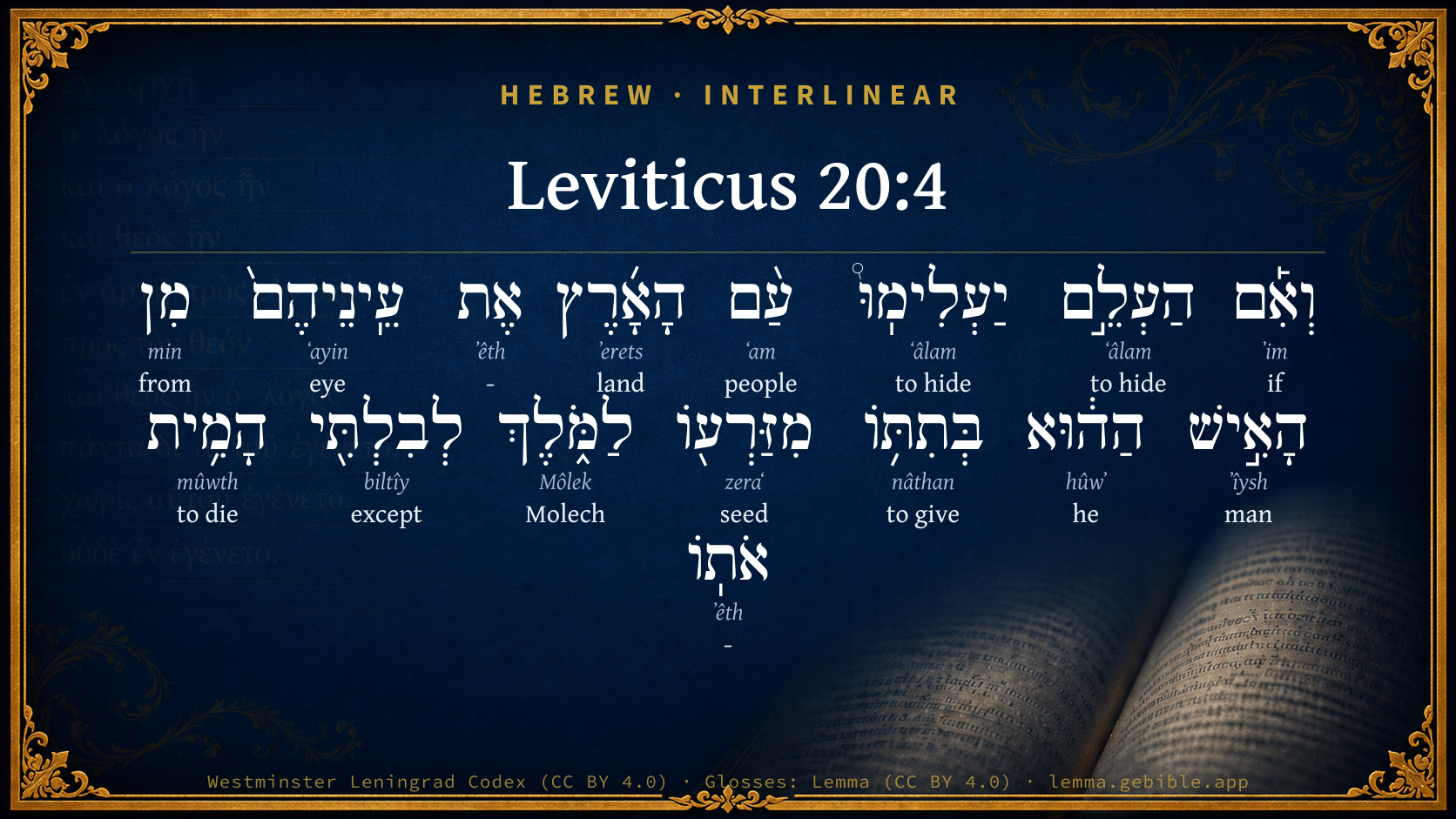
Hebrew (Westminster Leningrad Codex) Leviticus 20:4 appears in the Hebrew Old Testament. The text above is from the Westminster Leningrad Codex. Each word links to its Strong’s number, a concise gloss, and parsing drawn from the Open Scriptures Hebrew Bible morphology. Click any word for its full Brown-Driver-Briggs (BDB) entry.
Download image
Cite this verse

Leviticus 20:4 (World English Bible). Public Domain. Lemma interlinear Bible study tool, https://lemma.gebible.app/v/leviticus/20/4.

Show BibTeX & RIS
BibTeX
RIS
English Translation
If the people of the land all hide their eyes from that person, when he gives of his seed to Molech, and don't put him to death;
World English Bible · Public Domain
Download a study sheet

One document with this verse’s original text, its word-by-word gloss line, the meaning frame, cross-references with their text, attributed commentary, and full source and license credits — printable, and it pastes into notes with its structure intact.

This verse Autodidact and up

Study sheet (.html) Plain text (.txt)

A passage Seminary Student

Up to 50 verses in one chapter. A passage sheet keeps up to 6 commentary sources and 12 cross-references per verse, in the order this page ranks them, and says so on the sheet whenever that leaves anything out. Ask for a single verse and you get the Autodidact verse sheet above.

Everything on this page stays free to read, with no account — the sheet is a download of what is already on screen, not access to it.

Want to remove ads? Support Godless Engineer
Compare translations 3

The same verse in 3 English versions, stacked beneath the original-language interlinear above. Click any original word for its lexicon entry.

Each is an independent rendering of the whole verse — the interlinear is not word-aligned to these translations.

Highlighted words mark where these versions differ — a whole-verse word diff, not a word-by-word alignment.

  • World English Bible Public Domain
    If the people of the land all hide their eyes from that person, when he gives of his seed to Molech, and don't put him to death;
  • King James Version Public Domain
    And if the people of the land do any ways hide their eyes from the man, when he giveth of his seed unto Molech, and kill him not:
  • unfoldingWord Literal Text CC BY-SA 4.0
    And if, hiding, the people of the land hide their eyes from that man when he gives his seed to Molech, so as not to execute him,

unfoldingWord Literal Text — © unfoldingWord, licensed CC BY-SA 4.0. Word-aligned USFM3 via Door43 (git.door43.org/unfoldingWord/en_ult).

Versions to compare (up to 4)

3 of 4 selected

Show all 18 translations

Every available English version of this verse, each an independent rendering of the whole verse.

  • World English Bible Public Domain
    If the people of the land all hide their eyes from that person, when he gives of his seed to Molech, and don't put him to death;
  • Berean Standard Bible Public Domain
    And if the people of the land ever hide their eyes and fail to put to death the man who gives one of his children to Molech,
  • Majority Standard Bible Public Domain
    And if the people of the land ever hide their eyes and fail to put to death the man who gives one of his children to Molech,
  • King James Version Public Domain
    And if the people of the land do any ways hide their eyes from the man, when he giveth of his seed unto Molech, and kill him not:
  • American Standard Version (1901) Public Domain
    And if the people at the land do at all hide their eyes from that man, when he giveth of his seed unto Molech, and put him not to death;
  • Revised Version (1885) Public Domain
    And if the people of the land do any ways hide their eyes from that man, when he giveth of his seed unto Molech, and put him not to death:
  • Geneva Bible (1599) Public Domain
    And if the people of the lande hide their eyes, and winke at that man when he giueth his children vnto Molech, and kill him not,
  • Douay-Rheims (1899) Public Domain
    And if the people of the land neglecting, and as it were little regarding my commandment, let alone the man that hath given of his seed to Moloch, and will not kill him:
  • Young's Literal Translation Public Domain
    `And if the people of the land really hide their eyes from that man, in his giving of his seed to the Molech, so as not to put him to death,
  • Literal Standard Version CC BY-SA 4.0
    And if the people of the land really hide their eyes from that man, in his giving to the Molech from his seed, so as not to put him to death,
  • Unlocked Literal Bible CC BY-SA 4.0
    If the people of the land close their eyes to that man when he gives any of his children to Molech, if they do not put him to death,
  • unfoldingWord Literal Text CC BY-SA 4.0
    And if, hiding, the people of the land hide their eyes from that man when he gives his seed to Molech, so as not to execute him,
  • Darby Bible Public Domain
    And if the people of the land do any ways hide their eyes from that man, when he giveth of his seed unto Molech, that they kill him not,
  • World Messianic Bible Public Domain
    If the people of the land all hide their eyes from that person when he gives of his offspring to Molech, and don’t put him to death,
  • Webster's Bible Public Domain
    And if the people of the land do any ways hide their eyes from the man, when he giveth of his seed to Molech, and kill him not;
  • Free Bible Version CC BY-SA 4.0
    If the community decides to look the other way and not execute those who sacrifice their children to Molech, then I will take action against them myself.
  • Bible in Basic English Public Domain
    And if the people of the land do not take note of that man when he gives his offspring to Molech, and do not put him to death,
  • JPS Tanakh (1917) Public Domain
    And if the people of the land do at all hide their eyes from that man, when he giveth of his seed unto Molech, and put him not to death;

Literal Standard Version (2020), Covenant Press — licensed CC BY-SA 4.0. Text via the HelloAO Bible API (eBible.org). Unlocked Literal Bible (unfoldingWord) — licensed CC BY-SA 4.0. Text via the HelloAO Bible API (eBible.org). unfoldingWord Literal Text — © unfoldingWord, licensed CC BY-SA 4.0. Word-aligned USFM3 via Door43 (git.door43.org/unfoldingWord/en_ult). Free Bible Version, Dr. Jonathan Gallagher — licensed CC BY-SA 4.0. Text via the HelloAO Bible API (eBible.org).

Word by word

More ways to search: Search by grammar → Find every occurrence → Compare this word →

Practice this passage: Drill this verse → Learn its vocabulary →

לַמֹּ֑לֶךְ
Môlek
H4432
“to/for the · Molech”
Preposition, Determined + Noun, Proper
Part of Speech
Preposition + Noun
Type
Proper
Full BDB Definition

Origin: from H4427

TWOT: 1199h

Molech = "king" - the god of the Ammonites and Phoenicians to whom some Israelites sacrificed their infants in the valley of Hinnom
  1. וְאִ֡ם ʼim H518 “and · if” Conjunction + Conjunction
  2. הַעְלֵ֣ם ʻâlam H5956 “to hide” Verb, Hiphil, Infinitive Absolute
  3. יַעְלִימֽוּ֩ ʻâlam H5956 “to hide” Verb, Hiphil, Imperfect, 3rd Person, Masculine, Plural
  4. עַ֨ם ʻam H5971 “people of” Noun, Common, Masculine, Singular, Construct
  5. הָאָ֜רֶץ ʼerets H776 “the · land” Particle, Definite Article + Noun, Common, Both, Singular, Absolute
  6. אֶת ʼêth H853 “-” Particle, Direct Object
  7. עֵֽינֵיהֶם֙ ʻayin H5869 “eyes · their” Noun, Common, Both, Dual, Construct + Suffix, Personal, 3rd Person, Masculine, Plural
  8. מִן min H4480 “from” Preposition
  9. הָאִ֣ישׁ ʼîysh H376 “the · man” Particle, Definite Article + Noun, Common, Masculine, Singular, Absolute
  10. הַה֔וּא hûwʼ H1931 “the · he” Particle, Definite Article + Pronoun, Personal, 3rd Person, Masculine, Singular
  11. בְּתִתּ֥וֹ nâthan H5414 “in/at · to give · him” Preposition + Verb, Qal, Infinitive Construct + Suffix, Personal, 3rd Person, Masculine, Singular
  12. מִזַּרְע֖וֹ zeraʻ H2233 “from · seed · his” Preposition + Noun, Common, Masculine, Singular, Construct + Suffix, Personal, 3rd Person, Masculine, Singular
  13. לְבִלְתִּ֖י biltîy H1115 “to/for · except” Preposition + Conjunction
  14. הָמִ֥ית mûwth H4191 “to die” Verb, Hiphil, Infinitive Construct
  15. אֹתֽוֹ ʼêth H853 “- · him” Particle, Direct Object + Suffix, Personal, 3rd Person, Masculine, Singular

About this verse

These counts appear in no published source. They are computed here, from the morphology-tagged text and Lemma’s own curated glosses. What Lemma adds →

16
words
14
distinct lemmas
Pentateuch
section

Notable vocabulary

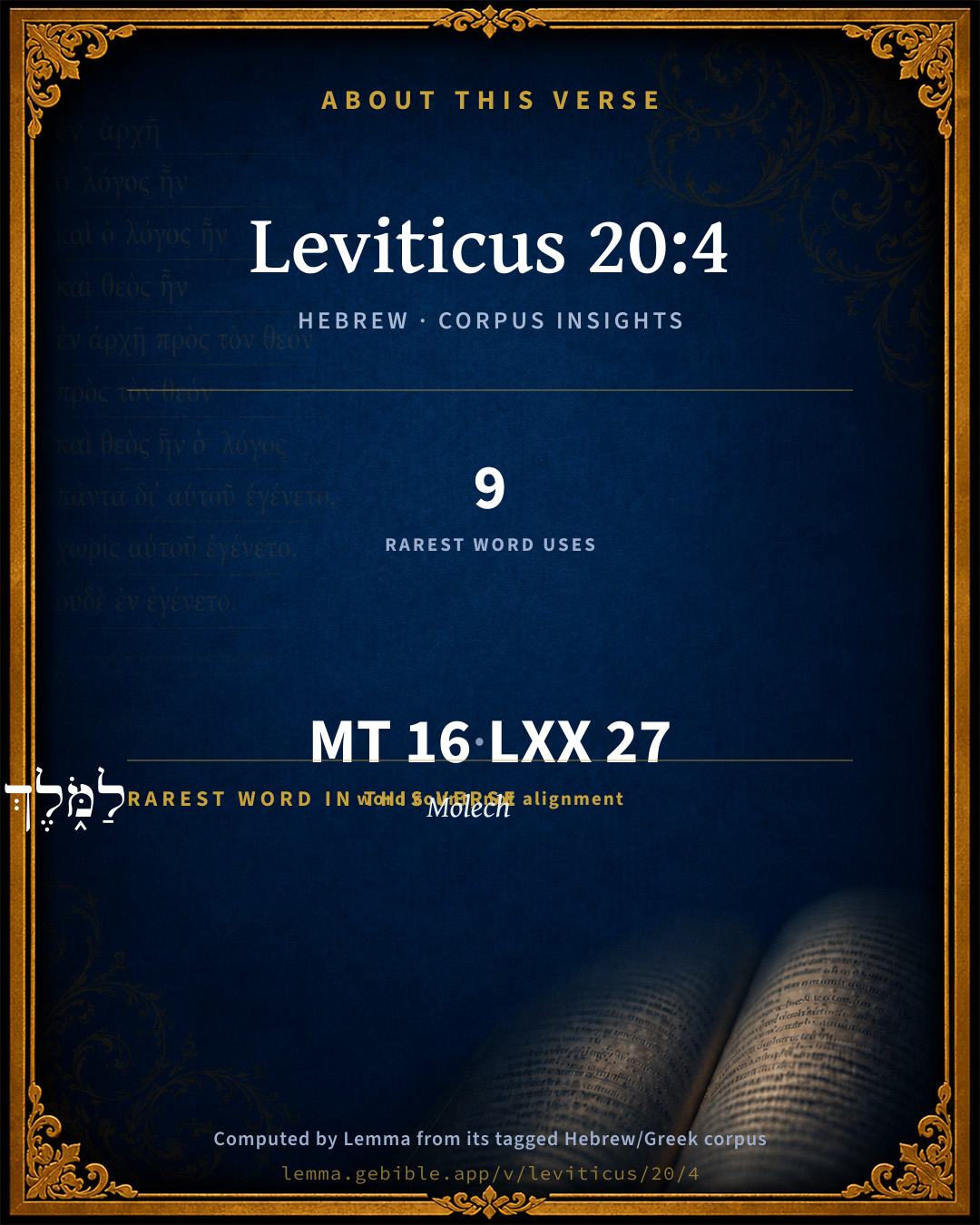
The rarest word here is לַמֹּ֑לֶךְ Molech H4432 — appearing just 9 times in the whole Hebrew Bible.

Shared distinctive vocabulary

לַמֹּ֑לֶךְ Molech H4432 occurs in 9 verses of the Hebrew Bible. Also found in:

Grammatical profile

  • 4 verbs
  • 6 nouns
  • 1 pronoun
  • 1 preposition
  • 2 conjunctions
  • 2 particles

Verb forms

  • הַעְלֵ֣ם Hiphil · Infinitive Absolute
  • יַעְלִימֽוּ֩ Hiphil · Imperfect
  • בְּתִתּ֥וֹ Qal · Infinitive Construct
  • הָמִ֥ית Hiphil · Infinitive Construct

Repetition

A word recurs within this verse — often emphatic in Hebrew:

  • הַעְלֵ֣ם to hide H5956 ×2

Hebrew & Septuagint length

In English translation the verse runs 27 words from the Hebrew and 28 from the Septuagint (LXX English) — closely comparable.

A rough comparison of the two English renderings, which tokenize alike — not a word-level alignment.

Word counts can differ between the Hebrew and the Greek without any difference in meaning — e.g. the Hebrew direct-object marker אֵת has no separate Greek word, and Greek often adds the article ὁ.

In the original languages it is 16 Hebrew tokens and 27 Greek tokens — but the two are counted differently (Hebrew bundles its prefixes and suffixes into one token; the Greek is in lemma form), so that isn’t a like-for-like length.

Cross-references

7

Topical passages linked to Leviticus 20:4 in the Treasury of Scripture Knowledge — connected by theme and wording, ordered by reader-vote popularity; previews shown in the World English Bible.

  • Deuteronomy 17:2–5 If there be found in the midst of you, within any of your gates which Yahweh your God gives you, man or woman, who does that which is evil in the sight of Yahweh your God, in transgressing his covenant,
  • Acts 17:30 The times of ignorance therefore God overlooked. But now he commands that all people everywhere should repent,
  • Deuteronomy 13:8 you shall not consent to him, nor listen to him; neither shall your eye pity him, neither shall you spare, neither shall you conceal him:
  • Joshua 7:12 Therefore the children of Israel can't stand before their enemies; they turn their backs before their enemies, because they are become accursed: I will not be with you any more, except you destroy the devoted thing from among you.
  • 1 Samuel 3:13–14 For I have told him that I will judge his house forever, for the iniquity which he knew, because his sons did bring a curse on themselves, and he didn't restrain them.
  • 1 Kings 20:42 He said to him, Thus says Yahweh, Because you have let go out of your hand the man whom I had devoted to destruction, therefore your life shall go for his life, and your people for his people.
  • Revelation 2:14 But I have a few things against you, because you have there some who hold the teaching of Balaam, who taught Balak to throw a stumbling block before the children of Israel, to eat things sacrificed to idols, and to commit sexual immorality.

Cross-references courtesy of OpenBible.info (CC BY 4.0).

Hebrew and Greek witnesses Masoretic Hebrew ↔ Greek Septuagint

The same verse in the two great witnesses to the Old Testament, shown verse-for-verse.

These are two independent witnesses, not word-aligned to each other, and the Septuagint is shown in lemma (dictionary) form.

Hebrew Leviticus 20:4 Masoretic · Westminster Leningrad Codex

וְאִ֡ם הַעְלֵ֣ם יַעְלִימֽוּ֩ עַ֨ם הָאָ֜רֶץ אֶת עֵֽינֵיהֶם֙ מִן הָאִ֣ישׁ הַה֔וּא בְּתִתּ֥וֹ מִזַּרְע֖וֹ לַמֹּ֑לֶךְ לְבִלְתִּ֖י הָמִ֥ית אֹתֽוֹ

If the people of the land all hide their eyes from that person, when he gives of his seed to Molech, and don't put him to death;

World English Bible · Public Domain

Greek LXX Leviticus 20:4 Septuagint · lemma form

ἐάν δέ ὑπερόψις ὑπερὁράω ὁ αὐτόχθων ὁ γῆ ὁ ὀφθαλμός αὐτός ἀπό ὁ ἄνθρωπος ἐκεῖνος ἐν ὁ δίδωμι αὐτός ὁ σπέρμα αὐτός ἄρχων ὁ μή ἀποκτείνω αὐτός

And if the natives of the land should in anyway overlook that man in giving of his seed to Moloch, so as not to put him to death;

LXX2012 (modern English Septuagint) · Public Domain

On this verse, Haydock's Catholic Bible Commentary discusses the Septuagint’s reading. Read the note in Commentary ↓

Hebrew: Westminster Leningrad Codex (CC BY 4.0). Greek: Septuagint (public domain); English from LXX2012 (modern English Septuagint) (Public Domain). How the Septuagint differs from the Hebrew →

Targum (Aramaic paraphrase)

2

The Targum is the ancient Jewish Aramaic paraphrase of the Hebrew Scriptures — an interpretive translation, not the Hebrew text itself. Onkelos (literal) and Pseudo-Jonathan (expansive) render the Torah, and Jonathan the Prophets. Coverage is partial: where no permissively-licensed English translation exists for a verse, only the Aramaic is shown. This is verse-level text, not a word-by-word alignment to the Hebrew.

  1. Targum Onkelos Torah (Genesis–Deuteronomy)
    וְאִם מִכְבַּשׁ יִכְבְּשׁוּן עַמָא בֵית יִשְׂרָאֵל יָת עֵינֵיהוֹן מִן גַבְרָא הַהוּא בִּדְיָהֵב מִזַרְעֵהּ לְמוֹלֶךְ בְּדִיל דְלָא לְקַטָלָא יָתֵהּ

    (no public-domain English translation for this verse)

    Targum Onkelos — Aramaic: “Onkelos Genesis” (public domain); “Onkelos Exodus” (public domain); “Onkelos Leviticus” (public domain); “Onkelos Numbers” (public domain); “Onkelos Deuteronomy” (public domain). English: “Sefaria Community Translation” (CC0 1.0 (public-domain dedication)); “J.W. Etheridge. The Targums of Onkelos and Jonathan Ben Uzziel on the Pentateuch. London: Longmans, Green, 1862” (public domain). Text via Sefaria.

  2. Targum Pseudo-Jonathan Torah (Genesis–Deuteronomy)
    וְאִין מִכְבַּשׁ יִכְבְשׁוּן עַמָא בֵית יִשְרָאֵל יַת עֵינֵיהוֹן מִן גַבְרָא הַהוּא בִּדְיִתֵּן מִזַרְעֵיהּ לְפוּלְחָנָא אוֹחֲרָא מְטוֹל דְלָא לְמִקְטוֹל יָתֵיהּ

    And if the people of the house of Israel hiding hide their eyes from that man, when he giveth his offspring unto strange worship, that they might not kill him,

    Targum Pseudo-Jonathan — Aramaic: “Targum Jonathan on Genesis” (public domain); “Targum Jonathan on Exodus” (public domain); “Targum Jonathan on Leviticus” (public domain); “Targum Jonathan on Numbers” (public domain); “Targum Jonathan on Deuteronomy” (public domain). English: “The Targum of Jonathan ben Uzziel, trans. J. W. Etheridge, London, 1862” (public domain). Text via Sefaria.

Commentary

Notes on Leviticus 20:4 from classic Christian and Jewish commentators (each source and its license shown beneath its notes). The classic Christian expositions comment on the surrounding passage and are grouped to its opening verse, so a note may address several verses; the Jewish commentaries on the Tanakh (Rashi and others) are per-verse, so they appear only where the commentator wrote on this verse.

Lemma curates 59 commentaries, every one of them public domain or Creative Commons licensed, each selected and text-cleaned for this edition rather than reprinted as found. About our sources →

Trapp's Complete Commentary

John Trapp

Lev 20:4 And if the people of the land do any ways hide their eyes from the man, when he giveth of his seed unto Molech, and kill him not:

Ver. 4:. Hide their eyes,] i.e., Be negligent or ignorant.

John Trapp, A Commentary or Exposition upon All the Books of the Old and New Testament (1647–1656) — public domain. Text from a community e-Sword module.

Joseph Benson's Commentary

Lev 20:4. Hide their eyes — Wink at his fault, and forbear to accuse and punish him.

Joseph Benson's Commentary on the Old and New Testaments (1811–1818) — public domain. Text from a community e-Sword module.

Geneva Bible (1599)

Geneva Bible translators

Though the people be negligent to do their duty, and defend God’s right, yet he will not suffer wickedness to go unpunished.

Geneva Bible (1599) marginal notes — public domain. Text via Bolls.life.

Jamieson, Fausset & Brown

Robert Jamieson, A. R. Fausset & David Brown

If the people of the land do any ways hide their eyes from the man, &c.--that is, connive at their countrymen practising the horrid rites of Molech. Awful was it that any Hebrew parents could so violate their national covenant, and no wonder that God denounced the severest penalties against them and their families.

Jamieson, Fausset & Brown — Commentary Critical and Explanatory on the Whole Bible (1871) — public domain (CC PDM 1.0). Text via the HelloAO Bible API.

Ellicott's Commentary for English Readers

(4) And if the people of the land . . . —In the former verse the Legislator treated of cases where there was insufficient evidence. Here he declares what God would do if the community itself, whose duty it is to execute the sentence, either from culpable indifference or criminal sympathy with the sin, connive at it.

A Bible Commentary for English Readers, edited by Charles John Ellicott (1878–1897) — public domain. Text from a community e-Sword module.

The Cambridge Bible for Schools and Colleges

gen. ed. J. J. S. Perowne

4. hide their eyes] i.e. disregard. For the expression in this sense cp. Pro_28:27; Isa_1:15.

The Cambridge Bible for Schools and Colleges (gen. ed. J. J. S. Perowne; Cambridge University Press, 1878–1918) — public domain. Text from a community e-Sword module.

John Gill's Exposition

And if the people of the land do any ways hide their eyes from the man,.... That is, the people of the house of Israel, as the Targums of Onkelos and Jonathan; if the friends, relations, and neighbours of such a man, though they know what he is about to do, or has done, yet they shut their eyes wilfully, or look another way; or, however, wink and connive at his wickedness, and will not discover him, and bear witness against him; or if a court of judicature, before whom he comes, does not take the evidence of his crime, nor condemn for it, or are negligent in punishing him as the law directs, a gift having blinded their eyes, or they careless and remiss in their duty:

when he giveth his seed unto Molech; a crime so heinous and abominable:

and kill him not; do not bring witness against him, so as that he may be put to death, or do not upon the evidence given condemn him to death, or do not take care to have sentence executed, by stoning him to death.

John Gill's Exposition of the Whole Bible (1746–1763) — public domain (CC PDM 1.0). Text via the HelloAO Bible API.

Haydock's Catholic Bible Commentary

My commandment: Hebrew, "If the people hide their face not to see:" (Calmet) or Septuagint, "look over on purpose, and neglect the man who has given of his seed to the ruler."

George Leo Haydock (1774–1849), Haydock's Catholic Family Bible and Commentary, 1859 edition — public domain. Excludes Psalms (Douay-Rheims chapter numbering differs from Protestant) and Deuterocanonical books (Catholic canon only).

Matthew Poole's English Annotations

i.e. Wink at his fault, and forbear to accuse and punish him. Compare Act 17:30.

Matthew Poole's English Annotations on the Holy Bible (1683–1685) — public domain. Text from a community e-Sword/MySword module.

Whedon's Commentary on the Bible

Daniel D. Whedon

4, 5. Hide their eyes — The Lawgiver foresees and provides for an amazing moral degeneracy and hardness of heart, when the people’s conscience will be so stupified that they will let this great crime go unpunished.

Against his family — This does not necessarily imply the guilt of the family, for ancient law viewed the family as a part of the man’s personality, and inflicted suffering upon them all as if guilty. See Exo_20:5; and Jos_7:24, notes.

Whoredom — This term is here used figuratively for idolatry. See chap. Lev_17:7, note.

Daniel D. Whedon (gen. ed.), Commentary on the Old and New Testaments (1874–1909) — public domain. Text from a community e-Sword module.

The Pulpit Commentary

Vers. 4, 5. There is to be no connivance with Molech-worship. The penalty is death, and is to be carried out by the proper tribunals, whose business it was to see that the stoning took place. So in Deuteronomy the duty of killing those who entice to idolatry is laid down. "Thou shalt not consent unto him, nor hearken unto him; neither shall thine eye pity him, neither shall thou spare, neither shalt thou conceal him: but thou shalt surely kill him; thine hand shall be first upon him to put him to death, and afterwards the hand of all the people". (Deu_13:8, Deu_13:9) In the case of Molech-worship God declares that, if the tribunals of the nation fail to adjudge the penalty of death to the offender, he will himself lake the matter into his hands, and cut him off with his family and all that follow him in his sin of unfaithfulness.

The Pulpit Commentary (1880–1919), ed. H.D.M. Spence-Jones & Joseph S. Exell — public domain. Text from a community e-Sword module.

John Wesley's Explanatory Notes

Hide their eyes - Wink at his fault, and forbear to accuse and punish him.

John Wesley, Explanatory Notes Upon the Whole Bible (1754–1765) — public domain. Text via the GEBible commentary corpus.

Keil & Delitzsch

C. F. Keil & F. Delitzsch

If the people, however (the people of the land), should hide their eyes from him (on the dagesh in חעלּם and יעלּימוּ see the note on Lev 4:13-21), from an unscrupulous indifference or a secret approval of his sin, the Lord would direct His face against him and his family, and cut him off with all that went a whoring after him.

Keil & Delitzsch — Biblical Commentary on the Old Testament (1861–1891) — public domain (CC PDM 1.0). Text via the HelloAO Bible API. (Old Testament only.)

Rashi

Rabbi Shlomo Yitzchaki (Rashi)

‎ואם העלם יעלימו AND IF [THE PEOPLE OF THE LAND] DO ANY WAYS HIDE THEIR EYES [FROM THE MAN] — If they hide their eyes in one thing they will in the end hide their eyes also in many other matters (Sifra, Kedoshim, Section 4 9); if the Small Sanhedrin (a judicial court of twenty-three) hide their eyes, in the end the Great Sanhedrin (the Supreme Court of seventy-one) will also hide their eyes (Sifra, Kedoshim, Section 4 11).

Rashi on the Tanakh — English translations: “The Judaica Press complete Tanach with Rashi, translated by A. J. Rosenberg” (CC BY 4.0); “Pentateuch with Rashi's commentary by M. Rosenbaum and A.M. Silbermann, 1929-1934” (public domain); “The Metsudah Tanach series, Lakewood, N.J” (CC BY 4.0); and “The Book of Joshua, Metsudah Publications, 1997” (CC BY 4.0). Text via Sefaria.

Lesson kit

Teaching starters — assembled from the data on this page, not authored interpretation. Every prompt links to the verse data it draws on. Edit before teaching.

Leviticus, in the Pentateuch, opens this verse with 16 words (14 distinct Hebrew lemmas). Its most distinctive word is Môlek (“Molech”). A historical commentator’s framing appears above. Read the whole chapter for the surrounding context.

Discussion questions

  1. The word Môlek carries the sense “Molech.” How does it shape the verse?
  2. Leviticus 18:21 shares the word «Molech» with this verse. How do the two illuminate each other?
  3. “to hide” occurs 2× in this one verse. What is the effect of the repetition?
  4. These translations render this verse differently; the difference is in the English rendering, not the original. What questions does that raise?
  5. The verb «הַעְלֵ֣ם» is Hiphil Infinitive Absolute. How does its form color the action?
  6. Reading how Trapp's Complete Commentary and Joseph Benson's Commentary read this verse, where do the two commentators agree and where do they part?

Things to notice

Reading settings

Reading text

Shown beneath each verse's original-language words.

Old Testament
Old Testament edition

Read the OT as the Masoretic Hebrew (MT) or the Greek Septuagint (LXX).

English shown for the Greek Septuagint (in the Hebrew ↔ Greek comparison).

Comparing translations? Open the Compare panel on any verse page to stack up to four side by side.