
Genesis 11:32

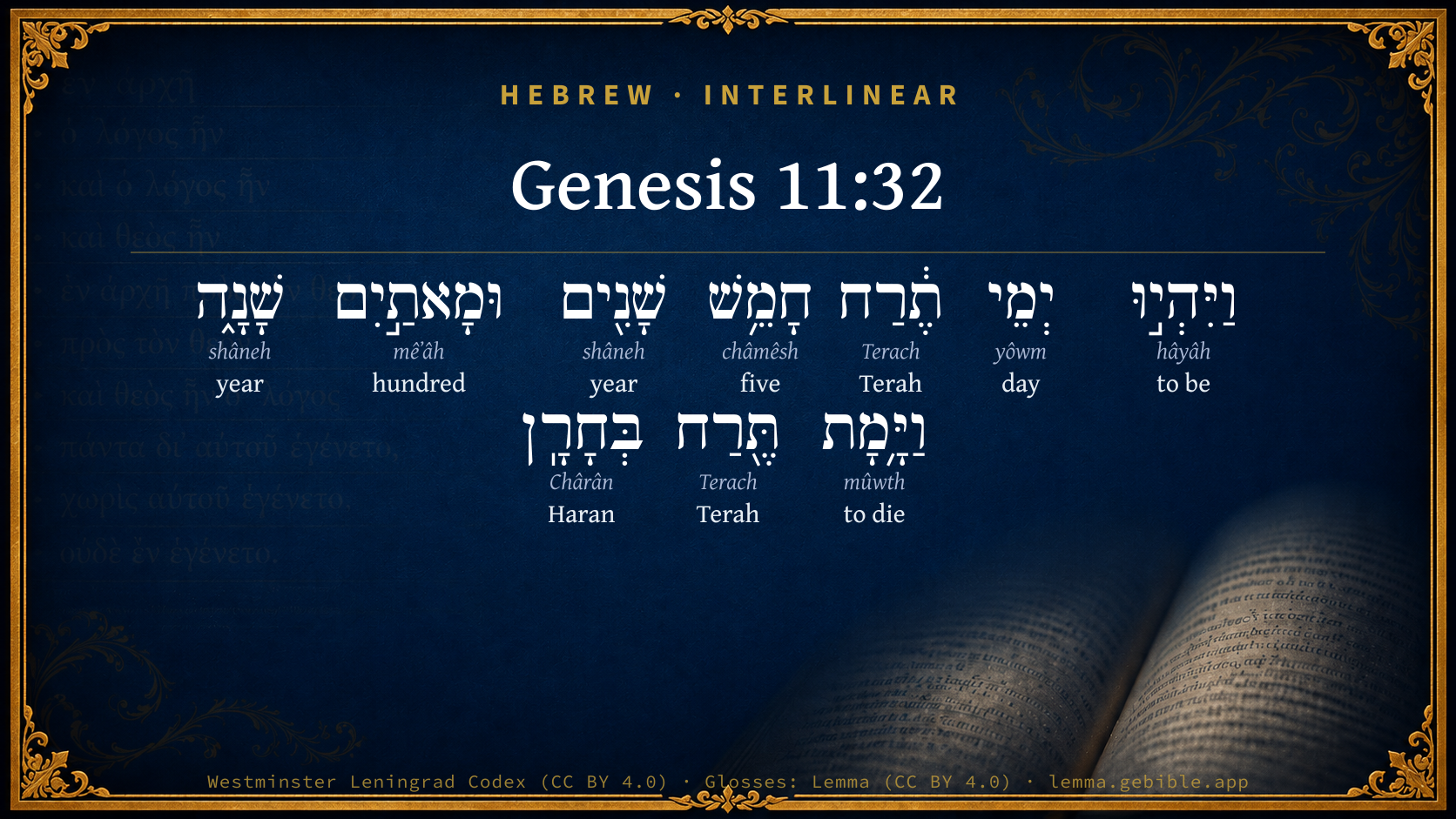
Hebrew (Westminster Leningrad Codex) Genesis 11:32 appears in the Hebrew Old Testament. The text above is from the Westminster Leningrad Codex. Each word links to its Strong’s number, a concise gloss, and parsing drawn from the Open Scriptures Hebrew Bible morphology. Click any word for its full Brown-Driver-Briggs (BDB) entry.
Download image
Cite this verse

Genesis 11:32 (World English Bible). Public Domain. Lemma interlinear Bible study tool, https://lemma.gebible.app/v/genesis/11/32.

Show BibTeX & RIS
BibTeX
RIS
English Translation
The days of Terah were two hundred five years. Terah died in Haran.
World English Bible · Public Domain
Download a study sheet

One document with this verse’s original text, its word-by-word gloss line, the meaning frame, cross-references with their text, attributed commentary, and full source and license credits — printable, and it pastes into notes with its structure intact.

This verse Autodidact and up

Study sheet (.html) Plain text (.txt)

A passage Seminary Student

Up to 50 verses in one chapter. A passage sheet keeps up to 6 commentary sources and 12 cross-references per verse, in the order this page ranks them, and says so on the sheet whenever that leaves anything out. Ask for a single verse and you get the Autodidact verse sheet above.

Everything on this page stays free to read, with no account — the sheet is a download of what is already on screen, not access to it.

Want to remove ads? Support Godless Engineer
Compare translations 3

The same verse in 3 English versions, stacked beneath the original-language interlinear above. Click any original word for its lexicon entry.

Each is an independent rendering of the whole verse — the interlinear is not word-aligned to these translations.

Highlighted words mark where these versions differ — a whole-verse word diff, not a word-by-word alignment.

  • World English Bible Public Domain
    The days of Terah were two hundred five years. Terah died in Haran.
  • King James Version Public Domain
    And the days of Terah were two hundred and five years: and Terah died in Haran.
  • unfoldingWord Literal Text CC BY-SA 4.0
    And the days of Terah were 205 years, then Terah died in Haran.

unfoldingWord Literal Text — © unfoldingWord, licensed CC BY-SA 4.0. Word-aligned USFM3 via Door43 (git.door43.org/unfoldingWord/en_ult).

Versions to compare (up to 4)

3 of 4 selected

Show all 18 translations

Every available English version of this verse, each an independent rendering of the whole verse.

  • World English Bible Public Domain
    The days of Terah were two hundred five years. Terah died in Haran.
  • Berean Standard Bible Public Domain
    Terah lived 205 years, and he died in Haran.
  • Majority Standard Bible Public Domain
    Terah lived 205 years, and he died in Haran.
  • King James Version Public Domain
    And the days of Terah were two hundred and five years: and Terah died in Haran.
  • American Standard Version (1901) Public Domain
    And the days of Terah were two hundred and five years: and Terah died in Haran.
  • Revised Version (1885) Public Domain
    And the days of Terah were two hundred and five years: and Terah died in Haran.
  • Geneva Bible (1599) Public Domain
    So the dayes of Terah were two hundreth and fiue yeeres, and Terah died in Haran.
  • Douay-Rheims (1899) Public Domain
    And the days of Thare were tow hundred and five years, and he died in Haran.
  • Young's Literal Translation Public Domain
    And the days of Terah are two hundred and five years, and Terah dieth in Charan.
  • Literal Standard Version CC BY-SA 4.0
    And the days of Terah are two hundred and five years, and Terah dies in Haran.
  • Unlocked Literal Bible CC BY-SA 4.0
    Terah lived 205 years and then died in Haran.
  • unfoldingWord Literal Text CC BY-SA 4.0
    And the days of Terah were 205 years, then Terah died in Haran.
  • Darby Bible Public Domain
    And the days of Terah were two hundred and five years; and Terah died in Haran.
  • World Messianic Bible Public Domain
    The days of Terah were two hundred five years. Terah died in Haran.
  • Webster's Bible Public Domain
    And the days of Terah were two hundred and five years: and Terah died in Haran.
  • Free Bible Version CC BY-SA 4.0
    Terah lived for 205 years and died in Haran.
  • Bible in Basic English Public Domain
    And all the years of Terah's life were two hundred and five: and Terah came to his end in Haran.
  • JPS Tanakh (1917) Public Domain
    And the days of Terah were two hundred and five years; and Terah died in Haran.

Literal Standard Version (2020), Covenant Press — licensed CC BY-SA 4.0. Text via the HelloAO Bible API (eBible.org). Unlocked Literal Bible (unfoldingWord) — licensed CC BY-SA 4.0. Text via the HelloAO Bible API (eBible.org). unfoldingWord Literal Text — © unfoldingWord, licensed CC BY-SA 4.0. Word-aligned USFM3 via Door43 (git.door43.org/unfoldingWord/en_ult). Free Bible Version, Dr. Jonathan Gallagher — licensed CC BY-SA 4.0. Text via the HelloAO Bible API (eBible.org).

Word by word

More ways to search: Search by grammar → Find every occurrence → Compare this word →

Practice this passage: Drill this verse → Learn its vocabulary →

בְּחָרָֽן
Chârân
H2771
“in/at · Haran”
Preposition + Noun, Proper
Part of Speech
Preposition + Noun
Type
Proper
Full BDB Definition

Origin: from H2787

TWOT: 747

Haran = "mountaineer" - a son of Caleb by his concubine Ephah (noun proper masculine) - the city to which Abraham migrated when he left Ur of the Chaldees and where he stayed until his father died before leaving for the promised land; located in Mesopotamia in Padan-aram at the foot of Mount Masius between the Khabour and the Euphrates (noun proper locative)
  1. וַיִּהְי֣וּ hâyâh H1961 “and · to be” Conjunction + Verb, Qal, Sequential Imperfect, 3rd Person, Masculine, Plural
  2. יְמֵי yôwm H3117 “days of” Noun, Common, Masculine, Plural, Construct
  3. תֶ֔רַח Terach H8646 “Terah” Noun, Proper
  4. חָמֵ֥שׁ châmêsh H2568 “five” Adjective, Cardinal number, Feminine, Singular, Absolute
  5. שָׁנִ֖ים shâneh H8141 “years” Noun, Common, Feminine, Plural, Absolute
  6. וּמָאתַ֣יִם mêʼâh H3967 “and · hundred” Conjunction + Adjective, Cardinal number, Both, Dual, Absolute
  7. שָׁנָ֑ה shâneh H8141 “year” Noun, Common, Feminine, Singular, Absolute
  8. וַיָּ֥מָת mûwth H4191 “and · to die” Conjunction + Verb, Qal, Sequential Imperfect, 3rd Person, Masculine, Singular
  9. תֶּ֖רַח Terach H8646 “Terah” Noun, Proper

About this verse

These counts appear in no published source. They are computed here, from the morphology-tagged text and Lemma’s own curated glosses. What Lemma adds →

10
words
8
distinct lemmas
Pentateuch
section

Notable vocabulary

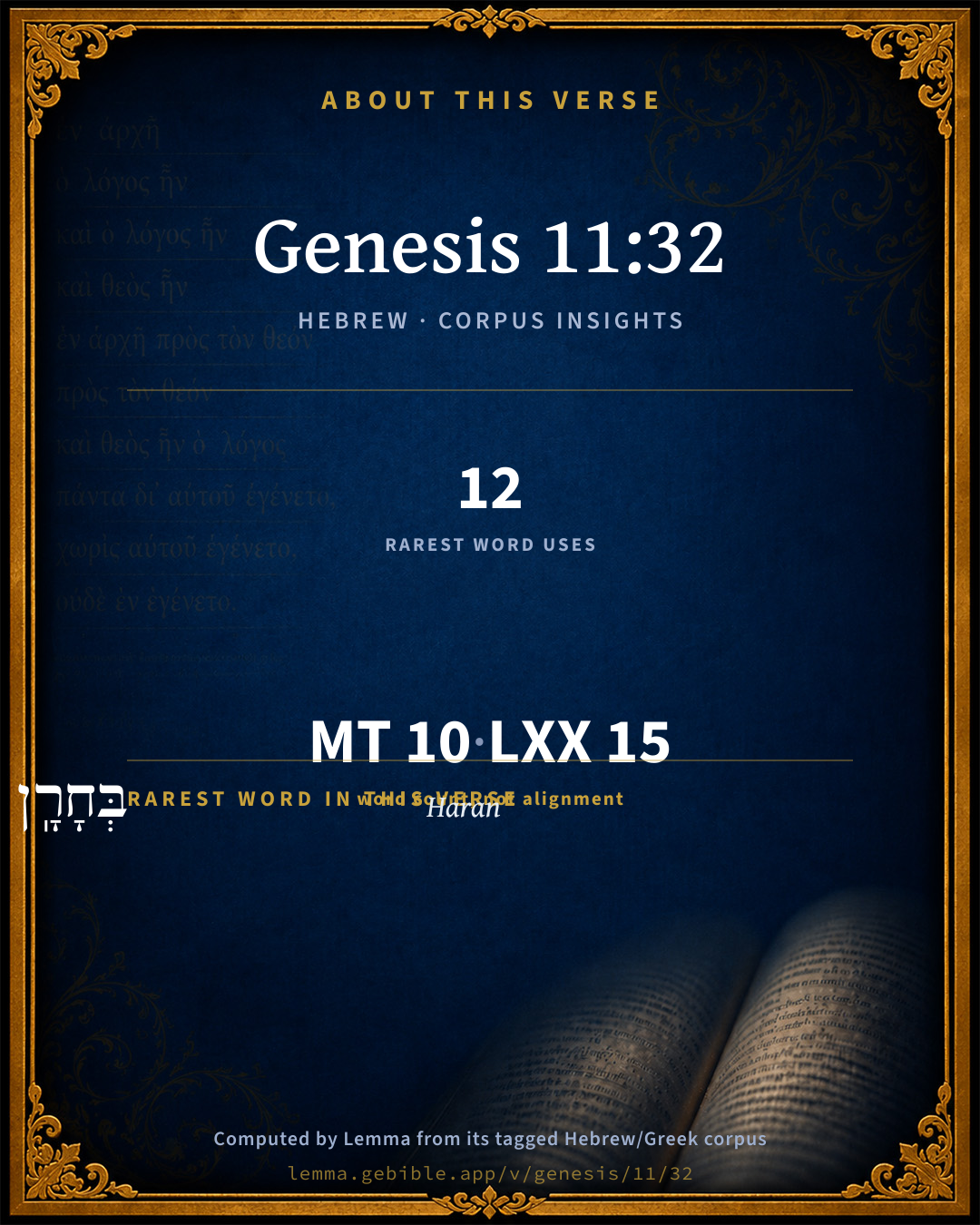
The rarest word here is בְּחָרָֽן Haran H2771 — appearing just 12 times in the whole Hebrew Bible.

Shared distinctive vocabulary

בְּחָרָֽן Haran H2771 occurs in 11 verses of the Hebrew Bible. Also found in:

Grammatical profile

  • 2 verbs
  • 6 nouns
  • 2 adjectives

Verb forms

  • וַיִּהְי֣וּ Qal · Sequential Imperfect
  • וַיָּ֥מָת Qal · Sequential Imperfect

Repetition

Words recur within this verse — often emphatic in Hebrew:

  • תֶ֔רַח Terah H8646 ×2
  • שָׁנִ֖ים year H8141 ×2

Hebrew & Septuagint length

In English translation the verse runs 13 words from the Hebrew and 22 from the Septuagint (LXX English) — the Septuagint runs noticeably longer here. See the side-by-side →

A rough comparison of the two English renderings, which tokenize alike — not a word-level alignment.

Word counts can differ between the Hebrew and the Greek without any difference in meaning — e.g. the Hebrew direct-object marker אֵת has no separate Greek word, and Greek often adds the article ὁ.

In the original languages it is 10 Hebrew tokens and 15 Greek tokens — but the two are counted differently (Hebrew bundles its prefixes and suffixes into one token; the Greek is in lemma form), so that isn’t a like-for-like length.

Hebrew and Greek witnesses Masoretic Hebrew ↔ Greek Septuagint

The same verse in the two great witnesses to the Old Testament, shown verse-for-verse.

Here the Septuagint runs noticeably longer than the Hebrew — LXX2012 (modern English Septuagint) 22 words vs World English Bible 13. A rough length comparison of the two English translations, not a word-level alignment — read both below.

These are two independent witnesses, not word-aligned to each other, and the Septuagint is shown in lemma (dictionary) form.

Hebrew Genesis 11:32 Masoretic · Westminster Leningrad Codex

וַיִּהְי֣וּ יְמֵי תֶ֔רַח חָמֵ֥שׁ שָׁנִ֖ים וּמָאתַ֣יִם שָׁנָ֑ה וַיָּ֥מָת תֶּ֖רַח בְּחָרָֽן

The days of Terah were two hundred five years. Terah died in Haran.

World English Bible · Public Domain

Greek LXX Genesis 11:32 Septuagint · lemma form

καί γίγνομαι ὁ ἡμέρα θαρα ἐν χαρραν διακόσιοι πέντε ἔτος καί ἀποθνήσκω θαρα ἐν χαρραν

And all the days of Tharrha in the land of Charrhan were two hundred and five years, and Tharrha died in Charrhan.

LXX2012 (modern English Septuagint) · Public Domain

On this verse, The Cambridge Bible for Schools and Colleges discusses the Septuagint’s reading. Read the note in Commentary ↓

Hebrew: Westminster Leningrad Codex (CC BY 4.0). Greek: Septuagint (public domain); English from LXX2012 (modern English Septuagint) (Public Domain). How the Septuagint differs from the Hebrew →

Targum (Aramaic paraphrase)

2

The Targum is the ancient Jewish Aramaic paraphrase of the Hebrew Scriptures — an interpretive translation, not the Hebrew text itself. Onkelos (literal) and Pseudo-Jonathan (expansive) render the Torah, and Jonathan the Prophets. Coverage is partial: where no permissively-licensed English translation exists for a verse, only the Aramaic is shown. This is verse-level text, not a word-by-word alignment to the Hebrew.

  1. Targum Onkelos Torah (Genesis–Deuteronomy)
    וַהֲווֹ יוֹמֵי תֶרַח מָאָתן וַחֲמֵשׁ שְׁנִין וּמִית תֶּרַח בְּחָרָן

    And the days of Terach were two hundred and five years, and Terach died in Charan.

    Targum Onkelos — Aramaic: “Onkelos Genesis” (public domain); “Onkelos Exodus” (public domain); “Onkelos Leviticus” (public domain); “Onkelos Numbers” (public domain); “Onkelos Deuteronomy” (public domain). English: “Sefaria Community Translation” (CC0 1.0 (public-domain dedication)); “J.W. Etheridge. The Targums of Onkelos and Jonathan Ben Uzziel on the Pentateuch. London: Longmans, Green, 1862” (public domain). Text via Sefaria.

  2. Targum Pseudo-Jonathan Torah (Genesis–Deuteronomy)
    וַהֲווֹ יוֹמֵי תֶּרַח מָאתָן וַחֲמֵשׁ שְׁנִין וּמִית תֶּרַח בְּחָרָן

    And the days of Terah were two hundred and five years. And Terah died in Haran.

    Targum Pseudo-Jonathan — Aramaic: “Targum Jonathan on Genesis” (public domain); “Targum Jonathan on Exodus” (public domain); “Targum Jonathan on Leviticus” (public domain); “Targum Jonathan on Numbers” (public domain); “Targum Jonathan on Deuteronomy” (public domain). English: “The Targum of Jonathan ben Uzziel, trans. J. W. Etheridge, London, 1862” (public domain). Text via Sefaria.

Commentary

Notes on Genesis 11:32 from classic Christian and Jewish commentators (each source and its license shown beneath its notes). The classic Christian expositions comment on the surrounding passage and are grouped to its opening verse, so a note may address several verses; the Jewish commentaries on the Tanakh (Rashi and others) are per-verse, so they appear only where the commentator wrote on this verse.

Lemma curates 59 commentaries, every one of them public domain or Creative Commons licensed, each selected and text-cleaned for this edition rather than reprinted as found. About our sources →

The Cambridge Bible for Schools and Colleges

gen. ed. J. J. S. Perowne

32. two hundred and five years] For this figure the Samaritan version gives 145, obviously in order to make the year of Abram’s departure from Haran (when Abram was 75 years old; see Gen_12:4) coincide with the year of Terah’s death, since Abram was born (Gen_11:26) in Terah’s 70th year. It is this tradition which is followed by Stephen, Act_7:4.

In this Table it is possible to follow the different chronologies of the Massoretic, Samaritan, and Septuagint Text (L = Lucian).

(a) The Samaritan Text (except in the case of Shem, Nahor, and Terah) adds 100 years to the ages at the birth of the firstborn: in the case of Nahor, it adds 50.

The Septuagint Text does the same.

(b) The Samaritan Text (except in the case of Shem, Eber, Nahor, and Terah) deducts 100 years from the ages subsequent to the birth of the firstborn; in the case of Eber it deducts 160 years; in the case of Nahor it deducts 50 years; in the case of Terah it deducts 60 years.

The Septuagint Text adds in the case of Arpachshad 27 years; and of Nahor 10 years; and deducts in the case of Shelah 73 years, and of Eber 60 years.

(c) In chap. 11 only nine generations are recorded, as against ten in chap. 5. The Septuagint, by inserting Cainan, secures the number ten.

(d) It will be noticed that the ages of the Shemite Patriarchs become greatly diminished in duration after Eber.

(e) The difficulty, occasioned by Gen_11:32 (Terah’s death in Haran at the age of 205), and by Gen_12:4 (Abram’s departure from Haran at the age of 75, when Terah was 145 years old (cf. Gen_11:26)), is obviated in the Samaritan Text, according to which Terah died at the age of 145, the year of Abram’s departure.

The Cambridge Bible for Schools and Colleges (gen. ed. J. J. S. Perowne; Cambridge University Press, 1878–1918) — public domain. Text from a community e-Sword module.

Trapp's Complete Commentary

John Trapp

Gen 11:32 And the days of Terah were two hundred and five years: and Terah died in Haran.

Ver. 32. Terah died in Haran.] And so fell short of the earthly, but not of the heavenly Canaan; to the which, there is as ready a way and as speedy a passage, from one place, as from another. But as the body, when once glorified, shall soon be wheresoever the soul will: so soon shall be the soul where God wills, when once delivered.

John Trapp, A Commentary or Exposition upon All the Books of the Old and New Testament (1647–1656) — public domain. Text from a community e-Sword module.

Adam Clarke's Commentary

|-------------------------------------------------|

| A TABLE |

| |

| SHOWING THE |

| |

| GENEALOGY OF THE PATRIARCHS |

| |

| FROM |

| |

| ADAM TO JACOB |

| |

| (A Period of 2168 Years) |

| |

| AND ALSO |

| |

| WHICH OF THE PATRIARCHS WERE |

| CONTEMPORARY WITH EACH OTHER |

| -------------------------- |

| |

| Presented to Dr. Clarke, for his |

| Commentary by William Blair, Esq. |

|-------------------------------------------------|

|--------------------------------------------------|

| ADAM | NOAH | SHEM |

|was contemporary|was contemporary|was contemporary|

| with | with | with |

| Years| Years| Years|

|LAMECH 56|LAMECH 595|LAMECH 93|

|METHUSELAH 243|METHUSELAH 600|METHUSELAH 98|

|JARED 470|JARED 366|NOAH 448|

|MAHALELEEL 535|MAHALELEEL 234|after the flood |

|CAINAN 605|CAINAN 179|ABRAHAM 150|

|ENOS 695|ENOS 84|ISAAC 50|

|--------------------------------------------------|

|----------------------------------------------------------------------|

| | Age| |Born| | |D |D |

| | at| L A|A.M.|Died| | A | A |

| BIRTH OF CHRIST | the| i f| and|A.M.| GENEALOGY | T | T |

| ANNO MUNDI 4004 |birth| v t|Died| | OF THE | E| E|

| | of| e e|Aged| | PATRIARCHS | | |

| | the| d r| | | |A. |B. |

| | Heir| | | | | M.| C.|

|----------------------------------------------------------------------|

|Gen.v.3,4 ADAM.........| 130| | | |ADAM Created|----|4004|

| | | 800| 930| 932|-------------------------|

|--------------------------------------------|SETH born| 130|3784|

| " 3 SETH..born AM| 130| | 130| |-------------------------|

| 6,7............| 105| 807| 912|1042|ENOS born| 235|3769|

|----------------------------------------------------------------------|

| | | | | |CAINAN born| 325|3679|

| " 6 ENOS.......".| 235| | 235| |-------------------------|

| 9,10,11........| 90| 815| 905|1140|MAHALALEEL born| 395|3609|

|----------------------------------------------------------------------|

| | | | | |JARED born| 460|3544|

| " 9 CAINAN.....".| 325| | 325| |-------------------------|

| 12,13,14........| 70| 840| 910|1235|ENOCH born| 622|3382|

|----------------------------------------------------------------------|

| | | | | |METHUSELAH born| 687|3317|

| " 12 MAHALALEEL.".| 395| | 395| |-------------------------|

| 15,16,17........| 65| 830| 895|1290|LAMECH born| 874|3130|

|----------------------------------------------------------------------|

| | | | | |ADAM died| 930|3074|

| " 15 JARED......".| 460| | 460| |-------------------------|

| 18,19,29........| 162| 800| 962|1422|ENOCH translatd| 987|3017|

|----------------------------------------------------------------------|

| | | | | |SETH died|1042|2962|

| " 18 ENOCH......".| 622| | 622| |-------------------------|

| 21,22,23........| 65| 300| 365| 987|NOAH born|1056|2948|

|----------------------------------------------------------------------|

| | | | | |ENOS died|1140|2864|

| " 21 METHUSELAH.".| 687| | 687| |-------------------------|

| 25,26,27........| 187| 782| 969|1656|CAINAN died|1235|2769|

|----------------------------------------------------------------------|

| | | | | |MAHALALEEL died|1290|2714|

| " 25 LAMECH.....".| 874| | 874| |-------------------------|

| 28,30,31........| 182| 595| 777|1651|JARED died|1422|2582|

|----------------------------------------------------------------------|

| | | | | |SHEM born|1558|2446|

| " 29 NOAH.......".| 1056| |1056| |-------------------------|

| 32, and ix.29...| 502| 448| 950|2006|LAMECH died|1651|2353|

|----------------------------------------------------------------------|

| | | | | |METHUSELAH died|1656|2348|

| " 32 SHEM.......".| 1558| |1558| |-------------------------|

|Gen.vii.6, and ix.10...| 98| | | |THE DELUGE |1656|2348|

|----------------------------------------------------------------------|

| | | | | |ARPHAXAD born|1658|2346|

| " 6 THE DELUGE...| 1656| | | |-------------------------|

|Gen.xi.10,11...........| 2| 500| 600|2158|SELAH born|1693|2311|

|----------------------------------------------------------------------|

| | | | | |EBER born|1723|2281|

| " 11 ARPHAXAD.b.AM| 1658| |1658| |-------------------------|

| " 12,13...........| 35| 403| 438|2096|PELEG born|1757|2247|

|----------------------------------------------------------------------|

| | | | | |REU born|1787|2217|

| " 12 SELAH......".| 1693| |1693| |-------------------------|

| " 14,15...........| 30| 403| 433|2126|SERUG born|1819|2185|

|----------------------------------------------------------------------|

| | | | | |NAHOR born|1849|2155|

| " 14 EBER.......".| 1723| |1723| |-------------------------|

| " 16,17...........| 34| 430| 464|2187|TERAH born|1878|2126|

|----------------------------------------------------------------------|

| | | | | |PELEG died|1996|2008|

| " 16 PELEG......".| 1757| |1757| |-------------------------|

| " 18,19...........| 30| 209| 239|1996|NAHOR died|1997|2007|

|----------------------------------------------------------------------|

| | | | | |NOAH died|2006|1998|

| " 18 REU........".| 1787| |1787| |-------------------------|

| " 20,21...........| 32| 207| 239|2026|ABRAM born|2008|1996|

|----------------------------------------------------------------------|

| | | | | |REU died|2026|1978|

| " 20 SERUG......".| 1819| |1819| |-------------------------|

| " 22,23...........| 30| 200| 230|2049|SERUG died|2049|1955|

|----------------------------------------------------------------------|

| | | | | |TERAH died|2083|1921|

| " 22 NAHOR......".| 1849| |1849| |-------------------------|

| " 24,25...........| 29| 119| 148|1997|ARPHAXAD died|2096|1908|

|----------------------------------------------------------------------|

| | | | | |ISAAC born|2108|1896|

| " 24 TERAH......".| 1878| |1878| |-------------------------|

| 32 & xii.4. Acts vii.4| 130| 75| 205|2083|SELAH died|2126|1878|

|----------------------------------------------------------------------|

| | | | | |SHEM died|2158|1846|

|Gen.xii.4 ABRAM......".| 2008| |2008| |-------------------------|

|Gen.xxi.5, and xxv.7...| 100| 75| 175|2183|JACOB born|2168|1836|

|----------------------------------------------------------------------|

| | | | | |ABRAHAM died|2183|1821|

| " 5 ISAAC......".| 2108| |2108| |-------------------------|

|Gen.xxv.6..............| 60| 120| 180|2288|EBER died|2187|1817|

|----------------------------------------------------------------------|

| | | | | |ISAAC died|2288|1716|

| " 6 JACOB......".| 2168| |2168| |-------------------------|

|Gen.xlvii.28...........| | | 147|2315|JACOB died|2315|1689|

|----------------------------------------------------------------------|

|---------------------------------------------------------------------|

| | | | A | S | E | C | M | J | E | M | L | N | S |

| | | | D | E | N | A | A | A | N | E | A | O | H |

| |D |D | A | T | O | I | H | R | O | T | M | A | E |

| | A | A | M | H | S | N | A | E | C | H | E | H | M |

| GENEALOGY | T | T | | | | A | L | D | H | U | C | | |

| OF THE | E| E| | | | N | A | | | S | H | | |

| PATRIARCHS | | | | | | | L | | | E | | | |

| |A. |B. | | | | | E | | | L | | | |

| | M.| C.| | | | | E | | | A | | | |

| | | | | | | | L | | | H | | | |

| | | |-------------------------------------------|

| | | | ------------- aged when --------------- |

|---------------------------------------------------------------------|

|ADAM Created|----|4004| | | | | | | | | | | |

|---------------------------------------------------------------------|

|SETH born| 130|3784|130| | | | | | | | | | |

|---------------------------------------------------------------------|

|ENOS born| 235|3769|235|105| | | | | | | | | |

|---------------------------------------------------------------------|

|CAINAN born| 325|3679|325|195| 90| | | | | | | | |

|---------------------------------------------------------------------|

|MAHALALEEL born| 395|3609|395|265|160| 70| | | | | | | |

|---------------------------------------------------------------------|

|JARED born| 460|3544|460|330|225|135| 65| | | | | | |

|---------------------------------------------------------------------|

|ENOCH born| 622|3382|622|492|387|297|227|162| | | | | |

|---------------------------------------------------------------------|

|METHUSELAH born| 687|3317|687|557|452|362|292|227| 65| | | | |

|---------------------------------------------------------------------|

|LAMECH born| 874|3130|874|744|639|549|479|414|252|187| | | |

|---------------------------------------------------------------------|

|ADAM died| 930|3074|930|800|695|605|535|470|308|243| 56| | |

|---------------------------------------------------------------------|

|ENOCH translatd| 987|3017| |857|752|662|592|527|365|300|113| | |

|---------------------------------------------------------------------|

|SETH died|1042|2962| |912|807|717|647|582| |355|168| | |

|---------------------------------------------------------------------|

|NOAH born|1056|2948| | |821|731|661|596| |369|182| | |

|---------------------------------------------------------------------|

|ENOS died|1140|2864| | |905|815|745|680| |453|266| 84| |

|---------------------------------------------------------------------|

|CAINAN died|1235|2769| | | |910|840|775| |548|361|179| |

|---------------------------------------------------------------------|

|MAHALALEEL died|1290|2714| | | | |895|830| |603|416|234| |

|---------------------------------------------------------------------|

|JARED died|1422|2582| | | | | |962| |735|548|366| |

|---------------------------------------------------------------------|

|SHEM born|1558|2446| | | | | | | |869|682|500| |

|---------------------------------------------------------------------|

|LAMECH died|1651|2353| | | | | | | |964|777|595| 93|

|---------------------------------------------------------------------|

|METHUSELAH died|1656|2348| | | | | | | |969| |600| 98|

|---------------------------------------------------------------------|

|THE DELUGE |1656|2348| | | | | | | | | |600| 98|

|---------------------------------------------------------------------|

|ARPHAXAD born|1658|2346| | | | | | | | | |602|100|

|---------------------------------------------------------------------|

|SELAH born|1693|2311| | | | | | | | | |637|135|

|---------------------------------------------------------------------|

|EBER born|1723|2281| | | | | | | | | |667|165|

|---------------------------------------------------------------------|

|PELEG born|1757|2247| | | | | | | | | |701|199|

|---------------------------------------------------------------------|

|REU born|1787|2217| | | | | | | | | |731|229|

|---------------------------------------------------------------------|

|SERUG born|1819|2185| | | | | | | | | |763|261|

|---------------------------------------------------------------------|

|NAHOR born|1849|2155| | | | | | | | | |793|291|

|---------------------------------------------------------------------|

|TERAH born|1878|2126| | | | | | | | | |822|320|

|---------------------------------------------------------------------|

|PELEG died|1996|2008| | | | | | | | | |940|438|

|---------------------------------------------------------------------|

|NAHOR died|1997|2007| | | | | | | | | |941|439|

|---------------------------------------------------------------------|

|NOAH died|2006|1998| | | | | | | | | |950|448|

|---------------------------------------------------------------------|

|ABRAM born|2008|1996| | | | | | | | | | |450|

|---------------------------------------------------------------------|

|REU died|2026|1978| | | | | | | | | | |468|

|---------------------------------------------------------------------|

|SERUG died|2049|1955| | | | | | | | | | |491|

|---------------------------------------------------------------------|

|TERAH died|2083|1921| | | | | | | | | | |525|

|---------------------------------------------------------------------|

|ARPHAXAD died|2096|1908| | | | | | | | | | |538|

|---------------------------------------------------------------------|

|ISAAC born|2108|1896| | | | | | | | | | |550|

|---------------------------------------------------------------------|

|SELAH died|2126|1878| | | | | | | | | | |568|

|---------------------------------------------------------------------|

|SHEM died|2158|1846| | | | | | | | | | |600|

|---------------------------------------------------------------------|

|---------------------------------------------------------------------|

| | | | A | S | E | P | R | S | N | T | A | I | J |

| | | | R | E | B | E | E | E | A | E | B | S | A |

| |D |D | P | L | E | L | U | R | H | R | R | A | C |

| | A | A | H | A | R | E | | U | O | A | A | A | O |

| GENEALOGY | T | T | A | H | | G | | G | R | H | M | C | B |

| OF THE | E| E| X | | | | | | | | | | |

| PATRIARCHS | | | A | | | | | | | | | | |

| |A. |B. | D | | | | | | | | | | |

| | M.| C.|-------------------------------------------|

| | | | ------------- aged when --------------- |

|---------------------------------------------------------------------|

|THE DELUGE |1656|2348| | | | | | | | | | | |

|---------------------------------------------------------------------|

|ARPHAXAD born|1658|2346| | | | | | | | | | | |

|---------------------------------------------------------------------|

|SELAH born|1693|2311| 35| | | | | | | | | | |

|---------------------------------------------------------------------|

|EBER born|1723|2281| 65| 30| | | | | | | | | |

|---------------------------------------------------------------------|

|PELEG born|1757|2247| 99| 64| 34| | | | | | | | |

|---------------------------------------------------------------------|

|REU born|1787|2217|129| 94| 64| 30| | | | | | | |

|---------------------------------------------------------------------|

|SERUG born|1819|2185|161|126| 96| 62| 32| | | | | | |

|---------------------------------------------------------------------|

|NAHOR born|1849|2155|191|156|126| 92| 62| 30| | | | | |

|---------------------------------------------------------------------|

|TERAH born|1878|2126|220|185|155|121| 91| 59| 29| | | | |

|---------------------------------------------------------------------|

|PELEG died|1996|2008|338|303|273|239|209|177|147|118| | | |

|---------------------------------------------------------------------|

|NAHOR died|1997|2007|339|304|274| |210|178|148|119| | | |

|---------------------------------------------------------------------|

|NOAH died|2006|1998|348|313|283| |219|187| |128| | | |

|---------------------------------------------------------------------|

|ABRAM born|2008|1996|350|315|285| |221|189| |130| | | |

|---------------------------------------------------------------------|

|REU died|2026|1978|368|333|303| |239|207| |148| 18| | |

|---------------------------------------------------------------------|

|SERUG died|2049|1955|391|356|326| | |230| |171| 41| | |

|---------------------------------------------------------------------|

|TERAH died|2083|1921|425|390|360| | | | |205| 75| | |

|---------------------------------------------------------------------|

|ARPHAXAD died|2096|1908|438|403|373| | | | | | 88| | |

|---------------------------------------------------------------------|

|ISAAC born|2108|1896| |415|385| | | | | |100| | |

|---------------------------------------------------------------------|

|SELAH died|2126|1878| |433|403| | | | | |118| 18| |

|---------------------------------------------------------------------|

|SHEM died|2158|1846| | |435| | | | | |150| 50| |

|---------------------------------------------------------------------|

|JACOB born|2168|1836| | |445| | | | | |160| 60| |

|---------------------------------------------------------------------|

|ABRAHAM died|2183|1821| | |460| | | | | |175| 75| 15|

|---------------------------------------------------------------------|

|EBER died|2187|1817| | |464| | | | | | | 79| 15|

|---------------------------------------------------------------------|

|ISAAC died|2288|1716| | | | | | | | | |180|120|

|---------------------------------------------------------------------|

|JACOB died|2315|1689| | | | | | | | | | |147|

|---------------------------------------------------------------------|

Adam Clarke's Commentary on the Bible (1810–1826) — public domain. Text from a community e-Sword/MySword module.

Ellicott's Commentary for English Readers

(32) The days of Terah.—See note on Gen_11:26. According to the Samaritan text, Abram left Haran in the same year as that in which Terah died. Nahor had probably joined Terah about this time, as we find him subsequently settled in Haran (Gen_24:10); and moreover, Abram is expressly commanded to leave “his kindred and his father’s house,” whereas all those who are mentioned by name as going with Terah shared in Abram’s subsequent migration. (See Gen_11:31.)

A Bible Commentary for English Readers, edited by Charles John Ellicott (1878–1897) — public domain. Text from a community e-Sword module.

Whedon's Commentary on the Bible

Daniel D. Whedon

32. Two hundred and five years — We see, from Gen_12:4, that Abram was seventy-five years old when he left Haran. If now he remained in Haran till Terah’s death, then Terah must have been at least one hundred and thirty years old at the time of Abram’s birth, since 205-75=130. But this does not seem likely, since Abram regards it a miraculous thing that he should be a father at one hundred, (Gen_17:17,) and this surprise at the divine promise is unaccountable if he were himself born when his father was one hundred and thirty. But the narrative allows us to suppose that Abram left Haran some years before Terah’s death, the history of Terah being finished up in this chapter, and the narrative then doubling back upon itself to resume the history of Abram. The only difficulty in this interpretation is, that we find St. Stephen, in his discourse, (Act_7:4,) assuming that Abram remained in Haran till the death of Terah. In this, however, Stephen, as we see from Philo, followed a Jewish tradition, which was probably erroneous. We do not certainly know in what year of Terah’s life Abram was born.

Daniel D. Whedon (gen. ed.), Commentary on the Old and New Testaments (1874–1909) — public domain. Text from a community e-Sword module.

The Pulpit Commentary

And the days of Terah were two hundred and five years. So that if Abram was born in Terah"s 70th year, Terah must have been 145 when Abram left Haran, and must have survived that departure sixty years (Kalisch, Dykes); whereas if Abram was born in his father"s 130th year, then Terah must have died before his son s departure from Haran, which agrees with Act_7:4. And Terah died in Haran.

The Pulpit Commentary (1880–1919), ed. H.D.M. Spence-Jones & Joseph S. Exell — public domain. Text from a community e-Sword module.

Rashi

Rabbi Shlomo Yitzchaki (Rashi)

וימת תרח בחרן AND TERAH DIED IN HARAN after Abram had left Haran (as related in the next chapter) and had come to the land of Canaan and had been there more than sixty years. For it is written, (Genesis 12:4) “And Abram was seventy five years old when he left Haran”, and Terah was seventy years old when Abram was born (Genesis 11:26), making Terah 145 years old when Abram left Haran, so that there were then many years of his life left (i. e. he lived many years after that — as a matter of fact, 60 years, as he was 205 years old when he died). Why, then, does Scripture mention the death of Terah before the departure of Abram? In order that this matter (his leaving home during his father’s lifetime) might not become known to all, lest people should say that Abram did not show a son’s respect to his father, for he left him in his old age and went his way. That is why Scripture speaks of him as dead (Genesis Rabbah 39:7). For indeed the wicked even while alive are called dead and the righteous even when dead are called living, as it is said, (2 Samuel 23:20) “And Benaiah the son of Jehoiada the son of a living man”.

בחרן IN HARAN — The נ is inverted to tell you that until the time of Abraham, the fierce anger (חרון) of the Omnipotent was kindled against the world.

Rashi on the Tanakh — English translations: “The Judaica Press complete Tanach with Rashi, translated by A. J. Rosenberg” (CC BY 4.0); “Pentateuch with Rashi's commentary by M. Rosenbaum and A.M. Silbermann, 1929-1934” (public domain); “The Metsudah Tanach series, Lakewood, N.J” (CC BY 4.0); and “The Book of Joshua, Metsudah Publications, 1997” (CC BY 4.0). Text via Sefaria.

Ramban (Nachmanides)

Rabbi Moshe ben Nachman (Ramban / Nachmanides)

AND TERAH DIED IN HARAN. After Abram had left [Haran, as related in the next chapter, and had come to the land of Canaan], Terah remained alive for many years after that. Why then does Scripture mention the death of Terah before the departure of Abram? [The answer is that Scripture does so] in order that this matter [of leaving his home during his father’s lifetime] might not become publicized to all, lest people say that Abram did not show a son’s respect to his father and mother as he left his father in his old age and went his way. That is why Scripture speaks of Terah as dead. Moreover, for the wicked, even while alive, are called dead. Thus the words of Rashi which are found in Bereshith Rabbah. But I wonder about their words for this is the customary way for Scripture to relate the life of a father, his begetting a son, and his death, and afterwards to begin the narration of the son in all generations. This is the usual manner of Scripture. Noah himself lived yet in the days of Abraham, and his son Shem lived thoughout Abraham’s life span. Now it is possible that the Rabbis came to conclusion of this Midrash because with respect to Terah, Scripture departed from the format of the entire chapter. Regarding Shem and his descendants, Scripture did not mention their death at all, nor did it total the sum of their years. But here with Terah it again follows the first order it used concerning the longevity of the people from Adam to Noah and totals up all the days of Terah and mentions his death. In addition, it mentions the place of death as having been in Haran, the same place it had mentioned concerning Abraham, [i.e., that he had gone there, in Verse 31]. That is why the Rabbis expounded that all this was to make it easily apparent that Abraham was there with Terah when he died. Moreover, because Scripture had already begun the subject of Abraham and told how he had gone forth with his father from Ur of the Chaldees to go into the land of Canaan, the Rabbis found it difficult to understand why Scripture did not systematically arrange Terah’s life and death, and write it chronologically. [That is why they made the aforementioned interpretation.]And as for that which the Rabbis also said in Bereshith Rabbah — “First you interpret that the wicked, even while alive, are called dead” — this too I find surprising, for the Sages have already deduced from the verse, “And thou shalt come to thy fathers in peace. [His father was an idolater, and yet G-d informed Abraham that after death he would go to him! Clearly the verse teaches you] that He announced to Abraham that his father would have a portion in the World to Come.” Perhaps the intent of the Rabbis was that Terah repented at the time of death, but he lived all his days in wickedness and therefore was called “dead.” In the words of Rashi: “Scripture teaches you that Terah did repentance at the time of death.” Perhaps it may be that our Sages, of blessed memory, say that Terah has a portion in the World to Come by virtue of his son. And that was the announcement, for Abraham did not know it until he was informed of it at the time G-d told him, And thou shalt come to thy fathers in peace. And so I found in a Midrash: “All kinds of wood were valid for use in the altar fire save only the wood of the olive and the vine,. for since oil and wine were offered upon the altar, the fruits save the trees. And so we find in the case of Abraham that he saved Terah, as it is said, And thou shalt come to thy fathers in peace.” Lech Lecha

Ramban (Nachmanides) on the Tanakh — English translation: “Commentary on the Torah by Ramban (Nachmanides). Translated and annotated by Charles B. Chavel. New York, Shilo Pub. House, 1971-1976” (CC BY 4.0). Text via Sefaria.

Radak

Rabbi David Kimhi (Radak)

ויהיו ימי תרח, Terach lived for 205 years. Seeing that the Torah had told us that he was 70 years old when Avram was born, Avram was 135 years old at the time his father died. According to the report in Seder Olam, Avram buried his father two years before the death of his wife Sarah, a statement that is absolutely correct. We know that Avraham was 137 years old when Sarah died, as he had previously been reported as being 10 years Sarah’s senior. This means that Terach must have died 2 years before his granddaughter Sarah.

וימת תרח בחרן, this line tells us that Terach had not abandoned his idolatry and had moved to Charan only out of love for his son Avraham. Following Avraham who had obeyed instructions given to him in a vision, did not mean that Terach changed his philosophy or lifestyle. This is why he saw nothing wrong in remaining in Charan until the time of his death. [even though his son had attained great prominence in the land of Canaan during the intervening 62 years. Ed.] If he had really done teshuvah, and returned to the G’d of his forefathers, he surely would have followed in his sons footsteps and have moved to Canaan. Possibly, Terach did keep the other Noachide laws, except for his idolatry, seeing that Avraham his son had become his guide in matters of theology as far as it concerned the dealings with is fellow man. The conviction that natural forces represent independent powers, even though they in turn might have to obey a higher law, was something he could not rid himself of, as he, as well as his contemporaries, were too deeply steeped in such a world outlook. We know that Joshua testified concerning Terach (Joshua 25,2) when he addressed the Israelites shortly before his death: ”your forefathers dwelled in the land beyond the river (Euprates), Terach the father of Avram and Nachor. They served alien deities, etc.” If Terach had indeed become a penitent and had returned to monotheism, it is inconceivable that Joshua would not have credited him with such a meritorious deed. The final letter ן in the word חרן is meluffaf, i.e. inverted, and our sages explained concerning this (Rashi and Torah Shleyma 115) that Terach died while being out of favour with his Creator, seeing that he had failed to repent his erstwhile idolatry. [Having had a son such as Avraham, his obstinacy was less forgivable than that of other idolaters. Ed.] There is, however, a different explanation offered by Bereshir Rabbah 38,12 based on G’d promising Avraham that he would die of a ripe old age before joining his fathers, etc (Genesis 15,15) This is understood as G’d telling Avraham that his father had indeed become a penitent before he died, how else could the prospect of joining his father after his death be a sort of comfort for Avraham?

Radak on the Tanakh — English translations: “Sefaria Community Translation” (CC0 1.0 (public-domain dedication)); “Eliyahu Munk, HaChut Hameshulash” (CC BY 4.0); “Rabbi Mike Feuer, Jerusalem Anthology” (CC BY 4.0); and “R. David Kimhi on the first book of Psalms, Translated by R.G. Finch, London, 1919” (public domain). Text via Sefaria.

Lesson kit

Teaching starters — assembled from the data on this page, not authored interpretation. Every prompt links to the verse data it draws on. Edit before teaching.

Genesis, in the Pentateuch, opens this verse with 10 words (8 distinct Hebrew lemmas). Its most distinctive word is Chârân (“Haran”). The Greek Septuagint runs longer here. A historical commentator’s framing appears above. Read the whole chapter for the surrounding context.

Discussion questions

  1. The word Chârân carries the sense “Haran.” How does it shape the verse?
  2. How does Genesis 11:31, which shares the word «Haran», read alongside this verse?
  3. What does the repetition of “Terah” (2× in this one verse) do in this verse?
  4. The Septuagint runs longer here than the Hebrew. What might account for the difference?
  5. These translations render this verse differently. What is at stake in choosing one wording over another?
  6. «וַיִּהְי֣וּ» is a Qal Sequential Imperfect verb. How does that grammatical form shape the action described?
  7. Compare how The Cambridge Bible for Schools and Colleges and Trapp's Complete Commentary read this verse. Where do they agree or differ?

Things to notice

Reading settings

Reading text

Shown beneath each verse's original-language words.

Old Testament
Old Testament edition

Read the OT as the Masoretic Hebrew (MT) or the Greek Septuagint (LXX).

English shown for the Greek Septuagint (in the Hebrew ↔ Greek comparison).

Comparing translations? Open the Compare panel on any verse page to stack up to four side by side.