
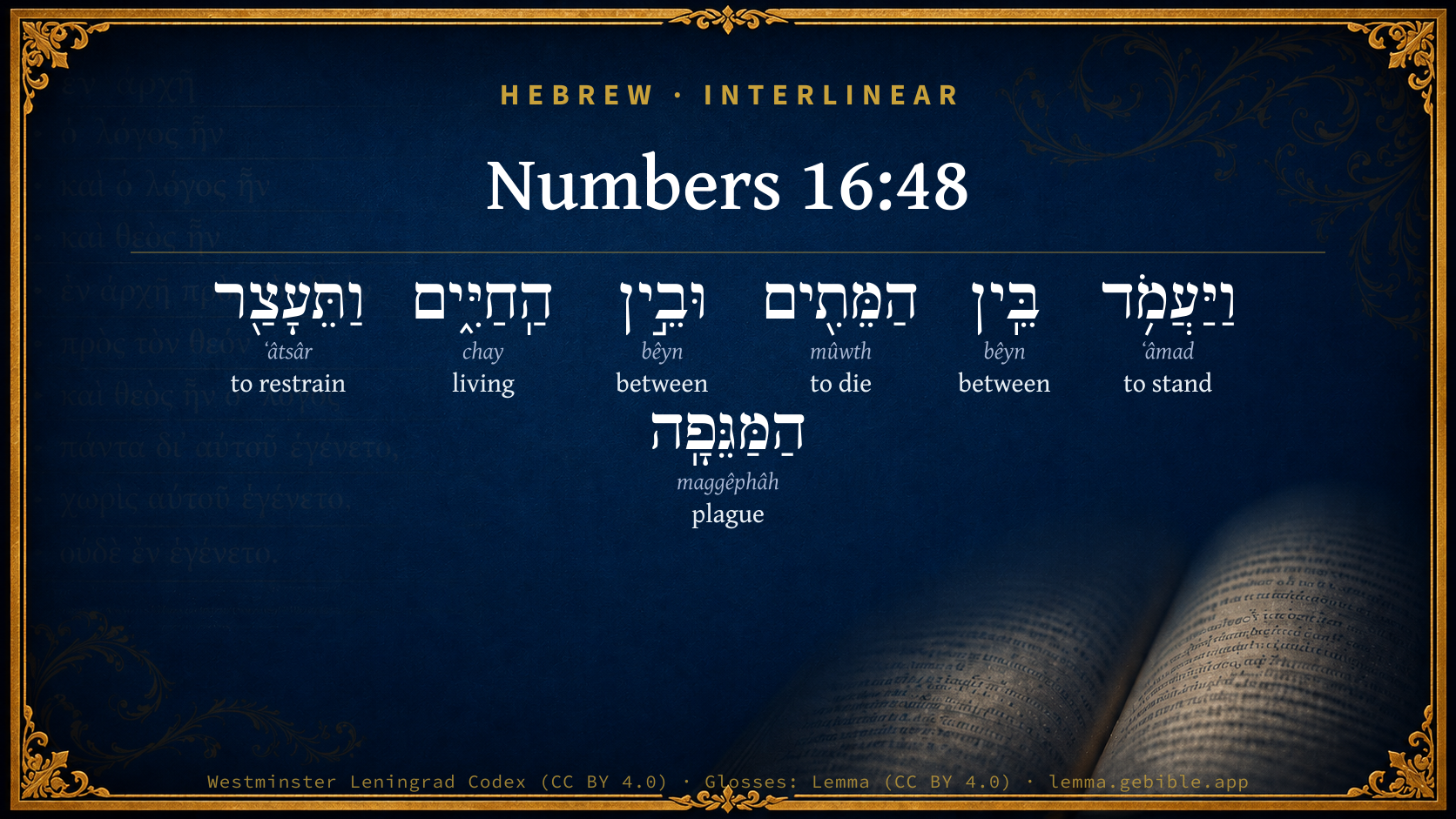
Numbers 16:48

Hebrew (Westminster Leningrad Codex) Numbers 16:48 appears in the Hebrew Old Testament. The text above is from the Westminster Leningrad Codex. Each word links to its Strong’s number, a concise gloss, and parsing drawn from the Open Scriptures Hebrew Bible morphology. Click any word for its full Brown-Driver-Briggs (BDB) entry.
Download image
Cite this verse

Numbers 16:48 (World English Bible). Public Domain. Lemma interlinear Bible study tool, https://lemma.gebible.app/v/numbers/16/48.

Show BibTeX & RIS
BibTeX
RIS
English Translation
He stood between the dead and the living; and the plague was stayed.
World English Bible · Public Domain
Download a study sheet

One document with this verse’s original text, its word-by-word gloss line, the meaning frame, cross-references with their text, attributed commentary, and full source and license credits — printable, and it pastes into notes with its structure intact.

This verse Autodidact and up

Study sheet (.html) Plain text (.txt)

A passage Seminary Student

Up to 50 verses in one chapter. A passage sheet keeps up to 6 commentary sources and 12 cross-references per verse, in the order this page ranks them, and says so on the sheet whenever that leaves anything out. Ask for a single verse and you get the Autodidact verse sheet above.

Everything on this page stays free to read, with no account — the sheet is a download of what is already on screen, not access to it.

Want to remove ads? Support Godless Engineer
Compare translations 3

The same verse in 3 English versions, stacked beneath the original-language interlinear above. Click any original word for its lexicon entry.

Each is an independent rendering of the whole verse — the interlinear is not word-aligned to these translations.

Highlighted words mark where these versions differ — a whole-verse word diff, not a word-by-word alignment.

  • World English Bible Public Domain
    He stood between the dead and the living; and the plague was stayed.
  • King James Version Public Domain
    And he stood between the dead and the living; and the plague was stayed.
  • unfoldingWord Literal Text CC BY-SA 4.0
    And he stood between the ones dying and between the ones living. And the plague was restrained.

unfoldingWord Literal Text — © unfoldingWord, licensed CC BY-SA 4.0. Word-aligned USFM3 via Door43 (git.door43.org/unfoldingWord/en_ult).

Versions to compare (up to 4)

3 of 4 selected

Show all 18 translations

Every available English version of this verse, each an independent rendering of the whole verse.

  • World English Bible Public Domain
    He stood between the dead and the living; and the plague was stayed.
  • Berean Standard Bible Public Domain
    He stood between the living and the dead, and the plague was halted.
  • Majority Standard Bible Public Domain
    He stood between the living and the dead, and the plague was halted.
  • King James Version Public Domain
    And he stood between the dead and the living; and the plague was stayed.
  • American Standard Version (1901) Public Domain
    And he stood between the dead and the living; and the plague was stayed.
  • Revised Version (1885) Public Domain
    And he stood between the dead and the living; and the plague was stayed.
  • Geneva Bible (1599) Public Domain
    And when hee stoode betweene the dead, and them that were aliue, the plague was stayed.
  • Douay-Rheims (1899) Public Domain
    And standing between the dead and the living, he prayed for the people, and the plague ceased.
  • Young's Literal Translation Public Domain
    and standeth between the dead and the living, and the plague is restrained;
  • Literal Standard Version CC BY-SA 4.0
    and stands between the dead and the living, and the plague is restrained;
  • Unlocked Literal Bible CC BY-SA 4.0
    Aaron stood between the dead and the living; in this way the plague was stopped.
  • unfoldingWord Literal Text CC BY-SA 4.0
    And he stood between the ones dying and between the ones living. And the plague was restrained.
  • Darby Bible Public Domain
    And he stood between the dead and the living; and the plague was stayed.
  • World Messianic Bible Public Domain
    He stood between the dead and the living; and the plague was stayed.
  • Webster's Bible Public Domain
    And he stood between the dead and the living; and the plague was stayed.
  • Free Bible Version CC BY-SA 4.0
    He stood between those who had died and those who were still alive, and the plague was stopped.
  • Bible in Basic English Public Domain
    And he took his place between the dead and the living: and the disease was stopped.
  • JPS Tanakh (1917) Public Domain
    (17-13) And he stood between the dead and the living; and the plague was stayed.

Literal Standard Version (2020), Covenant Press — licensed CC BY-SA 4.0. Text via the HelloAO Bible API (eBible.org). Unlocked Literal Bible (unfoldingWord) — licensed CC BY-SA 4.0. Text via the HelloAO Bible API (eBible.org). unfoldingWord Literal Text — © unfoldingWord, licensed CC BY-SA 4.0. Word-aligned USFM3 via Door43 (git.door43.org/unfoldingWord/en_ult). Free Bible Version, Dr. Jonathan Gallagher — licensed CC BY-SA 4.0. Text via the HelloAO Bible API (eBible.org).

Word by word

More ways to search: Search by grammar → Find every occurrence → Compare this word →

Practice this passage: Drill this verse → Learn its vocabulary →

About this verse

These counts appear in no published source. They are computed here, from the morphology-tagged text and Lemma’s own curated glosses. What Lemma adds →

7
words
6
distinct lemmas
Pentateuch
section

Shared distinctive vocabulary

הַמַּגֵּפָֽה plague H4046 occurs in 25 verses of the Hebrew Bible. Also found in:

Grammatical profile

  • 3 verbs
  • 1 noun
  • 1 adjective
  • 2 prepositions

Verb forms

  • וַיַּעֲמֹ֥ד Qal · Sequential Imperfect
  • הַמֵּתִ֖ים Qal · Participle Active
  • וַתֵּעָצַ֖ר Niphal · Sequential Imperfect

Repetition

A word recurs within this verse — often emphatic in Hebrew:

  • בֵּֽין between H996 ×2

Hebrew & Septuagint length

In English translation the verse runs 13 words from the Hebrew and 13 from the Septuagint (LXX English) — the same length.

A rough comparison of the two English renderings, which tokenize alike — not a word-level alignment.

Word counts can differ between the Hebrew and the Greek without any difference in meaning — e.g. the Hebrew direct-object marker אֵת has no separate Greek word, and Greek often adds the article ὁ.

Cross-references

12

Topical passages linked to Numbers 16:48 in the Treasury of Scripture Knowledge — connected by theme and wording, ordered by reader-vote popularity; previews shown in the World English Bible.

  • 2 Samuel 24:25 David built there an altar to Yahweh, and offered burnt offerings and peace-offerings. So Yahweh was entreated for the land, and the plague was stayed from Israel.
  • Numbers 16:18 They took every man his censer, and put fire in them, and laid incense thereon, and stood at the door of the tent of meeting with Moses and Aaron.
  • Numbers 16:35 Fire came forth from Yahweh, and devoured the two hundred fifty men who offered the incense.
  • Numbers 25:8–11 and he went after the man of Israel into the pavilion, and thrust both of them through, the man of Israel, and the woman through her body. So the plague was stayed from the children of Israel.
  • 2 Samuel 24:16–17 When the angel stretched out his hand toward Jerusalem to destroy it, Yahweh repented him of the evil, and said to the angel who destroyed the people, It is enough; now stay your hand. The angel of Yahweh was by the threshing floor of Araunah the Jebusite.
  • 1 Chronicles 21:26–27 David built there an altar to Yahweh, and offered burnt offerings and peace-offerings, and called on Yahweh; and he answered him from the sky by fire on the altar of burnt offering.
  • Psalms 106:30 Then Phinehas stood up, and executed judgment, So the plague was stopped.
  • John 5:14 Afterward Jesus found him in the temple, and said to him, "Behold, you are made well. Sin no more, so that nothing worse happens to you."
  • 1 Thessalonians 1:10 and to wait for his Son from heaven, whom he raised from the dead-- Jesus, who delivers us from the wrath to come.
  • 1 Timothy 2:5–6 For there is one God, and one mediator between God and men, the man Christ Jesus,
  • Hebrews 7:24–25 But he, because he lives forever, has his priesthood unchangeable.
  • James 5:16 Confess your offenses to one another, and pray one for another, that you may be healed. The effective, earnest prayer of a righteous man is powerfully effective.

Cross-references courtesy of OpenBible.info (CC BY 4.0).

Hebrew and Greek witnesses Masoretic Hebrew ↔ Greek Septuagint

The same verse in the two great witnesses to the Old Testament, shown verse-for-verse.

These are two independent witnesses, not word-aligned to each other, and the Septuagint is shown in lemma (dictionary) form.

Hebrew Numbers 16:48 Masoretic · Westminster Leningrad Codex

וַיַּעֲמֹ֥ד בֵּֽין הַמֵּתִ֖ים וּבֵ֣ין הַֽחַיִּ֑ים וַתֵּעָצַ֖ר הַמַּגֵּפָֽה

He stood between the dead and the living; and the plague was stayed.

World English Bible · Public Domain

Greek LXX Numbers 16:48 Septuagint · lemma form
And he stood between the dead and the living, and the plague ceased.

LXX2012 (modern English Septuagint) · Public Domain

Hebrew: Westminster Leningrad Codex (CC BY 4.0). Greek: Septuagint (public domain); English from LXX2012 (modern English Septuagint) (Public Domain). How the Septuagint differs from the Hebrew →

Commentary

Notes on Numbers 16:48 from classic Christian and Jewish commentators (each source and its license shown beneath its notes). The classic Christian expositions comment on the surrounding passage and are grouped to its opening verse, so a note may address several verses; the Jewish commentaries on the Tanakh (Rashi and others) are per-verse, so they appear only where the commentator wrote on this verse.

Lemma curates 59 commentaries, every one of them public domain or Creative Commons licensed, each selected and text-cleaned for this edition rather than reprinted as found. About our sources →

Trapp's Complete Commentary

John Trapp

Num 16:48 And he stood between the dead and the living; and the plague was stayed.

Ver. 48. And he stood between.] A clear type of Christ.

John Trapp, A Commentary or Exposition upon All the Books of the Old and New Testament (1647–1656) — public domain. Text from a community e-Sword module.

Joseph Benson's Commentary

Num 16:48. Between the dead and the living — Whereby it may seem that this plague, like that fire, (Num 11:1,) began in the uttermost parts of the congregation, and so proceeded destroying one after another in an orderly manner, which gave Aaron occasion and direction so to place himself as a mediator with God on their behalf. In this action Aaron was a most eminent type of Christ, and the effect of Aaron’s oblation of incense an expressive emblem of the efficacy and happy fruits of the interposition of our great High-Priest.

Joseph Benson's Commentary on the Old and New Testaments (1811–1818) — public domain. Text from a community e-Sword module.

Geneva Bible (1599)

Geneva Bible translators

God drew back his hand and ceased to punish them.

Geneva Bible (1599) marginal notes — public domain. Text via Bolls.life.

Jamieson, Fausset & Brown

Robert Jamieson, A. R. Fausset & David Brown

he stood between the living and the dead--The plague seems to have begun in the extremities of the camp. Aaron, in this remarkable act, was a type of Christ.

Next: Numbers Chapter 17

Jamieson, Fausset & Brown — Commentary Critical and Explanatory on the Whole Bible (1871) — public domain (CC PDM 1.0). Text via the HelloAO Bible API.

Adam Clarke's Commentary

Verse 48. He stood between the dead and the living; and the plague, c.] What the plague was we know not, but it seems to have begun at one part of the camp, and to have proceeded regularly onward and Aaron went to the quarter where it was then prevailing, and stood with his atonement where it was now making its ravages, and the plague was stayed; but not before 14,700 had fallen victims to it, Nu 16:49.

IF Aaron the high priest, with his censer and incense, could disarm the wrath of an insulted, angry Deity, so that a guilty people, who deserved nothing but destruction, should be spared; how much more effectual may we expect the great atonement to be which was made by the Lord Jesus Christ, of whom Aaron was only the type! The sacrifices of living animals pointed out the death of Christ on the cross; the incense, his intercession. Through his death salvation is purchased for the world; by his intercession the offending children of men are spared. Hence St. Paul, Ro 5:10, says: If, while we were enemies, we were reconciled to God by the death of his Son, much more, being reconciled, we shall be saved THROUGH HIS LIFE, i. e., by the prevalence of his continual intercession. 2Co 5:18-19: "And all things are of God, who hath reconciled us to himself by Jesus Christ, and hath given to us the ministry of reconciliation; to wit, that God was in Christ, reconciling the world unto himself, not imputing their trespasses unto them; and hath committed unto us the word of reconciliation."

By the awful transactions recorded in this chapter, we may see how jealous God is of the sole right of appointing the way and means of salvation. Had any priesthood, and any kind of service, no matter how solemn and sincere, been equally available in the sight of Divine justice and mercy, God would not have resented in so awful a manner the attempts of Korah and his company in their new service. The way of God's own appointment, the agony and death of Christ, is the only way in which souls can be saved. His is the priesthood, and his is the only available sacrifice. All other modes and schemes of salvation are the inventions of men or devils, and will in the end prove ruinous to all those who trust in them. Reader, forget not the Lord who bought thee.

Adam Clarke's Commentary on the Bible (1810–1826) — public domain. Text from a community e-Sword/MySword module.

Ellicott's Commentary for English Readers

(48) And he stood between the dead and the living . . . —Aaron was, in this respect, a striking type of Christ, who “hath given himself for us an offering and a sacrifice to God for a sweet-smelling savour” (Eph_5:2).

A Bible Commentary for English Readers, edited by Charles John Ellicott (1878–1897) — public domain. Text from a community e-Sword module.

John Gill's Exposition

Now they that died in the plague were fourteen thousand and seven hundred,.... 14,700. Thus what they were threatened with, that their carcasses should fall in the wilderness, Num 14:29, was more and more fulfilled:

beside them that died about the matter of Korah; these are not taken into the number here, even the two hundred fifty men of Korah's company, and the families of Dathan and Abiram, Num 16:32; how many they were is not certain, but they were but few in comparison of these.

John Gill's Exposition of the Whole Bible (1746–1763) — public domain (CC PDM 1.0). Text via the HelloAO Bible API.

Matthew Poole's English Annotations

Whereby it may seem that this plague, like that fire, Num 11:1, began in the uttermost parts of the congregation, and proceeded, destroying one after another in an orderly manner, which gave Aaron occasion and direction so to place himself as a mediator to God on their behalf.

Matthew Poole's English Annotations on the Holy Bible (1683–1685) — public domain. Text from a community e-Sword/MySword module.

Whedon's Commentary on the Bible

Daniel D. Whedon

48. Between the dead and the living — The secret blast was moving along, like the angel of death, from one extremity of the camp to the other, destroying the people. At the line which ran between the living and the dead, Aaron heroically takes his stand in imminent peril of his own life.

The plague was stayed — A notable instance of the efficiency of faith. Intercessory prayer seems not to have been made because all the arguments had been already exhausted. “He could not stake his life for the nation as at Horeb, (Exo_32:32,) for the nation had rejected him. He could no longer plead the honour of Jehovah among the heathen, seeing that the Lord, even when sentencing the rebellious race to fall in the desert, had assured him that the whole earth should be filled with his glory. Num_14:20, etc.” — Keil.

Daniel D. Whedon (gen. ed.), Commentary on the Old and New Testaments (1874–1909) — public domain. Text from a community e-Sword module.

The Pulpit Commentary

And he stood between the dead and the living. If this is to be understood literally, as seems most consistent with the character of the narrative, then the plague must have been strictly local in its character; striking down its victims in one quarter before passing on to another; only thus could it be arrested by tile actual interposition of Aaron with the smoking censer. And the plague was stayed. Thus was given to the people the most striking and public proof of the saving efficacy of that mediatorial and intercessory office which they had been ready to invade and to reject. Thus also was it shown that what in profane hands was a savour of death unto death, became when rightly and lawfully used a savour of life unto life.

The Pulpit Commentary (1880–1919), ed. H.D.M. Spence-Jones & Joseph S. Exell — public domain. Text from a community e-Sword module.

John Wesley's Explanatory Notes

The living - Whereby it may seem that this plague, like that fire, chap. xi, 1, began in the uttermost parts of the congregation, and so proceeded destroying one after another in an orderly manner, which gave Aaron occasion and direction so to place himself, as a mediator to God on their behalf.

John Wesley, Explanatory Notes Upon the Whole Bible (1754–1765) — public domain. Text via the GEBible commentary corpus.

Lesson kit

Teaching starters — assembled from the data on this page, not authored interpretation. Every prompt links to the verse data it draws on. Edit before teaching.

Numbers, in the Pentateuch, opens this verse with 7 words (6 distinct Hebrew lemmas). Its most distinctive word is maggêphâh (“plague”). A historical commentator’s framing appears above. Read the whole chapter for the surrounding context.

Discussion questions

  1. What does “plague” (maggêphâh) contribute to the verse as a whole?
  2. How does Exodus 9:14, which shares the word «plague», read alongside this verse?
  3. What does the repetition of “between” (2× in this one verse) do in this verse?
  4. The translations on this page render this verse differently — a whole-verse word diff, not a word-by-word alignment. What might account for the different wordings?
  5. «וַיַּעֲמֹ֥ד» is a Qal Sequential Imperfect verb. How does that grammatical form shape the action described?
  6. Compare how Trapp's Complete Commentary and Joseph Benson's Commentary read this verse. Where do they agree or differ?

Things to notice

  • These translations choose different wording for 5 words in this verse.
  • “between” occurs 2× in this single verse.
  • 6 distinct Hebrew lemmas span 7 words in this verse.

Reading settings

Reading text

Shown beneath each verse's original-language words.

Old Testament
Old Testament edition

Read the OT as the Masoretic Hebrew (MT) or the Greek Septuagint (LXX).

English shown for the Greek Septuagint (in the Hebrew ↔ Greek comparison).

Comparing translations? Open the Compare panel on any verse page to stack up to four side by side.