
Numbers 14:2

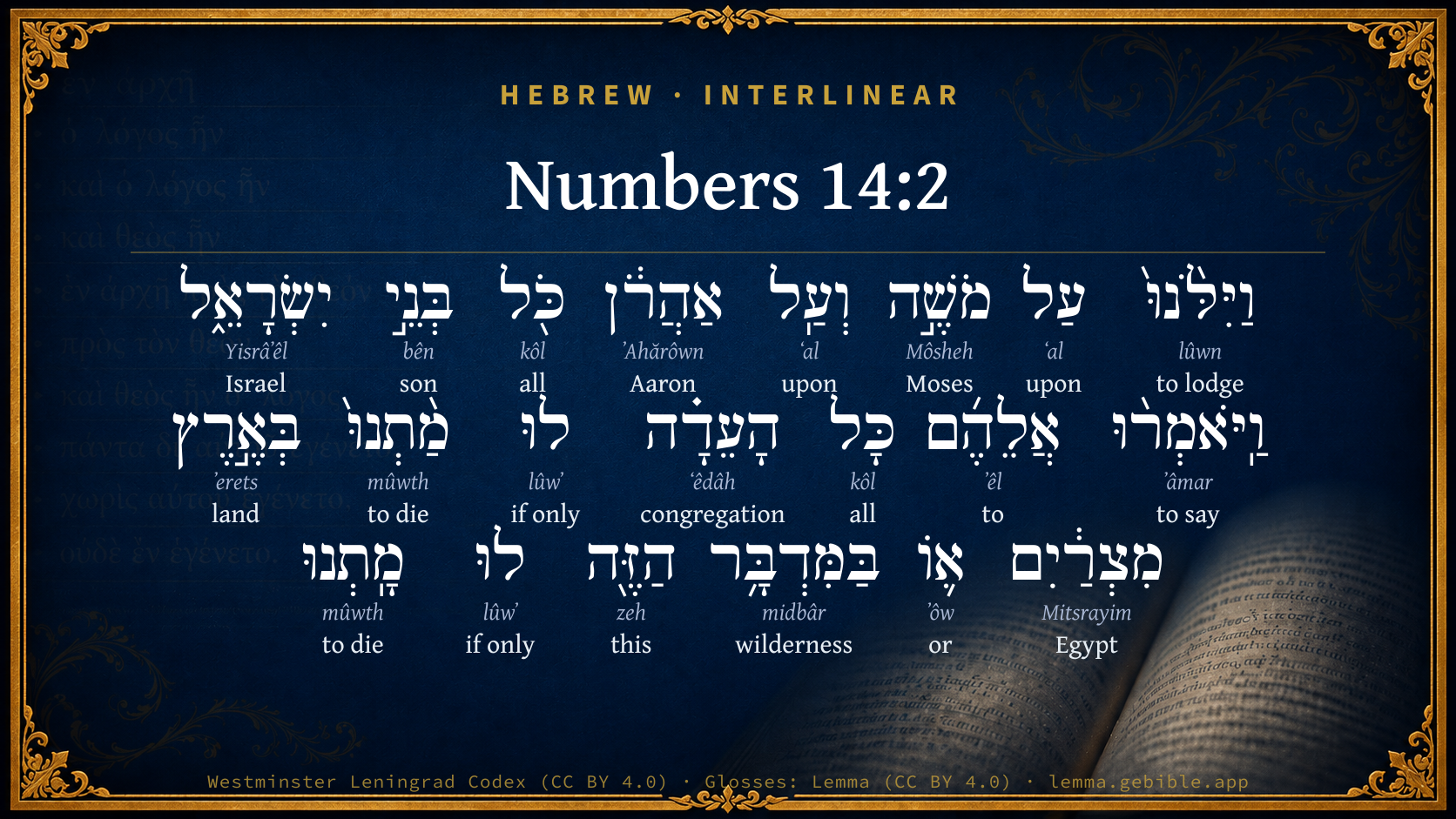
Hebrew (Westminster Leningrad Codex) Numbers 14:2 appears in the Hebrew Old Testament. The text above is from the Westminster Leningrad Codex. Each word links to its Strong’s number, a concise gloss, and parsing drawn from the Open Scriptures Hebrew Bible morphology. Click any word for its full Brown-Driver-Briggs (BDB) entry.
Download image
Cite this verse

Numbers 14:2 (World English Bible). Public Domain. Lemma interlinear Bible study tool, https://lemma.gebible.app/v/numbers/14/2.

Show BibTeX & RIS
BibTeX
RIS
English Translation
All the children of Israel murmured against Moses and against Aaron: and the whole congregation said to them, Would that we had died in the land of Egypt! or would that we had died in this wilderness!
World English Bible · Public Domain
Download a study sheet

One document with this verse’s original text, its word-by-word gloss line, the meaning frame, cross-references with their text, attributed commentary, and full source and license credits — printable, and it pastes into notes with its structure intact.

This verse Autodidact and up

Study sheet (.html) Plain text (.txt)

A passage Seminary Student

Up to 50 verses in one chapter. A passage sheet keeps up to 6 commentary sources and 12 cross-references per verse, in the order this page ranks them, and says so on the sheet whenever that leaves anything out. Ask for a single verse and you get the Autodidact verse sheet above.

Everything on this page stays free to read, with no account — the sheet is a download of what is already on screen, not access to it.

Want to remove ads? Support Godless Engineer
Compare translations 3

The same verse in 3 English versions, stacked beneath the original-language interlinear above. Click any original word for its lexicon entry.

Each is an independent rendering of the whole verse — the interlinear is not word-aligned to these translations.

Highlighted words mark where these versions differ — a whole-verse word diff, not a word-by-word alignment.

  • World English Bible Public Domain
    All the children of Israel murmured against Moses and against Aaron: and the whole congregation said to them, Would that we had died in the land of Egypt! or would that we had died in this wilderness!
  • King James Version Public Domain
    And all the children of Israel murmured against Moses and against Aaron: and the whole congregation said unto them, Would God that we had died in the land of Egypt! or would God we had died in this wilderness!
  • unfoldingWord Literal Text CC BY-SA 4.0
    And all the sons of Israel murmured against Moses and against Aaron. And all the congregation said to them, “If only we died in the land of Egypt, or if only we died in this wilderness!

unfoldingWord Literal Text — © unfoldingWord, licensed CC BY-SA 4.0. Word-aligned USFM3 via Door43 (git.door43.org/unfoldingWord/en_ult).

Versions to compare (up to 4)

3 of 4 selected

Show all 18 translations

Every available English version of this verse, each an independent rendering of the whole verse.

  • World English Bible Public Domain
    All the children of Israel murmured against Moses and against Aaron: and the whole congregation said to them, Would that we had died in the land of Egypt! or would that we had died in this wilderness!
  • Berean Standard Bible Public Domain
    All the Israelites grumbled against Moses and Aaron, and the whole congregation said to them, “If only we had died in the land of Egypt, or if only we had died in this wilderness!
  • Majority Standard Bible Public Domain
    All the Israelites grumbled against Moses and Aaron, and the whole congregation said to them, “If only we had died in the land of Egypt, or if only we had died in this wilderness!
  • King James Version Public Domain
    And all the children of Israel murmured against Moses and against Aaron: and the whole congregation said unto them, Would God that we had died in the land of Egypt! or would God we had died in this wilderness!
  • American Standard Version (1901) Public Domain
    And all the children of Israel murmured against Moses and against Aaron: and the whole congregation said unto them, Would that we had died in the land of Egypt! or would that we had died in this wilderness!
  • Revised Version (1885) Public Domain
    And all the children of Israel murmured against Moses and against Aaron: and the whole congregation said unto them, Would God that we had died in the land of Egypt! or would God we had died in this wilderness!
  • Geneva Bible (1599) Public Domain
    And all the children of Israel murmured against Moses and Aaron: and the whole assemblie said vnto them, Would God we had died in the land of Egypt, or in this wildernesse: would God we were dead.
  • Douay-Rheims (1899) Public Domain
    And all the children of Israel murmured against Moses and Aaron, saying:
  • Young's Literal Translation Public Domain
    and all the sons of Israel murmur against Moses, and against Aaron, and all the company say unto them, `O that we had died in the land of Egypt, or in this wilderness, O that we had died!
  • Literal Standard Version CC BY-SA 4.0
    and all the sons of Israel murmur against Moses and against Aaron, and all the congregation says to them, “O that we had died in the land of Egypt, or in this wilderness, O that we had died!
  • Unlocked Literal Bible CC BY-SA 4.0
    All the people of Israel criticized Moses and Aaron. The whole community said to them, “We wish we had died in the land of Egypt, or here in this wilderness!
  • unfoldingWord Literal Text CC BY-SA 4.0
    And all the sons of Israel murmured against Moses and against Aaron. And all the congregation said to them, “If only we died in the land of Egypt, or if only we died in this wilderness!
  • Darby Bible Public Domain
    And all the children of Israel murmured against Moses and against Aaron; and the whole assembly said to them, Would that we had died in the land of Egypt! or in this wilderness would that we had died!
  • World Messianic Bible Public Domain
    All the children of Israel murmured against Moses and against Aaron. The whole congregation said to them, “We wish that we had died in the land of Egypt, or that we had died in this wilderness!
  • Webster's Bible Public Domain
    And all the children of Israel murmured against Moses and against Aaron: and the whole congregation said to them, O that we had died in the land of Egypt! or O that we had died in this wilderness!
  • Free Bible Version CC BY-SA 4.0
    All the Israelites went and complained to Moses and Aaron, telling them, “If only we'd died in Egypt, or here in this desert!
  • Bible in Basic English Public Domain
    And all the children of Israel, crying out against Moses and Aaron, said, If only we had come to our death in the land of Egypt, or even in this waste land!
  • JPS Tanakh (1917) Public Domain
    And all the children of Israel murmured against Moses and against Aaron; and the whole congregation said unto them: 'Would that we had died in the land of Egypt! or would we had died in this wilderness!

Literal Standard Version (2020), Covenant Press — licensed CC BY-SA 4.0. Text via the HelloAO Bible API (eBible.org). Unlocked Literal Bible (unfoldingWord) — licensed CC BY-SA 4.0. Text via the HelloAO Bible API (eBible.org). unfoldingWord Literal Text — © unfoldingWord, licensed CC BY-SA 4.0. Word-aligned USFM3 via Door43 (git.door43.org/unfoldingWord/en_ult). Free Bible Version, Dr. Jonathan Gallagher — licensed CC BY-SA 4.0. Text via the HelloAO Bible API (eBible.org).

Word by word

More ways to search: Search by grammar → Find every occurrence → Compare this word →

Practice this passage: Drill this verse → Learn its vocabulary →

לוּ
lûwʼ
H3863
“if only”
Conjunction
Part of Speech
Conjunction
Full BDB Definition

Origin: a conditional particle

TWOT: 1085

if, oh that!, if only! - if (unlikely condition) - if only!, oh that!, would that!
  1. וַיִּלֹּ֨נוּ֙ lûwn H3885 “and · to lodge” Conjunction + Verb, Niphal, Sequential Imperfect, 3rd Person, Masculine, Plural
  2. עַל ʻal H5921 “upon” Preposition
  3. מֹשֶׁ֣ה Môsheh H4872 “Moses” Noun, Proper
  4. וְעַֽל ʻal H5921 “and · upon” Conjunction + Preposition
  5. אַהֲרֹ֔ן ʼAhărôwn H175 “Aaron” Noun, Proper
  6. כֹּ֖ל kôl H3605 “all of” Noun, Common, Masculine, Singular, Construct
  7. בְּנֵ֣י bên H1121 “sons of” Noun, Common, Masculine, Plural, Construct
  8. יִשְׂרָאֵ֑ל Yisrâʼêl H3478 “Israel” Noun, Proper
  9. וַֽיֹּאמְר֨וּ ʼâmar H559 “and · to say” Conjunction + Verb, Qal, Sequential Imperfect, 3rd Person, Masculine, Plural
  10. אֲלֵהֶ֜ם ʼêl H413 “to · them” Preposition + Suffix, Personal, 3rd Person, Masculine, Plural
  11. כָּל kôl H3605 “all of” Noun, Common, Masculine, Singular, Construct
  12. הָעֵדָ֗ה ʻêdâh H5712 “the · congregation” Particle, Definite Article + Noun, Common, Feminine, Singular, Absolute
  13. מַ֨תְנוּ֙ mûwth H4191 “to die” Verb, Qal, Perfect, 1st Person, Common, Plural
  14. בְּאֶ֣רֶץ ʼerets H776 “in/at · land of” Preposition + Noun, Common, Both, Singular, Construct
  15. מִצְרַ֔יִם Mitsrayim H4714 “Egypt” Noun, Proper
  16. א֛וֹ ʼôw H176 “or” Conjunction
  17. בַּמִּדְבָּ֥ר midbâr H4057 “in/at the · wilderness” Preposition, Determined + Noun, Common, Masculine, Singular, Absolute
  18. הַזֶּ֖ה zeh H2088 “the · this” Particle, Definite Article + Pronoun, Demonstrative, Masculine, Singular
  19. לוּ lûwʼ H3863 “if only” Conjunction
  20. מָֽתְנוּ mûwth H4191 “to die” Verb, Qal, Perfect, 1st Person, Common, Plural

About this verse

These counts appear in no published source. They are computed here, from the morphology-tagged text and Lemma’s own curated glosses. What Lemma adds →

21
words
17
distinct lemmas
Pentateuch
section

Notable vocabulary

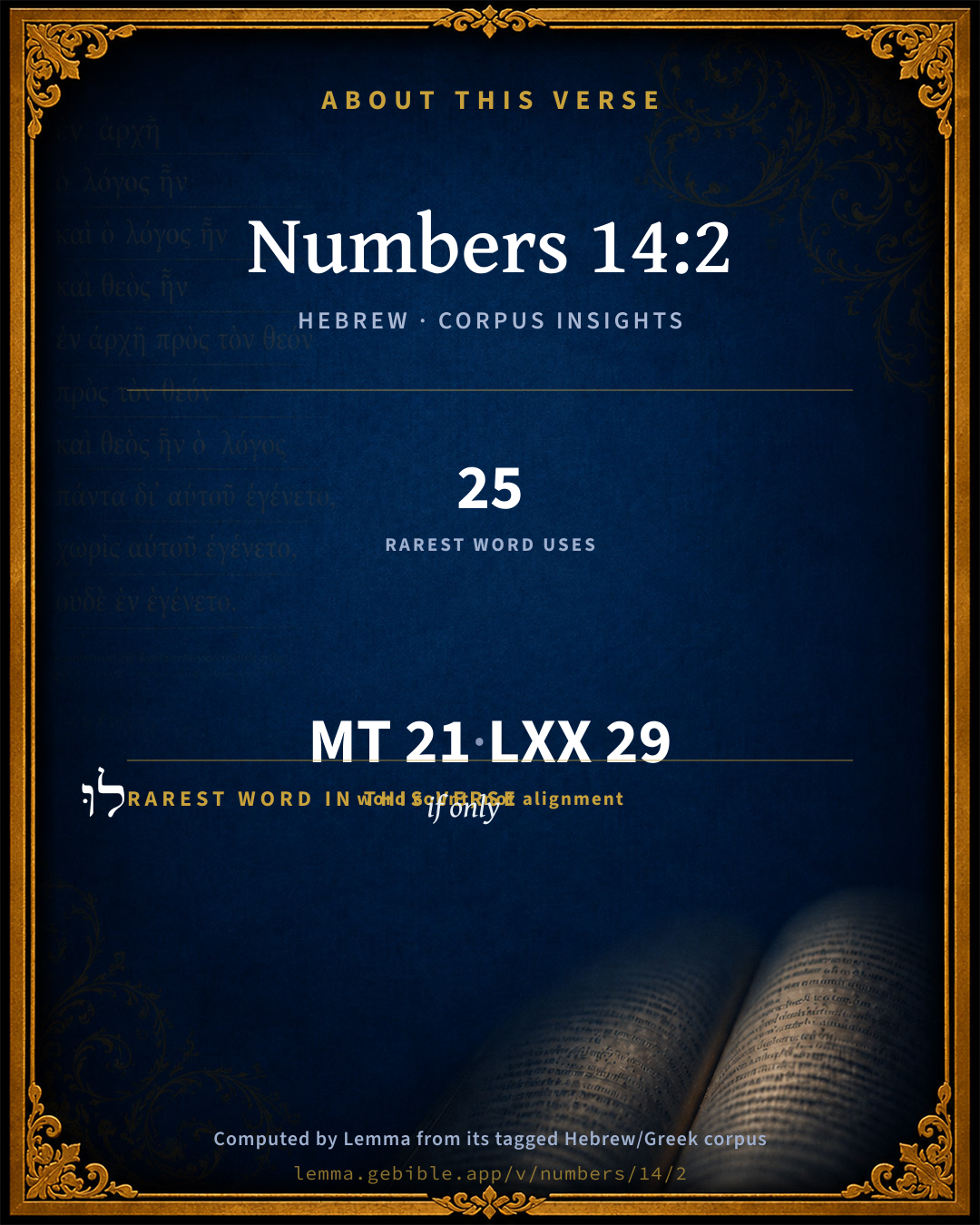
The rarest word here is לוּ if only H3863 — appearing just 25 times in the whole Hebrew Bible.

Shared distinctive vocabulary

לוּ if only H3863 occurs in 22 verses of the Hebrew Bible. Also found in:

Grammatical profile

  • 4 verbs
  • 10 nouns
  • 1 pronoun
  • 3 prepositions
  • 3 conjunctions

Verb forms

  • וַיִּלֹּ֨נוּ֙ Niphal · Sequential Imperfect
  • וַֽיֹּאמְר֨וּ Qal · Sequential Imperfect
  • מַ֨תְנוּ֙ Qal · Perfect
  • מָֽתְנוּ Qal · Perfect

Repetition

Words recur within this verse — often emphatic in Hebrew:

  • עַל upon H5921 ×2
  • כֹּ֖ל all H3605 ×2
  • לוּ if only H3863 ×2
  • מַ֨תְנוּ֙ to die H4191 ×2

Hebrew & Septuagint length

In English translation the verse runs 37 words from the Hebrew and 18 from the Septuagint (LXX English) — the Septuagint runs noticeably shorter here. See the side-by-side →

A rough comparison of the two English renderings, which tokenize alike — not a word-level alignment.

Word counts can differ between the Hebrew and the Greek without any difference in meaning — e.g. the Hebrew direct-object marker אֵת has no separate Greek word, and Greek often adds the article ὁ.

In the original languages it is 21 Hebrew tokens and 29 Greek tokens — but the two are counted differently (Hebrew bundles its prefixes and suffixes into one token; the Greek is in lemma form), so that isn’t a like-for-like length.

Cross-references

18

Topical passages linked to Numbers 14:2 in the Treasury of Scripture Knowledge — connected by theme and wording, ordered by reader-vote popularity; previews shown in the World English Bible.

  • Exodus 15:24 The people murmured against Moses, saying, "What shall we drink?"
  • Exodus 17:3 The people were thirsty for water there; and the people murmured against Moses, and said, "Why have you brought us up out of Egypt, to kill us, our children, and our livestock with thirst?"
  • Numbers 16:41 But on the next day all the congregation of the children of Israel murmured against Moses and against Aaron, saying, You have killed the people of Yahweh.
  • Exodus 16:2–3 The whole congregation of the children of Israel murmured against Moses and against Aaron in the wilderness;
  • Numbers 14:27–29 How long [shall I bear] with this evil congregation, that murmur against me? I have heard the murmurings of the children of Israel, which they murmur against me.
  • 1 Corinthians 10:10 Neither grumble, as some of them also grumbled, and perished by the destroyer.
  • Philippians 2:14–15 Do all things without murmurings and disputes,
  • Jude 1:16 These are murmurers and complainers, walking after their lusts (and their mouth speaks proud things), showing respect of persons to gain advantage.
  • Numbers 11:1 The people were as murmurers, [speaking] evil in the ears of Yahweh: and when Yahweh heard it, his anger was kindled; and the fire of Yahweh burnt among them, and devoured in the uttermost part of the camp.
  • Numbers 11:15 If you deal thus with me, please kill me out of hand, if I have found favor in your sight; and let me not see my wretchedness.
  • Deuteronomy 1:27 and you murmured in your tents, and said, Because Yahweh hated us, he has brought us forth out of the land of Egypt, to deliver us into the hand of the Amorites, to destroy us.
  • Psalms 106:24 Yes, they despised the pleasant land. They didn't believe his word,
  • Jonah 4:3 Therefore now, Yahweh, take, I beg you, my life from me; for it is better for me to die than to live."
  • Jonah 4:8 It happened, when the sun arose, that God prepared a sultry east wind; and the sun beat on Jonah's head, so that he fainted, and requested for himself that he might die, and said, "It is better for me to die than to live."
  • 1 Kings 19:4 But he himself went a day's journey into the wilderness, and came and sat down under a juniper tree: and he requested for himself that he might die, and said, It is enough; now, O Yahweh, take away my life; for I am not better than my fathers.
  • Job 3:11 "Why didn't I die from the womb? Why didn't I give up the spirit when my mother bore me?
  • Job 7:15–16 So that my soul chooses strangling, Death rather than my bones.
  • Psalms 106:45 He remembered for them his covenant, And repented according to the multitude of his loving kindnesses.

Cross-references courtesy of OpenBible.info (CC BY 4.0).

Hebrew and Greek witnesses Masoretic Hebrew ↔ Greek Septuagint

The same verse in the two great witnesses to the Old Testament, shown verse-for-verse.

Here the Septuagint runs noticeably shorter than the Hebrew — LXX2012 (modern English Septuagint) 18 words vs World English Bible 37. A rough length comparison of the two English translations, not a word-level alignment — read both below.

These are two independent witnesses, not word-aligned to each other, and the Septuagint is shown in lemma (dictionary) form.

Hebrew Numbers 14:2 Masoretic · Westminster Leningrad Codex

וַיִּלֹּ֨נוּ֙ עַל מֹשֶׁ֣ה וְעַֽל אַהֲרֹ֔ן כֹּ֖ל בְּנֵ֣י יִשְׂרָאֵ֑ל וַֽיֹּאמְר֨וּ אֲלֵהֶ֜ם כָּל הָעֵדָ֗ה לוּ מַ֨תְנוּ֙ בְּאֶ֣רֶץ מִצְרַ֔יִם א֛וֹ בַּמִּדְבָּ֥ר הַזֶּ֖ה לוּ מָֽתְנוּ

All the children of Israel murmured against Moses and against Aaron: and the whole congregation said to them, Would that we had died in the land of Egypt! or would that we had died in this wilderness!

World English Bible · Public Domain

Greek LXX Numbers 14:2 Septuagint · lemma form

καί διαγογγύζω ἐπί μωυσῆς καί ἀαρών πᾶς ὁ υἱός ἰσραήλ καί εἶπον πρός αὐτός πᾶς ὁ συναγωγή ὀφείλω ἀποθνήσκω ἐν γῆ αἴγυπτος ἤ ἐν ὁ ἔρημος οὗτος εἰ ἀποθνήσκω

And all the children of Israel murmured against Moses and Aaron; and all the congregation said to them,

LXX2012 (modern English Septuagint) · Public Domain

On this verse, The Pulpit Commentary discusses the Septuagint’s reading. Read the note in Commentary ↓

Hebrew: Westminster Leningrad Codex (CC BY 4.0). Greek: Septuagint (public domain); English from LXX2012 (modern English Septuagint) (Public Domain). How the Septuagint differs from the Hebrew →

Targum (Aramaic paraphrase)

2

The Targum is the ancient Jewish Aramaic paraphrase of the Hebrew Scriptures — an interpretive translation, not the Hebrew text itself. Onkelos (literal) and Pseudo-Jonathan (expansive) render the Torah, and Jonathan the Prophets. Coverage is partial: where no permissively-licensed English translation exists for a verse, only the Aramaic is shown. This is verse-level text, not a word-by-word alignment to the Hebrew.

  1. Targum Onkelos Torah (Genesis–Deuteronomy)
    וְאִתְרַעֲמוּ עַל משֶׁה וְעַל אַהֲרֹן כֹּל בְּנֵי יִשְׂרָאֵל וַאֲמָרוּ לְהוֹן כָּל כְּנִשְׁתָּא לְוַי דְמִיתְנָא בְּאַרְעָא דְמִצְרַיִם אוֹ בְּמַדְבְּרָא הָדֵין לְוַי דְמִיתְנָא

    (no public-domain English translation for this verse)

    Targum Onkelos — Aramaic: “Onkelos Genesis” (public domain); “Onkelos Exodus” (public domain); “Onkelos Leviticus” (public domain); “Onkelos Numbers” (public domain); “Onkelos Deuteronomy” (public domain). English: “Sefaria Community Translation” (CC0 1.0 (public-domain dedication)); “J.W. Etheridge. The Targums of Onkelos and Jonathan Ben Uzziel on the Pentateuch. London: Longmans, Green, 1862” (public domain). Text via Sefaria.

  2. Targum Pseudo-Jonathan Torah (Genesis–Deuteronomy)
    וְאִתְרַעֲמוּ עַל משֶׁה וְעַל אַהֲרן כָּל בְּנֵי יִשְרָאֵל וַאֲמַר לְהוֹן כָּל כְּנִישְׁתָּא לְוַאי דְמִתְנָא בְּאַרְעָא דְמִצְרַיִם אוֹ בְּמַדְבְּרָא הָדֵין לְוַאי דְמִתְנָא

    And all the sons of Israel murmured against Mosheh and Aharon, and said: Would that we had died in the land of Mizraim, or that we may die in this wilderness!

    Targum Pseudo-Jonathan — Aramaic: “Targum Jonathan on Genesis” (public domain); “Targum Jonathan on Exodus” (public domain); “Targum Jonathan on Leviticus” (public domain); “Targum Jonathan on Numbers” (public domain); “Targum Jonathan on Deuteronomy” (public domain). English: “The Targum of Jonathan ben Uzziel, trans. J. W. Etheridge, London, 1862” (public domain). Text via Sefaria.

Commentary

Notes on Numbers 14:2 from classic Christian and Jewish commentators (each source and its license shown beneath its notes). The classic Christian expositions comment on the surrounding passage and are grouped to its opening verse, so a note may address several verses; the Jewish commentaries on the Tanakh (Rashi and others) are per-verse, so they appear only where the commentator wrote on this verse.

Lemma curates 59 commentaries, every one of them public domain or Creative Commons licensed, each selected and text-cleaned for this edition rather than reprinted as found. About our sources →

Trapp's Complete Commentary

John Trapp

Num 14:2 And all the children of Israel murmured against Moses and against Aaron: and the whole congregation said unto them, Would God that we had died in the land of Egypt! or would God we had died in this wilderness!

Ver. 2. Would God that we had died.] Words of deep discontent, despair, and unthanklulness.

John Trapp, A Commentary or Exposition upon All the Books of the Old and New Testament (1647–1656) — public domain. Text from a community e-Sword module.

Joseph Benson's Commentary

Num 14:2-3. Against Moses and Aaron — As the instruments and causes of their present calamity. That we had died in the wilderness — It was not long till they had their desire, and did die in the wilderness. Wherefore hath the Lord brought us, &c. — From instruments they rise higher, and not only vent their passion against his servants, but strike at God himself, as the cause and author of their journey most impiously accusing him as if he had dealt deceitfully with them. By this we see the rapid and prodigious growth and progress of sin when it is not resisted. A prey — To the Canaanites, whose land we were made to believe we should possess.

Joseph Benson's Commentary on the Old and New Testaments (1811–1818) — public domain. Text from a community e-Sword module.

Jamieson, Fausset & Brown

Robert Jamieson, A. R. Fausset & David Brown

Would God that we had died in Egypt--Such insolence to their generous leaders, and such base ingratitude to God, show the deep degradation of the Israelites, and the absolute necessity of the decree that debarred that generation from entering the promised land [Num 14:29-35]. They were punished by their wishes being granted to die in that wilderness [Heb 3:17; Jde 1:5]. A leader to reconduct them to Egypt is spoken of (Neh 9:17) as actually nominated. The sinfulness and insane folly of their conduct are almost incredible. Their conduct, however, is paralleled by too many among us, who shrink from the smallest difficulties and rather remain slaves to sin than resolutely try to surmount the obstacles that lie in their way to the Canaan above.

Jamieson, Fausset & Brown — Commentary Critical and Explanatory on the Whole Bible (1871) — public domain (CC PDM 1.0). Text via the HelloAO Bible API.

Ellicott's Commentary for English Readers

XIV.

(2) And all the children of Israel murmured.—When the people murmured in like manner in the wilderness of Sin (Exo_16:2-3) against Moses and Aaron because they had brought them forth into the wilderness, Moses assured them that at even they should know that it was Jehovah Himself who had brought them out from the land of Egypt (Ibid, Num_14:6). On the present occasion their murmuring was not against Moses and Aaron only, but they openly rebelled against Jehovah Himself, to whom they ascribed, in the way of reproach, their exodus from the land of Egypt.

A Bible Commentary for English Readers, edited by Charles John Ellicott (1878–1897) — public domain. Text from a community e-Sword module.

The Cambridge Bible for Schools and Colleges

gen. ed. J. J. S. Perowne

2. would that we had died] ‘God’ does not form part of the Heb. expression. The R.V. is not consistent; see Num_20:4, Exo_16:3.

The Cambridge Bible for Schools and Colleges (gen. ed. J. J. S. Perowne; Cambridge University Press, 1878–1918) — public domain. Text from a community e-Sword module.

John Gill's Exposition

And all the children of Israel murmured against Moses, and against Aaron,.... They being the instruments of bringing them out of Egypt, and conducting them hither:

and the whole congregation said unto them; some of them, the rest assenting to it by their cries and tears and gestures:

would God we had died in the land of Egypt; and then what they left behind they thought might have come into the hands of their children or relations; but now they concluded it would become a prey to the Canaanites:

or would God we had died in this wilderness; the wilderness of Paran, at Taberah, where many of them had been destroyed by fire, Num 11:1, and now they wish they had perished with them.

John Gill's Exposition of the Whole Bible (1746–1763) — public domain (CC PDM 1.0). Text via the HelloAO Bible API.

Matthew Poole's English Annotations

Against Moses and against Aaron, as the instruments and occasions of their present calamity.

That we had died in the wilderness: it was not long before they had their desire, and did die in the wilderness.

Matthew Poole's English Annotations on the Holy Bible (1683–1685) — public domain. Text from a community e-Sword/MySword module.

Whedon's Commentary on the Bible

Daniel D. Whedon

2. Murmured against Moses and… Aaron — They begin with God’s ministers, not having become so hardened as to murmur against God himself. He seems to have been absent from their thoughts both as the object of trust and as their providential guide in the wilderness. They have fallen from a supernatural to a merely natural view of their condition. Hence they childishly vent their indignation against their human leaders.

The whole congregation — This must be understood, as it is in all languages, in a conventional sense, as we are said to utter our opinions in the face of the whole world, or begin our deeds of lands with the words, “Know all men by these presents.” See Exo_9:6, note.

Would God — The word God is not in the Hebrew. This is the strongest English formula for an unattainable wish, and expresses the strength of the peoples’ desire.

Died in… Egypt — They who prefer death in bondage to life in freedom are not the brave people whom Jehovah can lead to the conquest of Canaan. This wish to return to the groanings, burdens, tasks, and insults of the brick-yards of Egypt, from which a pitying Jehovah had led them forth, was indicative of a base ingratitude, and a servility of spirit exceedingly offensive. Yet all this grief was in view of no present suffering, but in apprehension of imaginary future ills.

Daniel D. Whedon (gen. ed.), Commentary on the Old and New Testaments (1874–1909) — public domain. Text from a community e-Sword module.

The Pulpit Commentary

Murmured against Moses and against Aaron; whom they probably suspected and accused of seeking their own personal ends. Here we may see the true reason why Joshua had not been put forward to advocate an immediate advance. The Septuagint has diegogguzon . (cf. 1Co_10:10) Would God we had died. WntmAWl. Septuagint, ofelon apeyanomen . The A.V is unnecessarily strong.

The Pulpit Commentary (1880–1919), ed. H.D.M. Spence-Jones & Joseph S. Exell — public domain. Text from a community e-Sword module.

John Wesley's Explanatory Notes

Against Moses and Aaron - As the instruments and occasions of their present calamity. That we had died in this wilderness - It was not long before they had their desire, and did die in the wilderness.

John Wesley, Explanatory Notes Upon the Whole Bible (1754–1765) — public domain. Text via the GEBible commentary corpus.

Rashi

Rabbi Shlomo Yitzchaki (Rashi)

לו מתנו means WOULD THAT WE HAD DIED.

Rashi on the Tanakh — English translations: “The Judaica Press complete Tanach with Rashi, translated by A. J. Rosenberg” (CC BY 4.0); “Pentateuch with Rashi's commentary by M. Rosenbaum and A.M. Silbermann, 1929-1934” (public domain); “The Metsudah Tanach series, Lakewood, N.J” (CC BY 4.0); and “The Book of Joshua, Metsudah Publications, 1997” (CC BY 4.0). Text via Sefaria.

Lesson kit

Teaching starters — assembled from the data on this page, not authored interpretation. Every prompt links to the verse data it draws on. Edit before teaching.

Numbers, in the Pentateuch, opens this verse with 21 words (17 distinct Hebrew lemmas). Its most distinctive word is lûwʼ (“if only”). The Greek Septuagint runs shorter here. A historical commentator’s framing appears above. Read the whole chapter for the surrounding context.

Discussion questions

  1. What does “if only” (lûwʼ) contribute to the verse as a whole?
  2. How does Genesis 17:18, which shares the word «if only», read alongside this verse?
  3. What does the repetition of “upon” (2× in this one verse) do in this verse?
  4. The Septuagint runs shorter here than the Hebrew. What might account for the difference?
  5. These translations render this verse differently. What is at stake in choosing one wording over another?
  6. «וַיִּלֹּ֨נוּ֙» is a Niphal Sequential Imperfect verb. How does that grammatical form shape the action described?
  7. Compare how Trapp's Complete Commentary and Joseph Benson's Commentary read this verse. Where do they agree or differ?

Things to notice

Reading settings

Reading text

Shown beneath each verse's original-language words.

Old Testament
Old Testament edition

Read the OT as the Masoretic Hebrew (MT) or the Greek Septuagint (LXX).

English shown for the Greek Septuagint (in the Hebrew ↔ Greek comparison).

Comparing translations? Open the Compare panel on any verse page to stack up to four side by side.