Numbers 35:16

Hebrew (Westminster Leningrad Codex) Numbers 35:16 appears in the Hebrew Old Testament. The text above is from the Westminster Leningrad Codex. Each word links to its Strong’s number, a concise gloss, and parsing drawn from the Open Scriptures Hebrew Bible morphology. Click any word for its full Brown-Driver-Briggs (BDB) entry.
Download image
Cite this verse

Numbers 35:16 (World English Bible). Public Domain. Lemma interlinear Bible study tool, https://lemma.gebible.app/v/numbers/35/16.

Show BibTeX & RIS
BibTeX
RIS
English Translation
But if he struck him with an instrument of iron, so that he died, he is a murderer: the murderer shall surely be put to death.
World English Bible · Public Domain
Download a study sheet

One document with this verse’s original text, its word-by-word gloss line, the meaning frame, cross-references with their text, attributed commentary, and full source and license credits — printable, and it pastes into notes with its structure intact.

This verse Autodidact and up

Study sheet (.html) Plain text (.txt)

A passage Seminary Student

Up to 50 verses in one chapter. A passage sheet keeps up to 6 commentary sources and 12 cross-references per verse, in the order this page ranks them, and says so on the sheet whenever that leaves anything out. Ask for a single verse and you get the Autodidact verse sheet above.

Everything on this page stays free to read, with no account — the sheet is a download of what is already on screen, not access to it.

Want to remove ads? Support Godless Engineer
Compare translations 3

The same verse in 3 English versions, stacked beneath the original-language interlinear above. Click any original word for its lexicon entry.

Each is an independent rendering of the whole verse — the interlinear is not word-aligned to these translations.

Highlighted words mark where these versions differ — a whole-verse word diff, not a word-by-word alignment.

  • World English Bible Public Domain
    But if he struck him with an instrument of iron, so that he died, he is a murderer: the murderer shall surely be put to death.
  • King James Version Public Domain
    And if he smite him with an instrument of iron, so that he die, he is a murderer: the murderer shall surely be put to death.
  • unfoldingWord Literal Text CC BY-SA 4.0
    And if he struck him down with an object of iron and he died, he is one who murders. The one who murders shall certainly be put to death.

unfoldingWord Literal Text — © unfoldingWord, licensed CC BY-SA 4.0. Word-aligned USFM3 via Door43 (git.door43.org/unfoldingWord/en_ult).

Versions to compare (up to 4)

3 of 4 selected

Show all 18 translations

Every available English version of this verse, each an independent rendering of the whole verse.

  • World English Bible Public Domain
    But if he struck him with an instrument of iron, so that he died, he is a murderer: the murderer shall surely be put to death.
  • Berean Standard Bible Public Domain
    If, however, anyone strikes a person with an iron object and kills him, he is a murderer; the murderer must surely be put to death.
  • Majority Standard Bible Public Domain
    If, however, anyone strikes a person with an iron object and kills him, he is a murderer; the murderer must surely be put to death.
  • King James Version Public Domain
    And if he smite him with an instrument of iron, so that he die, he is a murderer: the murderer shall surely be put to death.
  • American Standard Version (1901) Public Domain
    But if he smote him with an instrument of iron, so that he died, he is a murderer: the murderer shall surely be put to death.
  • Revised Version (1885) Public Domain
    But if he smote him with an instrument of iron, so that he died, he is a manslayer: the manslayer shall surely be put to death.
  • Geneva Bible (1599) Public Domain
    And if one smite another with an instrument of yron that hee die, hee is a murtherer, and the murtherer shall die the death.
  • Douay-Rheims (1899) Public Domain
    If any man strike with iron, and he die that was struck: he shall be guilty of murder, and he himself shall die.
  • Young's Literal Translation Public Domain
    `And if with an instrument of iron he hath smitten him, and he dieth, he `is' a murderer: the murderer is certainly put to death.
  • Literal Standard Version CC BY-SA 4.0
    And if he has struck him with an instrument of iron, and he dies, he [is] a murderer: the murderer is certainly put to death.
  • Unlocked Literal Bible CC BY-SA 4.0
    But if an accused man has struck his victim with an instrument of iron, and if his victim dies, then the accused is indeed a murderer. He must certainly be put to death.
  • unfoldingWord Literal Text CC BY-SA 4.0
    And if he struck him down with an object of iron and he died, he is one who murders. The one who murders shall certainly be put to death.
  • Darby Bible Public Domain
    And if he have smitten him with an instrument of iron, so that he die, he is a murderer: the murderer shall certainly be put to death.
  • World Messianic Bible Public Domain
    “‘But if he struck him with an instrument of iron, so that he died, he is a murderer. The murderer shall surely be put to death.
  • Webster's Bible Public Domain
    And if he shall smite him with an instrument of iron, so that he shall die, he is a murderer: the murderer shall surely be put to death.
  • Free Bible Version CC BY-SA 4.0
    But if anyone deliberately hits someone with something made of iron and kills them, that person is a murderer and must be executed.
  • Bible in Basic English Public Domain
    But if a man gives another man a blow with an iron instrument, causing his death, he is a taker of life and is certainly to be put to death.
  • JPS Tanakh (1917) Public Domain
    But if he smote him with an instrument of iron, so that he died, he is a murderer; the murderer shall surely be put to death.

Literal Standard Version (2020), Covenant Press — licensed CC BY-SA 4.0. Text via the HelloAO Bible API (eBible.org). Unlocked Literal Bible (unfoldingWord) — licensed CC BY-SA 4.0. Text via the HelloAO Bible API (eBible.org). unfoldingWord Literal Text — © unfoldingWord, licensed CC BY-SA 4.0. Word-aligned USFM3 via Door43 (git.door43.org/unfoldingWord/en_ult). Free Bible Version, Dr. Jonathan Gallagher — licensed CC BY-SA 4.0. Text via the HelloAO Bible API (eBible.org).

Word by word

More ways to search: Search by grammar → Find every occurrence → Compare this word →

Practice this passage: Drill this verse → Learn its vocabulary →

רֹצֵ֣חַֽ
râtsach
H7523
“murdering”
Verb, Qal, Participle Active, Masculine, Singular, Absolute
Part of Speech
Verb
Stem
Qal
Form
Participle Active
Gender
Masculine
Number
Singular
State
Absolute
Full BDB Definition

Origin: a primitive root

TWOT: 2208

to murder, slay, kill - (Qal) to murder, slay - premeditated - accidental - as avenger - slayer (intentional) (participle) - (Niphal) to be slain - (Piel) - to murder, assassinate - murderer, assassin (participle) (substantive) - (Pual) to be killed
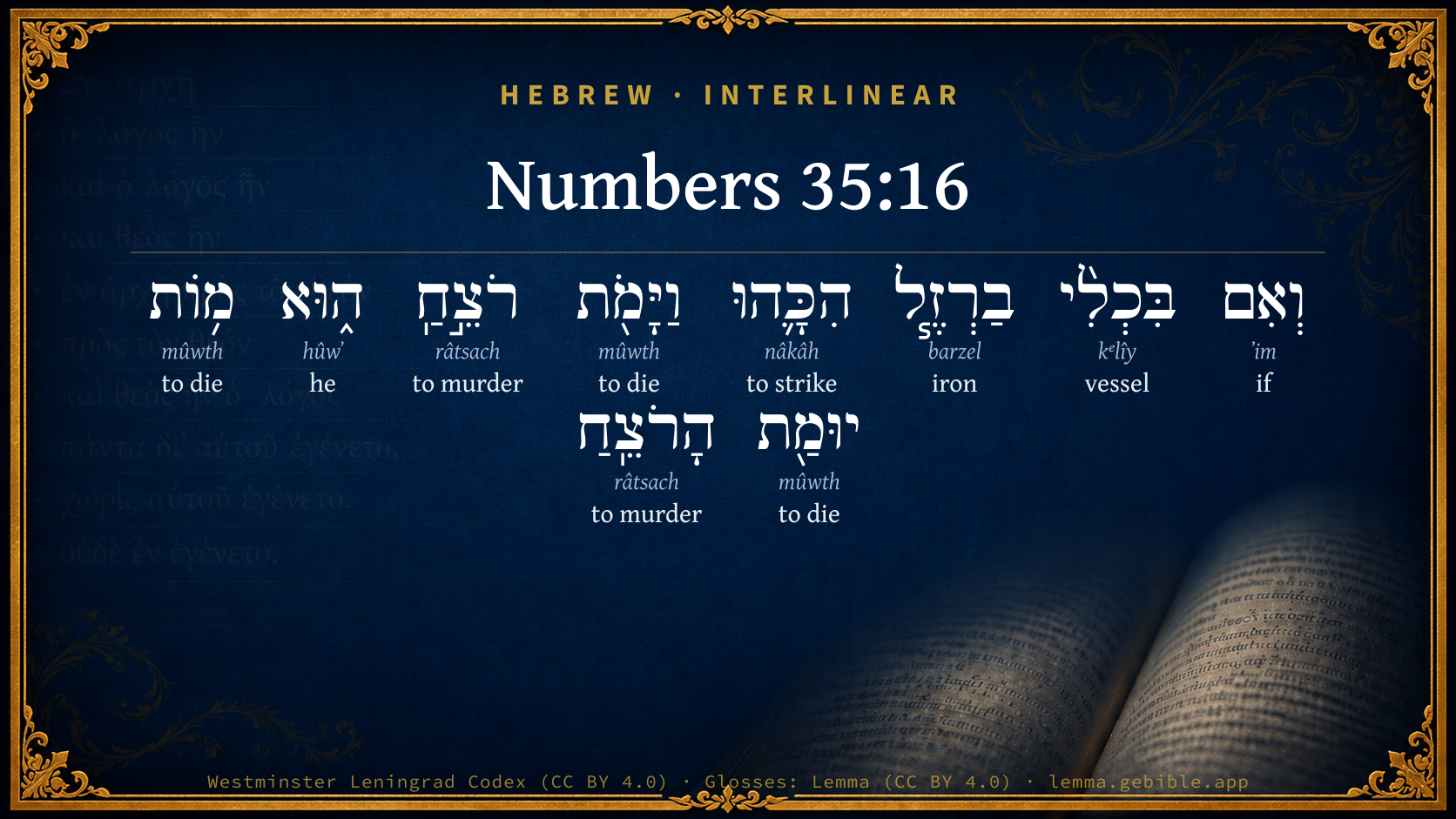
  1. וְאִם ʼim H518 “and · if” Conjunction + Conjunction
  2. בִּכְלִ֨י kᵉlîy H3627 “in/at · vessel of” Preposition + Noun, Common, Masculine, Singular, Construct
  3. בַרְזֶ֧ל barzel H1270 “iron” Noun, Common, Masculine, Singular, Absolute
  4. הִכָּ֛הוּ nâkâh H5221 “to strike · him” Verb, Hiphil, Perfect, 3rd Person, Masculine, Singular + Suffix, Personal, 3rd Person, Masculine, Singular
  5. וַיָּמֹ֖ת mûwth H4191 “and · to die” Conjunction + Verb, Qal, Sequential Imperfect, 3rd Person, Masculine, Singular
  6. ה֑וּא hûwʼ H1931 “he” Pronoun, Personal, 3rd Person, Masculine, Singular
  7. מ֥וֹת mûwth H4191 “to die” Verb, Qal, Infinitive Absolute
  8. יוּמַ֖ת mûwth H4191 “to die” Verb, Hophal, Imperfect, 3rd Person, Masculine, Singular
  9. הָרֹצֵֽחַ râtsach H7523 “the · murdering” Particle, Definite Article + Verb, Qal, Participle Active, Masculine, Singular, Absolute

About this verse

These counts appear in no published source. They are computed here, from the morphology-tagged text and Lemma’s own curated glosses. What Lemma adds →

10
words
7
distinct lemmas
Pentateuch
section

Shared distinctive vocabulary

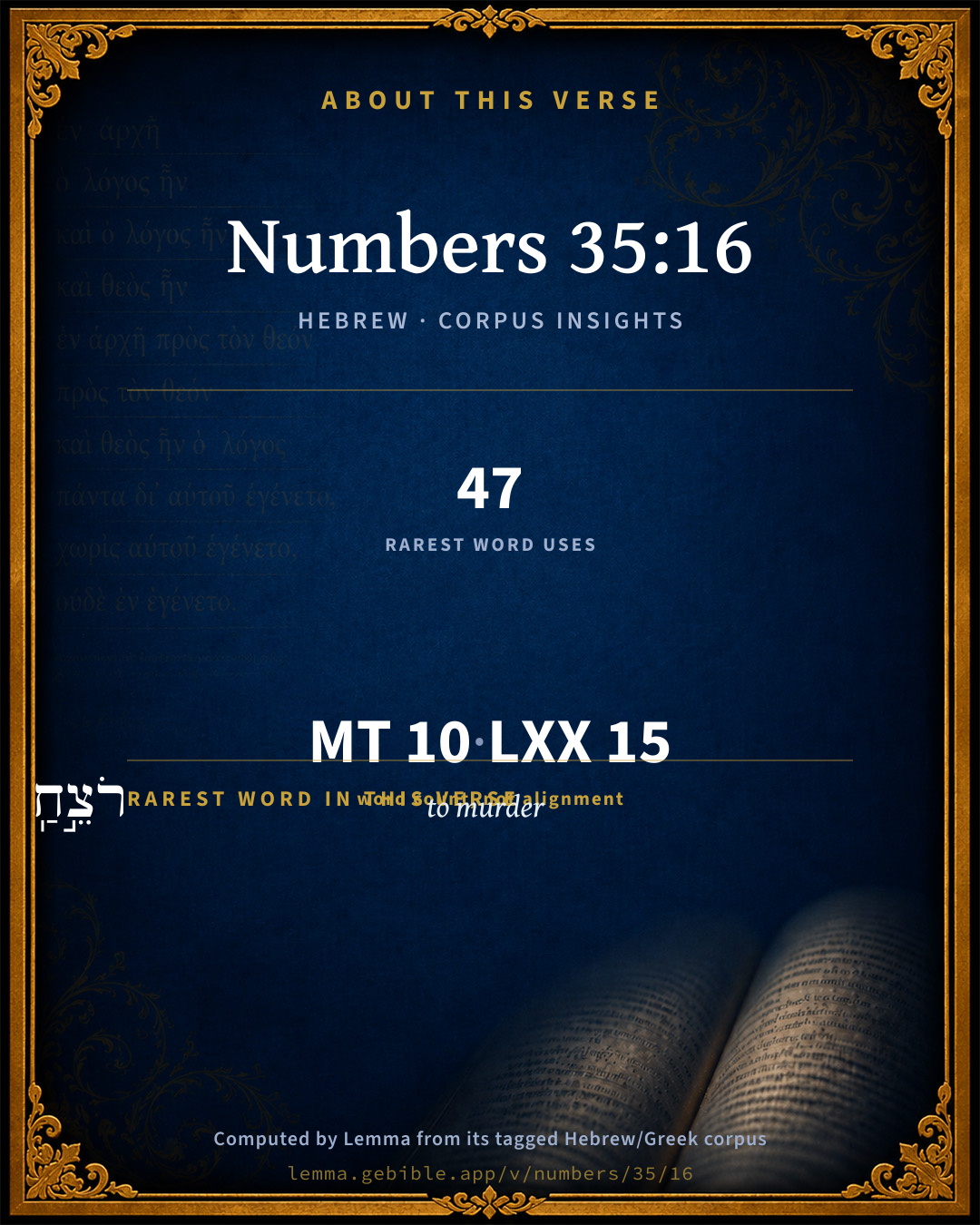
רֹצֵ֣חַֽ to murder H7523 occurs in 40 verses of the Hebrew Bible. Also found in:

Grammatical profile

  • 6 verbs
  • 2 nouns
  • 1 pronoun
  • 1 conjunction

Verb forms

  • הִכָּ֛הוּ Hiphil · Perfect
  • וַיָּמֹ֖ת Qal · Sequential Imperfect
  • רֹצֵ֣חַֽ Qal · Participle Active
  • מ֥וֹת Qal · Infinitive Absolute
  • יוּמַ֖ת Hophal · Imperfect
  • הָרֹצֵֽחַ Qal · Participle Active

Repetition

Words recur within this verse — often emphatic in Hebrew:

  • וַיָּמֹ֖ת to die H4191 ×3
  • רֹצֵ֣חַֽ to murder H7523 ×2

Hebrew & Septuagint length

In English translation the verse runs 26 words from the Hebrew and 29 from the Septuagint (LXX English) — closely comparable.

A rough comparison of the two English renderings, which tokenize alike — not a word-level alignment.

Word counts can differ between the Hebrew and the Greek without any difference in meaning — e.g. the Hebrew direct-object marker אֵת has no separate Greek word, and Greek often adds the article ὁ.

In the original languages it is 10 Hebrew tokens and 15 Greek tokens — but the two are counted differently (Hebrew bundles its prefixes and suffixes into one token; the Greek is in lemma form), so that isn’t a like-for-like length.

Cross-references

6

Topical passages linked to Numbers 35:16 in the Treasury of Scripture Knowledge — connected by theme and wording, ordered by reader-vote popularity; previews shown in the World English Bible.

  • Leviticus 24:17 "'He who strikes any man mortally shall surely be put to death.
  • Genesis 9:5–6 I will surely require your blood of your lives. At the hand of every animal I will require it. At the hand of man, even at the hand of every man's brother, I will require the life of man.
  • Exodus 21:12–14 "One who strikes a man so that he dies shall surely be put to death,
  • Numbers 35:22–24 But if he thrust him suddenly without enmity, or hurled on him anything without lying in wait,
  • Numbers 35:30–33 Whoever kills any person, the murderer shall be slain at the mouth of witnesses: but one witness shall not testify against any person that he die.
  • Deuteronomy 19:11–13 But if any man hate his neighbor, and lie in wait for him, and rise up against him, and strike him mortally so that he dies, and he flee into one of these cities;

Cross-references courtesy of OpenBible.info (CC BY 4.0).

Hebrew and Greek witnesses Masoretic Hebrew ↔ Greek Septuagint

The same verse in the two great witnesses to the Old Testament, shown verse-for-verse.

These are two independent witnesses, not word-aligned to each other, and the Septuagint is shown in lemma (dictionary) form.

Hebrew Numbers 35:16 Masoretic · Westminster Leningrad Codex

וְאִם בִּכְלִ֨י בַרְזֶ֧ל הִכָּ֛הוּ וַיָּמֹ֖ת רֹצֵ֣חַֽ ה֑וּא מ֥וֹת יוּמַ֖ת הָרֹצֵֽחַ

But if he struck him with an instrument of iron, so that he died, he is a murderer: the murderer shall surely be put to death.

World English Bible · Public Domain

Greek LXX Numbers 35:16 Septuagint · lemma form

ἐάν δέ ἐν σκεῦος σίδηρος πατάσσω αὐτός καί τελευτάω φονευτής εἰμί θάνατος θανατόω ὁ φονευτής

And if he should strike him with an iron instrument, and the man should die, he is a murderer; let the murderer by all means be put to death.

LXX2012 (modern English Septuagint) · Public Domain

Hebrew: Westminster Leningrad Codex (CC BY 4.0). Greek: Septuagint (public domain); English from LXX2012 (modern English Septuagint) (Public Domain). How the Septuagint differs from the Hebrew →

Targum (Aramaic paraphrase)

2

The Targum is the ancient Jewish Aramaic paraphrase of the Hebrew Scriptures — an interpretive translation, not the Hebrew text itself. Onkelos (literal) and Pseudo-Jonathan (expansive) render the Torah, and Jonathan the Prophets. Coverage is partial: where no permissively-licensed English translation exists for a verse, only the Aramaic is shown. This is verse-level text, not a word-by-word alignment to the Hebrew.

  1. Targum Onkelos Torah (Genesis–Deuteronomy)
    וְאִם בְּמָאן דְפַרְזְלָא מְחָהִי וְקַטְלֵהּ קָטוֹלָא הוּא אִתְקְטָלָא יִתְקְטֵל קָטוֹלָא

    (no public-domain English translation for this verse)

    Targum Onkelos — Aramaic: “Onkelos Genesis” (public domain); “Onkelos Exodus” (public domain); “Onkelos Leviticus” (public domain); “Onkelos Numbers” (public domain); “Onkelos Deuteronomy” (public domain). English: “Sefaria Community Translation” (CC0 1.0 (public-domain dedication)); “J.W. Etheridge. The Targums of Onkelos and Jonathan Ben Uzziel on the Pentateuch. London: Longmans, Green, 1862” (public domain). Text via Sefaria.

  2. Targum Pseudo-Jonathan Torah (Genesis–Deuteronomy)
    וְאִין בְּמָנָא דְפַרְזְלָא בְּמַשְׁהוּ מְחָהִי וְקַטְלֵיהּ קָטוֹלָא הוּא אִתְקְטָלָא יִתְקְטֵיל קָטוֹלָא

    But if he smote him with an instrument of iron and killed him, he is a murderer; and the murderer shall be surely put to death.

    Targum Pseudo-Jonathan — Aramaic: “Targum Jonathan on Genesis” (public domain); “Targum Jonathan on Exodus” (public domain); “Targum Jonathan on Leviticus” (public domain); “Targum Jonathan on Numbers” (public domain); “Targum Jonathan on Deuteronomy” (public domain). English: “The Targum of Jonathan ben Uzziel, trans. J. W. Etheridge, London, 1862” (public domain). Text via Sefaria.

Commentary

Notes on Numbers 35:16 from classic Christian and Jewish commentators (each source and its license shown beneath its notes). The classic Christian expositions comment on the surrounding passage and are grouped to its opening verse, so a note may address several verses; the Jewish commentaries on the Tanakh (Rashi and others) are per-verse, so they appear only where the commentator wrote on this verse.

Lemma curates 59 commentaries, every one of them public domain or Creative Commons licensed, each selected and text-cleaned for this edition rather than reprinted as found. About our sources →

Trapp's Complete Commentary

John Trapp

Num 35:16 And if he smite him with an instrument of iron, so that he die, he [is] a murderer: the murderer shall surely be put to death.

Ver. 16. So that he die.] Though he had no intent to kill, yet because he should have looked better to it, he is a murderer; he smote him purposely and presumptuously, and the man dies of it. King James was wont to say, that if God did leave him to kill a man (though beside his intention), he should think God did not love him.

John Trapp, A Commentary or Exposition upon All the Books of the Old and New Testament (1647–1656) — public domain. Text from a community e-Sword module.

Whedon's Commentary on the Bible

Daniel D. Whedon

THE COMMISSIONERS FOR DISTRIBUTING THE LAND, Num_34:16-29.

The ex officio members of this commission were Eleazar, the high priest, and Joshua, the commander of the army, as the lieutenant of Jehovah.

Jos_5:14. Of the ten princes, representing the nine and a half tribes, Caleb is the only one of whom any thing else is known. The order of the tribes here enumerated, with slight exceptions, corresponds both to their fraternal relationship and to their geographical location in Canaan, reckoning from south to north. This deviates somewhat from the order in which the lots came out for the different tribes according to Joshua 15-19.

THE INTENTIONAL MANSLAYER, Num_35:16-21.

16-21. If any person has struck another with an instrument of iron, as an axe or hammer, or with a stone, literally, a stone of the hand, that is, large enough to fill the hand and to kill a man with, or with a hand weapon of wood, as a thick club, and death ensued, a murderous intent is inferred, and the death penalty is inflicted. An ambuscade or laying of wait, preceding the fatal blow, is a still stronger proof of malice aforethought. Gen_9:5-6; Exo_20:13, note. Capital punishment is discussed in Lev_24:21, note, and in the concluding note of the same chapter.

The revenger of blood shall slay the murderer — This duty was never outlawed by any limitation of time or of place, save within the walls of the city of refuge. If the offender took refuge in a free city the elders of the city were to hand him over to the avenger, or goel, to be slain. Gen_4:15, note; Deu_19:11-12.

Daniel D. Whedon (gen. ed.), Commentary on the Old and New Testaments (1874–1909) — public domain. Text from a community e-Sword module.

Keil & Delitzsch

C. F. Keil & F. Delitzsch

Special instructions are given in Num 35:16-28, with reference to the judicial procedure. First of all (Num 35:16-21), with regard to qualified slaying or murder. If any person has struck another with an iron instrument (an axe, hatchet, hammer, etc.), or "with a stone of the hand, from which one dies," i.e., with a stone which filled the hand, - a large stone, therefore, with which it was possible to kill, - or "with a wooden instrument of the hand, from which one dies," i.e., with a thick club, or a large, strong wooden instrument, and he then died (so that he died in consequence), he was a murderer, who was to be put to death. "For the suspicion would rest upon any one who had used an instrument, that endangered life and therefore was not generally used in striking, that he had intended to take life away" (Knobel).

Keil & Delitzsch — Biblical Commentary on the Old Testament (1861–1891) — public domain (CC PDM 1.0). Text via the HelloAO Bible API. (Old Testament only.)

Geneva Bible (1599)

Geneva Bible translators

Wittingly, and willingly.

Geneva Bible (1599) marginal notes — public domain. Text via Bolls.life.

Jamieson, Fausset & Brown

Robert Jamieson, A. R. Fausset & David Brown

If he smite him with an instrument of iron, so that he die, &c.--Various cases are here enumerated in which the Goel or avenger was at liberty to take the life of the murderer; and every one of them proves a premeditated purpose.

Jamieson, Fausset & Brown — Commentary Critical and Explanatory on the Whole Bible (1871) — public domain (CC PDM 1.0). Text via the HelloAO Bible API.

The Cambridge Bible for Schools and Colleges

gen. ed. J. J. S. Perowne

16–23. Specimen cases of murder and accidental homicide respectively; cf. Exo_21:13 f.

The Cambridge Bible for Schools and Colleges (gen. ed. J. J. S. Perowne; Cambridge University Press, 1878–1918) — public domain. Text from a community e-Sword module.

John Gill's Exposition

And if he smite him with an instrument of iron, so that he die,.... As with an hatchet, hammer, sword, knife, &c.

he is a murderer; the instrument used by him, and with which he smote, shows that he had a bad design, and intended to kill, or he would never have smitten a man with such an instrument:

the murderer shall surely be put to death; be condemned to death, and be executed, by the order of the civil magistrate, according to the law in Gen 9:6 and not be allowed the benefit of a city of refuge.

John Gill's Exposition of the Whole Bible (1746–1763) — public domain (CC PDM 1.0). Text via the HelloAO Bible API.

Albert Barnes' Notes on the Bible

The sense is: Inasmuch as to take another man’s life by any means whatsoever is murder, and exposes the murderer to the penalty of retaliation; so, if the deed is done in hostility, it is in truth actual murder, and the murderer shall be slain; but if it be not done in hostility, then the congregation shall interpose to stop the avenger’s hand.

Num 35:19

When he meeteth him - Provided, of course, it were without a city of refuge.

Num 35:24

The case of the innocent slayer is here contemplated. In a doubtful case there would necessarily have to be a judicial decision as to the guilt or innocence of the person who claimed the right of asylum.

Num 35:25

The homicide was safe only within the walls of his city of refuge. He became a virtual exile from his home. The provisions here made serve to mark the gravity of the act of manslaughter, even when not premeditated; and the inconveniences attending on them fell, as is right and fair, upon him who committed the deed.

Unto the death of the high priest - The atoning death of the Saviour cast its shadow before on the statute-book of the Law and on the annals of Jewish history. The high priest, as the head and representative of the whole chosen family of sacerdotal mediators, as exclusively entrusted with some of the chief priestly functions, as alone privileged to make yearly atonement within the holy of holies, and to gain, from the mysterious Urim and Thummim, special revelations of the will of God, was, preeminently, a type of Christ. And thus the death of each successive high priest presignified that death of Christ by which the captives were to be freed, and the remembrance of transgressions made to cease.

Albert Barnes' Notes on the Bible (1834–1885) — public domain. Text from a community e-Sword/MySword module.

Matthew Poole's English Annotations

If he smite him, wittingly and wilfully, though not with premeditated malice or design, as appears by comparing this with Num 35:20-23.

So that he die, to wit, suddenly, not so if he walked abroad afterward, Exo 21:19,20.

Shall surely be put to death; yea, though he were fled into the city of refuge.

Matthew Poole's English Annotations on the Holy Bible (1683–1685) — public domain. Text from a community e-Sword/MySword module.

The Pulpit Commentary

With an instrument of iron. There is no reasonable doubt that lyrB has here (as elsewhere) its proper meaning of iron. The expression must be held to include both weapons and other instruments; the former may have been mostly made of bronze, but where iron is used at all it is sure to be employed in war.

The Pulpit Commentary (1880–1919), ed. H.D.M. Spence-Jones & Joseph S. Exell — public domain. Text from a community e-Sword module.

John Wesley's Explanatory Notes

If he smite him - Wittingly and wilfully, though not with premeditated malice. He shall be put to death - Yea though he were fled into the city of refuge.

John Wesley, Explanatory Notes Upon the Whole Bible (1754–1765) — public domain. Text via the GEBible commentary corpus.

unfoldingWord translationNotes

Door43 World Missions Community

General Information:

Yahweh continues telling Moses what the people must do.

He must certainly be put to death

This can be stated in active form. AT: "You must certainly execute him" (See: Active or Passive and Idiom)

translationWords

accuse

die

unfoldingWord translationNotes — © Distant Shores Media and the Door43 World Missions Community, licensed CC BY-SA 4.0. Source: git.door43.org/Door43/en_tn.

Rashi

Rabbi Shlomo Yitzchaki (Rashi)

ואם בכלי ברזל הכהו BUT IF HE SMOTE HIM WITH AN INSTRUMENT OF IRON — This is not speaking of one who kills inadvertently, who is mentioned near this (in the preceding verse), but of one who kills intentionally; and its purpose is to teach us that with whatever instrument one kills, it is necessary that it must have a size sufficient to cause death, because in the case of all of them (vv. 17, 18) it is said, אשר ימות “[an instrument] by which one may die”, the Hebrew of which we translate in the Targum by, “[an instrument] which is of such a size that one may die through it” — in the case of all, except in that of iron, because it is manifest and known to the Holy One, blessed be He, that iron kills whatever size it may be (however small it is), even a needle. Therefore the Torah does not assign a size to it by writing,אשר ימות בה (Sifrei Bamidbar 160:3; Sanhedrin 76b). And if you say that Scripture is speaking of one who kills inadvertently, — but surely it says lower down, (v. 23) “Or with any stone, even though one may die by it, (even though it is large enough to kill him) seeing him not”, which certainly is by inadvertence. This proves as regards the cases mentioned before it, that Scripture is speaking of one who kills intentionally.

Rashi on the Tanakh — English translations: “The Judaica Press complete Tanach with Rashi, translated by A. J. Rosenberg” (CC BY 4.0); “Pentateuch with Rashi's commentary by M. Rosenbaum and A.M. Silbermann, 1929-1934” (public domain); “The Metsudah Tanach series, Lakewood, N.J” (CC BY 4.0); and “The Book of Joshua, Metsudah Publications, 1997” (CC BY 4.0). Text via Sefaria.

Lesson kit

Teaching starters — assembled from the data on this page, not authored interpretation. Every prompt links to the verse data it draws on. Edit before teaching.

Numbers, in the Pentateuch, opens this verse with 10 words (7 distinct Hebrew lemmas). Its most distinctive word is râtsach (“to murder”). A historical commentator’s framing appears above. Read the whole chapter for the surrounding context.

Discussion questions

  1. The word râtsach carries the sense “to murder.” How does it shape the verse?
  2. How does Exodus 20:13, which shares the word «to murder», read alongside this verse?
  3. What does the repetition of “to die” (3× in this one verse) do in this verse?
  4. These translations render this verse differently. What is at stake in choosing one wording over another?
  5. «הִכָּ֛הוּ» is a Hiphil Perfect verb. How does that grammatical form shape the action described?
  6. Compare how Trapp's Complete Commentary and Whedon's Commentary on the Bible read this verse. Where do they agree or differ?

Things to notice

Reading settings

Reading text

Shown beneath each verse's original-language words.

Old Testament
Old Testament edition

Read the OT as the Masoretic Hebrew (MT) or the Greek Septuagint (LXX).

English shown for the Greek Septuagint (in the Hebrew ↔ Greek comparison).

Comparing translations? Open the Compare panel on any verse page to stack up to four side by side.