
Exodus 14:11

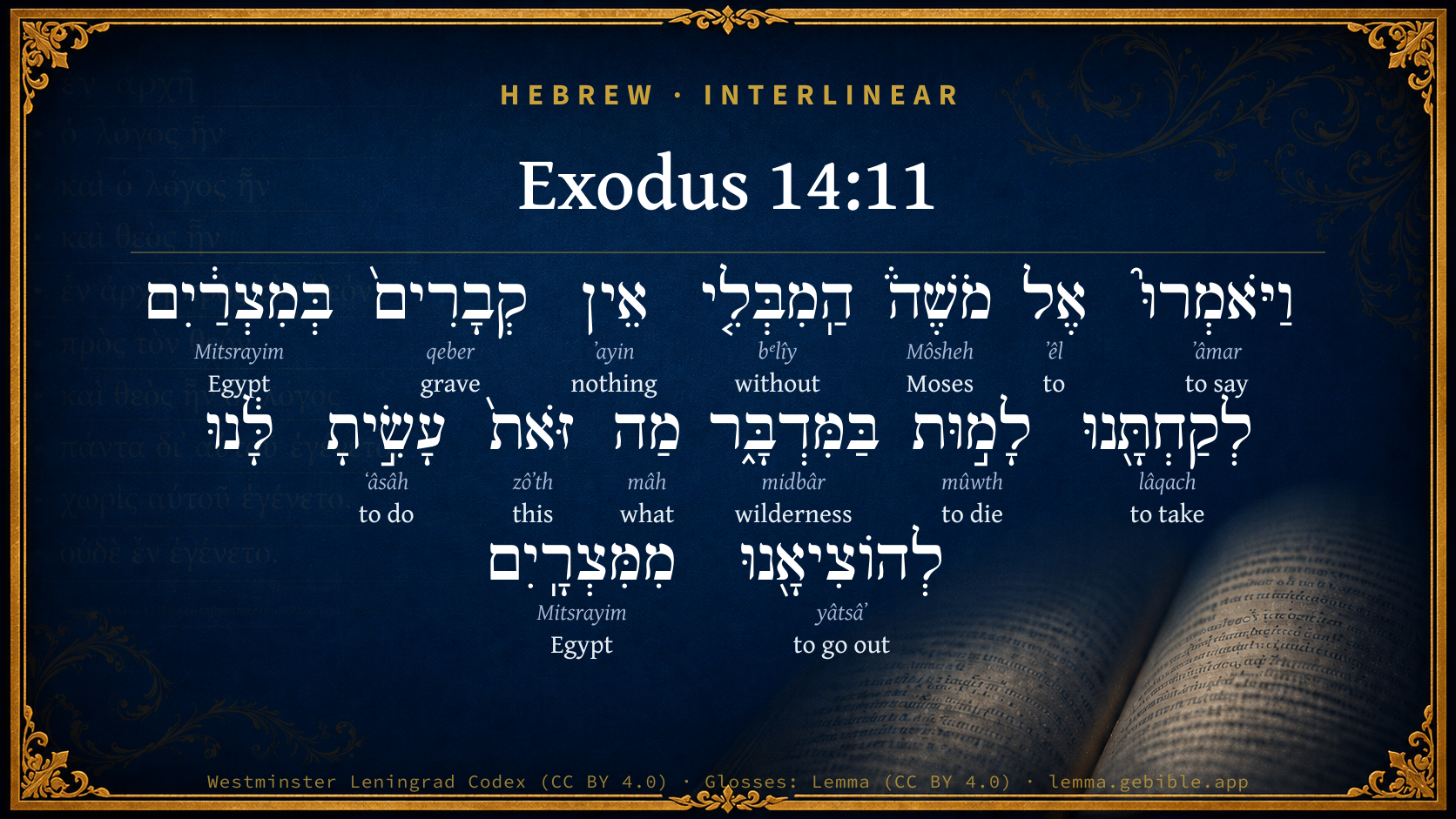
Hebrew (Westminster Leningrad Codex) Exodus 14:11 appears in the Hebrew Old Testament. The text above is from the Westminster Leningrad Codex. Each word links to its Strong’s number, a concise gloss, and parsing drawn from the Open Scriptures Hebrew Bible morphology. Click any word for its full Brown-Driver-Briggs (BDB) entry.
Download image
Cite this verse

Exodus 14:11 (World English Bible). Public Domain. Lemma interlinear Bible study tool, https://lemma.gebible.app/v/exodus/14/11.

Show BibTeX & RIS
BibTeX
RIS
English Translation
They said to Moses, "Because there were no graves in Egypt, have you taken us away to die in the wilderness? Why have you treated us this way, to bring us forth out of Egypt?
World English Bible · Public Domain
Download a study sheet

One document with this verse’s original text, its word-by-word gloss line, the meaning frame, cross-references with their text, attributed commentary, and full source and license credits — printable, and it pastes into notes with its structure intact.

This verse Autodidact and up

Study sheet (.html) Plain text (.txt)

A passage Seminary Student

Up to 50 verses in one chapter. A passage sheet keeps up to 6 commentary sources and 12 cross-references per verse, in the order this page ranks them, and says so on the sheet whenever that leaves anything out. Ask for a single verse and you get the Autodidact verse sheet above.

Everything on this page stays free to read, with no account — the sheet is a download of what is already on screen, not access to it.

Want to remove ads? Support Godless Engineer
Compare translations 3

The same verse in 3 English versions, stacked beneath the original-language interlinear above. Click any original word for its lexicon entry.

Each is an independent rendering of the whole verse — the interlinear is not word-aligned to these translations.

Highlighted words mark where these versions differ — a whole-verse word diff, not a word-by-word alignment.

  • World English Bible Public Domain
    They said to Moses, "Because there were no graves in Egypt, have you taken us away to die in the wilderness? Why have you treated us this way, to bring us forth out of Egypt?
  • King James Version Public Domain
    And they said unto Moses, Because there were no graves in Egypt, hast thou taken us away to die in the wilderness? wherefore hast thou dealt thus with us, to carry us forth out of Egypt?
  • unfoldingWord Literal Text CC BY-SA 4.0
    And they said to Moses, “Is it because there were not any graves in Egypt that you have taken us away to die in the wilderness? What is this you have done to us, to bring us out from Egypt?

unfoldingWord Literal Text — © unfoldingWord, licensed CC BY-SA 4.0. Word-aligned USFM3 via Door43 (git.door43.org/unfoldingWord/en_ult).

Versions to compare (up to 4)

3 of 4 selected

Show all 18 translations

Every available English version of this verse, each an independent rendering of the whole verse.

  • World English Bible Public Domain
    They said to Moses, "Because there were no graves in Egypt, have you taken us away to die in the wilderness? Why have you treated us this way, to bring us forth out of Egypt?
  • Berean Standard Bible Public Domain
    They said to Moses, “Was it because there were no graves in Egypt that you brought us into the wilderness to die? What have you done to us by bringing us out of Egypt?
  • Majority Standard Bible Public Domain
    They said to Moses, “Was it because there were no graves in Egypt that you brought us into the wilderness to die? What have you done to us by bringing us out of Egypt?
  • King James Version Public Domain
    And they said unto Moses, Because there were no graves in Egypt, hast thou taken us away to die in the wilderness? wherefore hast thou dealt thus with us, to carry us forth out of Egypt?
  • American Standard Version (1901) Public Domain
    And they said unto Moses, Because there were no graves in Egypt, hast thou taken us away to die in the wilderness? wherefore hast thou dealt thus with us, to bring us forth out of Egypt?
  • Revised Version (1885) Public Domain
    And they said unto Moses, Because there were no graves in Egypt, hast thou taken us away to die in the wilderness? wherefore hast thou dealt thus with us, to bring us forth out of Egypt?
  • Geneva Bible (1599) Public Domain
    And they sayde vnto Moses, Hast thou brought vs to die in the wildernes, because there were no graues in Egypt? wherefore hast thou serued vs thus, to carie vs out of Egypt?
  • Douay-Rheims (1899) Public Domain
    And they said to Moses: Perhaps there were no graves in Egypt, therefore thou hast brought us to die in the wilderness: why wouldst thou do this, to lead us out of Egypt?
  • Young's Literal Translation Public Domain
    And they say unto Moses, `Because there are no graves in Egypt, hast thou taken us away to die in a wilderness? what is this thou hast done to us -- to bring us out from Egypt?
  • Literal Standard Version CC BY-SA 4.0
    And they say to Moses, “Because there are no graves in Egypt, have you taken us away to die in a wilderness? What is this you have done to us—to bring us out from Egypt?
  • Unlocked Literal Bible CC BY-SA 4.0
    They said to Moses, “Is it because there were no graves in Egypt, that you have taken us away to die in the wilderness? Why have you treated us like this, bringing us out of Egypt?
  • unfoldingWord Literal Text CC BY-SA 4.0
    And they said to Moses, “Is it because there were not any graves in Egypt that you have taken us away to die in the wilderness? What is this you have done to us, to bring us out from Egypt?
  • Darby Bible Public Domain
    And they said to Moses, Is it because there were no graves in Egypt, thou hast taken us away to die in the wilderness? why hast thou done this to us, that thou hast led us out of Egypt?
  • World Messianic Bible Public Domain
    They said to Moses, “Because there were no graves in Egypt, have you taken us away to die in the wilderness? Why have you treated us this way, to bring us out of Egypt?
  • Webster's Bible Public Domain
    And they said to Moses, Because there were no graves in Egypt, hast thou taken us away to die in the wilderness? Why hast thou dealt thus with us, to conduct us out of Egypt?
  • Free Bible Version CC BY-SA 4.0
    They complained to Moses, “Were there no graves in Egypt that you had to bring us out here in the desert to die? What have you done to us by making us leave Egypt?
  • Bible in Basic English Public Domain
    And they said to Moses, Was there no resting-place for the dead in Egypt, that you have taken us away to come to our death in the waste land? why have you taken us out of Egypt?
  • JPS Tanakh (1917) Public Domain
    And they said unto Moses: 'Because there were no graves in Egypt, hast thou taken us away to die in the wilderness? wherefore hast thou dealt thus with us, to bring us forth out of Egypt?

Literal Standard Version (2020), Covenant Press — licensed CC BY-SA 4.0. Text via the HelloAO Bible API (eBible.org). Unlocked Literal Bible (unfoldingWord) — licensed CC BY-SA 4.0. Text via the HelloAO Bible API (eBible.org). unfoldingWord Literal Text — © unfoldingWord, licensed CC BY-SA 4.0. Word-aligned USFM3 via Door43 (git.door43.org/unfoldingWord/en_ult). Free Bible Version, Dr. Jonathan Gallagher — licensed CC BY-SA 4.0. Text via the HelloAO Bible API (eBible.org).

Word by word

More ways to search: Search by grammar → Find every occurrence → Compare this word →

Practice this passage: Drill this verse → Learn its vocabulary →

הַֽמִבְּלִ֤י
bᵉlîy
H1097
“from · without”
Particle, Interrogative + Preposition + Particle, Negative
Part of Speech
Particle + Preposition + Particle
Type
Negative
Full BDB Definition

Origin: from H1086

TWOT: 246e

wearing out (substantive) - without, no, not (adverb of negation)
  1. וַיֹּאמְרוּ֮ ʼâmar H559 “and · to say” Conjunction + Verb, Qal, Sequential Imperfect, 3rd Person, Masculine, Plural
  2. אֶל ʼêl H413 “to” Preposition
  3. מֹשֶׁה֒ Môsheh H4872 “Moses” Noun, Proper
  4. אֵין ʼayin H369 “nothing” Particle, Negative
  5. קְבָרִים֙ qeber H6913 “graves” Noun, Common, Masculine, Plural, Absolute
  6. בְּמִצְרַ֔יִם Mitsrayim H4714 “in/at · Egypt” Preposition + Noun, Proper
  7. לְקַחְתָּ֖נוּ lâqach H3947 “to take · us” Verb, Qal, Perfect, 2nd Person, Masculine, Singular + Suffix, Personal, 1st Person, Common, Plural
  8. לָמ֣וּת mûwth H4191 “to die” Preposition + Verb, Qal, Infinitive Construct
  9. בַּמִּדְבָּ֑ר midbâr H4057 “in/at the · wilderness” Preposition, Determined + Noun, Common, Masculine, Singular, Absolute
  10. מַה mâh H4100 “what” Particle, Interrogative
  11. זֹּאת֙ zôʼth H2063 “this” Pronoun, Demonstrative, Feminine, Singular
  12. עָשִׂ֣יתָ ʻâsâh H6213 “to do” Verb, Qal, Perfect, 2nd Person, Masculine, Singular
  13. לְהוֹצִיאָ֖נוּ yâtsâʼ H3318 “to go out · us” Preposition + Verb, Hiphil, Infinitive Construct + Suffix, Personal, 1st Person, Common, Plural
  14. מִמִּצְרָֽיִם Mitsrayim H4714 “from · Egypt” Preposition + Noun, Proper

About this verse

These counts appear in no published source. They are computed here, from the morphology-tagged text and Lemma’s own curated glosses. What Lemma adds →

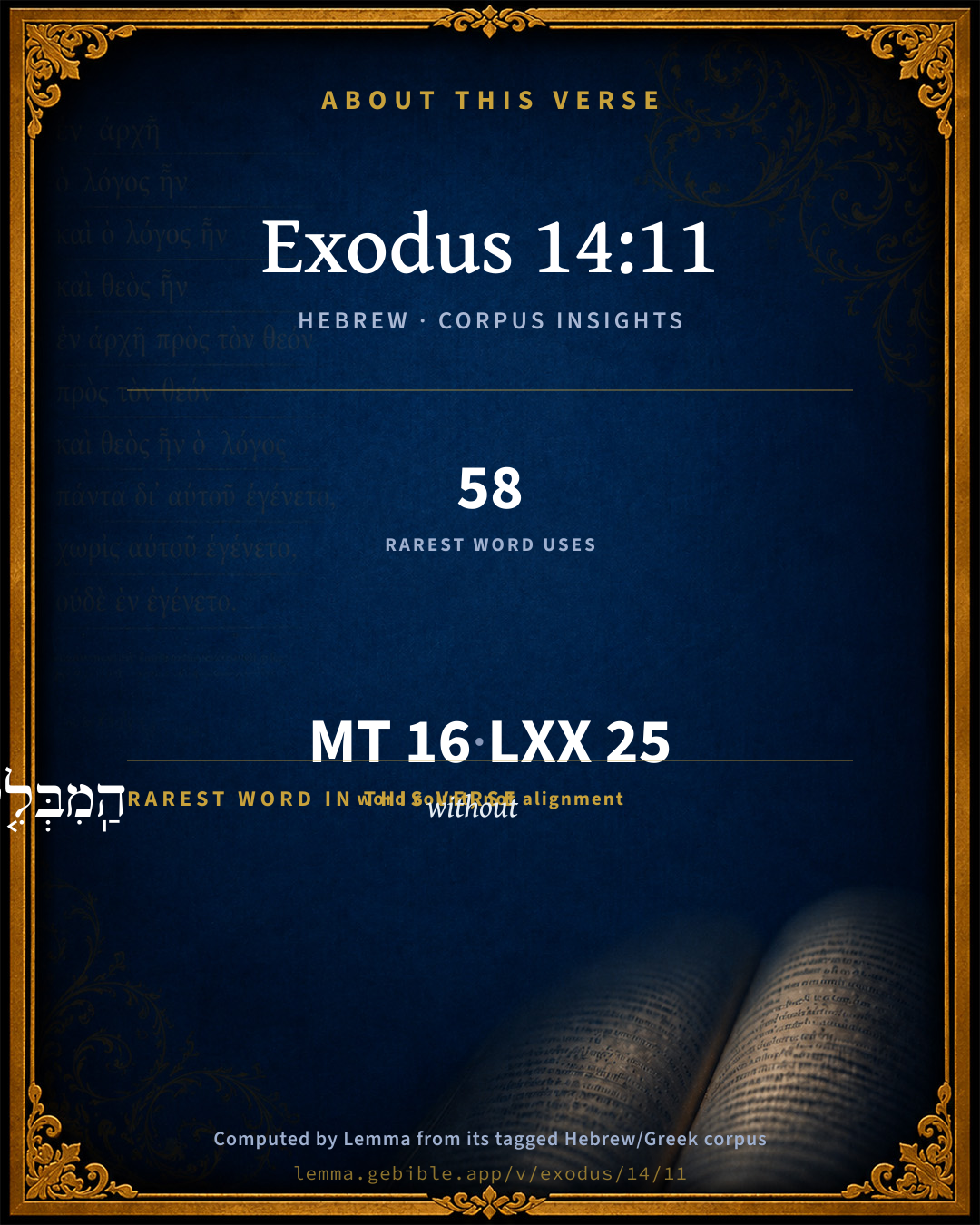
16
words
14
distinct lemmas
Pentateuch
section

Shared distinctive vocabulary

הַֽמִבְּלִ֤י without H1097 occurs in 57 verses of the Hebrew Bible. Also found in:

Grammatical profile

  • 5 verbs
  • 5 nouns
  • 1 pronoun
  • 2 prepositions
  • 3 particles

Verb forms

  • וַיֹּאמְרוּ֮ Qal · Sequential Imperfect
  • לְקַחְתָּ֖נוּ Qal · Perfect
  • לָמ֣וּת Qal · Infinitive Construct
  • עָשִׂ֣יתָ Qal · Perfect
  • לְהוֹצִיאָ֖נוּ Hiphil · Infinitive Construct

Repetition

A word recurs within this verse — often emphatic in Hebrew:

  • בְּמִצְרַ֔יִם Egypt H4714 ×2

Hebrew & Septuagint length

In English translation the verse runs 35 words from the Hebrew and 40 from the Septuagint (LXX English) — closely comparable.

A rough comparison of the two English renderings, which tokenize alike — not a word-level alignment.

Word counts can differ between the Hebrew and the Greek without any difference in meaning — e.g. the Hebrew direct-object marker אֵת has no separate Greek word, and Greek often adds the article ὁ.

In the original languages it is 16 Hebrew tokens and 25 Greek tokens — but the two are counted differently (Hebrew bundles its prefixes and suffixes into one token; the Greek is in lemma form), so that isn’t a like-for-like length.

Cross-references

7

Topical passages linked to Exodus 14:11 in the Treasury of Scripture Knowledge — connected by theme and wording, ordered by reader-vote popularity; previews shown in the World English Bible.

  • Numbers 14:1–4 All the congregation lifted up their voice, and cried; and the people wept that night.
  • Psalms 106:7–8 Our fathers didn't understand your wonders in Egypt. They didn't remember the multitude of your loving kindnesses, But were rebellious at the sea, even at the Red Sea.
  • Exodus 15:23–24 When they came to Marah, they couldn't drink from the waters of Marah, for they were bitter. Therefore the name of it was called Marah.
  • Exodus 16:2–3 The whole congregation of the children of Israel murmured against Moses and against Aaron in the wilderness;
  • Exodus 17:2–3 Therefore the people quarreled with Moses, and said, "Give us water to drink." Moses said to them, "Why do you quarrel with me? Why do you test Yahweh?"
  • Numbers 11:1 The people were as murmurers, [speaking] evil in the ears of Yahweh: and when Yahweh heard it, his anger was kindled; and the fire of Yahweh burnt among them, and devoured in the uttermost part of the camp.
  • Numbers 11:15 If you deal thus with me, please kill me out of hand, if I have found favor in your sight; and let me not see my wretchedness.

Cross-references courtesy of OpenBible.info (CC BY 4.0).

Hebrew and Greek witnesses Masoretic Hebrew ↔ Greek Septuagint

The same verse in the two great witnesses to the Old Testament, shown verse-for-verse.

These are two independent witnesses, not word-aligned to each other, and the Septuagint is shown in lemma (dictionary) form.

Hebrew Exodus 14:11 Masoretic · Westminster Leningrad Codex

וַיֹּאמְרוּ֮ אֶל מֹשֶׁה֒ הַֽמִבְּלִ֤י אֵין קְבָרִים֙ בְּמִצְרַ֔יִם לְקַחְתָּ֖נוּ לָמ֣וּת בַּמִּדְבָּ֑ר מַה זֹּאת֙ עָשִׂ֣יתָ לָּ֔נוּ לְהוֹצִיאָ֖נוּ מִמִּצְרָֽיִם

They said to Moses, "Because there were no graves in Egypt, have you taken us away to die in the wilderness? Why have you treated us this way, to bring us forth out of Egypt?

World English Bible · Public Domain

Greek LXX Exodus 14:11 Septuagint · lemma form

καί εἶπον πρός μωυσῆς παρά ὁ μή ὑποἄρχω μνῆμα ἐν γῆ αἴγυπτος ἐκἄγω ἐγώ θανατόω ἐν ὁ ἔρημος τίς οὗτος ποιέω ἐγώ ἐκἄγω ἐκ αἴγυπτος

and said to Moses, Because there were no graves in the land of Egypt, have you brought us forth to kill us in the wilderness? What is this that you have done to us, having brought us out of Egypt?

LXX2012 (modern English Septuagint) · Public Domain

Hebrew: Westminster Leningrad Codex (CC BY 4.0). Greek: Septuagint (public domain); English from LXX2012 (modern English Septuagint) (Public Domain). How the Septuagint differs from the Hebrew →

Targum (Aramaic paraphrase)

2

The Targum is the ancient Jewish Aramaic paraphrase of the Hebrew Scriptures — an interpretive translation, not the Hebrew text itself. Onkelos (literal) and Pseudo-Jonathan (expansive) render the Torah, and Jonathan the Prophets. Coverage is partial: where no permissively-licensed English translation exists for a verse, only the Aramaic is shown. This is verse-level text, not a word-by-word alignment to the Hebrew.

  1. Targum Onkelos Torah (Genesis–Deuteronomy)
    וַאֲמָרוּ לְמשֶׁה הֲמִדְלֵית קְבָרִין בְּמִצְרַיִם דְבַרְתָּנָא לִמְמַת בְּמַדְבְּרָא מָא דָא עֲבַדְתָּא לָנָא לְאַפָּקוּתָנָא מִמִצְרָיִם:

    (no public-domain English translation for this verse)

    Targum Onkelos — Aramaic: “Onkelos Genesis” (public domain); “Onkelos Exodus” (public domain); “Onkelos Leviticus” (public domain); “Onkelos Numbers” (public domain); “Onkelos Deuteronomy” (public domain). English: “Sefaria Community Translation” (CC0 1.0 (public-domain dedication)); “J.W. Etheridge. The Targums of Onkelos and Jonathan Ben Uzziel on the Pentateuch. London: Longmans, Green, 1862” (public domain). Text via Sefaria.

  2. Targum Pseudo-Jonathan Torah (Genesis–Deuteronomy)
    וַאֲמָרוּ רַשִׁיעֵי דָרָא לְמשֶׁה הֲמִן בִּגְלַל דְּלָא הֲוַת לָנָא בֵּית קְבוּרְתָּא בְּמִצְרָיִם דְּבַרְתָּנָא לִמְמַת בְּמַדְבְּרָא מַה דָּא עָבַדְתְּ לָנָא לְהַנְפָּקוּתָנָא מִמִּצְרָיִם

    But the wicked generation said to Mosheh, Because there were no places of burial for us in Mizraim, hast thou led us forth to die in the wilderness? What hast thou done to us, in bringing us out of Mizraim?

    Targum Pseudo-Jonathan — Aramaic: “Targum Jonathan on Genesis” (public domain); “Targum Jonathan on Exodus” (public domain); “Targum Jonathan on Leviticus” (public domain); “Targum Jonathan on Numbers” (public domain); “Targum Jonathan on Deuteronomy” (public domain). English: “The Targum of Jonathan ben Uzziel, trans. J. W. Etheridge, London, 1862” (public domain). Text via Sefaria.

Commentary

Notes on Exodus 14:11 from classic Christian and Jewish commentators (each source and its license shown beneath its notes). The classic Christian expositions comment on the surrounding passage and are grouped to its opening verse, so a note may address several verses; the Jewish commentaries on the Tanakh (Rashi and others) are per-verse, so they appear only where the commentator wrote on this verse.

Lemma curates 59 commentaries, every one of them public domain or Creative Commons licensed, each selected and text-cleaned for this edition rather than reprinted as found. About our sources →

Trapp's Complete Commentary

John Trapp

Exo 14:11 And they said unto Moses, Because [there were] no graves in Egypt, hast thou taken us away to die in the wilderness? wherefore hast thou dealt thus with us, to carry us forth out of Egypt?

Ver. 11. Because there were no graves.] Thus "they provoked him at the sea, at the Red Sea; nevertheless he saved them for his name’s sake." {Psa 106:7-8}

John Trapp, A Commentary or Exposition upon All the Books of the Old and New Testament (1647–1656) — public domain. Text from a community e-Sword module.

The Biblical Illustrator

Joseph S. Exell

Exo_14:11-12

Hast thou taken us away to die in the wilderness?

The foolish way in which many people anticipate difficulties

I. That many people meet anticipated difficulties in a spirit of great fear.

II. That many people meet anticipated difficulty in a spirit of complaint against those who have generously aided them in their enterprise. It is base to turn upon men who have spent their best energy and wisdom in our service when trouble seems to threaten, But this is the way of the world, a momentary cloud will eclipse a lifetime of heroic work.

III. That many people meet anticipated difficulties in a spirit which degrades previous events of a glorious character. Lessons:

1. That when trials threaten we should trust in God.

2. That fear weakens men in the hour of trial.

3. That it is ungenerous to murmur against those who earnestly seek our good. (J. S. Exell, M. A.)

An unreasonable complaint

During one of the campaigns in the American Civil War, when the winter weather was very severe, some of Stonewall Jacksons men, having crawled out in the morning from their snow-laden blankets half frozen, began to curse him as the cause of their sufferings. He lay close by under a tree, also snowed up, and heard all this; but, without noticing it, presently crawled out too, and, shaking off the snow, made some jocular remark to the nearest men, who had no idea he had ridden up in the night and lain down amongst them! The incident ran through the army in a few hours, and reconciled his followers to all the hardships of the expedition, and fully re-established his popularity.

The Biblical Illustrator, edited by Joseph S. Exell (c. 1880s–1900s) — public domain. Text from a community e-Sword module.

Ellicott's Commentary for English Readers

(11) Because there were no graves in Egypt.—Spoken in bitter irony, doubtless, but scarcely with any conscious reference to Egypt as “a land of tombs.” They meant simply to say: “Might we not as well have died there as here?”

A Bible Commentary for English Readers, edited by Charles John Ellicott (1878–1897) — public domain. Text from a community e-Sword module.

The Cambridge Bible for Schools and Colleges

gen. ed. J. J. S. Perowne

11. Comp. similar expostulations in Exo_16:3, Exo_17:3, Num_11:4 f., Exo_14:3, Exo_16:13, Exo_20:3 f., Exo_21:5.

the wilderness] as v. 3, the Egyptian wilderness, W. of the Isthmus and Gulf of Suez.

The Cambridge Bible for Schools and Colleges (gen. ed. J. J. S. Perowne; Cambridge University Press, 1878–1918) — public domain. Text from a community e-Sword module.

John Gill's Exposition

And they said unto Moses,.... The Targum of Jonathan is,"the ungodly of that generation said unto Moses;''but it seems rather to be understood of the body of the people in general, and is not to be limited to some particular persons of the worse characters among them:

because there were no graves in Egypt; as if there had been none, when there were so many; the Egyptians being more solicitous about their graves than their houses, as Diodorus Siculus reports (u); thus upbraiding Moses in a sarcastic way for what he had done:

hast thou taken us away to die in the wilderness? that so there might be room and graves enough to bury them in, for nothing but death was before their eyes:

wherefore hast thou dealt thus with us, to carry us forth out of Egypt? which was very ungrateful and disingenuous.

(u) Bibliothec. l. 1. p. 47.

John Gill's Exposition of the Whole Bible (1746–1763) — public domain (CC PDM 1.0). Text via the HelloAO Bible API.

Albert Barnes' Notes on the Bible

No graves in Egypt - This bitter taunt was probably suggested by the vast extent of cemeteries in Egypt, which might not improperly be called the land of tombs.

Albert Barnes' Notes on the Bible (1834–1885) — public domain. Text from a community e-Sword/MySword module.

The Pulpit Commentary

And they said to Moses. It was not unnatural that, while flying to God as their only refuge, they should be angry with Moses. Moses, they would argue, ought to have known better than to have brought them into a situation of such peril. He, the leader, should have known the geography of the country he, the courtier, should have known the temper of the court. It is always a satisfaction to men to vent their anger upon some one when they are in a difficulty. No graves in Egypt. Egypt, with a necropolis outside every city, was a land of tombs; " surely they might have found graves there, instead of being led out to such a distance simply to die.

HOMILIES BY D. YOUNG Ver. 11. Cruel words out of cowardly hearts.

There was much, as we have seen, to excuse the terror of Israel; but there is one thing not so easy to excuse, and that is the sarcastic, unjust spirit in which these terrified Israelites treat their visible leader. Formerly (Exo_5:21) they had turned on him with bitter reproaches; but their conduct then was the effect of ignorance and hasty expectations, and their language, however strong, was simply the language of reproach. But now to reproach they add sarcasm; they speak so as to set Moses in a ridiculous as well as a painful position. We may suppose that when the question was asked, Whatever can we have been brought here for?" some of the wits of Israel would reply, There is no room in Egypt to bury us, and so we are brought to be buried here. " Then this sharp speech, quickly flying from lip to lip, as clever things usually do, would in no long time become the well-nigh universal thought. We have then here to consider the evils of sarcastic speech. That such speech may do good sometimes, and sometimes be necessary, need not be denied. But inasmuch as the temptation is almost entirely the other way, we may dismiss as needless the work of considering what benefits there may be in sarcastic speech. The ills of sarcasm have so far outweighed the good, that we had better set ourselves earnestly to consider them. Is it not to be presumed that fewer such sayings would fall from our lips, if only we habitually considered all the ill effects that may flow from such a way of speaking?

I CONSIDER THE PAIN INFLICTED BY SARCASTIC SPEECH. There may be a great deal of pain inflicted where no sense of pain is expressed. Moses does not here take any notice of this bitter, clever, far-echoing word about the graves; but thereby, he only gives another illustration of his characteristic natural meekness. He may have felt, and felt deeply, even though he did not speak. If, indeed, he reckoned nothing of these words, we should hardly think so well of him. To be what is called thick-skinned is not good, if it is meant thereby that one has no perception of the insolent, inconsiderate language of others. Lack of sensibility to pain means a corresponding lack of sensibility to pleasure. We can no more avoid feeling pain when a harsh word is spoken, than when we receive a cut or a blow. No doubt it is pleasant to say sharp, clever things; but the pleasure is a momentary one, an entirely selfish one; it will not bear thinking about; and it may inflict a durable pain. Sharp words may be like barbed arrows that not all the lapse of years can work out of the memory. Assuredly we must not shrink from inflicting pain, if duty, affection, and prudence point that way; but we had need to be very sure of the indications. To inflict bodily pain for our own pleasure is admittedly an unchristian thing; and yet what a monstrous inconsistency is revealed in the fact that persons who would not tread on a worm, are constantly found inflicting the intensest pain by the words they speak. Knock a man down, and you might do him less harm than by the few words that pass so lightly, easily, and pleasantly between your lips. Less harm is done by the fist than by the tongue.

II CONSIDER THE INJUSTICE DONE BY IT. Sarcastic speeches never can be true speeches. If they were true, it would be no justification of them, but in the very nature of things they cannot be true. They must have about them, more or less, elements of the false and exaggerated. If a thing is to be sharp at all, there is an irresistible temptation to make it as sharp and striking as possible; and truth cannot but suffer in the process. Epigrams are always to be distrusted. How clearly the injustice of sharp sayings comes out in the illustration before us! The speech about these graves was a witty, clever one, but how unjust! As it happened, Moses was under no responsibility whatever for bringing the Israelites to this particular place. lie had not been left to use his own judgment and discretion, but was as much under the guidance of the cloudy pillar as all the rest. Hence from this illustration we receive a slight warning that we may not only be inflicting pain, Which is much, but injustice, which is a great deal more. You who would not steal the least fragment of a man"s property, be equally careful to speak no word which may do hurt to his reputation. Speak that you may inflict no pain; speak also that you may do no injustice.

III CONSIDER THE PERIL TO THE SPEAKER HIMSELF. Cleverness is a perilous, and not unfrequently a fatal gift. To be sharper than our neighbours may prove in the end a dangerous thing for our own interests. Some who are admired, courted, widely spoken about, for their powers of mimicry, find in the end that it might have been far more for their comfort and permanent well-being, if they had been of only commonplace abilities. To be admired is a poor satisfaction, mere dust and ashes, if it has to stand instead of being loved. Make fun of other people, seize without mercy on their weaknesses, their follies and their natural defects, and the chances are that you will find yourself exposed, in turn, to like treatment. Those who attack with sharp speeches are just the men who deserve if they always got their deserts, and it were expedient to retaliate equally sharp speeches in return. What about these Israelites here? Did they not by talking in this fashion show clearly what a mean, miserable company they were? They hurt themselves far more than they hurt Moses. There is hardly one who takes pride in what he calls his plain speaking, but might be pilloried himself, and greeted with sarcastic speeches as severe as any he had uttered, and probably more charged with truth. And the worst of all is, that in the end those habituated to evil-speaking may find themselves forsaken in their own great need. We need friends, and, if we would have them, we must show ourselves friendly. If we go through the world constantly replenishing our sarcastic quiver with arrows, and stretching the bow on every slight provocation, then we must expect people to give us a wide berth; and when at last we come to be stricken ourselves, it will be no matter of just complaint if we are left well-nigh alone.

IV CONSIDER HOW MUCH GOOD IS THWARTED AND NEUTRALISED BY THIS WAY OF SPEAKING. We may flatter ourselves that there is good to be gained in making folly ridiculous, and so there may be; but it can only be when the speaker is one of great wisdom, goodness, and habitual elevation of life. Certainly we find in the Scriptures the language of solemn irony from God himself; but his words are above our criticism, and we are not at liberty to speak as he speaks. We are all upon the same level of sin, ignorance, and partial views, and must speak as remembering this level. To affect authority and superior station will be ruinous to all good effects from any remonstrance of ours. Whatever truth is revealed to us, and put upon our consciences to speak, must be spoken in love, in humility, and in the very best season we can find. If it is really our desire to win others to better, wiser and manlier courses, we had better not begin with sharp speeches. True it may be that the world is mostly made up of fools, and perhaps there is no occasion when we do more to prove our own place in the large company than when, in our contempt and impatience, we call other people fools. We are not then behaving as fishers of men. We are not then becoming all things to all men in order to save some. Many a Christian has had to sorrow for his imperfect control over the gift of intellectual quickness. Before his conversion, he used his gift of wit, repartee, and ludicrous conception with careless freedom and delight, not staying to consider whom he hurt, whom he hindered. Then when such a one submits at last to the true lord of the intellect, he finds it hard, in this matter in particular, to bring his thoughts into captivity to the obedience of Christ.

V GOD"S PEOPLE MUST THEMSELVES PREPARE TO BE SARCASTICALLY AND BITTERLY SPOKEN OF. Only let each one of us consider his own temptation to say hard things, and then we shall cease to wonder that hard things are said of us. We cannot expect to receive from others, but as we give to them. Anyway we must be ready for hard things, ready in particular for hard speeches. Where Christ went, his people must go; and he went in a path where he was called a gluttonous man and a winebibber, a friend of publicans and sinners. If he was sneered at on the very Cross, it is babyish on our part to complain because the world sneers at us in the comparatively easy paths we have to tread. Our strength, our joy, and our serenity must not depend on the world"s opinion. Moses was getting a hint even thus early that he must not expect consideration from his brethren, with respect to his feelings and difficulties. The joys of Moses were to be got from quite another direction, even from the assiduous tenderness of Jehovah himself.

VI CULTIVATE A HABIT OF PITIFUL CONSIDERATION TOWARDS THE MEN OF SARCASTIC SPEECH. Remember that they are not happy men. How can a man be happy whose eye is for ever lighting on the blots and loathsome ulcers of human nature; who seems to have a morbid acuteness of vision with respect to them, but to become purblind when noble and Divinely-produced elements of character appear? Such a man is to be pitied with Christ"s own gentle pity. Do not meet his sarcasm with sarcasm, but here emphatically return good for evil. Force him to see that there is a great deal more in the world, if only he will look for it, than duplicity, selfishness, and stupidity. Show him how to discern, even in the jostling and wrangling crowd, men who have in them the mind which was in Christ. Y.

The Pulpit Commentary (1880–1919), ed. H.D.M. Spence-Jones & Joseph S. Exell — public domain. Text from a community e-Sword module.

Rashi

Rabbi Shlomo Yitzchaki (Rashi)

המבלי אין קברים signifies, was it on account of lack of graves — because there were no graves in Egypt in which to be buried — that thou didst bring us out from there? old French si pour faillance de non fossés.

Rashi on the Tanakh — English translations: “The Judaica Press complete Tanach with Rashi, translated by A. J. Rosenberg” (CC BY 4.0); “Pentateuch with Rashi's commentary by M. Rosenbaum and A.M. Silbermann, 1929-1934” (public domain); “The Metsudah Tanach series, Lakewood, N.J” (CC BY 4.0); and “The Book of Joshua, Metsudah Publications, 1997” (CC BY 4.0). Text via Sefaria.

Lesson kit

Teaching starters — assembled from the data on this page, not authored interpretation. Every prompt links to the verse data it draws on. Edit before teaching.

Exodus, in the Pentateuch, opens this verse with 16 words (14 distinct Hebrew lemmas). Its most distinctive word is bᵉlîy (“without”). A historical commentator’s framing appears above. Read the whole chapter for the surrounding context.

Discussion questions

  1. The word bᵉlîy carries the sense “without.” How does it shape the verse?
  2. How does Genesis 31:20, which shares the word «without», read alongside this verse?
  3. What does the repetition of “Egypt” (2× in this one verse) do in this verse?
  4. The translations on this page render this verse differently — a whole-verse word diff, not a word-by-word alignment. What might account for the different wordings?
  5. «וַיֹּאמְרוּ֮» is a Qal Sequential Imperfect verb. How does that grammatical form shape the action described?
  6. Compare how Trapp's Complete Commentary and The Biblical Illustrator read this verse. Where do they agree or differ?

Things to notice

Reading settings

Reading text

Shown beneath each verse's original-language words.

Old Testament
Old Testament edition

Read the OT as the Masoretic Hebrew (MT) or the Greek Septuagint (LXX).

English shown for the Greek Septuagint (in the Hebrew ↔ Greek comparison).

Comparing translations? Open the Compare panel on any verse page to stack up to four side by side.