
Exodus 11:5

Hebrew (Westminster Leningrad Codex) Exodus 11:5 appears in the Hebrew Old Testament. The text above is from the Westminster Leningrad Codex. Each word links to its Strong’s number, a concise gloss, and parsing drawn from the Open Scriptures Hebrew Bible morphology. Click any word for its full Brown-Driver-Briggs (BDB) entry.
Download image
Cite this verse

Exodus 11:5 (World English Bible). Public Domain. Lemma interlinear Bible study tool, https://lemma.gebible.app/v/exodus/11/5.

Show BibTeX & RIS
BibTeX
RIS
English Translation
and all the firstborn in the land of Egypt shall die, from the firstborn of Pharaoh who sits on his throne, even to the firstborn of the maid-servant who is behind the mill; and all the firstborn of cattle.
World English Bible · Public Domain
Highlights
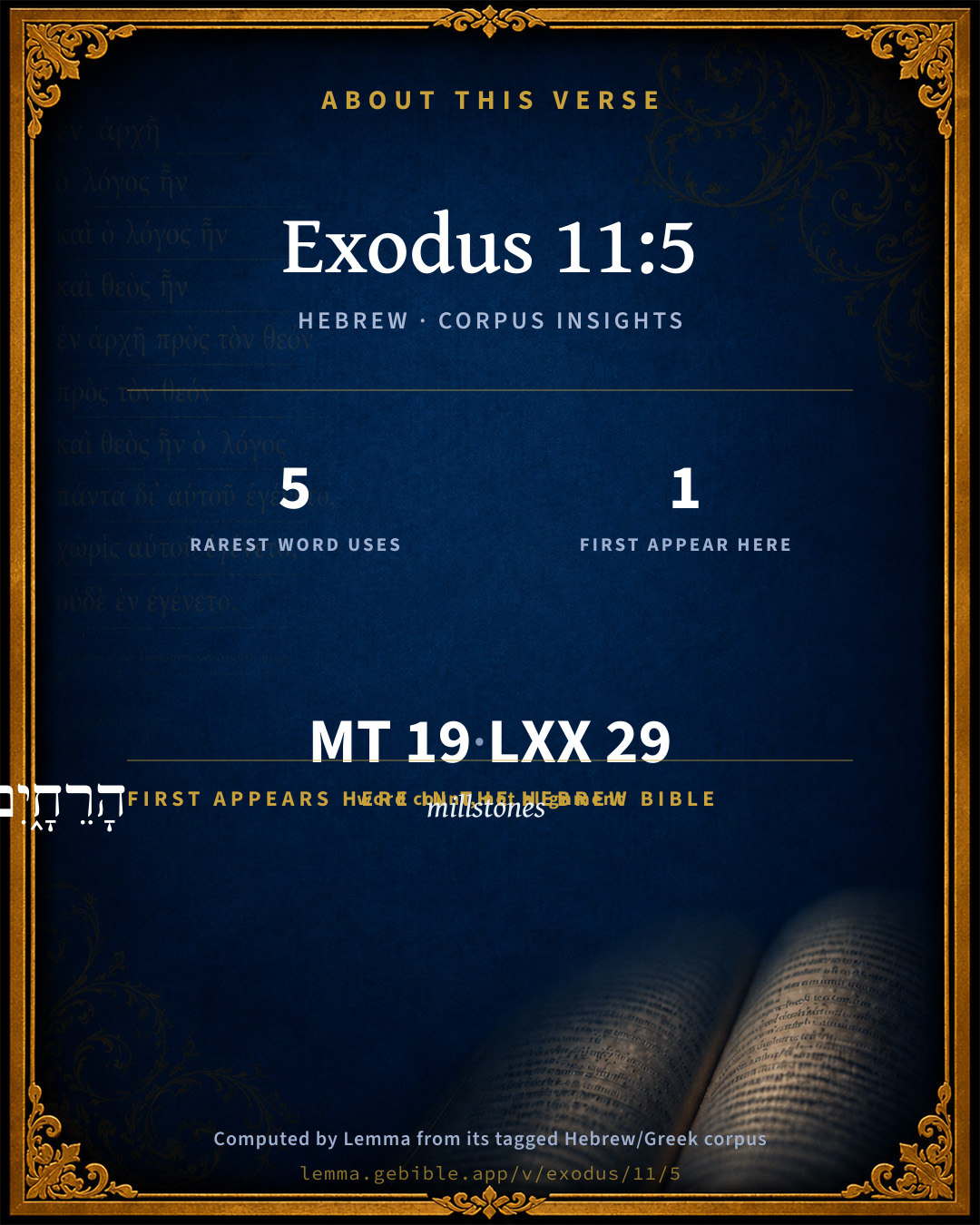
  • 1 first appearance in the Hebrew Bible
Full analysis ↓
Download a study sheet

One document with this verse’s original text, its word-by-word gloss line, the meaning frame, cross-references with their text, attributed commentary, and full source and license credits — printable, and it pastes into notes with its structure intact.

This verse Autodidact and up

Study sheet (.html) Plain text (.txt)

A passage Seminary Student

Up to 50 verses in one chapter. A passage sheet keeps up to 6 commentary sources and 12 cross-references per verse, in the order this page ranks them, and says so on the sheet whenever that leaves anything out. Ask for a single verse and you get the Autodidact verse sheet above.

Everything on this page stays free to read, with no account — the sheet is a download of what is already on screen, not access to it.

Want to remove ads? Support Godless Engineer
Compare translations 3

The same verse in 3 English versions, stacked beneath the original-language interlinear above. Click any original word for its lexicon entry.

Each is an independent rendering of the whole verse — the interlinear is not word-aligned to these translations.

Highlighted words mark where these versions differ — a whole-verse word diff, not a word-by-word alignment.

  • World English Bible Public Domain
    and all the firstborn in the land of Egypt shall die, from the firstborn of Pharaoh who sits on his throne, even to the firstborn of the maid-servant who is behind the mill; and all the firstborn of cattle.
  • King James Version Public Domain
    And all the firstborn in the land of Egypt shall die, from the first born of Pharaoh that sitteth upon his throne, even unto the firstborn of the maidservant that is behind the mill; and all the firstborn of beasts.
  • unfoldingWord Literal Text CC BY-SA 4.0
    and every firstborn in the land of Egypt will die, from the firstborn of Pharaoh, who sits on his throne, to the firstborn of the slave girl who is behind the mill, and every firstborn of a beast.

unfoldingWord Literal Text — © unfoldingWord, licensed CC BY-SA 4.0. Word-aligned USFM3 via Door43 (git.door43.org/unfoldingWord/en_ult).

Versions to compare (up to 4)

3 of 4 selected

Show all 18 translations

Every available English version of this verse, each an independent rendering of the whole verse.

  • World English Bible Public Domain
    and all the firstborn in the land of Egypt shall die, from the firstborn of Pharaoh who sits on his throne, even to the firstborn of the maid-servant who is behind the mill; and all the firstborn of cattle.
  • Berean Standard Bible Public Domain
    and every firstborn son in the land of Egypt will die, from the firstborn of Pharaoh who sits on his throne, to the firstborn of the servant girl behind the hand mill, as well as the firstborn of all the cattle.
  • Majority Standard Bible Public Domain
    and every firstborn son in the land of Egypt will die, from the firstborn of Pharaoh who sits on his throne, to the firstborn of the servant girl behind the hand mill, as well as the firstborn of all the cattle.
  • King James Version Public Domain
    And all the firstborn in the land of Egypt shall die, from the first born of Pharaoh that sitteth upon his throne, even unto the firstborn of the maidservant that is behind the mill; and all the firstborn of beasts.
  • American Standard Version (1901) Public Domain
    and all the first-born in the land of Egypt shall die, from the first-born of Pharaoh that sitteth upon his throne, even unto the first-born of the maid-servant that is behind the mill; and all the first-born of cattle.
  • Revised Version (1885) Public Domain
    and all the firstborn in the land of Egypt shall die, from the firstborn of Pharaoh that sitteth upon his throne, even unto the firstborn of the maidservant that is behind the mill; and all the firstborn of cattle.
  • Geneva Bible (1599) Public Domain
    And all the first borne in the lande of Egypt shall die, from the first borne of Pharaoh that sitteth on his throne, vnto the first borne of the maide seruant, that is at the mille, and all the first borne of beastes.
  • Douay-Rheims (1899) Public Domain
    And every firstborn in the land of the Egyptians shall die, from the firstborn of Pharao who sitteth on his throne, even to the first born of the handmaid that is at the mill, and all the firstborn of beasts.
  • Young's Literal Translation Public Domain
    and every first-born in the land of Egypt hath died, from the first-born of Pharaoh who is sitting on his throne, unto the first-born of the maid-servant who `is' behind the millstones, and all the first-born of beasts;
  • Literal Standard Version CC BY-SA 4.0
    and every firstborn in the land of Egypt has died, from the firstborn of Pharaoh who is sitting on his throne, to the firstborn of the maidservant who [is] behind the millstones, and all the firstborn of beasts;
  • Unlocked Literal Bible CC BY-SA 4.0
    All the firstborn in the land of Egypt will die, from the firstborn of Pharaoh, who sits on his throne, to the firstborn of the slave girl who is behind the handmill grinding it, and to all the firstborn of the cattle.
  • unfoldingWord Literal Text CC BY-SA 4.0
    and every firstborn in the land of Egypt will die, from the firstborn of Pharaoh, who sits on his throne, to the firstborn of the slave girl who is behind the mill, and every firstborn of a beast.
  • Darby Bible Public Domain
    And all the firstborn in the land of Egypt shall die, from the firstborn of Pharaoh who sitteth on his throne, even unto the firstborn of the bondwoman that is behind the mill; and all the firstborn of cattle.
  • World Messianic Bible Public Domain
    and all the firstborn in the land of Egypt shall die, from the firstborn of Pharaoh who sits on his throne, even to the firstborn of the female servant who is behind the mill, and all the firstborn of livestock.
  • Webster's Bible Public Domain
    And all the first-born in the land of Egypt shall die, from the first-born of Pharaoh that sitteth upon his throne, even to the first-born of the maid-servant that is behind the mill; and all the first-born of beasts.
  • Free Bible Version CC BY-SA 4.0
    Every firstborn son in the land of Egypt will die, from the firstborn of Pharaoh sitting on his throne to the firstborn of the servant girl working with a handmill, as well as all the firstborn of the cattle.
  • Bible in Basic English Public Domain
    And death will come to every mother's first male child in all the land of Egypt, from the child of Pharaoh on his seat of power, to the child of the servant-girl crushing the grain; and the first births of all the cattle.
  • JPS Tanakh (1917) Public Domain
    and all the first-born in the land of Egypt shall die, from the first-born of Pharaoh that sitteth upon his throne, even unto the first-born of the maid-servant that is behind the mill; and all the first-born of cattle.

Literal Standard Version (2020), Covenant Press — licensed CC BY-SA 4.0. Text via the HelloAO Bible API (eBible.org). Unlocked Literal Bible (unfoldingWord) — licensed CC BY-SA 4.0. Text via the HelloAO Bible API (eBible.org). unfoldingWord Literal Text — © unfoldingWord, licensed CC BY-SA 4.0. Word-aligned USFM3 via Door43 (git.door43.org/unfoldingWord/en_ult). Free Bible Version, Dr. Jonathan Gallagher — licensed CC BY-SA 4.0. Text via the HelloAO Bible API (eBible.org).

Word by word

More ways to search: Search by grammar → Find every occurrence → Compare this word →

Practice this passage: Drill this verse → Learn its vocabulary →

הָרֵחָ֑יִם
rêcheh
H7347
“the · millstones”
Particle, Definite Article + Noun, Common, Masculine, Dual, Absolute
Part of Speech
Particle + Noun
Type
Common
Gender
Masculine
Number
Dual
State
Absolute
Full BDB Definition

Origin: from an unused root meaning to pulverise

TWOT: 2144a

handmills - a pair of millstones for grinding
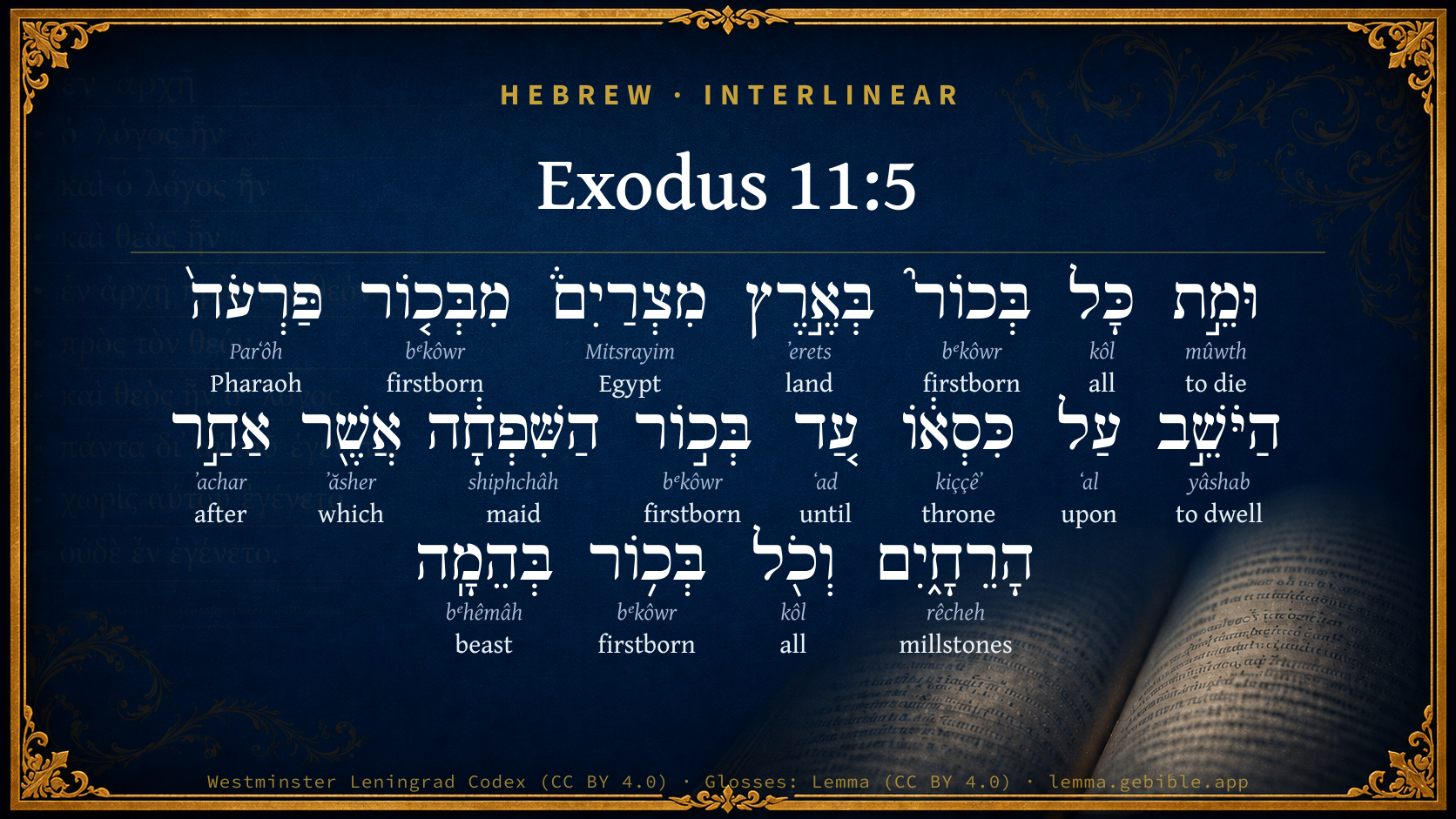
  1. וּמֵ֣ת mûwth H4191 “and · to die” Conjunction + Verb, Qal, Sequential Perfect, 3rd Person, Masculine, Singular
  2. כָּל kôl H3605 “all of” Noun, Common, Masculine, Singular, Construct
  3. בְּכוֹר֮ bᵉkôwr H1060 “firstborn” Noun, Common, Masculine, Singular, Absolute
  4. בְּאֶ֣רֶץ ʼerets H776 “in/at · land of” Preposition + Noun, Common, Both, Singular, Construct
  5. מִצְרַיִם֒ Mitsrayim H4714 “Egypt” Noun, Proper
  6. מִבְּכ֤וֹר bᵉkôwr H1060 “from · firstborn of” Preposition + Noun, Common, Masculine, Singular, Construct
  7. פַּרְעֹה֙ Parʻôh H6547 “Pharaoh” Noun, Proper
  8. הַיֹּשֵׁ֣ב yâshab H3427 “the · dwelling” Particle, Definite Article + Verb, Qal, Participle Active, Masculine, Singular, Absolute
  9. עַל ʻal H5921 “upon” Preposition
  10. כִּסְא֔וֹ kiççêʼ H3678 “throne · his” Noun, Common, Masculine, Singular, Construct + Suffix, Personal, 3rd Person, Masculine, Singular
  11. עַ֚ד ʻad H5704 “until” Preposition
  12. בְּכ֣וֹר bᵉkôwr H1060 “firstborn of” Noun, Common, Masculine, Singular, Construct
  13. הַשִּׁפְחָ֔ה shiphchâh H8198 “the · maid” Particle, Definite Article + Noun, Common, Feminine, Singular, Absolute
  14. אֲשֶׁ֖ר ʼăsher H834 “which” Particle, Relative
  15. אַחַ֣ר ʼachar H310 “after” Preposition
  16. וְכֹ֖ל kôl H3605 “and · all of” Conjunction + Noun, Common, Masculine, Singular, Construct
  17. בְּכ֥וֹר bᵉkôwr H1060 “firstborn of” Noun, Common, Masculine, Singular, Construct
  18. בְּהֵמָֽה bᵉhêmâh H929 “beast” Noun, Common, Feminine, Singular, Absolute

About this verse

These counts appear in no published source. They are computed here, from the morphology-tagged text and Lemma’s own curated glosses. What Lemma adds →

19
words
15
distinct lemmas
Pentateuch
section

Notable vocabulary

The rarest word here is הָרֵחָ֑יִם millstones H7347 — appearing just 5 times in the whole Hebrew Bible.

First appearance in Scripture

This word makes its first canonical appearance in the Hebrew Bible here:

  • הָרֵחָ֑יִם millstones H7347

Shared distinctive vocabulary

הָרֵחָ֑יִם millstones H7347 occurs in 5 verses of the Hebrew Bible. Also found in:

Grammatical profile

  • 2 verbs
  • 13 nouns
  • 3 prepositions
  • 1 particle

Verb forms

  • וּמֵ֣ת Qal · Sequential Perfect
  • הַיֹּשֵׁ֣ב Qal · Participle Active

Repetition

Words recur within this verse — often emphatic in Hebrew:

  • בְּכוֹר֮ firstborn H1060 ×4
  • כָּל all H3605 ×2

Hebrew & Septuagint length

In English translation the verse runs 39 words from the Hebrew and 39 from the Septuagint (LXX English) — the same length.

A rough comparison of the two English renderings, which tokenize alike — not a word-level alignment.

Word counts can differ between the Hebrew and the Greek without any difference in meaning — e.g. the Hebrew direct-object marker אֵת has no separate Greek word, and Greek often adds the article ὁ.

In the original languages it is 19 Hebrew tokens and 29 Greek tokens — but the two are counted differently (Hebrew bundles its prefixes and suffixes into one token; the Greek is in lemma form), so that isn’t a like-for-like length.

Cross-references

13

Topical passages linked to Exodus 11:5 in the Treasury of Scripture Knowledge — connected by theme and wording, ordered by reader-vote popularity; previews shown in the World English Bible.

  • Psalms 78:51 And struck all the firstborn in Egypt, The chief of their strength in the tents of Ham.
  • Exodus 4:23 and I have said to you, "Let my son go, that he may serve me;" and you have refused to let him go. Behold, I will kill your son, your firstborn.'"
  • Exodus 12:12 For I will go through the land of Egypt in that night, and will strike all the firstborn in the land of Egypt, both man and animal. Against all the gods of Egypt I will execute judgments: I am Yahweh.
  • Exodus 12:29 It happened at midnight, that Yahweh struck all the firstborn in the land of Egypt, from the firstborn of Pharaoh who sat on his throne to the firstborn of the captive who was in the dungeon; and all the firstborn of cattle.
  • Exodus 13:15 and it happened, when Pharaoh would hardly let us go, that Yahweh killed all the firstborn in the land of Egypt, both the firstborn of man, and the firstborn of animal. Therefore I sacrifice to Yahweh all that opens the womb, being males; but all the firstborn of my sons I redeem.'
  • Psalms 105:36 He struck also all the firstborn in their land, The first fruits of all their manhood.
  • Psalms 135:8 Who struck the firstborn of Egypt, Both of man and animal;
  • Psalms 136:10 To him who struck down the Egyptian firstborn; For his loving kindness endures forever;
  • Matthew 24:41 two women grinding at the mill, one will be taken and one will be left.
  • Hebrews 11:28 By faith, he kept the Passover, and the sprinkling of the blood, that the destroyer of the firstborn should not touch them.
  • Judges 16:21 The Philistines laid hold on him, and put out his eyes; and they brought him down to Gaza, and bound him with fetters of brass; and he did grind in the prison-house.
  • Isaiah 47:2 Take the millstones, and grind meal; remove your veil, strip off the train, uncover the leg, pass through the rivers.
  • Lamentations 5:13 The young men bare the mill; The children stumbled under the wood.

Cross-references courtesy of OpenBible.info (CC BY 4.0).

Hebrew and Greek witnesses Masoretic Hebrew ↔ Greek Septuagint

The same verse in the two great witnesses to the Old Testament, shown verse-for-verse.

These are two independent witnesses, not word-aligned to each other, and the Septuagint is shown in lemma (dictionary) form.

Hebrew Exodus 11:5 Masoretic · Westminster Leningrad Codex

וּמֵ֣ת כָּל בְּכוֹר֮ בְּאֶ֣רֶץ מִצְרַיִם֒ מִבְּכ֤וֹר פַּרְעֹה֙ הַיֹּשֵׁ֣ב עַל כִּסְא֔וֹ עַ֚ד בְּכ֣וֹר הַשִּׁפְחָ֔ה אֲשֶׁ֖ר אַחַ֣ר הָרֵחָ֑יִם וְכֹ֖ל בְּכ֥וֹר בְּהֵמָֽה

and all the firstborn in the land of Egypt shall die, from the firstborn of Pharaoh who sits on his throne, even to the firstborn of the maid-servant who is behind the mill; and all the firstborn of cattle.

World English Bible · Public Domain

Greek LXX Exodus 11:5 Septuagint · lemma form

καί τελευτάω πᾶς πρωτότοκος ἐν γῆ αἴγυπτος ἀπό πρωτότοκος φαραώ ὅς καταἧμαι ἐπί ὁ θρόνος καί ἕως πρωτότοκος ὁ θεράπαινα ὁ παρά ὁ μύλος καί ἕως πρωτότοκος πᾶς κτῆνος

And every firstborn in the land of Egypt shall die, from the firstborn of Pharao that sits on the throne, even to the firstborn of the woman-servant that is by the mill, and to the firstborn of all cattle.

LXX2012 (modern English Septuagint) · Public Domain

On this verse, John Gill's Exposition discusses the Septuagint’s reading. Read the note in Commentary ↓

Hebrew: Westminster Leningrad Codex (CC BY 4.0). Greek: Septuagint (public domain); English from LXX2012 (modern English Septuagint) (Public Domain). How the Septuagint differs from the Hebrew →

Targum (Aramaic paraphrase)

2

The Targum is the ancient Jewish Aramaic paraphrase of the Hebrew Scriptures — an interpretive translation, not the Hebrew text itself. Onkelos (literal) and Pseudo-Jonathan (expansive) render the Torah, and Jonathan the Prophets. Coverage is partial: where no permissively-licensed English translation exists for a verse, only the Aramaic is shown. This is verse-level text, not a word-by-word alignment to the Hebrew.

  1. Targum Onkelos Torah (Genesis–Deuteronomy)
    וִימוּת כָּל בּוּכְרָא בְּאַרְעָא דְמִצְרַיִם מִבּוּכְרָא דְפַרְעֹה דְעָתִיד לְמִתַּב עַל כָּרְסֵי מַלְכוּתֵהּ עַד בּוּכְרָא דְאַמְתָא דִי בָּתַר רֵיחְיָא וְכֹל בּוּכְרָא דִבְעִירָא:

    (no public-domain English translation for this verse)

    Targum Onkelos — Aramaic: “Onkelos Genesis” (public domain); “Onkelos Exodus” (public domain); “Onkelos Leviticus” (public domain); “Onkelos Numbers” (public domain); “Onkelos Deuteronomy” (public domain). English: “Sefaria Community Translation” (CC0 1.0 (public-domain dedication)); “J.W. Etheridge. The Targums of Onkelos and Jonathan Ben Uzziel on the Pentateuch. London: Longmans, Green, 1862” (public domain). Text via Sefaria.

  2. Targum Pseudo-Jonathan Torah (Genesis–Deuteronomy)
    וִימוּת כָּל בּוּכְרָא בְּאַרְעָא דְמִצְרַיִם מִבִּיר בּוּכְרָא דְפַרְעה דְּעָתִיד דְּיֵיתִיב עַל כּוּרְסַיָא מַלְכוּתֵיהּ עַד בּוּכְרָא דְאַמְתָא בִּיצִירְתָּא דִבְמִצְרַיִם דְּמִתְיְלִיד לָהּ כַּד הִיא טַחְנָא אֲחוֹרֵי רֵיחַיָא וְכָל בּוּכְרָא דִבְעִירָא

    and every firstborn in the land of Mizraim shall die: from the firstborn of Pharoh who should sit upon the throne of his kingdom, unto the firstborn son of the humblest mother in Mizraim who grindeth behind the mills, and all the firstborn of cattle.

    Targum Pseudo-Jonathan — Aramaic: “Targum Jonathan on Genesis” (public domain); “Targum Jonathan on Exodus” (public domain); “Targum Jonathan on Leviticus” (public domain); “Targum Jonathan on Numbers” (public domain); “Targum Jonathan on Deuteronomy” (public domain). English: “The Targum of Jonathan ben Uzziel, trans. J. W. Etheridge, London, 1862” (public domain). Text via Sefaria.

Commentary

Notes on Exodus 11:5 from classic Christian and Jewish commentators (each source and its license shown beneath its notes). The classic Christian expositions comment on the surrounding passage and are grouped to its opening verse, so a note may address several verses; the Jewish commentaries on the Tanakh (Rashi and others) are per-verse, so they appear only where the commentator wrote on this verse.

Lemma curates 59 commentaries, every one of them public domain or Creative Commons licensed, each selected and text-cleaned for this edition rather than reprinted as found. About our sources →

Adam Clarke's Commentary

Verse 5. The first-born of Pharaoh, c.] From the heir to the Egyptian throne to the son of the most abject slave, or the principal person in each family. See Clarke on Ex 12:29.

The maid-servant that is behind the mill] The meanest slaves were employed in this work. In many parts of the east they still grind all their corn with a kind of portable mill-stones, the upper one of which is turned round by a sort of lever fixed in the rim. A drawing of one of these machines as used in China is now before me, and the person who grinds is represented as pushing the lever before him, and thus running round with the stone. Perhaps something like this is intended by the expression BEHIND the mill in the text. On this passage Dr. Shaw has the following observation: - "Most families grind their wheat and barley at home, having two portable mill-stones for that purpose, the uppermost of which is turned round by a small handle of wood or iron that is placed in the rim. When this stone is large, or expedition required, a second person is called in to assist and as it is usual for women alone to be concerned in this employment, who seat themselves over against each other with the mill-stone between them, we may see, not only the propriety of the expression (Ex 11:5) of sitting behind the mill, but the force of another, (Mt 24:41), that two women shall be grinding at the mill; the one shall be taken, and the other left." - Travels, p. 231, 4to edit. These portable mills, under the name of querns, were used among our ancestors in this and the sister kingdoms, and some of them are in use to the present day. Both the instrument and its name our forefathers seem to have borrowed from the continent. They have long existed among the inhabitants of Shetland, Iceland, Norway, Denmark, &c.

Adam Clarke's Commentary on the Bible (1810–1826) — public domain. Text from a community e-Sword/MySword module.

Trapp's Complete Commentary

John Trapp

Exo 11:5 And all the firstborn in the land of Egypt shall die, from the firstborn of Pharaoh that sitteth upon his throne, even unto the firstborn of the maidservant that [is] behind the mill; and all the firstborn of beasts.

Ver. 5. That sitteth upon his throne.] As co-partner in the kingdom. Our Henry II crowned his eldest son Henry while he was yet alive. But this young king, through discontent, fell into a fever, whereof he died before his father; who cast him away first by his indulgence, and after by his rigour, not suffering him to be what himself had made him. Mr Knox, in his "History of Scotland," reporteth of one Sir John Hamilton, murdered by the king’s means, that he appeared to him in a vision with a naked sword drawn, and struck off both his arms with these words, Take this before thou receive a final payment for all thine impieties; and within twenty-four hours two of the king’s sons died.

That is behind the mill.] The hand mill which they drove before them. {Jdg 16:21 Isa 47:2 Mat 24:41}

John Trapp, A Commentary or Exposition upon All the Books of the Old and New Testament (1647–1656) — public domain. Text from a community e-Sword module.

Joseph Benson's Commentary

Exo 11:5. The death of the firstborn had been threatened, Exo 4:23, but is last executed, and less judgments are tried; which, if they had done the work, would have prevented this. See how slow God is to wrath, and how willing to be met in the way of his judgments, and to have his anger turned away! That sitteth upon his throne: the maidservant behind the mill — The poor captive slave, employed in the hardest labour. It was the custom then, as it is with the Arabs at present, to grind their corn with hand-mills, turned by their women-servants, who, for that purpose, stood behind the mill.

Joseph Benson's Commentary on the Old and New Testaments (1811–1818) — public domain. Text from a community e-Sword module.

Tyndale Open Study Notes

Tyndale Open Resources

11:5 In much of the world, the issue of survival is addressed through children, and it is through the firstborn sons that the family line is carried on. If we have a child, there is a sense of satisfaction that even when we are dead, we will live on through our children. In the death of the Egyptian firstborn, God was showing that humans can do nothing by themselves to guarantee survival. Life is a gift, and that gift is in the hand of the one Lord, the “I Am.”

Tyndale Open Study Notes — © Tyndale Open Resources, licensed CC BY-SA 4.0. Text via the HelloAO Bible API.

Geneva Bible (1599)

Geneva Bible translators

From the highest to the lowest.

Geneva Bible (1599) marginal notes — public domain. Text via Bolls.life.

Jamieson, Fausset & Brown

Robert Jamieson, A. R. Fausset & David Brown

And all the first-born in the land . . . shall die--The time, the suddenness, the dreadful severity of this coming calamity, and the peculiar description of victims, among both men and beasts, on whom it was to fall, would all contribute to aggravate its character.

the maid-servant that is behind the mill--The grinding of the meal for daily use in every household is commonly done by female slaves and is considered the lowest employment. Two portable millstones are used for the purpose, of which the uppermost is turned by a small wooden handle, and during the operation the maid sits behind the mill.

Jamieson, Fausset & Brown — Commentary Critical and Explanatory on the Whole Bible (1871) — public domain (CC PDM 1.0). Text via the HelloAO Bible API.

Ellicott's Commentary for English Readers

(5) All the firstborn . . . shall die.—The Heb. word translated firstborn is applied only to males; and thus the announcement was that in every family the eldest son should be cut off. In Egypt, as in most other countries, the law of primogeniture prevailed—the eldest son was the hope, stay, and support of the household, his father’s companion, his mother’s joy, the object of his brothers’ and sisters’ reverence. The firstborn of the Pharaoh bore the title of erpa suten sa, or “hereditary crown prince,” and succeeded his father, unless he died or was formally set aside during his father’s lifetime. Among the nobles, estates were inherited, and sometimes titles descended to the firstborn. No greater affliction can be conceived, short of the general destruction of the people, than the sudden death in every family of him round whom the highest interests and fondest hopes clustered.

The maidservant that is behind the mill marks the lowest grade in the social scale, as the king that sits upon his throne marks the highest. All alike were to suffer. In every family there was to be one dead (Exo_12:30).

All the firstborn of beasts.—The aggravation of the calamity by its extension to beasts is very remarkable, and is probably to be connected with the Egyptian animal-worship. At all times there were in Egypt four animals regarded as actual incarnations of deity, and the objects of profound veneration. Three of these were bulls, while one was a white cow. It is not unlikely that all were required to be “firstborns;” in which case the whole of Egypt would have been plunged into a religious mourning on account of their deaths, in addition to the domestic mourning that must have prevailed in each house. The deaths of other sacred animals, and of many pet animals in houses, would have increased the general consternation.

A Bible Commentary for English Readers, edited by Charles John Ellicott (1878–1897) — public domain. Text from a community e-Sword module.

The Cambridge Bible for Schools and Colleges

gen. ed. J. J. S. Perowne

5. the mill] The Heb. word is a dual, properly, no doubt, the two mill-stones (though the root-meaning of rçḥaim is not known). The reference is to the hand-mill, consisting of two circular stones, 18 inches or two feet in diameter, the lower one being fixed on the ground, while the upper one is turned round by a woman—or sometimes (cf. Mat_24:41) by two women—kneeling or sitting beside it. The mill is fed by grain being poured in through an opening in the centre of the upper stone. The hand-mill is still in daily use in practically every household in an Eastern village. In the houses of the rich, the work of the mill fell to the female slaves; cf. Isa_47:2 where the command to ‘take the mill-stones and grind meal’ is a prophecy of impending slavery. Captives were also sometimes compelled to do the same work (Judges 14:21, Lam_5:13).

of cattle] comp. on Exo_9:6; Exo_9:19.

The Cambridge Bible for Schools and Colleges (gen. ed. J. J. S. Perowne; Cambridge University Press, 1878–1918) — public domain. Text from a community e-Sword module.

John Gill's Exposition

And all the firstborn in the land of Eygpt shall die,.... By the destroying angel inflicting a disease upon them, as Josephus says (q), very probably the pestilence; however, it was sudden and immediate death, and which was universal, reaching to all the firstborn that were in the families of the Egyptians in all parts of the kingdom:

from the firstborn of Pharaoh that sitteth upon his throne: this periphrasis, "that sitteth upon his throne", either belongs to Pharaoh, and is a description of him who now sat upon the throne of Egypt; and the Septuagint version leaves out the pronoun "his"; and so it is the same as if it had been said the firstborn of Pharaoh, king of Egypt; or else, to the firstborn, and describes him who either already sat upon the throne with his father, as was sometimes the case, that the firstborn was taken a partner in the throne, in the lifetime of his father; or who was the presumptive heir of the crown, and should succeed him, and so the Targum of Jonathan,"who shall or is to sit upon the throne of his kingdom:"

even unto the firstborn of the maidservant that is behind the mill; or "behind the two mills" (r), or "two millstones"; for it was the custom then, as with the Arabs now, as Doctor Shaw relates (s), to grind their corn with hand mills, which were two stones laid on one another, and in the uppermost was a handle, with which it was turned about by women, between whom the two stones were placed, and so they might be said to be behind them; though the phrase used does not necessarily suppose that they sat behind the mill, for it may as well be rendered "by" or "near the mill" (t): this is not to be understood of the firstborn, as behind the mill, or at it, and grinding, as Aben Ezra interpret's it, but of the maidservant; it being the business of such in early times to turn these mills, and grind corn, as it is now in Arabia, as the above traveller relates; and so it was in Judea, in the times of Christ, Mat 24:41 and Homer (u), in his times, speaks of women grinding at the mill; see Gill on Mat 24:41, the design of these expressions is to show that none would escape this calamity threatened, neither the king nor his nobles, nor any of his subjects, high and low, rich and poor, bond and free: and all the firstborn of beasts: such as had escaped the plagues of the murrain and boils: this is added, not because they were such as were worshipped as gods, as Jarchi observes, but to increase their misery and aggravate their punishment, these being their property and substance, and became scarce and valuable, through the preceding plagues of the murrain, boils, and hail, which destroyed many of their cattle.

(q) Antiqu. l. 2. c. 14. sect. 6. (r) "post molas", Pagninus, Montanus, Vatablus, Junius & Tremellius, Piscator; "after the mill stones", Ainsworth. (s) Travels, p. 231. Ed. 2. (t) , Sept. "ad molam", V. L. "apud molas", Noldius, p. 11. No. 75. (u) , &c. Homer. Odyss. 7. l. 109.

John Gill's Exposition of the Whole Bible (1746–1763) — public domain (CC PDM 1.0). Text via the HelloAO Bible API.

Albert Barnes' Notes on the Bible

Two points are to be noticed:

1. The extent of the visitation: the whole land suffers in the persons of its firstborn, not merely for the guilt of the sovereign, but for the actual participation of the people in the crime of infanticide Exo 1:22.

2. The limitation: Pharaoh’s command had been to slay ALL the male children of the Israelites, but only one child in each Egyptian family was to die. If Tothmosis II was the Pharaoh, the visitation fell with special severity on his family. He left no son, but was succeeded by his widow.

The mill - This consisted of two circular stones, one fixed in the ground, the other turned by a handle. The work of grinding was extremely laborious, and performed by women of the lowest rank.

Firstborn of beasts - This visitation has a special force in reference to the worship of beasts, which was universal in Egypt; each district having its own sacred animal, adored as a manifestation or representative of the local tutelary deity.

Albert Barnes' Notes on the Bible (1834–1885) — public domain. Text from a community e-Sword/MySword module.

Haydock's Catholic Bible Commentary

Mill. The vilest slaves were thus employed in a sort of prison, chap. xii. 21. God makes no distinction between the king and the beggar. Death levels all.

George Leo Haydock (1774–1849), Haydock's Catholic Family Bible and Commentary, 1859 edition — public domain. Excludes Psalms (Douay-Rheims chapter numbering differs from Protestant) and Deuterocanonical books (Catholic canon only).

Matthew Poole's English Annotations

That sitteth upon his throne; either now actually ruling with his father, as Solomon did even whilst David lived, 1Ki 1:34; or, more probably, he that is to sit, the present time for the future, he whose right this is by the custom of Egypt, and by the law of nations.

The first-born of the maid-servant; the poor captive slave that was in the prison, as it is Exo 12:29, and there did grind at the mill. In those times and places they had divers mills, which were not turned about by wind or water, as ours are, but by the hands of their servants, who for that purpose stood behind the mill, and so with hard labour turned it about. See Jdg 16:21; Isa 47:1,2; La 5:13.

Matthew Poole's English Annotations on the Holy Bible (1683–1685) — public domain. Text from a community e-Sword/MySword module.

Whedon's Commentary on the Bible

Daniel D. Whedon

5. And all the firstborn in the land of Egypt shall die — Israel consecrated all its firstborn to God, and Egypt’s firstborn were taken in wrath, as were Israel’s in mercy. The firstborn is the flower, the glory, of the nation, and thus the choice victims were taken from all ranks of men and from all kinds of beasts. The maidservant that is behind the mill, behind the two millstones. Here the specified ranks are from the king to the maidservant, and in Exo_12:29, from the king to the captive.

The handmill in common use in Egypt, as in the East, generally consists now, as then, of two round stones, from one and a half to two feet in diameter, the lower one being convex upon its upper surface, which fits into a corresponding concavity in the upper stone. The corn is dropped through a hole in the upper stone, which is revolved by means of an upright handle. It is usually worked by two women sitting on the ground, facing each other, with the mill between them, both holding the handle and pushing and pulling in alternation. See illustration at Mat_24:41. The Egyptians had also larger mills worked by asses or cattle.

Daniel D. Whedon (gen. ed.), Commentary on the Old and New Testaments (1874–1909) — public domain. Text from a community e-Sword module.

The Pulpit Commentary

All the first-born. The law of primogeniture prevailed in Egypt, as among most of the nations of antiquity. The monarchy (under the New Empire, at any rate) was hereditary, and the eldest son was known as erpa suten sa, or "hereditary Crown Prince." Estates descended to the eldest son, and in many cases high dignities also. No severer blow could have been sent on the nation, if it were not to be annihilated, than the less in each house of the hope of the family the parents" stay, the other children"s guardian and protector. Who sitteth. "Sitteth" refers to "Pharaoh," not to "first-born." The meaning is, "from the first-born of the king who occupies the throne to the first-born of the humblest slave or servant. This last is represented by the handmaid who is behind the mill; since grinding at a mill was regarded as one of the severest and most irksome forms of labour. The work was commonly assigned to captives. (Isa_47:1, Isa_47:2; Jud_1:16:21) It was done by either one or twopersons sitting, and consisted in rotating rapidly the upper millstone upon the lower by means of a handle. All the first-born of beasts. Not the firstborn of cattle only, but of all beasts. The Egyptians had pet animals in most houses, dogs, apes, monkeys, perhaps cats and ichneumons. Most temples had sacred animals, and in most districts of Egypt, some beasts were regarded as sacred, and might not be killed, their death being viewed as a calamity. The loss of so many animals would consequently be felt by the Egyptians as a sensible aggravation of the infliction. It would wound them both in their domestic and in their religious sensibilities.

Vers. 5-7. The issues of life and death are in the hand of God.

For the most part there is, or there seems to be, one event to the righteous and to the wicked. (Ecc_9:2) Death happens alike to all, and does not appear to choose his victims on any principle of sparing good and punishing ill desert. War, famine, pestilence, sweep away equally the good and the bad. This is the general law of God"s providence; but he makes occasional exceptions. The issues of life and death are really his. Not a sparrow falls to the ground without our Father. If he see fit, he can "put a difference" between his own people and others. He can strike with death whomsoever he pleases; he can spare those whom he chooses to spare. We see him here:

I MAKING DEATH AN INSTRUMENT OF VENGEANCE, NOT ON THOSE WHO DIE, BUT ON THOSE WHO SURVIVE. Pharaoh is punished, and the Egyptians generally are punished, by the sudden death of the first-born. They had deserved this retribution by their cruelty to the Hebrews, and especially by the drowning of the Hebrew male children. (Exo_1:22) It afflicted all, however, alike, whether they had taken part in the above-mentioned cruelties or not. This was because it was a national chastisement; and the case had been the same with almost all the other plagues.

II STRIKING TERROR INTO A WHOLE COMMUNITY BY VISITING WITH DEATH A CERTAIN NUMBER. Death is the main fear of worldly men. Anything else may be endured, made up for, made the best of. But for death there is no help, no remedy. The awful phantom is, as far as possible, kept out of sight, unthought of, unprepared for, thrust into the background. Men live as if they had a freehold of life, not a leasehold. When the gaunt spectre draws near; when, in the shape of cholera or fever, he makes his entrance upon the scene and challenges attention, the result is, for the most part, a panic. So it was in Egypt. The Egyptians wrote much of death, reminded each other of death (Heb 2:78), prepared tombs for themselves with great care speculated largely upon the condition of souls in another world; but it would seem that they shrank, as much as ordinary men, from near contact with the grisly phantom. It was now about to be suddenly brought home to them how thin a barrier separates between the two worlds. In the presence of death they would wake up to the realities of life. They would be conquered, submissive, ready to do whatever was God"s will. Some such results are traceable whenever and wherever imminent death threatens a large number, and are to be watched for by the minister, who will find his opportunity at such seasons, and should take advantage of it.

III SHOWING HIS FAVOUR TO HIS OWN PEOPLE BY EXEMPTING THEM WHOLLY FROM THE VISITATION. Against the Israelites not even a dog would move his tongue (ver. 7). With mortality all around them, with a corpse in each Egyptian house, with animals lying dead on all sides, in the open country as well as in the towns and houses, they would be completely free from the visitation; a special providence would save and protect them. Such an exemption was, of course, miraculous, and is well nigh unparalleled. But still there have been cases where God"s people have suffered marvellously little in a time of pestilence, when it has seemed to strike almost none but reckless and vicious lives, when an arm has appeared to be extended over the righteous. At such times what praise and gratitude are not due to God for "putting a difference between the Egyptians and Israel!" He spares when we deserve punishment, and in his wrath thinks upon mercy. He gives a token of his approval to men of regular lives and temperate habits, by "passing them over" when he walks through the land dealing out destruction.

The Pulpit Commentary (1880–1919), ed. H.D.M. Spence-Jones & Joseph S. Exell — public domain. Text from a community e-Sword module.

John Wesley's Explanatory Notes

The death of the first-born had been threatened, chap. iv, 23, but is last executed, and less judgments tried, which, if they had done the work, would have prevented this. See how slow God is to wrath, and how willing to be met in the way of his judgments, and to have his anger turned away! That sitteth upon his throne - That is to set. The maid-servant behind the mill - The poor captive slave, employed in the hardest labour.

John Wesley, Explanatory Notes Upon the Whole Bible (1754–1765) — public domain. Text via the GEBible commentary corpus.

Rashi

Rabbi Shlomo Yitzchaki (Rashi)

עד בכור השבי UNTO THE FIRSTBORN OF THE CAPTIVE (these words are used in 12:29 instead of עד בכור השפחה “unto the firstborn of the handmaid” in this verse) — Why were the captives smitten, for they had not enslaved the Israelites? In order that these might not say that their god had claimed satisfaction for the humiliation imposed upon them and had brought this punishment upon the Egyptians (cf. Mekhilta).

מבכור פרעה עד בכור השפחה FROM THE FIRSTBORN OF PHARAOH UNTO THE FIRSTBORN OF THE HANDMAID — All who were of less importance than the firstborn of Pharaoh and of more importance than the firstborn of the handmaid are included in this description. And why were the sons of the handmaids stricken? Because they, too, treated them (the Israelites) as slaves and rejoiced at their misery (Midrash Tanchuma, Bo 7).

וכל בכור בהמה AND ALL THE FIRSTBORN OF BEASTS — because they worshipped these as gods. When the Holy One, blessed be He, exacts punishment from a nation, He punishes their gods at the same time (Genesis Rabbah 96:5).

Rashi on the Tanakh — English translations: “The Judaica Press complete Tanach with Rashi, translated by A. J. Rosenberg” (CC BY 4.0); “Pentateuch with Rashi's commentary by M. Rosenbaum and A.M. Silbermann, 1929-1934” (public domain); “The Metsudah Tanach series, Lakewood, N.J” (CC BY 4.0); and “The Book of Joshua, Metsudah Publications, 1997” (CC BY 4.0). Text via Sefaria.

Lesson kit

Teaching starters — assembled from the data on this page, not authored interpretation. Every prompt links to the verse data it draws on. Edit before teaching.

Exodus, in the Pentateuch, opens this verse with 19 words (15 distinct Hebrew lemmas). Its most distinctive word is rêcheh (“millstones”). A historical commentator’s framing appears above. Read the whole chapter for the surrounding context.

Discussion questions

  1. What does “millstones” (rêcheh) contribute to the verse as a whole?
  2. This is the first place “millstones” appears in Scripture (first appears here). What does its debut here establish?
  3. How does Numbers 11:8, which shares the word «millstones», read alongside this verse?
  4. What does the repetition of “firstborn” (4× in this one verse) do in this verse?
  5. These translations render this verse differently. What is at stake in choosing one wording over another?
  6. «וּמֵ֣ת» is a Qal Sequential Perfect verb. How does that grammatical form shape the action described?
  7. Compare how Adam Clarke's Commentary and Trapp's Complete Commentary read this verse. Where do they agree or differ?

Things to notice

Reading settings

Reading text

Shown beneath each verse's original-language words.

Old Testament
Old Testament edition

Read the OT as the Masoretic Hebrew (MT) or the Greek Septuagint (LXX).

English shown for the Greek Septuagint (in the Hebrew ↔ Greek comparison).

Comparing translations? Open the Compare panel on any verse page to stack up to four side by side.