
Psalms 106:28

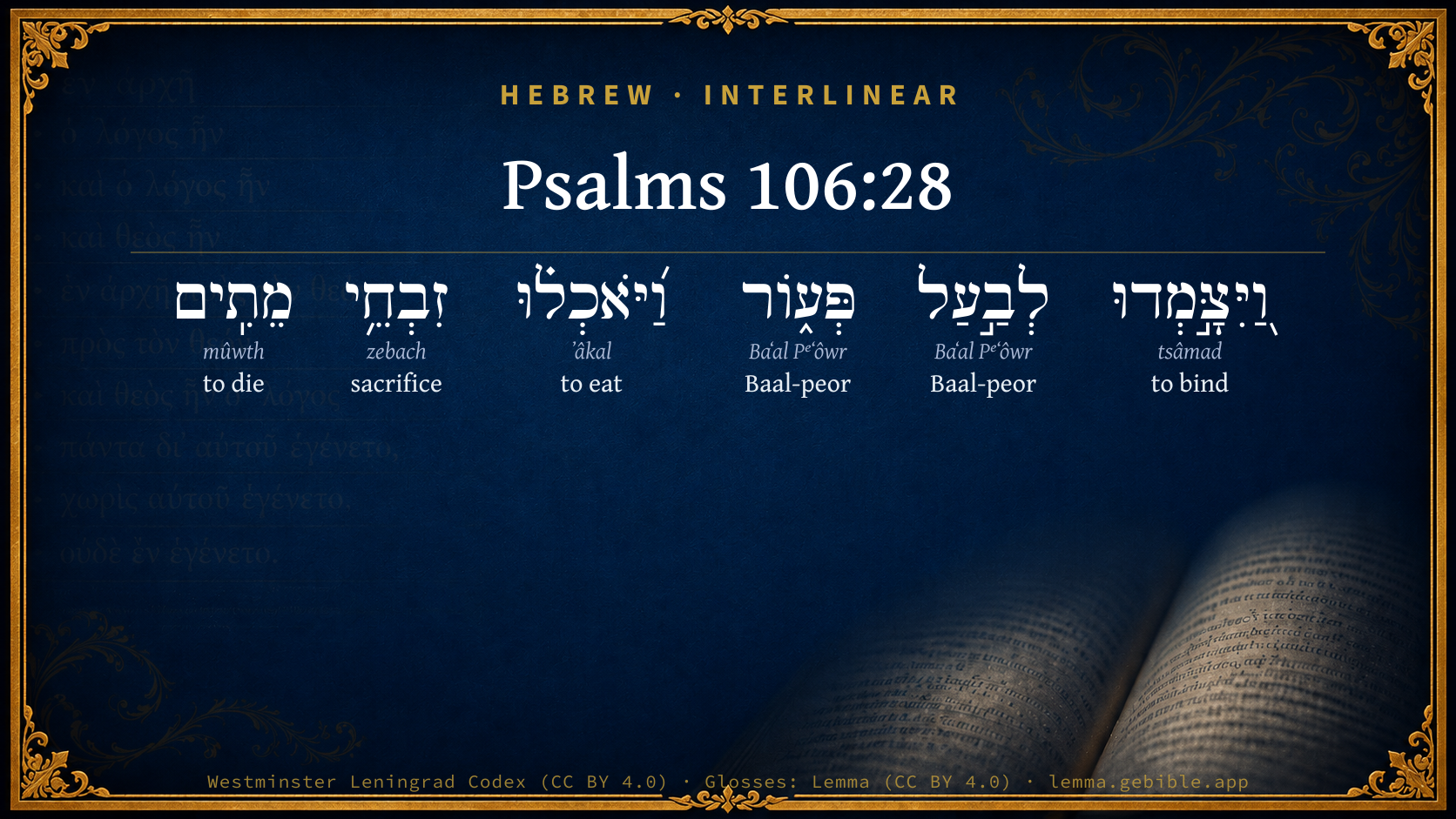
Hebrew (Westminster Leningrad Codex) Psalms 106:28 appears in the Hebrew Old Testament. The text above is from the Westminster Leningrad Codex. Each word links to its Strong’s number, a concise gloss, and parsing drawn from the Open Scriptures Hebrew Bible morphology. Click any word for its full Brown-Driver-Briggs (BDB) entry.
Download image
Cite this verse

Psalms 106:28 (World English Bible). Public Domain. Lemma interlinear Bible study tool, https://lemma.gebible.app/v/psalms/106/28.

Show BibTeX & RIS
BibTeX
RIS
English Translation
They joined themselves also to Baal Peor, And ate the sacrifices of the dead.
World English Bible · Public Domain
Download a study sheet

One document with this verse’s original text, its word-by-word gloss line, the meaning frame, cross-references with their text, attributed commentary, and full source and license credits — printable, and it pastes into notes with its structure intact.

This verse Autodidact and up

Study sheet (.html) Plain text (.txt)

A passage Seminary Student

Up to 50 verses in one chapter. A passage sheet keeps up to 6 commentary sources and 12 cross-references per verse, in the order this page ranks them, and says so on the sheet whenever that leaves anything out. Ask for a single verse and you get the Autodidact verse sheet above.

Everything on this page stays free to read, with no account — the sheet is a download of what is already on screen, not access to it.

Want to remove ads? Support Godless Engineer
Compare translations 3

The same verse in 3 English versions, stacked beneath the original-language interlinear above. Click any original word for its lexicon entry.

Each is an independent rendering of the whole verse — the interlinear is not word-aligned to these translations.

Highlighted words mark where these versions differ — a whole-verse word diff, not a word-by-word alignment.

  • World English Bible Public Domain
    They joined themselves also to Baal Peor, And ate the sacrifices of the dead.
  • King James Version Public Domain
    They joined themselves also unto Baalpeor, and ate the sacrifices of the dead.
  • unfoldingWord Literal Text CC BY-SA 4.0
    They joined themselves to the Baal of Peor and ate the sacrifices of the dead.

unfoldingWord Literal Text — © unfoldingWord, licensed CC BY-SA 4.0. Word-aligned USFM3 via Door43 (git.door43.org/unfoldingWord/en_ult).

Versions to compare (up to 4)

3 of 4 selected

Show all 18 translations

Every available English version of this verse, each an independent rendering of the whole verse.

  • World English Bible Public Domain
    They joined themselves also to Baal Peor, And ate the sacrifices of the dead.
  • Berean Standard Bible Public Domain
    They yoked themselves to Baal of Peor and ate sacrifices offered to lifeless gods.
  • Majority Standard Bible Public Domain
    They yoked themselves to Baal of Peor and ate sacrifices offered to lifeless gods.
  • King James Version Public Domain
    They joined themselves also unto Baalpeor, and ate the sacrifices of the dead.
  • American Standard Version (1901) Public Domain
    They joined themselves also unto Baal-peor, And ate the sacrifices of the dead.
  • Revised Version (1885) Public Domain
    They joined themselves also unto Baal-peor, and ate the sacrifices of the dead.
  • Geneva Bible (1599) Public Domain
    They ioyned themselues also vnto Baalpeor, and did eate the offrings of the dead.
  • Douay-Rheims (1899) Public Domain
    They also were initiated to Beelphegor: and ate the sacrifices of the dead.
  • Young's Literal Translation Public Domain
    And they are coupled to Baal-Peor, And eat the sacrifices of the dead,
  • Literal Standard Version CC BY-SA 4.0
    And they are coupled to Ba‘al-Peor, || And eat the sacrifices of the dead,
  • Unlocked Literal Bible CC BY-SA 4.0
    They worshiped the Baal of Peor and ate the sacrifices offered to the dead.
  • unfoldingWord Literal Text CC BY-SA 4.0
    They joined themselves to the Baal of Peor and ate the sacrifices of the dead.
  • Darby Bible Public Domain
    And they joined themselves unto Baal-Peor, and ate the sacrifices of the dead;
  • World Messianic Bible Public Domain
    They joined themselves also to Baal Peor, and ate the sacrifices of the dead.
  • Webster's Bible Public Domain
    They joined themselves also to Baal-peor, and ate the sacrifices of the dead.
  • Free Bible Version CC BY-SA 4.0
    They gave their allegiance to Baal Peor, and ate food sacrificed to the dead.
  • Bible in Basic English Public Domain
    And they were joined to Baal-peor, and took part in the offerings to the dead.
  • JPS Tanakh (1917) Public Domain
    They joined themselves also unto Baal of Peor, and ate the sacrifices of the dead.

Literal Standard Version (2020), Covenant Press — licensed CC BY-SA 4.0. Text via the HelloAO Bible API (eBible.org). Unlocked Literal Bible (unfoldingWord) — licensed CC BY-SA 4.0. Text via the HelloAO Bible API (eBible.org). unfoldingWord Literal Text — © unfoldingWord, licensed CC BY-SA 4.0. Word-aligned USFM3 via Door43 (git.door43.org/unfoldingWord/en_ult). Free Bible Version, Dr. Jonathan Gallagher — licensed CC BY-SA 4.0. Text via the HelloAO Bible API (eBible.org).

Word by word

More ways to search: Search by grammar → Find every occurrence → Compare this word →

Practice this passage: Drill this verse → Learn its vocabulary →

About this verse

These counts appear in no published source. They are computed here, from the morphology-tagged text and Lemma’s own curated glosses. What Lemma adds →

6
words
5
distinct lemmas
Wisdom
section

Notable vocabulary

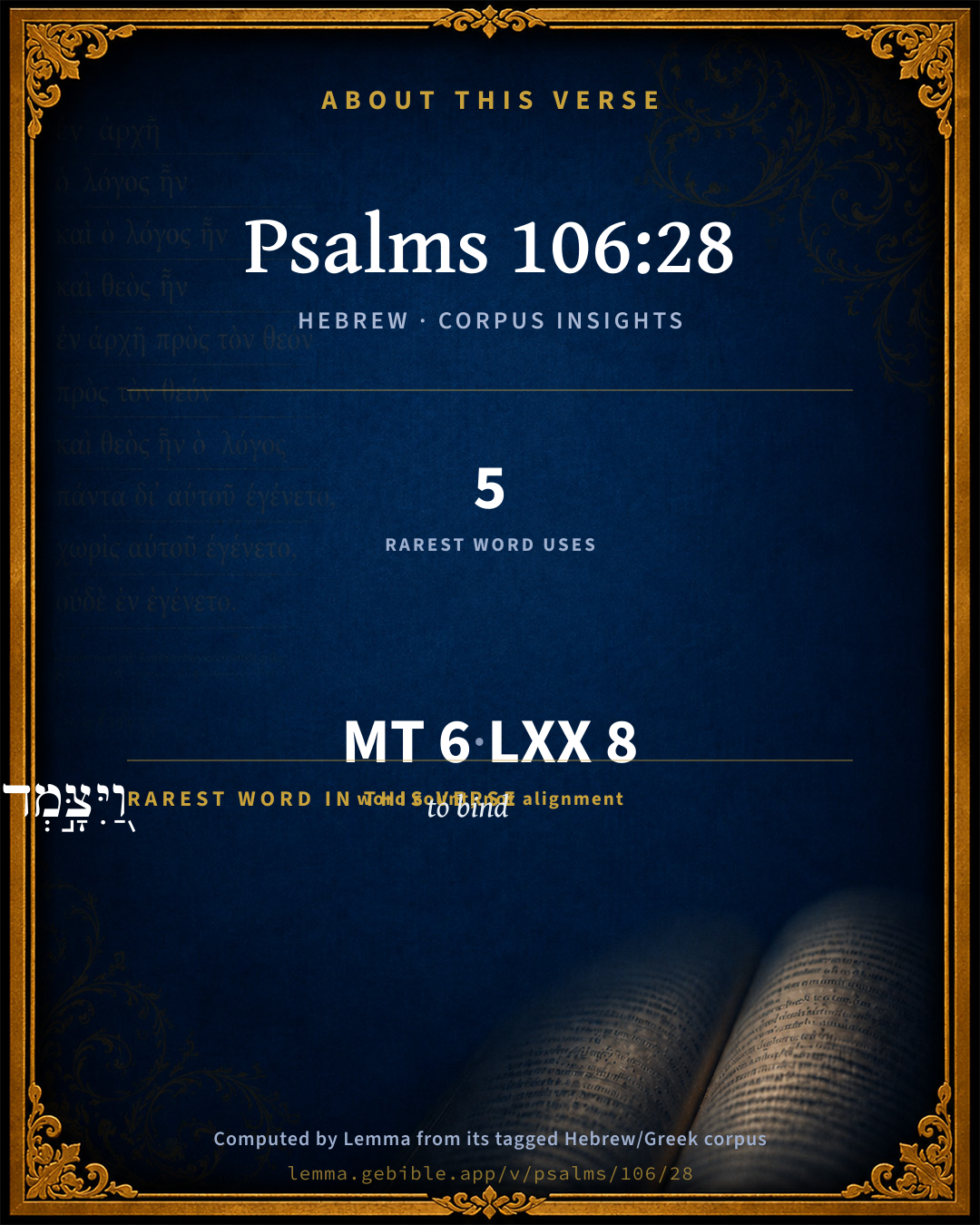
The rarest word here is וַ֭יִּצָּ֣מְדוּ to bind H6775 — appearing just 5 times in the whole Hebrew Bible.

Shared distinctive vocabulary

וַ֭יִּצָּ֣מְדוּ to bind H6775 occurs in 5 verses of the Hebrew Bible. Also found in:

Grammatical profile

  • 3 verbs
  • 3 nouns

Verb forms

  • וַ֭יִּצָּ֣מְדוּ Niphal · Sequential Imperfect
  • וַ֝יֹּאכְל֗וּ Qal · Sequential Imperfect
  • מֵתִֽים Qal · Participle Active

Repetition

A word recurs within this verse — often emphatic in Hebrew:

  • לְבַ֣עַל Baal-peor H1187 ×2

Hebrew & Septuagint length

In English translation the verse runs 14 words from the Hebrew and 20 from the Septuagint (LXX English) — closely comparable.

A rough comparison of the two English renderings, which tokenize alike — not a word-level alignment.

Word counts can differ between the Hebrew and the Greek without any difference in meaning — e.g. the Hebrew direct-object marker אֵת has no separate Greek word, and Greek often adds the article ὁ.

In the original languages it is 6 Hebrew tokens and 8 Greek tokens — but the two are counted differently (Hebrew bundles its prefixes and suffixes into one token; the Greek is in lemma form), so that isn’t a like-for-like length.

Cross-references

11

Topical passages linked to Psalms 106:28 in the Treasury of Scripture Knowledge — connected by theme and wording, ordered by reader-vote popularity; previews shown in the World English Bible.

  • Numbers 25:1–3 Israel abode in Shittim; and the people began to play the prostitute with the daughters of Moab:
  • Numbers 25:5 Moses said to the judges of Israel, Kill you everyone his men who have joined themselves to Baal Peor.
  • Hosea 9:10 I found Israel like grapes in the wilderness. I saw your fathers as the first ripe in the fig tree at its first season; But they came to Baal Peor, and consecrated themselves to the shameful thing, And became abominable like that which they loved.
  • Deuteronomy 4:3 Your eyes have seen what Yahweh did because of Baal Peor; for all the men who followed Baal Peor, Yahweh your God has destroyed them from the midst of you.
  • Jeremiah 10:8–10 But they are together brutish and foolish: the instruction of idols! it is but a stock.
  • 1 Corinthians 10:19–20 What am I saying then? That a thing sacrificed to idols is anything, or that an idol is anything?
  • Deuteronomy 32:17 They sacrificed to demons, [which were] no God, To gods that they didn't know, To new [gods] that came up of late, Which your fathers didn't dread.
  • Revelation 2:14 But I have a few things against you, because you have there some who hold the teaching of Balaam, who taught Balak to throw a stumbling block before the children of Israel, to eat things sacrificed to idols, and to commit sexual immorality.
  • Numbers 31:16 Behold, these caused the children of Israel, through the counsel of Balaam, to commit trespass against Yahweh in the matter of Peor, and so the plague was among the congregation of Yahweh.
  • Joshua 22:17 Is the iniquity of Peor too little for us, from which we have not cleansed ourselves to this day, although there came a plague on the congregation of Yahweh,
  • Psalms 115:4–8 Their idols are silver and gold, The work of men's hands.

Cross-references courtesy of OpenBible.info (CC BY 4.0).

Hebrew and Greek witnesses Masoretic Hebrew ↔ Greek Septuagint

The same verse in the two great witnesses to the Old Testament, shown verse-for-verse.

You’re reading Greek Psalm 105 (Hebrew Psalm 106). The Septuagint counts the superscription, so verse numbers can differ from the Hebrew — chapter-level alignment, not verse-by-verse. Numbering follows Rahlfs.

These are two independent witnesses, not word-aligned to each other, and the Septuagint is shown in lemma (dictionary) form.

Hebrew Psalms 106:28 Masoretic · Westminster Leningrad Codex

וַ֭יִּצָּ֣מְדוּ לְבַ֣עַל פְּע֑וֹר וַ֝יֹּאכְל֗וּ זִבְחֵ֥י מֵתִֽים

They joined themselves also to Baal Peor, And ate the sacrifices of the dead.

World English Bible · Public Domain

Greek LXX Greek Psalm 105:28 Septuagint · lemma form

καί τελέω ὁ βεελφεγωρ καί ἐσθίω θυσία νεκρός

They were joined also to Beelphegor, and ate the sacrifices of the dead. And they provoked him with their devices;

LXX2012 (modern English Septuagint) · Public Domain

On this verse, Adam Clarke's Commentary discusses the Septuagint’s reading. Read the note in Commentary ↓

Hebrew: Westminster Leningrad Codex (CC BY 4.0). Greek: Septuagint (public domain); English from LXX2012 (modern English Septuagint) (Public Domain). How the Septuagint differs from the Hebrew →

Commentary

Notes on Psalms 106:28 from classic Christian and Jewish commentators (each source and its license shown beneath its notes). The classic Christian expositions comment on the surrounding passage and are grouped to its opening verse, so a note may address several verses; the Jewish commentaries on the Tanakh (Rashi and others) are per-verse, so they appear only where the commentator wrote on this verse.

Lemma curates 59 commentaries, every one of them public domain or Creative Commons licensed, each selected and text-cleaned for this edition rather than reprinted as found. About our sources →

Trapp's Complete Commentary

John Trapp

Psa 106:28 They joined themselves also unto Baalpeor, and ate the sacrifices of the dead.

Ver. 28. They joined themselves also unto Baalpeor] Heb. they were unequally yoked, as 2Co 6:14.

Quam male inaequales veniunt ad aratra iuvenci.

They separated themselves to that shame, Priapus, Hos 9:10, who had his name from showing all, Ab operatione seu nudatione pudendorum; and his worshippers were most impudent servants.

And ate the sacrifices of the dead] i.e. Of idols opposed to the living God. The beginning of idolatry, some say, was the attributing of divine honours to great persons when they were dead. The heathens showed the sepulchres of their oldest deities.

John Trapp, A Commentary or Exposition upon All the Books of the Old and New Testament (1647–1656) — public domain. Text from a community e-Sword module.

Joseph Benson's Commentary

Psa 106:28-30. They joined themselves also unto Baal-peor — To wit, in worship, whereby they had a union and communion with him, as God’s people have with God in acts of his worship. And ate the sacrifices of the dead — Which were offered to idols, which he calls dead, in opposition to the true and living God, and by way of contempt, and to denote the stupidity of idolaters, who worshipped lifeless things, as dead images, or men deified after death. Or, by the sacrifices of the dead, he may mean sacrifices offered to the infernal deities, so called, on behalf of their dead friends. They provoked him with their inventions — Various species of idolatry, and false worship, and other branches of wickedness, devised in contempt of God and his institutions, his commands and threatenings. And the plague brake in upon them — And swept away twenty-four thousand of those impudent sinners. Then stood up Phinehas — In his zeal for the Lord of hosts; and executed judgement — Namely, upon Zimri and Cozbi, sinners of the first rank; genteel sinners; he put the law in execution upon them; and this was a service so pleasing to God, that upon it the plague was stayed, Psa 106:30. By this, and some other like acts of public justice on that occasion, Num 25:4-5, the guilt ceased to be national, and the general controversy was let fall: when the proper officers did their duty, God left it to them, and did not any longer keep the work in his own hands by the plague. The best commentary on this Psalm is a reference to the history.

Joseph Benson's Commentary on the Old and New Testaments (1811–1818) — public domain. Text from a community e-Sword module.

J. A. Alexander on Psalms

Joseph Addison Alexander

28. (Psa 106:28) And they joined themselves to Baal Peor, and ate the sacrifices of the dead. He now adds a sin committed near the end of the long error, and on the very borders of the Promised Land. The first verb is properly passive, they were joined, but this of course does not mean by others but themselves, and thus the simple passive comes to have a reflexive meaning. Baal Peor is the name given to Baal, or the supreme god of the Tyrians and Moabites, as he was worshipped, with licentious rites, at Peor, mountain in the land of Moab. See Num 25:1-3. The dead, not dead men, in allusion to necromantic superstitions, but the dumb or lifeless gods whom they worshipped. See below, on Psa 115:4-7, and compare 1Co 12:2.

Joseph Addison Alexander, The Psalms Translated and Explained (1850) — public domain. Text from a community e-Sword module.

Tyndale Open Study Notes

Tyndale Open Resources

106:28-39 Israel’s idolatry outside of the land came with them into the land. Their nature did not change; they continued to provoke the Lord to anger by their actions.

106:28 the worship of Baal at Peor: See Num 25:3; Deut 4:3.

Tyndale Open Study Notes — © Tyndale Open Resources, licensed CC BY-SA 4.0. Text via the HelloAO Bible API.

Geneva Bible (1599)

Geneva Bible translators

Which was the idol of the Moabites.

Sacrifices offered to the dead idols.

Geneva Bible (1599) marginal notes — public domain. Text via Bolls.life.

Adam Clarke's Commentary

Verse 28. They joined themselves also unto Baalpeor] The Vulgate, Septuagint, and others, have Belphegor; the Syriac and Arabic, the idol Phegor, or Phaaur; the ע ain in the word being pronounced as gh.

Ate the sacrifices or the dead] מתים methim, of dead men. Most of the heathen idols were men, who had been deified after their death; many of whom had been execrated during their life.

Adam Clarke's Commentary on the Bible (1810–1826) — public domain. Text from a community e-Sword/MySword module.

John Calvin's Commentaries

28 And they joined themselves to Baal-peor The prophet tells us that the Jews, after they had been threatened with very awful punishment, very soon fell into a new species of apostasy. Some think, that they are indirectly accused of falling away to the superstitions of the Midianites, in consequence of having been imposed upon by female intrigue. This, it is well known, was the design of Balaam, as soon as he knew that he was forbidden by God to curse the people. His counsel to king Balak was to set the daughters of Moab before the people, to entice them by their allurements to the practice of idolatry,

“Behold, these women caused the children of Israel, through the counsel of Balaam, to commit trespass against the Lord in the matter of Peor.” Numbers 31:16

And as the idolatry here mentioned originated from carnal intrigues, some expositors are of opinion, that on this account the prophet charges the people with the commission of a twofold trespass, in their not only being inveigled by the Midianitish women, but also in binding themselves by another bond to Baal-peor, (Numbers 25) Be that as it may, the prophet exclaims against the perfidy of his own nation, because in forsaking the true worship of God, they had broken that holy union by which they had been betrothed to him. For we know, that as God adopts the Church as his spouse, when she gives herself up to idolatry, she no less shamefully violates her fidelity, than when a wife leaves her husband, and becomes an adulteress. It is well known, that Baal-peor was the idol of the Midianites; but it is not so well known how he received this appellation. The word בעל, Baal, has a signification equivalent to lord, master, or patron. And since פער, paar, signifies to open, some render it the God of opening, and assign as a reason, which, however, I dare not affirm, their shamefully exposing themselves in his presence. Perhaps it is the name of some place, for we know that the heathens often gave to their idols the names of the countries where they were worshipped. We now perceive the prophet’s meaning, That the Jews had wickedly revolted from God, and defiled themselves in joining themselves to Baal-peor. In saying that they ate the sacrifices of the dead, he points out the greater baseness of their offense. By the sacrifices of idols, he means that they ate things that were offered to idols, as they had been wont to partake of those sacrifices which bound them to the true God, the inexhaustible fountain of life. Hence their conduct was the more detestable, when they wilfully gave themselves over to death by perpetrating such a heinous crime. And we know, that banqueting was to some extent connected with their worship. The result of this was, that, renouncing the true God, they joined themselves in marriage with the dead; and thus the prophet charges them with acting a very disgraceful part, in not only bowing the knee to Baal, and offering sacrifices to him, but also in feasting upon these sacrifices.

John Calvin's Commentaries (1540-1563) — public domain. Text from the Calvin Translation Society English edition (1840s-50s) via the Christian Classics Ethereal Library (ccel.org). Calvin's coverage is partial (roughly two-thirds of the Bible); uncommented books and verses are honest gaps, never fabricated. The 19th-century editor's footnotes and remarks are omitted so the notes are faithfully Calvin's own voice.

Ellicott's Commentary for English Readers

(28) Ate the sacrifices of the dead—i.e., the sacrifices of a dead divinity. Num_25:2, “and they called the people unto the sacrifices of their gods,” shows that here we must not see any allusion to necromantic rites, such as are referred to in Deu_18:11; Isa_8:19, and the parallelism shows that the “god” in question is Baal-peor.

Carcases of idols.—This phrase is actually used in Lev_26:30; here no doubt the plural is used poetically for the singular.

(28-31) The licentious character of the cult of Baal-peor in Numbers 25 is expressed in the word “joined,” better, yoked. LXX. and Vulg., “were initiated,” i.e., by prostitution.

A Bible Commentary for English Readers, edited by Charles John Ellicott (1878–1897) — public domain. Text from a community e-Sword module.

The Cambridge Bible for Schools and Colleges

gen. ed. J. J. S. Perowne

28. They joined themselves also unto Baal-peor] Attached themselves as devotees. The phrase is taken from Num_25:3. The LXX renders ἐτελέσθησαν, they were initiated; but the word does not necessarily denote this. Peor seems to have been a locality (Num_23:28), and Baal-peor was the particular Baal worshipped there by the Moabites.

and ate the sacrifices of the dead] See Num_25:2. By the dead are meant heathen gods in contrast to Jehovah, the one living and true God. Cp. Psa_115:4 ff.; Jer_10:11; Wis_13:10, “Miserable were they, and in dead things were their hopes, who called them gods which are works of men’s hands”; Wis_15:17; 1Co_12:2. Participation in the sacrificial feasts of the Moabites was an act of communion with their lifeless gods. There is no reference to ancestor worship or funeral offerings.

28–31. A sixth instance; the sin of participating in the abominations of Moabite worship.

The Cambridge Bible for Schools and Colleges (gen. ed. J. J. S. Perowne; Cambridge University Press, 1878–1918) — public domain. Text from a community e-Sword module.

John Gill's Exposition

They joined themselves also unto Baalpeor,.... Or to the idol Peor, as the Targum. Baal, which signifies Lord or master, was a common name for an idol in many countries; wherefore, to distinguish one from another, an additional name was used. Baalzephon was the god of the Egyptians; Baalzebub the god of the Ekronites; and here Baalpeor the god of the Moabites: for the fact referred to was committed when the children of Israel were on the borders of Moab, and when Balak sent for Balaam to curse them; who at last advised him to draw them to commit fornication with the daughters of Moab; who might then prevail upon them to commit idolatry, which would bring the wrath of God upon them. And in this he succeeded. The above idol had its name of Peor either from the obscene actions done in the worship of it, too filthy to be related, and which, it is thought, are referred to in Hos 9:10. It seems to be the Priapus of the Heathens. Or, as others, from a mountain of this name, where was the house or temple in which it was worshipped: hence we read of Mount Peor, and of Bethpeor, Num 23:28. So Suidas (t) says, Baal is Saturn, and Peor the place where he was worshipped. Or else from some great man of this name, Lord Peor; who being of great fame and note among the Moabites, for some extraordinary things done by him, was deified and worshipped after his death; as was common among the Heathens. To this idol the Israelites joined or "yoked" themselves, as the word (u) signifies: they withdrew themselves from the yoke of the true God, whose yoke is easy, and put their necks under the yoke of an idol; which was to be unequally yoked: or they were tempted unto it; they committed spiritual whoredom with it, which is idolatry; they left their first and lawful husband, to whom they were married, and joined themselves to an idol, and cleaved to it. The phrase is expressive of their fellowship with it, and with the idolatrous worshippers of it; they devoted and gave up themselves to the worship of it; just as the true worshippers of God are said to join themselves to him, Jer 50:6, they were, as the Septuagint renders it, initiated into the rites and mysteries of this idol.

And ate the sacrifices of the dead; which were offered up to this lifeless statue. So idols are called the dead, in opposition to and distinction from the living God, Isa 8:19. Or they partook of the feasts which were kept in honour of their dead deified hero, Lord Peor; see the history in Num 25:1. These were sacrifices offered to the Stygian Jupiter, or Pluto, called by the Phoenicians Mot (w), the same with Chemosh, the god of the Moabites; and who also was Baalpeor, according to Jerom (x).

(t) In voce (u) "conjugati sunt", Vatablus; "subdiderunt sese jugo", Gejerus. (w) Sanchoniatho apud Euseb. Praepar. Evangel. l. 1. p. 38. Vid. Castell. Annot. Samar. p. 13. in vol. 6. Lond. Polyglott. (x) Comment. in Esaiam, fol. 26. H.

John Gill's Exposition of the Whole Bible (1746–1763) — public domain (CC PDM 1.0). Text via the HelloAO Bible API.

Albert Barnes' Notes on the Bible

They joined themselves also unto Baal-peor - They joined in their devotions, or, they shared in the rites of idolatrous worship. This occurred when they were in the regions of Moab, and on the very borders of the promised land. Num. 25. Many other instances of a similar kind are passed over by the psalmist, and this seems to have been selected because of its special aggravation, and to show the general character of the nation. Even after their long-continued enjoyment of the favor and protection of God - after he had conducted them safely through the wilderness - after he had brought them to the very border of the land of Canaan, and all his promises were about to be fulfilled, they still showed a disposition to depart from God. Baal-peor was an idol of the Moabites, in whose worship females prostituted themselves. Gesenius, Lexicon. Compare Num 25:1-3. Baal was the name of the idol; Peor was the name of a mountain in Moab, where the idol was worshipped.

And ate the sacrifices of the dead - Of false gods, represented as “dead” or having no life, in contradistinction from the true and “living God.” They ate the sacrifices offered to those idols; that is, they participated in their worship. Num 25:2.

Albert Barnes' Notes on the Bible (1834–1885) — public domain. Text from a community e-Sword/MySword module.

Matthew Poole's English Annotations

They joined themselves, to wit, in worship, whereby they had a union and communion with him, as God’s people have with God in acts of his worship. And this phrase seems also to note their carnal copulation with

the daughters of Moab in the temple, or to the honour of Baal-peor.

The sacrifices of the dead; which were offered to idols, which he calls dead, in opposition to the true and living God, and by way of contempt, and to note the sottishness of idolaters, who worshipped lifeless things, as stocks and stones, or dead men. And some learned men conceive that this is spoken with particular regard to Baal-peor, or the lord of Peor, a place so called, who had been a person of great eminency in those parts, and therefore was worshipped, according to the custom of the heathens, after his death, by sacrifices and feasts appointed for his honour and memory.

Matthew Poole's English Annotations on the Holy Bible (1683–1685) — public domain. Text from a community e-Sword/MySword module.

The Treasury of David

Charles H. Spurgeon

Ver. 28. They joined themselves also unto Baalpeor. Ritualism led on to the adoration of false gods. If we choose a false way of worship we shall, ere long, choose to worship a false god. This abomination of the Moabites was an idol in whose worship women gave up their bodies to the most shameless lust. Think of the people of a holy God coming down to this.

And ate the sacrifices of the dead. In the orgies with which the Baalites celebrated their detestable worship Israel joined, partaking even in their sacrifices as earnest inner court worshippers, though the gods were but dead idols. Perhaps they assisted in necromantic rites which were intended to open a correspondence with departed spirits, thus endeavouring to break the seal of God's providence, and burst into the secret chambers which God has shut up. Those who are weary of seeking the living God have often shown a hankering after dark sciences, and have sought after fellowship with demons and spirits. To what strong delusions those are often given up who cast off the fear of God! This remark is as much needed now as in days gone by.

Ver. 28. They joined themselves also unto Baalpeor, rather "bound themselves with his badge": for it was the custom in ancient times, as it is now, in all Pagan countries, for every idol to have some specific badge, or ensign, by which his votaries are known. John Kitto, in "Daily Bible Illustrations."

Ver. 28. They joined themselves also unto Baalpeor. The narrative (Nu 25:1-18) seems clearly to show that this form of Baal worship was connected with licentious rites. Without laying too much stress on the Rabbinical derivation of the word rwep, hiatus, i.e., "aperire hymenem virgineum", we seem to have reason to conclude that this was the nature of the worship. Baal Peor was identified by the Rabbins and early fathers with Priapus (see the authorities quoted by Selden, De Diis Syris, 1., 4, p. 302, sq., who, however, dissents from this view.) This is, moreover, the view of Creuzer (2., 411), Winer, Gesenius, Furst, and almost all critics. The reader is referred for more detailed information particularly to Creuzer's Symbolik and Movers' Phönizier. William Gotch, in "Smith's Dictionary of the Bible."

Ver. 28. Ate the sacrifices. It was usual for the officers to eat the chief part of the sacrifice. Hence the remarks of Paul on this subject, 1Co 8:1-13. Benjamin Boothroyd.

Ver. 28. The dead. The word Mytm, maithim, signifies dead men; for the idols of the heathen were generally men, warriors, kings, or lawgivers, who had been deified after their death; though many of them had been execrated during their life. Comprehensive Bible.

Ver. 28. And they ate the sacrifices of the dead.

His obsequies to Polydorus paying

A tomb we raise, and altars to the dead

With dark blue fillets and black cypress bind

Our dames with hair dishevelled stand to mourn;

Warm frothy bowls of milk and sacred blood

We offer, in his grave the spirit lay,

Call him aloud, and bid our last farewell. Virgil.

Psalms 106:29*

Charles H. Spurgeon's The Treasury of David (1869–1885) — public domain. Psalms only. Text from a community e-Sword/MySword module.

Whedon's Commentary on the Bible

Daniel D. Whedon

28. Baal-peor—Or, lord of Peor. “Peor” is the same of a mountain of Moab, (Num_23:28,) mentioned in full elsewhere only in Num_25:3; Num_25:5; Deu_4:3; Hos_9:10. “Baal” was the chief male divinity of the Phoenicians and Canaanites, as Ashtoreth was the female. His worship was very pompous and popular, cruel and obscene. Probably the same as that of Bel of the Chaldaeans, (Isa_46:1 :) sometimes called “Peor.” Num_31:16; Jos_22:17. The allusion of the text is to Num_25:3.

Sacrifices of the dead—So called because their idols were dead, inanimate, opposed to the living God: or, as Delitzsch, quoting from Jewish rabbins, “because the eating of meat consecrated to idols pollutes like a dead body.” For New Testament doctrine on this subject see 1Co_10:28-31. But Hammond thinks, that their Baal, plural Baalim, were only dead heroes whom they had deified and continued to worship, and hence sacrificed to the dead— which is quite probable. Hero worship was a popular form of idolatry.

Daniel D. Whedon (gen. ed.), Commentary on the Old and New Testaments (1874–1909) — public domain. Text from a community e-Sword module.

The Pulpit Commentary

They joined themselves also unto Baal-peor. (see Num_25:3) The exact expression used in the Pentateuch is repeated. It signifies a mystic union, such as was supposed to exist between a heathen god and his worshippers, and to be kept up by sacrificial meals and the like. "Baal-peori.e. "the Lord of Pehor is probably identified with Chemosh. And ate the sacrifices of the dead. The corresponding phrase in Numbers (Num_25:2) is, "the sacrifices of their gods," who were "dead," as opposed to the true living God.

The Pulpit Commentary (1880–1919), ed. H.D.M. Spence-Jones & Joseph S. Exell — public domain. Text from a community e-Sword module.

John Wesley's Explanatory Notes

Joined - They had communion with him, as God's people have with God in acts of his worship.

John Wesley, Explanatory Notes Upon the Whole Bible (1754–1765) — public domain. Text via the GEBible commentary corpus.

unfoldingWord translationNotes

Door43 World Missions Community

the sacrifices offered to the dead

This can be stated in active form. AT: "the sacrifices that they offered to the dead" (See: Active or Passive)

to the dead

"The dead" refers to the idols and gods that the Israelites were worshiping. AT: "to gods who are dead" or "to lifeless gods" (See: Nominal Adjectives)

a plague broke out

"a plague spread"

provoked him to anger

"angered him"

translationWords

worship

Peor

sacrifice

plague

unfoldingWord translationNotes — © Distant Shores Media and the Door43 World Missions Community, licensed CC BY-SA 4.0. Source: git.door43.org/Door43/en_tn.

Lesson kit

Teaching starters — assembled from the data on this page, not authored interpretation. Every prompt links to the verse data it draws on. Edit before teaching.

Psalms, in the Wisdom, opens this verse with 6 words (5 distinct Hebrew lemmas). Its most distinctive word is tsâmad (“to bind”). A historical commentator’s framing appears above. Read the whole chapter for the surrounding context.

Discussion questions

  1. The word tsâmad carries the sense “to bind.” How does it shape the verse?
  2. How does Numbers 25:3, which shares the word «to bind», read alongside this verse?
  3. What does the repetition of “Baal-peor” (2× in this one verse) do in this verse?
  4. These translations render this verse differently; the difference is in the English rendering, not the original. What questions does that raise?
  5. «וַ֭יִּצָּ֣מְדוּ» is a Niphal Sequential Imperfect verb. How does that grammatical form shape the action described?
  6. Compare how Trapp's Complete Commentary and Joseph Benson's Commentary read this verse. Where do they agree or differ?

Things to notice

Reading settings

Reading text

Shown beneath each verse's original-language words.

Old Testament
Old Testament edition

Read the OT as the Masoretic Hebrew (MT) or the Greek Septuagint (LXX).

English shown for the Greek Septuagint (in the Hebrew ↔ Greek comparison).

Comparing translations? Open the Compare panel on any verse page to stack up to four side by side.