
Leviticus 8:35

Hebrew (Westminster Leningrad Codex) Leviticus 8:35 appears in the Hebrew Old Testament. The text above is from the Westminster Leningrad Codex. Each word links to its Strong’s number, a concise gloss, and parsing drawn from the Open Scriptures Hebrew Bible morphology. Click any word for its full Brown-Driver-Briggs (BDB) entry.
Download image
Cite this verse

Leviticus 8:35 (World English Bible). Public Domain. Lemma interlinear Bible study tool, https://lemma.gebible.app/v/leviticus/8/35.

Show BibTeX & RIS
BibTeX
RIS
English Translation
At the door of the Tent of Meeting you shall stay day and night seven days, and keep the charge of Yahweh, that you don't die: for so I am commanded."
World English Bible · Public Domain
Download a study sheet

One document with this verse’s original text, its word-by-word gloss line, the meaning frame, cross-references with their text, attributed commentary, and full source and license credits — printable, and it pastes into notes with its structure intact.

This verse Autodidact and up

Study sheet (.html) Plain text (.txt)

A passage Seminary Student

Up to 50 verses in one chapter. A passage sheet keeps up to 6 commentary sources and 12 cross-references per verse, in the order this page ranks them, and says so on the sheet whenever that leaves anything out. Ask for a single verse and you get the Autodidact verse sheet above.

Everything on this page stays free to read, with no account — the sheet is a download of what is already on screen, not access to it.

Want to remove ads? Support Godless Engineer
Compare translations 3

The same verse in 3 English versions, stacked beneath the original-language interlinear above. Click any original word for its lexicon entry.

Each is an independent rendering of the whole verse — the interlinear is not word-aligned to these translations.

Highlighted words mark where these versions differ — a whole-verse word diff, not a word-by-word alignment.

  • World English Bible Public Domain
    At the door of the Tent of Meeting you shall stay day and night seven days, and keep the charge of Yahweh, that you don't die: for so I am commanded."
  • King James Version Public Domain
    Therefore shall ye abide at the door of the tabernacle of the congregation day and night seven days, and keep the charge of the LORD, that ye die not: for so I am commanded.
  • unfoldingWord Literal Text CC BY-SA 4.0
    And at the entrance of the tent of meeting, you shall stay day and night seven days, and you shall keep the watch of Yahweh, and you will not die, because thus I have been commanded.”

unfoldingWord Literal Text — © unfoldingWord, licensed CC BY-SA 4.0. Word-aligned USFM3 via Door43 (git.door43.org/unfoldingWord/en_ult).

Versions to compare (up to 4)

3 of 4 selected

Show all 18 translations

Every available English version of this verse, each an independent rendering of the whole verse.

  • World English Bible Public Domain
    At the door of the Tent of Meeting you shall stay day and night seven days, and keep the charge of Yahweh, that you don't die: for so I am commanded."
  • Berean Standard Bible Public Domain
    You must remain at the entrance to the Tent of Meeting day and night for seven days and keep the LORD’s charge so that you will not die, for this is what I have been commanded.”
  • Majority Standard Bible Public Domain
    You must remain at the entrance to the Tent of Meeting day and night for seven days and keep the LORD’s charge so that you will not die, for this is what I have been commanded.”
  • King James Version Public Domain
    Therefore shall ye abide at the door of the tabernacle of the congregation day and night seven days, and keep the charge of the LORD, that ye die not: for so I am commanded.
  • American Standard Version (1901) Public Domain
    And at the door of the tent of meeting shall ye abide day and night seven days, and keep the charge of Jehovah, that ye die not: for so I am commanded.
  • Revised Version (1885) Public Domain
    And at the door of the tent of meeting shall ye abide day and night seven days, and keep the charge of the LORD, that ye die not: for so I am commanded.
  • Geneva Bible (1599) Public Domain
    Therefore shall yee abide at the doore of the Tabernacle of the Congregation day and night, seuen dayes, and shall keepe the watch of the Lord, that ye dye not: for so I am commanded.
  • Douay-Rheims (1899) Public Domain
    Day and night shall you remain in the tabernacle observing the watches of the Lord, lest you die: for so it hath been commanded me.
  • Young's Literal Translation Public Domain
    and at the opening of the tent of meeting ye abide, by day and by night seven days, and ye have kept the charge of Jehovah, and die not, for so I have been commanded.'
  • Literal Standard Version CC BY-SA 4.0
    and you abide at the opening of the Tent of Meeting by day and by night [for] seven days, and you have kept the charge of YHWH, and do not die, for so I have been commanded.”
  • Unlocked Literal Bible CC BY-SA 4.0
    You will stay day and night for seven days at the entrance to the tent of meeting, and keep the command of Yahweh, so you will not die, because this is what I have been commanded.”
  • unfoldingWord Literal Text CC BY-SA 4.0
    And at the entrance of the tent of meeting, you shall stay day and night seven days, and you shall keep the watch of Yahweh, and you will not die, because thus I have been commanded.”
  • Darby Bible Public Domain
    And ye shall abide at the entrance of the tent of meeting day and night seven days, and keep the charge of Jehovah, that ye die not; for so I am commanded.
  • World Messianic Bible Public Domain
    You shall stay at the door of the Tent of Meeting day and night seven days, and keep the LORD’s command, that you don’t die: for so I am commanded.”
  • Webster's Bible Public Domain
    Therefore shall ye abide at the door of the tabernacle of the congregation day and night seven days, and keep the charge of the LORD, that ye die not: for so I am commanded.
  • Free Bible Version CC BY-SA 4.0
    You must stay at the entrance to the Tent of Meeting for seven days, day and night, and follow the Lord's commands so that you will not die, for this is what I have been ordered to do.”
  • Bible in Basic English Public Domain
    And you are to keep watch for the Lord at the door of the Tent of meeting day and night for seven days, so that death may not come to you: for so he has given me orders.
  • JPS Tanakh (1917) Public Domain
    And at the door of the tent of meeting shall ye abide day and night seven days, and keep the charge of the LORD, that ye die not; for so I am commanded.

Literal Standard Version (2020), Covenant Press — licensed CC BY-SA 4.0. Text via the HelloAO Bible API (eBible.org). Unlocked Literal Bible (unfoldingWord) — licensed CC BY-SA 4.0. Text via the HelloAO Bible API (eBible.org). unfoldingWord Literal Text — © unfoldingWord, licensed CC BY-SA 4.0. Word-aligned USFM3 via Door43 (git.door43.org/unfoldingWord/en_ult). Free Bible Version, Dr. Jonathan Gallagher — licensed CC BY-SA 4.0. Text via the HelloAO Bible API (eBible.org).

Word by word

More ways to search: Search by grammar → Find every occurrence → Compare this word →

Practice this passage: Drill this verse → Learn its vocabulary →

יוֹמָ֤ם
yôwmâm
H3119
“daytime”
Adverb
Part of Speech
Adverb
Full BDB Definition

Origin: from H3117

TWOT: 852a

by day, in the daytime (adverb) - daytime (substantive)
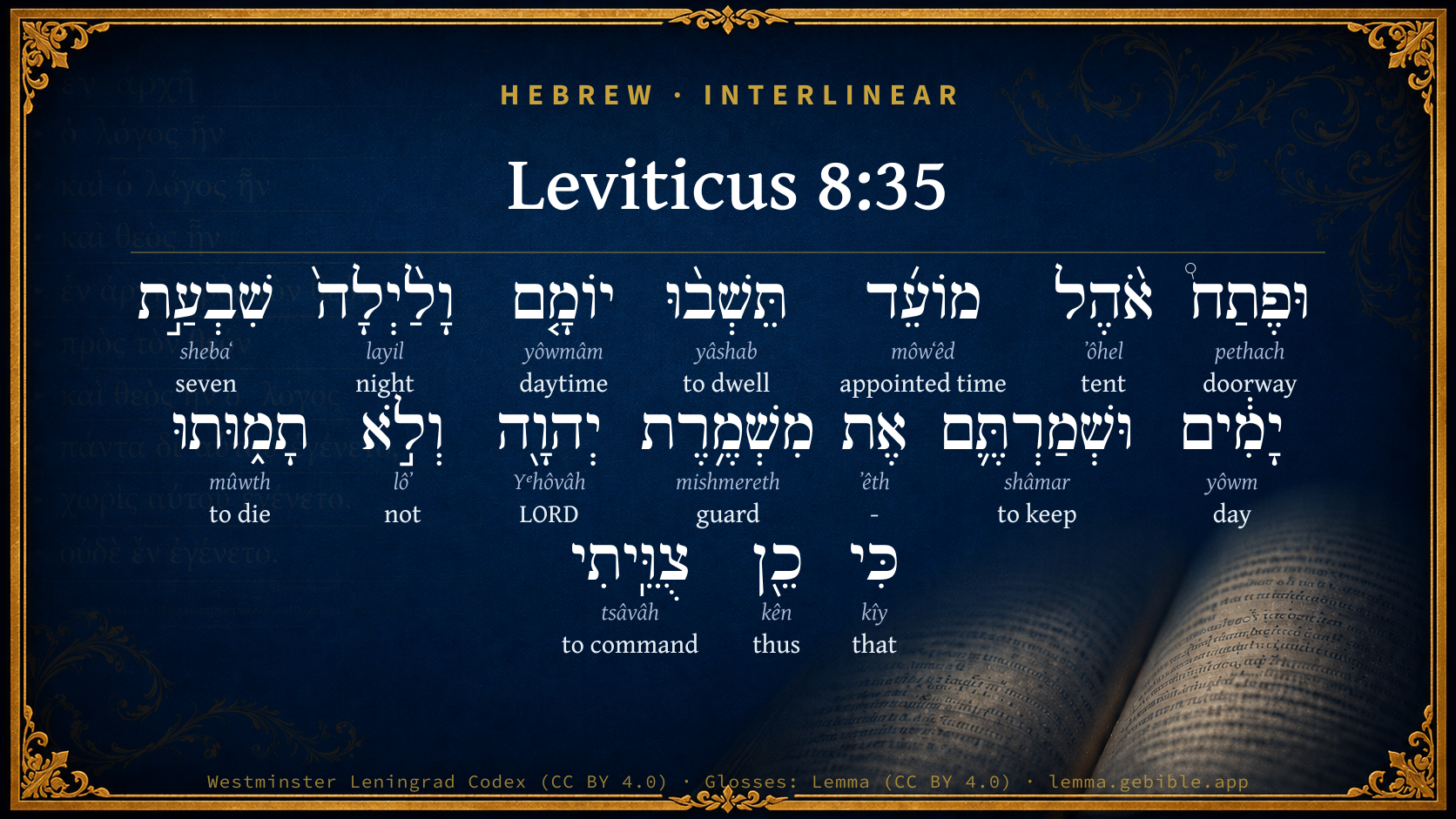
  1. וּפֶתַח֩ pethach H6607 “and · doorway of” Conjunction + Noun, Common, Masculine, Singular, Construct
  2. אֹ֨הֶל ʼôhel H168 “tent of” Noun, Common, Masculine, Singular, Construct
  3. מוֹעֵ֜ד môwʻêd H4150 “appointed time” Noun, Common, Masculine, Singular, Absolute
  4. תֵּשְׁב֨וּ yâshab H3427 “to dwell” Verb, Qal, Imperfect, 2nd Person, Masculine, Plural
  5. וָלַ֨יְלָה֙ layil H3915 “and · night” Conjunction + Noun, Common, Masculine, Singular, Absolute
  6. שִׁבְעַ֣ת shebaʻ H7651 “seven” Adjective, Cardinal number, Masculine, Singular, Construct
  7. יָמִ֔ים yôwm H3117 “days” Noun, Common, Masculine, Plural, Absolute
  8. וּשְׁמַרְתֶּ֛ם shâmar H8104 “and · to keep” Conjunction + Verb, Qal, Sequential Perfect, 2nd Person, Masculine, Plural
  9. אֶת ʼêth H853 “-” Particle, Direct Object
  10. מִשְׁמֶ֥רֶת mishmereth H4931 “guard of” Noun, Common, Feminine, Singular, Construct
  11. יְהוָ֖ה Yᵉhôvâh H3068 “LORD” Noun, Proper
  12. וְלֹ֣א lôʼ H3808 “and · not” Conjunction + Particle, Negative
  13. תָמ֑וּתוּ mûwth H4191 “to die” Verb, Qal, Imperfect, 2nd Person, Masculine, Plural
  14. כִּי kîy H3588 “that” Conjunction
  15. כֵ֖ן kên H3651 “thus” Adverb
  16. צֻוֵּֽיתִי tsâvâh H6680 “to command” Verb, Pual, Perfect, 1st Person, Common, Singular

About this verse

These counts appear in no published source. They are computed here, from the morphology-tagged text and Lemma’s own curated glosses. What Lemma adds →

17
words
17
distinct lemmas
Pentateuch
section

Shared distinctive vocabulary

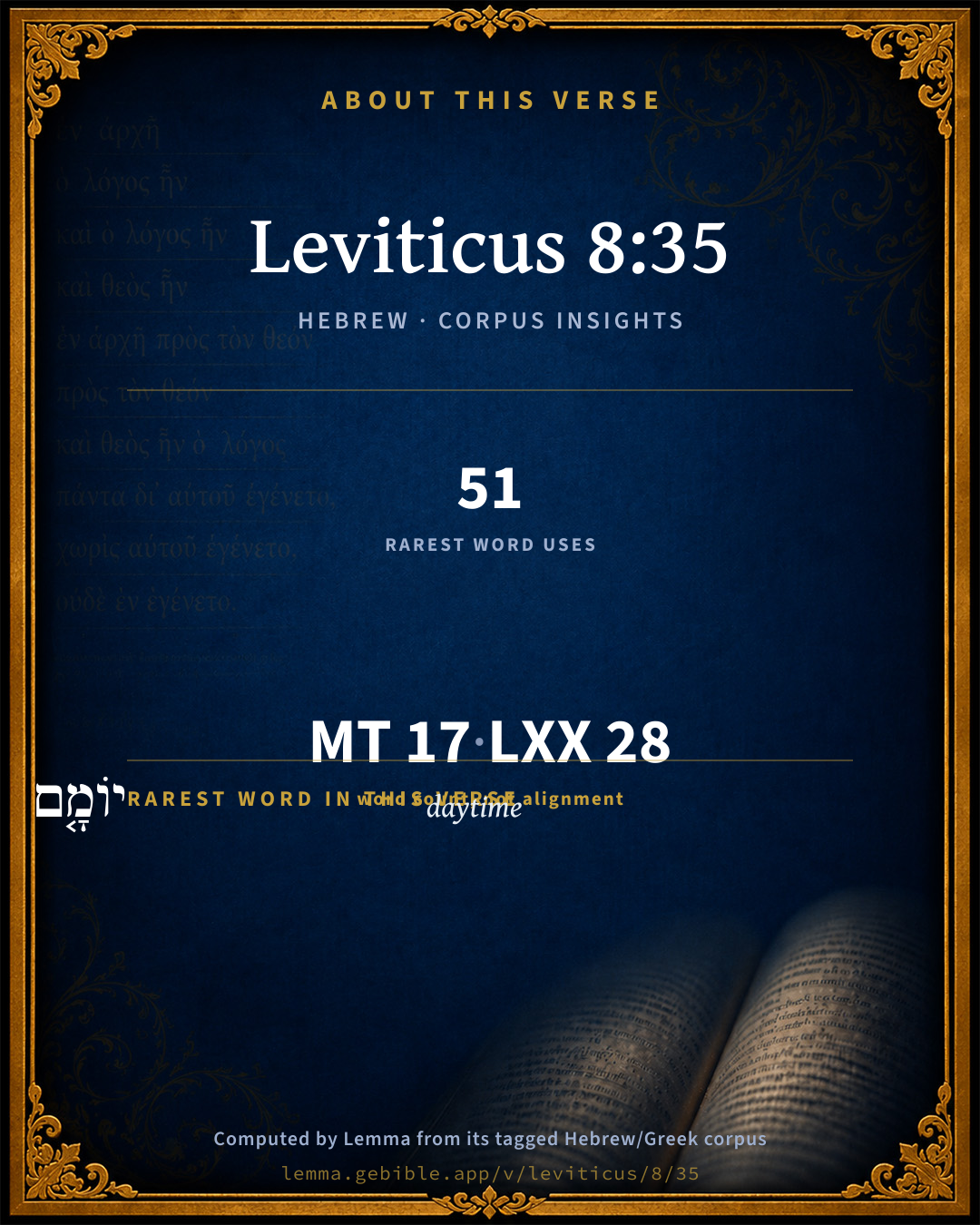
יוֹמָ֤ם daytime H3119 occurs in 50 verses of the Hebrew Bible. Also found in:

Grammatical profile

  • 4 verbs
  • 7 nouns
  • 1 adjective
  • 1 conjunction
  • 2 adverbs
  • 2 particles

Verb forms

  • תֵּשְׁב֨וּ Qal · Imperfect
  • וּשְׁמַרְתֶּ֛ם Qal · Sequential Perfect
  • תָמ֑וּתוּ Qal · Imperfect
  • צֻוֵּֽיתִי Pual · Perfect

Hebrew & Septuagint length

In English translation the verse runs 31 words from the Hebrew and 37 from the Septuagint (LXX English) — closely comparable.

A rough comparison of the two English renderings, which tokenize alike — not a word-level alignment.

Word counts can differ between the Hebrew and the Greek without any difference in meaning — e.g. the Hebrew direct-object marker אֵת has no separate Greek word, and Greek often adds the article ὁ.

In the original languages it is 17 Hebrew tokens and 28 Greek tokens — but the two are counted differently (Hebrew bundles its prefixes and suffixes into one token; the Greek is in lemma form), so that isn’t a like-for-like length.

Cross-references

22

Topical passages linked to Leviticus 8:35 in the Treasury of Scripture Knowledge — connected by theme and wording, ordered by reader-vote popularity; previews shown in the World English Bible.

  • Numbers 3:7 They shall keep his charge, and the charge of the whole congregation before the Tent of Meeting, to do the service of the tabernacle.
  • Numbers 9:19 When the cloud stayed on the tabernacle many days, then the children of Israel kept the charge of Yahweh, and didn't travel.
  • Deuteronomy 11:1 Therefore you shall love Yahweh your God, and keep his charge, and his statutes, and his ordinances, and his commandments, always.
  • 1 Kings 2:3 and keep the charge of Yahweh your God, to walk in his ways, to keep his statutes, [and] his commandments, and his ordinances, and his testimonies, according to that which is written in the law of Moses, that you may prosper in all that you do, and wherever you turn yourself.
  • Exodus 29:35 "Thus shall you do to Aaron, and to his sons, according to all that I have commanded you. Seven days shall you consecrate them.
  • Leviticus 8:30 Moses took some of the anointing oil, and some of the blood which was on the altar, and sprinkled it on Aaron, on his garments, and on his sons, and on his sons' garments with him, and sanctified Aaron, his garments, and his sons, and his sons' garments with him.
  • Leviticus 10:1 Nadab and Abihu, the sons of Aaron, each took his censer, and put fire in it, and laid incense on it, and offered strange fire before Yahweh, which he had not commanded them.
  • Leviticus 14:8 "He who is to be cleansed shall wash his clothes, and shave off all his hair, and bathe himself in water; and he shall be clean. After that he shall come into the camp, but shall dwell outside his tent seven days.
  • Numbers 19:12 the same shall purify himself therewith on the third day, and on the seventh day he shall be clean: but if he doesn't purify himself the third day, then the seventh day he shall not be clean.
  • Ezekiel 43:25 Seven days shall you prepare every day a goat for a sin-offering: they shall also prepare a young bull, and a ram out of the flock, without blemish.
  • Ezekiel 48:11 [It shall be] for the priests who are sanctified of the sons of Zadok, who have kept my charge, who didn't go astray when the children of Israel went astray, as the Levites went astray.
  • 2 Corinthians 7:1 Having therefore these promises, beloved, let us cleanse ourselves from all defilement of flesh and spirit, perfecting holiness in the fear of God.
  • Colossians 2:9–10 For in him all the fullness of the Godhead dwells bodily,
  • 1 Timothy 1:3–4 As I exhorted you to stay at Ephesus when I was going into Macedonia, that you might charge certain men not to teach a different doctrine,
  • 1 Timothy 1:18 This charge I commit to you, my child Timothy, according to the prophecies which led the way to you, that by them you may wage the good warfare;
  • 1 Timothy 5:21 I charge you in the sight of God, and Christ Jesus, and the chosen angels, that you observe these things without prejudice, doing nothing by partiality.
  • 1 Timothy 6:13 I charge you before God, who gives life to all things, and before Christ Jesus, who before Pontius Pilate testified the good confession,
  • 1 Timothy 6:17 Charge those who are rich in this present world that they not be haughty, nor have their hope set on the uncertainty of riches, but on the living God, who richly provides us with everything to enjoy;
  • 1 Timothy 6:20 Timothy, guard that which is committed to you, turning away from the empty chatter and oppositions of the knowledge which is falsely so called;
  • 2 Timothy 4:1 I charge you therefore before God and the Lord Jesus Christ, who will judge the living and the dead at his appearing and his Kingdom:
  • Hebrews 7:28 For the law appoints men as high priests who have weakness, but the word of the oath which came after the law appoints a Son forever who has been perfected.
  • Hebrews 9:23–24 It was necessary therefore that the copies of the things in the heavens should be cleansed with these; but the heavenly things themselves with better sacrifices than these.

Cross-references courtesy of OpenBible.info (CC BY 4.0).

Hebrew and Greek witnesses Masoretic Hebrew ↔ Greek Septuagint

The same verse in the two great witnesses to the Old Testament, shown verse-for-verse.

These are two independent witnesses, not word-aligned to each other, and the Septuagint is shown in lemma (dictionary) form.

Hebrew Leviticus 8:35 Masoretic · Westminster Leningrad Codex

וּפֶתַח֩ אֹ֨הֶל מוֹעֵ֜ד תֵּשְׁב֨וּ יוֹמָ֤ם וָלַ֨יְלָה֙ שִׁבְעַ֣ת יָמִ֔ים וּשְׁמַרְתֶּ֛ם אֶת מִשְׁמֶ֥רֶת יְהוָ֖ה וְלֹ֣א תָמ֑וּתוּ כִּי כֵ֖ן צֻוֵּֽיתִי

At the door of the Tent of Meeting you shall stay day and night seven days, and keep the charge of Yahweh, that you don't die: for so I am commanded."

World English Bible · Public Domain

Greek LXX Leviticus 8:35 Septuagint · lemma form

καί ἐπί ὁ θύρα ὁ σκηνή ὁ μαρτύριον καταἧμαι ἑπτά ἡμέρα ἡμέρα καί νύξ φυλάσσω ὁ φύλαγμα κύριος ἵνα μή ἀποθνήσκω οὕτως γάρ ἐντέλλομαι ἐγώ κύριος ὁ θεός

And you⌃ shall remain seven days at the door of the tabernacle of witness, day and night; you⌃ shall observe the ordinances of the Lord, that you⌃ die not; for so has the Lord God commanded me.

LXX2012 (modern English Septuagint) · Public Domain

Hebrew: Westminster Leningrad Codex (CC BY 4.0). Greek: Septuagint (public domain); English from LXX2012 (modern English Septuagint) (Public Domain). How the Septuagint differs from the Hebrew →

Targum (Aramaic paraphrase)

2

The Targum is the ancient Jewish Aramaic paraphrase of the Hebrew Scriptures — an interpretive translation, not the Hebrew text itself. Onkelos (literal) and Pseudo-Jonathan (expansive) render the Torah, and Jonathan the Prophets. Coverage is partial: where no permissively-licensed English translation exists for a verse, only the Aramaic is shown. This is verse-level text, not a word-by-word alignment to the Hebrew.

  1. Targum Onkelos Torah (Genesis–Deuteronomy)
    וּבִתְרַע מַשְׁכַּן זִמְנָא תֵּיתְבוּן יְמָם וְלֵילֵי שִׁבְעָא יוֹמִין וְתִטְרוּן יָת מַטְרַת מֵימְרָא דַיְיָ וְלָא תְמוּתוּן אֲרֵי כֵן אִתְפַּקָדִית

    (no public-domain English translation for this verse)

    Targum Onkelos — Aramaic: “Onkelos Genesis” (public domain); “Onkelos Exodus” (public domain); “Onkelos Leviticus” (public domain); “Onkelos Numbers” (public domain); “Onkelos Deuteronomy” (public domain). English: “Sefaria Community Translation” (CC0 1.0 (public-domain dedication)); “J.W. Etheridge. The Targums of Onkelos and Jonathan Ben Uzziel on the Pentateuch. London: Longmans, Green, 1862” (public domain). Text via Sefaria.

  2. Targum Pseudo-Jonathan Torah (Genesis–Deuteronomy)
    וּבִתְרַע מַשְׁכַּן זִימְנָא תֵּיתְבוּן יוֹמָם וְלֵילֵי שׁוּבְעָא יוֹמִין וְתִטְרוּן יַת מַטְרַת מֵימְרָא דַיְיָ וְלָא תְמוּתוּן אֲרוּם הֵיכְדֵין אִיתְפַּקֵדִית

    And at the door of the tabernacle of ordinance you shall reside day and night seven days, and watch the vigils of the Word of the Lord, that you may not die, for thus it hath been commanded.

    Targum Pseudo-Jonathan — Aramaic: “Targum Jonathan on Genesis” (public domain); “Targum Jonathan on Exodus” (public domain); “Targum Jonathan on Leviticus” (public domain); “Targum Jonathan on Numbers” (public domain); “Targum Jonathan on Deuteronomy” (public domain). English: “The Targum of Jonathan ben Uzziel, trans. J. W. Etheridge, London, 1862” (public domain). Text via Sefaria.

Commentary

Notes on Leviticus 8:35 from classic Christian and Jewish commentators (each source and its license shown beneath its notes). The classic Christian expositions comment on the surrounding passage and are grouped to its opening verse, so a note may address several verses; the Jewish commentaries on the Tanakh (Rashi and others) are per-verse, so they appear only where the commentator wrote on this verse.

Lemma curates 59 commentaries, every one of them public domain or Creative Commons licensed, each selected and text-cleaned for this edition rather than reprinted as found. About our sources →

Joseph Benson's Commentary

Lev 8:35. Abide at the door of the tabernacle — day and night — Apply yourselves assiduously to the service of God and the business of your consecration. Let nothing divert you from your sacred duty. Gospel ministers are compared to those that served at the altar, (1Co 9:13,) and being solemnly dedicated to God, ought not to depart from his service, but faithfully abide in it all their days; and they that do so, and continue labouring in the word and doctrine, ought to be counted worthy of double honour, double to that of the Old Testament priests.

Joseph Benson's Commentary on the Old and New Testaments (1811–1818) — public domain. Text from a community e-Sword module.

Tyndale Open Study Notes

Tyndale Open Resources

8:35 seven days: This command emphasized God’s absolute holiness and mandated strict compliance with his commands. The priests, now anointed as God’s holy servants, were to remain in the Tabernacle court for seven days before venturing out into everyday life.

Tyndale Open Study Notes — © Tyndale Open Resources, licensed CC BY-SA 4.0. Text via the HelloAO Bible API.

The Cambridge Bible for Schools and Colleges

gen. ed. J. J. S. Perowne

35. shall ye abide day and night] an additional command not given in Exodus 29.

The Cambridge Bible for Schools and Colleges (gen. ed. J. J. S. Perowne; Cambridge University Press, 1878–1918) — public domain. Text from a community e-Sword module.

John Gill's Exposition

Therefore shall ye abide at the door of the tabernacle of the congregation,.... Or rather "within" it, as Noldius renders it, since they were not to go out of the door of it, Lev 8:33 whereas our version seems to leave it undetermined whether they abode without the door or within; where they were to continue:

day and night, seven days; even the seven days of their consecration:

and keep the charge of the Lord, that ye die not; not the charge of the tabernacle, and the service of it committed to them upon their investiture with their office, hereafter to be observed by them; but what was charged upon them to attend unto, during the seven days of their consecration; and the penalty being death in case of failure, was to make them more careful and cautious of transgressing; and which was the more necessary, as they were to be pure and holy at their entrance upon their work: and though this may seem somewhat severe, yet the aggravation of their sin would be the greater, as it was to a sacred and honourable work they were called, and to which they were now consecrating; and as what was required of them was what might easily be complied with: however Moses, to show that this was not of himself, but by divine authority, adds:

for so I am commanded; that is, to declare unto them, that if they did not punctually observe the above orders, they must expect to die.

John Gill's Exposition of the Whole Bible (1746–1763) — public domain (CC PDM 1.0). Text via the HelloAO Bible API.

Haydock's Catholic Bible Commentary

Watches. They might be permitted to take a little sleep during part of this week. (Tirinus) --- In: Hebrew, "at the door of the tabernacle of the assembly, attentive to the ordinances of the Lord." (Haydock) --- Die, as Nadab did afterwards. Moses officiated as the consecrating priest. One of the most venerable of the order, consecrated the successors of Aaron. Some assert, that they only invested him with the pontifical robes. (Numbers xx. 25.; 1 Machabees x. 21.) (Calmet) --- The power of Moses was extraordinary; that of Aaron was ordinary, designed to continue in after ages. (St. Augustine, q. 23.) None must presume to take this office of priest, but such as are called by God, Hebrews v. Those of the old law, were initiated by sacred rites or sacraments, which signified the grace of God, requisite to perform their duties well. They were chosen from among men, to be more holy; of which their washing was a sign, as their splendid robes were to remind them of their sublime dignity and authority over the people. The high priest had seven special ornaments: 1. white linen, to denote purity; 2. a curious girdle, intimating that he must use discretion in all things; 3. the long tunic of various colours, with bells, &c., signifying heavenly conversation upon earth, union and harmony in faith and morals; 4. an ephod, with two precious stones on the shoulders, teaching him to support the failings of the multitude; 5. the rational, with its ornaments, shew that the pontiff should be solicitous to teach sound and profitable doctrine; 6. the mitre indicates, that all his actions should be referred to God above; and lastly, the plate of gold denotes that he should have God always in view, and never forget that consummate holiness which He requireth. See St. Jerome, ep. ad Fabiol. --- The three ornaments of the priests, put them in mind of purity, discretion, and a right intention, to be observed in all their conduct. On this occasion, a change was introduced in the priesthood, as the law was new; the first-born being obliged to give place to Aaron’s family. Thus, when these were deprived of the exclusive privilege, and people from any family were chosen by Christ, the law of Moses ceased to exist, Hebrews vii. The ordination of the former was a figure of that sacrament, by which Christian priests still receive grace and power. (2 Timothy i.; Theodoret q. 48. Num.; St. Augustine, de bono conj. 24.) (Worthington)

George Leo Haydock (1774–1849), Haydock's Catholic Family Bible and Commentary, 1859 edition — public domain. Excludes Psalms (Douay-Rheims chapter numbering differs from Protestant) and Deuterocanonical books (Catholic canon only).

Matthew Poole's English Annotations

The charge of the Lord; what God hath commanded you concerning your consecration.

If the threatening seem too severe for the fault, it must be considered both that it is the usual practice of lawgivers most severely to punish the first offences for the terror and caution of others, and for the maintenance of their own authority; and that this transgression was aggravated by many circumstances, being committed by sacred and eminent persons, and that in the presence of the people, which made it a public scandal, and in God’s worship, where he is very tender and jealous, and against a plain and easy command of God, and at a time when they were receiving high favours and privileges from God. Nor is sin to be esteemed or measured by the idle fancies of men of corrupt minds and lives, whose interests and lusts easily blind their minds; but by the authority, majesty, and will of the great, and wise, and just Lawgiver.

Matthew Poole's English Annotations on the Holy Bible (1683–1685) — public domain. Text from a community e-Sword/MySword module.

Whedon's Commentary on the Bible

Daniel D. Whedon

35. Abide at the door of the tabernacle — The candidates were charged to remain within the sacred court during this probation. They could not enter the holy place or apartment of the priests because their consecration was not complete; they could not come in contact with unsanctified things without the enclosure, because their consecration was begun. “Here we have a fine type of Christ and his people feeding together upon the results of accomplished atonement. Aaron and his sons, having been anointed together on the ground of the shed blood, are here presented to our view as shut in within the precincts of the tabernacle seven days. A striking figure of the present position of Christ and his members during the entire period of this dispensation, shut in with God, and waiting for the manifestation of his glory.” See Lev_9:23.

The charge of the Lord — This was the exact fulfilment of the commands found in Exodus 29.

That ye die not — Obedience is the best preparation for service. The omission of any of the prescribed ceremonies, or the addition thereto of any human invention, would prove fatal. This strictness was designed to keep this important service free from any heathenish mixture. It was this verse that suggested to Charles Wesley that beautiful hymn now sung throughout Christendom,

“A charge to keep I have.”

For the peril attending the handling of sacred things see Num_4:18, note.

Daniel D. Whedon (gen. ed.), Commentary on the Old and New Testaments (1874–1909) — public domain. Text from a community e-Sword module.

Rashi

Rabbi Shlomo Yitzchaki (Rashi)

ולא תמותו [THEREFORE SHALL YE ABIDE AT THE ENTRANCE OF THE APPOINTED TENT DAY AND NIGHT. SEVEN DAYS] … THAT YE DIE NOT — Consequently if you will not do thus, you become liable to the death penalty.

Rashi on the Tanakh — English translations: “The Judaica Press complete Tanach with Rashi, translated by A. J. Rosenberg” (CC BY 4.0); “Pentateuch with Rashi's commentary by M. Rosenbaum and A.M. Silbermann, 1929-1934” (public domain); “The Metsudah Tanach series, Lakewood, N.J” (CC BY 4.0); and “The Book of Joshua, Metsudah Publications, 1997” (CC BY 4.0). Text via Sefaria.

Ramban (Nachmanides)

Rabbi Moshe ben Nachman (Ramban / Nachmanides)

AND AT THE DOOR OF THE TENT OF MEETING SHALL YE ABIDE DAY AND NIGHT SEVEN DAYS, AND KEEP THE CHARGE OF THE ETERNAL, THAT YE DIE NOT. In the opinion of the Beraitha of Torath Kohanim, 42. See also Ramban further, 10:6, where he quotes again this Beraitha more fully. the meaning of this verse is that they shall not go out from the door of the Tent of Meeting day and night at the time of the service, that is to say, until they finish all the work incumbent upon them at that time. This is a commandment which applies for all generations, that a priest may not leave the Sanctuary while he is ministering the Service, and he is liable to death [by the hand of Heaven, for the transgression thereof]. It is with reference to this that He said about the High Priest, Neither shall he go out of the Sanctuary, nor profane [the Sanctuary of G-d]. The Rabbis have said about this: 42. See also Ramban further, 10:6, where he quotes again this Beraitha more fully. “When is he not permitted to go out of the Sanctuary [and must stay there in order] not to profane it? One must say that this applies only when he is ministering.” And they have further interpreted: 42. See also Ramban further, 10:6, where he quotes again this Beraitha more fully. “[And ye shall not go out from the door of the Tent of Meeting,] lest ye die. From the negative you infer the positive [that if they do go out whilst ministering, they are liable to death by the hand of Heaven]. I would only know that Aaron and his sons, who were anointed with the oil of anointment, are liable to death [by the hand of Heaven] if they leave the Sanctuary while they are ministering. How do I know that the prohibition applies also to all priests at all times? Scripture therefore says, for the anointing oil of the Eternal is upon you.” The meaning of that is as follows: since He did not say: “for you are anointed with the anointing oil of the Eternal,” but instead He said “upon you,” it is like the verse, and their anointing shall be to them for an everlasting priesthood throughout their generations.

Ramban (Nachmanides) on the Tanakh — English translation: “Commentary on the Torah by Ramban (Nachmanides). Translated and annotated by Charles B. Chavel. New York, Shilo Pub. House, 1971-1976” (CC BY 4.0). Text via Sefaria.

Lesson kit

Teaching starters — assembled from the data on this page, not authored interpretation. Every prompt links to the verse data it draws on. Edit before teaching.

Leviticus, in the Pentateuch, opens this verse with 17 words (17 distinct Hebrew lemmas). Its most distinctive word is yôwmâm (“daytime”). A historical commentator’s framing appears above. Read the whole chapter for the surrounding context.

Discussion questions

  1. The word yôwmâm carries the sense “daytime.” How does it shape the verse?
  2. Exodus 13:21 shares the word «daytime» with this verse. How do the two illuminate each other?
  3. The translations on this page render this verse differently — a whole-verse word diff, not a word-by-word alignment. What might account for the different wordings?
  4. The verb «תֵּשְׁב֨וּ» is Qal Imperfect. How does its form color the action?
  5. Reading how Joseph Benson's Commentary and Tyndale Open Study Notes read this verse, where do the two commentators agree and where do they part?

Things to notice

Reading settings

Reading text

Shown beneath each verse's original-language words.

Old Testament
Old Testament edition

Read the OT as the Masoretic Hebrew (MT) or the Greek Septuagint (LXX).

English shown for the Greek Septuagint (in the Hebrew ↔ Greek comparison).

Comparing translations? Open the Compare panel on any verse page to stack up to four side by side.