Joshua 10:26

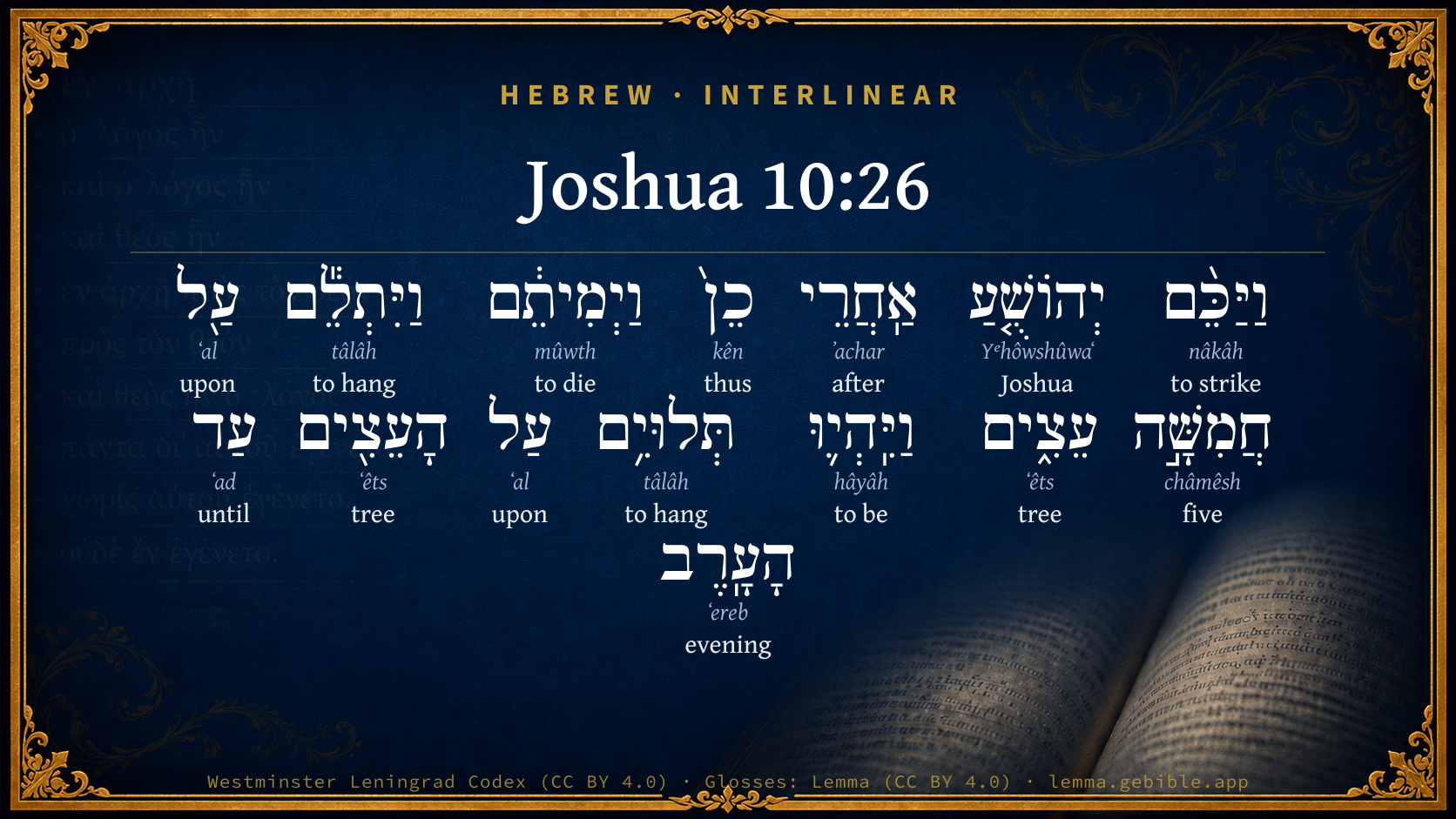
Hebrew (Westminster Leningrad Codex) Joshua 10:26 appears in the Hebrew Old Testament. The text above is from the Westminster Leningrad Codex. Each word links to its Strong’s number, a concise gloss, and parsing drawn from the Open Scriptures Hebrew Bible morphology. Click any word for its full Brown-Driver-Briggs (BDB) entry.
Download image
Cite this verse

Joshua 10:26 (World English Bible). Public Domain. Lemma interlinear Bible study tool, https://lemma.gebible.app/v/joshua/10/26.

Show BibTeX & RIS
BibTeX
RIS
English Translation
Afterward Joshua struck them, and put them to death, and hanged them on five trees: and they were hanging on the trees until the evening.
World English Bible · Public Domain
Download a study sheet

One document with this verse’s original text, its word-by-word gloss line, the meaning frame, cross-references with their text, attributed commentary, and full source and license credits — printable, and it pastes into notes with its structure intact.

This verse Autodidact and up

Study sheet (.html) Plain text (.txt)

A passage Seminary Student

Up to 50 verses in one chapter. A passage sheet keeps up to 6 commentary sources and 12 cross-references per verse, in the order this page ranks them, and says so on the sheet whenever that leaves anything out. Ask for a single verse and you get the Autodidact verse sheet above.

Everything on this page stays free to read, with no account — the sheet is a download of what is already on screen, not access to it.

Want to remove ads? Support Godless Engineer
Compare translations 3

The same verse in 3 English versions, stacked beneath the original-language interlinear above. Click any original word for its lexicon entry.

Each is an independent rendering of the whole verse — the interlinear is not word-aligned to these translations.

Highlighted words mark where these versions differ — a whole-verse word diff, not a word-by-word alignment.

  • World English Bible Public Domain
    Afterward Joshua struck them, and put them to death, and hanged them on five trees: and they were hanging on the trees until the evening.
  • King James Version Public Domain
    And afterward Joshua smote them, and slew them, and hanged them on five trees: and they were hanging upon the trees until the evening.
  • unfoldingWord Literal Text CC BY-SA 4.0
    And after this Joshua struck them and killed them and hanged them on five trees. And they were hanging on the trees until the evening.

unfoldingWord Literal Text — © unfoldingWord, licensed CC BY-SA 4.0. Word-aligned USFM3 via Door43 (git.door43.org/unfoldingWord/en_ult).

Versions to compare (up to 4)

3 of 4 selected

Show all 18 translations

Every available English version of this verse, each an independent rendering of the whole verse.

  • World English Bible Public Domain
    Afterward Joshua struck them, and put them to death, and hanged them on five trees: and they were hanging on the trees until the evening.
  • Berean Standard Bible Public Domain
    After this, Joshua struck down and killed the kings, and he hung their bodies on five trees and left them there until evening.
  • Majority Standard Bible Public Domain
    After this, Joshua struck down and killed the kings, and he hung their bodies on five trees and left them there until evening.
  • King James Version Public Domain
    And afterward Joshua smote them, and slew them, and hanged them on five trees: and they were hanging upon the trees until the evening.
  • American Standard Version (1901) Public Domain
    And afterward Joshua smote them, and put them to death, and hanged them on five trees: and they were hanging upon the trees until the evening.
  • Revised Version (1885) Public Domain
    And afterward Joshua smote them, and put them to death, and hanged them on five trees: and they were hanging upon the trees until the evening.
  • Geneva Bible (1599) Public Domain
    So then Ioshua smote them, and slewe them, and hanged them on fiue trees, and they hanged still vpon the trees vntill the euening.
  • Douay-Rheims (1899) Public Domain
    And Josue struck, and slew them, and hanged them upon five gibbets, and they hung until the evening.
  • Young's Literal Translation Public Domain
    and Joshua smiteth them afterwards, and putteth them to death, and hangeth them on five trees; and they are hanging on the trees till the evening.
  • Literal Standard Version CC BY-SA 4.0
    and Joshua strikes them afterward, and puts them to death, and hangs them on five trees; and they are hanging on the trees until the evening.
  • Unlocked Literal Bible CC BY-SA 4.0
    Then Joshua attacked and killed the kings. He hung them on five trees. They hung on the trees until evening.
  • unfoldingWord Literal Text CC BY-SA 4.0
    And after this Joshua struck them and killed them and hanged them on five trees. And they were hanging on the trees until the evening.
  • Darby Bible Public Domain
    And afterwards Joshua smote them, and put them to death, and hanged them on five trees; and they were hanging upon the trees until the evening.
  • World Messianic Bible Public Domain
    Afterward Joshua struck them, put them to death, and hanged them on five trees. They were hanging on the trees until the evening.
  • Webster's Bible Public Domain
    And afterward Joshua smote them, and slew them, and hanged them on five trees: and they were hanging upon the trees until the evening.
  • Free Bible Version CC BY-SA 4.0
    Then Joshua killed the kings and hung their bodies on five trees and left them hanging there until the evening.
  • Bible in Basic English Public Domain
    Then Joshua had them put to death, hanging them on five trees, where they were till evening.
  • JPS Tanakh (1917) Public Domain
    And afterward Joshua smote them, and put them to death, and hanged them on five trees; and they were hanging upon the trees until the evening.

Literal Standard Version (2020), Covenant Press — licensed CC BY-SA 4.0. Text via the HelloAO Bible API (eBible.org). Unlocked Literal Bible (unfoldingWord) — licensed CC BY-SA 4.0. Text via the HelloAO Bible API (eBible.org). unfoldingWord Literal Text — © unfoldingWord, licensed CC BY-SA 4.0. Word-aligned USFM3 via Door43 (git.door43.org/unfoldingWord/en_ult). Free Bible Version, Dr. Jonathan Gallagher — licensed CC BY-SA 4.0. Text via the HelloAO Bible API (eBible.org).

Word by word

More ways to search: Search by grammar → Find every occurrence → Compare this word →

Practice this passage: Drill this verse → Learn its vocabulary →

וַיִּתְלֵ֕ם
tâlâh
H8518
“and · to hang · them”
Conjunction + Verb, Qal, Sequential Imperfect, 3rd Person, Masculine, Singular + Suffix, Personal, 3rd Person, Masculine, Plural
Part of Speech
Conjunction + Verb
Stem
Qal
Form
Sequential Imperfect
Person
3rd Person
Gender
Masculine
Number
Singular
Full BDB Definition

Origin: a primitive root

TWOT: 2512

to hang - (Qal) - to hang - to hang up (any object) - to put to death by hanging - (Niphal) to be hanged - (Piel) to hang, hang up (for display)
  1. וַיַּכֵּ֨ם nâkâh H5221 “and · to strike · them” Conjunction + Verb, Hiphil, Sequential Imperfect, 3rd Person, Masculine, Singular + Suffix, Personal, 3rd Person, Masculine, Plural
  2. יְהוֹשֻׁ֤עַ Yᵉhôwshûwaʻ H3091 “Joshua” Noun, Proper
  3. אַֽחֲרֵי ʼachar H310 “after” Preposition
  4. כֵן֙ kên H3651 “thus” Adverb
  5. וַיְמִיתֵ֔ם mûwth H4191 “and · to die · them” Conjunction + Verb, Hiphil, Sequential Imperfect, 3rd Person, Masculine, Singular + Suffix, Personal, 3rd Person, Masculine, Plural
  6. עַ֖ל ʻal H5921 “upon” Preposition
  7. חֲמִשָּׁ֣ה châmêsh H2568 “five” Adjective, Cardinal number, Masculine, Singular, Absolute
  8. עֵצִ֑ים ʻêts H6086 “trees” Noun, Common, Masculine, Plural, Absolute
  9. וַיִּֽהְי֛וּ hâyâh H1961 “and · to be” Conjunction + Verb, Qal, Sequential Imperfect, 3rd Person, Masculine, Plural
  10. תְּלוּיִ֥ם tâlâh H8518 “hung” Verb, Qal, Participle Passive, Masculine, Plural, Absolute
  11. עַל ʻal H5921 “upon” Preposition
  12. הָעֵצִ֖ים ʻêts H6086 “the · trees” Particle, Definite Article + Noun, Common, Masculine, Plural, Absolute
  13. עַד ʻad H5704 “until” Preposition
  14. הָעָֽרֶב ʻereb H6153 “the · evening” Particle, Definite Article + Noun, Common, Masculine, Singular, Absolute

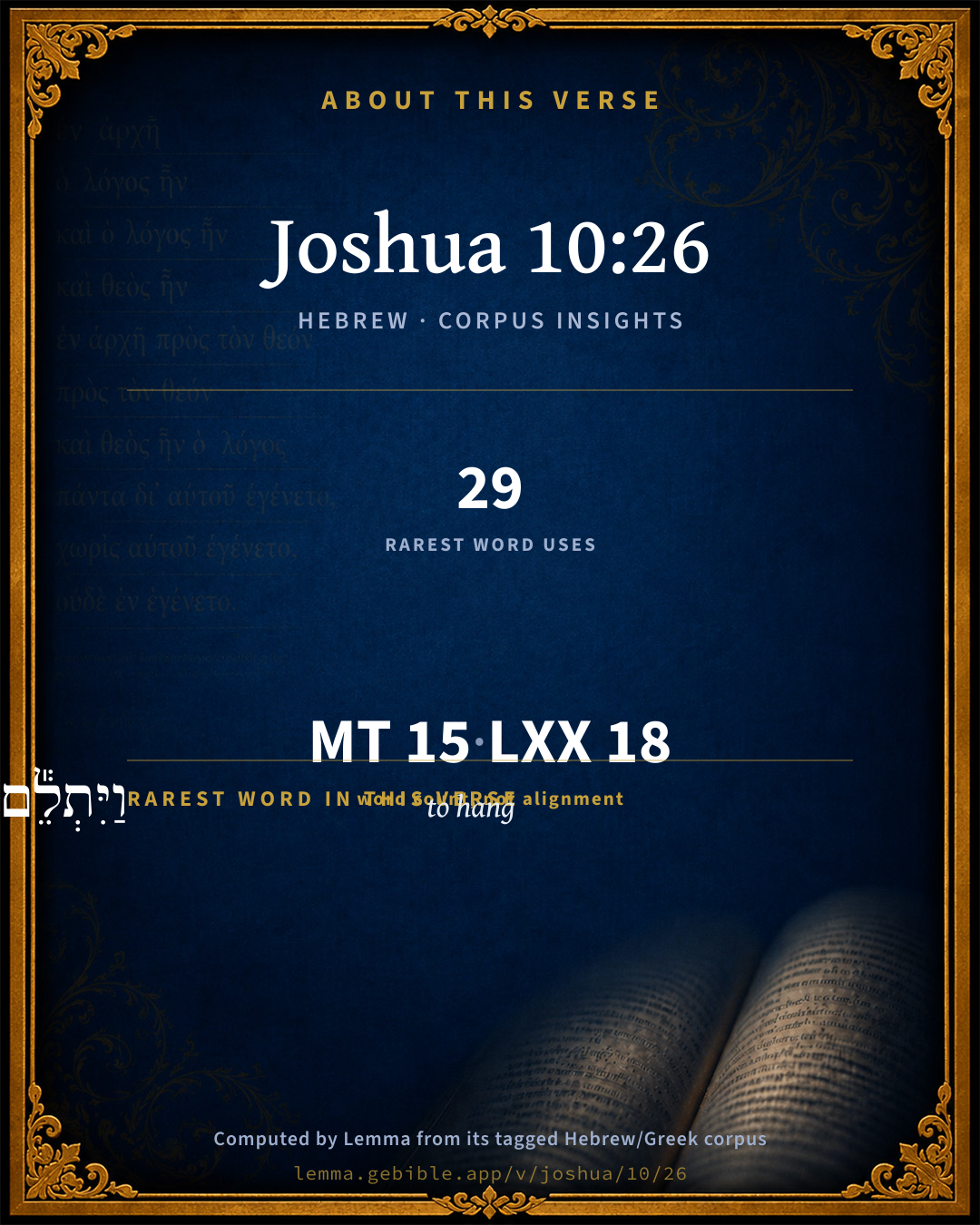
About this verse

These counts appear in no published source. They are computed here, from the morphology-tagged text and Lemma’s own curated glosses. What Lemma adds →

15
words
12
distinct lemmas
Historical
section

Shared distinctive vocabulary

וַיִּתְלֵ֕ם to hang H8518 occurs in 27 verses of the Hebrew Bible. Also found in:

Grammatical profile

  • 5 verbs
  • 4 nouns
  • 1 adjective
  • 4 prepositions
  • 1 adverb

Verb forms

  • וַיַּכֵּ֨ם Hiphil · Sequential Imperfect
  • וַיְמִיתֵ֔ם Hiphil · Sequential Imperfect
  • וַיִּתְלֵ֕ם Qal · Sequential Imperfect
  • וַיִּֽהְי֛וּ Qal · Sequential Imperfect
  • תְּלוּיִ֥ם Qal · Participle Passive

Repetition

Words recur within this verse — often emphatic in Hebrew:

  • וַיִּתְלֵ֕ם to hang H8518 ×2
  • עַ֖ל upon H5921 ×2
  • עֵצִ֑ים tree H6086 ×2

Hebrew & Septuagint length

In English translation the verse runs 25 words from the Hebrew and 19 from the Septuagint (LXX English) — closely comparable.

A rough comparison of the two English renderings, which tokenize alike — not a word-level alignment.

Word counts can differ between the Hebrew and the Greek without any difference in meaning — e.g. the Hebrew direct-object marker אֵת has no separate Greek word, and Greek often adds the article ὁ.

In the original languages it is 15 Hebrew tokens and 18 Greek tokens — but the two are counted differently (Hebrew bundles its prefixes and suffixes into one token; the Greek is in lemma form), so that isn’t a like-for-like length.

Cross-references

11

Topical passages linked to Joshua 10:26 in the Treasury of Scripture Knowledge — connected by theme and wording, ordered by reader-vote popularity; previews shown in the World English Bible.

  • Joshua 8:29 The king of Ai he hanged on a tree until the evening: and at the going down of the sun Joshua commanded, and they took his body down from the tree, and cast it at the entrance of the gate of the city, and raised thereon a great heap of stones, to this day.
  • Numbers 25:4 Yahweh said to Moses, Take all the chiefs of the people, and hang them up to Yahweh before the sun, that the fierce anger of Yahweh may turn away from Israel.
  • Deuteronomy 21:22–23 If a man have committed a sin worthy of death, and he be put to death, and you hang him on a tree;
  • Judges 8:21 Then Zebah and Zalmunna said, Rise you, and fall on us; for as the man is, so is his strength. Gideon arose, and killed Zebah and Zalmunna, and took the crescents that were on their camels' necks.
  • 1 Samuel 15:33 Samuel said, As your sword has made women childless, so shall your mother be childless among women. Samuel hewed Agag in pieces before Yahweh in Gilgal.
  • 2 Samuel 21:6 let seven men of his sons be delivered to us, and we will hang them up to Yahweh in Gibeah of Saul, the chosen of Yahweh. The king said, I will give them.
  • 2 Samuel 21:9 He delivered them into the hands of the Gibeonites, and they hanged them in the mountain before Yahweh, and they fell [all] seven together. They were put to death in the days of harvest, in the first days, at the beginning of barley harvest.
  • Esther 2:23 When inquisition was made of the matter, and it was found to be so, they were both hanged on a tree: and it was written in the book of the chronicles before the king.
  • Esther 7:9–10 Then said Harbonah, one of the chamberlains who were before the king, Behold also, the gallows fifty cubits high, which Haman has made for Mordecai, who spoke good for the king, stands in the house of Haman. The king said, Hang him thereon.
  • Matthew 27:25 All the people answered, "May his blood be on us, and on our children!"
  • Galatians 3:13 Christ redeemed us from the curse of the law, having become a curse for us. For it is written, "Cursed is everyone who hangs on a tree,"

Cross-references courtesy of OpenBible.info (CC BY 4.0).

Hebrew and Greek witnesses Masoretic Hebrew ↔ Greek Septuagint

The same verse in the two great witnesses to the Old Testament, shown verse-for-verse.

These are two independent witnesses, not word-aligned to each other, and the Septuagint is shown in lemma (dictionary) form.

Hebrew Joshua 10:26 Masoretic · Westminster Leningrad Codex

וַיַּכֵּ֨ם יְהוֹשֻׁ֤עַ אַֽחֲרֵי כֵן֙ וַיְמִיתֵ֔ם וַיִּתְלֵ֕ם עַ֖ל חֲמִשָּׁ֣ה עֵצִ֑ים וַיִּֽהְי֛וּ תְּלוּיִ֥ם עַל הָעֵצִ֖ים עַד הָעָֽרֶב

Afterward Joshua struck them, and put them to death, and hanged them on five trees: and they were hanging on the trees until the evening.

World English Bible · Public Domain

Greek LXX Joshua 10:26 Septuagint · lemma form

καί ἀποκτείνω αὐτός ἰησοῦς καί κρεμάζω αὐτός ἐπί πέντε ξύλον καί εἰμί κρεμάζω ἐπί ὁ ξύλον ἕως ἑσπέρα

And Joshua killed them, and hanged them on five trees; and they hung upon the trees until the evening.

LXX2012 (modern English Septuagint) · Public Domain

Hebrew: Westminster Leningrad Codex (CC BY 4.0). Greek: Septuagint (public domain); English from LXX2012 (modern English Septuagint) (Public Domain). How the Septuagint differs from the Hebrew →

Targum (Aramaic paraphrase)

1

The Targum is the ancient Jewish Aramaic paraphrase of the Hebrew Scriptures — an interpretive translation, not the Hebrew text itself. Onkelos (literal) and Pseudo-Jonathan (expansive) render the Torah, and Jonathan the Prophets. Coverage is partial: where no permissively-licensed English translation exists for a verse, only the Aramaic is shown. This is verse-level text, not a word-by-word alignment to the Hebrew.

  1. Targum Jonathan Prophets (Joshua–Malachi)
    וּמְחָנוּן יְהוֹשֻׁעַ בָּתַר כֵּן וְקַטְלִינוּן וְצַלְבִינוּן עַל חַמְשָׁא צְלִיבִין וַהֲווֹ צְלִיבִין עַל צְלִיבַיָא עַד רַמְשָׁא:

    (no public-domain English translation for this verse)

    Targum Jonathan — Aramaic: “Mikraot Gedolot” (public domain). English: “Sefaria Community Translation” (CC0 1.0 (public-domain dedication)); “London "Chaldee Paraphrase," 1871” (public domain). Text via Sefaria.

Commentary

Notes on Joshua 10:26 from classic Christian and Jewish commentators (each source and its license shown beneath its notes). The classic Christian expositions comment on the surrounding passage and are grouped to its opening verse, so a note may address several verses; the Jewish commentaries on the Tanakh (Rashi and others) are per-verse, so they appear only where the commentator wrote on this verse.

Lemma curates 59 commentaries, every one of them public domain or Creative Commons licensed, each selected and text-cleaned for this edition rather than reprinted as found. About our sources →

Trapp's Complete Commentary

John Trapp

Jos 10:26 And afterward Joshua smote them, and slew them, and hanged them on five trees: and they were hanging upon the trees until the evening.

Ver. 26. Hanged them on five trees.] See Jos 8:26.

John Trapp, A Commentary or Exposition upon All the Books of the Old and New Testament (1647–1656) — public domain. Text from a community e-Sword module.

Tyndale Open Study Notes

Tyndale Open Resources

10:26-27 Joshua’s execution of the five kings followed the pattern established with the king of Ai (see note on 8:29).

Tyndale Open Study Notes — © Tyndale Open Resources, licensed CC BY-SA 4.0. Text via the HelloAO Bible API.

Adam Clarke's Commentary

Verse 26. Smote - slew - and hanged them on five trees] Hanging alive seems a barbarous custom: among the Hebrews, criminals were first deprived of life; this was the debt required by justice: then they were hanged up, perhaps generally by the hands, not by the neck; this was done by way of example, to deter others from committing the crimes for which those had suffered: but they were never permitted to hang thus exposed all night, as this could have answered no purpose, either of justice or example, as they could not be seen in the night-season. One day also was deemed enough for their exposure, it being thought sufficient to show the public that justice had been executed; and to have exhibited them longer would have appeared to be a barbarous cruelty which attempted to extend punishment beyond the possible requisitions of justice. See Clarke on De 21:23.

Adam Clarke's Commentary on the Bible (1810–1826) — public domain. Text from a community e-Sword/MySword module.

Ellicott's Commentary for English Readers

(26) And hanged them.—Here the hanging appears to have been a token of disgrace after death. Upon the cross of the true Joshua, the enemies of the Israel of God are exhibited. “He made a shew of them openly, triumphing over them in it” (Col_2:15).

A Bible Commentary for English Readers, edited by Charles John Ellicott (1878–1897) — public domain. Text from a community e-Sword module.

The Cambridge Bible for Schools and Colleges

gen. ed. J. J. S. Perowne

26. Joshua smote them] The actual execution of the kings he reserved for his own hands.

hanged them] “Hongide upon fiue stokkis,” Wyclif; or suspended their bodies after death. Comp. Deu_21:23; Jos_8:29. In like manner Joshua had done to the king of Ai; Jos_8:29.

on five trees] Each body on its own tree.

The Cambridge Bible for Schools and Colleges (gen. ed. J. J. S. Perowne; Cambridge University Press, 1878–1918) — public domain. Text from a community e-Sword module.

John Gill's Exposition

And it came to pass, at the time of the going down of the sun,.... Which was the time fixed by the law of God for taking down bodies that were hanged, Deu 21:23,

that Joshua commanded, and they took them down off the trees; not from, any respect to them, but that they might not defile the land, as dead bodies in a ceremonial sense did, Deu 21:23; and this Joshua was the more careful of, as they were just entered into it, and were taking possession of it:

and they cast them into the cave wherein they had been hid; so that what had been their hiding place now became their grave; and according to the Samaritan Chronicle (q), the trees also on which they were hanged were cast in with them:

and laid great stones in the cave's mouth: not as a monumental pile, as in the instances of Achan and the king of Ai, Jos 7:26; but to prevent their carcasses being dragged out, and eaten by wild beasts, as some think; or that they might not be taken out, and buried in a more honourable manner:

which remain until this very day; when Joshua was grown old, the writer of this book.

(q) Apud Hottinger. Smegma. p. 511.

John Gill's Exposition of the Whole Bible (1746–1763) — public domain (CC PDM 1.0). Text via the HelloAO Bible API.

Matthew Poole's English Annotations

He hanged them, after they were dead, as a brand of infamy, and for the terror and instruction of others.

Matthew Poole's English Annotations on the Holy Bible (1683–1685) — public domain. Text from a community e-Sword/MySword module.

Whedon's Commentary on the Bible

Daniel D. Whedon

26. Joshua smote them — Here observe, they were slain before they were hung. This summary infliction of capital punishment so abhorrent to the humane spirit of our Christian civilization, was in accordance with the character of that age and people, who would have construed mercy as cowardice. European nations in their wars with the semi-barbarous Orientals of modern times are compelled to adopt the severe war-code of those nations. Compare the note on Jos_8:29.

Hanged them on five trees — As a mark of further indignity, and to strike the enemy with increased terror.

Until the evening — See on Jos_8:29.

Daniel D. Whedon (gen. ed.), Commentary on the Old and New Testaments (1874–1909) — public domain. Text from a community e-Sword module.

The Pulpit Commentary

And hanged them. This was also a symbolical act, intended to encourage Israel in their warfare. All that day, until its close, were the bodies of the five kings visible to the whole host, to remind them of the signal victory God had vouchsafed them. The same thing had been done at Ai. See Jos_8:29.

The Pulpit Commentary (1880–1919), ed. H.D.M. Spence-Jones & Joseph S. Exell — public domain. Text from a community e-Sword module.

unfoldingWord translationNotes

Door43 World Missions Community

to this very day

"until the author wrote this story"

translationWords

Joshua

king

unfoldingWord translationNotes — © Distant Shores Media and the Door43 World Missions Community, licensed CC BY-SA 4.0. Source: git.door43.org/Door43/en_tn.

Lesson kit

Teaching starters — assembled from the data on this page, not authored interpretation. Every prompt links to the verse data it draws on. Edit before teaching.

Joshua, in the Historical, opens this verse with 15 words (12 distinct Hebrew lemmas). Its most distinctive word is tâlâh (“to hang”). A historical commentator’s framing appears above. Read the whole chapter for the surrounding context.

Discussion questions

  1. How does “to hang” (tâlâh) shape what this verse is saying?
  2. How does Genesis 40:19, which shares the word «to hang», read alongside this verse?
  3. What does the repetition of “to hang” (2× in this one verse) do in this verse?
  4. These translations render this verse differently; the difference is in the English rendering, not the original. What questions does that raise?
  5. «וַיַּכֵּ֨ם» is a Hiphil Sequential Imperfect verb. How does that grammatical form shape the action described?
  6. Compare how Trapp's Complete Commentary and Tyndale Open Study Notes read this verse. Where do they agree or differ?

Things to notice

Reading settings

Reading text

Shown beneath each verse's original-language words.

Old Testament
Old Testament edition

Read the OT as the Masoretic Hebrew (MT) or the Greek Septuagint (LXX).

English shown for the Greek Septuagint (in the Hebrew ↔ Greek comparison).

Comparing translations? Open the Compare panel on any verse page to stack up to four side by side.