
1 Chronicles 10:14

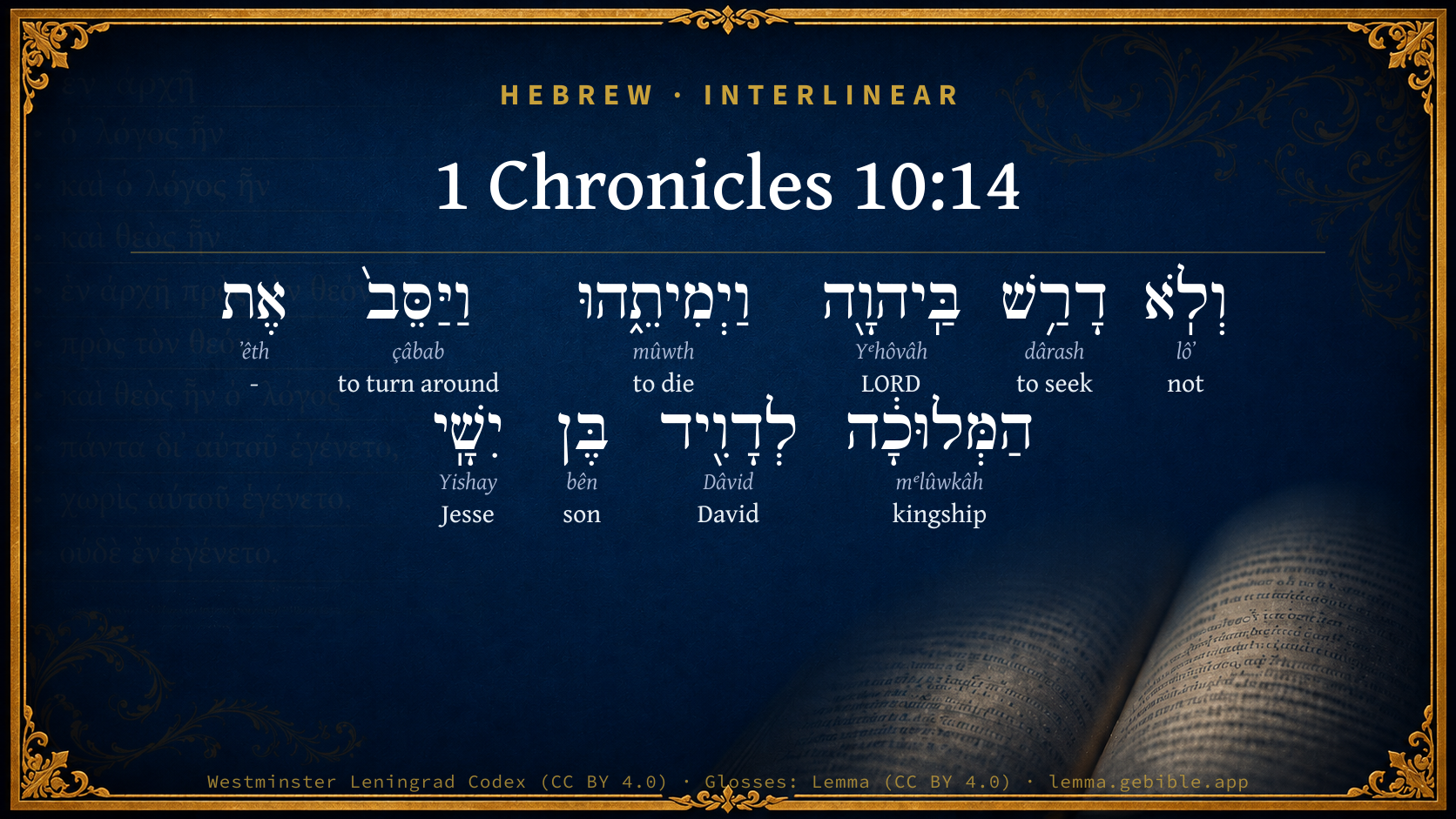
Hebrew (Westminster Leningrad Codex) 1 Chronicles 10:14 appears in the Hebrew Old Testament. The text above is from the Westminster Leningrad Codex. Each word links to its Strong’s number, a concise gloss, and parsing drawn from the Open Scriptures Hebrew Bible morphology. Click any word for its full Brown-Driver-Briggs (BDB) entry.
Download image
Cite this verse

1 Chronicles 10:14 (World English Bible). Public Domain. Lemma interlinear Bible study tool, https://lemma.gebible.app/v/1-chronicles/10/14.

Show BibTeX & RIS
BibTeX
RIS
English Translation
and didn't inquire of Yahweh: therefore he killed him, and turned the kingdom to David the son of Jesse.
World English Bible · Public Domain
Download a study sheet

One document with this verse’s original text, its word-by-word gloss line, the meaning frame, cross-references with their text, attributed commentary, and full source and license credits — printable, and it pastes into notes with its structure intact.

This verse Autodidact and up

Study sheet (.html) Plain text (.txt)

A passage Seminary Student

Up to 50 verses in one chapter. A passage sheet keeps up to 6 commentary sources and 12 cross-references per verse, in the order this page ranks them, and says so on the sheet whenever that leaves anything out. Ask for a single verse and you get the Autodidact verse sheet above.

Everything on this page stays free to read, with no account — the sheet is a download of what is already on screen, not access to it.

Want to remove ads? Support Godless Engineer
Compare translations 3

The same verse in 3 English versions, stacked beneath the original-language interlinear above. Click any original word for its lexicon entry.

Each is an independent rendering of the whole verse — the interlinear is not word-aligned to these translations.

Highlighted words mark where these versions differ — a whole-verse word diff, not a word-by-word alignment.

  • World English Bible Public Domain
    and didn't inquire of Yahweh: therefore he killed him, and turned the kingdom to David the son of Jesse.
  • King James Version Public Domain
    And inquired not of the LORD: therefore he slew him, and turned the kingdom unto David the son of Jesse.
  • unfoldingWord Literal Text CC BY-SA 4.0
    For he did not seek Yahweh, so he killed him. And he turned the kingdom to David, the son of Jesse.

unfoldingWord Literal Text — © unfoldingWord, licensed CC BY-SA 4.0. Word-aligned USFM3 via Door43 (git.door43.org/unfoldingWord/en_ult).

Versions to compare (up to 4)

3 of 4 selected

Show all 18 translations

Every available English version of this verse, each an independent rendering of the whole verse.

  • World English Bible Public Domain
    and didn't inquire of Yahweh: therefore he killed him, and turned the kingdom to David the son of Jesse.
  • Berean Standard Bible Public Domain
    and he failed to inquire of the LORD. So the LORD put him to death and turned the kingdom over to David son of Jesse.
  • Majority Standard Bible Public Domain
    and he failed to inquire of the LORD. So the LORD put him to death and turned the kingdom over to David son of Jesse.
  • King James Version Public Domain
    And inquired not of the LORD: therefore he slew him, and turned the kingdom unto David the son of Jesse.
  • American Standard Version (1901) Public Domain
    and inquired not of Jehovah: therefore he slew him, and turned the kingdom unto David the son of Jesse.
  • Revised Version (1885) Public Domain
    and inquired not of the LORD: therefore he slew him, and turned the kingdom unto David the son of Jesse.
  • Geneva Bible (1599) Public Domain
    And asked not of the Lord: therefore he slewe him, and turned the kingdome vnto Dauid the sonne of Ishai.
  • Douay-Rheims (1899) Public Domain
    And trusted not is the Lord: therefore he slew him, and transferred his kingdom to David the son of Isai.
  • Young's Literal Translation Public Domain
    and he inquired not at Jehovah, and He putteth him to death, and turneth round the kingdom to David son of Jesse.
  • Literal Standard Version CC BY-SA 4.0
    and he did not inquire of YHWH, and He puts him to death, and turns around the kingdom to David son of Jesse.
  • Unlocked Literal Bible CC BY-SA 4.0
    He did not seek guidance from Yahweh, so Yahweh killed him and turned over the kingdom to David son of Jesse.
  • unfoldingWord Literal Text CC BY-SA 4.0
    For he did not seek Yahweh, so he killed him. And he turned the kingdom to David, the son of Jesse.
  • Darby Bible Public Domain
    and he asked not counsel of Jehovah; therefore he slew him, and transferred the kingdom to David the son of Jesse.
  • World Messianic Bible Public Domain
    and didn’t inquire of the LORD. Therefore he killed him, and turned the kingdom over to David the son of Jesse.
  • Webster's Bible Public Domain
    And inquired not of the LORD: therefore he slew him, and turned the kingdom to David the son of Jesse.
  • Free Bible Version CC BY-SA 4.0
    He did not consult the Lord, so the Lord put him to death and he handed over the kingship to David, son of Jesse.
  • Bible in Basic English Public Domain
    And not to the Lord: for this reason, he put him to death and gave the kingdom to David, the son of Jesse.
  • JPS Tanakh (1917) Public Domain
    and inquired not of the LORD; therefore He slew him, and turned the kingdom unto David the son of Jesse.

Literal Standard Version (2020), Covenant Press — licensed CC BY-SA 4.0. Text via the HelloAO Bible API (eBible.org). Unlocked Literal Bible (unfoldingWord) — licensed CC BY-SA 4.0. Text via the HelloAO Bible API (eBible.org). unfoldingWord Literal Text — © unfoldingWord, licensed CC BY-SA 4.0. Word-aligned USFM3 via Door43 (git.door43.org/unfoldingWord/en_ult). Free Bible Version, Dr. Jonathan Gallagher — licensed CC BY-SA 4.0. Text via the HelloAO Bible API (eBible.org).

Word by word

More ways to search: Search by grammar → Find every occurrence → Compare this word →

Practice this passage: Drill this verse → Learn its vocabulary →

הַמְּלוּכָ֔ה
mᵉlûwkâh
H4410
“the · kingship”
Particle, Definite Article + Noun, Common, Feminine, Singular, Absolute
Part of Speech
Particle + Noun
Type
Common
Gender
Feminine
Number
Singular
State
Absolute
Full BDB Definition

Origin: pass. participle of H4427

TWOT: 1199d

kingship, royalty, kingly office
  1. וְלֹֽא lôʼ H3808 “and · not” Conjunction + Particle, Negative
  2. דָרַ֥שׁ dârash H1875 “to seek” Verb, Qal, Perfect, 3rd Person, Masculine, Singular
  3. בַּֽיהוָ֖ה Yᵉhôvâh H3068 “in/at · LORD” Preposition + Noun, Proper
  4. וַיְמִיתֵ֑הוּ mûwth H4191 “and · to die · him” Conjunction + Verb, Hiphil, Sequential Imperfect, 3rd Person, Masculine, Singular + Suffix, Personal, 3rd Person, Masculine, Singular
  5. וַיַּסֵּב֙ çâbab H5437 “and · to turn around” Conjunction + Verb, Hiphil, Sequential Imperfect, 3rd Person, Masculine, Singular
  6. אֶת ʼêth H853 “-” Particle, Direct Object
  7. לְדָוִ֖יד Dâvid H1732 “to/for · David” Preposition + Noun, Proper
  8. בֶּן bên H1121 “son of” Noun, Common, Masculine, Singular, Construct
  9. יִשָֽׁי Yishay H3448 “Jesse” Noun, Proper

About this verse

These counts appear in no published source. They are computed here, from the morphology-tagged text and Lemma’s own curated glosses. What Lemma adds →

10
words
10
distinct lemmas
Historical
section

Notable vocabulary

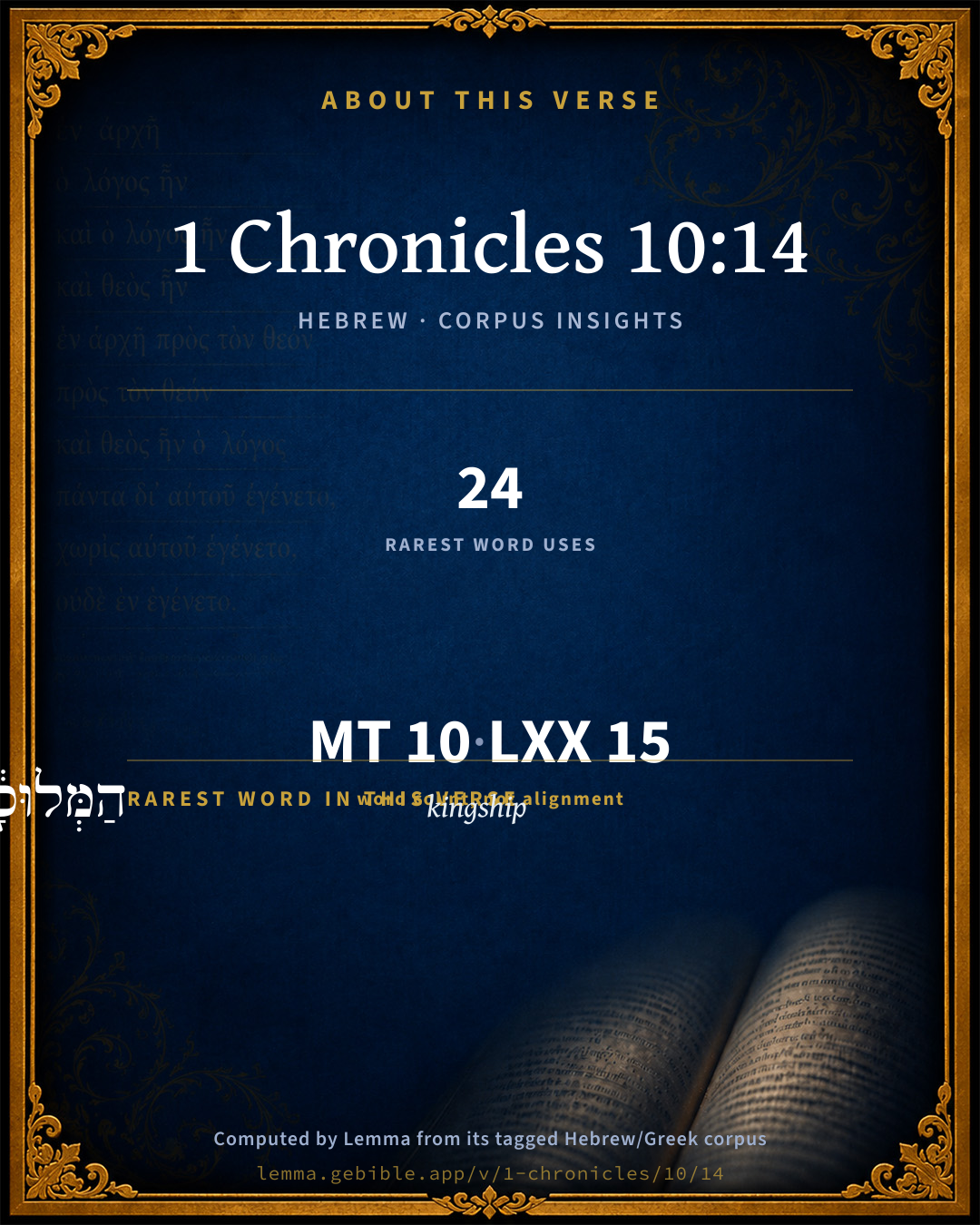
The rarest word here is הַמְּלוּכָ֔ה kingship H4410 — appearing just 24 times in the whole Hebrew Bible.

Shared distinctive vocabulary

הַמְּלוּכָ֔ה kingship H4410 occurs in 23 verses of the Hebrew Bible. Also found in:

Grammatical profile

  • 3 verbs
  • 5 nouns
  • 2 particles

Verb forms

  • דָרַ֥שׁ Qal · Perfect
  • וַיְמִיתֵ֑הוּ Hiphil · Sequential Imperfect
  • וַיַּסֵּב֙ Hiphil · Sequential Imperfect

Hebrew & Septuagint length

In English translation the verse runs 19 words from the Hebrew and 20 from the Septuagint (LXX English) — closely comparable.

A rough comparison of the two English renderings, which tokenize alike — not a word-level alignment.

Word counts can differ between the Hebrew and the Greek without any difference in meaning — e.g. the Hebrew direct-object marker אֵת has no separate Greek word, and Greek often adds the article ὁ.

In the original languages it is 10 Hebrew tokens and 15 Greek tokens — but the two are counted differently (Hebrew bundles its prefixes and suffixes into one token; the Greek is in lemma form), so that isn’t a like-for-like length.

Cross-references

14

Topical passages linked to 1 Chronicles 10:14 in the Treasury of Scripture Knowledge — connected by theme and wording, ordered by reader-vote popularity; previews shown in the World English Bible.

  • 1 Samuel 15:28 Samuel said to him, Yahweh has torn the kingdom of Israel from you this day, and has given it to a neighbor of yours who is better than you.
  • 1 Samuel 13:14 But now your kingdom shall not continue: Yahweh has sought him a man after his own heart, and Yahweh has appointed him to be prince over his people, because you have not kept that which Yahweh commanded you.
  • 1 Samuel 16:1 Yahweh said to Samuel, How long will you mourn for Saul, seeing I have rejected him from being king over Israel? fill your horn with oil, and go: I will send you to Jesse the Bethlehemite; for I have provided me a king among his sons.
  • 1 Samuel 28:17 Yahweh has done to you, as he spoke by me: and Yahweh has torn the kingdom out of your hand, and given it to your neighbor, even to David.
  • 1 Samuel 28:6 When Saul inquired of Yahweh, Yahweh didn't answer him, neither by dreams, nor by Urim, nor by prophets.
  • 2 Samuel 3:9–10 God do so to Abner, and more also, if, as Yahweh has sworn to David, I don't do even so to him;
  • 1 Chronicles 12:23 These are the numbers of the heads of those who were armed for war, who came to David to Hebron, to turn the kingdom of Saul to him, according to the word of Yahweh.
  • Judges 10:11–16 Yahweh said to the children of Israel, Didn't I save you from the Egyptians, and from the Amorites, from the children of Ammon, and from the Philistines?
  • Proverbs 17:13 Whoever rewards evil for good, Evil shall not depart from his house.
  • 1 Samuel 16:11–13 Samuel said to Jesse, Are here all your children? He said, There remains yet the youngest, and, behold, he is keeping the sheep. Samuel said to Jesse, Send and get him; for we will not sit down until he come here.
  • 2 Samuel 5:3 So all the elders of Israel came to the king to Hebron; and king David made a covenant with them in Hebron before Yahweh: and they anointed David king over Israel.
  • Isaiah 10:7 However he doesn't mean so, neither does his heart think so; but it is in his heart to destroy, and to cut off not a few nations.
  • Isaiah 10:15 Shall the axe boast itself against him who hews therewith? Shall the saw magnify itself against him who wields it? as if a rod should wield those who lift it up, [or] as if a staff should lift up [him who is] not wood.
  • Ezekiel 14:3–6 Son of man, these men have taken their idols into their heart, and put the stumbling block of their iniquity before their face: should I be inquired of at all by them?

Cross-references courtesy of OpenBible.info (CC BY 4.0).

Hebrew and Greek witnesses Masoretic Hebrew ↔ Greek Septuagint

The same verse in the two great witnesses to the Old Testament, shown verse-for-verse.

These are two independent witnesses, not word-aligned to each other, and the Septuagint is shown in lemma (dictionary) form.

Hebrew 1 Chronicles 10:14 Masoretic · Westminster Leningrad Codex

וְלֹֽא דָרַ֥שׁ בַּֽיהוָ֖ה וַיְמִיתֵ֑הוּ וַיַּסֵּב֙ אֶת הַמְּלוּכָ֔ה לְדָוִ֖יד בֶּן יִשָֽׁי

and didn't inquire of Yahweh: therefore he killed him, and turned the kingdom to David the son of Jesse.

World English Bible · Public Domain

Greek LXX 1 Chronicles 10:14 Septuagint · lemma form

καί οὐ ζητέω κύριος καί ἀποκτείνω αὐτός καί ἐπιστρέφω ὁ βασιλεία ὁ δαυίδ υἱός ιεσσαι

and he sought not the Lord: so he killed him, and turned the kingdom to David the son of Jesse.

LXX2012 (modern English Septuagint) · Public Domain

Hebrew: Westminster Leningrad Codex (CC BY 4.0). Greek: Septuagint (public domain); English from LXX2012 (modern English Septuagint) (Public Domain). How the Septuagint differs from the Hebrew →

Commentary

Notes on 1 Chronicles 10:14 from classic Christian and Jewish commentators (each source and its license shown beneath its notes). The classic Christian expositions comment on the surrounding passage and are grouped to its opening verse, so a note may address several verses; the Jewish commentaries on the Tanakh (Rashi and others) are per-verse, so they appear only where the commentator wrote on this verse.

Lemma curates 59 commentaries, every one of them public domain or Creative Commons licensed, each selected and text-cleaned for this edition rather than reprinted as found. About our sources →

Trapp's Complete Commentary

John Trapp

1Ch 10:14 And enquired not of the LORD: therefore he slew him, and turned the kingdom unto David the son of Jesse.

Ver. 14. And inquired not of the Lord.] He did, and yet he did not. {See Trapp on "1Sa 28:6"}

Therefore he slew him.] He killed him with death, as Rev 2:23.

And turned the kingdom unto David.] Though it were long first, and after many trials and tribulations. Sic petitur caelum; heaven is not to be had, but after much pains and patience.

“ Durate, et vosmet rebus servate secundis ”

John Trapp, A Commentary or Exposition upon All the Books of the Old and New Testament (1647–1656) — public domain. Text from a community e-Sword module.

Joseph Benson's Commentary

1Ch 10:14. Inquired not of the Lord — He did in some sort, but not in a right manner; not humbly and penitently, not diligently and importunately, not patiently and perseveringly; nor till he was brought to the last extremity, and then it was too late.

Joseph Benson's Commentary on the Old and New Testaments (1811–1818) — public domain. Text from a community e-Sword module.

Jamieson, Fausset & Brown

Robert Jamieson, A. R. Fausset & David Brown

And inquired not of the Lord--He had done so in form (Sa1 28:6), but not in the spirit of a humble penitent, nor with the believing confidence of a sincere worshipper. His enquiry was, in fact, a mere mockery, and his total want of all right religious impressions was manifested by his rushing from God to a wretched impostor in the service of the devil [Sa1 28:7].

Next: 1 Chronicles Chapter 11

Jamieson, Fausset & Brown — Commentary Critical and Explanatory on the Whole Bible (1871) — public domain (CC PDM 1.0). Text via the HelloAO Bible API.

Adam Clarke's Commentary

Verse 14. Inquired not of the Lord] On these two last verses the Targum speaks thus: "And Saul died for the transgression by which he transgressed against the WORD of the Lord, and because he did not keep the commandment of the Lord when he warred against the house of Amalek; and because he consulted Pythons, and sought oracular answers from them. Neither did he ask counsel from before the Lord by Urim and Thummim, for he had slain the priests that were in Nob; therefore the Lord slew him, and transferred the kingdom to David the son of Jesse."

A LITERARY friend furnishes the following remarks:-

"The sacred writer, in the first book of Samuel, 1Sa 31:11-13, and 1Ch 10:11-12, after relating the defeat and death of Saul, and the ignominious treatment of his remains, thus concludes:-

"'And when the inhabitants of Jabesh-gilead heard of that which the Philistines had done to Saul, all the valiant men arose, and went all night, and took the body of Saul, and the bodies of his sons, from the wall of Beth-shan, and came to Jabesh, and burnt them there; and they took the bones, and buried them under a tree at Jabesh, and fasted seven days.'

"Often has this account been read with admiration of the bravery and devotedness of the men of Jabesh-gilead, but without considering that these men had any greater cause than others for honouring the remains of their sovereign; but, on reflection, it will be perceived that the strong impulse of gratitude prompted them to this honourable exertion. They remembered their preservation from destruction, and, which to brave men is more galling, from bearing marks of having been defeated, and being deprived of the honourable hope of wiping off disgrace, or defending their country at future seasons.

"Reading these verses in conjunction with the attack of Nahash, we perceive the natural feelings of humanity, of honourable respect, prompting the men of Jabesh to act as they did in rescuing the bones of Saul and his family.

"The father of Grecian poetry relates in how great a degree the warriors of ancient days honoured the remains of their leaders; how severe were the contests for the body of the fallen chief, more determined oftentimes than the struggle for victory: this point of military honour was possibly excited or heightened by the religious idea so prevalent in his age, and after times, respecting the fate of the spirits of those who were unburied.

"Homer wrote of events passing at no distant period from those recorded in the first volume of Samuel; and these accounts mutually corroborate each other, being in unison, not only with the feelings of humanity, but with the customs of ancient nations. These may be farther illustrated by comparing the conduct of the Philistines with regard to Saul and his sons, with that of the hero of the Iliad towards Hector, the most finished character of the poem. Saul had been a severe scourge to the Philistines throughout a long series of years; the illustrious chief of Troy had long warded off the ruin of his country, and destroyed the flower of her foes, independently of his last victory over Patroclus, which drew on his remains that dishonour which, however, fell only on his destroyer.

"Should the siege of Troy be considered a fable, it may then be concluded that Homer introduced into his poems the customs and manners known to those for whose perusal he wrote, if these customs were not prevalent among his readers; but anxiety for the body of the illustrious dead, or regret for his death, has often caused success when all exertions prior to this powerful stimulus have not availed; and this even in our days.

"The Philistines had long been confined to the southwest angle of the promised land, and in the earlier part of Saul's reign had suffered many and severe losses; yet it appears by this chapter that, alone or in conjunction with allies, they had been able to penetrate nearly to the banks of the Jordan, to fight the battle on Mount Gilboa. This could only have been effected by a march through great part of the kingdom of Israel.

"Doubtless the attention of Saul in its defence might have been greatly distracted by his pursuit and fear of David, which appeared to have absorbed his whole mind; and it may account for the defenceless or weakened state of his forces.

"These circumstances appear to corroborate the authenticity of these books, independently of the many private transactions therein recorded; particularly the interesting and singular friendship of Jonathan and David, a transaction not likely to occur to a forger of a narrative. J.W."

Adam Clarke's Commentary on the Bible (1810–1826) — public domain. Text from a community e-Sword/MySword module.

Ellicott's Commentary for English Readers

(14) And enquired not of the Lord.—Saul had, in fact, enquired of Jehovah before resorting to the witch of En-dor, “but the Lord answered him not, neither by the dreams, nor by the Urim, nor by the prophets” (1Sa_28:6). We shall not be reading a meaning of our own into the text if we say that Saul’s natural impatience (1Sa_13:13) on this occasion betrayed him again; he at once despaired of help from his God, instead of seeking it with self-humiliation and penitence. His character is consistently drawn throughout the history. The sin that ruined the first king was essentially that which led to the final ruin of the nation, viz., unfaithfulness to the covenant-God. The same word characterises both. (Comp. 1Ch_10:13 with 1Ch_5:25; 1Ch_9:1.)

Therefore he slew him.—God acts through the instrumentality of His creatures. In this case He employed the Philistines, and the suicidal hand of Saul himself; just as He employed the Assyrian conquerors of a later age to be the scourge of guilty peoples (Isa_10:5-15), and raised up Cyrus to be His servant, who should fulfil all His pleasure (Isa_44:28; Isa_45:1-13).

Turned the kingdom unto David.—By means of the warriors of Israel (1Ch_12:23). This sentence shows that 1 Chronicles 10 is transitional to the history of David as king.

A Bible Commentary for English Readers, edited by Charles John Ellicott (1878–1897) — public domain. Text from a community e-Sword module.

The Cambridge Bible for Schools and Colleges

gen. ed. J. J. S. Perowne

14. and inquired not of the Lord] Cp. 1Ch_13:3. The Chronicler does not count inquiries made too late; cp. 1Sa_28:6 (Saul inquires of the Lord, but receives no answer).

The Cambridge Bible for Schools and Colleges (gen. ed. J. J. S. Perowne; Cambridge University Press, 1878–1918) — public domain. Text from a community e-Sword module.

Matthew Poole's English Annotations

Inquired not of the Lord.

Object. Saul inquired of the Lord, 1Sa 28:6.

Answ. He did so, but not in a right manner, not humbly and penitently, not diligently and importunately, not patiently and perseveringly; but when God would not answer him speedily, he gives it over, and goes from God to the devil. Compare 1Sa 14:18,19. Such an inconsiderable and trifling inquiry as Saul made, is justly accounted to be no inquiry at all; as they are said not to eat the Lord’s supper, 1Co 11:20, who did eat it in a sinful and irregular manner.

Matthew Poole's English Annotations on the Holy Bible (1683–1685) — public domain. Text from a community e-Sword/MySword module.

Whedon's Commentary on the Bible

Daniel D. Whedon

14. Inquired not of the Lord — 1Sa_28:6 clearly implies that he did inquire of the Lord, but received no answer. His inquiring of Jehovah, however, seems to have been fitful, superstitious, and prompted by a sense of terror, and also with a conviction that he was forsaken of God, (1Sa_28:15;) and being followed so speedily by a resolution to inquire of a necromancer, it is treated by the chronicler as no true, earnest, and worthy inquiring of Jehovah.

He slew him — Hebrews caused him to die; that is, gave him over to destruction, as a vessel of wrath already fitted to that end. Rom_9:22, note.

Daniel D. Whedon (gen. ed.), Commentary on the Old and New Testaments (1874–1909) — public domain. Text from a community e-Sword module.

The Pulpit Commentary

And inquired not of the Lord. Saul seems to have, in point of fact, inquired in some sense. (1Sa_14:37 1Sa_28:5, 1Sa_28:6, 1Sa_28:15) But the probable meaning is that he did not inquire in the first instance (see vers. 3, 4); and when he did inquire, he did not await the reply solely and exclusively of Jehovah. Therefore he slew him. (so see 1Ch_2:3) David the son of Jesse. The compiler, having heretofore given so scrupulously whatever of genealogical fact he could, is now careful to use it. And he identifies the future chief hero of his history as him who had already been instanced, (1Ch_2:15) "son of Jesse.

Judgments come through men, but they are from the Lord.

This topic is suggested by the expression, "Therefore he slew him." This passage gives the reason for the death of Saul, as viewed from a later standpoint; amoral is pointed from it that might serve as a warning to the returned captives of Babylon. Saul came under judgment, and we must see that it was Divine judgment. It may be well to form a careful estimate of Saul"s character and reign, so that the Divine dealings with him may be worthily apprehended. "It is impossible not to recognize elements of good in him. David"s lament does but express the national admiration for one, who, in his best days, must have been both prudent in counsel and mighty in war. We cannot fail to see the evil taint of self-will making sinister marks across the entire record and utterly darkening the closing chapters." There is little bat warning to be gathered from the story of King Saul; but we should receive those warnings humbly, for "let him that thinketh he standeth take heed lest he fall.

I GOD"S JUDGMENTS FIND EARTHLY SPHERES. One of the great objects for the sake of which the Old Testament histories are preserved to us is to convince us that God visits sins now, and lets his judgments be executed here on earth. Judgment, in Saul"s case, came on a battle-field; it may come on a sick-bed or a ruined home. Our tendency is to call earthly troubles accidents, and to shift the idea of Divine judgment into the world that is to come. We think that God will judge, condemn, and execute his judgments there, and so we too easily separate him from the calamities of our life. It is to be impressively apprehended that Saul had his judgment in this sphere. No man can be sure of postponing the Divine judgment to the next life. Whosoever "transgresseth" lies under this exceeding peril; the Divine indignation is over him now, and he has no security as to how or when it will fall.

II GOD"S JUDGMENTS AND HUMAN AGENTS. This needs to be set forth so as to correct a common fallacy and self-deception. Men may be willing to admit that fire and tempest, famine and pestilence, are executive agents of God, and work out his judgments, but they are less willing to see that their fellow-men, even in doing wrong, may be used by God as his executioners. Even the Philistines, in their violence and wilfulness, became the executors of the Divine wrath on Saul. See how much larger and more comprehensive a view of the Divine administration this gives; and it may afford some very humbling revelations of some misunderstood passages of our lives. Maybe we thought ourselves only wronged by men; through the wrong we were punished by God.

III THE EARTHLY AND THE HUMAN JUDGMENTS MUST NOT HIDE THE DIVINE IN THEM. As we see things, the Philistines defeated Saul and he ultimately slew himself. But we must not thus obscure the Divine. The deeper truth is that God slew him. So of the incidents of our lives; nothing should hide the Divine meaning of them.

IV THE EARTHLY AND THE HUMAN SHOULD NOT BE ALLOWED TO CONFUSE OUR VIEWS OF THE FUTURE AND ETERNAL JUDGMENT. No judgment, limited to the earthly spheres, can be properly said to exhaust the Divine sentence. God wants the next life for the adequate vindications of his righteousness. The fact of a man"s having suffered in this life gives him no security against judgment to come.

V THE EARTHLY AND THE HUMAN FIND THEIR COMPLETE MISSION, NOT IN THE SUFFERER, BUT IN THE WARNING OF THOSE WHO MAY HEAR OF THE JUDGMENT. This is illustrated in the preservation of the records of the Flood, the destruction of Sodom, the ruin of Balaam, the miserable end of Saul, etc. Deal with our Lord"s teachings concerning "calamity." Distinguish "calamity" from "judgment." We call a thing a judgment when we can connect together as in Saul"s case the sin and the suffering. Otherwise we say, "It is a calamity, and it may be a judgment." Plead for a real and practical belief in God"s present rule, and solemn vindications el his will and authority, both in national and individual spheres. R.T.

The Pulpit Commentary (1880–1919), ed. H.D.M. Spence-Jones & Joseph S. Exell — public domain. Text from a community e-Sword module.

John Wesley's Explanatory Notes

Inquired not - He did in some sort, but not in a right manner, not humbly and penitently, not diligently and importunately, not patiently and perseveringly. Nor 'till he was brought to the last extremity. And then it was too late.

John Wesley, Explanatory Notes Upon the Whole Bible (1754–1765) — public domain. Text via the GEBible commentary corpus.

Lesson kit

Teaching starters — assembled from the data on this page, not authored interpretation. Every prompt links to the verse data it draws on. Edit before teaching.

1 Chronicles, in the Historical, opens this verse with 10 words (10 distinct Hebrew lemmas). Its most distinctive word is mᵉlûwkâh (“kingship”). A historical commentator’s framing appears above. Read the whole chapter for the surrounding context.

Discussion questions

  1. What does “kingship” (mᵉlûwkâh) contribute to the verse as a whole?
  2. How does 1 Samuel 10:16, which shares the word «kingship», read alongside this verse?
  3. These translations render this verse differently; the difference is in the English rendering, not the original. What questions does that raise?
  4. «דָרַ֥שׁ» is a Qal Perfect verb. How does that grammatical form shape the action described?
  5. Compare how Trapp's Complete Commentary and Joseph Benson's Commentary read this verse. Where do they agree or differ?

Things to notice

Reading settings

Reading text

Shown beneath each verse's original-language words.

Old Testament
Old Testament edition

Read the OT as the Masoretic Hebrew (MT) or the Greek Septuagint (LXX).

English shown for the Greek Septuagint (in the Hebrew ↔ Greek comparison).

Comparing translations? Open the Compare panel on any verse page to stack up to four side by side.