Genesis 36:35

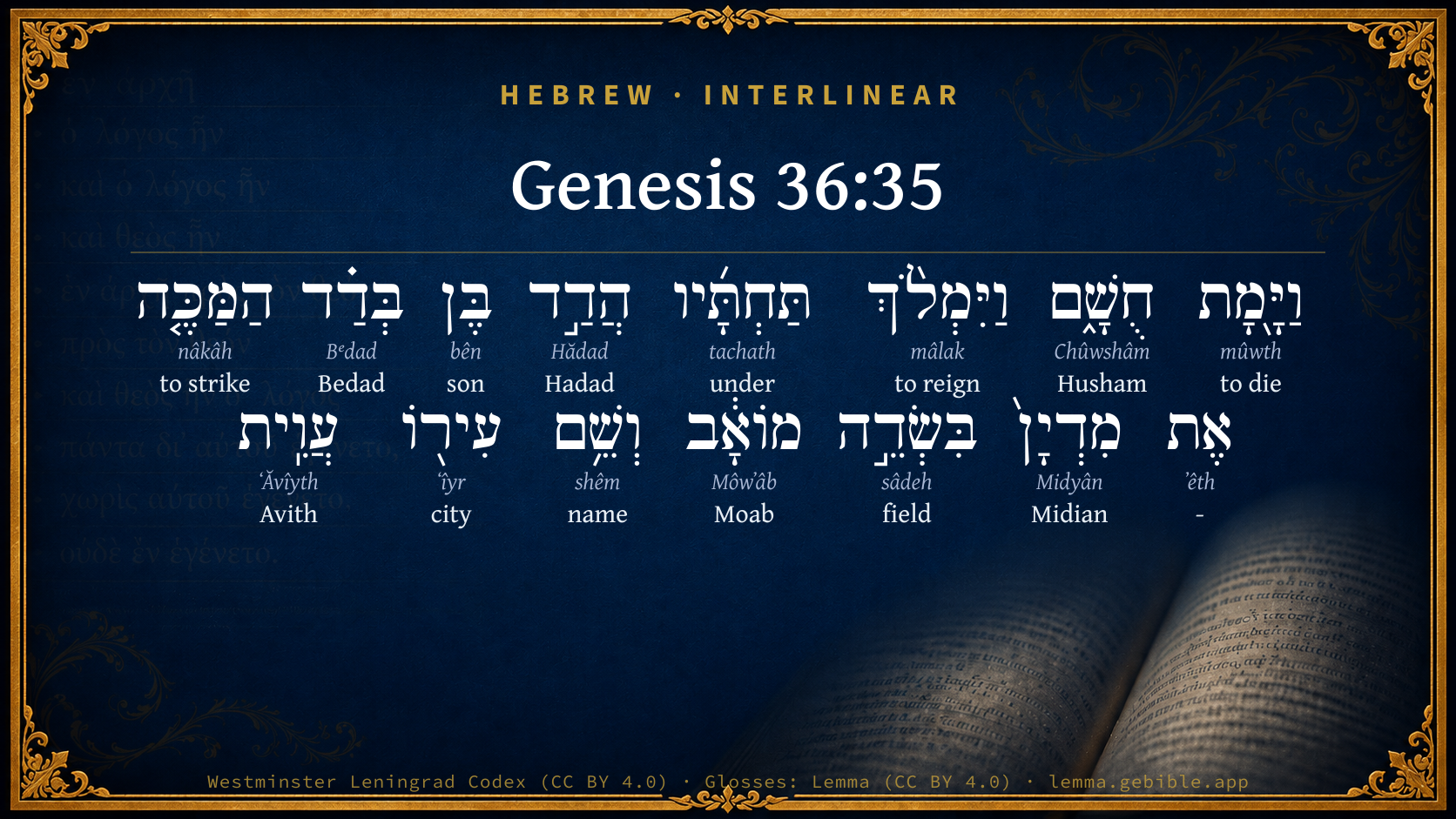
Hebrew (Westminster Leningrad Codex) Genesis 36:35 appears in the Hebrew Old Testament. The text above is from the Westminster Leningrad Codex. Each word links to its Strong’s number, a concise gloss, and parsing drawn from the Open Scriptures Hebrew Bible morphology. Click any word for its full Brown-Driver-Briggs (BDB) entry.
Download image
Cite this verse

Genesis 36:35 (World English Bible). Public Domain. Lemma interlinear Bible study tool, https://lemma.gebible.app/v/genesis/36/35.

Show BibTeX & RIS
BibTeX
RIS
English Translation
Husham died, and Hadad, the son of Bedad, who struck Midian in the field of Moab, reigned in his place. The name of his city was Avith.
World English Bible · Public Domain
Highlights
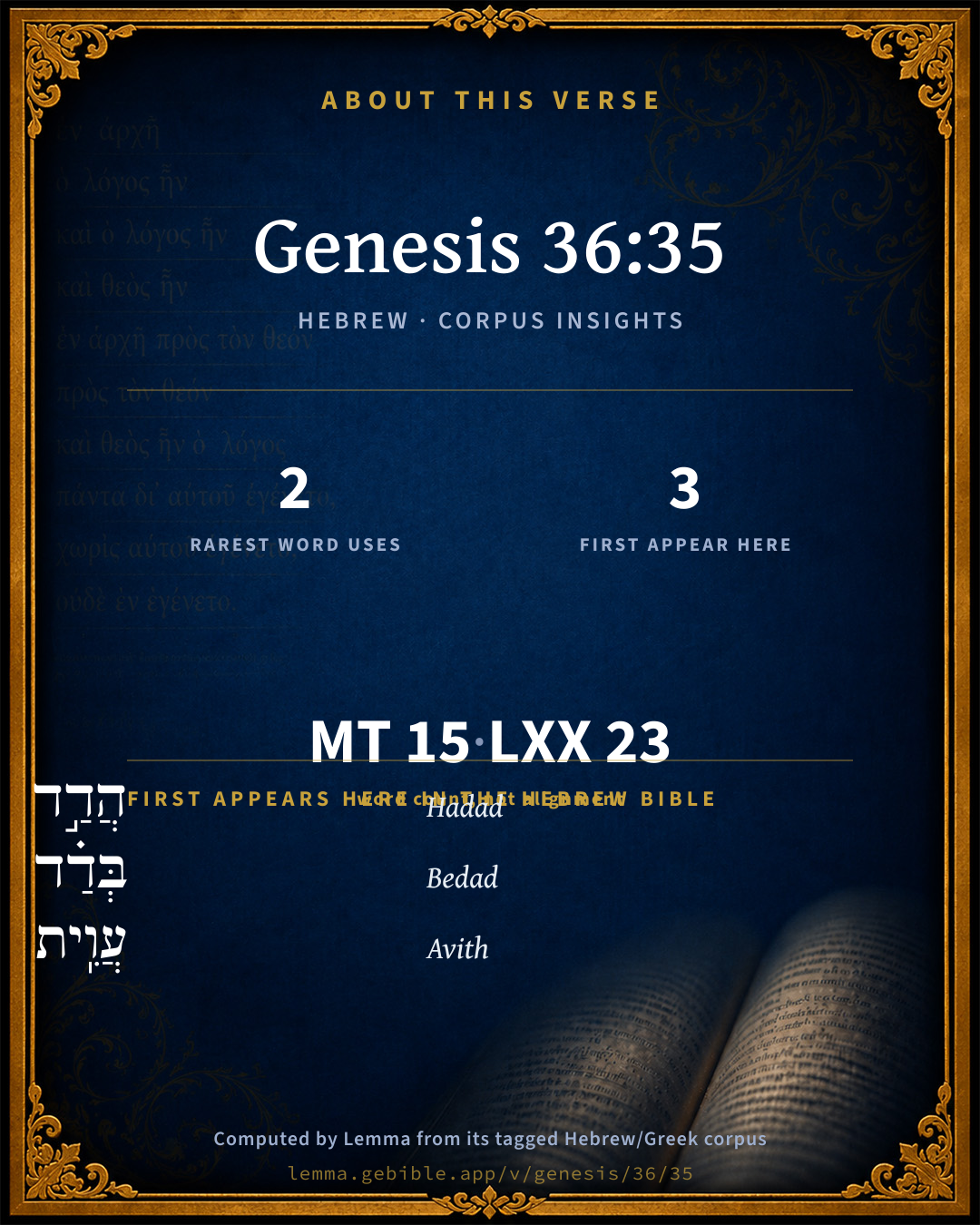
  • 3 first appearances in the Hebrew Bible
Full analysis ↓
Download a study sheet

One document with this verse’s original text, its word-by-word gloss line, the meaning frame, cross-references with their text, attributed commentary, and full source and license credits — printable, and it pastes into notes with its structure intact.

This verse Autodidact and up

Study sheet (.html) Plain text (.txt)

A passage Seminary Student

Up to 50 verses in one chapter. A passage sheet keeps up to 6 commentary sources and 12 cross-references per verse, in the order this page ranks them, and says so on the sheet whenever that leaves anything out. Ask for a single verse and you get the Autodidact verse sheet above.

Everything on this page stays free to read, with no account — the sheet is a download of what is already on screen, not access to it.

Want to remove ads? Support Godless Engineer
Compare translations 3

The same verse in 3 English versions, stacked beneath the original-language interlinear above. Click any original word for its lexicon entry.

Each is an independent rendering of the whole verse — the interlinear is not word-aligned to these translations.

Highlighted words mark where these versions differ — a whole-verse word diff, not a word-by-word alignment.

  • World English Bible Public Domain
    Husham died, and Hadad, the son of Bedad, who struck Midian in the field of Moab, reigned in his place. The name of his city was Avith.
  • King James Version Public Domain
    And Husham died, and Hadad the son of Bedad, who smote Midian in the field of Moab, reigned in his stead: and the name of his city was Avith.
  • unfoldingWord Literal Text CC BY-SA 4.0
    Then Husham died, and Hadad the son of Bedad reigned in his place, who struck the Midianites in the field of Moab. And the name of his city Avith.

unfoldingWord Literal Text — © unfoldingWord, licensed CC BY-SA 4.0. Word-aligned USFM3 via Door43 (git.door43.org/unfoldingWord/en_ult).

Versions to compare (up to 4)

3 of 4 selected

Show all 18 translations

Every available English version of this verse, each an independent rendering of the whole verse.

  • World English Bible Public Domain
    Husham died, and Hadad, the son of Bedad, who struck Midian in the field of Moab, reigned in his place. The name of his city was Avith.
  • Berean Standard Bible Public Domain
    When Husham died, Hadad son of Bedad, who defeated Midian in the country of Moab, reigned in his place. And the name of his city was Avith.
  • Majority Standard Bible Public Domain
    When Husham died, Hadad son of Bedad, who defeated Midian in the country of Moab, reigned in his place. And the name of his city was Avith.
  • King James Version Public Domain
    And Husham died, and Hadad the son of Bedad, who smote Midian in the field of Moab, reigned in his stead: and the name of his city was Avith.
  • American Standard Version (1901) Public Domain
    And Husham died, and Hadad the son of Bedad, who smote Midian in the field of Moab, reigned in his stead: and the name of his city was Avith.
  • Revised Version (1885) Public Domain
    And Husham died, and Hadad the son of Bedad, who smote Midian in the field of Moab, reigned in his stead: and the name of his city was Avith.
  • Geneva Bible (1599) Public Domain
    And after the death of Husham, Hadad the sonne of Bedad, which slewe Midian in the field of Moab, reigned in his steade, and the name of his citie was Auith.
  • Douay-Rheims (1899) Public Domain
    And after his death, Adad the son of Badad reigned in his stead, who defeated the Madianites in the country of Moab: and the name of his city was Avith.
  • Young's Literal Translation Public Domain
    And Husham dieth, and reign in his stead doth Hadad son of Bedad (who smiteth Midian in the field of Moab), and the name of his city `is' Avith;
  • Literal Standard Version CC BY-SA 4.0
    And Husham dies, and Hadad son of Bedad reigns in his stead (who strikes Midian in the field of Moab), and the name of his city [is] Avith;
  • Unlocked Literal Bible CC BY-SA 4.0
    When Husham died, Hadad son of Bedad who defeated the Midianites in the land of Moab, reigned in his place. The name of his city was Avith.
  • unfoldingWord Literal Text CC BY-SA 4.0
    Then Husham died, and Hadad the son of Bedad reigned in his place, who struck the Midianites in the field of Moab. And the name of his city Avith.
  • Darby Bible Public Domain
    And Husham died; and Hadad the son of Bedad, who smote Midian in the fields of Moab, reigned in his stead. And the name of his city was Avith.
  • World Messianic Bible Public Domain
    Husham died, and Hadad, the son of Bedad, who struck Midian in the field of Moab, reigned in his place. The name of his city was Avith.
  • Webster's Bible Public Domain
    And Husham died, and Hadad the son of Bedad (who smote Midian in the field of Moab) reigned in his stead: and the name of his city was Avith.
  • Free Bible Version CC BY-SA 4.0
    When Husham died, Hadad, son of Bedad, took over as king. He was the one who defeated the Midianites in the country of Moab, and the name of his town was Avith.
  • Bible in Basic English Public Domain
    And at the death of Husham, Hadad, son of Bedad, who overcame the Midianites in the field of Moab, became king; his chief town was named Avith.
  • JPS Tanakh (1917) Public Domain
    And Husham died, and Hadad the son of Bedad, who smote Midian in the field of Moab, reigned in his stead; and the name of his city was Avith.

Literal Standard Version (2020), Covenant Press — licensed CC BY-SA 4.0. Text via the HelloAO Bible API (eBible.org). Unlocked Literal Bible (unfoldingWord) — licensed CC BY-SA 4.0. Text via the HelloAO Bible API (eBible.org). unfoldingWord Literal Text — © unfoldingWord, licensed CC BY-SA 4.0. Word-aligned USFM3 via Door43 (git.door43.org/unfoldingWord/en_ult). Free Bible Version, Dr. Jonathan Gallagher — licensed CC BY-SA 4.0. Text via the HelloAO Bible API (eBible.org).

Word by word

More ways to search: Search by grammar → Find every occurrence → Compare this word →

Practice this passage: Drill this verse → Learn its vocabulary →

בְּדַ֗ד
Bᵉdad
H911
“Bedad”
Noun, Proper
Part of Speech
Noun
Type
Proper
Full BDB Definition

Origin: from H909

TWOT: None

Bedad = "solitary" - the father of an Edomite chief
  1. וַיָּ֖מָת mûwth H4191 “and · to die” Conjunction + Verb, Qal, Sequential Imperfect, 3rd Person, Masculine, Singular
  2. חֻשָׁ֑ם Chûwshâm H2367 “Husham” Noun, Proper
  3. וַיִּמְלֹ֨ךְ mâlak H4427 “and · to reign” Conjunction + Verb, Qal, Sequential Imperfect, 3rd Person, Masculine, Singular
  4. תַּחְתָּ֜יו tachath H8478 “under · him” Preposition + Suffix, Personal, 3rd Person, Masculine, Singular
  5. הֲדַ֣ד Hădad H1908 “Hadad” Noun, Proper
  6. בֶּן bên H1121 “son of” Noun, Common, Masculine, Singular, Construct
  7. הַמַּכֶּ֤ה nâkâh H5221 “the · striking” Particle, Definite Article + Verb, Hiphil, Participle Active, Masculine, Singular, Absolute
  8. אֶת ʼêth H853 “-” Particle, Direct Object
  9. מִדְיָן֙ Midyân H4080 “Midian” Noun, Proper
  10. בִּשְׂדֵ֣ה sâdeh H7704 “in/at · field of” Preposition + Noun, Common, Masculine, Singular, Construct
  11. מוֹאָ֔ב Môwʼâb H4124 “Moab” Noun, Proper
  12. וְשֵׁ֥ם shêm H8034 “and · name of” Conjunction + Noun, Common, Masculine, Singular, Construct
  13. עִיר֖וֹ ʻîyr H5892 “city · his” Noun, Common, Feminine, Singular, Construct + Suffix, Personal, 3rd Person, Masculine, Singular
  14. עֲוִֽית ʻĂvîyth H5762 “Avith” Noun, Proper

About this verse

These counts appear in no published source. They are computed here, from the morphology-tagged text and Lemma’s own curated glosses. What Lemma adds →

15
words
15
distinct lemmas
Pentateuch
section

Notable vocabulary

The rarest word here is בְּדַ֗ד Bedad H911 — appearing just 2 times in the whole Hebrew Bible.

First appearance in Scripture

These words make their first canonical appearance in the Hebrew Bible here:

  • הֲדַ֣ד Hadad H1908
  • בְּדַ֗ד Bedad H911
  • עֲוִֽית Avith H5762

Shared distinctive vocabulary

בְּדַ֗ד Bedad H911 occurs in 2 verses of the Hebrew Bible. Also found in:

Grammatical profile

  • 3 verbs
  • 10 nouns
  • 1 preposition
  • 1 particle

Verb forms

  • וַיָּ֖מָת Qal · Sequential Imperfect
  • וַיִּמְלֹ֨ךְ Qal · Sequential Imperfect
  • הַמַּכֶּ֤ה Hiphil · Participle Active

Hebrew & Septuagint length

In English translation the verse runs 27 words from the Hebrew and 29 from the Septuagint (LXX English) — closely comparable.

A rough comparison of the two English renderings, which tokenize alike — not a word-level alignment.

Word counts can differ between the Hebrew and the Greek without any difference in meaning — e.g. the Hebrew direct-object marker אֵת has no separate Greek word, and Greek often adds the article ὁ.

In the original languages it is 15 Hebrew tokens and 23 Greek tokens — but the two are counted differently (Hebrew bundles its prefixes and suffixes into one token; the Greek is in lemma form), so that isn’t a like-for-like length.

Hebrew and Greek witnesses Masoretic Hebrew ↔ Greek Septuagint

The same verse in the two great witnesses to the Old Testament, shown verse-for-verse.

These are two independent witnesses, not word-aligned to each other, and the Septuagint is shown in lemma (dictionary) form.

Hebrew Genesis 36:35 Masoretic · Westminster Leningrad Codex

וַיָּ֖מָת חֻשָׁ֑ם וַיִּמְלֹ֨ךְ תַּחְתָּ֜יו הֲדַ֣ד בֶּן בְּדַ֗ד הַמַּכֶּ֤ה אֶת מִדְיָן֙ בִּשְׂדֵ֣ה מוֹאָ֔ב וְשֵׁ֥ם עִיר֖וֹ עֲוִֽית

Husham died, and Hadad, the son of Bedad, who struck Midian in the field of Moab, reigned in his place. The name of his city was Avith.

World English Bible · Public Domain

Greek LXX Genesis 36:35 Septuagint · lemma form

ἀποθνήσκω δέ ασομ καί βασιλεύω ἀντί αὐτός αδαδ υἱός βαραδ ὁ ἐκκόπτω μαδιαμ ἐν ὁ πεδίον μωαβ καί ὄνομα ὁ πόλις αὐτός γεθθαιμ

And Asom died; and Adad son of Barad, who cut off Madiam in the plain of Moab, ruled in his stead; and the name of his city was Getthaim.

LXX2012 (modern English Septuagint) · Public Domain

On this verse, The Cambridge Bible for Schools and Colleges discusses the Septuagint’s reading. Read the note in Commentary ↓

Hebrew: Westminster Leningrad Codex (CC BY 4.0). Greek: Septuagint (public domain); English from LXX2012 (modern English Septuagint) (Public Domain). How the Septuagint differs from the Hebrew →

Targum (Aramaic paraphrase)

2

The Targum is the ancient Jewish Aramaic paraphrase of the Hebrew Scriptures — an interpretive translation, not the Hebrew text itself. Onkelos (literal) and Pseudo-Jonathan (expansive) render the Torah, and Jonathan the Prophets. Coverage is partial: where no permissively-licensed English translation exists for a verse, only the Aramaic is shown. This is verse-level text, not a word-by-word alignment to the Hebrew.

  1. Targum Onkelos Torah (Genesis–Deuteronomy)
    וּמִית חֻשָׁם וּמְלַךְ תְּחוֹתוֹהִי הֲדַד בַּר בְּדַד דִקְטִיל יָת מִדְיָנָאֵי בְּחַקְלָא דְמוֹאָב וְשׁוּם קַרְתֵּהּ עֲוִית

    (no public-domain English translation for this verse)

    Targum Onkelos — Aramaic: “Onkelos Genesis” (public domain); “Onkelos Exodus” (public domain); “Onkelos Leviticus” (public domain); “Onkelos Numbers” (public domain); “Onkelos Deuteronomy” (public domain). English: “Sefaria Community Translation” (CC0 1.0 (public-domain dedication)); “J.W. Etheridge. The Targums of Onkelos and Jonathan Ben Uzziel on the Pentateuch. London: Longmans, Green, 1862” (public domain). Text via Sefaria.

  2. Targum Pseudo-Jonathan Torah (Genesis–Deuteronomy)
    וּמִית חוּשָׁם וּמְלַךְ תְּחוֹתוֹי הֲדַד בַּר בְּדַד דִקְטַל יַת מִדְיָנָאֵי בְּסַדְרוּתֵיהּ עִמְהוֹן קְרָבָא בְּחַקְלֵי מוֹאָב וְשׁוּם קַרְתָּא דְבֵית מַלְכוּתֵיהּ עֲוִית

    and Husham died, and in his stead reigned Hadad the son of Bedad, who slew the Midianites when he arrayed war with them in the fields of Moab, and the name of the city of the house of his kingdom was Avith.

    Targum Pseudo-Jonathan — Aramaic: “Targum Jonathan on Genesis” (public domain); “Targum Jonathan on Exodus” (public domain); “Targum Jonathan on Leviticus” (public domain); “Targum Jonathan on Numbers” (public domain); “Targum Jonathan on Deuteronomy” (public domain). English: “The Targum of Jonathan ben Uzziel, trans. J. W. Etheridge, London, 1862” (public domain). Text via Sefaria.

Commentary

Notes on Genesis 36:35 from classic Christian and Jewish commentators (each source and its license shown beneath its notes). The classic Christian expositions comment on the surrounding passage and are grouped to its opening verse, so a note may address several verses; the Jewish commentaries on the Tanakh (Rashi and others) are per-verse, so they appear only where the commentator wrote on this verse.

Lemma curates 59 commentaries, every one of them public domain or Creative Commons licensed, each selected and text-cleaned for this edition rather than reprinted as found. About our sources →

Adam Clarke's Commentary

Verse 35. Smote Midian in the field of Moab] Bishop Cumberland supposes that this was Midian, the son of Abraham by Keturah, and that he was killed by Hadad some time before he was one hundred and nine years of age; and that Moses recorded this, probably, because it was a calamity to the ancestor of Jethro, his father-in-law. - Orig. of Nat., p. 14.

Adam Clarke's Commentary on the Bible (1810–1826) — public domain. Text from a community e-Sword/MySword module.

Ellicott's Commentary for English Readers

(35) Who smote Midian . . . —All memory of this exploit has passed away, and the complete silence of the Bible regarding every one of these kings, makes it probable that they belonged to an early date prior to the time in Israel when historical events were carefully recorded.

A Bible Commentary for English Readers, edited by Charles John Ellicott (1878–1897) — public domain. Text from a community e-Sword module.

The Cambridge Bible for Schools and Colleges

gen. ed. J. J. S. Perowne

35. Hadad] A name familiar as that of a Syrian deity, occurring in the royal names “Ben-Hadad” and “Hadad-Ezer.” The defeat of “Midian in the field of Moab,” the solitary note of history, illustrates the extent to which the power of Edom at one time was developed. See note on the same name, Gen_25:2. Ewald conjectured that this king Hadad I was a contemporary of Gideon’s, and joined in resistance to the Midianite invasion, circ. 1100 (Judges 6 ff.).

Avith] LXX reads “Gittaim.”

The Cambridge Bible for Schools and Colleges (gen. ed. J. J. S. Perowne; Cambridge University Press, 1878–1918) — public domain. Text from a community e-Sword module.

John Gill's Exposition

And these are the names of the dukes that came of Esau,.... After the regal monarchy ceased, the government in Edom was by dukes, and of these there were two sons, one of which an account has been given of already, who were partly of the race of Seir, and partly of the race of Esau; and who were dukes not by succession, but together, in and over their respective families: and it may be observed, that neither Esau, nor his sons by his two first wives, Eliphaz and Reuel, are called dukes, only his three sons by his last wife; all the rest are his grandsons and sons of the two former, which seems to give some light as to the time when those dukedoms took place; and very probably it was by the joint influence of Seir and Esau, whose families had intermarried, that an end was put to the regal power, and who, for a course of years, governed in the above manner: and they of Esau's race in those times are said to be "dukes in the land of Edom", as a learned man (o) has observed; whereas those that follow, which are a second race of them, are called "dukes of Edom", Gen 36:43; who took possession of the country and ruled in it, driving out the Horites and succeeding in their stead: these are described

according to their families; they were the heads of:

after their places, by their names; the places where they lived, which were called after their names, and are as follow:

Duke Timnah, Duke Alvah, Duke Jetheth; these were both the names of the dukes, and of the places where they governed, called after their names; so Timnah or Themna, as Jerom calls it, is by him said to be a city of the princes of Edom, the same he says of Jetheth (p), so the like may be concluded of Alvah.

(o) Shuckford's Connection, p. 192. (p) De loc. Heb. fol. 92. F. 95. C.

John Gill's Exposition of the Whole Bible (1746–1763) — public domain (CC PDM 1.0). Text via the HelloAO Bible API.

The Pulpit Commentary

And Husham died, and Hadad e.g. for joy (Gesenius); whence "Conqueror" (Furst)the son of Bedad, (Gesenius)who smote Midian (vide Gen_25:2) in the field of Moab, (vide Gen_19:37) reigned in his stead: and the name of his city was Avith (Gesenius), "Twisting" (Murphy), "Hut-Village" (Furst). An attempt has been made (Bohlen) to identify this monarch with the Edomite of the same name who rose against Solomon; (1Ki_11:14) but

(1) this Hadad was not of royal blood, while Solomon"s contemporary was;

(2) this Hadad was a king, while Solomon"s adversary was only a pretender;

(3) this Hadad was a conqueror of the Midianites, while in Solomon"s time the Midianites had vanished from history; and

(4) this Hadad lived and reigned before Israel had any kings (vide Hengstenberg, "On the Genuineness of the Pentateuch," vol. 2. dissert. 6; and cf. Havernick"s "Introd.," and Keil in loco).

The Pulpit Commentary (1880–1919), ed. H.D.M. Spence-Jones & Joseph S. Exell — public domain. Text from a community e-Sword module.

Rashi

Rabbi Shlomo Yitzchaki (Rashi)

המכה את מדין בשדה מואב WHO SMOTE MIDIAN IN THE FIELD OF MOAB — for Midian came to war against Moab and the king of Edom went to assist Moab. From here we learn that although Midian and Moab were at strife one with the other yet in the time of Balaam they made peace in order to band themselves against Israel (Midrash Tanchuma, Balak 3).

Rashi on the Tanakh — English translations: “The Judaica Press complete Tanach with Rashi, translated by A. J. Rosenberg” (CC BY 4.0); “Pentateuch with Rashi's commentary by M. Rosenbaum and A.M. Silbermann, 1929-1934” (public domain); “The Metsudah Tanach series, Lakewood, N.J” (CC BY 4.0); and “The Book of Joshua, Metsudah Publications, 1997” (CC BY 4.0). Text via Sefaria.

Ramban (Nachmanides)

Rabbi Moshe ben Nachman (Ramban / Nachmanides)

WHO SMOTE MIDIAN IN THE FIELD OF MOAB. The intent thereof is to tell of Hadad’s prowess, for the Midianites had come into the field of Moab to overpower them, but he was victorious over them all.Baal-hanan the son of Achbor was of the same place as Shaul of Rehoboth by the River, in whose stead he reigned, and therefore Scripture does not ascribe another city to him. It is possible that “Hanan” is the name of a place, and he was the master thereof, which accounts for his name Baal-hanan, and afterwards he became king.

Ramban (Nachmanides) on the Tanakh — English translation: “Commentary on the Torah by Ramban (Nachmanides). Translated and annotated by Charles B. Chavel. New York, Shilo Pub. House, 1971-1976” (CC BY 4.0). Text via Sefaria.

Lesson kit

Teaching starters — assembled from the data on this page, not authored interpretation. Every prompt links to the verse data it draws on. Edit before teaching.

Genesis, in the Pentateuch, opens this verse with 15 words (15 distinct Hebrew lemmas). Its most distinctive word is Bᵉdad (“Bedad”). A historical commentator’s framing appears above. Read the whole chapter for the surrounding context.

Discussion questions

  1. The word Bᵉdad carries the sense “Bedad.” How does it shape the verse?
  2. 3 words make their first appearance in Scripture here. What does this debut establish?
  3. How does 1 Chronicles 1:46, which shares the word «Bedad», read alongside this verse?
  4. These translations render this verse differently. What is at stake in choosing one wording over another?
  5. «וַיָּ֖מָת» is a Qal Sequential Imperfect verb. How does that grammatical form shape the action described?
  6. Compare how Adam Clarke's Commentary and Ellicott's Commentary for English Readers read this verse. Where do they agree or differ?

Things to notice

Reading settings

Reading text

Shown beneath each verse's original-language words.

Old Testament
Old Testament edition

Read the OT as the Masoretic Hebrew (MT) or the Greek Septuagint (LXX).

English shown for the Greek Septuagint (in the Hebrew ↔ Greek comparison).

Comparing translations? Open the Compare panel on any verse page to stack up to four side by side.