Genesis 42:2

Hebrew (Westminster Leningrad Codex) Genesis 42:2 appears in the Hebrew Old Testament. The text above is from the Westminster Leningrad Codex. Each word links to its Strong’s number, a concise gloss, and parsing drawn from the Open Scriptures Hebrew Bible morphology. Click any word for its full Brown-Driver-Briggs (BDB) entry.
Download image
Cite this verse

Genesis 42:2 (World English Bible). Public Domain. Lemma interlinear Bible study tool, https://lemma.gebible.app/v/genesis/42/2.

Show BibTeX & RIS
BibTeX
RIS
English Translation
He said, "Behold, I have heard that there is grain in Egypt. Go down there, and buy for us from there, so that we may live, and not die."
World English Bible · Public Domain
Download a study sheet

One document with this verse’s original text, its word-by-word gloss line, the meaning frame, cross-references with their text, attributed commentary, and full source and license credits — printable, and it pastes into notes with its structure intact.

This verse Autodidact and up

Study sheet (.html) Plain text (.txt)

A passage Seminary Student

Up to 50 verses in one chapter. A passage sheet keeps up to 6 commentary sources and 12 cross-references per verse, in the order this page ranks them, and says so on the sheet whenever that leaves anything out. Ask for a single verse and you get the Autodidact verse sheet above.

Everything on this page stays free to read, with no account — the sheet is a download of what is already on screen, not access to it.

Want to remove ads? Support Godless Engineer
Compare translations 3

The same verse in 3 English versions, stacked beneath the original-language interlinear above. Click any original word for its lexicon entry.

Each is an independent rendering of the whole verse — the interlinear is not word-aligned to these translations.

Highlighted words mark where these versions differ — a whole-verse word diff, not a word-by-word alignment.

  • World English Bible Public Domain
    He said, "Behold, I have heard that there is grain in Egypt. Go down there, and buy for us from there, so that we may live, and not die."
  • King James Version Public Domain
    And he said, Behold, I have heard that there is corn in Egypt: get you down thither, and buy for us from thence; that we may live, and not die.
  • unfoldingWord Literal Text CC BY-SA 4.0
    And he said, “Behold, I have heard that there is grain in Egypt. Go down there and buy for us from there so that we will live and not die.”

unfoldingWord Literal Text — © unfoldingWord, licensed CC BY-SA 4.0. Word-aligned USFM3 via Door43 (git.door43.org/unfoldingWord/en_ult).

Versions to compare (up to 4)

3 of 4 selected

Show all 18 translations

Every available English version of this verse, each an independent rendering of the whole verse.

  • World English Bible Public Domain
    He said, "Behold, I have heard that there is grain in Egypt. Go down there, and buy for us from there, so that we may live, and not die."
  • Berean Standard Bible Public Domain
    “Look,” he added, “I have heard that there is grain in Egypt. Go down there and buy some for us, so that we may live and not die.”
  • Majority Standard Bible Public Domain
    “Look,” he added, “I have heard that there is grain in Egypt. Go down there and buy some for us, so that we may live and not die.”
  • King James Version Public Domain
    And he said, Behold, I have heard that there is corn in Egypt: get you down thither, and buy for us from thence; that we may live, and not die.
  • American Standard Version (1901) Public Domain
    And he said, Behold, I have heard that there is grain in Egypt: get you down thither, and buy for us from thence; that we may live, and not die.
  • Revised Version (1885) Public Domain
    And he said, Behold, I have heard that there is corn in Egypt: get you down thither, and buy for us from thence; that we may live, and not die.
  • Geneva Bible (1599) Public Domain
    And he said, Behold, I haue heard that there is foode in Egypt, Get you downe thither, and bie vs foode thence, that we may liue and not die.
  • Douay-Rheims (1899) Public Domain
    I have heard that wheat is sold in Egypt: go ye down, and buy us necessaries, that we may live, and not be consumed with want.
  • Young's Literal Translation Public Domain
    he saith also, `Lo, I have heard that there is corn in Egypt, go down thither, and buy for us from thence, and we live and do not die;'
  • Literal Standard Version CC BY-SA 4.0
    He also says, “Behold, I have heard that there is grain in Egypt, go down there, and buy for us from there, and we live and do not die”;
  • Unlocked Literal Bible CC BY-SA 4.0
    He said, “See here, I have heard that there is grain in Egypt. Go down there and buy for us from there so we may live and not die.”
  • unfoldingWord Literal Text CC BY-SA 4.0
    And he said, “Behold, I have heard that there is grain in Egypt. Go down there and buy for us from there so that we will live and not die.”
  • Darby Bible Public Domain
    And he said, Behold, I have heard that there is grain in Egypt; go down thither and buy [grain] for us from thence, in order that we may live, and not die.
  • World Messianic Bible Public Domain
    He said, “Behold, I have heard that there is grain in Egypt. Go down there, and buy for us from there, so that we may live, and not die.”
  • Webster's Bible Public Domain
    And he said, Behold, I have heard that there is corn in Egypt: go down thither, and buy for us from thence; that we may live, and not die.
  • Free Bible Version CC BY-SA 4.0
    I've heard there's grain in Egypt. Go there and buy some for us so we can stay alive—if not, we're going to die!”
  • Bible in Basic English Public Domain
    And he said, I have had news that there is grain in Egypt: go down there and get grain for us, so that life and not death may be ours.
  • JPS Tanakh (1917) Public Domain
    And he said: 'Behold, I have heard that there is corn in Egypt. Get you down thither, and buy for us from thence; that we may live, and not die.'

Literal Standard Version (2020), Covenant Press — licensed CC BY-SA 4.0. Text via the HelloAO Bible API (eBible.org). Unlocked Literal Bible (unfoldingWord) — licensed CC BY-SA 4.0. Text via the HelloAO Bible API (eBible.org). unfoldingWord Literal Text — © unfoldingWord, licensed CC BY-SA 4.0. Word-aligned USFM3 via Door43 (git.door43.org/unfoldingWord/en_ult). Free Bible Version, Dr. Jonathan Gallagher — licensed CC BY-SA 4.0. Text via the HelloAO Bible API (eBible.org).

Word by word

More ways to search: Search by grammar → Find every occurrence → Compare this word →

Practice this passage: Drill this verse → Learn its vocabulary →

שֶׁ֖בֶר
sheber
H7668
“grain”
Noun, Common, Masculine, Singular, Absolute
Part of Speech
Noun
Type
Common
Gender
Masculine
Number
Singular
State
Absolute
Full BDB Definition

Origin: the same as H7667

TWOT: 2322a

grain, corn (as foodstuff)
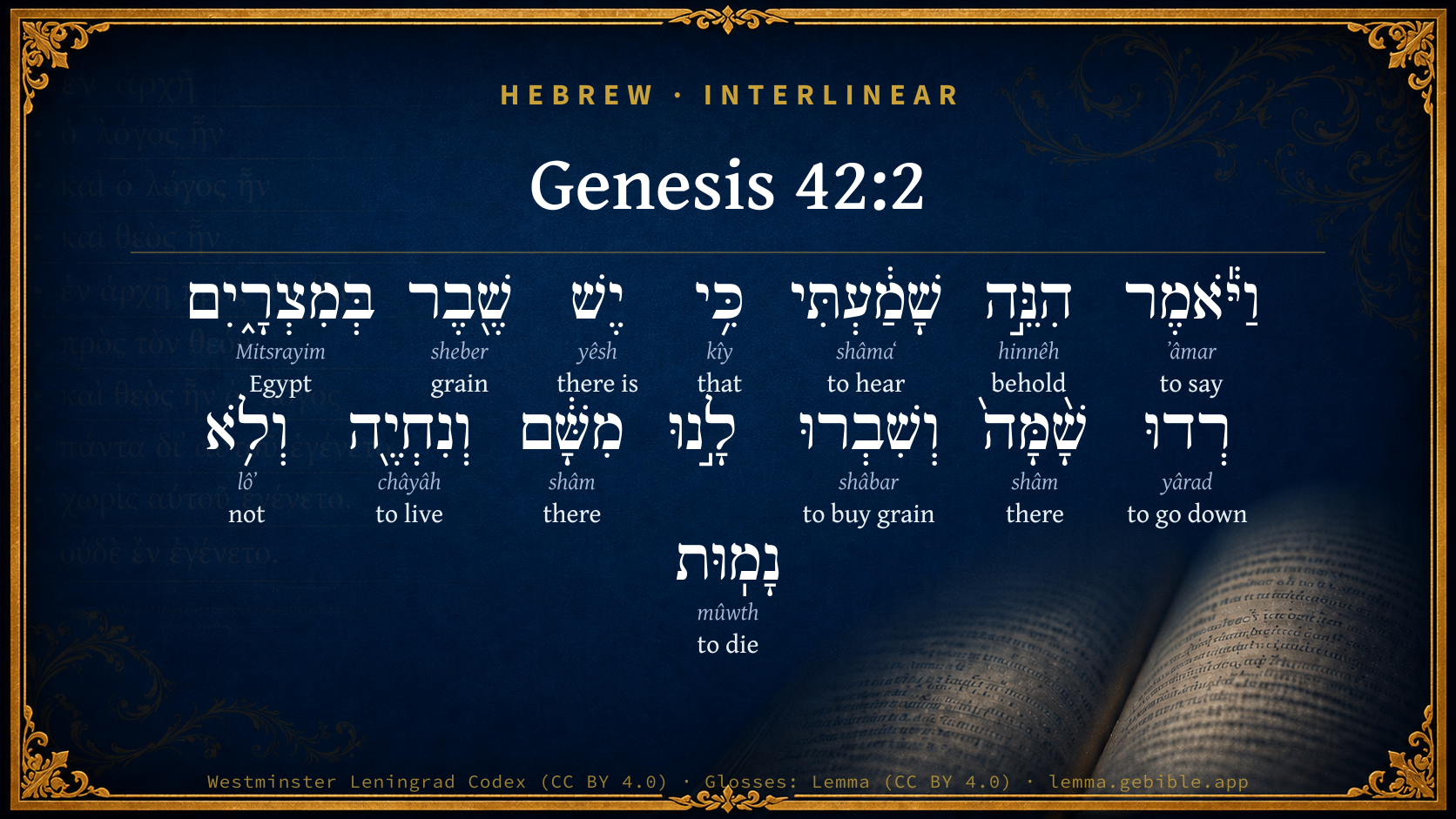
  1. וַיֹּ֕אמֶר ʼâmar H559 “and · to say” Conjunction + Verb, Qal, Sequential Imperfect, 3rd Person, Masculine, Singular
  2. הִנֵּ֣ה hinnêh H2009 “behold” Particle, Demonstrative
  3. שָׁמַ֔עְתִּי shâmaʻ H8085 “to hear” Verb, Qal, Perfect, 1st Person, Common, Singular
  4. כִּ֥י kîy H3588 “that” Conjunction
  5. יֶשׁ yêsh H3426 “there is” Particle, Demonstrative
  6. בְּמִצְרָ֑יִם Mitsrayim H4714 “in/at · Egypt” Preposition + Noun, Proper
  7. רְדוּ yârad H3381 “go down” Verb, Qal, Imperative, 2nd Person, Masculine, Plural
  8. שָׁ֨מָּה֙ shâm H8033 “there · toward” Adverb + Suffix, Demonstrative
  9. וְשִׁבְרוּ shâbar H7666 “and · buy grain” Conjunction + Verb, Qal, Imperative, 2nd Person, Masculine, Plural
  10. מִשָּׁ֔ם shâm H8033 “from · there” Preposition + Adverb
  11. וְנִחְיֶ֖ה châyâh H2421 “and · to live” Conjunction + Verb, Qal, Imperfect, 1st Person, Common, Plural
  12. וְלֹ֥א lôʼ H3808 “and · not” Conjunction + Particle, Negative
  13. נָמֽוּת mûwth H4191 “to die” Verb, Qal, Imperfect, 1st Person, Common, Plural

About this verse

These counts appear in no published source. They are computed here, from the morphology-tagged text and Lemma’s own curated glosses. What Lemma adds →

15
words
13
distinct lemmas
Pentateuch
section

Notable vocabulary

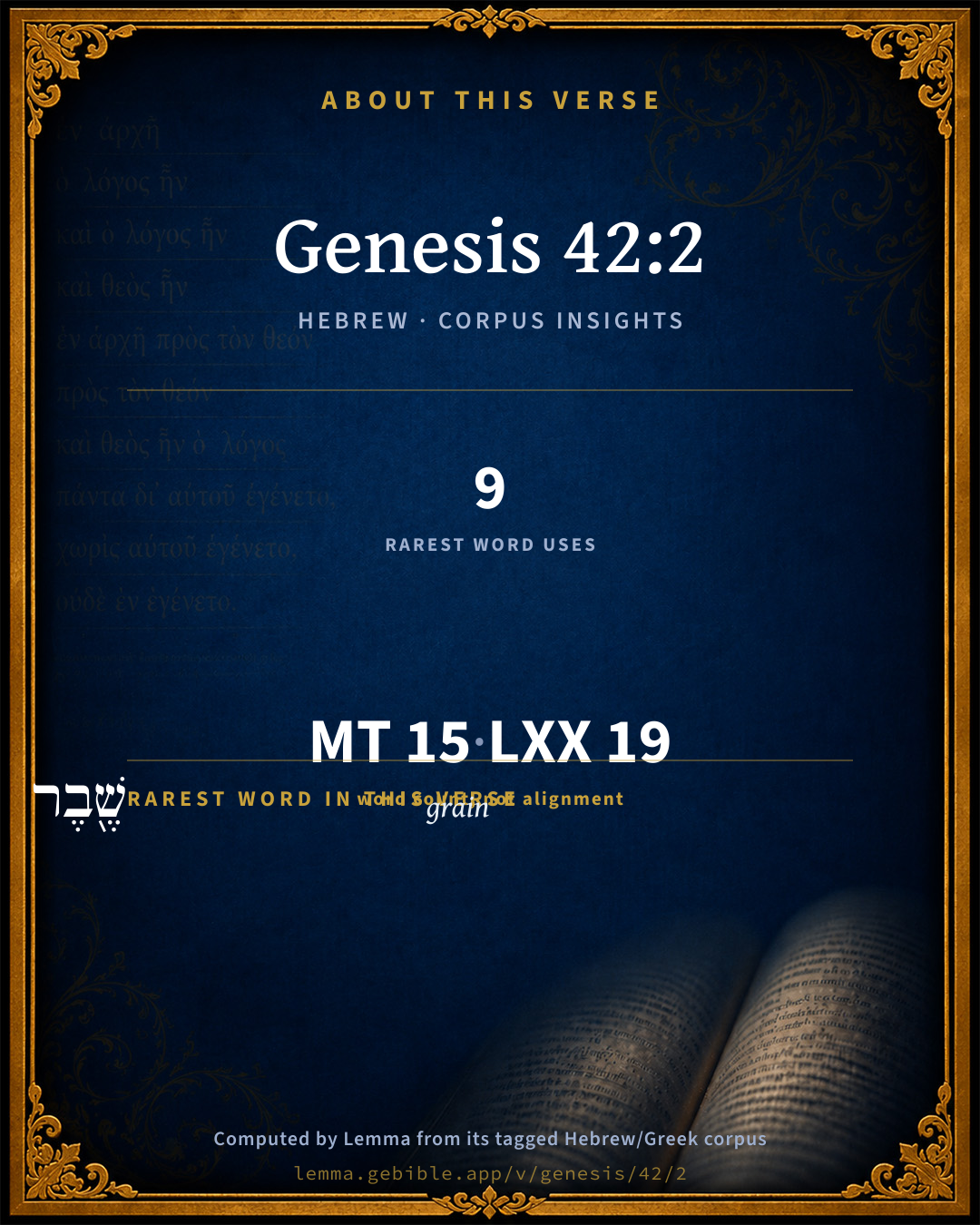
The rarest word here is שֶׁ֖בֶר grain H7668 — appearing just 9 times in the whole Hebrew Bible.

Shared distinctive vocabulary

שֶׁ֖בֶר grain H7668 occurs in 9 verses of the Hebrew Bible. Also found in:

Grammatical profile

  • 6 verbs
  • 2 nouns
  • 1 preposition
  • 1 conjunction
  • 2 adverbs
  • 3 particles

Verb forms

  • וַיֹּ֕אמֶר Qal · Sequential Imperfect
  • שָׁמַ֔עְתִּי Qal · Perfect
  • רְדוּ Qal · Imperative
  • וְשִׁבְרוּ Qal · Imperative
  • וְנִחְיֶ֖ה Qal · Imperfect
  • נָמֽוּת Qal · Imperfect

Repetition

A word recurs within this verse — often emphatic in Hebrew:

  • שָׁ֨מָּה֙ there H8033 ×2

Hebrew & Septuagint length

In English translation the verse runs 29 words from the Hebrew and 27 from the Septuagint (LXX English) — closely comparable.

A rough comparison of the two English renderings, which tokenize alike — not a word-level alignment.

Word counts can differ between the Hebrew and the Greek without any difference in meaning — e.g. the Hebrew direct-object marker אֵת has no separate Greek word, and Greek often adds the article ὁ.

In the original languages it is 15 Hebrew tokens and 19 Greek tokens — but the two are counted differently (Hebrew bundles its prefixes and suffixes into one token; the Greek is in lemma form), so that isn’t a like-for-like length.

Cross-references

7

Topical passages linked to Genesis 42:2 in the Treasury of Scripture Knowledge — connected by theme and wording, ordered by reader-vote popularity; previews shown in the World English Bible.

  • Genesis 43:8 Judah said to Israel, his father, "Send the boy with me, and we will arise and go, so that we may live, and not die, both we, and you, and also our little ones.
  • Genesis 43:2 It happened, when they had eaten up the grain which they had brought out of Egypt, their father said to them, "Go again, buy us a little more food."
  • Genesis 43:4 If you will send our brother with us, we will go down and buy you food,
  • Genesis 45:9 Hurry, and go up to my father, and tell him, 'This is what your son Joseph says, "God has made me lord of all Egypt. Come down to me. Don't wait.
  • Psalms 118:17 I will not die, but live, And declare Yah's works.
  • Isaiah 38:1 In those days was Hezekiah sick to death. Isaiah the prophet the son of Amoz came to him, and said to him, Thus says Yahweh, Set your house in order; for you shall die, and not live.
  • Matthew 4:4 But he answered, "It is written, 'Man shall not live by bread alone, but by every word that proceeds out of the mouth of God.'"

Cross-references courtesy of OpenBible.info (CC BY 4.0).

Hebrew and Greek witnesses Masoretic Hebrew ↔ Greek Septuagint

The same verse in the two great witnesses to the Old Testament, shown verse-for-verse.

These are two independent witnesses, not word-aligned to each other, and the Septuagint is shown in lemma (dictionary) form.

Hebrew Genesis 42:2 Masoretic · Westminster Leningrad Codex

וַיֹּ֕אמֶר הִנֵּ֣ה שָׁמַ֔עְתִּי כִּ֥י יֶשׁ שֶׁ֖בֶר בְּמִצְרָ֑יִם רְדוּ שָׁ֨מָּה֙ וְשִׁבְרוּ לָ֣נוּ מִשָּׁ֔ם וְנִחְיֶ֖ה וְלֹ֥א נָמֽוּת

He said, "Behold, I have heard that there is grain in Egypt. Go down there, and buy for us from there, so that we may live, and not die."

World English Bible · Public Domain

Greek LXX Genesis 42:2 Septuagint · lemma form

ἰδού ἀκούω ὅτι εἰμί σῖτος ἐν αἴγυπτος καταβαίνω ἐκεῖ καί πρίαμαι ἐγώ μικρός βρῶμα ἵνα ζάω καί μή ἀποθνήσκω

Behold, I have heard that there is corn in Egypt; go down there, and buy for us a little food, that we may live, and not die.

LXX2012 (modern English Septuagint) · Public Domain

On this verse, The Pulpit Commentary discusses the Septuagint’s reading. Read the note in Commentary ↓

Hebrew: Westminster Leningrad Codex (CC BY 4.0). Greek: Septuagint (public domain); English from LXX2012 (modern English Septuagint) (Public Domain). How the Septuagint differs from the Hebrew →

Targum (Aramaic paraphrase)

2

The Targum is the ancient Jewish Aramaic paraphrase of the Hebrew Scriptures — an interpretive translation, not the Hebrew text itself. Onkelos (literal) and Pseudo-Jonathan (expansive) render the Torah, and Jonathan the Prophets. Coverage is partial: where no permissively-licensed English translation exists for a verse, only the Aramaic is shown. This is verse-level text, not a word-by-word alignment to the Hebrew.

  1. Targum Onkelos Torah (Genesis–Deuteronomy)
    וַאֲמַר הָא שְׁמָעִית אָמְרִין אֲרֵי אִית עִיבוּרָא מִזְדַּבַּן בְּמִצְרָיִם חוּתוּ תַמָּן וּזְבוּנוּ לָנָא מִּתַּמָּן וְנֵחֵי וְלָא נְמוּת

    (no public-domain English translation for this verse)

    Targum Onkelos — Aramaic: “Onkelos Genesis” (public domain); “Onkelos Exodus” (public domain); “Onkelos Leviticus” (public domain); “Onkelos Numbers” (public domain); “Onkelos Deuteronomy” (public domain). English: “Sefaria Community Translation” (CC0 1.0 (public-domain dedication)); “J.W. Etheridge. The Targums of Onkelos and Jonathan Ben Uzziel on the Pentateuch. London: Longmans, Green, 1862” (public domain). Text via Sefaria.

  2. Targum Pseudo-Jonathan Torah (Genesis–Deuteronomy)
    וַאֲמַר הָא שְׁמָעִית אֲרוּם אִית עִיבּוּרָא מִזְדַבֵּן בְּמִצְרַיִם חוּתוּ תַּמָן וְזַבּוּנוּ לָנָא מִן תַּמָן וְנֵחֵי וְלָא נְמוּת

    And he said, Behold, I have heard that corn is sold in Mizraim: go down thither and buy for us from thence, that we may live and not die.

    Targum Pseudo-Jonathan — Aramaic: “Targum Jonathan on Genesis” (public domain); “Targum Jonathan on Exodus” (public domain); “Targum Jonathan on Leviticus” (public domain); “Targum Jonathan on Numbers” (public domain); “Targum Jonathan on Deuteronomy” (public domain). English: “The Targum of Jonathan ben Uzziel, trans. J. W. Etheridge, London, 1862” (public domain). Text via Sefaria.

Commentary

Notes on Genesis 42:2 from classic Christian and Jewish commentators (each source and its license shown beneath its notes). The classic Christian expositions comment on the surrounding passage and are grouped to its opening verse, so a note may address several verses; the Jewish commentaries on the Tanakh (Rashi and others) are per-verse, so they appear only where the commentator wrote on this verse.

Lemma curates 59 commentaries, every one of them public domain or Creative Commons licensed, each selected and text-cleaned for this edition rather than reprinted as found. About our sources →

Trapp's Complete Commentary

John Trapp

Gen 42:2 And he said, Behold, I have heard that there is corn in Egypt: get you down thither, and buy for us from thence; that we may live, and not die.

Ver. 2. Get you down thither,] Here the divine decree of Israel’s sojourning and suffering in Egypt begins to be fulfilled, by a wonderful providence. The ruinous of Joseph’s barns invites Jacob, first to send, and then to go thither himself for relief. Shall not the fulness that is in Christ {Joh 1:16} incite and entice us to come to him; as bees to a meadow full of flowers; as merchants to the Indies full of spices and othex riches; as the Queen of Sheba to Solomon full of wisdom; as Jacob’s sons to Egypt full of corn, in that extreme famine; that we may return full fraught with treasures of truth and grace? "It pleased God, that in him should all fulness dwell." {Col 1:19} And his fulnees is not only repletive, but diffusive; a fuiness of plenty and abundance, but of bounty also and redundance. He was "anointed with the oil of gladness," not only "above," but for "his fellows." {Heb 1:9}

That we may live, and not die.] Saints have their share in common calamities. Jacob tasted of the famine, as well as his neighbonrs the Canaanites; so had Abraham and Isaac done before him. Both the good figs and bad figs were carried captive; {Jer 24:5} the corn as well as the weeds is cut down at harvest, &c.

John Trapp, A Commentary or Exposition upon All the Books of the Old and New Testament (1647–1656) — public domain. Text from a community e-Sword module.

The Cambridge Bible for Schools and Colleges

gen. ed. J. J. S. Perowne

2. down thither] Egypt being regarded as on the low ground, in comparison with Palestine; cf. Gen_12:10, Gen_13:1, Gen_43:4; Gen_43:15, Gen_46:3-4.

The Cambridge Bible for Schools and Colleges (gen. ed. J. J. S. Perowne; Cambridge University Press, 1878–1918) — public domain. Text from a community e-Sword module.

John Gill's Exposition

And he said, behold, I have heard that there is corn in Egypt,.... This explains what is meant by the phrase he saw, one sense being put for another:

get ye down thither; as fast as you can without delay; Egypt lay lower than Canaan, and therefore they are bid to go down, as when they went from thence to Canaan they are said to go up, Gen 45:25,

and buy for us from thence, that we may live, and not die; which shows the famine was very pressing, since, unless they could buy corn from Egypt they could not live, but must die.

John Gill's Exposition of the Whole Bible (1746–1763) — public domain (CC PDM 1.0). Text via the HelloAO Bible API.

Matthew Poole's English Annotations

I have heard: this word explains the word saw, Gen 42:1.

Get you down; for Egypt was lower than Canaan; whence, on the contrary, they are said to go up to Canaan, Gen 45:9.

That we may live, and not die; an emphatical repetition of the same thing, used here to make them more sensible of their danger.

Matthew Poole's English Annotations on the Holy Bible (1683–1685) — public domain. Text from a community e-Sword/MySword module.

The Pulpit Commentary

And he said, Behold, I have heard (this does not imply that the rumor had not also reached Jacob"s sons, but only that the proposal to visit Egypt did not originate with them) that there is corn rb,v, ut supra, sitov (LXX.), triticum (Vulgate)in Egypt: get you down thither. That Jacob did not, like Abraham (Gen_12:10) and Isaac, (Gen_26:2) propose to remove his family to Egypt, may be explained either by the length of the journey, which was too great for so large a household, or by the circumstance that the famine prevailed in Egypt as well as Canaan (Gerlach). That he entrusted his sons, and not his servants, with the mission, though perhaps dictated by a sense of its importance (Lawson), was clearly of Divine arrangement for the further accomplishment of the Divine plan concerning Joseph and his brethren. And buy (i.e. buy corn, the verb being a denominative from rb,v, corn) for us from thence. From this it is apparent that the hitherto abundant flocks and herds of the patriarchal family had been greatly reduced by the long-continued and severe drought, thus requiring them to obtain food from Egypt, if either any portion of their flocks were to be saved, or themselves to escape starvation, as the patriarch explained to his sons. That we may (literally, and we shall) live, and not die.

The Pulpit Commentary (1880–1919), ed. H.D.M. Spence-Jones & Joseph S. Exell — public domain. Text from a community e-Sword module.

John Wesley's Explanatory Notes

Get you down thither - Masters of families must not only pray for daily bread for their families, but must with care and industry provide it.

John Wesley, Explanatory Notes Upon the Whole Bible (1754–1765) — public domain. Text via the GEBible commentary corpus.

Rashi

Rabbi Shlomo Yitzchaki (Rashi)

רדו שמה GO DOWN THITHER — He did not say to them לכו “Go ye” but רדו an allusion to the 210 years during which Israel was to be enslaved in Egypt corresponding to the numerical value of (רד״ו (210 (Genesis Rabbah 91:2).

Rashi on the Tanakh — English translations: “The Judaica Press complete Tanach with Rashi, translated by A. J. Rosenberg” (CC BY 4.0); “Pentateuch with Rashi's commentary by M. Rosenbaum and A.M. Silbermann, 1929-1934” (public domain); “The Metsudah Tanach series, Lakewood, N.J” (CC BY 4.0); and “The Book of Joshua, Metsudah Publications, 1997” (CC BY 4.0). Text via Sefaria.

Lesson kit

Teaching starters — assembled from the data on this page, not authored interpretation. Every prompt links to the verse data it draws on. Edit before teaching.

Genesis, in the Pentateuch, opens this verse with 15 words (13 distinct Hebrew lemmas). Its most distinctive word is sheber (“grain”). A historical commentator’s framing appears above. Read the whole chapter for the surrounding context.

Discussion questions

  1. The word sheber carries the sense “grain.” How does it shape the verse?
  2. Genesis 42:1 shares the word «grain» with this verse. How do the two illuminate each other?
  3. “there” occurs 2× in this one verse. What is the effect of the repetition?
  4. The translations on this page render this verse differently — a whole-verse word diff, not a word-by-word alignment. What might account for the different wordings?
  5. The verb «וַיֹּ֕אמֶר» is Qal Sequential Imperfect. How does its form color the action?
  6. Reading how Trapp's Complete Commentary and The Cambridge Bible for Schools and Colleges read this verse, where do the two commentators agree and where do they part?

Things to notice

Reading settings

Reading text

Shown beneath each verse's original-language words.

Old Testament
Old Testament edition

Read the OT as the Masoretic Hebrew (MT) or the Greek Septuagint (LXX).

English shown for the Greek Septuagint (in the Hebrew ↔ Greek comparison).

Comparing translations? Open the Compare panel on any verse page to stack up to four side by side.