
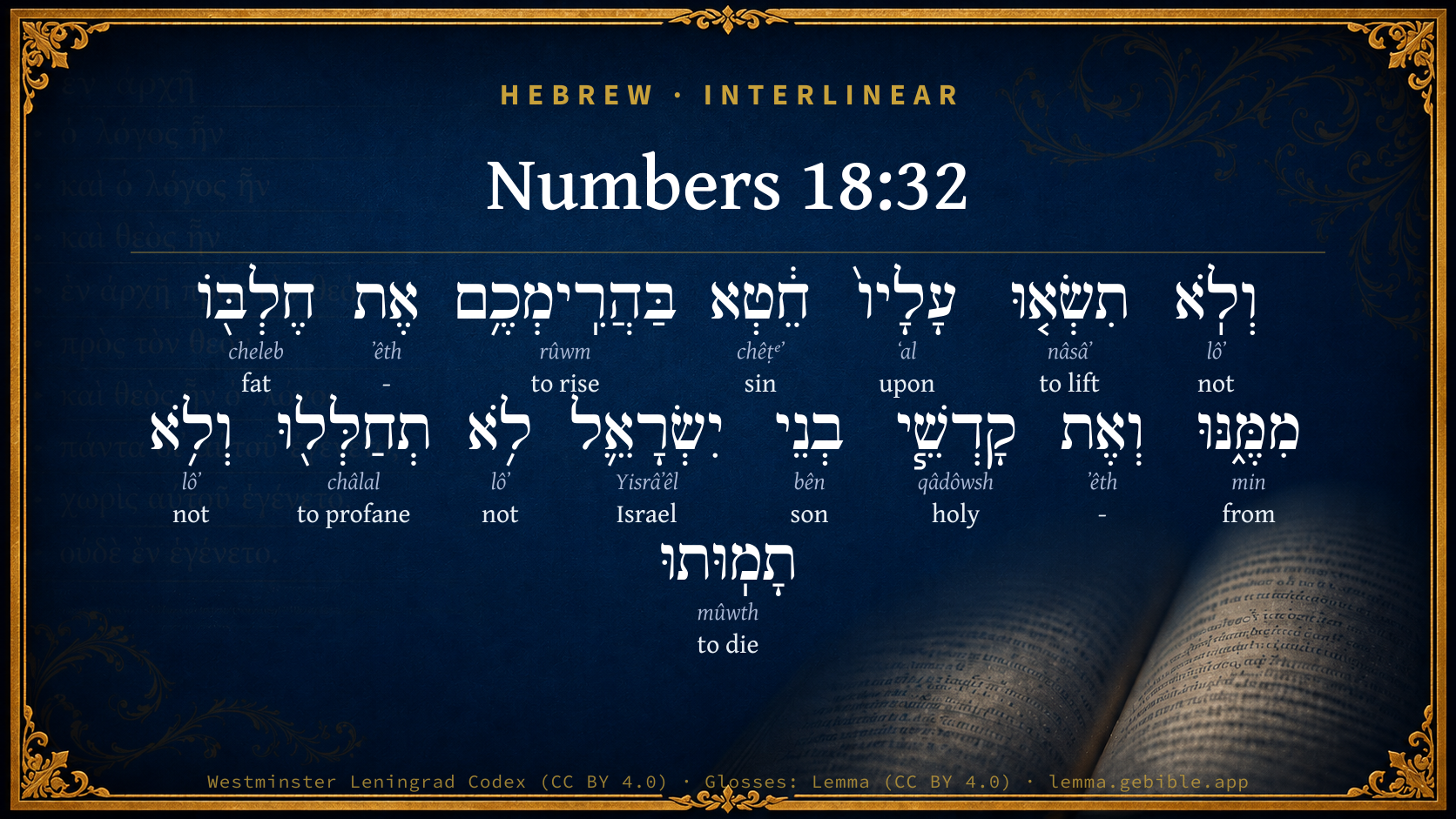
Numbers 18:32

Hebrew (Westminster Leningrad Codex) Numbers 18:32 appears in the Hebrew Old Testament. The text above is from the Westminster Leningrad Codex. Each word links to its Strong’s number, a concise gloss, and parsing drawn from the Open Scriptures Hebrew Bible morphology. Click any word for its full Brown-Driver-Briggs (BDB) entry.
Download image
Cite this verse

Numbers 18:32 (World English Bible). Public Domain. Lemma interlinear Bible study tool, https://lemma.gebible.app/v/numbers/18/32.

Show BibTeX & RIS
BibTeX
RIS
English Translation
You shall bear no sin by reason of it, when you have heaved from it the best of it: and you shall not profane the holy things of the children of Israel, that you not die.
World English Bible · Public Domain
Download a study sheet

One document with this verse’s original text, its word-by-word gloss line, the meaning frame, cross-references with their text, attributed commentary, and full source and license credits — printable, and it pastes into notes with its structure intact.

This verse Autodidact and up

Study sheet (.html) Plain text (.txt)

A passage Seminary Student

Up to 50 verses in one chapter. A passage sheet keeps up to 6 commentary sources and 12 cross-references per verse, in the order this page ranks them, and says so on the sheet whenever that leaves anything out. Ask for a single verse and you get the Autodidact verse sheet above.

Everything on this page stays free to read, with no account — the sheet is a download of what is already on screen, not access to it.

Want to remove ads? Support Godless Engineer
Compare translations 3

The same verse in 3 English versions, stacked beneath the original-language interlinear above. Click any original word for its lexicon entry.

Each is an independent rendering of the whole verse — the interlinear is not word-aligned to these translations.

Highlighted words mark where these versions differ — a whole-verse word diff, not a word-by-word alignment.

  • World English Bible Public Domain
    You shall bear no sin by reason of it, when you have heaved from it the best of it: and you shall not profane the holy things of the children of Israel, that you not die.
  • King James Version Public Domain
    And ye shall bear no sin by reason of it, when ye have heaved from it the best of it: neither shall ye pollute the holy things of the children of Israel, lest ye die.
  • unfoldingWord Literal Text CC BY-SA 4.0
    And you shall not lift up sin upon it when you raise its fat from it. And the holy things of the sons of Israel you shall not profane, and you shall not die.’”

unfoldingWord Literal Text — © unfoldingWord, licensed CC BY-SA 4.0. Word-aligned USFM3 via Door43 (git.door43.org/unfoldingWord/en_ult).

Versions to compare (up to 4)

3 of 4 selected

Show all 18 translations

Every available English version of this verse, each an independent rendering of the whole verse.

  • World English Bible Public Domain
    You shall bear no sin by reason of it, when you have heaved from it the best of it: and you shall not profane the holy things of the children of Israel, that you not die.
  • Berean Standard Bible Public Domain
    Once you have presented the best part of it, you will not incur guilt because of it. But you must not defile the sacred offerings of the Israelites, or else you will die.’”
  • Majority Standard Bible Public Domain
    Once you have presented the best part of it, you will not incur guilt because of it. But you must not defile the sacred offerings of the Israelites, or else you will die.’”
  • King James Version Public Domain
    And ye shall bear no sin by reason of it, when ye have heaved from it the best of it: neither shall ye pollute the holy things of the children of Israel, lest ye die.
  • American Standard Version (1901) Public Domain
    And ye shall bear no sin by reason of it, when ye have heaved from it the best thereof: and ye shall not profane the holy things of the children of Israel, that ye die not.
  • Revised Version (1885) Public Domain
    And ye shall bear no sin by reason of it, when ye have heaved from it the best thereof: and ye shall not profane the holy things of the children of Israel, that ye die not.
  • Geneva Bible (1599) Public Domain
    And ye shall beare no sinne by the reason of it, when ye haue offred the fatte of it: neither shall ye pollute the holy things of the children of Israel, lest ye die.
  • Douay-Rheims (1899) Public Domain
    And you shall not sin in this point, by reserving the choicest and fat things to yourselves, lest you profane the oblations of the children of Israel, and die.
  • Young's Literal Translation Public Domain
    and ye bear no sin for it, in your lifting up its fat out of it, and the holy things of the sons of Israel ye do not pollute, and ye die not.'
  • Literal Standard Version CC BY-SA 4.0
    and you bear no sin for it in your lifting up its fat out of it, but you do not defile the holy things of the sons of Israel, and you do not die.”
  • Unlocked Literal Bible CC BY-SA 4.0
    You will not incur any guilt by eating and drinking it, if you have presented to Yahweh the best of what you have received. But you must not profane the holy offerings of the people of Israel, or you will die.'”
  • unfoldingWord Literal Text CC BY-SA 4.0
    And you shall not lift up sin upon it when you raise its fat from it. And the holy things of the sons of Israel you shall not profane, and you shall not die.’”
  • Darby Bible Public Domain
    And ye shall bear no sin by reason of it, if ye heave from it the best of it; and ye shall not profane the holy things of the children of Israel, lest ye die.
  • World Messianic Bible Public Domain
    You shall bear no sin by reason of it, when you have heaved from it its best. You shall not profane the holy things of the children of Israel, that you not die.’”
  • Webster's Bible Public Domain
    And ye shall bear no sin by reason of it, when ye have heaved from it the best of it: neither shall ye pollute the holy things of the children of Israel, lest ye die.
  • Free Bible Version CC BY-SA 4.0
    You will not be considered to have sinned if you have presented the best part of it. But if you treat the sacred offerings of the Israelites with disrespect you will die.’”
  • Bible in Basic English Public Domain
    And no sin will be yours on account of it, when the best of it has been lifted up on high; you are not to make a wrong use of the holy things of the children of Israel, so that death may not overtake you.
  • JPS Tanakh (1917) Public Domain
    And ye shall bear no sin by reason of it, seeing that ye have set apart from it the best thereof; and ye shall not profane the holy things of the children of Israel, that ye die not.'

Literal Standard Version (2020), Covenant Press — licensed CC BY-SA 4.0. Text via the HelloAO Bible API (eBible.org). Unlocked Literal Bible (unfoldingWord) — licensed CC BY-SA 4.0. Text via the HelloAO Bible API (eBible.org). unfoldingWord Literal Text — © unfoldingWord, licensed CC BY-SA 4.0. Word-aligned USFM3 via Door43 (git.door43.org/unfoldingWord/en_ult). Free Bible Version, Dr. Jonathan Gallagher — licensed CC BY-SA 4.0. Text via the HelloAO Bible API (eBible.org).

Word by word

More ways to search: Search by grammar → Find every occurrence → Compare this word →

Practice this passage: Drill this verse → Learn its vocabulary →

חֵ֔טְא
chêṭᵉʼ
H2399
“sin”
Noun, Common, Masculine, Singular, Absolute
Part of Speech
Noun
Type
Common
Gender
Masculine
Number
Singular
State
Absolute
Full BDB Definition

Origin: from H2398

TWOT: 638a

sin - sin - guilt for sin - punishment for sin
  1. וְלֹֽא lôʼ H3808 “and · not” Conjunction + Particle, Negative
  2. תִשְׂא֤וּ nâsâʼ H5375 “to lift” Verb, Qal, Imperfect, 2nd Person, Masculine, Plural
  3. עָלָיו֙ ʻal H5921 “upon · him” Preposition + Suffix, Personal, 3rd Person, Masculine, Singular
  4. בַּהֲרִֽימְכֶ֥ם rûwm H7311 “in/at · to rise · you” Preposition + Verb, Hiphil, Infinitive Construct + Suffix, Personal, 2nd Person, Masculine, Plural
  5. אֶת ʼêth H853 “-” Particle, Direct Object
  6. חֶלְבּ֖וֹ cheleb H2459 “fat · his” Noun, Common, Masculine, Singular, Construct + Suffix, Personal, 3rd Person, Masculine, Singular
  7. מִמֶּ֑נּוּ min H4480 “from · us” Preposition + Suffix, Personal, 1st Person, Common, Plural
  8. וְאֶת ʼêth H853 “and · -” Conjunction + Particle, Direct Object
  9. קָדְשֵׁ֧י qâdôwsh H6918 “holy ones of” Noun, Common, Masculine, Plural, Construct
  10. בְנֵי bên H1121 “sons of” Noun, Common, Masculine, Plural, Construct
  11. יִשְׂרָאֵ֛ל Yisrâʼêl H3478 “Israel” Noun, Proper
  12. לֹ֥א lôʼ H3808 “not” Particle, Negative
  13. תְחַלְּל֖וּ châlal H2490 “to profane” Verb, Piel, Imperfect, 2nd Person, Masculine, Plural
  14. וְלֹ֥א lôʼ H3808 “and · not” Conjunction + Particle, Negative
  15. תָמֽוּתוּ mûwth H4191 “to die” Verb, Qal, Imperfect, 2nd Person, Masculine, Plural

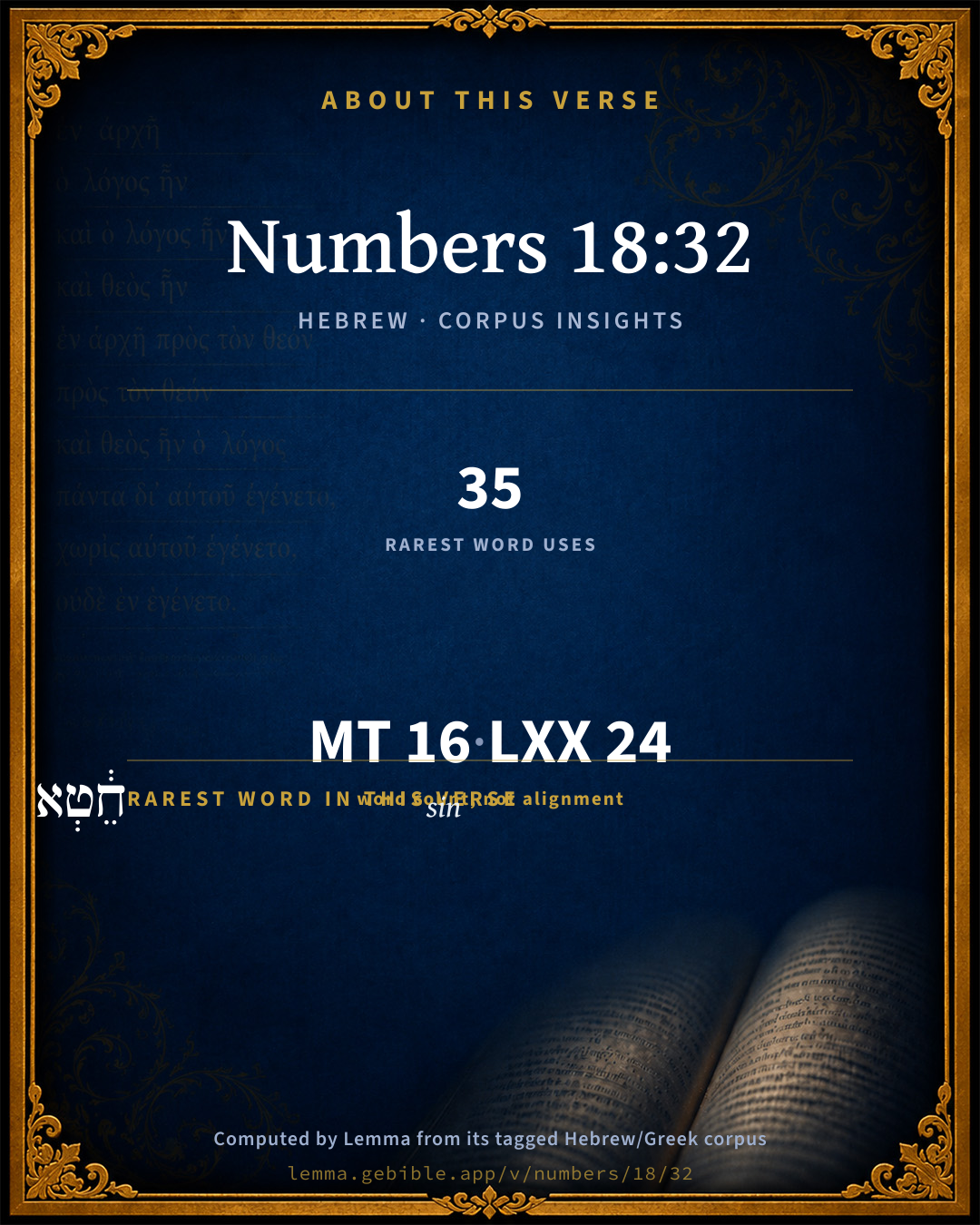
About this verse

These counts appear in no published source. They are computed here, from the morphology-tagged text and Lemma’s own curated glosses. What Lemma adds →

16
words
13
distinct lemmas
Pentateuch
section

Shared distinctive vocabulary

חֵ֔טְא sin H2399 occurs in 34 verses of the Hebrew Bible. Also found in:

Grammatical profile

  • 4 verbs
  • 5 nouns
  • 2 prepositions
  • 5 particles

Verb forms

  • תִשְׂא֤וּ Qal · Imperfect
  • בַּהֲרִֽימְכֶ֥ם Hiphil · Infinitive Construct
  • תְחַלְּל֖וּ Piel · Imperfect
  • תָמֽוּתוּ Qal · Imperfect

Repetition

A word recurs within this verse — often emphatic in Hebrew:

  • וְלֹֽא not H3808 ×3

Hebrew & Septuagint length

In English translation the verse runs 36 words from the Hebrew and 39 from the Septuagint (LXX English) — closely comparable.

A rough comparison of the two English renderings, which tokenize alike — not a word-level alignment.

Word counts can differ between the Hebrew and the Greek without any difference in meaning — e.g. the Hebrew direct-object marker אֵת has no separate Greek word, and Greek often adds the article ὁ.

In the original languages it is 16 Hebrew tokens and 24 Greek tokens — but the two are counted differently (Hebrew bundles its prefixes and suffixes into one token; the Greek is in lemma form), so that isn’t a like-for-like length.

Cross-references

7

Topical passages linked to Numbers 18:32 in the Treasury of Scripture Knowledge — connected by theme and wording, ordered by reader-vote popularity; previews shown in the World English Bible.

  • Leviticus 19:8 but everyone who eats it shall bear his iniquity, because he has profaned the holy thing of Yahweh, and that soul shall be cut off from his people.
  • Leviticus 22:2 "Tell Aaron and his sons to separate themselves from the holy things of the children of Israel, which they make holy to me, and that they not profane my holy name. I am Yahweh.
  • Leviticus 22:15–16 The priests shall not profane the holy things of the children of Israel, which they offer to Yahweh,
  • Numbers 18:22 Henceforth the children of Israel shall not come near the tent of meeting, lest they bear sin, and die.
  • Malachi 1:7 You offer polluted bread on my altar. You say, 'How have we polluted you?' In that you say, 'Yahweh's table contemptible.'
  • 1 Corinthians 11:27 Therefore whoever eats this bread or drinks the Lord's cup in a manner unworthy of the Lord will be guilty of the body and the blood of the Lord.
  • 1 Corinthians 11:29 For he who eats and drinks in an unworthy manner eats and drinks judgment to himself, if he doesn't discern the Lord's body.

Cross-references courtesy of OpenBible.info (CC BY 4.0).

Hebrew and Greek witnesses Masoretic Hebrew ↔ Greek Septuagint

The same verse in the two great witnesses to the Old Testament, shown verse-for-verse.

These are two independent witnesses, not word-aligned to each other, and the Septuagint is shown in lemma (dictionary) form.

Hebrew Numbers 18:32 Masoretic · Westminster Leningrad Codex

וְלֹֽא תִשְׂא֤וּ עָלָיו֙ חֵ֔טְא בַּהֲרִֽימְכֶ֥ם אֶת חֶלְבּ֖וֹ מִמֶּ֑נּוּ וְאֶת קָדְשֵׁ֧י בְנֵי יִשְׂרָאֵ֛ל לֹ֥א תְחַלְּל֖וּ וְלֹ֥א תָמֽוּתוּ

You shall bear no sin by reason of it, when you have heaved from it the best of it: and you shall not profane the holy things of the children of Israel, that you not die.

World English Bible · Public Domain

Greek LXX Numbers 18:32 Septuagint · lemma form

καί οὐ λαμβάνω διά αὐτός ἁμαρτία ὅτι ἄν ἀποαἱρέω ὁ ἀπαρχή ἀπό αὐτός καί ὁ ἅγιος ὁ υἱός ἰσραήλ οὐ βεβηλόω ἵνα μή ἀποθνήσκω

And you⌃ shall not bear sin by reason of it, for you⌃ shall have offered an offering of first fruits from it, and you⌃ shall not profane the holy things of the children of Israel, that you⌃ die not.

LXX2012 (modern English Septuagint) · Public Domain

Hebrew: Westminster Leningrad Codex (CC BY 4.0). Greek: Septuagint (public domain); English from LXX2012 (modern English Septuagint) (Public Domain). How the Septuagint differs from the Hebrew →

Targum (Aramaic paraphrase)

2

The Targum is the ancient Jewish Aramaic paraphrase of the Hebrew Scriptures — an interpretive translation, not the Hebrew text itself. Onkelos (literal) and Pseudo-Jonathan (expansive) render the Torah, and Jonathan the Prophets. Coverage is partial: where no permissively-licensed English translation exists for a verse, only the Aramaic is shown. This is verse-level text, not a word-by-word alignment to the Hebrew.

  1. Targum Onkelos Torah (Genesis–Deuteronomy)
    וְלָא תְקַבְּלוּן עֲלוֹהִי חוֹבָא בְּאַפְרָשׁוּתְכוֹן יָת שׁוּפְרֵיהּ מִנֵיהּ וְיָת קוּדְשַׁיָא דִבְנֵי יִשְׂרָאֵל לָא תְחַלְלוּן וְלָא תְמוּתוּן

    (no public-domain English translation for this verse)

    Targum Onkelos — Aramaic: “Onkelos Genesis” (public domain); “Onkelos Exodus” (public domain); “Onkelos Leviticus” (public domain); “Onkelos Numbers” (public domain); “Onkelos Deuteronomy” (public domain). English: “Sefaria Community Translation” (CC0 1.0 (public-domain dedication)); “J.W. Etheridge. The Targums of Onkelos and Jonathan Ben Uzziel on the Pentateuch. London: Longmans, Green, 1862” (public domain). Text via Sefaria.

  2. Targum Pseudo-Jonathan Torah (Genesis–Deuteronomy)
    וְלָא תְקַבְּלוּן עֲלוֹי חוֹבָא בִּזְמַן אַפְרָשׁוּתְכוֹן יַת שְׁפַר טוּבֵיהּ מִינֵיהּ וּבֵיהּ לְאוֹכְלֵי מִינֵיהּ לִדְסָאִיב וְיַת קוּדְשַּׁיָא דִבְנֵי יִשְ¦רָאֵל לָא תִפְסוּן וְלָא תְמוּתוּן

    And you shall not contract guilt by it, at what time you set apart the finest and best of it, by any one eating of it who is unclean; neither shall you profane the consecrated things of the children of Israel, lest you die.

    Targum Pseudo-Jonathan — Aramaic: “Targum Jonathan on Genesis” (public domain); “Targum Jonathan on Exodus” (public domain); “Targum Jonathan on Leviticus” (public domain); “Targum Jonathan on Numbers” (public domain); “Targum Jonathan on Deuteronomy” (public domain). English: “The Targum of Jonathan ben Uzziel, trans. J. W. Etheridge, London, 1862” (public domain). Text via Sefaria.

Commentary

Notes on Numbers 18:32 from classic Christian and Jewish commentators (each source and its license shown beneath its notes). The classic Christian expositions comment on the surrounding passage and are grouped to its opening verse, so a note may address several verses; the Jewish commentaries on the Tanakh (Rashi and others) are per-verse, so they appear only where the commentator wrote on this verse.

Lemma curates 59 commentaries, every one of them public domain or Creative Commons licensed, each selected and text-cleaned for this edition rather than reprinted as found. About our sources →

Joseph Benson's Commentary

Num 18:32. Neither shall ye pollute the holy things — As you will do, if you abuse their holy offerings, by reserving that entirely to yourselves which they offer to God, to be disposed as he hath appointed, namely, part to you, and part to the priests. Thus we learn in what manner God regulated the offices of the priests and Levites, and how he provided for their subsistence. The tribe of Levi had no part nor inheritance in the land of Canaan as the other tribes had; but had for their share the tithes of the whole country; and the priests, in particular, had their portions of the sacrifices and offerings, and a tenth part of the tithes. By these means the ministers of religion were supported in a comfortable, decent manner, without being forced to neglect the duties of their function to provide for the necessities of the body. This proves that, in the Christian Church, provision should be made for the maintenance of those that serve in the sacred ministry, as St. Paul teaches: “They which minister about holy things, live by the things of the temple; and they which wait at the altar are partakers with the altar; even so hath the Lord ordained that they which preach the gospel, should live by the gospel.”

Joseph Benson's Commentary on the Old and New Testaments (1811–1818) — public domain. Text from a community e-Sword module.

Tyndale Open Study Notes

Tyndale Open Resources

18:32 The food tithes had a sacred origin as holy gifts of the people of Israel; they were not to turn these gifts into something common by neglecting to give a tithe to the priests.

Tyndale Open Study Notes — © Tyndale Open Resources, licensed CC BY-SA 4.0. Text via the HelloAO Bible API.

Geneva Bible (1599)

Geneva Bible translators

The offerings which the Israelites have offered to God.

Ye shall not be punished therefore.

Geneva Bible (1599) marginal notes — public domain. Text via Bolls.life.

Jamieson, Fausset & Brown

Robert Jamieson, A. R. Fausset & David Brown

ye shall bear no sin by reason of it, &c.--Neglect in having the best entailed sin in the use of such unhallowed food. And the holy things would be polluted by the reservation to themselves of what should be offered to God and the priests.

Next: Numbers Chapter 19

Jamieson, Fausset & Brown — Commentary Critical and Explanatory on the Whole Bible (1871) — public domain (CC PDM 1.0). Text via the HelloAO Bible API.

Ellicott's Commentary for English Readers

(32) And ye shall bear no sin . . . —i.e., shall not incur any guilt, or become liable to any punishment. (See Note on Num_18:22.)

A Bible Commentary for English Readers, edited by Charles John Ellicott (1878–1897) — public domain. Text from a community e-Sword module.

The Cambridge Bible for Schools and Colleges

gen. ed. J. J. S. Perowne

32. profane the holy things] i.e. the tithe of the tithe, which they would profane if they did not give it to the priests.

The Cambridge Bible for Schools and Colleges (gen. ed. J. J. S. Perowne; Cambridge University Press, 1878–1918) — public domain. Text from a community e-Sword module.

Albert Barnes' Notes on the Bible

Neither shall ye pollute ... - Rather, and by not polluting the holy things of the children of Israel, ye shall not die.

Albert Barnes' Notes on the Bible (1834–1885) — public domain. Text from a community e-Sword/MySword module.

Haydock's Catholic Bible Commentary

By, &c. Hebrew, "when you have made a heave-offering of the best of it; nor shall you profane the holy things of," &c. (Haydock) --- This they would do, if they gave the worst only to the priests. (Du Hamel) --- There were only three at this time; yet they received the 100th part of the produce of so many thousands. Well therefore might God say, I will fill the souls of the priests with fatness: and my people shall be filled with good things, Jeremias xxxi. 14. (Tirinus)

George Leo Haydock (1774–1849), Haydock's Catholic Family Bible and Commentary, 1859 edition — public domain. Excludes Psalms (Douay-Rheims chapter numbering differs from Protestant) and Deuterocanonical books (Catholic canon only).

Matthew Poole's English Annotations

The best of it; implying, that if they neglected this duty, they sinned in the use of such unhallowed food.

Neither shall ye pollute the holy things, as you will do, if you abuse their holy offerings, by reserving that entirely to yourselves which they offer to God to be disposed as he hath appointed, to wit, part to you, and part to the priests.

Matthew Poole's English Annotations on the Holy Bible (1683–1685) — public domain. Text from a community e-Sword/MySword module.

Whedon's Commentary on the Bible

Daniel D. Whedon

32. Ye shall bear no sin — In the free use of the tithed tithe the Levites would violate no ceremonial law nor expose themselves to penalty.

Neither shall ye pollute — In this prohibition both priests and Levites are addressed. The holy things are to be exempt from profanation.

Mat_7:6, note.

Lest ye die — The attention of the Hebrews was directed more to a judicial, physical death than to a punishment after death. Yet even in the Pentateuch, מותand θανατος, death, sometimes implies the perdition and misery of that exclusion from the presence and favour of God which in the New Testament is called the second death. See Deu_30:19.

Daniel D. Whedon (gen. ed.), Commentary on the Old and New Testaments (1874–1909) — public domain. Text from a community e-Sword module.

The Pulpit Commentary

Ye shall bear no sin. wyl WactiAalo. They would not incur any guilty responsibility by enjoying it as and where they pleased. Neither shall ye pollute the holy things of the children of Israel, lest ye die. This seems to be the tree translation, and it conveyed a final warning. See Lev_22:2 for one very obvious way in which the Levites might pollute "holy things."

The Pulpit Commentary (1880–1919), ed. H.D.M. Spence-Jones & Joseph S. Exell — public domain. Text from a community e-Sword module.

John Wesley's Explanatory Notes

Neither shall ye pollute the holy things - As you will do, if you abuse their holy offerings, by reserving that entirely to yourselves, which they offer to God to be disposed as he hath appointed, namely, part to you, and part to the priests.

John Wesley, Explanatory Notes Upon the Whole Bible (1754–1765) — public domain. Text via the GEBible commentary corpus.

Keil & Delitzsch

C. F. Keil & F. Delitzsch

They would load no sin upon themselves by so doing (see Lev 19:17), if they only lifted off the best as tithe (for the priest), and did not desecrate the holy gifts, sc., by eating in all kinds of places, which was not allowed, according to Num 18:10, with regard to the most holy gifts. These regulations concerning the revenues of the priests and Levites were in perfect accordance with the true idea of the Israelitish kingdom of God. Whereas in heathen states, where there was an hereditary priestly caste, that caste was generally a rich one, and held a firm possession in the soil (in Egypt, for example; see at Gen 47:22), the Levites received no hereditary landed property in the land of Israel, but only towns to dwell in among the other tribes, with pasturage for their cattle (ch. 35), because Jehovah, the God of Israel, would be their inheritance. In this way their earthly existence as based upon the spiritual ground and soil of faith, in accordance with the calling assigned them to be the guardians and promoters of the commandments, statutes, and rights of Jehovah; and their authority and influence among the people were bound up with their unreserved surrender of themselves to the Lord, and their firm reliance upon the possession of their God. Now, whilst this position was to be a constant incitement to the Levites to surrender themselves entirely to the Lord and His service, it was also to become to the whole nation a constant admonition, inasmuch as it was a prerogative conferred upon them by the Lord, to seek the highest of all good in the possession of the Lord, as its portion and inheritance. - The revenue itself, however, which the Lord assigned to the Levites and priests, as His servants, consisting of the tenths and first-fruits, as well as certain portions of the different sacrificial gifts that were offered to Him, appears to have been a very considerable one, especially if we adopt the computation of J. D. Michaelis (Mos. Recht. i. 52) with reference to the tithes. "A tribe," he says, "which had only 22,000 males in it (23,000 afterwards), and therefore could hardly have numbered more than 12,000 grown-up men, received the tithes of 600,000 Israelites; consequently one single Levite, without the slightest necessity for sowing, and without any of the expenses of agriculture, reaped or received from the produce of the flocks and herds as much as five of the other Israelites." But this leaves out of sight the fact that tithes are never paid so exactly as this, and that no doubt there was as little conscientiousness in the matter then as there is at the present day, when those who are entitled to receive a tenth often receive even less than a twentieth. Moreover, the revenue of the tribe, which the Lord had chosen as His own peculiar possession, was not intended to be a miserable and beggarly one; but it was hardly equal, at any time, to the revenues which the priestly castes of other nations derived from their endowments. Again, the Levites had to give up the tenth of all the tithes they received to the priests; and the priests were to offer to Jehovah upon the altar a portion of the first-fruits, heave-offerings, and wave-offerings that were assigned to them. Consequently, as the whole nation was to make a practical acknowledgment, in the presentation of the tithe and first-fruits, that it had received its hereditary property as a fief from the Lord its God, so the Levites, by their payment of the tenth to the priests, and the priests, by presenting a portion of their revenues upon the altar, were to make a practical confession that they had received all their revenues from the Lord their God, and owed Him praise and adoration in return (see Bhr, Symbolik, ii. pp. 43ff.).

Keil & Delitzsch — Biblical Commentary on the Old Testament (1861–1891) — public domain (CC PDM 1.0). Text via the HelloAO Bible API. (Old Testament only.)

Rashi

Rabbi Shlomo Yitzchaki (Rashi)

ולא תשאו עליו חטא וגו׳ AND YE SHALL BEAR NO SIN BY REASON OF IT etc. — This implies: consequently if you do not set it aside you will bear sin on that account.

ולא תמותו LEST YE DIE — consequently if you do profane them you will die (Bekhorot 26b; cf. Rashi on Exodus 30:20 and Note thereon).

Rashi on the Tanakh — English translations: “The Judaica Press complete Tanach with Rashi, translated by A. J. Rosenberg” (CC BY 4.0); “Pentateuch with Rashi's commentary by M. Rosenbaum and A.M. Silbermann, 1929-1934” (public domain); “The Metsudah Tanach series, Lakewood, N.J” (CC BY 4.0); and “The Book of Joshua, Metsudah Publications, 1997” (CC BY 4.0). Text via Sefaria.

Lesson kit

Teaching starters — assembled from the data on this page, not authored interpretation. Every prompt links to the verse data it draws on. Edit before teaching.

Numbers, in the Pentateuch, opens this verse with 16 words (13 distinct Hebrew lemmas). Its most distinctive word is chêṭᵉʼ (“sin”). A historical commentator’s framing appears above. Read the whole chapter for the surrounding context.

Discussion questions

  1. What does “sin” (chêṭᵉʼ) contribute to the verse as a whole?
  2. Genesis 41:9 shares the word «sin» with this verse. How do the two illuminate each other?
  3. “not” occurs 3× in this one verse. What is the effect of the repetition?
  4. These translations render this verse differently. What is at stake in choosing one wording over another?
  5. The verb «תִשְׂא֤וּ» is Qal Imperfect. How does its form color the action?
  6. Reading how Joseph Benson's Commentary and Tyndale Open Study Notes read this verse, where do the two commentators agree and where do they part?

Things to notice

Reading settings

Reading text

Shown beneath each verse's original-language words.

Old Testament
Old Testament edition

Read the OT as the Masoretic Hebrew (MT) or the Greek Septuagint (LXX).

English shown for the Greek Septuagint (in the Hebrew ↔ Greek comparison).

Comparing translations? Open the Compare panel on any verse page to stack up to four side by side.