
Numbers 26:65

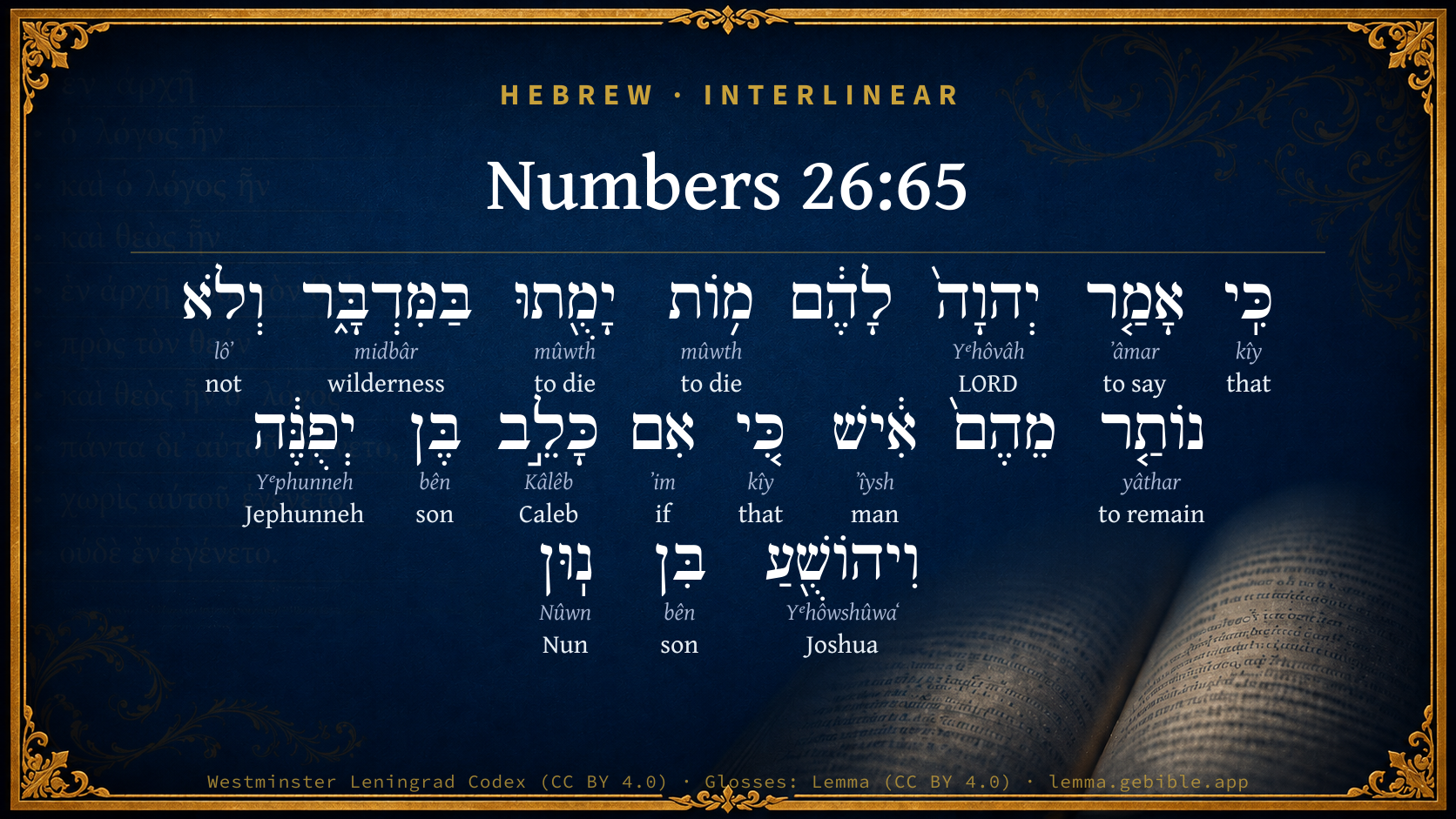
Hebrew (Westminster Leningrad Codex) Numbers 26:65 appears in the Hebrew Old Testament. The text above is from the Westminster Leningrad Codex. Each word links to its Strong’s number, a concise gloss, and parsing drawn from the Open Scriptures Hebrew Bible morphology. Click any word for its full Brown-Driver-Briggs (BDB) entry.
Download image
Cite this verse

Numbers 26:65 (World English Bible). Public Domain. Lemma interlinear Bible study tool, https://lemma.gebible.app/v/numbers/26/65.

Show BibTeX & RIS
BibTeX
RIS
English Translation
For Yahweh had said of them, They shall surely die in the wilderness. There was not left a man of them, save Caleb the son of Jephunneh, and Joshua the son of Nun.
World English Bible · Public Domain
Download a study sheet

One document with this verse’s original text, its word-by-word gloss line, the meaning frame, cross-references with their text, attributed commentary, and full source and license credits — printable, and it pastes into notes with its structure intact.

This verse Autodidact and up

Study sheet (.html) Plain text (.txt)

A passage Seminary Student

Up to 50 verses in one chapter. A passage sheet keeps up to 6 commentary sources and 12 cross-references per verse, in the order this page ranks them, and says so on the sheet whenever that leaves anything out. Ask for a single verse and you get the Autodidact verse sheet above.

Everything on this page stays free to read, with no account — the sheet is a download of what is already on screen, not access to it.

Want to remove ads? Support Godless Engineer
Compare translations 3

The same verse in 3 English versions, stacked beneath the original-language interlinear above. Click any original word for its lexicon entry.

Each is an independent rendering of the whole verse — the interlinear is not word-aligned to these translations.

Highlighted words mark where these versions differ — a whole-verse word diff, not a word-by-word alignment.

  • World English Bible Public Domain
    For Yahweh had said of them, They shall surely die in the wilderness. There was not left a man of them, save Caleb the son of Jephunneh, and Joshua the son of Nun.
  • King James Version Public Domain
    For the LORD had said of them, They shall surely die in the wilderness. And there was not left a man of them, save Caleb the son of Jephunneh, and Joshua the son of Nun.
  • unfoldingWord Literal Text CC BY-SA 4.0
    For Yahweh had said to them, “You shall surely die in the wilderness and a man shall not remain from them, except Caleb the son of Jephunneh and Joshua the son of Nun.”

unfoldingWord Literal Text — © unfoldingWord, licensed CC BY-SA 4.0. Word-aligned USFM3 via Door43 (git.door43.org/unfoldingWord/en_ult).

Versions to compare (up to 4)

3 of 4 selected

Show all 18 translations

Every available English version of this verse, each an independent rendering of the whole verse.

  • World English Bible Public Domain
    For Yahweh had said of them, They shall surely die in the wilderness. There was not left a man of them, save Caleb the son of Jephunneh, and Joshua the son of Nun.
  • Berean Standard Bible Public Domain
    For the LORD had told them that they would surely die in the wilderness. Not one was left except Caleb son of Jephunneh and Joshua son of Nun.
  • Majority Standard Bible Public Domain
    For the LORD had told them that they would surely die in the wilderness. Not one was left except Caleb son of Jephunneh and Joshua son of Nun.
  • King James Version Public Domain
    For the LORD had said of them, They shall surely die in the wilderness. And there was not left a man of them, save Caleb the son of Jephunneh, and Joshua the son of Nun.
  • American Standard Version (1901) Public Domain
    For Jehovah had said of them, They shall surely die in the wilderness. And there was not left a man of them, save Caleb the son of Jephunneh, and Joshua the son of Nun.
  • Revised Version (1885) Public Domain
    For the LORD had said of them, They shall surely die in the wilderness. And there was not left a man of them, save Caleb the son of Jephunneh, and Joshua the son of Nun.
  • Geneva Bible (1599) Public Domain
    For the Lord said of them, They shall die in the wildernes: so there was not left a man of them, saue Caleb the sonne of Iephunneh, and Ioshua the sonne of Nun.
  • Douay-Rheims (1899) Public Domain
    For the Lord had foretold that they should die in the wilderness. And none remained of them, but Caleb the son of Jephone, and Josue the son of Nun.
  • Young's Literal Translation Public Domain
    for Jehovah said of them, `They do certainly die in the wilderness;' and there hath not been left of them a man save Caleb son of Jephunneh, and Joshua son of Nun.
  • Literal Standard Version CC BY-SA 4.0
    for YHWH said of them, “They certainly die in the wilderness”; and there has not been left a man of them, except Caleb son of Jephunneh and Joshua son of Nun.
  • Unlocked Literal Bible CC BY-SA 4.0
    For Yahweh had said that all of those people would certainly die in the wilderness. There was not a man left among them, except Caleb son of Jephunneh and Joshua son of Nun.
  • unfoldingWord Literal Text CC BY-SA 4.0
    For Yahweh had said to them, “You shall surely die in the wilderness and a man shall not remain from them, except Caleb the son of Jephunneh and Joshua the son of Nun.”
  • Darby Bible Public Domain
    For Jehovah had said of them, They shall surely die in the wilderness. And there was not left a man of them, save Caleb the son of Jephunneh, and Joshua the son of Nun.
  • World Messianic Bible Public Domain
    For the LORD had said of them, “They shall surely die in the wilderness.” There was not a man left of them, except Caleb the son of Jephunneh, and Joshua the son of Nun.
  • Webster's Bible Public Domain
    For the LORD had said of them, They shall surely die in the wilderness. And there was not left a man of them, save Caleb the son of Jephunneh, and Joshua the son of Nun.
  • Free Bible Version CC BY-SA 4.0
    because the Lord had told them that they would all die in the desert. No one was left except Caleb, son of Jephunneh, and Joshua, son of Nun.
  • Bible in Basic English Public Domain
    For the Lord had said of them, Death will certainly overtake them in the waste land. And of them all, only Caleb, the son of Jephunneh, and Joshua, the son of Nun, were still living.
  • JPS Tanakh (1917) Public Domain
    For the LORD had said of them: 'They shall surely die in the wilderness.' And there was not left a man of them, save Caleb the son of Jephunneh, and Joshua the son of Nun.

Literal Standard Version (2020), Covenant Press — licensed CC BY-SA 4.0. Text via the HelloAO Bible API (eBible.org). Unlocked Literal Bible (unfoldingWord) — licensed CC BY-SA 4.0. Text via the HelloAO Bible API (eBible.org). unfoldingWord Literal Text — © unfoldingWord, licensed CC BY-SA 4.0. Word-aligned USFM3 via Door43 (git.door43.org/unfoldingWord/en_ult). Free Bible Version, Dr. Jonathan Gallagher — licensed CC BY-SA 4.0. Text via the HelloAO Bible API (eBible.org).

Word by word

More ways to search: Search by grammar → Find every occurrence → Compare this word →

Practice this passage: Drill this verse → Learn its vocabulary →

יְפֻנֶּ֔ה
Yᵉphunneh
H3312
“Jephunneh”
Noun, Proper
Part of Speech
Noun
Type
Proper
Full BDB Definition

Origin: from H6437

TWOT: None

Jephunneh = "He will be facing" - a Kenezite and father of Caleb the spy from the tribe of Judah - son of Jether and descendant of Asher
  1. כִּֽי kîy H3588 “that” Conjunction
  2. אָמַ֤ר ʼâmar H559 “to say” Verb, Qal, Perfect, 3rd Person, Masculine, Singular
  3. יְהוָה֙ Yᵉhôvâh H3068 “LORD” Noun, Proper
  4. מ֥וֹת mûwth H4191 “to die” Verb, Qal, Infinitive Absolute
  5. יָמֻ֖תוּ mûwth H4191 “to die” Verb, Qal, Imperfect, 3rd Person, Masculine, Plural
  6. בַּמִּדְבָּ֑ר midbâr H4057 “in/at the · wilderness” Preposition, Determined + Noun, Common, Masculine, Singular, Absolute
  7. וְלֹא lôʼ H3808 “and · not” Conjunction + Particle, Negative
  8. נוֹתַ֤ר yâthar H3498 “to remain” Verb, Niphal, Perfect, 3rd Person, Masculine, Singular
  9. אִ֔ישׁ ʼîysh H376 “man” Noun, Common, Masculine, Singular, Absolute
  10. כִּ֚י kîy H3588 “that” Conjunction
  11. אִם ʼim H518 “if” Conjunction
  12. כָּלֵ֣ב Kâlêb H3612 “Caleb” Noun, Proper
  13. בֶּן bên H1121 “son of” Noun, Common, Masculine, Singular, Construct
  14. וִיהוֹשֻׁ֖עַ Yᵉhôwshûwaʻ H3091 “and · Joshua” Conjunction + Noun, Proper
  15. בִּן bên H1121 “son of” Noun, Common, Masculine, Singular, Construct
  16. נֽוּן Nûwn H5126 “Nun” Noun, Proper

About this verse

These counts appear in no published source. They are computed here, from the morphology-tagged text and Lemma’s own curated glosses. What Lemma adds →

19
words
14
distinct lemmas
Pentateuch
section

Notable vocabulary

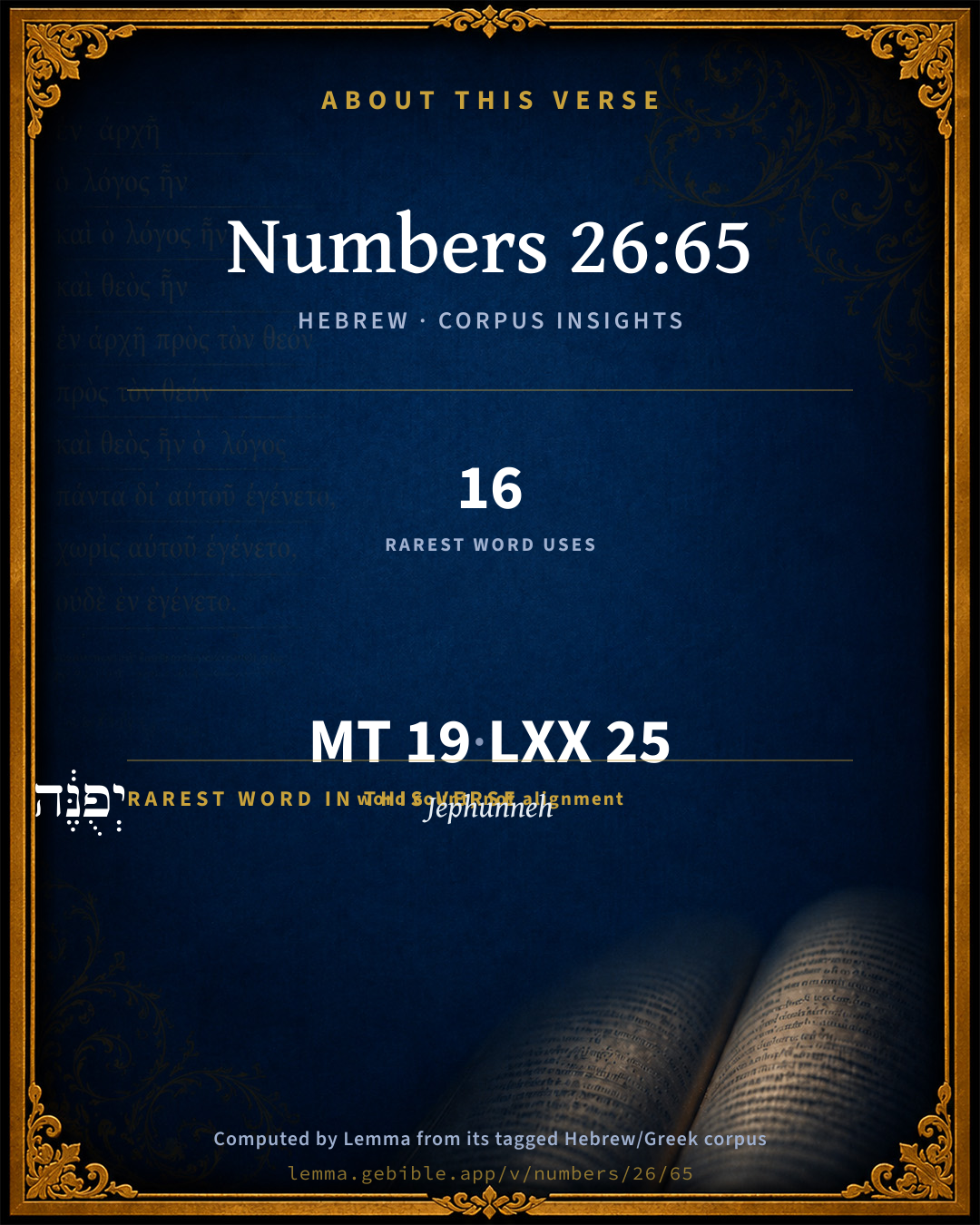
The rarest word here is יְפֻנֶּ֔ה Jephunneh H3312 — appearing just 16 times in the whole Hebrew Bible.

Shared distinctive vocabulary

יְפֻנֶּ֔ה Jephunneh H3312 occurs in 16 verses of the Hebrew Bible. Also found in:

Grammatical profile

  • 4 verbs
  • 9 nouns
  • 2 prepositions
  • 3 conjunctions
  • 1 particle

Verb forms

  • אָמַ֤ר Qal · Perfect
  • מ֥וֹת Qal · Infinitive Absolute
  • יָמֻ֖תוּ Qal · Imperfect
  • נוֹתַ֤ר Niphal · Perfect

Repetition

Words recur within this verse — often emphatic in Hebrew:

  • מ֥וֹת to die H4191 ×2
  • בֶּן son H1121 ×2
  • כִּֽי that H3588 ×2

Hebrew & Septuagint length

In English translation the verse runs 33 words from the Hebrew and 34 from the Septuagint (LXX English) — closely comparable.

A rough comparison of the two English renderings, which tokenize alike — not a word-level alignment.

Word counts can differ between the Hebrew and the Greek without any difference in meaning — e.g. the Hebrew direct-object marker אֵת has no separate Greek word, and Greek often adds the article ὁ.

In the original languages it is 19 Hebrew tokens and 25 Greek tokens — but the two are counted differently (Hebrew bundles its prefixes and suffixes into one token; the Greek is in lemma form), so that isn’t a like-for-like length.

Cross-references

13

Topical passages linked to Numbers 26:65 in the Treasury of Scripture Knowledge — connected by theme and wording, ordered by reader-vote popularity; previews shown in the World English Bible.

  • 1 Corinthians 10:5–6 However with most of them, God was not well pleased, for they were overthrown in the wilderness.
  • Numbers 14:38 But Joshua the son of Nun, and Caleb the son of Jephunneh, remained alive of those men who went to spy out the land.
  • Romans 11:22 See then the goodness and severity of God. Toward those who fell, severity; but toward you, goodness, if you continue in his goodness; otherwise you also will be cut off.
  • Hebrews 3:17–18 With whom was he displeased forty years? Wasn't it with those who sinned, whose bodies fell in the wilderness?
  • Numbers 14:28–30 Tell them, As I live, says Yahweh, surely as you have spoken in my ears, so will I do to you:
  • Numbers 14:35 I, Yahweh, have spoken, surely this will I do to all this evil congregation, who are gathered together against me: in this wilderness they shall be consumed, and there they shall die.
  • Psalms 90:3–7 You turn man to destruction, saying, "Return, you children of men."
  • Exodus 12:37 The children of Israel traveled from Rameses to Succoth, about six hundred thousand on foot who were men, besides children.
  • Numbers 14:23–24 surely they shall not see the land which I swore to their fathers, neither shall any of those who despised me see it:
  • Deuteronomy 2:14–15 The days in which we came from Kadesh-barnea, until we were come over the brook Zered, were thirty-eight years; until all the generation of the men of war were consumed from the midst of the camp, as Yahweh swore to them.
  • Deuteronomy 32:49–50 Go up into this mountain of Abarim, to Mount Nebo, which is in the land of Moab, that is over against Jericho; and see the land of Canaan, which I give to the children of Israel for a possession;
  • Joshua 14:6–10 Then the children of Judah drew near to Joshua in Gilgal: and Caleb the son of Jephunneh the Kenizzite said to him, You know the thing that Yahweh spoke to Moses the man of God concerning me and concerning you in Kadesh-barnea.
  • Jude 1:5 Now I desire to remind you, though you already know this, that the Lord, having saved a people out of the land of Egypt, afterward destroyed those who didn't believe.

Cross-references courtesy of OpenBible.info (CC BY 4.0).

Hebrew and Greek witnesses Masoretic Hebrew ↔ Greek Septuagint

The same verse in the two great witnesses to the Old Testament, shown verse-for-verse.

These are two independent witnesses, not word-aligned to each other, and the Septuagint is shown in lemma (dictionary) form.

Hebrew Numbers 26:65 Masoretic · Westminster Leningrad Codex

כִּֽי אָמַ֤ר יְהוָה֙ לָהֶ֔ם מ֥וֹת יָמֻ֖תוּ בַּמִּדְבָּ֑ר וְלֹא נוֹתַ֤ר מֵהֶם֙ אִ֔ישׁ כִּ֚י אִם כָּלֵ֣ב בֶּן יְפֻנֶּ֔ה וִיהוֹשֻׁ֖עַ בִּן נֽוּן

For Yahweh had said of them, They shall surely die in the wilderness. There was not left a man of them, save Caleb the son of Jephunneh, and Joshua the son of Nun.

World English Bible · Public Domain

Greek LXX Numbers 26:65 Septuagint · lemma form

ὅτι εἶπον κύριος αὐτός θάνατος ἀποθνήσκω ἐν ὁ ἔρημος καί οὐ καταλείπω ἐκ αὐτός οὐδέ εἷς πλήν χαλεβ υἱός ιεφοννη καί ἰησοῦς ὁ ὁ ναυη

For the Lord said to them, They shall surely die in the wilderness; and there was not left even one of them, except Chaleb the son of Jephonne, and Joshua the son of Naue.

LXX2012 (modern English Septuagint) · Public Domain

Hebrew: Westminster Leningrad Codex (CC BY 4.0). Greek: Septuagint (public domain); English from LXX2012 (modern English Septuagint) (Public Domain). How the Septuagint differs from the Hebrew →

Targum (Aramaic paraphrase)

2

The Targum is the ancient Jewish Aramaic paraphrase of the Hebrew Scriptures — an interpretive translation, not the Hebrew text itself. Onkelos (literal) and Pseudo-Jonathan (expansive) render the Torah, and Jonathan the Prophets. Coverage is partial: where no permissively-licensed English translation exists for a verse, only the Aramaic is shown. This is verse-level text, not a word-by-word alignment to the Hebrew.

  1. Targum Onkelos Torah (Genesis–Deuteronomy)
    אֲרֵי אֲמַר יְיָ לְהוֹן מֵימַת יְמוּתוּן בְּמַדְבְּרָא וְלָא אִשְׁתְּאַר מִנְהוֹן אֱנַשׁ אֶלָהֵן כָּלֵב בַּר יְפֻנֶה וִיהוֹשֻׁעַ בַּר נוּן

    (no public-domain English translation for this verse)

    Targum Onkelos — Aramaic: “Onkelos Genesis” (public domain); “Onkelos Exodus” (public domain); “Onkelos Leviticus” (public domain); “Onkelos Numbers” (public domain); “Onkelos Deuteronomy” (public domain). English: “Sefaria Community Translation” (CC0 1.0 (public-domain dedication)); “J.W. Etheridge. The Targums of Onkelos and Jonathan Ben Uzziel on the Pentateuch. London: Longmans, Green, 1862” (public domain). Text via Sefaria.

  2. Targum Pseudo-Jonathan Torah (Genesis–Deuteronomy)
    אֲרוּם אָמַר יְיָ לְהוֹן מְמַת יְמוּתוּן בְּמַדְבְּרָא וְלָא אִשְׁתַּיֵיר לְהוֹן אֱנַשׁ אֱלָהֵן כָּלֵב בַּר יְפוּנֶה וִיהוֹשֻׁעַ בַּר נוּן

    because the Lord had said that dying they should die in the wilderness; and none of them remained except Kaleb bar Jephunneh, and Jehoshua bar Nun.

    Targum Pseudo-Jonathan — Aramaic: “Targum Jonathan on Genesis” (public domain); “Targum Jonathan on Exodus” (public domain); “Targum Jonathan on Leviticus” (public domain); “Targum Jonathan on Numbers” (public domain); “Targum Jonathan on Deuteronomy” (public domain). English: “The Targum of Jonathan ben Uzziel, trans. J. W. Etheridge, London, 1862” (public domain). Text via Sefaria.

Commentary

Notes on Numbers 26:65 from classic Christian and Jewish commentators (each source and its license shown beneath its notes). The classic Christian expositions comment on the surrounding passage and are grouped to its opening verse, so a note may address several verses; the Jewish commentaries on the Tanakh (Rashi and others) are per-verse, so they appear only where the commentator wrote on this verse.

Lemma curates 59 commentaries, every one of them public domain or Creative Commons licensed, each selected and text-cleaned for this edition rather than reprinted as found. About our sources →

Joseph Benson's Commentary

Num 26:65. There was not left a man — Except of the Levites, who, not being guilty of that sin, did not partake of their judgment. Save Caleb and Joshua — Whom God promised to spare, in reward of their steady faith and piety.

Joseph Benson's Commentary on the Old and New Testaments (1811–1818) — public domain. Text from a community e-Sword module.

Geneva Bible (1599)

Geneva Bible translators

Num. 14:28,29; 1 Cor. 20:5,6

Geneva Bible (1599) marginal notes — public domain. Text via Bolls.life.

Matthew Poole's English Annotations

There was not left a man of them, to wit, of those who then murmured and rebelled against God, as plainly appears, both because this threatening and punishment is confined to those transgressors, and because otherwise this had not been true; for of those that were then numbered there were now left Eleazar and Ithamar, and possibly many of the Levites, and some others, who being not guilty of that sin, did not partake of their judgment. Caleb and Joshua are mentioned here, as also Num 14, not by way of exception, as if these were murmurers, which is utterly denied, Num 14:24, but by way of opposition, to signify that they, though they were two of the spies, and companions of them who were the chief authors and ringleaders of that mutiny, yet they kept themselves from their sin, and therefore God kept them from their plague and destruction, as also he did some others for the same reason.

Matthew Poole's English Annotations on the Holy Bible (1683–1685) — public domain. Text from a community e-Sword/MySword module.

The Pulpit Commentary

There was not left a man of them. This had been known to be practically the case before they left the wilderness, properly so called, (Deu_2:14, Deu_2:15) but it was now ascertained for certain. For the necessary exceptions to the statement see note on Num_14:24.

The Pulpit Commentary (1880–1919), ed. H.D.M. Spence-Jones & Joseph S. Exell — public domain. Text from a community e-Sword module.

John Wesley's Explanatory Notes

Not left a man - Only of the Levites, who being not guilty of that sin did not partake of their judgment.

John Wesley, Explanatory Notes Upon the Whole Bible (1754–1765) — public domain. Text via the GEBible commentary corpus.

unfoldingWord translationNotes

Door43 World Missions Community

There was not a man left among them, except

The word "them" refers to all of the people who were counted in the wilderness of Sinai. This can be stated in positive form. AT: "The only ones who were still alive were" (See: Double Negatives)

son of Jephunneh

Jephunneh was Caleb's father. See how you translated this in Numbers 13:6.

son of Nun

Nun was Joshua's father. See how you translated this in Numbers 11:28.

translationWords

Caleb

Joshua

unfoldingWord translationNotes — © Distant Shores Media and the Door43 World Missions Community, licensed CC BY-SA 4.0. Source: git.door43.org/Door43/en_tn.

Lesson kit

Teaching starters — assembled from the data on this page, not authored interpretation. Every prompt links to the verse data it draws on. Edit before teaching.

Numbers, in the Pentateuch, opens this verse with 19 words (14 distinct Hebrew lemmas). Its most distinctive word is Yᵉphunneh (“Jephunneh”). A historical commentator’s framing appears above. Read the whole chapter for the surrounding context.

Discussion questions

  1. The word Yᵉphunneh carries the sense “Jephunneh.” How does it shape the verse?
  2. How does Numbers 13:6, which shares the word «Jephunneh», read alongside this verse?
  3. What does the repetition of “to die” (2× in this one verse) do in this verse?
  4. These translations render this verse differently. What is at stake in choosing one wording over another?
  5. «אָמַ֤ר» is a Qal Perfect verb. How does that grammatical form shape the action described?
  6. Compare how Joseph Benson's Commentary and Geneva Bible (1599) read this verse. Where do they agree or differ?

Things to notice

Reading settings

Reading text

Shown beneath each verse's original-language words.

Old Testament
Old Testament edition

Read the OT as the Masoretic Hebrew (MT) or the Greek Septuagint (LXX).

English shown for the Greek Septuagint (in the Hebrew ↔ Greek comparison).

Comparing translations? Open the Compare panel on any verse page to stack up to four side by side.