2 Kings 1:4

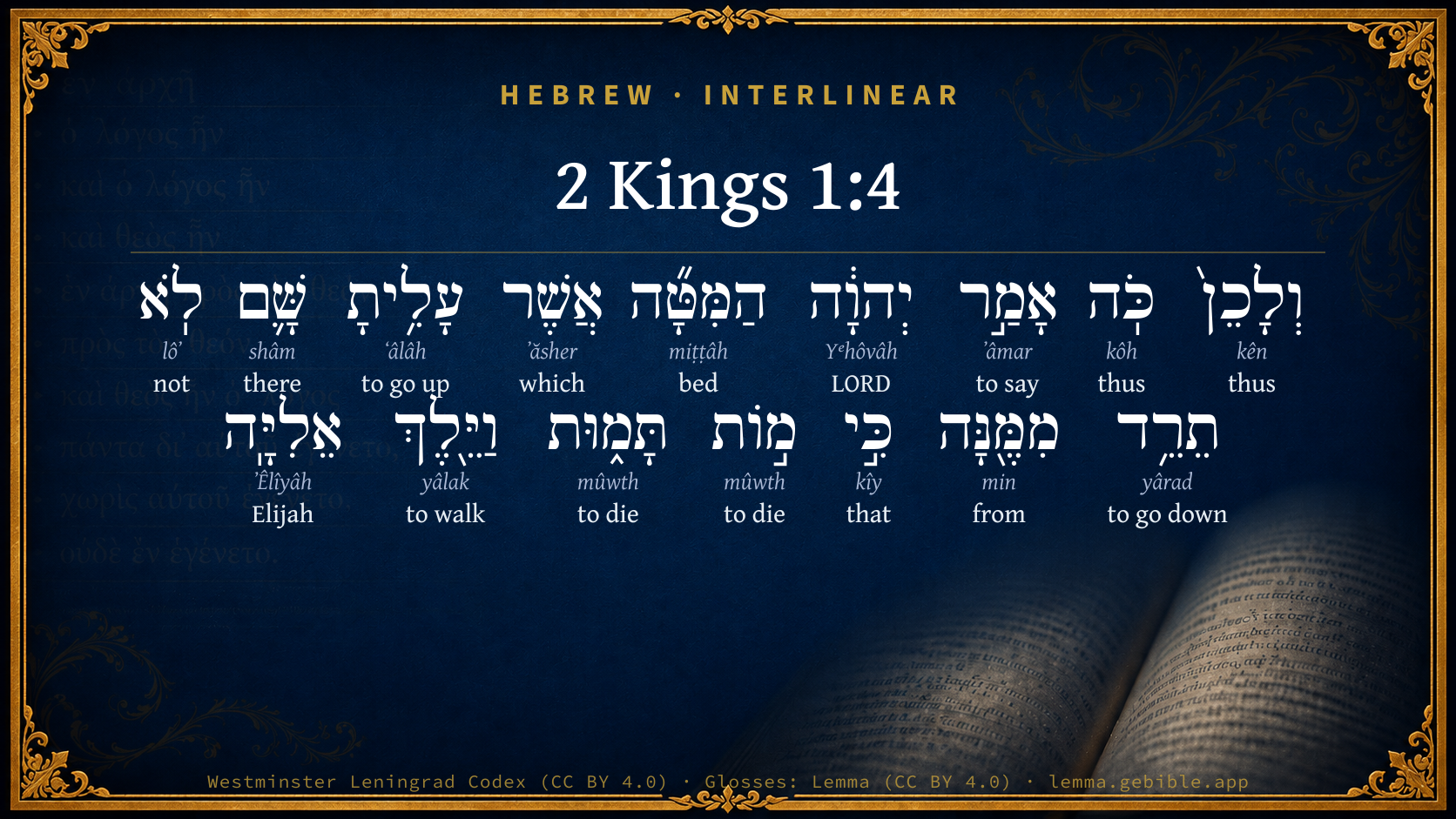
Hebrew (Westminster Leningrad Codex) 2 Kings 1:4 appears in the Hebrew Old Testament. The text above is from the Westminster Leningrad Codex. Each word links to its Strong’s number, a concise gloss, and parsing drawn from the Open Scriptures Hebrew Bible morphology. Click any word for its full Brown-Driver-Briggs (BDB) entry.
Download image
Cite this verse

2 Kings 1:4 (World English Bible). Public Domain. Lemma interlinear Bible study tool, https://lemma.gebible.app/v/2-kings/1/4.

Show BibTeX & RIS
BibTeX
RIS
English Translation
Now therefore thus says Yahweh, You shall not come down from the bed where you are gone up, but shall surely die. Elijah departed.
World English Bible · Public Domain
Download a study sheet

One document with this verse’s original text, its word-by-word gloss line, the meaning frame, cross-references with their text, attributed commentary, and full source and license credits — printable, and it pastes into notes with its structure intact.

This verse Autodidact and up

Study sheet (.html) Plain text (.txt)

A passage Seminary Student

Up to 50 verses in one chapter. A passage sheet keeps up to 6 commentary sources and 12 cross-references per verse, in the order this page ranks them, and says so on the sheet whenever that leaves anything out. Ask for a single verse and you get the Autodidact verse sheet above.

Everything on this page stays free to read, with no account — the sheet is a download of what is already on screen, not access to it.

Want to remove ads? Support Godless Engineer
Compare translations 3

The same verse in 3 English versions, stacked beneath the original-language interlinear above. Click any original word for its lexicon entry.

Each is an independent rendering of the whole verse — the interlinear is not word-aligned to these translations.

Highlighted words mark where these versions differ — a whole-verse word diff, not a word-by-word alignment.

  • World English Bible Public Domain
    Now therefore thus says Yahweh, You shall not come down from the bed where you are gone up, but shall surely die. Elijah departed.
  • King James Version Public Domain
    Now therefore thus saith the LORD, Thou shalt not come down from that bed on which thou art gone up, but shalt surely die. And Elijah departed.
  • unfoldingWord Literal Text CC BY-SA 4.0
    And therefore, thus says Yahweh, “The bed where you have gone up there, you will not come down from it, for dying, you will die.”’” So Elijah went.

unfoldingWord Literal Text — © unfoldingWord, licensed CC BY-SA 4.0. Word-aligned USFM3 via Door43 (git.door43.org/unfoldingWord/en_ult).

Versions to compare (up to 4)

3 of 4 selected

Show all 18 translations

Every available English version of this verse, each an independent rendering of the whole verse.

  • World English Bible Public Domain
    Now therefore thus says Yahweh, You shall not come down from the bed where you are gone up, but shall surely die. Elijah departed.
  • Berean Standard Bible Public Domain
    Therefore this is what the LORD says: ‘You will not get up from the bed on which you are lying. You will surely die.’” So Elijah departed.
  • Majority Standard Bible Public Domain
    Therefore this is what the LORD says: ‘You will not get up from the bed on which you are lying. You will surely die.’” So Elijah departed.
  • King James Version Public Domain
    Now therefore thus saith the LORD, Thou shalt not come down from that bed on which thou art gone up, but shalt surely die. And Elijah departed.
  • American Standard Version (1901) Public Domain
    Now therefore thus saith Jehovah, Thou shalt not come down from the bed whither thou art gone up, but shalt surely die. And Elijah departed.
  • Revised Version (1885) Public Domain
    Now therefore thus saith the LORD, Thou shalt not come down from the bed whither thou art gone up, but shalt surely die. And Elijah departed.
  • Geneva Bible (1599) Public Domain
    Wherefore thus saith the Lord, Thou shalt not come downe from the bed on which thou art gone vp, but shalt die the death. So Eliiah departed.
  • Douay-Rheims (1899) Public Domain
    Wherefore thus saith the Lord: From the bed, on which thou art gone up, thou shalt not come down, but thou shalt surely die. And Elias went away.
  • Young's Literal Translation Public Domain
    and therefore, thus said Jehovah, The bed whither thou hast gone up, thou dost not come down from it, for thou dost certainly die;' and Elijah goeth on.
  • Literal Standard Version CC BY-SA 4.0
    And therefore, thus said YHWH: The bed to where you have gone up, you do not come down from it, for you certainly die”; and Elijah goes on.
  • Unlocked Literal Bible CC BY-SA 4.0
    Therefore Yahweh says, “You will not come down from the bed to where you have gone up; instead, you will certainly die.”'” Then Elijah left.
  • unfoldingWord Literal Text CC BY-SA 4.0
    And therefore, thus says Yahweh, “The bed where you have gone up there, you will not come down from it, for dying, you will die.”’” So Elijah went.
  • Darby Bible Public Domain
    Now therefore thus saith Jehovah: Thou shalt not come down from the bed on which thou art gone up, but shalt certainly die. And Elijah departed.
  • World Messianic Bible Public Domain
    Now therefore the LORD says, “You will not come down from the bed where you have gone up, but you will surely die.”’” Then Elijah departed.
  • Webster's Bible Public Domain
    Now therefore thus saith the LORD, Thou shalt not come down from that bed on which thou art gone up, but shalt surely die. And Elijah departed.
  • Free Bible Version CC BY-SA 4.0
    So this is the Lord's answer: ‘You will not leave the bed on which you are lying. You're definitely going to die.’” And Elijah left.
  • Bible in Basic English Public Domain
    Give ear then to the words of the Lord: You will never again get down from the bed on to which you have gone up, but death will certainly come to you. Then Elijah went away.
  • JPS Tanakh (1917) Public Domain
    Now therefore thus saith the LORD: Thou shalt not come down from the bed whither thou art gone up, but shalt surely die.' And Elijah departed.

Literal Standard Version (2020), Covenant Press — licensed CC BY-SA 4.0. Text via the HelloAO Bible API (eBible.org). Unlocked Literal Bible (unfoldingWord) — licensed CC BY-SA 4.0. Text via the HelloAO Bible API (eBible.org). unfoldingWord Literal Text — © unfoldingWord, licensed CC BY-SA 4.0. Word-aligned USFM3 via Door43 (git.door43.org/unfoldingWord/en_ult). Free Bible Version, Dr. Jonathan Gallagher — licensed CC BY-SA 4.0. Text via the HelloAO Bible API (eBible.org).

Word by word

More ways to search: Search by grammar → Find every occurrence → Compare this word →

Practice this passage: Drill this verse → Learn its vocabulary →

הַמִּטָּ֞ה
miṭṭâh
H4296
“the · bed”
Particle, Definite Article + Noun, Common, Feminine, Singular, Absolute
Part of Speech
Particle + Noun
Type
Common
Gender
Feminine
Number
Singular
State
Absolute
Full BDB Definition

Origin: from H5186

TWOT: 1352c

couch, bed, bier
  1. וְלָכֵן֙ kên H3651 “and · to/for · thus” Conjunction + Preposition + Adverb
  2. כֹּֽה kôh H3541 “thus” Adverb
  3. אָמַ֣ר ʼâmar H559 “to say” Verb, Qal, Perfect, 3rd Person, Masculine, Singular
  4. יְהוָ֔ה Yᵉhôvâh H3068 “LORD” Noun, Proper
  5. אֲשֶׁר ʼăsher H834 “which” Particle, Relative
  6. עָלִ֥יתָ ʻâlâh H5927 “to go up” Verb, Qal, Perfect, 2nd Person, Masculine, Singular
  7. שָּׁ֛ם shâm H8033 “there” Adverb
  8. לֹֽא lôʼ H3808 “not” Particle, Negative
  9. תֵרֵ֥ד yârad H3381 “to go down” Verb, Qal, Imperfect, 2nd Person, Masculine, Singular
  10. מִמֶּ֖נָּה min H4480 “from · her” Preposition + Suffix, Personal, 3rd Person, Feminine, Singular
  11. כִּ֣י kîy H3588 “that” Conjunction
  12. מ֣וֹת mûwth H4191 “to die” Verb, Qal, Infinitive Absolute
  13. תָּמ֑וּת mûwth H4191 “to die” Verb, Qal, Imperfect, 2nd Person, Masculine, Singular
  14. וַיֵּ֖לֶךְ yâlak H3212 “and · to walk” Conjunction + Verb, Qal, Sequential Imperfect, 3rd Person, Masculine, Singular
  15. אֵלִיָּֽה ʼÊlîyâh H452 “Elijah” Noun, Proper

About this verse

These counts appear in no published source. They are computed here, from the morphology-tagged text and Lemma’s own curated glosses. What Lemma adds →

16
words
15
distinct lemmas
Historical
section

Shared distinctive vocabulary

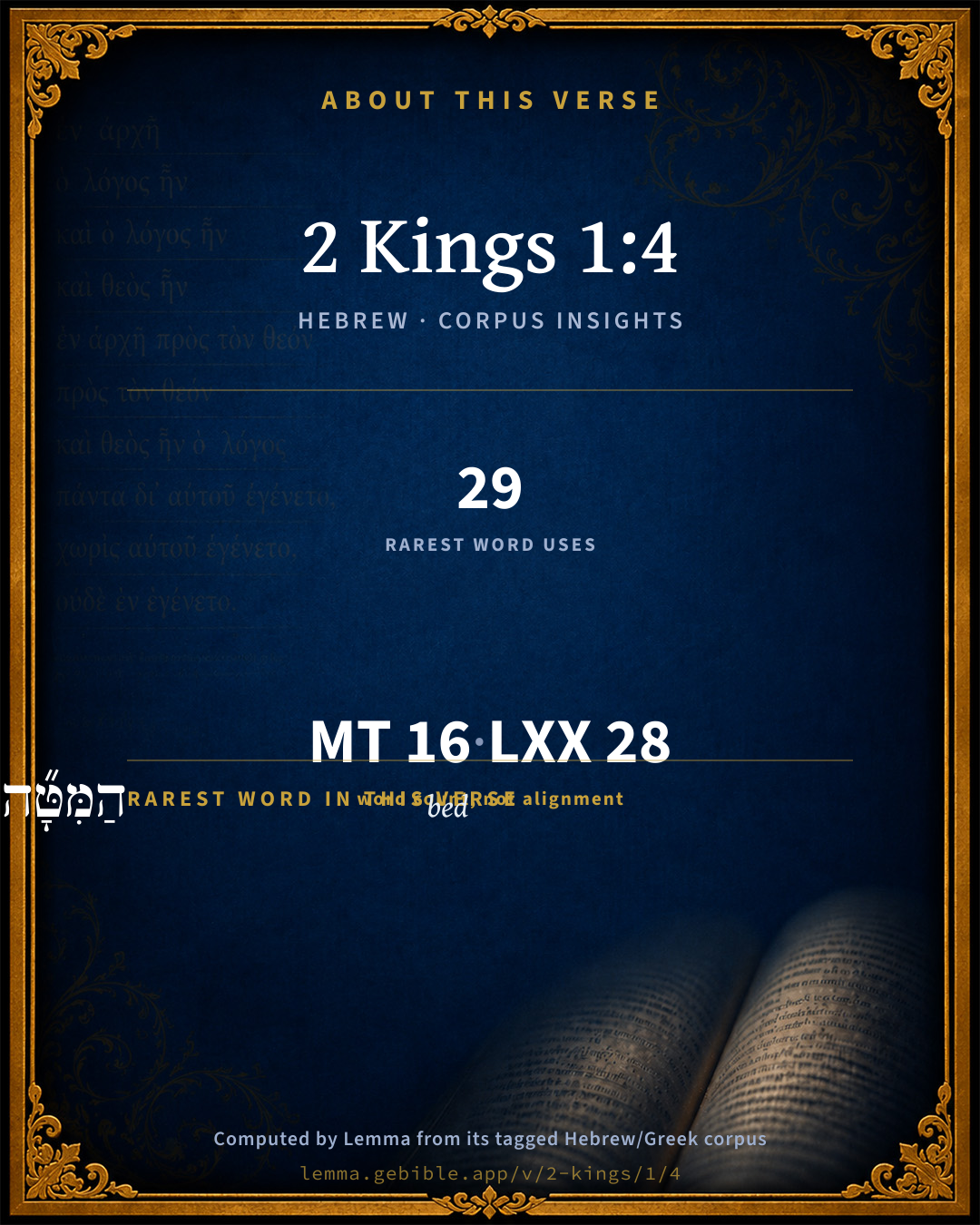
הַמִּטָּ֞ה bed H4296 occurs in 29 verses of the Hebrew Bible. Also found in:

Grammatical profile

  • 6 verbs
  • 3 nouns
  • 1 preposition
  • 1 conjunction
  • 3 adverbs
  • 2 particles

Verb forms

  • אָמַ֣ר Qal · Perfect
  • עָלִ֥יתָ Qal · Perfect
  • תֵרֵ֥ד Qal · Imperfect
  • מ֣וֹת Qal · Infinitive Absolute
  • תָּמ֑וּת Qal · Imperfect
  • וַיֵּ֖לֶךְ Qal · Sequential Imperfect

Repetition

A word recurs within this verse — often emphatic in Hebrew:

  • מ֣וֹת to die H4191 ×2

Hebrew & Septuagint length

In English translation the verse runs 24 words from the Hebrew and 33 from the Septuagint (LXX English) — closely comparable.

A rough comparison of the two English renderings, which tokenize alike — not a word-level alignment.

Word counts can differ between the Hebrew and the Greek without any difference in meaning — e.g. the Hebrew direct-object marker אֵת has no separate Greek word, and Greek often adds the article ὁ.

In the original languages it is 16 Hebrew tokens and 28 Greek tokens — but the two are counted differently (Hebrew bundles its prefixes and suffixes into one token; the Greek is in lemma form), so that isn’t a like-for-like length.

Cross-references

10

Topical passages linked to 2 Kings 1:4 in the Treasury of Scripture Knowledge — connected by theme and wording, ordered by reader-vote popularity; previews shown in the World English Bible.

  • Genesis 2:17 but of the tree of the knowledge of good and evil, you shall not eat of it: for in the day that you eat of it you will surely die."
  • Genesis 3:4 The serpent said to the woman, "You won't surely die,
  • Ezekiel 18:4 Behold, all souls are mine; as the soul of the father, so also the soul of the son is mine: the soul who sins, he shall die.
  • 1 Samuel 28:19 Moreover Yahweh will deliver Israel also with you into the hand of the Philistines; and tomorrow shall you and your sons be with me: Yahweh will deliver the host of Israel also into the hand of the Philistines.
  • 2 Kings 1:16 He said to him, Thus says Yahweh, Because you have sent messengers to inquire of Baal Zebub, the god of Ekron, is it because there is no God in Israel to inquire of his word? therefore you shall not come down from the bed where you are gone up, but shall surely die.
  • Proverbs 11:19 He who is truly righteous gets life. He who pursues evil gets death.
  • Numbers 26:65 For Yahweh had said of them, They shall surely die in the wilderness. There was not left a man of them, save Caleb the son of Jephunneh, and Joshua the son of Nun.
  • 1 Kings 14:12 Arise you therefore, get you to your house: [and] when your feet enter into the city, the child shall die.
  • 2 Kings 1:6 They said to him, There came up a man to meet us, and said to us, Go, turn again to the king who sent you, and tell him, Thus says Yahweh, Is it because there is no God in Israel, that you send to inquire of Baal Zebub, the god of Ekron? therefore you shall not come down from the bed where you are gone up, but shall surely die.
  • Proverbs 14:32 The wicked is brought down in his calamity, But in death, the righteous has a refuge.

Cross-references courtesy of OpenBible.info (CC BY 4.0).

Hebrew and Greek witnesses Masoretic Hebrew ↔ Greek Septuagint

The same verse in the two great witnesses to the Old Testament, shown verse-for-verse.

These are two independent witnesses, not word-aligned to each other, and the Septuagint is shown in lemma (dictionary) form.

Hebrew 2 Kings 1:4 Masoretic · Westminster Leningrad Codex

וְלָכֵן֙ כֹּֽה אָמַ֣ר יְהוָ֔ה הַמִּטָּ֞ה אֲשֶׁר עָלִ֥יתָ שָּׁ֛ם לֹֽא תֵרֵ֥ד מִמֶּ֖נָּה כִּ֣י מ֣וֹת תָּמ֑וּת וַיֵּ֖לֶךְ אֵלִיָּֽה

Now therefore thus says Yahweh, You shall not come down from the bed where you are gone up, but shall surely die. Elijah departed.

World English Bible · Public Domain

Greek LXX 2 Kings 1:4 Septuagint · lemma form

καί οὐ οὕτως ὅτι ὅδε λέγω κύριος ὁ κλίνη ἐπί ὅς ἀναβαίνω ἐκεῖ οὐ καταβαίνω ἀπό αὐτός ὅτι ἐκεῖ θάνατος ἀποθνήσκω καί πορεύομαι ηλιου καί εἶπον πρός αὐτός

For thus says the Lord, The bed on which you are gone up, you shall not come down from it, for you shall surely die. And Eliu went, and said so to them.

LXX2012 (modern English Septuagint) · Public Domain

On this verse, Ellicott's Commentary for English Readers discusses the Septuagint’s reading. Read the note in Commentary ↓

Hebrew: Westminster Leningrad Codex (CC BY 4.0). Greek: Septuagint (public domain); English from LXX2012 (modern English Septuagint) (Public Domain). How the Septuagint differs from the Hebrew →

Targum (Aramaic paraphrase)

1

The Targum is the ancient Jewish Aramaic paraphrase of the Hebrew Scriptures — an interpretive translation, not the Hebrew text itself. Onkelos (literal) and Pseudo-Jonathan (expansive) render the Torah, and Jonathan the Prophets. Coverage is partial: where no permissively-licensed English translation exists for a verse, only the Aramaic is shown. This is verse-level text, not a word-by-word alignment to the Hebrew.

  1. Targum Jonathan Prophets (Joshua–Malachi)
    וּבְכֵן כִּדְנַן אֲמַר יְיָ עַרְסָא דִסְלֵיקְתָּא תַּמָן לָא תֵיחוּת מִנָהּ אֲרֵי מְמַת תְּמוּת וַאֲזַל אֵלִיָה:

    (no public-domain English translation for this verse)

    Targum Jonathan — Aramaic: “Mikraot Gedolot” (public domain). English: “Sefaria Community Translation” (CC0 1.0 (public-domain dedication)); “London "Chaldee Paraphrase," 1871” (public domain). Text via Sefaria.

Commentary

Notes on 2 Kings 1:4 from classic Christian and Jewish commentators (each source and its license shown beneath its notes). The classic Christian expositions comment on the surrounding passage and are grouped to its opening verse, so a note may address several verses; the Jewish commentaries on the Tanakh (Rashi and others) are per-verse, so they appear only where the commentator wrote on this verse.

Lemma curates 59 commentaries, every one of them public domain or Creative Commons licensed, each selected and text-cleaned for this edition rather than reprinted as found. About our sources →

Trapp's Complete Commentary

John Trapp

2Ki 1:4 Now therefore thus saith the LORD, Thou shalt not come down from that bed on which thou art gone up, but shalt surely die. And Elijah departed.

Ver. 4. Thou shalt surely die.] Tempore non tuo {Ecc 7:17} then, when it were better for thee to do anything else than to die.

And Elijah departed.] Vanished, say some; and that so amazed the messengers that they presently returned. But whether he vanished or departed, they had their errand.

John Trapp, A Commentary or Exposition upon All the Books of the Old and New Testament (1647–1656) — public domain. Text from a community e-Sword module.

Jamieson, Fausset & Brown

Robert Jamieson, A. R. Fausset & David Brown

Thou shalt not come down from that bed--On being taken up, he had probably been laid on the divan--a raised frame, about three feet broad, extended along the sides of a room, covered with cushions and mattresses--serving, in short, as a sofa by day and a bed by night, and ascended by steps.

Elijah departed--to his ordinary abode, which was then at Mount Carmel (Kg2 2:25; Kg1 18:42).

Jamieson, Fausset & Brown — Commentary Critical and Explanatory on the Whole Bible (1871) — public domain (CC PDM 1.0). Text via the HelloAO Bible API.

Adam Clarke's Commentary

Verse 4. But shalt surely die.] The true God tells you this; he in whose hands are both life and death, who can kill and make alive. Baal-zebub can do nothing; God has determined that your master shall die.

Adam Clarke's Commentary on the Bible (1810–1826) — public domain. Text from a community e-Sword/MySword module.

Ellicott's Commentary for English Readers

(4) Now therefore.—For this act of faithlessness, and to prove by the event that there is a God in Israel, whose oracle is unerring. (Comp. 1Ki_18:24, seq.)

Thus saith.—Or, hath said. After these words the prophetic announcement comes in rather abruptly. Perhaps the verse has been abridged by the compiler, and in the original account from which he drew, the words of 2Ki_1:6 may have followed here, “Go, return to the king . . . Ekron.”

And Eijah departed.—On the Lord’s errand. The LXX. adds, “and said unto them,” or “told them,” which is perhaps due to a copyist’s eye having wandered to the words “unto him,” or “unto them,” in next verse (Thenius).

A Bible Commentary for English Readers, edited by Charles John Ellicott (1878–1897) — public domain. Text from a community e-Sword module.

The Cambridge Bible for Schools and Colleges

gen. ed. J. J. S. Perowne

4. And Elijah departed] i.e. to fulfil the command which had been given him by the angel. The LXX. adds ‘and spake unto them’. The compiler of the Kings leaves out here any mention of the first meeting of the messengers by the prophet, because it may be assumed that what the prophet was bidden to do, he did.

The Cambridge Bible for Schools and Colleges (gen. ed. J. J. S. Perowne; Cambridge University Press, 1878–1918) — public domain. Text from a community e-Sword module.

John Gill's Exposition

Now therefore thus saith the Lord,.... Jehovah, the only true God:

thou shalt not come down from that bed on which thou art gone up, but shall surely die; this sickness should be unto death, and the bed he had betaken himself to should be his deathbed. The phrases of going up to bed, and coming down, are used with great propriety; for in the eastern countries, in their bedchambers, they had a gallery raised four or five feet above the floor, with a balustrade on the front (d), and steps leading up to it; or ladders, which had more or fewer rounds, according as the beds were higher or lower (e):

and Elijah departed; having met the messengers, and delivered his message from the Lord unto them.

(d) See Dr. Shaw's Travels, p. 209. Ed. 2. (e) Vid. Isidor. Origin. l. 20. c. 11. & Alstorph. de Lect. Vet. c. 2.

John Gill's Exposition of the Whole Bible (1746–1763) — public domain (CC PDM 1.0). Text via the HelloAO Bible API.

Albert Barnes' Notes on the Bible

Therefore ... - As a punishment for this insult to Yahweh.

Albert Barnes' Notes on the Bible (1834–1885) — public domain. Text from a community e-Sword/MySword module.

Haydock's Catholic Bible Commentary

Away; probably to his usual abode, at Carmel, where the king sent to seize him.

George Leo Haydock (1774–1849), Haydock's Catholic Family Bible and Commentary, 1859 edition — public domain. Excludes Psalms (Douay-Rheims chapter numbering differs from Protestant) and Deuterocanonical books (Catholic canon only).

Matthew Poole's English Annotations

Now therefore; for this was a very heinous crime, to deny the perfections of God, and to transfer them to an idol. See Lev 19:31; 20:6,27; Deu 18:10.

Elijah departed; the messengers not daring to apprehend him, as suspecting him to be more than man, because he knew the secret message which the king delivered to them in his bedchamber.

Matthew Poole's English Annotations on the Holy Bible (1683–1685) — public domain. Text from a community e-Sword/MySword module.

The Pulpit Commentary

Now therefore. The word translated, "therefore" (kel;) is emphatic, and means "for this reason," "on this account." Because Ahaziah had apostatized from Cod, God sentenced him to die from the effects of his fall, and not to recover. It is implied that he might have recovered if he had acted otherwise. And Elijah departed; i.e. quitted the messengers, showing that his errand was accomplished he had said all that he was commissioned to say.

The Pulpit Commentary (1880–1919), ed. H.D.M. Spence-Jones & Joseph S. Exell — public domain. Text from a community e-Sword module.

Lesson kit

Teaching starters — assembled from the data on this page, not authored interpretation. Every prompt links to the verse data it draws on. Edit before teaching.

2 Kings, in the Historical, opens this verse with 16 words (15 distinct Hebrew lemmas). Its most distinctive word is miṭṭâh (“bed”). A historical commentator’s framing appears above. Read the whole chapter for the surrounding context.

Discussion questions

  1. What does “bed” (miṭṭâh) contribute to the verse as a whole?
  2. How does Genesis 47:31, which shares the word «bed», read alongside this verse?
  3. What does the repetition of “to die” (2× in this one verse) do in this verse?
  4. The translations on this page render this verse differently — a whole-verse word diff, not a word-by-word alignment. What might account for the different wordings?
  5. «אָמַ֣ר» is a Qal Perfect verb. How does that grammatical form shape the action described?
  6. Compare how Trapp's Complete Commentary and Jamieson, Fausset & Brown read this verse. Where do they agree or differ?

Things to notice

Reading settings

Reading text

Shown beneath each verse's original-language words.

Old Testament
Old Testament edition

Read the OT as the Masoretic Hebrew (MT) or the Greek Septuagint (LXX).

English shown for the Greek Septuagint (in the Hebrew ↔ Greek comparison).

Comparing translations? Open the Compare panel on any verse page to stack up to four side by side.