
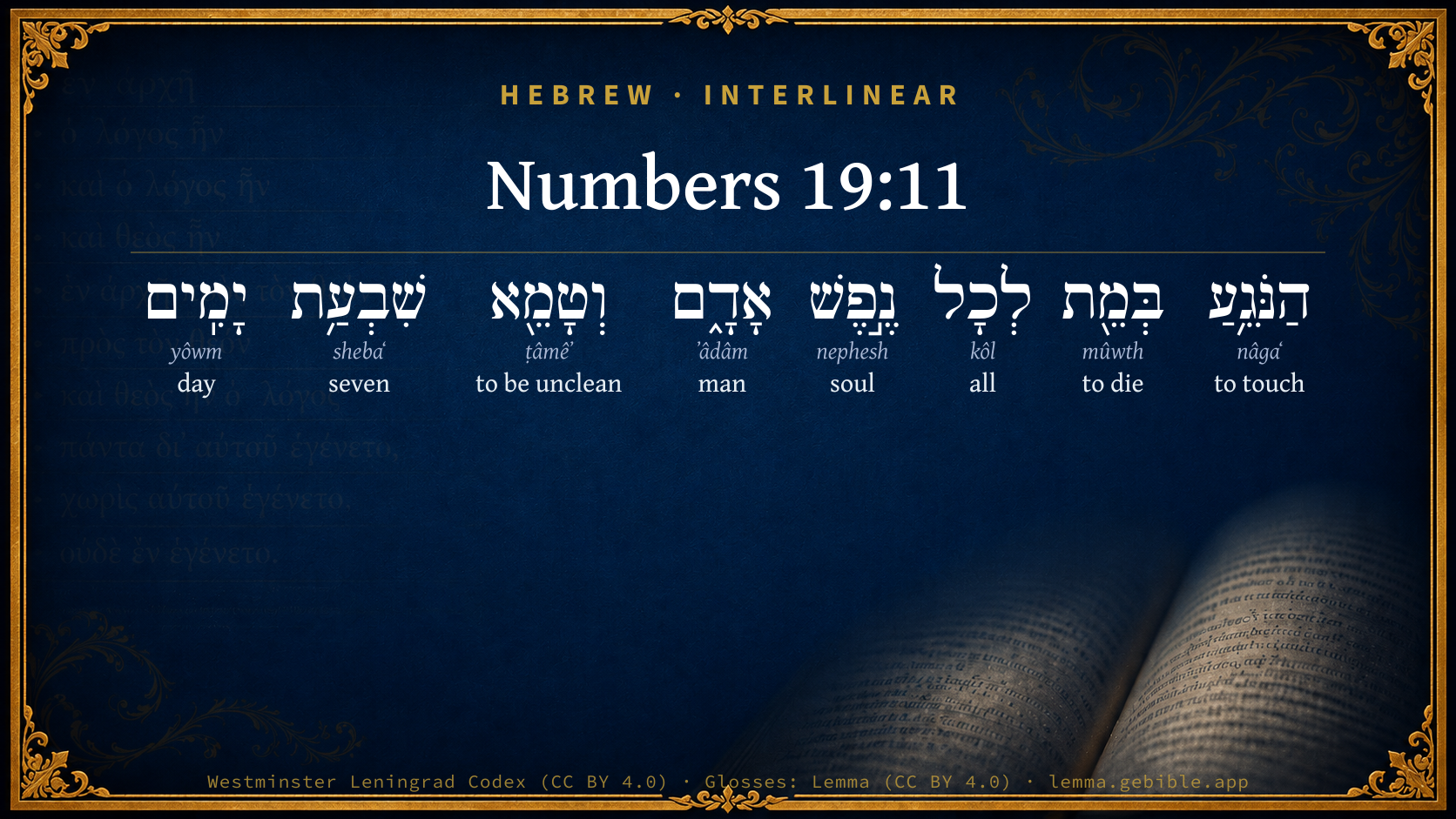
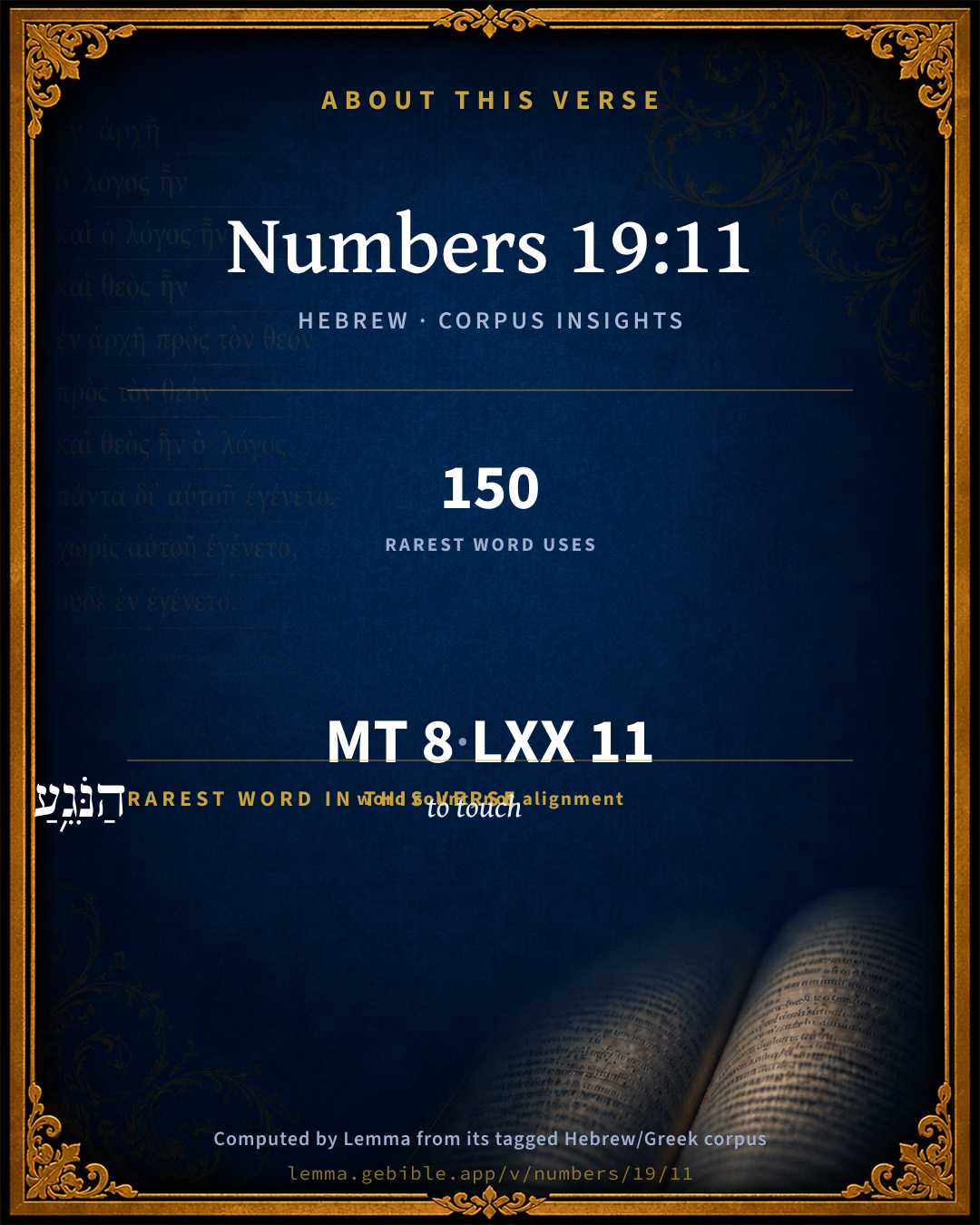
Numbers 19:11

Hebrew (Westminster Leningrad Codex) Numbers 19:11 appears in the Hebrew Old Testament. The text above is from the Westminster Leningrad Codex. Each word links to its Strong’s number, a concise gloss, and parsing drawn from the Open Scriptures Hebrew Bible morphology. Click any word for its full Brown-Driver-Briggs (BDB) entry.
Download image
Cite this verse

Numbers 19:11 (World English Bible). Public Domain. Lemma interlinear Bible study tool, https://lemma.gebible.app/v/numbers/19/11.

Show BibTeX & RIS
BibTeX
RIS
English Translation
He who touches the dead body of any man shall be unclean seven days:
World English Bible · Public Domain
Download a study sheet

One document with this verse’s original text, its word-by-word gloss line, the meaning frame, cross-references with their text, attributed commentary, and full source and license credits — printable, and it pastes into notes with its structure intact.

This verse Autodidact and up

Study sheet (.html) Plain text (.txt)

A passage Seminary Student

Up to 50 verses in one chapter. A passage sheet keeps up to 6 commentary sources and 12 cross-references per verse, in the order this page ranks them, and says so on the sheet whenever that leaves anything out. Ask for a single verse and you get the Autodidact verse sheet above.

Everything on this page stays free to read, with no account — the sheet is a download of what is already on screen, not access to it.

Want to remove ads? Support Godless Engineer
Compare translations 3

The same verse in 3 English versions, stacked beneath the original-language interlinear above. Click any original word for its lexicon entry.

Each is an independent rendering of the whole verse — the interlinear is not word-aligned to these translations.

Highlighted words mark where these versions differ — a whole-verse word diff, not a word-by-word alignment.

  • World English Bible Public Domain
    He who touches the dead body of any man shall be unclean seven days:
  • King James Version Public Domain
    He that toucheth the dead body of any man shall be unclean seven days.
  • unfoldingWord Literal Text CC BY-SA 4.0
    The one touching the dead of any soul of man shall be unclean seven days.

unfoldingWord Literal Text — © unfoldingWord, licensed CC BY-SA 4.0. Word-aligned USFM3 via Door43 (git.door43.org/unfoldingWord/en_ult).

Versions to compare (up to 4)

3 of 4 selected

Show all 18 translations

Every available English version of this verse, each an independent rendering of the whole verse.

  • World English Bible Public Domain
    He who touches the dead body of any man shall be unclean seven days:
  • Berean Standard Bible Public Domain
    Whoever touches any dead body will be unclean for seven days.
  • Majority Standard Bible Public Domain
    Whoever touches any dead body will be unclean for seven days.
  • King James Version Public Domain
    He that toucheth the dead body of any man shall be unclean seven days.
  • American Standard Version (1901) Public Domain
    He that toucheth the dead body of any man shall be unclean seven days:
  • Revised Version (1885) Public Domain
    He that toucheth the dead body of any man shall be unclean seven days:
  • Geneva Bible (1599) Public Domain
    Hee that toucheth the dead body of any man, shalbe vncleane euen seuen dayes.
  • Douay-Rheims (1899) Public Domain
    He that toucheth the corpse of a man, and is therefore unclean seven days,
  • Young's Literal Translation Public Domain
    `He who is coming against the dead body of any man -- is unclean seven days;
  • Literal Standard Version CC BY-SA 4.0
    He who is coming against the dead body of any man is unclean [for] seven days;
  • Unlocked Literal Bible CC BY-SA 4.0
    Whoever touches the dead body of any man will be unclean for seven days.
  • unfoldingWord Literal Text CC BY-SA 4.0
    The one touching the dead of any soul of man shall be unclean seven days.
  • Darby Bible Public Domain
    He that toucheth a dead person, any dead body of a man, shall be unclean seven days.
  • World Messianic Bible Public Domain
    “He who touches the dead body of any man shall be unclean seven days.
  • Webster's Bible Public Domain
    He that toucheth the dead body of any man shall be unclean seven days.
  • Free Bible Version CC BY-SA 4.0
    If you touch a dead body you will be unclean for seven days.
  • Bible in Basic English Public Domain
    Anyone touching a dead body will be unclean for seven days:
  • JPS Tanakh (1917) Public Domain
    He that toucheth the dead, even any man's dead body, shall be unclean seven days;

Literal Standard Version (2020), Covenant Press — licensed CC BY-SA 4.0. Text via the HelloAO Bible API (eBible.org). Unlocked Literal Bible (unfoldingWord) — licensed CC BY-SA 4.0. Text via the HelloAO Bible API (eBible.org). unfoldingWord Literal Text — © unfoldingWord, licensed CC BY-SA 4.0. Word-aligned USFM3 via Door43 (git.door43.org/unfoldingWord/en_ult). Free Bible Version, Dr. Jonathan Gallagher — licensed CC BY-SA 4.0. Text via the HelloAO Bible API (eBible.org).

Word by word

More ways to search: Search by grammar → Find every occurrence → Compare this word →

Practice this passage: Drill this verse → Learn its vocabulary →

הַנֹּגֵ֥עַ
nâgaʻ
H5060
“the · touching”
Particle, Definite Article + Verb, Qal, Participle Active, Masculine, Singular, Absolute
Part of Speech
Particle + Verb
Stem
Qal
Form
Participle Active
Gender
Masculine
Number
Singular
State
Absolute
Full BDB Definition

Origin: a primitive root

TWOT: 1293

to touch, reach, strike - (Qal) - to touch - to strike - to reach, extend to - to be stricken - stricken (participle) - (Niphal) to be stricken, be defeated - (Piel) to strike - (Pual) to be stricken (by disease) - (Hiphil) to cause to touch, reach, approach, arrive - to cause to touch, apply - to reach, extend, attain, arrive, come - to approach (of time) - to befall (of fate)
  1. בְּמֵ֖ת mûwth H4191 “in/at · dying” Preposition + Verb, Qal, Participle Active, Masculine, Singular, Absolute
  2. לְכָל kôl H3605 “to/for · all of” Preposition + Noun, Common, Masculine, Singular, Construct
  3. נֶ֣פֶשׁ nephesh H5315 “soul” Noun, Common, Both, Singular, Absolute
  4. אָדָ֑ם ʼâdâm H120 “man” Noun, Common, Masculine, Singular, Absolute
  5. וְטָמֵ֖א ṭâmêʼ H2930 “and · to be unclean” Conjunction + Verb, Qal, Sequential Perfect, 3rd Person, Masculine, Singular
  6. שִׁבְעַ֥ת shebaʻ H7651 “seven” Adjective, Cardinal number, Masculine, Singular, Construct
  7. יָמִֽים yôwm H3117 “days” Noun, Common, Masculine, Plural, Absolute

About this verse

These counts appear in no published source. They are computed here, from the morphology-tagged text and Lemma’s own curated glosses. What Lemma adds →

8
words
8
distinct lemmas
Pentateuch
section

Grammatical profile

  • 3 verbs
  • 4 nouns
  • 1 adjective

Verb forms

  • הַנֹּגֵ֥עַ Qal · Participle Active
  • בְּמֵ֖ת Qal · Participle Active
  • וְטָמֵ֖א Qal · Sequential Perfect

Hebrew & Septuagint length

In English translation the verse runs 14 words from the Hebrew and 14 from the Septuagint (LXX English) — the same length.

A rough comparison of the two English renderings, which tokenize alike — not a word-level alignment.

Word counts can differ between the Hebrew and the Greek without any difference in meaning — e.g. the Hebrew direct-object marker אֵת has no separate Greek word, and Greek often adds the article ὁ.

In the original languages it is 8 Hebrew tokens and 11 Greek tokens — but the two are counted differently (Hebrew bundles its prefixes and suffixes into one token; the Greek is in lemma form), so that isn’t a like-for-like length.

Cross-references

14

Topical passages linked to Numbers 19:11 in the Treasury of Scripture Knowledge — connected by theme and wording, ordered by reader-vote popularity; previews shown in the World English Bible.

  • Numbers 5:2 "Command the children of Israel that they put out of the camp every leper, and everyone who has an issue, and whoever is unclean by the dead.
  • Numbers 31:19 Encamp you outside of the camp seven days: whoever has killed any person, and whoever has touched any slain, purify yourselves on the third day and on the seventh day, you and your captives.
  • Leviticus 21:1 Yahweh said to Moses, "Speak to the priests, the sons of Aaron, and say to them, 'A priest shall not defile himself for the dead among his people;
  • Leviticus 21:11 neither shall he go in to any dead body, nor defile himself for his father, or for his mother;
  • Numbers 9:6 There were certain men, who were unclean because of the dead body of a man, so that they could not keep the Passover on that day, and they came before Moses and before Aaron on that day.
  • Numbers 9:10 "Say to the children of Israel, 'If any man of you or of your generations is unclean by reason of a dead body, or is on a journey far away, he shall still keep the Passover to Yahweh.
  • Numbers 19:16 Whoever in the open field touches one who is slain with a sword, or a dead body, or a bone of a man, or a grave, shall be unclean seven days.
  • Romans 5:12 Therefore, as sin entered into the world through one man, and death through sin; and so death passed to all men, because all sinned.
  • Leviticus 11:31 These are they which are unclean to you among all that creep. Whoever touches them when they are dead, shall be unclean until the evening.
  • Lamentations 4:14 They wander as blind men in the streets, they are polluted with blood, So that men can't touch their garments.
  • Haggai 2:13 Then Haggai said, "If one who is unclean by reason of a dead body touch any of these, will it be unclean?" The priests answered, "It will be unclean."
  • 2 Corinthians 6:17 Therefore, "'Come out from among them, And be separate,' says the Lord, 'Touch no unclean thing. I will receive you.
  • Ephesians 2:1 You were made alive when you were dead in transgressions and sins,
  • Hebrews 9:14 how much more will the blood of Christ, who through the eternal Spirit offered himself without blemish to God, cleanse your conscience from dead works to serve the living God?

Cross-references courtesy of OpenBible.info (CC BY 4.0).

Hebrew and Greek witnesses Masoretic Hebrew ↔ Greek Septuagint

The same verse in the two great witnesses to the Old Testament, shown verse-for-verse.

These are two independent witnesses, not word-aligned to each other, and the Septuagint is shown in lemma (dictionary) form.

Hebrew Numbers 19:11 Masoretic · Westminster Leningrad Codex

הַנֹּגֵ֥עַ בְּמֵ֖ת לְכָל נֶ֣פֶשׁ אָדָ֑ם וְטָמֵ֖א שִׁבְעַ֥ת יָמִֽים

He who touches the dead body of any man shall be unclean seven days:

World English Bible · Public Domain

Greek LXX Numbers 19:11 Septuagint · lemma form

ὁ ἅπτομαι ὁ θνήσκω πᾶς ψυχή ἄνθρωπος ἀκάθαρτος εἰμί ἑπτά ἡμέρα

He that touches the dead body of any man, shall be unclean seven days.

LXX2012 (modern English Septuagint) · Public Domain

Hebrew: Westminster Leningrad Codex (CC BY 4.0). Greek: Septuagint (public domain); English from LXX2012 (modern English Septuagint) (Public Domain). How the Septuagint differs from the Hebrew →

Targum (Aramaic paraphrase)

2

The Targum is the ancient Jewish Aramaic paraphrase of the Hebrew Scriptures — an interpretive translation, not the Hebrew text itself. Onkelos (literal) and Pseudo-Jonathan (expansive) render the Torah, and Jonathan the Prophets. Coverage is partial: where no permissively-licensed English translation exists for a verse, only the Aramaic is shown. This is verse-level text, not a word-by-word alignment to the Hebrew.

  1. Targum Onkelos Torah (Genesis–Deuteronomy)
    דְיִקְרַב בְּמִיתָא לְכָל נַפְשָׁא דֶאֱנָשָׁא וִיהֵי מְסָאָב שַׁבְעָא יוֹמִין

    (no public-domain English translation for this verse)

    Targum Onkelos — Aramaic: “Onkelos Genesis” (public domain); “Onkelos Exodus” (public domain); “Onkelos Leviticus” (public domain); “Onkelos Numbers” (public domain); “Onkelos Deuteronomy” (public domain). English: “Sefaria Community Translation” (CC0 1.0 (public-domain dedication)); “J.W. Etheridge. The Targums of Onkelos and Jonathan Ben Uzziel on the Pentateuch. London: Longmans, Green, 1862” (public domain). Text via Sefaria.

  2. Targum Pseudo-Jonathan Torah (Genesis–Deuteronomy)
    דְיִקְרַב בִּשְׁכִיבָא לְכָל בַּר נְשָׁא וַאֲפִילוּ לְוַולְדָא בַּר יַרְחִין לְגוּשְׁמֵיהּ וּבִדְמֵיהּ יְהֵי מְסָאָב שׁוּבְעָא יוֹמִין

    Whoever toucheth the body of a dead man, or of a child of some months old, either his body or his blood, shall be unclean seven days.

    Targum Pseudo-Jonathan — Aramaic: “Targum Jonathan on Genesis” (public domain); “Targum Jonathan on Exodus” (public domain); “Targum Jonathan on Leviticus” (public domain); “Targum Jonathan on Numbers” (public domain); “Targum Jonathan on Deuteronomy” (public domain). English: “The Targum of Jonathan ben Uzziel, trans. J. W. Etheridge, London, 1862” (public domain). Text via Sefaria.

Commentary

Notes on Numbers 19:11 from classic Christian and Jewish commentators (each source and its license shown beneath its notes). The classic Christian expositions comment on the surrounding passage and are grouped to its opening verse, so a note may address several verses; the Jewish commentaries on the Tanakh (Rashi and others) are per-verse, so they appear only where the commentator wrote on this verse.

Lemma curates 59 commentaries, every one of them public domain or Creative Commons licensed, each selected and text-cleaned for this edition rather than reprinted as found. About our sources →

Matthew Henry's Commentary

Directions are here given concerning the use and application of the ashes which were prepared for purification. they were laid up to be laid out; and therefore, though now one place would serve to keep them in, while all Israel lay so closely encamped, yet it is probable that afterwards, when they came to Canaan, some of these ashes were kept in every town, for there would be daily use for them. Observe,

I. In what cases there needed a purification with these ashes. No other is mentioned here than the ceremonial uncleanness that was contracted by the touch of a dead body, or of the bone or grave of a dead man, or being in the tent or house where a dead body lay, Num 19:11, Num 19:14-16. This I look upon to have been one of the greatest burdens of the ceremonial law, and one of the most unaccountable. He that touched the carcase of an unclean beast, or any living man under the greatest ceremonial uncleanness, was made unclean by it only till the evening, and needed only common water to purify himself with; but he that came near the dead body of man, woman, or child, much bear the reproach of his uncleanness seven days, must twice be purified with the water of separation, which he could not obtain without trouble and charge, and till he was purified must not come near the sanctuary upon pain of death.

1. This was strange, considering, (1.) that whenever any died (and we are in deaths oft) several persons must unavoidable contract this pollution, the body must be stripped, washed, wound up, carried out, and buried, and this could not be done without many hands, and yet all defiled, which signifies that in our corrupt and fallen state there is none that lives and sins not; we cannot avoid being polluted by the defiling world we pass through, and we offend daily, yet the impossibility of our being sinless does not make sin the less polluting. (2.) that taking care of the dead, to see them decently buried, is not only necessary, but a very good office, and an act of kindness, both to the honour of the dead and the comfort of the living, and yet uncleanness was contracted by it, which intimates that the pollutions of sin mix with and cleave to our best services. There is not a just man upon earth that doeth good and sinneth not; we are apt some way or other to do amiss even in our doing good. (3.) That this pollution was contracted by what was done privately in their own houses, which intimates (as bishop Patrick observes) that God sees what is done in secret, and nothing can be concealed from the divine Majesty. (4.) This pollution might be contracted, and yet a man might never know it, as by the touch of a grave which appeared not, of which our Saviour says, Those that walk over it are not aware of it (Luk 11:44), which intimates the defilement of the conscience by sins of ignorance, and the cause we have to cry out, "Who can understand his errors?" and to pray, "Cleanse us from secret faults, faults which we ourselves do not see ourselves guilty of."

2. But why did the law make a dead corpse such a defiling thing? (1.) Because death is the wages of sin, entered into the world by it, and reigns by the power of it. Death to mankind is another thing from what it is to other creatures: it is a curse, it is the execution of the law, and therefore the defilement of death signifies the defilement of sin. (2.) Because the law could not conquer death, nor abolish it and alter the property of it, as the gospel does by bringing life and immortality to light, and so introducing a better hope. Since our Redeemer was dead and buried, death is no more destroying to the Israel of God, and therefore dead bodies are no more defiling; but while the church was under the law, to show that it made not the comers thereunto perfect, the pollution contracted by dead bodies could not but form in their minds melancholy and uncomfortable notions concerning death, while believers now through Christ can triumph over it. O grave! where is thy victory? Where is thy pollution?

II. How the ashes were to be used and applied in these cases. 1. A small quantity of the ashes must be put into a cup of spring water, and mixed with the water, which thereby was made, as it is here called, a water of separation, because it was to be sprinkled on those who were separated or removed from the sanctuary by their uncleanness. As the ashes of the heifer signified the merit of Christ, so the running water signified the power and grace of the blessed Spirit, who is compared to rivers of living water; and it is by his operation that the righteousness of Christ is applied to us for our cleansing. Hence we are said to be washed, that is, sanctified and justified, not only in the name of the Lord Jesus, but by the Spirit of our God, Co1 6:11; Pe1 1:2. Those that promise themselves benefit by the righteousness of Christ, while they submit not to the grace and influence of the Spirit, do but deceive themselves, for we cannot put asunder what God has joined, nor be purified by the ashes otherwise than in the running water. 2. This water must be applied by a bunch of hyssop dipped in it, with which the person or thing to be cleansed must be sprinkled (Num 19:18), in allusion to which David prays, Purge me with hyssop. Faith is the bunch of hyssop wherewith the conscience is sprinkled and the heart purified. Many might be sprinkled at once, and the water with which the ashes were mingled might serve for many sprinklings, till it was all spent; and a very little lighting upon a man served to purify him, if done with that intention. In allusion to this application of the water of separation by sprinkling, the blood of Christ is said to be the blood of sprinkling (Heb 12:24), and with it were are said to be sprinkled from an evil conscience (Heb 10:22), that is, we are freed from the uneasiness that arises from a sense of our guilt. And it is foretold that Christ, by his baptism, shall sprinkle many nations, Isa 52:15. 3. The unclean person must be sprinkled with this water on the third day after his pollution, and on the seventh day, Num 19:12-19. The days were reckoned (we may suppose) from the last time of his touching or coming near the dead body; for he would not begin the days of his cleansing while he was still under a necessity of repeating the pollution; but when the dead body was buried, so that there was no further occasion of meddling with it, then he began to reckon his days. Then, and then only, we may with comfort apply Christ's merit to our souls, when we have forsaken sin, and cease all fellowship with the unfruitful works of death and darkness. The repetition of the sprinkling teaches us often to renew the actings of repentance and faith, wash as Naaman, seven times; we need to do that often which is so necessary to be well done. 4. Though the pollution contracted was only ceremonial, yet the neglect of the purification prescribed would turn into moral guilt: He that shall be unclean and shall not purify himself, that soul shall be cut off, Num 19:20. Note, It is a dangerous thing to contemn divine institutions, though they may seem minute. A slight wound, if neglected, may prove fatal; a sin we call little, if not repented of, will be our ruin, when great sinners that repent shall find mercy. Our uncleanness separates us from God, but it is our being unclean and not purifying ourselves that will separate us for ever from him: it is not the wound that is fatal, so much as the contempt of the remedy. 5. Even he that sprinkled the water of separation, or touched it, or touched the unclean person, must be unclean till the evening, that is, must not come near the sanctuary on that day, Num 19:21, Num 19:22. Thus God would show them the imperfection of those services, and their insufficiency to purify the conscience, that they might look for the Messiah, who in the fulness of time should by the eternal Spirit offer himself without spot unto God, and so purge our consciences from dead works (that is, from sin, which defiles like a dead body, and is therefore called a body of death), that we may have liberty of access to the sanctuary, to serve the living God with living sacrifices.

Matthew Henry's Commentary on the Whole Bible (1708–1710) — public domain (CC PDM 1.0). Text via the HelloAO Bible API.

Trapp's Complete Commentary

John Trapp

Num 19:11 He that toucheth the dead body of any man shall be unclean seven days.

Ver. 11. He that toucheth.] To teach them to observe God’s curse in death, and to avoid the society of sinful men.

John Trapp, A Commentary or Exposition upon All the Books of the Old and New Testament (1647–1656) — public domain. Text from a community e-Sword module.

Whedon's Commentary on the Bible

Daniel D. Whedon

THE USE OF THE PURIFYING WATER, Num_19:11-22.

The water of separation is chiefly used to remove the uncleanness arising from the dead. From remote antiquity many nations have shared in the notion that death and its attendant putrefaction, as the embodiment of sin in consequence of the fall, defiled and excluded from fellowship with the holy God. This notion is presupposed by the laws given on Sinai, and confirmed by the prohibition of the priests to attend the funerals of any except their nearest blood relations, (Lev_21:1-6; Lev_21:10-12, notes,) and by the order to remove from the camp every corpse-defiled person.

Num_5:2-4, note. The Egyptian priests were required to shun graves, funerals, and funeral feasts; the Persian Zenda-vesta, the ancient and modern religions of India, as well as the old Grecian and Roman rituals, were remarkably emphatic in this injunction. In New Zealand the man who has handled the dead is deemed so impure that he may not put forth his hands to his own food. In all these nations the rites of purification have points of resemblance to the Mosaic.

11. The dead body of any man — Literally, He who toucheth the dead with regard to every soul of man; any human corpse. Contact with a dead beast defiled for only one day, (Lev_11:24; Lev_11:27; Lev_11:39, notes,) but by reason of the peculiar sinfulness of man and the infectiousness and hatefulness of sin, his dead body was regarded as polluting seven times more than that of the vilest animal.

Daniel D. Whedon (gen. ed.), Commentary on the Old and New Testaments (1874–1909) — public domain. Text from a community e-Sword module.

Tyndale Open Study Notes

Tyndale Open Resources

19:11-19 Coming into contact with a human corpse produced ritual impurity for seven days (cp. Lev 21:1-3). The remedy was the water of purification, applied on the third and seventh days.

Tyndale Open Study Notes — © Tyndale Open Resources, licensed CC BY-SA 4.0. Text via the HelloAO Bible API.

Jamieson, Fausset & Brown

Robert Jamieson, A. R. Fausset & David Brown

He that toucheth the dead body of any man shall be unclean--This law is noticed here to show the uses to which the water of separation [Num 19:9] was applied. The case of a death is one; and as in every family which sustained a bereavement the members of the household became defiled, so in an immense population, where instances of mortality and other cases of uncleanness would be daily occurring, the water of separation must have been in constant requisition. To afford the necessary supply of the cleansing mixture, the Jewish writers say that a red heifer was sacrificed every year, and that the ashes, mingled with the sprinkling ingredients, were distributed through all the cities and towns of Israel.

Jamieson, Fausset & Brown — Commentary Critical and Explanatory on the Whole Bible (1871) — public domain (CC PDM 1.0). Text via the HelloAO Bible API.

Adam Clarke's Commentary

Verse 11. He that toucheth the dead body of any man shall be unclean seven days.] How low does this lay man! He who touched a dead beast was only unclean for one day, Le 11:24; Le 11:27; Le 11:39; but he who touches a dead man is unclean for seven days. This was certainly designed to mark the peculiar impurity of man, and to show his sinfulness - seven times worse than the vilest animal! O thou son of the morning, how art thou fallen!

Adam Clarke's Commentary on the Bible (1810–1826) — public domain. Text from a community e-Sword/MySword module.

Ellicott's Commentary for English Readers

(11) He that toucheth the dead body . . . —The defilement caused by touching the dead body of a beast lasted only until the evening (Lev_11:24). The death of man was the wages of sin; and hence contact with the dead body of a man was attended by ceremonial defilement of longer duration.

A Bible Commentary for English Readers, edited by Charles John Ellicott (1878–1897) — public domain. Text from a community e-Sword module.

John Gill's Exposition

He that toucheth the dead body of any man,.... A man and not a beast, as Aben Ezra observes; for he that touched the dead body of a beast was unclean only until evening, Lev 11:24; any man, Jew or Gentile, as the same writer notes: this is instanced in, as being the principal pollution, though not the only one, yet so some think, for which the water of purification made of the ashes of the burnt heifer was appointed:

shall be unclean seven days; the reason of which is, because death is the fruit of sin, which is of a defiling nature, and to show that all that are dead in sins are defiled and defiling, and are not to be touched, or to have communion and fellowship held with them but to be abstained from.

John Gill's Exposition of the Whole Bible (1746–1763) — public domain (CC PDM 1.0). Text via the HelloAO Bible API.

Albert Barnes' Notes on the Bible

One practical effect of attaching defilement to a dead body, and to all that touched it, etc., would be to insure early burial, and to correct a practice not uncommon in the East, of leaving the deal to be devoured by the wild beasts.

Albert Barnes' Notes on the Bible (1834–1885) — public domain. Text from a community e-Sword/MySword module.

Matthew Poole's English Annotations

Whereas the touch of a dead beast made a man unclean only till even, Lev 11:24.

Matthew Poole's English Annotations on the Holy Bible (1683–1685) — public domain. Text from a community e-Sword/MySword module.

The Pulpit Commentary

Shall be unclean seven days. The fact of defilement by contact with the dead had been mentioned before, (Lev_21:1 Num_5:2 Num_6:6 Num_9:6) and had no doubt been recognized as a religious pollution from ancient times; but the exact period of consequent uncleanness is here definitely fixed.

The Pulpit Commentary (1880–1919), ed. H.D.M. Spence-Jones & Joseph S. Exell — public domain. Text from a community e-Sword module.

Kretzmann's Popular Commentary

Paul E. Kretzmann

The Use of the Water

v. 11. He that toucheth the dead body of any man shall be unclean seven days. It made no difference what the age of the dead person was or what relationship existed, the one that touched the dead body was defiled.

v. 12. He shall purify himself with it, the water of purification, on the third day, and on the seventh day he shall be clean; but if he purify not himself the third day, then the seventh day he shall not be clean. Neglect in complying with the rules simply lengthened the time needed for purification.

v. 13. Whosoever toucheth the dead body of any man that is dead, of any soul, no matter of what age and sex, and purifleth not himself, deflleth the Tabernacle of the Lord; and that soul shall be cut off from Israel; a refusal to comply with the rules resulted in death to the offender; because the water of separation was not sprinkled upon him, he shall be unclean; his uncleanness is yet upon him. Unless atonement was made, such a person forfeited his life.

v. 14. This is the law when a man dieth in a tent: all that come into the tent and all that is in the tent shall be unclean seven days.

v. 15. And every open vessel which hath no covering bound upon it, tied firmly to it by means of a string or cord, to keep out the odor of decay, is unclean.

v. 16. And whosoever toucheth one that is slain with a sword in the open fields, even for the purpose of burial, or a dead body, or a bone of a man, or a grave, shall be unclean seven days. It was for this reason that the Jewish elders were so strict about marking the graves, especially shortly before a large festival, lest some one inadvertently touch such a grave and be defiled. Cf Mat 23:27.

v. 17. And for an unclean person, one defiled in the manner just described, they shall take of the ashes of the burnt heifer of purification for sin, and running water shall be put thereto, added to and mixed with the ashes, in a vessel;

v. 18. and a clean person shall take hyssop, on account of the cleansing powers ascribed to it, and dip it in the water, as thus prepared, and sprinkle it upon the tent, and upon all the vessels, and upon the persons that were there, and upon him that touched a bone, a skeleton, or one slain, or one dead, or a grave;

v. 19. and the clean person shall sprinkle upon the unclean on the third day and on the seventh day; and on the seventh day he, the defiled person, shall purify himself, and wash his clothes, and bathe himself in water, and shall be clean at even.

v. 20. And the man that shall be unclean and shall not purify himself, deliberately and willfully neglect the act of purification, that soul shall be cut off from among the congregation, as the Lord here repeats for the sake of emphasis, because he hath defiled the Sanctuary of the Lord; the water of separation hath not been sprinkled upon him; he is unclean.

v. 21. And it shall be a perpetual statute unto them, that he that sprinkleth the water of separation shall wash his clothes; and he that toucheth the water of separation shall be unclean until even, both having come in contact with the uncleanness of death in the rite of purification.

v. 22. And whatsoever the unclean person toucheth shall be unclean; and the soul that toucheth it, the water of purification, shall be unclean until even. These rites of external purification were symbols of the inner, spiritual cleansing which should be found in all true believers. "The ashes of an heifer sprinkling the unclean sanctifieth to the purifying of the flesh; how much more shall the blood of Christ. . purge your conscience from dead works to serve the living God!" Heb 9:13-14. The water of purification is also a type of the water of Baptism, for by having our souls sprinkled from an evil conscience, we have boldness to enter into the Holiest by the blood of Jesus, Heb 10:19-22.

Paul E. Kretzmann, Popular Commentary of the Bible (1921–1924) — public domain. Text from a community e-Sword module.

unfoldingWord translationNotes

Door43 World Missions Community

General Information:

The ideas of "clean" and "purify" represent being acceptable to God. (See: Metaphor)

General Information:

The ideas of "unclean," "defile," "impurity," and "uncleanness" represent not being acceptable to God. (See: Metaphor)

the dead body of any man

"the dead body of any person"

purify himself

The person would ask someone who is clean to purify him by sprinkling on him some water mixed with the cows ashes. Asking someone to purify him is spoken of as if he were to purify himself. AT: "ask someone to purify him" (See: Metonymy)

if he does not purify himself the third day, then he will not be clean on the seventh day

This can be stated in a positive form. AT: "he will be clean on the seventh day only if he purifies himself the third day" (See: Double Negatives)

That person must be cut off

Here the phrase "be cut off" means to be disowned and sent away. See how you translated this in Numbers 9:13. AT: "That person must be sent away" or "you must send that person away" (See: Metaphor and Active or Passive)

the water for impurity was not sprinkled on him

This can be stated in active form. AT: "no one sprinkled the water for impurity on him" (See: Active or Passive)

the water for impurity

"the water that is sprinkled on impure things to make them pure" or "the water for making things pure"

He will remain unclean; his uncleanness will remain on him

These two phrases mean basically the same thing and are combined for emphasis. (See: Parallelism)

translationWords

die

body

defile

Yahweh

tabernacle

cut off

unfoldingWord translationNotes — © Distant Shores Media and the Door43 World Missions Community, licensed CC BY-SA 4.0. Source: git.door43.org/Door43/en_tn.

Lesson kit

Teaching starters — assembled from the data on this page, not authored interpretation. Every prompt links to the verse data it draws on. Edit before teaching.

Numbers, in the Pentateuch, opens this verse with 8 words (8 distinct Hebrew lemmas). Its most distinctive word is nâgaʻ (“to touch”). A historical commentator’s framing appears above. Read the whole chapter for the surrounding context.

Discussion questions

  1. What does “to touch” (nâgaʻ) contribute to the verse as a whole?
  2. Numbers 5:2 shares this passage’s theme. How do the two illuminate each other?
  3. The translations on this page render this verse differently — a whole-verse word diff, not a word-by-word alignment. What might account for the different wordings?
  4. The verb «הַנֹּגֵ֥עַ» is Qal Participle Active. How does its form color the action?
  5. Reading how Matthew Henry's Commentary and Trapp's Complete Commentary read this verse, where do the two commentators agree and where do they part?

Things to notice

Reading settings

Reading text

Shown beneath each verse's original-language words.

Old Testament
Old Testament edition

Read the OT as the Masoretic Hebrew (MT) or the Greek Septuagint (LXX).

English shown for the Greek Septuagint (in the Hebrew ↔ Greek comparison).

Comparing translations? Open the Compare panel on any verse page to stack up to four side by side.