
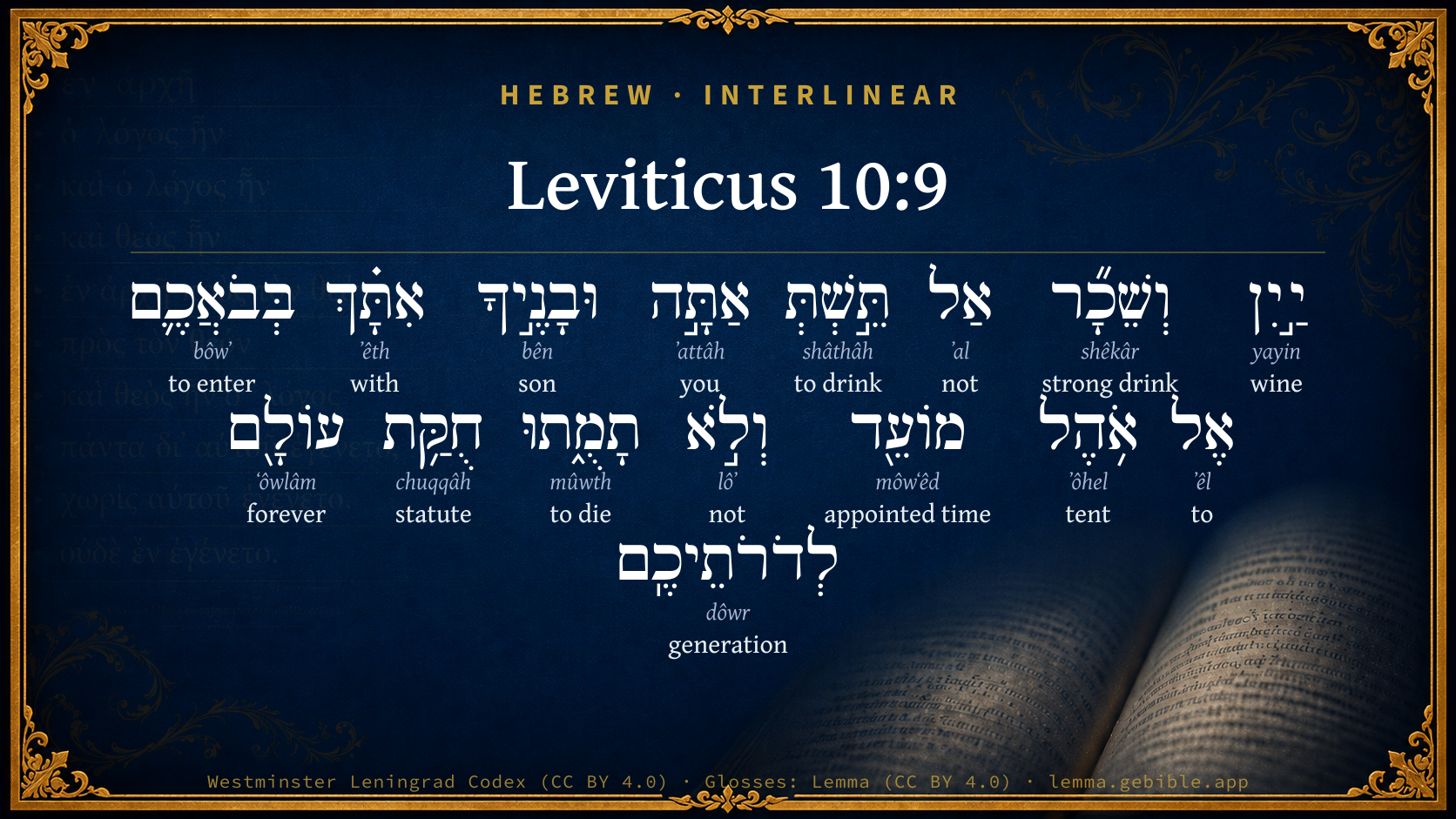
Leviticus 10:9

Hebrew (Westminster Leningrad Codex) Leviticus 10:9 appears in the Hebrew Old Testament. The text above is from the Westminster Leningrad Codex. Each word links to its Strong’s number, a concise gloss, and parsing drawn from the Open Scriptures Hebrew Bible morphology. Click any word for its full Brown-Driver-Briggs (BDB) entry.
Download image
Cite this verse

Leviticus 10:9 (World English Bible). Public Domain. Lemma interlinear Bible study tool, https://lemma.gebible.app/v/leviticus/10/9.

Show BibTeX & RIS
BibTeX
RIS
English Translation
"Drink no wine nor strong drink, you, nor your sons with you, when you go into the Tent of Meeting, that you don't die: it shall be a statute forever throughout your generations:
World English Bible · Public Domain
Highlights
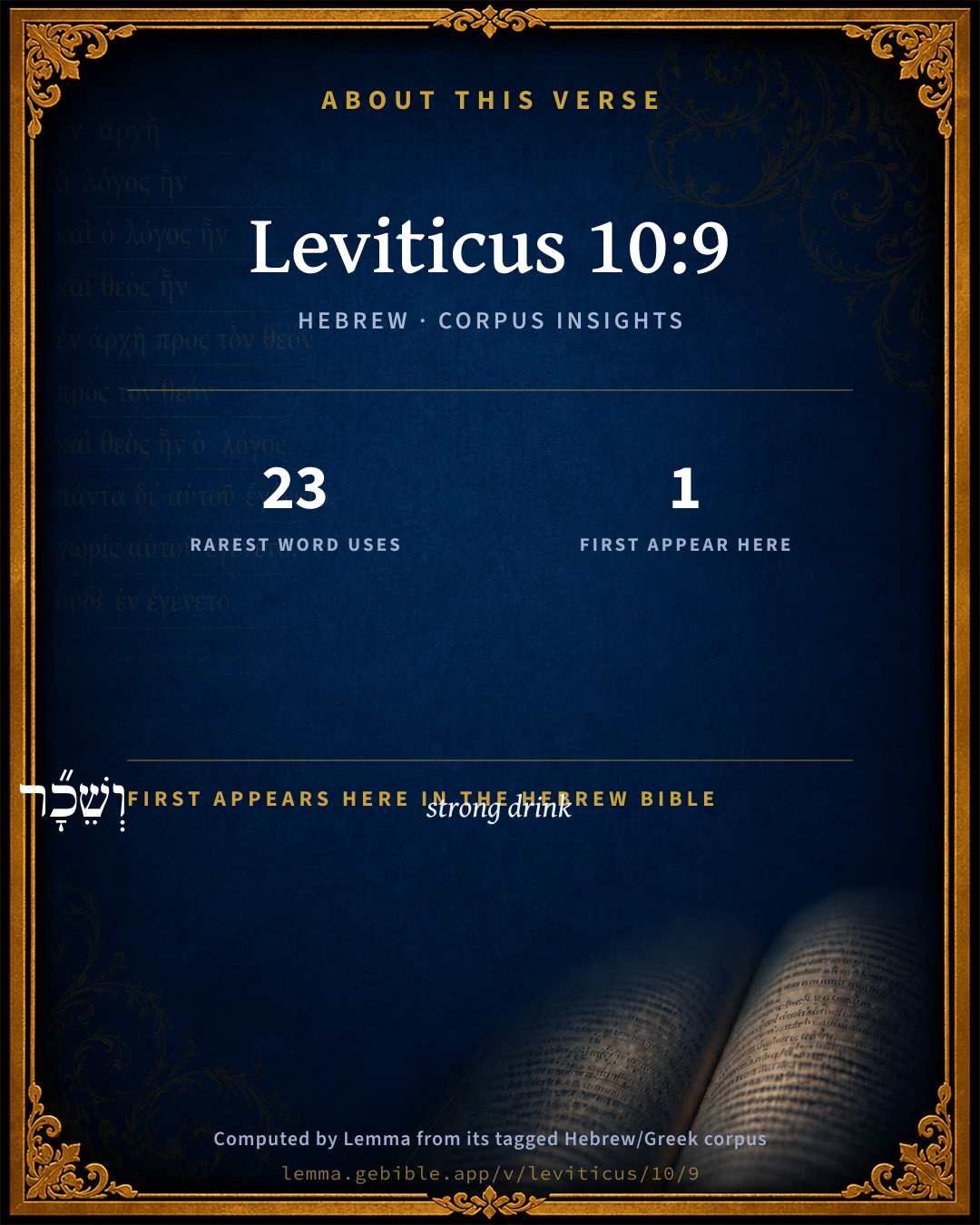
  • 1 first appearance in the Hebrew Bible
Full analysis ↓
Download a study sheet

One document with this verse’s original text, its word-by-word gloss line, the meaning frame, cross-references with their text, attributed commentary, and full source and license credits — printable, and it pastes into notes with its structure intact.

This verse Autodidact and up

Study sheet (.html) Plain text (.txt)

A passage Seminary Student

Up to 50 verses in one chapter. A passage sheet keeps up to 6 commentary sources and 12 cross-references per verse, in the order this page ranks them, and says so on the sheet whenever that leaves anything out. Ask for a single verse and you get the Autodidact verse sheet above.

Everything on this page stays free to read, with no account — the sheet is a download of what is already on screen, not access to it.

Want to remove ads? Support Godless Engineer
Compare translations 3

The same verse in 3 English versions, stacked beneath the original-language interlinear above. Click any original word for its lexicon entry.

Each is an independent rendering of the whole verse — the interlinear is not word-aligned to these translations.

Highlighted words mark where these versions differ — a whole-verse word diff, not a word-by-word alignment.

  • World English Bible Public Domain
    "Drink no wine nor strong drink, you, nor your sons with you, when you go into the Tent of Meeting, that you don't die: it shall be a statute forever throughout your generations:
  • King James Version Public Domain
    Do not drink wine nor strong drink, thou, nor thy sons with thee, when ye go into the tabernacle of the congregation, lest ye die: it shall be a statute for ever throughout your generations:
  • unfoldingWord Literal Text CC BY-SA 4.0
    “Wine or beer do not drink, you or your sons with you, when you go into the tent of meeting, so you will not die—a statute of eternity throughout your generations—

unfoldingWord Literal Text — © unfoldingWord, licensed CC BY-SA 4.0. Word-aligned USFM3 via Door43 (git.door43.org/unfoldingWord/en_ult).

Versions to compare (up to 4)

3 of 4 selected

Show all 18 translations

Every available English version of this verse, each an independent rendering of the whole verse.

  • World English Bible Public Domain
    "Drink no wine nor strong drink, you, nor your sons with you, when you go into the Tent of Meeting, that you don't die: it shall be a statute forever throughout your generations:
  • Berean Standard Bible Public Domain
    “You and your sons are not to drink wine or strong drink when you enter the Tent of Meeting, or else you will die; this is a permanent statute for the generations to come.
  • Majority Standard Bible Public Domain
    “You and your sons are not to drink wine or strong drink when you enter the Tent of Meeting, or else you will die; this is a permanent statute for the generations to come.
  • King James Version Public Domain
    Do not drink wine nor strong drink, thou, nor thy sons with thee, when ye go into the tabernacle of the congregation, lest ye die: it shall be a statute for ever throughout your generations:
  • American Standard Version (1901) Public Domain
    Drink no wine nor strong drink, thou, nor thy sons with thee, when ye go into the tent of meeting, that ye die not: it shall be a statute for ever throughout your generations:
  • Revised Version (1885) Public Domain
    Drink no wine nor strong drink, thou, nor thy sons with thee, when ye go into the tent of meeting, that ye die not: it shall be a statute for ever throughout your generations:
  • Geneva Bible (1599) Public Domain
    Thou shalt not drinke wine nor strong drinke, thou, nor thy sonnes with thee, when yee come into the Tabernacle of the Congregation, lest ye die: this is an ordinance for euer throughout your generations,
  • Douay-Rheims (1899) Public Domain
    You shall not drink wine nor any thing that may make drunk, thou nor thy sons, when you enter into the tabernacle of the testimony, lest you die: because it is an everlasting precept through your generations:
  • Young's Literal Translation Public Domain
    `Wine and strong drink thou dost not drink, thou, and thy sons with thee, in your going in unto the tent of meeting, and ye die not -- a statute age-during to your generations;
  • Literal Standard Version CC BY-SA 4.0
    “You do not drink wine and strong drink, you and your sons with you, in your going into the Tent of Meeting, and you do not die—a continuous statute throughout your generations,
  • Unlocked Literal Bible CC BY-SA 4.0
    “Do not drink wine or strong drink, you, or your sons who remain with you, when you go into the tent of meeting, so you will not die. This will be a permanent statute throughout your people's generations,
  • unfoldingWord Literal Text CC BY-SA 4.0
    “Wine or beer do not drink, you or your sons with you, when you go into the tent of meeting, so you will not die—a statute of eternity throughout your generations—
  • Darby Bible Public Domain
    Thou shalt not drink wine nor strong drink, thou, and thy sons with thee, when ye go into the tent of meeting, lest ye die -- [it is] an everlasting statute throughout your generations,
  • World Messianic Bible Public Domain
    “You and your sons are not to drink wine or strong drink whenever you go into the Tent of Meeting, or you will die. This shall be a statute forever throughout your generations.
  • Webster's Bible Public Domain
    Do not drink wine nor strong drink, thou, nor thy sons with thee, when ye go into the tabernacle of the congregation, lest ye die: it shall be a statute for ever throughout your generations:
  • Free Bible Version CC BY-SA 4.0
    “You and your descendants must not drink wine or any other alcohol when you go in to the Tent of Meeting, otherwise you will die. This regulation is for all time and for all future generations.
  • Bible in Basic English Public Domain
    Take no wine, or strong drink, you or your sons with you, when you go into the Tent of meeting, that it may not be the cause of death to you; this is an order for ever through all your generations.
  • JPS Tanakh (1917) Public Domain
    'Drink no wine nor strong drink, thou, nor thy sons with thee, when ye go into the tent of meeting, that ye die not; it shall be a statute forever throughout your generations.

Literal Standard Version (2020), Covenant Press — licensed CC BY-SA 4.0. Text via the HelloAO Bible API (eBible.org). Unlocked Literal Bible (unfoldingWord) — licensed CC BY-SA 4.0. Text via the HelloAO Bible API (eBible.org). unfoldingWord Literal Text — © unfoldingWord, licensed CC BY-SA 4.0. Word-aligned USFM3 via Door43 (git.door43.org/unfoldingWord/en_ult). Free Bible Version, Dr. Jonathan Gallagher — licensed CC BY-SA 4.0. Text via the HelloAO Bible API (eBible.org).

Word by word

More ways to search: Search by grammar → Find every occurrence → Compare this word →

Practice this passage: Drill this verse → Learn its vocabulary →

וְשֵׁכָ֞ר
shêkâr
H7941
“and · strong drink”
Conjunction + Noun, Common, Masculine, Singular, Absolute
Part of Speech
Conjunction + Noun
Type
Common
Gender
Masculine
Number
Singular
State
Absolute
Full BDB Definition

Origin: from H7937

TWOT: 2388a

strong drink, intoxicating drink, fermented or intoxicating liquor
  1. יַ֣יִן yayin H3196 “wine” Noun, Common, Masculine, Singular, Absolute
  2. אַל ʼal H408 “not” Particle, Negative
  3. תֵּ֣שְׁתְּ shâthâh H8354 “to drink” Verb, Qal, Jussive, 2nd Person, Masculine, Singular
  4. אַתָּ֣ה ʼattâh H859 “you” Pronoun, Personal, 2nd Person, Masculine, Singular
  5. וּבָנֶ֣יךָ bên H1121 “and · sons · your” Conjunction + Noun, Common, Masculine, Plural, Construct + Suffix, Personal, 2nd Person, Masculine, Singular
  6. אִתָּ֗ךְ ʼêth H854 “with · you” Preposition + Suffix, Personal, 2nd Person, Feminine, Singular
  7. בְּבֹאֲכֶ֛ם bôwʼ H935 “in/at · to enter · you” Preposition + Verb, Qal, Infinitive Construct + Suffix, Personal, 2nd Person, Masculine, Plural
  8. אֶל ʼêl H413 “to” Preposition
  9. אֹ֥הֶל ʼôhel H168 “tent of” Noun, Common, Masculine, Singular, Construct
  10. מוֹעֵ֖ד môwʻêd H4150 “appointed time” Noun, Common, Masculine, Singular, Absolute
  11. וְלֹ֣א lôʼ H3808 “and · not” Conjunction + Particle, Negative
  12. תָמֻ֑תוּ mûwth H4191 “to die” Verb, Qal, Imperfect, 2nd Person, Masculine, Plural
  13. חֻקַּ֥ת chuqqâh H2708 “statute of” Noun, Common, Both, Singular, Construct
  14. עוֹלָ֖ם ʻôwlâm H5769 “forever” Noun, Common, Masculine, Singular, Absolute
  15. לְדֹרֹתֵיכֶֽם dôwr H1755 “to/for · generations · your” Preposition + Noun, Common, Masculine, Plural, Construct + Suffix, Personal, 2nd Person, Masculine, Plural

About this verse

These counts appear in no published source. They are computed here, from the morphology-tagged text and Lemma’s own curated glosses. What Lemma adds →

16
words
16
distinct lemmas
Pentateuch
section

Notable vocabulary

The rarest word here is וְשֵׁכָ֞ר strong drink H7941 — appearing just 23 times in the whole Hebrew Bible.

First appearance in Scripture

This word makes its first canonical appearance in the Hebrew Bible here:

  • וְשֵׁכָ֞ר strong drink H7941

Shared distinctive vocabulary

וְשֵׁכָ֞ר strong drink H7941 occurs in 20 verses of the Hebrew Bible. Also found in:

Grammatical profile

  • 3 verbs
  • 8 nouns
  • 1 pronoun
  • 2 prepositions
  • 2 particles

Verb forms

  • תֵּ֣שְׁתְּ Qal · Jussive
  • בְּבֹאֲכֶ֛ם Qal · Infinitive Construct
  • תָמֻ֑תוּ Qal · Imperfect

Hebrew & Septuagint length

In English translation the verse runs 33 words from the Hebrew and 41 from the Septuagint (LXX English) — closely comparable.

A rough comparison of the two English renderings, which tokenize alike — not a word-level alignment.

Word counts can differ between the Hebrew and the Greek without any difference in meaning — e.g. the Hebrew direct-object marker אֵת has no separate Greek word, and Greek often adds the article ὁ.

Cross-references

15

Topical passages linked to Leviticus 10:9 in the Treasury of Scripture Knowledge — connected by theme and wording, ordered by reader-vote popularity; previews shown in the World English Bible.

  • Luke 1:15 For he will be great in the sight of the Lord, and he will drink no wine nor strong drink. He will be filled with the Holy Spirit, even from his mother's womb.
  • 1 Timothy 3:3 not a drinker, not violent, not greedy for money, but gentle, not quarrelsome, not covetous;
  • Isaiah 28:7 Even these reel with wine, and stagger with strong drink; the priest and the prophet reel with strong drink, they are swallowed up of wine, they stagger with strong drink; they err in vision, they stumble in judgment.
  • Ezekiel 44:21 Neither shall any of the priests drink wine, when they enter into the inner court.
  • Ephesians 5:18 Don't be drunken with wine, in which is dissipation, but be filled with the Spirit,
  • Titus 1:7 For the overseer must be blameless, as God's steward; not self-pleasing, not easily angered, not given to wine, not violent, not greedy for dishonest gain;
  • Numbers 6:3 he shall separate himself from wine and strong drink. He shall drink no vinegar of wine, or vinegar of fermented drink, neither shall he drink any juice of grapes, nor eat fresh grapes or dried.
  • 1 Timothy 3:8 Deacons, in the same way, must be reverent, not double-tongued, not addicted to much wine, not greedy for money;
  • Numbers 6:20 and the priest shall wave them for a wave offering before Yahweh. This is holy for the priest, together with the breast that is waved and the thigh that is offered. After that the Nazirite may drink wine.
  • Proverbs 20:1 Wine is a mocker, and beer is a brawler; Whoever is led astray by them is not wise.
  • Proverbs 31:4–5 It is not for kings, Lemuel; It is not for kings to drink wine; Nor for princes to say, 'Where is strong drink?'
  • Hosea 4:11 Prostitution, wine, and new wine take away understanding.
  • 1 Timothy 5:23 Be no longer a drinker of water only, but use a little wine for your stomach's sake and your frequent infirmities.
  • Jeremiah 35:5–6 I set before the sons of the house of the Rechabites bowls full of wine, and cups; and I said to them, Drink you wine.
  • Leviticus 3:17 "'It shall be a perpetual statute throughout your generations in all your dwellings, that you shall eat neither fat nor blood.'"

Cross-references courtesy of OpenBible.info (CC BY 4.0).

Hebrew and Greek witnesses Masoretic Hebrew ↔ Greek Septuagint

The same verse in the two great witnesses to the Old Testament, shown verse-for-verse.

These are two independent witnesses, not word-aligned to each other, and the Septuagint is shown in lemma (dictionary) form.

Hebrew Leviticus 10:9 Masoretic · Westminster Leningrad Codex

יַ֣יִן וְשֵׁכָ֞ר אַל תֵּ֣שְׁתְּ אַתָּ֣ה וּבָנֶ֣יךָ אִתָּ֗ךְ בְּבֹאֲכֶ֛ם אֶל אֹ֥הֶל מוֹעֵ֖ד וְלֹ֣א תָמֻ֑תוּ חֻקַּ֥ת עוֹלָ֖ם לְדֹרֹתֵיכֶֽם

"Drink no wine nor strong drink, you, nor your sons with you, when you go into the Tent of Meeting, that you don't die: it shall be a statute forever throughout your generations:

World English Bible · Public Domain

Greek LXX Leviticus 10:9 Septuagint · lemma form

οἶνος καί σικερα οὐ πίνω σύ καί ὁ υἱός σύ μετά σύ ἡνίκα ἄν εἰςπορεύομαι εἰς ὁ σκηνή ὁ μαρτύριον ἤ προςπορεύομαι σύ πρός ὁ θυσιαστήριον καί οὐ μή ἀποθνήσκω νόμιμος αἰώνιος εἰς ὁ γενεά σύ

You⌃ shall not drink wine nor strong drink, you and your sons with you, whenever you⌃ enter into the tabernacle of witness, or when you⌃ approach the altar, so shall you⌃ not die; it is a perpetual statute for your generations,

LXX2012 (modern English Septuagint) · Public Domain

On this verse, Haydock's Catholic Bible Commentary discusses the Septuagint’s reading. Read the note in Commentary ↓

Hebrew: Westminster Leningrad Codex (CC BY 4.0). Greek: Septuagint (public domain); English from LXX2012 (modern English Septuagint) (Public Domain). How the Septuagint differs from the Hebrew →

Targum (Aramaic paraphrase)

2

The Targum is the ancient Jewish Aramaic paraphrase of the Hebrew Scriptures — an interpretive translation, not the Hebrew text itself. Onkelos (literal) and Pseudo-Jonathan (expansive) render the Torah, and Jonathan the Prophets. Coverage is partial: where no permissively-licensed English translation exists for a verse, only the Aramaic is shown. This is verse-level text, not a word-by-word alignment to the Hebrew.

  1. Targum Onkelos Torah (Genesis–Deuteronomy)
    חֲמַר וּמְרַוֵי לָא תִשְׁתֵּי אַתְּ וּבְנָיךְ עִמָךְ בְּמֵעַלְכוֹן לְמַשְׁכַּן זִמְנָא וְלָא תְמוּתוּן קְיַם עָלָם לְדָרֵיכוֹן

    (no public-domain English translation for this verse)

    Targum Onkelos — Aramaic: “Onkelos Genesis” (public domain); “Onkelos Exodus” (public domain); “Onkelos Leviticus” (public domain); “Onkelos Numbers” (public domain); “Onkelos Deuteronomy” (public domain). English: “Sefaria Community Translation” (CC0 1.0 (public-domain dedication)); “J.W. Etheridge. The Targums of Onkelos and Jonathan Ben Uzziel on the Pentateuch. London: Longmans, Green, 1862” (public domain). Text via Sefaria.

  2. Targum Pseudo-Jonathan Torah (Genesis–Deuteronomy)
    חֲמַר וְכָל מִדַעַם מַרְוֵי לָא תִשְׁתֵּי אַנְתְּ וּבְנָךְ עִמָךְ בִּזְמַן מֵיעַלְכוֹן לְמַשְׁכַּן זִימְנָא הֵיכְמָא דְעָבְדוּ בְּנָךְ דְמִיתוּ בִּיקִידַת אֵישָׁתָא קְיַים עֲלָם לְדָרֵיכוֹן

    Drink neither wine nor anything that maketh drunk, neither thou nor thy sons with thee at the time when ye are to enter into the tabernacle of ordinance, as thy sons did who have died by the burning of fire. It is an everlasting statute for your generations;

    Targum Pseudo-Jonathan — Aramaic: “Targum Jonathan on Genesis” (public domain); “Targum Jonathan on Exodus” (public domain); “Targum Jonathan on Leviticus” (public domain); “Targum Jonathan on Numbers” (public domain); “Targum Jonathan on Deuteronomy” (public domain). English: “The Targum of Jonathan ben Uzziel, trans. J. W. Etheridge, London, 1862” (public domain). Text via Sefaria.

Commentary

Notes on Leviticus 10:9 from classic Christian and Jewish commentators (each source and its license shown beneath its notes). The classic Christian expositions comment on the surrounding passage and are grouped to its opening verse, so a note may address several verses; the Jewish commentaries on the Tanakh (Rashi and others) are per-verse, so they appear only where the commentator wrote on this verse.

Lemma curates 59 commentaries, every one of them public domain or Creative Commons licensed, each selected and text-cleaned for this edition rather than reprinted as found. About our sources →

Trapp's Complete Commentary

John Trapp

Lev 10:9 Do not drink wine nor strong drink, thou, nor thy sons with thee, when ye go into the tabernacle of the congregation, lest ye die: [it shall be] a statute for ever throughout your generations:

Ver. 9. Do not drink wine, nor strong drink.] As some are of opinion Nadab and Abihu had done; which miscarriage of theirs occasioned this precept. {a} The perpetual equity whereof is, that ministers be no wine bibbers or tipplers or drunken sots. {1Ti 3:3} Why should it be said as of old, "They have erred because of wine, and have gone out of the way because of strong drink, even the priest and the prophet?" {Isa 28:7} Drunkenness is a crime in all, but it is a kind of sacrilege in ministers. And if other drunkards deserve double punishments for their misdemeanours, as Aristotle {b} judgeth, first for their drunkenness, and then for the sin committed in and by their drunkenness what do drunken priests? {Isa 56:12}

{a} Ex malis moribus bonae leges.

{b} διπλα τα επιτιμια. - Arist., Ethic., lib. iii. cap. 5.

John Trapp, A Commentary or Exposition upon All the Books of the Old and New Testament (1647–1656) — public domain. Text from a community e-Sword module.

Albert Barnes' Notes on the Bible

When the priest was on duty he was to abstain from wine and strong drink, lest he should commit excess (see Lev 10:1), and so become disqualified for carrying out the precepts of the ceremonial Law.

Lev 10:9

Strong drink - The Hebrew word is employed here to denote strong drinks of any kind except wine made from the grape.

Lev 10:10

Unholy ... unclean - Common, as not consecrated; and what would occasion defilement by being touched or eaten. Compare Act 10:14.

Lev 10:11

That is, “that you may, by your example in your ministrations, preserve the minds of the Israelites from confusion in regard to the distinctions made by the divine Law.”

Albert Barnes' Notes on the Bible (1834–1885) — public domain. Text from a community e-Sword/MySword module.

The Biblical Illustrator

Joseph S. Exell

Lev_10:9-11

Do not drink wine.

Help to temperance

Combine with this verse Jer_35:6; Eph_5:18; 1Th_5:7. Intemperance, one of the giant evils of the land, is self-imposed. This is its saddest feature. All the evils connected with it might be swept away if men so willed.

I. The natural. Use no intoxicants; and thus never acquire a passion for them.

II. The medical. Some treat drunkenness as a disease; and by medicine seek to destroy the appetite for alcohol.

III. The sanitary. Asylums for inebriates have been opened, which combine physical and moral means to effect a cure; and with success.

IV. The legal. Its object is to control or arrest the evil; and by prohibition of its manufacture and sale, to remove it from the land.

V. The voluntary. This involves the pledge and membership in societies banded together for mutual help and safety. Earnest work for others is a good preventative, so long as it is actively continued.

VI. The spiritual. Grace, wherever received, casts out the demon of drink.

VII. The philanthropic. Here is a reform in which to engage. The beneficent change in public sentiment demands devout thankfulness, and is prophetic of what shall be achieved. (Lewis O. Thompson.)

Abstinence recommended

It is one of the attractions of a glass of wine to those who like it, that it gives a different colour to everything the drinker looks at, just as soon as it has any effect at all. If there were no effect from wine-drinking, there would be no temptation to drink wine. But so soon as the wine takes hold of the brain, the brain takes hold with a new grip of everything it thinks of. Memory is keener, anticipation is brighter, and the present is a great deal livelier. Everybody in sight or in thought looks brighter, too. This isnt so bad a world as it seemed an hour ago! When the wine is in, the wit is out. What does a man under the influence of champagne know of sharp distinctions in morals, or in social life, or in logic? The inspired teacher was never more clearly inspired than when that teacher wrote, It is not for kings, O Lemuel, it is not for kings to drink wine, nor for princes strong drink; lest they drink and forget the law, and pervert the judgment of any of the afflicted. And it was God Himself who insisted that priests should let wine and strong drink alone, lest they should fail to know the difference between holy and unholy, clean and unclean, and lest they should be unable to teach the truth aright. If you want to know what is right, and to do what is right, and to be able to teach others to know and do right, do you let wine and strong drink alone--before you go to church, and after you come back from church. What is good enough for a king, and safe enough for a priest, can wisely be your choice wherever you are. (H. C. Trumbull.)

Excitement to be avoided by ministers

The effect of wine is to excite nature, and all natural excitement hinders that calm, well-balanced condition of soul which is essential to the proper discharge of the priestly office. The things which excite mere nature are manifold indeed--wealth, ambition, politics, the various objects of emulation around us in the world. All these things act, with exciting power, upon nature, and entirely unfit us for every department of priestly service. If the heart be swollen with feelings of pride, covetousness, or emulation, it is utterly impossible that the pure air of the sanctuary can be enjoyed, or the sacred functions of priestly ministry discharged. If we are not keeping our priestly garments unspotted, and if we are not keeping ourselves free from all that would excite nature, we shall, assuredly, break down. The priest must keep his heart with all diligence, else the Levite will fail, and the warrior will be defeated. It is, let me repeat it, the business of each one to be fully aware of what it is that to him proves to be wine and strong drink--what it is that produces excitement--that blunts his spiritual perception, or dims his priestly vision. It may be an auction-mart, a cattle-show, a newspaper. It may be the merest trifle. But no matter what it is, if it tends to excite, it will disqualify us for priestly ministry; and if we are disqualified as priests, we are unfit for everything, inasmuch as our success in every department and in every sphere must ever depend upon our cultivating a spirit of worship. (C. H. Mackintosh.)

Testimony of a clergyman as to the value of total abstinence

The Rev. S. Hooke, vicar of Clopton, Woodbridge, offers the following testimony:--As there are so many of my clerical brethren who are doubtful if they could carry on their arduous labours if they abstained from alcoholic drinks, I write my experience of the last seven years, during which time I have been an abstainer. I believe I can do treble the amount of work without the use of these drinks than with them. At first I doubted if I could, and it was with trembling hand that I signed the pledge of the C.E.T.S. But I thank God from the depth of my heart that I took that step, for I am certain that I have been able to do more real good by my advocacy of total abstinence than I did before. On looking through my diary of last year I find I have preached a hundred and seventy-five times, given forty-four temperance lectures, ninety-five gospel addresses and cottage lectures, besides travelling nearly four thousand miles. Included in the above are the sermons and addresses I delivered at two Church Missions of ten days each. I am thankful to say I enjoy robust health, which I am confident is the result, in part, at least, of total abstinence. I am sure the happiness and joy of doing good to our fallen brothers and sisters more than compensates for the loss of a trifling gratification.

The value of abstinence

It was Dr. Hooks boast that for more than thirty years he had laboured in the manufacturing districts, not for the working classes, but with them, in the measures desired by themselves for the improvement of their class, and having for their object the formation of habits of temperance and prudence; and especially that he had worked with them in the cause of rational recreation and education. It was with a view to aid this wide and general step in the education of the masses that, late in life, he joined the temperance movement, and became a pledged teetotaler. He used to tell the story of his change in this direction in the following way:--I had in my parish at Leeds a man who earned 18s. a week; out of this he used to give 7s. to his wife, and to spend the rest in drink; but for all that, he was a good sort of man. I went to him and said, Now, suppose you abstain altogether for six months. Well, if I do, will you, sir? was his reply. Yes, I said, I will. What, said he, from beer, from spirits, and from wine? Yes. And how shall I know if you keep your promise? Why, sir, you ask my missus, and Ill ask yourn. It was agreed between us for six months at first, and afterwards we renewed the promise. He never resumed the bad habit that he had left off; and he is now a prosperous and happy man in business at St. Petersburg, and I am Dean of Chichester.

Total abstinence a safeguard in responsible positions

On almost all boilers connected with engines there can be found a safety-valve. Whenever the boiler gets too full of steam and is in danger of bursting, this little valve opens and lets the steam out. No one has to watch it, for it opens of itself. There was once a man who wanted to travel on a certain steamboat. He went to the boat and examined the machinery, but he found that there was not an efficient safety-valve on the boiler, so he said to the captain, I wont go on your boat, captain. You havent a proper safety-valve, and I am afraid the boat may be blown up without it. Come down with me to the engine-room, said the captain, and I will show you the best safety-valve in the world. When they reached the engine-room the captain went up to the engineer, and laying his hand on his shoulder, said, There, sir, is my safety-valve, the best to be found anywhere--a man who never drinks anything but cold water. You are right, captain; I want no better safety-valve than that. I will go on this boat. He knew that the engineer would always watch the machinery, and if anything went wrong he would know it instantly. Only a sober man ought to be trusted in such a responsible position; and when boats have such engineers they have the best safety-valves in the world.

The Biblical Illustrator, edited by Joseph S. Exell (c. 1880s–1900s) — public domain. Text from a community e-Sword module.

Joseph Benson's Commentary

Lev 10:9. Do not drink wine nor strong drink — It is certainly not improbable that the sin of Nadab and Abihu was owing to this. But if not, yet drunkenness is so odious a sin in itself, especially in a minister, and most of all at the time of his administration of sacred things, that God saw fit to prevent all occasions of it. And hence the devil, who is God’s ape, required this abstinence from his priests in their idolatrous service. By strong drink here, is meant such inflammatory, intoxicating liquors as were made in imitation of wine, as of dates, figs, honey, with many other sorts of liquors, particularly palm-wine, which was much used in those countries, and was reckoned the most intoxicating of any. The intention of this law was to be always in force: accordingly it is required of the ministers of the gospel, that they be sober, not given to wine.

Joseph Benson's Commentary on the Old and New Testaments (1811–1818) — public domain. Text from a community e-Sword module.

Geneva Bible (1599)

Geneva Bible translators

Or, drink that maketh drunk.

Geneva Bible (1599) marginal notes — public domain. Text via Bolls.life.

Adam Clarke's Commentary

Verse 9. Do not drink wine nor strong drink] The cabalistical commentator, Baal Hatturim, and others, have supposed, from the introduction of this command here, that Aaron's sons had sinned through excess of wine, and that they had attempted to celebrate the Divine service in a state of inebriation.

Strong drink. - The word שכר shechar, from shachar, to inebriate, signifies any kind of fermented liquors. This is exactly the same prohibition that was given in the case of John Baptist, Lu 1:15: Οινον και σικερα ου μη πιῃ· Wine and sikera he shall not drink. Any inebriating liquor, says St. Jerome, (Epist. ad nepot.,) is called sicera, whether made of corn, apples, honey, dates, or other fruit. One of the four prohibited drinks among the Mohammedans in India is called [Arabic] sakar, (see the Hedaya, vol. iv., p. 158,) which signifies inebriating drink in general, but especially date wine or arrack. From the original word probably we have borrowed our term cider or sider, which among us exclusively signifies the fermented juice of apples. See on Lu 1:15.

Adam Clarke's Commentary on the Bible (1810–1826) — public domain. Text from a community e-Sword/MySword module.

Ellicott's Commentary for English Readers

(9) Do not drink wine.—As the command that the priests are to abstain from any intoxicating liquors when performing their sacred functions follows so closely upon the death of Nadab and Abihu, the opinion obtained as early at least as the time of Christ that there is a connection between the specific sin and the general law, that the two sons of Aaron drank wine to excess when they offered strange fire, and that the present prohibition is based upon that circumstance. Accordingly, the Apostle enjoins that a bishop “must not be given to wine,” that “deacons must not be given to much wine” (1Ti_3:2-3). A similar law existed among the ancient Greeks and Persians, enjoining the priests to abstain from wine.

Nor strong drink.—The word (shçchâr) here rendered strong drink, is the general name of intoxicating drinks, whether made of wheat, barley, millet, apples, dates, honey, or other fruits. One of the four intoxicating drinks which are prohibited among the Mahommedans in India is called “Sachar.”

When ye go into the tabernacle of the congregation.—Better, when ye go into the tent of meeting. The Palestinian Chaldee adds here, “as thy sons did who died by the burning fire.” The same precept is repeated in Eze_44:21, “Neither shall any priest drink wine when they enter into the inner court.” The injunction that on these particular occasions the priests are to abstain from taking it clearly implies that, ordinarily, when not going into the tent of meeting—that is, when not performing their sacred functions in the sanctuary—they were not forbidden to use it if required.

A Bible Commentary for English Readers, edited by Charles John Ellicott (1878–1897) — public domain. Text from a community e-Sword module.

John Gill's Exposition

And that ye may put difference between holy and unholy,.... That being sober they might be able to distinguish between the one and the other; which a drunken man, having his mind and senses disturbed, is not capable of; as between holy and unholy persons, and between holy and unholy things; particularly, as Aben Ezra interprets it, between a sacred place and one that is common, and between a holy day and a common week day; the knowledge and memory of which may be lost through intemperance; and so that may be done in a place and on a day which ought not to be done, or that omitted on a day and in a place which ought to be done:

and between unclean and clean; between unclean men and women, beasts and fowls, and clean ones; and between unclean things in a ceremonial sense, and those that are clean, which a man in liquor may be no judge of: hence, as the above writer observes, after this section follow laws concerning fowls clean and unclean, the purification of a woman after childbirth, the leprosy in men, garments and houses, and concerning profluvious and menstruous persons; all which the priests were to be judges of, and therefore ought to be sober.

John Gill's Exposition of the Whole Bible (1746–1763) — public domain (CC PDM 1.0). Text via the HelloAO Bible API.

Haydock's Catholic Bible Commentary

Drunk. Hebrew shekar; which the Septuagint and Vulgate commonly translate by sicera, any strong liquor, (St. Jerome) particularly palm-wine. (St. Chrysostom in Isai. v. 11.) Jonathan says old wine. Hecateus assures us, that the Jews drink no wine at all in the temple. But the Rabbins admit of some exceptions. This abstinence was prescribed by any other nations to their priests and magistrates in office. (Calmet) --- The intent of the law, is to prevent any mistake arising from the fumes of wine, (ver. 10,) as likewise all drowsiness or foolish mirth. As mourning and excessive grief are prohibited on the one hand; so are intoxicating liquors, on the other. (Haydock)

George Leo Haydock (1774–1849), Haydock's Catholic Family Bible and Commentary, 1859 edition — public domain. Excludes Psalms (Douay-Rheims chapter numbering differs from Protestant) and Deuterocanonical books (Catholic canon only).

Matthew Poole's English Annotations

This is here added, either because Nadab and Abihu had been led to their error by drinking too much, which might easily fall out when they were feasting and full of joy for their entrance into so honourable and profitable an employment; or at least because others might thereby be drawn to commit the same miscarriages, which they might now commit from other causes. Drunkenness is so odious a sin in itself, especially in a minister, and most of all in the time of his administration of sacred things, that God saw fit to prevent all occasions of it. And hence the devil, who is God’s ape in his prescriptions for his worship, required this abstinence from his priests in their idolatrous service.

Matthew Poole's English Annotations on the Holy Bible (1683–1685) — public domain. Text from a community e-Sword/MySword module.

John Wesley's Explanatory Notes

Drink not wine - it is not improbable, that the sin of Nadab and Abihu was owing to this very thing. But if not, yet drunkenness is so odious a sin in itself, especially in a minister, and most of all in the time of his administration of sacred things, that God saw fit to prevent all occasions of it. And hence the devil, who is God's ape, required this abstinence from his priests in their idolatrous service.

John Wesley, Explanatory Notes Upon the Whole Bible (1754–1765) — public domain. Text via the GEBible commentary corpus.

Kretzmann's Popular Commentary

Paul E. Kretzmann

Chiefly of the Second Table

v. 9. And when ye reap the harvest of your land, thou shalt not wholly reap the corners of thy field, to the very edge of the property line, neither shalt thou gather the gleanings of thy harvest, single stalks and ears that dropped when the sheaves were bound.

v. 10. And thou shalt not glean thy vineyard after the first picking, neither shalt thou gather every grape of thy vineyard, those that had fallen to the ground during the picking; thou shalt leave them for the poor and stranger. I am the Lord, your God. Love toward one’s neighbor was emphasized again and again as a fundamental requirement of the Law.

v. 11. Ye shall not steal, neither deal falsely, hypocritically, neither lie one to another, said of deceit and perfidiousness. Note that falsehood and fraud are enumerated with theft, for the three go together.

v. 12. And ye shall not swear by My name falsely; true oaths are indeed permitted, those in the interest of one’s neighbor, but not false oaths; neither shalt thou profane the name of thy God, desecrate it by taking it in vain. I am the Lord.

v. 13. Thou shalt not defraud, oppress, thy neighbor, neither rob him, in any manner whatever deprive him of something which is due him; the wages of him that is hired shall not abide with thee all night until the morning. The day-laborer was to receive his pay at the end of each day, Deu 24:14-15.

v. 14. Thou shalt not curse the deaf, the poor man not being able to hear the maledictions and to defend himself, nor put a stumbling-block before the blind, to cause him to fall, a decidedly ill-conceived form of practical joke, but shalt fear thy God, who both hears and sees, and will avenge the wrong in due time. I am the Lord.

v. 15. Ye shall do no unrighteousness in judgment, not let personal interests influence you to disregard the demands of justice. Thou shalt not respect the person of the poor, take his part from false sympathy, nor honor the person of the mighty, with the aim of gaining his favor; but in righteousness shalt thou judge thy neighbor.

v. 16. Thou shalt not go up and down as a talebearer among thy people; neither shalt thou stand against the blood of thy neighbor, as the false witness often does. I am the Lord. This involves, of course, "casting aside all inhumane conduct, all ill will, as manifested in malicious belittling, blackening, and slandering, and especially in attempts against the life of a neighbor, whether in court or in private life. " (Lange. )

v. 17. Thou shalt not hate thy brother in thine heart, not bear him any grudge. Thou shalt in any wise rebuke thy neighbor, frankly and openly tell him his fault in the event of a transgression, as the Lord also bids us do, Mat 18:15-17, and not suffer sin upon him, that is, not bear a sin on his account by remaining silent, when a remonstrance in time might save one’s neighbor from severe transgressions. So even the Israelites, according to this precept, would become partakers of other men’s sins.

v. 18. Thou shalt not avenge, seek and take revenge for a wrong which has been inflicted, nor bear any grudge against the children of thy people, Rom 12:19, after a wrong has been committed, but thou shalt love thy neighbor as thyself. I am the Lord. Cf Mat 19:19; Mat 22:39. Many of these cases, if not all, are applications of the law of love, and therefore require to be observed by Christians to this day.

Paul E. Kretzmann, Popular Commentary of the Bible (1921–1924) — public domain. Text from a community e-Sword module.

Rashi

Rabbi Shlomo Yitzchaki (Rashi)

ושכר ‎יין [DO NOT DRINK] WINE NOR STRONG DRINK — do not drink wine in a manner that brings out its intoxicating force (i. e. do not drink a “log” of wine) (Sifra, Shemini, Section 1 1; Keritot 13b).

‎‏ בבאכם אל אהל מועד WHEN YE GO INTO THE APPOINTED TENT — I have in these words only a law that forbids this when ye go into the Sanctuary; whence can it be derived that it applies also whenever they approached the outer altar? But there is mention here of entering into the appointed tent and there is mention, in connection with the sanctification (the washing) of the hands and feet, of entering into the appointed tent (Exodus 30:20). What is the law there? It (the Torah) made the law regarding approaching to the altar exactly similar to that regarding entering the appointed tent (“when they go into the appointed tent they shall wash with water … or when they come near to the altar”)! Here, also, it makes approaching the altar exactly similar to entering the appointed tent (Sifra, Shemini, Section 1 5).

Rashi on the Tanakh — English translations: “The Judaica Press complete Tanach with Rashi, translated by A. J. Rosenberg” (CC BY 4.0); “Pentateuch with Rashi's commentary by M. Rosenbaum and A.M. Silbermann, 1929-1934” (public domain); “The Metsudah Tanach series, Lakewood, N.J” (CC BY 4.0); and “The Book of Joshua, Metsudah Publications, 1997” (CC BY 4.0). Text via Sefaria.

Ramban (Nachmanides)

Rabbi Moshe ben Nachman (Ramban / Nachmanides)

DRINK NO WINE NOR STRONG DRINK. “[Do not drink] wine to such an extent that it has an intoxicating effect.” This is Rashi’s language. The meaning thereof is that if he paused during the drinking [of a fourth of a log of wine], or if he mixed a little water into it, he is free from punishment. The opinion of the Rabbi [Rashi] is thus that the priests were only prohibited from drinking wine, but not from other intoxicating drinks, the meaning of the term sheichar (strong drink) mentioned here being derived from the law of the Nazirite [where a similar expression appears, (strong drink) (Numbers 6:3). and only wine is forbidden to him]. must not therefore be understood as strong drink [as it is found in all English translations], but rather as “strong wine.” The vav in the Hebrew yayin v’sheichar (literally: “wine and strong wine”) is thus to be understood as if it said yayin k’shehu sheichar — you must not drink “wine when it is strong wine,” or “when it is intoxicating” (Mizrachi). Rambam’s opinion, however, as mentioned further on in the text, is that sheichar means “strong drink,” and the priests were warned against both — wine and strong drink, although the punishment for violation was different for each. This is correct according to my opinion. But in the opinion of Rabbi Moshe [ben Maimon], 1:2. however, other intoxicating drinks are prohibited [through a negative commandment, without being punishable by death, and the Service performed after drinking them is not invalidated, whereas for drinking wine the punishment is death by the hand of Heaven, and the Service is invalidated]; thus sheichar is to be understood in its plain sense [i.e., strong drink]. The reason why this commandment was given at that time, was in order that the priest should not go astray through the intoxicating effect of wine, and thus come to entertain some improper thought which might cause his death, as happened to [Aaron’s] sons. It is possible that when the Rabbis interpreted that Nadab and Abihu died because they entered the Sanctuary whilst intoxicated by wine, they meant to say that it was because of the wine they had drunk that they erred in the matter of the strange fire, but not that their punishment actually was because they had drunk the wine, since they had not yet been warned against it. Rather, their punishment was because they erred with respect to the fire of G-d, as I have alluded to.

WHEN YE GO INTO THE TENT OF MEETING. “From this verse I know only [that they are forbidden to drink wine and strong drink] when they go into the Sanctuary. Whence do I know that this applies also whenever they approach the altar? Entering the Tent of Meeting is mentioned here, and entering the Tent is also mentioned in connection with the washing of hands and feet. (Exodus 30:20). Now just as there the Torah made approaching the altar similar to entering the Tent of Meeting, so here too it made approaching the altar like entering the Tent of Meeting.” This is Rashi’s language, and that of the Torath Kohanim. 1:4.It would appear from this analogy that a priest [drunk with wine] is not liable to death for approaching the altar or for entering the Sanctuary, unless he performed there some [Divine] Service, just as in the case of washing the hands and feet, where the admonition is only against performing the Service [without washing], as it says, or when they come near to the altar to minister, to burn a fire-offering unto the Eternal. (Exodus 30:20). In this form it is taught there in the Sifra: “Sifra” is another name for the Torath Kohanim. See in Seder Vayikra, Note 121. “Rabbi, “our holy teacher,” or simply “Rabbi.” states: Here it says, when ye go into the Tent of Meeting, and there [in connection with the law of the priests washing their hands and feet] it says, when they go into the Tent of Meeting. (Exodus 30:20). Now just as there He made going out [of the Sanctuary] similar to going into it, and the altar similar to the Tent of Meeting, and the penalty of death [by the hand of Heaven] is only if he performed the Service [without washing], so here also He made going out [of the Sanctuary] similar to going into it, ). and the altar similar to the Tent of Meeting, and the punishment is only if he performs the Service [whilst intoxicated].” That is to say, the liability [to punishment] is only if the priest performs the Service, whether he entered while drunk, or drank there [after he had come in] and then performed some Service. There [in the Sifra] 1:5. the Rabbis have said: “It shall be a statute forever. This includes the pouring of oil [upon the flour of a meal-offering], mixing it, waving it, bringing near [the meal-offering to the altar], removing the handful and burning it, pinching a bird’s head, and sprinkling the blood,” [so that all these acts must not be done by the priest while drunk, and if he did any of them in that state, he is liable to death by the hand of Heaven]. For since Scripture stated, to burn a fire-offering unto the Eternal, (Exodus 30:20). [I might have excluded these acts from this law since they are not “a fire-offering”], therefore it was necessary to include them [here in the verse before us].It further appears that this liability [to punishment] does not apply where one offers up on a bamah. were permitted until the eighth day of consecration when the Tabernacle was erected, but from that day onwards they were prohibited until the people came into the Land of Israel, when for a period of fourteen years comprising the conquest and division of the Land, the Tabernacle was at Gilgal, and bamoth were temporarily permitted. Then a central Sanctuary was built at Shiloh, which lasted for 369 years, and during that time the bamoth were again prohibited. After the Philistines destroyed the Sanctuary at Shiloh, the bamoth were once again permitted. This period [covering also the reigns of Saul and David] lasted 57 years, and is known as that of Nob and Gibeon. Then finally the Sanctuary at Jerusalem was built, and from then on the bamoth were prohibited forever, since that is “the Eternal House,” so that even when it was destroyed, the place is still holy. — From this account it is thus clear why as stated in the Torath Kohanim [mentioned further on in the text] the central Sanctuary at Shiloh and “the Eternal House” at Jerusalem were alike as far as the prohibition to perform the Service while drunk is concerned. In both only a priest could perform the Service, while at a bamah even an Israelite was permitted to do it. That is why the Rabbis said there [in the Torath Kohanim]: 1:5. “From this verse I know only that it is prohibited [to perform the Service] in the Tent of Meeting [while drunk]. Whence do I know to include the Sanctuary at Shiloh and the Eternal House at Jerusalem? Scripture therefore says, it shall be a statute for ever.” For this prohibition applies to the priests performing their Services, and it was not necessary that it be a priest who performed the Service at a bamah; were permitted until the eighth day of consecration when the Tabernacle was erected, but from that day onwards they were prohibited until the people came into the Land of Israel, when for a period of fourteen years comprising the conquest and division of the Land, the Tabernacle was at Gilgal, and bamoth were temporarily permitted. Then a central Sanctuary was built at Shiloh, which lasted for 369 years, and during that time the bamoth were again prohibited. After the Philistines destroyed the Sanctuary at Shiloh, the bamoth were once again permitted. This period [covering also the reigns of Saul and David] lasted 57 years, and is known as that of Nob and Gibeon. Then finally the Sanctuary at Jerusalem was built, and from then on the bamoth were prohibited forever, since that is “the Eternal House,” so that even when it was destroyed, the place is still holy. — From this account it is thus clear why as stated in the Torath Kohanim [mentioned further on in the text] the central Sanctuary at Shiloh and “the Eternal House” at Jerusalem were alike as far as the prohibition to perform the Service while drunk is concerned. In both only a priest could perform the Service, while at a bamah even an Israelite was permitted to do it. [therefore the prohibition did not apply there].Now the meaning of the expression when ye go into the Tent of Meeting, is “when you perform Service,” and He used this expression because all the Services were done there, either inside the Tent or at the altar of the burnt-offering which was at the door of the Tent of Meeting. The general principle then, is that the prohibition and punishment in these matters are only to the effect that the priest should not perform the Service while drunk with wine or with hands and feet unwashed, likewise if he lacks any of the required priestly garments; but merely for entering the Sanctuary in these conditions, there is no prohibition in the Torah. Thus that which we have been taught in the Mishnah: “Rabbi Yosei says: In five things is the space between the Porch [of the Sanctuary] and the altar equal to the Sanctuary: that those priests may not enter there who have a blemish, or who have dishevelled hair, or who have hands and feet unwashed” and the whole Mishnah there — all these are gradations of Rabbinic enactment [and are not matters prohibited by Scriptural law]. In the opinion, however, of Rabbi Moshe [ben Maimon], 1:15-16. See “The Commandments,” Vol. II pp. 68, 72-73. one who [wilfully] enters the Sanctuary [in the above-mentioned conditions] without performing the Service, [has also violated] a negative commandment, for which the punishment is not death [by the hand of Heaven but whipping].

Ramban (Nachmanides) on the Tanakh — English translation: “Commentary on the Torah by Ramban (Nachmanides). Translated and annotated by Charles B. Chavel. New York, Shilo Pub. House, 1971-1976” (CC BY 4.0). Text via Sefaria.

Lesson kit

Teaching starters — assembled from the data on this page, not authored interpretation. Every prompt links to the verse data it draws on. Edit before teaching.

Leviticus, in the Pentateuch, opens this verse with 16 words (16 distinct Hebrew lemmas). Its most distinctive word is shêkâr (“strong drink”). A historical commentator’s framing appears above. Read the whole chapter for the surrounding context.

Discussion questions

  1. What does “strong drink” (shêkâr) contribute to the verse as a whole?
  2. The word “strong drink” first appears here in Scripture. What is being introduced at this debut?
  3. Numbers 6:3 shares the word «strong drink» with this verse. How do the two illuminate each other?
  4. The translations on this page render this verse differently — a whole-verse word diff, not a word-by-word alignment. What might account for the different wordings?
  5. The verb «תֵּ֣שְׁתְּ» is Qal Jussive. How does its form color the action?
  6. Reading how Trapp's Complete Commentary and Albert Barnes' Notes on the Bible read this verse, where do the two commentators agree and where do they part?

Things to notice

Reading settings

Reading text

Shown beneath each verse's original-language words.

Old Testament
Old Testament edition

Read the OT as the Masoretic Hebrew (MT) or the Greek Septuagint (LXX).

English shown for the Greek Septuagint (in the Hebrew ↔ Greek comparison).

Comparing translations? Open the Compare panel on any verse page to stack up to four side by side.