
Deuteronomy 10:6

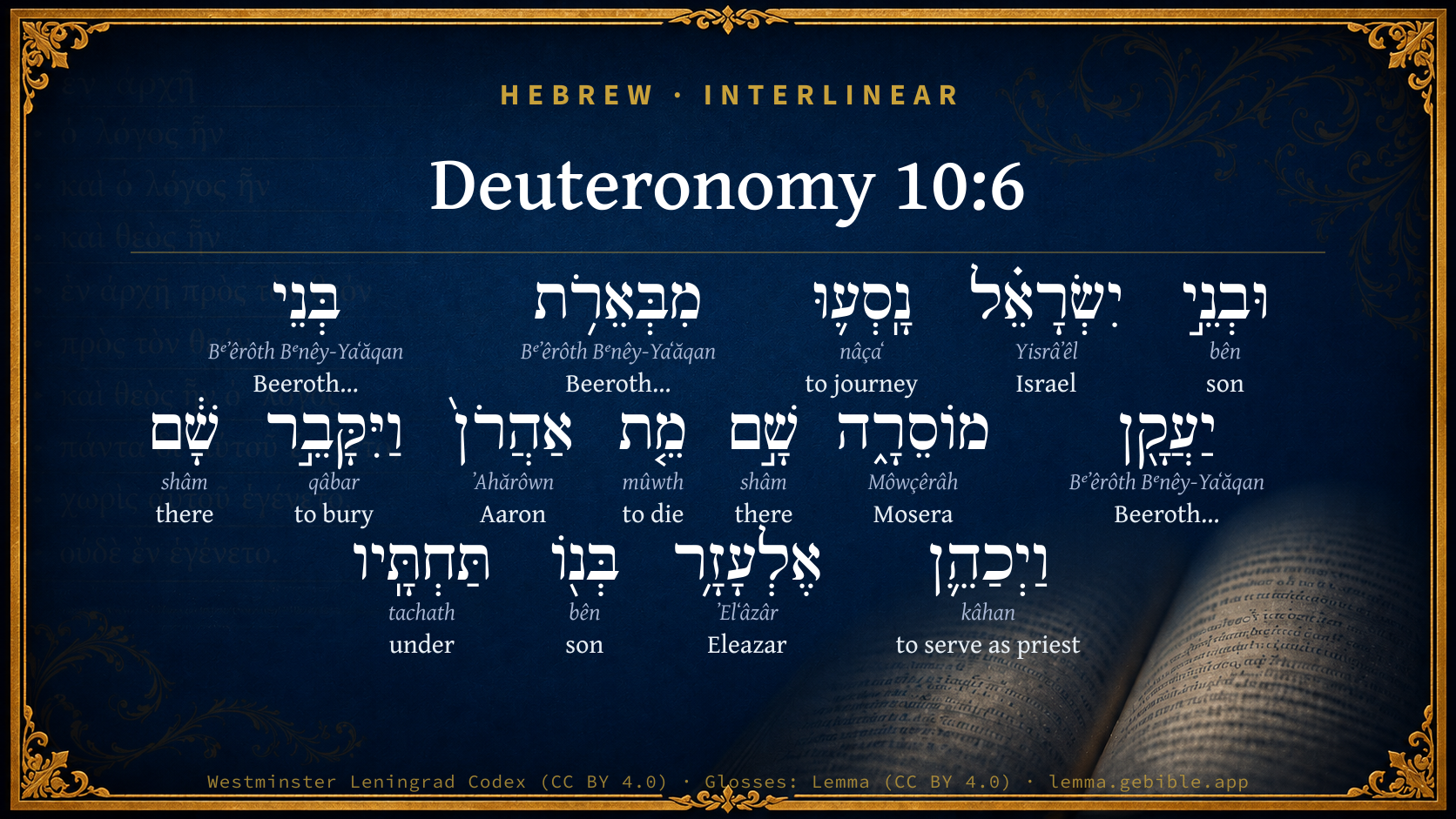
Hebrew (Westminster Leningrad Codex) Deuteronomy 10:6 appears in the Hebrew Old Testament. The text above is from the Westminster Leningrad Codex. Each word links to its Strong’s number, a concise gloss, and parsing drawn from the Open Scriptures Hebrew Bible morphology. Click any word for its full Brown-Driver-Briggs (BDB) entry.
Download image
Cite this verse

Deuteronomy 10:6 (World English Bible). Public Domain. Lemma interlinear Bible study tool, https://lemma.gebible.app/v/deuteronomy/10/6.

Show BibTeX & RIS
BibTeX
RIS
English Translation
(The children of Israel traveled from Beeroth Bene Jaakan to Moserah. There Aaron died, and there he was buried; and Eleazar his son ministered in the priest's office in his place.
World English Bible · Public Domain
Highlights
  • 1 first appearance in the Hebrew Bible
Full analysis ↓
Download a study sheet

One document with this verse’s original text, its word-by-word gloss line, the meaning frame, cross-references with their text, attributed commentary, and full source and license credits — printable, and it pastes into notes with its structure intact.

This verse Autodidact and up

Study sheet (.html) Plain text (.txt)

A passage Seminary Student

Up to 50 verses in one chapter. A passage sheet keeps up to 6 commentary sources and 12 cross-references per verse, in the order this page ranks them, and says so on the sheet whenever that leaves anything out. Ask for a single verse and you get the Autodidact verse sheet above.

Everything on this page stays free to read, with no account — the sheet is a download of what is already on screen, not access to it.

Want to remove ads? Support Godless Engineer
Compare translations 3

The same verse in 3 English versions, stacked beneath the original-language interlinear above. Click any original word for its lexicon entry.

Each is an independent rendering of the whole verse — the interlinear is not word-aligned to these translations.

Highlighted words mark where these versions differ — a whole-verse word diff, not a word-by-word alignment.

  • World English Bible Public Domain
    (The children of Israel traveled from Beeroth Bene Jaakan to Moserah. There Aaron died, and there he was buried; and Eleazar his son ministered in the priest's office in his place.
  • King James Version Public Domain
    And the children of Israel took their journey from Beeroth of the children of Jaakan to Mosera: there Aaron died, and there he was buried; and Eleazar his son ministered in the priest's office in his stead.
  • unfoldingWord Literal Text CC BY-SA 4.0
    (And the sons of Israel journeyed from Beeroth Bene Jaakan to Moserah. There Aaron died, and there he was buried. And Eleazar, his son, was priest in his place.

unfoldingWord Literal Text — © unfoldingWord, licensed CC BY-SA 4.0. Word-aligned USFM3 via Door43 (git.door43.org/unfoldingWord/en_ult).

Versions to compare (up to 4)

3 of 4 selected

Show all 18 translations

Every available English version of this verse, each an independent rendering of the whole verse.

  • World English Bible Public Domain
    (The children of Israel traveled from Beeroth Bene Jaakan to Moserah. There Aaron died, and there he was buried; and Eleazar his son ministered in the priest's office in his place.
  • Berean Standard Bible Public Domain
    The Israelites traveled from Beeroth Bene-jaakan to Moserah, where Aaron died and was buried, and Eleazar his son succeeded him as priest.
  • Majority Standard Bible Public Domain
    The Israelites traveled from Beeroth Bene-jaakan to Moserah, where Aaron died and was buried, and Eleazar his son succeeded him as priest.
  • King James Version Public Domain
    And the children of Israel took their journey from Beeroth of the children of Jaakan to Mosera: there Aaron died, and there he was buried; and Eleazar his son ministered in the priest's office in his stead.
  • American Standard Version (1901) Public Domain
    (And the children of Israel journeyed from Beeroth Bene-jaakan to Moserah. There Aaron died, and there he was buried; and Eleazar his son ministered in the priest's office in his stead.
  • Revised Version (1885) Public Domain
    (And the children of Israel journeyed from Beeroth Bene-jaakan to Moserah: there Aaron died, and there he was buried; and Eleazar his son ministered in the priest’s office in his stead.
  • Geneva Bible (1599) Public Domain
    And ye children of Israel tooke their iourney from Beeroth of the children of Iaakan to Mosera, where Aaron dyed, and was buried, and Eleazar his sonne became Priest in his steade.
  • Douay-Rheims (1899) Public Domain
    And the children of Israel removed their camp from Beroth of the children of Jacan into Mosera, where Aaron died and was buried, and Eleazar his son succeeded him in the priestly office.
  • Young's Literal Translation Public Domain
    `And the sons of Israel have journeyed from Beeroth of the sons of Jaakan to Mosera, there Aaron died, and he is buried there, and Eleazar his son doth act as priest in his stead;
  • Literal Standard Version CC BY-SA 4.0
    And the sons of Israel have journeyed from Beeroth of the sons of Jaakan to Mosera; Aaron died there, and he is buried there, and his son Eleazar acts as priest in his stead.
  • Unlocked Literal Bible CC BY-SA 4.0
    (The people of Israel journeyed from Beeroth Bene Jaakan to Moserah. There Aaron died, and there he was buried; Eleazar, his son, served in the priest's office in his place.
  • unfoldingWord Literal Text CC BY-SA 4.0
    (And the sons of Israel journeyed from Beeroth Bene Jaakan to Moserah. There Aaron died, and there he was buried. And Eleazar, his son, was priest in his place.
  • Darby Bible Public Domain
    (And the children of Israel took their journey from Beeroth-Bene-Jaakan to Moserah: there Aaron died, and there he was buried; and Eleazar his son exercised the priesthood in his stead.
  • World Messianic Bible Public Domain
    (The children of Israel traveled from Beeroth Bene Jaakan to Moserah. There Aaron died, and there he was buried; and Eleazar his son ministered in the priest’s office in his place.
  • Webster's Bible Public Domain
    And the children of Israel took their journey from Beeroth of the children of Jakan to Mosira: there Aaron died, and there he was buried; and Eleazar his son ministered in the priest's office in his stead.
  • Free Bible Version CC BY-SA 4.0
    The Israelites went from the wells of the people of Jaakan to Moserah. Aaron died there and was buried, and Eleazar his son took over as priest.
  • Bible in Basic English Public Domain
    (And the children of Israel went on from Beeroth Bene-jaakan to Moserah: there death came to Aaron and he was put to rest in the earth; and Eleazar, his son, took his place as priest.
  • JPS Tanakh (1917) Public Domain
    And the children of Israel journeyed from Beeroth-benejaakan to Moserah; there Aaron died, and there he was buried; and Eleazar his son ministered in the priest's office in his stead.

Literal Standard Version (2020), Covenant Press — licensed CC BY-SA 4.0. Text via the HelloAO Bible API (eBible.org). Unlocked Literal Bible (unfoldingWord) — licensed CC BY-SA 4.0. Text via the HelloAO Bible API (eBible.org). unfoldingWord Literal Text — © unfoldingWord, licensed CC BY-SA 4.0. Word-aligned USFM3 via Door43 (git.door43.org/unfoldingWord/en_ult). Free Bible Version, Dr. Jonathan Gallagher — licensed CC BY-SA 4.0. Text via the HelloAO Bible API (eBible.org).

Word by word

More ways to search: Search by grammar → Find every occurrence → Compare this word →

Practice this passage: Drill this verse → Learn its vocabulary →

מִבְּאֵרֹ֥ת
Bᵉʼêrôth Bᵉnêy-Yaʻăqan
H885
“from · Beeroth Bene-Jaakan”
Preposition + Noun, Proper
Part of Speech
Preposition + Noun
Type
Proper
Full BDB Definition

Origin: from the fem. pl. of H875 , and the pl. contraction of H1121 , and H3292

TWOT: None

Beeroth Bene-Jaakan or Beeroth = "wells" or " wells of the sons of Jaakan" - an encampment for Israel in the wilderness probably in the country of the Horites
  1. וּבְנֵ֣י bên H1121 “and · sons of” Conjunction + Noun, Common, Masculine, Plural, Construct
  2. יִשְׂרָאֵ֗ל Yisrâʼêl H3478 “Israel” Noun, Proper
  3. נָֽסְע֛וּ nâçaʻ H5265 “to journey” Verb, Qal, Perfect, 3rd Person, Common, Plural
  4. בְּנֵי Bᵉʼêrôth Bᵉnêy-Yaʻăqan H885 “Beeroth Bene-Jaakan” Noun, Proper
  5. יַעֲקָ֖ן Bᵉʼêrôth Bᵉnêy-Yaʻăqan H885 “Beeroth Bene-Jaakan” Noun, Proper
  6. מוֹסֵרָ֑ה Môwçêrâh H4149 “Mosera” Noun, Proper
  7. שָׁ֣ם shâm H8033 “there” Adverb
  8. מֵ֤ת mûwth H4191 “to die” Verb, Qal, Perfect, 3rd Person, Masculine, Singular
  9. אַהֲרֹן֙ ʼAhărôwn H175 “Aaron” Noun, Proper
  10. וַיִּקָּבֵ֣ר qâbar H6912 “and · to bury” Conjunction + Verb, Niphal, Sequential Imperfect, 3rd Person, Masculine, Singular
  11. שָׁ֔ם shâm H8033 “there” Adverb
  12. וַיְכַהֵ֛ן kâhan H3547 “and · to serve as priest” Conjunction + Verb, Piel, Sequential Imperfect, 3rd Person, Masculine, Singular
  13. אֶלְעָזָ֥ר ʼElʻâzâr H499 “Eleazar” Noun, Proper
  14. בְּנ֖וֹ bên H1121 “son · his” Noun, Common, Masculine, Singular, Construct + Suffix, Personal, 3rd Person, Masculine, Singular
  15. תַּחְתָּֽיו tachath H8478 “under · him” Preposition + Suffix, Personal, 3rd Person, Masculine, Singular

About this verse

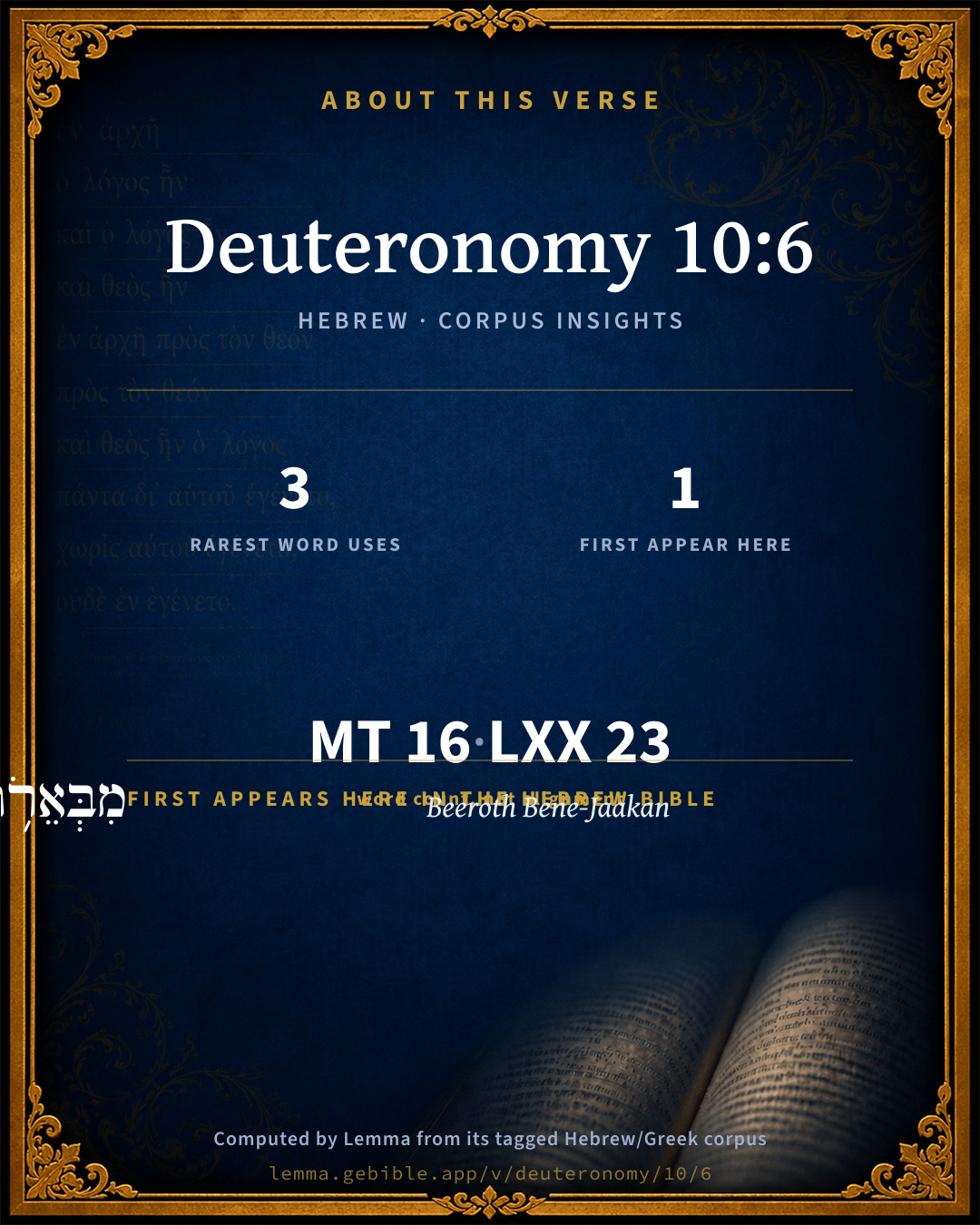
These counts appear in no published source. They are computed here, from the morphology-tagged text and Lemma’s own curated glosses. What Lemma adds →

16
words
12
distinct lemmas
Pentateuch
section

Notable vocabulary

The rarest word here is מִבְּאֵרֹ֥ת Beeroth Bene-Jaakan H885 — appearing just 3 times in the whole Hebrew Bible.

First appearance in Scripture

This word makes its first canonical appearance in the Hebrew Bible here:

  • מִבְּאֵרֹ֥ת Beeroth Bene-Jaakan H885

Grammatical profile

  • 4 verbs
  • 9 nouns
  • 1 preposition
  • 2 adverbs

Verb forms

  • נָֽסְע֛וּ Qal · Perfect
  • מֵ֤ת Qal · Perfect
  • וַיִּקָּבֵ֣ר Niphal · Sequential Imperfect
  • וַיְכַהֵ֛ן Piel · Sequential Imperfect

Repetition

Words recur within this verse — often emphatic in Hebrew:

  • מִבְּאֵרֹ֥ת Beeroth Bene-Jaakan H885 ×3
  • וּבְנֵ֣י son H1121 ×2
  • שָׁ֣ם there H8033 ×2

Hebrew & Septuagint length

In English translation the verse runs 31 words from the Hebrew and 32 from the Septuagint (LXX English) — closely comparable.

A rough comparison of the two English renderings, which tokenize alike — not a word-level alignment.

Word counts can differ between the Hebrew and the Greek without any difference in meaning — e.g. the Hebrew direct-object marker אֵת has no separate Greek word, and Greek often adds the article ὁ.

In the original languages it is 16 Hebrew tokens and 23 Greek tokens — but the two are counted differently (Hebrew bundles its prefixes and suffixes into one token; the Greek is in lemma form), so that isn’t a like-for-like length.

Cross-references

6

Topical passages linked to Deuteronomy 10:6 in the Treasury of Scripture Knowledge — connected by theme and wording, ordered by reader-vote popularity; previews shown in the World English Bible.

  • Numbers 33:38 Aaron the priest went up into Mount Hor at the commandment of Yahweh, and died there, in the fortieth year after the children of Israel were come out of the land of Egypt, in the fifth month, on the first day of the month.
  • Numbers 20:23–28 Yahweh spoke to Moses and Aaron in Mount Hor, by the border of the land of Edom, saying,
  • Numbers 33:30–33 They traveled from Hashmonah, and encamped in Moseroth.
  • Numbers 10:6 When you blow an alarm the second time, the camps that lie on the south side shall take their journey: they shall blow an alarm for their journeys.
  • Numbers 10:12–13 The children of Israel set forward according to their journeys out of the wilderness of Sinai; and the cloud abode in the wilderness of Paran.
  • Numbers 33:1–2 These are the journeys of the children of Israel, when they went forth out of the land of Egypt by their hosts under the hand of Moses and Aaron.

Cross-references courtesy of OpenBible.info (CC BY 4.0).

Hebrew and Greek witnesses Masoretic Hebrew ↔ Greek Septuagint

The same verse in the two great witnesses to the Old Testament, shown verse-for-verse.

These are two independent witnesses, not word-aligned to each other, and the Septuagint is shown in lemma (dictionary) form.

Hebrew Deuteronomy 10:6 Masoretic · Westminster Leningrad Codex

וּבְנֵ֣י יִשְׂרָאֵ֗ל נָֽסְע֛וּ מִבְּאֵרֹ֥ת בְּנֵי יַעֲקָ֖ן מוֹסֵרָ֑ה שָׁ֣ם מֵ֤ת אַהֲרֹן֙ וַיִּקָּבֵ֣ר שָׁ֔ם וַיְכַהֵ֛ן אֶלְעָזָ֥ר בְּנ֖וֹ תַּחְתָּֽיו

(The children of Israel traveled from Beeroth Bene Jaakan to Moserah. There Aaron died, and there he was buried; and Eleazar his son ministered in the priest's office in his place.

World English Bible · Public Domain

Greek LXX Deuteronomy 10:6 Septuagint · lemma form

καί ὁ υἱός ἰσραήλ ἀποαἴρω ἐκ βηρωθ υἱός ιακιμ μισαδαι ἐκεῖ ἀποθνήσκω ἀαρών καί θάπτω ἐκεῖ καί ἱερατεύω ελεαζαρ υἱός αὐτός ἀντί αὐτός

And the children of Israel departed from Beeroth of the sons of Jakim to Misadai: there Aaron died, and there he was buried, and Eleazar his son was priest in his stead.

LXX2012 (modern English Septuagint) · Public Domain

On this verse, Ellicott's Commentary for English Readers discusses the Septuagint’s reading. Read the note in Commentary ↓

Hebrew: Westminster Leningrad Codex (CC BY 4.0). Greek: Septuagint (public domain); English from LXX2012 (modern English Septuagint) (Public Domain). How the Septuagint differs from the Hebrew →

Targum (Aramaic paraphrase)

2

The Targum is the ancient Jewish Aramaic paraphrase of the Hebrew Scriptures — an interpretive translation, not the Hebrew text itself. Onkelos (literal) and Pseudo-Jonathan (expansive) render the Torah, and Jonathan the Prophets. Coverage is partial: where no permissively-licensed English translation exists for a verse, only the Aramaic is shown. This is verse-level text, not a word-by-word alignment to the Hebrew.

  1. Targum Onkelos Torah (Genesis–Deuteronomy)
    וּבְנֵי יִשְׂרָאֵל נְטָלוּ מִבְּאֵרוֹת בְּנֵי יַעֲקָן לְמוֹסֵרָה תַּמָן מִית אַהֲרֹן וְאִתְקְבַר תַּמָן וְשַׁמֵשׁ אֶלְעָזָר בְּרֵהּ תְּחוֹתוֹהִי

    (no public-domain English translation for this verse)

    Targum Onkelos — Aramaic: “Onkelos Genesis” (public domain); “Onkelos Exodus” (public domain); “Onkelos Leviticus” (public domain); “Onkelos Numbers” (public domain); “Onkelos Deuteronomy” (public domain). English: “Sefaria Community Translation” (CC0 1.0 (public-domain dedication)); “J.W. Etheridge. The Targums of Onkelos and Jonathan Ben Uzziel on the Pentateuch. London: Longmans, Green, 1862” (public domain). Text via Sefaria.

  2. Targum Pseudo-Jonathan Torah (Genesis–Deuteronomy)
    וּבְנֵי יִשְרָאֵל נְטָלוּ מִן כּוּפְרָנֵי בֵּירֵי בְּנֵי יַעֲקָן לְמוֹסֵרָה תַּמָּן אַגַח עִמְהוֹן עֲמָלֵק כַּד מְלָךְ בַּעֲרָד דִּשְׁמַע דְּמִית אַהֲרן וְאִסְתַּלְקוּ עֲנָנֵי יְקָרָא וּמִדְעָקַת עַל יִשְרָאֵל עַל קְרָבָא הַהוּא בָּעוּ לְמֵיתוּב לְמִצְרַיִם וְהַדְרֵי שִׁית מַטְלִין רְדָפוּ בְּנֵי לֵוִי בַּתְרֵיהוֹן וּקְטָלוּ מִנְהוֹן תַּמְנֵי גְנִיסַן וַהֲדָרוּ לַאֲחוֹרֵיהוֹן אַף מִבְּנֵי לֵוִי אִתְקְטִילוּ אַרְבַּע גְּנִיסַן אָמְרוּ דֵין לְדֵין מַאן גָּרַם לָנָא קָטוֹלָא הָדָא אֶלָא עַל דְּאִתְרְשַׁלְנָא בְּמִסְפְּדָא דְאַהֲרן חֲסִידָא וּקְבָעוּ תַּמָּן מִסְפְּדָא כָּל בְּנֵי יִשְרָאֵל כְּאִלּוּ תַמָּן מִית אַהֲרן וְאִתְקְבַר תַּמָּן וּבְכֵן שַׁמֵּישׁ אֶלְעָזָר בְּרֵיהּ בְּאַתְרוֹי

    And the children of Israel journeyed from the villages of the wells of the Beni Jahakan to Mosera. There Amalek, who reigned in Arad, and who had heard that Aharon was dead, and that the Cloud of Glory had gone up, (came and) fought with them. And those of Israel who were distressed by that war sought to go back into Mizraim, and returned (towards it) six journeys; (but) the sons of Levi followed after them, and slew eight families of them, and the remainder returned. Of the sons of Levi also four families were slain. And they said one to another, What hath been the cause of this slaughter? Because we have been remiss in the mourning for Aharon the Saint. Therefore all the children of Israel observed there a mourning for Aharon’s death; and there was he buried, and Elazar his son ministered in his stead.

    Targum Pseudo-Jonathan — Aramaic: “Targum Jonathan on Genesis” (public domain); “Targum Jonathan on Exodus” (public domain); “Targum Jonathan on Leviticus” (public domain); “Targum Jonathan on Numbers” (public domain); “Targum Jonathan on Deuteronomy” (public domain). English: “The Targum of Jonathan ben Uzziel, trans. J. W. Etheridge, London, 1862” (public domain). Text via Sefaria.

Commentary

Notes on Deuteronomy 10:6 from classic Christian and Jewish commentators (each source and its license shown beneath its notes). The classic Christian expositions comment on the surrounding passage and are grouped to its opening verse, so a note may address several verses; the Jewish commentaries on the Tanakh (Rashi and others) are per-verse, so they appear only where the commentator wrote on this verse.

Lemma curates 59 commentaries, every one of them public domain or Creative Commons licensed, each selected and text-cleaned for this edition rather than reprinted as found. About our sources →

Ellicott's Commentary for English Readers

(6, 7) On these verses, which are among the most difficult in Deuteronomy, see a separate Excursus. The difficulty is two-fold. First, the account of Israel’s marches about the time of Aaron’s death is given in a different form here to that which we have in Numbers 20, 21, 33. Secondly, there is the further question why Aaron’s death should be recorded here. It appears to have taken place before Moses began the delivery of the discourses in Deuteronomy. It is separated by thirty-nine years from the incidents which Moses is recapitulating in this passage. The Jewish commentator Rashi gives a very curious tale to account for the allusion to Aaron’s death in this place. But though his theory is mythical, he seems to hit the main point, which is that Israel re-visited in their journey round the land of Edom four places where they had previously encamped, and among them Mosera, or Moseroth, the district in which Mount Hor, where Aaron died, was situated. There is no impossibility in this; in fact, it is highly probable, and would partly account for the statement in Num_21:4, that “the soul of the people was much discouraged because of the way.” It was just about this time that the fiery serpents came.

If the connection of these verses with the train of thought in Moses’ mind is spiritual, the difficulty may be solved. The death of the priest of Israel, whose first representative Aaron was, is spiritually identical with the destruction of the first pair of tables, the death of the first Adam and of all mankind in the person of our representative, the Lord Jesus Christ. After that death He “ariseth” as “another priest, made not after the law of a carnal commandment, but after the power of an endless life.” Thus the incident is connected with what goes before. The separation of the tribe of Levi “to bear the ark of the covenant of the Lord,” i.e., “to bear the burden of the Law,” is the same thing in another form. It deprives them of an earthly inheritance, just as He whose representatives they were gave Himself an offering and sacrifice to God; and “His life is taken from the earth.”

Further, the names of the places themselves have in this aspect a spiritual significance. From certain “wells of water”—the wells of the children of Jaakan (crookedness)—the people of God take their journey to the scene of the high priest’s death. From thence to Hor-hagidgad, or Gudgodah, the mount of the “troop,” or “band” (Sinai is the mount of the “congregation” in the Old Testament, Zion in the New), and thence to a land of rivers of water. It is only another way of relating how from the wells of the Law we pass to the rivers of living water opened by the Gospel. But we must pass by way of the cross of Christ.

EXCURSUS ON NOTES TO DEUTERONOMY.

EXCURSUS ON Deu_10:6-7.

THESE verses have always seemed to me to present the greatest difficulty in the whole of Deuteronomy. If it were not for their beautiful spiritual connection with the context, I should not know how to account for their presence in this place at all. And even so, the difference between this allusion to Aaron’s death and the account given in Numbers, and the superficial resemblance between the four stages of the journey of Israel here mentioned, and four stages which belong to a different period (in Num_33:31-34)—together create a somewhat formidable perplexity. The Samaritan Pentateuch increases the confusion by introducing here the stages mentioned in Num_33:34-37—an obvious attempt to harmonise the accounts of two distinct things. The LXX. version of Deu_10:6-7 supports the Hebrew text. The fact that the burial of Aaron is alluded to in this place only, shows that the verses in Deuteronomy cannot have been taken from those in Numbers. The following comparison will show the difference.

In THE FOURTH PERIOD OF THE EXODUS.IN THE FIFTH PERIOD OF THE EXODUS.(Num_33:30-33.)(Deu_10:6-7.)“The children of Israel journeyed from Hash-monah to Moseroth; from Moseroth to Bene-jaakan; from Bene-jaakan to Hor-hagidgad; from Hor-hagidgad to Jotbathah.”

Three other encampments—at Ebronah,Ezion-gaber, and Kadesh—intervened before their arrival at Mount Hor, where Aaron died, in the fifth period of the Exodus, on the first day of the month.

N.B.-The fourth period of the Exodus has no dates mentioned.

The fifth period begins with the death of Miriam at Kadesh in the first month of the fortieth year. Num_20:1.“The children of Israel journeyed from Beeroth-bene-jaakan to Mosera, (where Aaron died and was buried), from Mosera to Gudgodah; from Gud-godah to Jotbath, a land of rivers of waters.”

Mosera is singular, Moseroth plural in form. Bene-jaakan means “the children of Jaakan”—Beeroth-bene-jaakan the wells of the children of Jaakan. Hor-hagidgad means the mount of Gid-gad, which differs from Gudgod only in the vowel pointing. Gudgodah may mean the neighbourhood of Gudgod or Gidgad, and Jotbathah may mean simply to Jotbath.

Gadgad and Etebatha are found both in Numbers and Deuteronomy in the LXX. The other names are given with some variation.The places are not mentioned in the same order in the two passages, and the difference in the form of the words shows that neither passage is copied from the other. All four sites are at present unknown. The additional particulars given in Deuteronomy suggest a reason why Israel should re-visit two of the four places; namely, because of the water which was to be had from the wells of the children of Jaakan and in Jotbath, the “land of rivers of waters.”

The return of Israel in the last period of the Exodus to four places previously visited is in no way remarkable. We are told that they were compelled, about the time of Aaron’s death, to “journey from Mount Hor to compass the land of Edom,” which the Edomites would not permit them to cross (Num_21:4; Num_20:21). The return to these former encampments may have enhanced the weariness and annoyance of the people, so that “their soul was much discouraged because of the way,” and if they were travelling in a different direction, they may well have revisited these four places in a different order. They need not have encamped at all of them the second time. The narrative in Deuteronomy merely says “they journeyed from,” not “they encamped in.” There is no reason why the district of Mount Hor may not have been called Mosera or Moseroth. And the name “chastisement” may have been given to it by Moses, like many other significant names in the Exodus (Meribah, Kibroth-hattaavah &c), in consequence of what took place there.

Further there is some reason to believe that the number of the “goings out” of Israel in the Exodus, given in Numbers 33 is made to be 42 for a special reason, like the forty-two generations of Matthew 1, in which there are at least three evidently intentional omissions. And therefore we need not be surprised at the insertion of places elsewhere, which are not included in that list. No place is mentioned twice in Numbers 33. Yet the children of Israel were certainly twice at Kadesh (for Num_13:26; Num_20:1, cannot refer to the same time), and probably twice at many other places.

The real difficulty is not in the facts related in Deu_10:6-7, but in the question why they should be narrated there. Further, they are narrated in the third person, “the children of Israel journeyed,” but all the other portions of their journey are narrated in the first person (Deu_1:19, we went; and so Deu_2:1; Deu_2:8; Deu_2:13; Deu_3:1; Deu_3:26). A reader of Deuteronomy who was not already familiar with the earlier books, would naturally suppose that at this period of the discourse the children of Israel did journey, as the narrative says. It is only by close attention that the verses are seen to refer to a time previous to the beginning of the book, but much later than the events recapitulated in Deu_10:5; Deu_10:8.

In form, these verses correspond to what may be called the historical or editorial, as distinct from the hortatory portions of Deuteronomy; as the title, Deu_1:1-5; the parenthetical notes, Deu_2:10-12; Deu_2:20-23; Deu_3:14, and Deu_4:41-43, Deu_4:44-49; with the historical portions of the last six chapters of the book.

Upon the whole, I am disposed to think that the only reason for the insertion of these verses is the spiritual reason which I have given in the notes.

From the wells of the children of Jaakan, or perversity, the people of God removed to Mosera the place of chastisement, where their great High Priest[12] died and was buried; and another priest arose in his stead. From thence they journeyed unto the mount of the congregation (Gudgod or Gidgad; compare Gad), and from thence to Jotbath (of which the root is good or goodness), a land of rivers of waters—the usual symbol in Scripture for the Holy Spirit given on Mount Zion, the “mount of the congregation” of Jehovah. (See Joh_7:37-39.)

[12] The following passage from the Talmudical treatise, Pirkê Aboth of Rabbi Nathan (section 34), may serve to show that the comparison between Christ and Aaron is not peculiar to the New Testament:—“These are the two sons of fresh oil who stand by the Lord of the whole earth” (Zec_4:14). “These are Aaron and Messiah. And I cannot say which of them is the best beloved. But when he saith (Ps. Exodus 4), Jehovah hath sworn and will not repent, Thou art priest for ever, then I know that the King Messiah is beloved above the Priest of Righteousness.”

The explanations given by the Jewish commentators are of a spiritual character, and in principle I am disposed to think them correct, though the details are far too fanciful for reproduction, or for our present acceptance.

A Bible Commentary for English Readers, edited by Charles John Ellicott (1878–1897) — public domain. Text from a community e-Sword module.

Trapp's Complete Commentary

John Trapp

Deu 10:6 And the children of Israel took their journey from Beeroth of the children of Jaakan to Mosera: there Aaron died, and there he was buried; and Eleazar his son ministered in the priest’s office in his stead.

Ver. 6. And the children of Israel.] Here are some seeming contradictions betwixt this place and that of Num 33:31-32. But though they seem to be, as the accusers of Christ, never a one speaking like the other, yet, if we well observe the text, and consult with interpreters, we shall find them, like Nathan and Bathsheba, both speaking the same things.

John Trapp, A Commentary or Exposition upon All the Books of the Old and New Testament (1647–1656) — public domain. Text from a community e-Sword module.

Joseph Benson's Commentary

Deu 10:6. This following history comes in manifestly by way of parenthesis, as appears from Deu 10:10, where he returns to his former discourse; and it seems to be here inserted as an evidence of God’s gracious answer to Moses’s prayers, and of his reconciliation to the people, notwithstanding their late and great provocation. For, saith he, after this they proceeded by God’s guidance in their journeys, and though Aaron died in one of them, yet God made up that breach, and Eleazar came in his place, and ministered as a priest, one branch of which office was to intercede for the people.

Joseph Benson's Commentary on the Old and New Testaments (1811–1818) — public domain. Text from a community e-Sword module.

Keil & Delitzsch

C. F. Keil & F. Delitzsch

And the Israelites owed to the grace of their God, which was turned towards them once more, through the intercession of Moses, not only the restoration of the tables of the covenant as a pledge that the covenant itself was restored, but also the institution and maintenance of the high-priesthood and priesthood generally for the purpose of mediation between them and the Lord.

(Note: Even Clericus pointed out this connection, and paraphrased Deu 10:6 and Deu 10:7 as follows: "But when, as I have said, God forgave the Hebrew people, He pardoned my brother Aaron also, who did not die till the fortieth year after we had come out of Egypt, and when we were coming round the borders of the Edomites to come hither. God also showed that He was reconciled towards him by conferring the priesthood upon him, which is now borne by his son Eleazar according to the will of God." Clericus has also correctly brought out the fact that Moses referred to what he had stated in Deu 9:20 as to the wrath of God against Aaron and his intercession on his behalf, or rather that he mentioned his intercession on behalf of Aaron in that passage, because he intended to call more particular attention to the successful result of it in this. Hengstenberg (Dissertations, vol. ii. pp. 351-2) has since pointed out briefly, but very conclusively, the connection of thought between Deu 10:6, Deu 10:7, and what goes before and follows. "Moses," he says, "points out to the people how the Lord had continued unchangeable in His mercy notwithstanding all their sins. Although they had rendered themselves unworthy of such goodness by their worship of the calf, He gave them the ark of the covenant with the new tables of the law in it (Deu 10:1-5). He followed up this gift of His grace by instituting the high-priesthood, and when Aaron died He caused it to be transferred to his son Eleazar (Deu 10:6, Deu 10:7). He set apart the tribe of Levi to serve Him and bless the people in His name, and thus to be the mediators of His mercy (Deu 10:8, Deu 10:9). In short, He omitted nothing that was requisite to place Israel in full possession of the dignity of a people of God." There is no ground for regarding Deu 10:6, Deu 10:7, as a gloss, as Capellus, Dathe, and Rosenmller do, or Deu 10:6-9 as "an interpolation of a historical statement concerning the bearers of the ark of the covenant and the holy persons generally, which has no connection with Moses' address," as Knobel maintains. The want of any formal connection is quite in keeping with the spirit of simplicity which characterizes the early Hebrew diction and historical writings. "The style of the Hebrews is not to be tried by the rules of rhetoricians" (Clericus).)

Moses reminds the people of this gracious gift on the part of their God, by recalling to their memory the time when Aaron died and his son Eleazar was invested with the high-priesthood in his stead. That he may transport his hearers the more distinctly to the period in question, he lets the history itself speak, and quotes from the account of their journeys the passage which supplied the practical proof of what he desires to say. Instead of saying: And the high-priesthood also, with which Aaron was invested by the grace of God notwithstanding his sin at Sinai, the Lord has still preserved to you; for when Aaron died, He invested his son with the same honour,

(Note: "In the death of Aaron they might discern the punishment of their rebellion. But the fact that Eleazar was appointed in his place, was a sign of the paternal grace of God, who did not suffer them to be forsaken on that account" (Calvin).)

and also directed you to continue your journey-he proceeds in the following historical style: "And the children of Israel took their journey from the wells of the sons of Jaakan to Mosera: there Aaron died, and there he was buried; and Eleazar his son became priest in his stead. And from thence they journeyed unto Gudgodah, and from Gudgodah to Jotbath, a land of water-brooks." The allusion to these marches, together with the events which had taken place at Mosera, taught in very few words "not only that Aaron was forgiven at the intercession of Moses, and even honoured with the high-priesthood, the medium of grace and blessing to the people of God (e.g., at the wells of Bene-jaakan) until the time of his death; but also that through this same intercession the high-priesthood was maintained in perpetuity, so that when Aaron had to die in the wilderness in consequence of a fresh sin (Num 20:12), it continued notwithstanding, and by no means diminished in strength, as might have been feared, since it led the way from the wells to water-brooks, helped on the journey to Canaan, which was now the object of their immediate aim, and still sustained their courage and their faith" (Schultz). The earlier commentators observed the inward connection between the continuation of the high-priesthood and the water-brooks. J. Gerhard, for example, observes: "God generally associates material blessings with spiritual; as long as the ministry of the word and the observance of divine worship flourish among us, God will also provide for our temporal necessities."_

Keil & Delitzsch — Biblical Commentary on the Old Testament (1861–1891) — public domain (CC PDM 1.0). Text via the HelloAO Bible API. (Old Testament only.)

Geneva Bible (1599)

Geneva Bible translators

This mountain was also called Hor, Num. 20:28.

Geneva Bible (1599) marginal notes — public domain. Text via Bolls.life.

Jamieson, Fausset & Brown

Robert Jamieson, A. R. Fausset & David Brown

the children of Israel took their journey from Beeroth of the children of Jaakan to Mosera--So sudden a change from a spoken discourse to a historical narrative has greatly puzzled the most eminent biblical scholars, some of whom reject the parenthesis as a manifest interpolation. But it is found in the most ancient Hebrew manuscripts, and, believing that all contained in this book was given by inspiration and is entitled to profound respect, we must receive it as it stands, although acknowledging our inability to explain the insertion of these encampment details in this place. There is another difficulty in the narrative itself. The stations which the Israelites are said successively to have occupied are enumerated here in a different order from Num 33:31. That the names of the stations in both passages are the same there can be no doubt; but, in Numbers, they are probably mentioned in reference to the first visit of the Hebrews during the long wandering southwards, before their return to Kadesh the second time; while here they have a reference to the second passage of the Israelites, when they again marched south, in order to compass the land of Edom. It is easy to conceive that Mosera (Hor) and the wells of Jaakan might lie in such a direction that a nomadic horde might, in different years, at one time take the former first in their way, and at another time the latter [ROBINSON].

Jamieson, Fausset & Brown — Commentary Critical and Explanatory on the Whole Bible (1871) — public domain (CC PDM 1.0). Text via the HelloAO Bible API.

Adam Clarke's Commentary

Verse 6. And the children of Israel took their journey, &c.] On this and the three following verses see Kennicott's remarks at the end of this chapter. See Clarke on De 10:22.

Adam Clarke's Commentary on the Bible (1810–1826) — public domain. Text from a community e-Sword/MySword module.

The Cambridge Bible for Schools and Colleges

gen. ed. J. J. S. Perowne

6. children of Israel] Non-deuteronomic; see on Deu_4:44.

Beeroth Bene-jaakan] Wells of the tribe so-called; in P, Num_33:31, the place name is simply that of the tribe, without wells. ‘Aḳan, Gen_36:27 = Ya‘aḳan, 1Ch_1:42, was a Ḥorite tribe. The place would probably be in the ‘Arabah.

Moserah] Num_33:31, Moserôth; the place is unknown.

there Aaron died, and there he was buried] This happened at Mt Hor acc. to P, Num_20:28; Num_33:38.

and Eleazar his son, etc.] P, Num_20:25-28; Num_32:2; Num_32:28; but see above, general note.

6, 7. Interruption of the address by a piece of narrative, recording certain stations of Israel with Aaron’s death and Eleazar’s succession, in which Israel are spoken of in the 3rd pers., and the phraseology is not deuteronomic. Obviously the fragment of an old itinerary. Although the names it contains are also found in an itinerary given by P, Numbers 33, they occur here in a different order; another name is given to the death-place of Aaron than P gives, nor do we find P’s usual formula for Israel on the march they journeyed from … and pitched at.… The fragment is therefore from another source than P. That this was E (D’s main source) is almost certain. The fragment uses E’s formula, they journeyed from thence to …, and may originally have formed part of the same itinerary of E, from which there are fragments in Numbers 21; E, too, assumes the succession of Eleazar to Aaron, Jos_24:33, and therefore probably had already mentioned this. (So already Vatke, Einl. i. d. A. T. 377 f., 383; but more fully Bacon, Triple Tradition of Exodus, 207 f., 257 f., 343 f. So, too, Driver, Steuern., Bertholet, and Marti on this passage, and Cornill, Einleitung). Why the fragment should be inserted here is not clear, unless the historical retrospect originally concluded with Deu_10:5. It seems more in place after Deu_10:11, but may owe its position here to the design of some editor to ascribe the consecration of the tribe of Levi to a later date than Ḥoreb, in the attempt to harmonise the conflicting data of D and P concerning the tribe of Levi and the priesthood. For other explanations see Driver’s Deut. 120.

The Cambridge Bible for Schools and Colleges (gen. ed. J. J. S. Perowne; Cambridge University Press, 1878–1918) — public domain. Text from a community e-Sword module.

John Gill's Exposition

And the children of Israel took their journey from Beeroth of the children of Jaakan,.... Not when or soon after they removed from Sinai; for if this place is the same with Benejaakan, as is generally supposed, they had a great many journeys, mansions, and stations before they came to it; see Num 33:31 and besides, since Aaron, according to this account, died at their next station from hence, that was thirty eight years after their departure from Mount Sinai; and it is hard to say what should be the reason of making mention of these two or three journeys here; and whereas they are here said to journey front the place here mentioned

to Mosera; on the contrary in Num 33:31 they are said to depart from Mosera, and pitch in Benejaakan; which is accounted for by their going backwards and forwards, and so both may be true. Aben Ezra is of opinion, that Beeroth Benejaakan, or the wells of the children of Jaakan, is not the same with Bene Jaakan, nor Mosera the same with Moseroth; but Beeroth is Kadesh, and Mosera is the name of the desert of Mount Hor; and it is certain that Moseroth was the twenty seventh station, and Mosera, or the desert of Mount Hor, where Aaron died, was the thirty fourth, and therefore must be distant; see Num 33:30, which seems to agree with what follows:

there Aaron died, and there he was buried; it is certain that Aaron died on Mount Hor, Num 20:23, or there died and was buried when in the desert of Mosera:

and Eleazar his son ministered in the priest's office in his stead; so that though the high priest died, the office continued, and the law of it remained in force, and the tribe of Levi was separated for the service of the sanctuary, as afterwards expressed.

John Gill's Exposition of the Whole Bible (1746–1763) — public domain (CC PDM 1.0). Text via the HelloAO Bible API.

Haydock's Catholic Bible Commentary

Mosera, by Mount Hor, for there Aaron died, Numbers xx. This and the following verses seem to be inserted by way of parenthesis, (Challoner) as far as the 10th. The reason of their insertion here cannot easily be explained; but we must adore, in silence, the designs of the Holy Spirit. (Calmet) --- Moses had just mentioned the ark, designed to contain the tables of the law; and as the priests and Levites were to be the guardians of those sacred things, he takes occasion to specify something with respect to their institution, &c. Mosera was perhaps twice visited by the Hebrews. The first time, they came thither from Beroth-Benejaacan, or from "the well of the children of Jacan," and thence measured back their steps; though, the second time, Mosera, or Moseroth, is not noticed, because it had been specified already, and they did not stop long there, but proceeded to Gadgad, Numbers xxxiii. 30. (Bonfrere) (Menochius) --- Others think that Mosera and Benejaacan are not the same places as Moseroth and Beroth Bensacan, though the names be similar. (Cornelius a Lapide) --- Perhaps it will be more satisfactory to acknowledge, that Mosera has been transposed by the copyists, as it ought to come before Beroth, particularly as Moses places it in that order, where he gives an account of the 42 stations; and the Samaritan copy agrees with him in this place. (Calmet) --- It also retains many words which have been omitted in Hebrew, and in all the versions taken from it; whence the omission seems to have taken place before the appearance of the version of the Septuagint. The Samaritan version, which is acknowledged to have preceded the Septuagint, agrees with its text, and reads, "And the children of Israel journeyed from Moseroth, and pitched in Benejaakan: from thence they journeyed, and pitched in Hagidgad: from thence they journeyed, and pitched in Jotbathah, a land of rivers of waters: from thence they journeyed, and pitched in Ebronah: from thence they journeyed, and pitched in Eziongaber: from thence they journeyed, and pitched in the wilderness of Zin, which is Kadesh: from thence they journeyed, and pitched in Mount Hor. And there Aaron died," &c. (Kennicott, 2. Dis.) --- Thus Mosera will be the 27th, and Mount Hor the 34th station; (Pococke) whence the Israelites departed, after the death of Aaron, to Salmona, directing their course to the countries east of the Jordan, which had been promised to them. The appointment of Eleazar to succeed Aaron, and the separation of the Levites unto the Lord, should be all placed together, after the different encampments. (Haydock)

George Leo Haydock (1774–1849), Haydock's Catholic Family Bible and Commentary, 1859 edition — public domain. Excludes Psalms (Douay-Rheims chapter numbering differs from Protestant) and Deuterocanonical books (Catholic canon only).

Matthew Poole's English Annotations

This following history comes in manifestly by way of parenthesis, as may appear from Deu 10:10, where he returns to his former discourse; and it seems to be here inserted, either,

1. Because the priests and Levites here mentioned were the guardians and keepers of the ark and tables here mentioned. Or rather,

2. As an evidence of God’s gracious answer to Moses’s prayers, and of his reconciliation to the people, notwithstanding their late and great provocation. For, saith he, after this they proceeded by God’s guidance in their journeys, some eminent stages whereof he names for all; and though Aaron died in one of them, yet God made up that breach, and Eleazar came in his place, and ministered as priest, one branch of which office was to intercede for the people. Then, saith he, God brought them from the barren parts of the wilderness to

a land of rivers of waters, Deu 10:7, a pleasant and fruitful soil. Then he adds, God separated the Levites, &c., Deu 10:8.

Mosera.

Object. This place seems directly contrary to that, Num 33:31, where their journey is quite contrary to this, even

from Moseroth to Bene-jaakan. This indeed is a great difficulty, and profane wits take occasion to cavil. And if a satisfactory answer be not yet given to it by interpreters, it ought not therefore to be concluded unanswerable, because many things formerly thought unanswerable have been since fully cleared, and therefore the like may be presumed concerning other doubts yet remaining. And it were much more reasonable to acknowledge here a transposition of the words through the scribe’s mistake, than upon such a pretence to reject the Divine authority of those sacred books, which hath been confirmed by such irresistible arguments. But there is no need of these general pleas, seeing particular answers are and may be given to this difficulty sufficient to satisfy modest and impartial inquirers.

Answ.

1. The places here mentioned are differing from those, Num 33, it being very frequent in Scripture for diverse persons and places to be called by the same names, and yet the names are not wholly the same; for there it is

Bene-jaakan, and here Beeroth bene-jaakan, or

Beeroth of the children of Jaakan; there Moseroth, here Mosera; there Horhagidgad, here Gudgodah; there Jotbathah, here Jotbath. If the places were the same, it may justly seem strange why Moses should so industriously make a change in every one of the names. And therefore these may be other stations, which being omitted in Num 33, are supplied here, it being usual in sacred Scripture to supply the defects of one place out of another.

Answ. 2. Admitting these two places to be the same with those Num 33:31, yet the journeys are diverse. They went from

Beeroth of the children of Jaakan to Mosera, which is omitted in Numbers, and therefore here supplied; and then back again from Mosera or Moseroth to Bene-jaakan, as is there said; for which return there might then be some sufficient reason, though now unknown to us, as the reasons of many such like things are: or God might order it so for his own pleasure, and it is not impossible he might do it for this reason, that by this seeming contradiction, as well as some others, he might in just judgment do what he threatened to the Jews, Jer 6:21, even lay stumbling-blocks before profane and proud wits, and give them that occasion of deceiving and ruining themselves, which they so greedily seek and gladly embrace; which is the reason given by some of the ancients why God hath left so many difficulties in Scripture.

Answ. 3. The words may be otherwise rendered,

from Beeroth of the children of Jaakan, and from Mosera; where the order of the places is not observed, as was noted before of the order of time, Deu 10:1, because it was nothing to the purpose here, and because that might be easily fetched from Num 33, where those journeys are more particularly and exactly described. For the conjunction and, that may be here wanting, and to be supplied, as it is Exo 6:23; 1Sa 4:7; Psa 133:3; Isa 63:11; Hab 3:11. And the preposition from is easily supplied from the foregoing words, as is most usual. Nor seems there to be any more reason to render it to Mosera, than from Mosera, seeing the Hebrew letter he in the end is made a part of the proper name, and therefore is not local. There Aaron died. Quest. How is this true? when Aaron died not in Mosera, but in Mount Hor, Num 33:38.

Answ. 1. Mosera may be a different place from Moseroth, and that may be the name of a town or region in which Mount Hor was, or to which it belonged. Or, the same mountain, in respect of diverse parts and opposite sides of it, might be called by diverse names, here Mosera, and there Hor. And it is possible they might go several journeys, and pass to divers stations, and by fetching a compass (which they oft did in their wilderness travels) come to the other side of the same mountain.

Answ. 2. The Hebrew particle scham may here note the time, and not the place of Aaron’s death, and may be rendered then, as it is taken, Gen 49:24; Psa 14:5; Ecc 3:17; Zep 1:14. And then is not to be taken precisely, but with some latitude, as it is oft used in Scripture; that is, about that time, after a few removes more; as the words, at that time, Deu 10:8, must necessarily be understood.

Matthew Poole's English Annotations on the Holy Bible (1683–1685) — public domain. Text from a community e-Sword/MySword module.

Whedon's Commentary on the Bible

Daniel D. Whedon

6. Beeroth — That is, Wells. These wells were a camping-place of one of the Horite tribes. Comp. Num_33:31, and Gen_36:24. In the passage in Genesis the word rendered mules should be rendered warm spring. Mosera is the Moseroth of Num_33:30, a station of the Israelites near Mount Hor, where Aaron died. See Deu_32:50. Also Num_20:28; Num_33:38.

Eleazar… ministered… in his stead — Though Aaron the high priest died God makes provision for the perpetuation of the priesthood. He shows by this that he had not cast away his people.

Daniel D. Whedon (gen. ed.), Commentary on the Old and New Testaments (1874–1909) — public domain. Text from a community e-Sword module.

The Pulpit Commentary

Vers. 6, 7. Not only did God, of his grace and in response to the intercession of Moses, give to the people, notwithstanding their apostasy, the ark of the covenant with the new tables of the Law, but he followed this up by instituting the high priesthood; and, when Aaron died, caused it to be continued to his son Eleazar. This Moses reminds the people of by referring to a fact in their past history, viz. their arrival at Mosera, where Aaron died, and Eleazar succeeded him in his office. Beeroth of the children of Jaakan (wells of the sons of Jaakan); the same place as Benejaakan, (Num_33:31) probably the Horite tribe, called "Akan, (Gen_36:27) for which, apparently, should be read Jakan, as in 1Ch_1:42. Mosera; Moseroth, plu. of Mosera. (Num_33:30) As Aaron died there, Mosera must have been in the vicinity of Mount Her. Gudgodah, Hor-hagidgad; (Num_33:32) cave of Gidgad, a place of caves. Jotbath, Jotbathah, (Num_33:33) a district abounding in streams, whence probably its name, Jot-bathah, pleasantness, from bfy to be good, to please. None of these places have been identified. Robinson mentions a Wady cf. Ghadaghidh, a broad sandy valley diverging from the Wady es Jerafeh, in the desert of Et-Tih, and this has been supposed to indicate the site of Gudgodah; but the difference of the consonants in the two words is such as to render this identification more than doubtful. In the Arabic of the London Polyglott, hdgdg is represented by (Judjuda), which is totally different from Ghadaghidh. All the places, however, must have been in the "Arabah, and in the region of Mount Her, or not far distant. That the places mentioned here are the same as those in Numbers cannot be doubted. The two passages, however, relate to different journeys; that in Numbers to the journeying of the Israelites from the wilderness of Sinai to Kadesh, that in Deuteronomy to the march in the fortieth year, when they went from Kadesh to Mount Her.

Vers. 6-11. Progress.

Progress is the law of human life. Perfection is reached only by steady advancement.

I PROGRESS IS MARKED BY DISTINCT STAGES. There are times for action, and times for rest. Neither body nor mind can, in our present state, bear the strain of continuous exertion. There is an advantage in an occasional halt, by which we can review the past, measure our progress, examine our resources, and reconnoiter the future. The soul is many-sided, and advance in knowledge, devout feeling, practical exertion, self-denial, cannot be made at one and the same time. Today we gain clearer perception of heavenly truths; tomorrow we exercise our best affections on abject sufferers; the day following we fight with the enemy with sword and buckler.

Each morning sees some task begun, Each evening sees its close.

II PROGRESS IS ACCOMPANIED BY CHANGEFUL INCIDENT, PAINFUL AND PLEASANT. At one halting-place Aaron died, and the camp was plunged into bitter mourning; at another halt they came upon streams of refreshing water. Yet all events may minister to the soul"s progress. There are no absolute impediments to the highest progress, "Out of the eater comes forth meat." "All things work together for good." The order of experience usually happens, as in this case, viz. first the bitter, then the sweet first loss, then gain. The evening and the morning make one day. "Blessed are they that mourn: for they shall be comforted.

III THERE IS PROGRESS TOO IN THE DEVELOPMENT OF GOD"S PLANS. At another stage of their pilgrimage, God chose the tribe of Levi to minister unto him in sacred things. Heretofore, the firstborn in each family was claimed by God as his special minister; now a particular tribe is selected on the ground of its zealous exertions in Gods cause. Character, not the accident of birth, is the basis of God"s approval. In God"s kingdom, he bears the palm who merits it. Higher service is to be accounted the most honorable reward. Promotion to a nearer fellowship with God this ought to be our richest joy.

IV THERE IS PROGRESS SHOWN ALSO IN THE NATURE OF DIVINE AWARDS. It had been considered hitherto that the supreme mark of Jehovah"s favor was the gift of Canaan. Now the people are gradually led to perceive that there is something better than that. One tribe, and that the most signally separated by God for favor, is deprived of participation in the Promised Land. The Levites, like Abraham, though dwelling in the land, shall possess no personal property in fields or vineyards. Their advantage it shall be, to be exempt from the cares and ambitions and jealousies pertaining to landed estate. An inheritance shall be theirs, boundless in extent; satisfying in its nature; inalienable in its tenure; uncorrupting, yea, ennobling, in its effect upon the possessor; uncreated, and therefore undecaying. Their inheritance was God himself. He who has God, has all things. The universe is his.

V TRUE PROGRESS IS THE RESULT OF COMBINED CONTEMPLATION AND ACTION. In the busy life of our Lord, communion with God and intense activity sweetly blended. To be always on the mount would make us pietists and recluses and mystics hothouse plants. To be always on the field of action will make us narrow, hard, arrogant, self-reliant. Both sides of our nature must grow in ratio, if we are to be full-orbed, attractive Christians. The ferry-boat of the gospel, which is to carry men to the other side, must be rowed with two oars prayer and labor.

VI THE PROGRESS OF ONE IS THE PROGRESS OF MANY. A useful principle of emulation appears in human nature. It is painful to be left behind in the race. If we cannot be in the front, we wish to be near it. Every man has a following. We cannot go to heaven or to hell alone. With more or less of persuasiveness, every man is saying, "Come with me!" Is my influence beneficial or baneful? D.

Vers. 6-9. The separation of the sons of Levi.

The tables of stone in the ark had to be committed to special officers. These were the sons cf. Levi. God called them to this, a high and glorious honor surely. They were also to minister unto him and to bless in his Name. To this order of men no mere temporal inheritance was given; God was their inheritance.

I IT IS SURELY DESIRABLE THAT A SPECIAL ORDER OF MEN SHOULD BE SET APART FOR THE CUSTODY OF THE DIVINE WORD. This was the primary office of the sons of Levi, custodians of the ark of the covenant. In this respect they resemble the Christian ministry, whose great office is to keep and to propagate the Divine Word. In the "division of labor" to which human wisdom brings us, it is surely important that a special class should be charged with the sacred deposit of the Divine Word. Men secularized by business cannot be expected to handle the Word of God with the wisdom and power of those who are set apart for this special purpose.

II THE SONS OF LEVI WERE ALSO TO BE MINISTERS UNTO GOD. They were directed to stand and officiate. They were the ministers of God. They were Ms servants, not man"s. We do not now refer to the priestly rites, through which they passed according to the Mosaic Law. These were special and temporary. They typified the priestly office fulfilled by Christ, and, when fulfilled, no longer needed. But the general idea of ministration in God"s presence and for the Lord is surely the very essence of the ministerial office.

III THE SONS OF LEVI WERE ALSO TO BLESS IN THE NAME OF THE LORD. They were charged to pronounce certain benedictions in God"s Name. And this right is manifestly continued in the Christian Church. The pronouncing of the benediction is surely something more than a mere prayer breathed to heaven for the blessings specialized. Is it not the assurance on the part of God"s officer that the blessings are conveyed to those waiting to receive them? (cf. Num_6:24 and 2Co_13:14)

IV IT WAS ARRANGED THAT THE LEVITES SHOULD NOT BE SECULARIZED, BUT SHOULD LIVE AT THE ALTAR OF GOD. "Wherefore Levi hath no part nor inheritance with his brethren; the Lord is his inheritance, according as the Lord thy God hath promised him." This means that this tribe was not to be secularized by worldly anxieties and common cares. The Lord guaranteed their support by arrangements at his altar.

And ministerial support" should mean no more! It is a Divine expedient to secure a class of men for his service, emancipated from secular cares and troubles. The privilege of studying and enforcing God"s Word is great and glorious. We only ask such support as ministers as will preserve us from corroding cares, and enable us with free spirits to give ourselves to this high business.

It is this only we ask for, the freedom from the secularity which the world demands even when one is most watchful, in business struggles, against it. It is when a believing Church gives the ministry of Christ such emancipation all round that they may expect the ministerial office to be fulfilled with superior power and to command the ablest men. R.M.E.

The Pulpit Commentary (1880–1919), ed. H.D.M. Spence-Jones & Joseph S. Exell — public domain. Text from a community e-Sword module.

John Wesley's Explanatory Notes

This following history comes in manifestly by way of parenthesis, as may appear from ver. 10, where he returns to his former discourse; and it seems to be here inserted as an evidence of God's gracious answer to Moses's prayers, and of his reconciliation to the people, notwithstanding their late and great provocation. For, saith he, after this they proceeded by God's guidance in their journeys, and though Aaron died in one of them, yet God made up that breach, and Eleazar came in his place, and ministered as priest, one branch of which office was to intercede for the people.

John Wesley, Explanatory Notes Upon the Whole Bible (1754–1765) — public domain. Text via the GEBible commentary corpus.

unfoldingWord translationNotes

Door43 World Missions Community

General Information:

The writer gives a short account of where the Israelites had traveled. (See: Background Information)

The people of Israel ... a land of streams of water

This gives background information about where the people of Israel traveled. It also covers Aaron's natural death in Moserah. (See: Background Information)

Beeroth Bene Jaakan to Moserah ... Gudgodah ... Jotbathah

These are names of different places the people of Israel went through while in the wilderness. (See: How to Translate Names)

Beeroth Bene Jaakan

Translator may add a footnote: "The name 'Beeroth Bene Jaakan' means 'the wells that belonged to the people of Jaakan.'"

there he was buried

This can be translated in active form. AT: "that is where they buried him" or "the Israelites buried him there" (See: Active or Passive)

Eleazar

This is the name of Aaron's son. (See: How to Translate Names)

translationWords

Israel

Aaron

die

bury

servant

priest

unfoldingWord translationNotes — © Distant Shores Media and the Door43 World Missions Community, licensed CC BY-SA 4.0. Source: git.door43.org/Door43/en_tn.

Rashi

Rabbi Shlomo Yitzchaki (Rashi)

ובני ישראל נסעו מבארת בני יעקן מוסרה AND THE CHILDREN OF ISRAEL JOURNEYED FROM BEEROTH OF THE CHILDREN OF JAAKAN TO MOSERA — What has this matter to do with what has been related here? Further: Did they indeed journey from Beeroth of the children of Jaakan to Mosera; did they not come from Mosera to Beeroth of the children of Jaakan, as it is said, (Numbers 33:31) “And they journeyed from Moseroth, [and they encamped in Bene Jaakan]”? And further: it states here, “There (at Mosera) did Aaron die”. But did he not die at Mount Hor? Go and count and you will find that there are eight stations from Mosera to Mount Hor! — But really this also is part of the reproof offered by Moses. In effect he said, “This, also, ye did: when Aaron died on Mount Hor at the end of forty years and the clouds of Divine Glory departed, ye feared war with the king of Arad and you appointed a leader that ye might return to Egypt, and ye turned backwards eight stages unto Bene Jaakan and hence to Mosera. There the sons of Levi fought with you, and they slew some of you, and you some of them, until they forced you back on the road along which you had retreated. From there (Mosera) ye returned to Gudgodah, — that is identical with Hor Hagidgod (Numbers 33:32).

Rashi on the Tanakh — English translations: “The Judaica Press complete Tanach with Rashi, translated by A. J. Rosenberg” (CC BY 4.0); “Pentateuch with Rashi's commentary by M. Rosenbaum and A.M. Silbermann, 1929-1934” (public domain); “The Metsudah Tanach series, Lakewood, N.J” (CC BY 4.0); and “The Book of Joshua, Metsudah Publications, 1997” (CC BY 4.0). Text via Sefaria.

Ramban (Nachmanides)

Rabbi Moshe ben Nachman (Ramban / Nachmanides)

AND THE CHILDREN OF ISRAEL JOURNEYED FROM BEEROTH-BENE-YAAKAN TO MOSERAH. “Why does this matter belong here? Furthermore, did they indeed journey from Beeroth-bene-yaakan to Moserah; did they not come from Moserah to Bene-yaakan, as it is said, And they journeyed from Moseroth, and pitched in Bene-yaakan? And further, here it is said, there [in Moserah] Aaron died; but did he not die in Mount Hor?, Verse 39. Go and count and you will find that there are eight journeys from Moseroth to Mount Hor!, Verses 31-37: Moseroth, Bene-yaakan, Hor-hagidgad, Jotbah, Abronah, Etzion-geber, Kadesh, Mount Hor. But really this is also part of the reproof [spoken by Moses, saying in effect]: ‘This also you did; When Aaron died in Mount Hor at the end of forty years [after the exodus] and the clouds of Divine Glory departed, you feared war with the king of Arad, 21:1. and you appointed a leader to return to Egypt and you turned backwards eight journeys until Bene-yaakan and from there [you continued] to Moserah [as stated here]. There the children of Levi fought you and slew some of you, and you [slew] some of them, until they forced you back the road [along which you had retreated]. From there [Moserah] you returned to Gudgod [Moserah] they journeyed unto Gudgod, and from Gudgod etc. which is identical with Hor-hagidgad,. Hence Gudgod is identical with Hor-hagidgad. and from Gudgod to Moserah. ‘etc’” (Verse 7). Ramban’s text of Rashi is to be understood as follows: “And from Gudgod you ultimately came back to Moserah” since the exact order in the process of their return was from Gudgod to Bene-yaakan, and thence to Moserah. See above, Note 190. And at Moserah you made a great lamentation on account of the death of Aaron which brought this [retreat and subsequent battle with the Levites] upon you, and it [the sadness] was as if Aaron had died there [thus accounting for the verse which states: there — at Moserah — Aaron died]!’ Now Moses placed this reproof next to the [narrative about the] breaking of the Tablets in order to intimate that the death of the righteous is as grievous before the Holy One, blessed be He, as was the day on which the Tablets were broken, and to inform you that it was displeasing to Him what they said Let us make a captain [and return to Egypt] in order to break away from Him, as was the day when they made the calf. At that time the Eternal separated the tribe of Levi — this refers back to the first subject [of this chapter]. At that time, in the first year of your departure from Egypt when you sinned by worshipping the calf, but the sons of Levi did not sin, G-d separated them from you. This event is placed next to the retreat to Bene-yaakan [where, as explained earlier, the Levites showed faith and heroism] in order to intimate that in this matter, also, the sons of Levi did not sin but stood steadfast in their faith.” All this is the language of our Rabbi Shlomo [Rashi] from the words of Agadah. 18.Now, Rabbi Abraham ibn Ezra, [in order not to deviate from the literal meaning of the text by saying that they retreated backwards eight stages] found it necessary to say by way of the plain meaning of Scripture that “Beeroth-bene-yaakan [mentioned in the verse before us: and the children of Israel journeyed from Beeroth-bene-yaakan to Moserah] is not identical with Bene-yaakan [mentioned in Numbers 33:31] and Moserah [mentioned here] is not Moseroth [mentioned in Numbers 33:30], but Kadesh (Numbers 33:37). is called Beeroth-bene-yaakan, and the name of the wilderness where Aaron died is Mount Hor-moserah [so that there is no need to say that they retreated back toward Egypt]. From thence they journeyed unto Gudgod is not identical with Hor-hagidgad. Hence Gudgod is identical with Hor-hagidgad. but instead is a general name for Zalmonah, Punon, and Oboth, while Jotbah is the place called B’eir, 21:16. this being the purport of the expression [here in Verse 7 describing Jotbah as] a land of brooks of water [and in B’eir was the well, whereof the Eternal said unto Moses: ‘Gather the people together, and I will give them water’]., 21:16. And the expression, and from Gudgod to Jotbah is connected with the phrase [in Verse 6 before us], and Eleazar his son ministered in the priest’s office in his [Aaron’s] stead, for it was there in Jotbah that Eleazar began ministering as the High Priest and performed the offerings.” [Thus far is Ibn Ezra’s language.]But all these are windy words [i.e., words devoid of substance]. For how is it possible for all these many places to be new locations that have not been referred to in the section [enumerating all] of the journeys [of Israel from Egypt to the promised Land]. Moreover, it is the custom of Scripture everywhere to make slight changes when mentioning names a second time, whether it is the name of a place or the name of a person [so that even slightly different names would refer to the same place or person] and surely here, when the names are alike, for between Moserah and Moseroth there is no [significant] change or difference; similarly, Hor-hagidgad and Gudgod are one name, and Jotbah [mentioned here and in Numbers 33:34] are surely alike. Furthermore, it was in Mount Hor that Eleazar ministered upon the death of his father [Aaron] when Moses clothed him in the garments [of the High Priest], 20:28. for he was immediately distinguished [as a High Priest simply] by virtue of [being clothed in] the larger number of official garments [of the High Priest], this being the law of the High Priests even during succeeding generations! [Hence there is no justification for Ibn Ezra to say that Eleazar ministered as a High Priest in Jotbah for the first time.]The correct interpretation appears to me to be that Mount Hor is the largest of the mountains and is many parasangs long. Its name [Hor Hahar — literally: “the mount of the mount”] so indicates, for it is called “mount” and people called it “the mountain” because of its height and length. And so our Rabbis said that this was a mount on top of a mount. 14, and mentioned by Rashi (Numbers 20:22): “Like a small apple on top of a large apple.” The end of the mountain extended as far as the border of the land of Edom, Verse 23. and the beginning of it was near Hashmonah, 33:30. [eight stages away from Mount Hor proper]., Verses 30-37. Now in the plain before Mount Hor there were cities or places called Moseroth, Bene-yaakan, Hor-hagidgad, Jotbah, Abronah, Ezion-geber, and Kadesh., Verses 30-37. There was no great distance between these places, for that large camp [of the Israelites] walked in one day about a parasang or less. From Kadesh they journeyed, and pitched in Mount Hor, Verse 37. entering a low place at the foot of the mount. Then G-d commanded Moses, Take Aaron and Eleazar his son, and bring them up unto Mount Hor, 20:25. meaning that he is to climb upward to the top of it [the lower part of the mountain] which is the beginning of the [upper part of the] mountain. Thus they ascended to the top of the mountain, arriving [at the part] opposite Moseroth, and Aaron died there, this being the intent of the verse, and Aaron died there ‘in the top of the mount,’, Verse 28. and thus his death [is also described in the verse before us as having] occurred in Moserah. It is possible that all these places as named were considered as if they were [also] on the mountain itself, so that the summit of the mountain and its opposite site in the plain were called “Moseroth” [in the plural] and the name of each place separately was “Moserah” [in the singular] so that people spoke of “Moserah in the mount” and “Moserah in the plain.” And in the place called Hashmonah there were wells in the field, which people referred to as Beeroth (“The wells of) bene-yaakan” because the inhabitants of Bene-yaakan came there to water their flocks and they made these wells, for there they found running water. And from there [from Beeroth-bene-yaakan] they journeyed to Moserah [as is mentioned in Verse 6 before us], and from there they journeyed to Moseroth, 33:30. and they journeyed from Moseroth, and pitched in Bene-yaakan, 33:31. for that [i.e., Bene-yaakan] was the name of that place. (“The Wells of”) bene-yaakan which, as explained above, was a spot in Hashmonah, where the people of Bene-yaakan dug wells to water their flocks. And Scripture continues to tell [here in Verse 7], From thence they journeyed unto Gudgod; and from Gudgod to Jotbah, a land of brooks of water in order to inform us that they stayed there [many] days on account of the brooks. It abbreviates [in listing] the journeys because it has already explained them [in the section on the journeys], but it states that from thence — from Moserah — they journeyed unto Gudgod and unto Jotbah which was all a land of brooks of water, for from Gudgod to Jotbah was well watered everywhere. It is further possible that we say that when Aaron went up to the top of the mountain and died there opposite Moseroth or in Moserah itself [as explained above that the top of the mountain was also called Moserah] and he was buried there, the Israelites went back to Moseroth [i.e., to “Moserah” at the foot of the mountain, mentioned here in Verse 6 before us] to weep and to mourn at the grave of the man of G-d, and, for the entire thirty days [of mourning] their prominent men would go up to the top of the mountain and mourn for the holy one of the Eternal,. and then they would return to the camp which was pitched in Moserah. After the thirty days [of mourning] they journeyed from Moserah to Hor-hagidgad, and from Gudgod to Jotbah [as stated here in Verse 7], for now, as they returned from Moserah, they travelled quickly [and did not stop in Bene-yaakan which was between Moseroth and Hor-hagidgad; hence it is not mentioned here]. This is a very proper interpretation of explaining the verses in a manner that fits the text. Scripture mentions that the name of the place was Yotbathah [“Jotbah,” from the root tovah — good] because it was a “good” place for there were brooks of water, while the rest of the wilderness was a land of drought, thirsty ground where there was no water. The reason for Moses’ mentioning the death of Aaron now while discussing these subjects is because he had said, and I prayed for Aaron also at the same time, 9:20. [and so he indicated here] that the punishment of “destruction” … did not touch him [Aaron] neither himself personally nor his seed — for Aaron did not die until the fortieth year [after the exodus], being old and full of days, and his son ministered in his stead. He said, And the children of Israel journeyed, and not “and you journeyed,” for in the sections of reproof he speaks directly to the people to chastise them, but in this [verse] he narrates the journeys of the children of Israel.

Ramban (Nachmanides) on the Tanakh — English translation: “Commentary on the Torah by Ramban (Nachmanides). Translated and annotated by Charles B. Chavel. New York, Shilo Pub. House, 1971-1976” (CC BY 4.0). Text via Sefaria.

Lesson kit

Teaching starters — assembled from the data on this page, not authored interpretation. Every prompt links to the verse data it draws on. Edit before teaching.

Deuteronomy, in the Pentateuch, opens this verse with 16 words (12 distinct Hebrew lemmas). Its most distinctive word is Bᵉʼêrôth Bᵉnêy-Yaʻăqan (“Beeroth Bene-Jaakan”). A historical commentator’s framing appears above. Read the whole chapter for the surrounding context.

Discussion questions

  1. The word Bᵉʼêrôth Bᵉnêy-Yaʻăqan carries the sense “Beeroth Bene-Jaakan.” How does it shape the verse?
  2. The word “Beeroth Bene-Jaakan” first appears here in Scripture. What is being introduced at this debut?
  3. Numbers 33:38 shares this passage’s theme. How do the two illuminate each other?
  4. “Beeroth Bene-Jaakan” occurs 3× in this one verse. What is the effect of the repetition?
  5. These translations render this verse differently. What is at stake in choosing one wording over another?
  6. The verb «נָֽסְע֛וּ» is Qal Perfect. How does its form color the action?
  7. Reading how Ellicott's Commentary for English Readers and Trapp's Complete Commentary read this verse, where do the two commentators agree and where do they part?

Things to notice

Reading settings

Reading text

Shown beneath each verse's original-language words.

Old Testament
Old Testament edition

Read the OT as the Masoretic Hebrew (MT) or the Greek Septuagint (LXX).

English shown for the Greek Septuagint (in the Hebrew ↔ Greek comparison).

Comparing translations? Open the Compare panel on any verse page to stack up to four side by side.