Leviticus 20:27

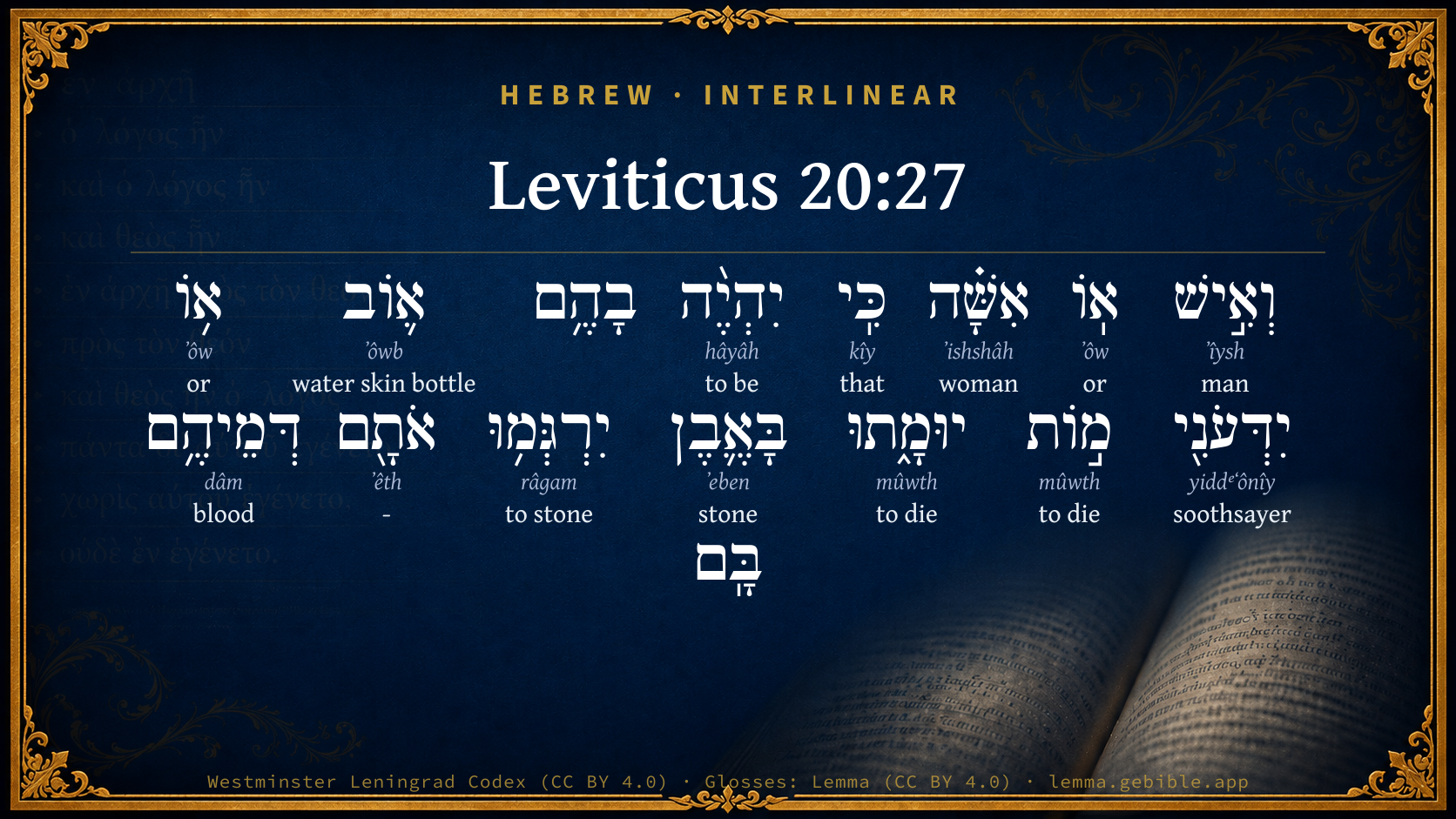
Hebrew (Westminster Leningrad Codex) Leviticus 20:27 appears in the Hebrew Old Testament. The text above is from the Westminster Leningrad Codex. Each word links to its Strong’s number, a concise gloss, and parsing drawn from the Open Scriptures Hebrew Bible morphology. Click any word for its full Brown-Driver-Briggs (BDB) entry.
Download image
Cite this verse

Leviticus 20:27 (World English Bible). Public Domain. Lemma interlinear Bible study tool, https://lemma.gebible.app/v/leviticus/20/27.

Show BibTeX & RIS
BibTeX
RIS
English Translation
"'A man or a woman that is a medium, or is a wizard, shall surely be put to death: they shall stone them with stones; their blood shall be upon them.'"
World English Bible · Public Domain
Download a study sheet

One document with this verse’s original text, its word-by-word gloss line, the meaning frame, cross-references with their text, attributed commentary, and full source and license credits — printable, and it pastes into notes with its structure intact.

This verse Autodidact and up

Study sheet (.html) Plain text (.txt)

A passage Seminary Student

Up to 50 verses in one chapter. A passage sheet keeps up to 6 commentary sources and 12 cross-references per verse, in the order this page ranks them, and says so on the sheet whenever that leaves anything out. Ask for a single verse and you get the Autodidact verse sheet above.

Everything on this page stays free to read, with no account — the sheet is a download of what is already on screen, not access to it.

Want to remove ads? Support Godless Engineer
Compare translations 3

The same verse in 3 English versions, stacked beneath the original-language interlinear above. Click any original word for its lexicon entry.

Each is an independent rendering of the whole verse — the interlinear is not word-aligned to these translations.

Highlighted words mark where these versions differ — a whole-verse word diff, not a word-by-word alignment.

  • World English Bible Public Domain
    "'A man or a woman that is a medium, or is a wizard, shall surely be put to death: they shall stone them with stones; their blood shall be upon them.'"
  • King James Version Public Domain
    A man also or woman that hath a familiar spirit, or that is a wizard, shall surely be put to death: they shall stone them with stones: their blood shall be upon them.
  • unfoldingWord Literal Text CC BY-SA 4.0
    And a man or woman, when there is among them a medium or spiritist—dying, they shall be executed. They must stone them with stones. Their blood on them.’”

unfoldingWord Literal Text — © unfoldingWord, licensed CC BY-SA 4.0. Word-aligned USFM3 via Door43 (git.door43.org/unfoldingWord/en_ult).

Versions to compare (up to 4)

3 of 4 selected

Show all 18 translations

Every available English version of this verse, each an independent rendering of the whole verse.

  • World English Bible Public Domain
    "'A man or a woman that is a medium, or is a wizard, shall surely be put to death: they shall stone them with stones; their blood shall be upon them.'"
  • Berean Standard Bible Public Domain
    A man or a woman who is a medium or spiritist must surely be put to death. They shall be stoned; their blood is upon them.’”
  • Majority Standard Bible Public Domain
    A man or a woman who is a medium or spiritist must surely be put to death. They shall be stoned; their blood is upon them.’”
  • King James Version Public Domain
    A man also or woman that hath a familiar spirit, or that is a wizard, shall surely be put to death: they shall stone them with stones: their blood shall be upon them.
  • American Standard Version (1901) Public Domain
    A man also or a woman that hath a familiar spirit, or that is a wizard, shall surely be put to death: they shall stone them with stones; their blood shall be upon them.
  • Revised Version (1885) Public Domain
    A man also or a woman that hath a familiar spirit, or that is a wizard, shall surely be put to death: they shall stone them with stones: their blood shall be upon them.
  • Geneva Bible (1599) Public Domain
    And if a man or woman haue a spirite of diuination, or soothsaying in them, they shall die the death: they shall stone them to death, their blood shalbe vpon them.
  • Douay-Rheims (1899) Public Domain
    A man, or woman, in whom there is a pythonical or divining spirit, dying let them die: they shall stone them: their blood be upon them.
  • Young's Literal Translation Public Domain
    `And a man or woman -- when there is in them a familiar spirit, or who `are' wizards -- are certainly put to death; with stones they stone them; their blood `is' on them.'
  • Literal Standard Version CC BY-SA 4.0
    And a man or woman, when there is a familiar spirit in them, or who [are] wizards, are certainly put to death; they stone them with stone; their blood [is] on them.”
  • Unlocked Literal Bible CC BY-SA 4.0
    A man or a woman who talks with the dead or who talks with spirits must certainly be put to death. The people must stone them with stones. They are guilty and deserve to die.'”
  • unfoldingWord Literal Text CC BY-SA 4.0
    And a man or woman, when there is among them a medium or spiritist—dying, they shall be executed. They must stone them with stones. Their blood on them.’”
  • Darby Bible Public Domain
    And if there be a man or a woman in whom is a spirit of Python or of divination, they shall certainly be put to death: they shall stone them with stones; their blood is upon them.
  • World Messianic Bible Public Domain
    “‘A man or a woman that is a medium or is a wizard shall surely be put to death. They shall be stoned with stones. Their blood shall be upon themselves.’”
  • Webster's Bible Public Domain
    A man also or a woman that hath a familiar spirit, or that is a wizard, shall surely be put to death: they shall stone them with stones: their blood shall be upon them.
  • Free Bible Version CC BY-SA 4.0
    Anyone, man or woman, who is a medium or a spiritist must be executed. They are to be stoned to death; they bear the responsibility for their punishment.”
  • Bible in Basic English Public Domain
    Any man or woman who makes use of spirits, or who is a wonder-worker, is to be put to death: they are to be stoned with stones: their blood will be on them.
  • JPS Tanakh (1917) Public Domain
    A man also or a woman that divineth by a ghost or a familiar spirit, shall surely be put to death; they shall stone them with stones; their blood shall be upon them.

Literal Standard Version (2020), Covenant Press — licensed CC BY-SA 4.0. Text via the HelloAO Bible API (eBible.org). Unlocked Literal Bible (unfoldingWord) — licensed CC BY-SA 4.0. Text via the HelloAO Bible API (eBible.org). unfoldingWord Literal Text — © unfoldingWord, licensed CC BY-SA 4.0. Word-aligned USFM3 via Door43 (git.door43.org/unfoldingWord/en_ult). Free Bible Version, Dr. Jonathan Gallagher — licensed CC BY-SA 4.0. Text via the HelloAO Bible API (eBible.org).

Word by word

More ways to search: Search by grammar → Find every occurrence → Compare this word →

Practice this passage: Drill this verse → Learn its vocabulary →

יִדְּעֹנִ֖י
yiddᵉʻônîy
H3049
“soothsayer”
Noun, Common, Masculine, Singular, Absolute
Part of Speech
Noun
Type
Common
Gender
Masculine
Number
Singular
State
Absolute
Full BDB Definition

Origin: from H3045

TWOT: 848d

a knower, one who has a familiar spirit - a familiar spirit, soothsayer, necromancer (metonymy)
  1. וְאִ֣ישׁ ʼîysh H376 “and · man” Conjunction + Noun, Common, Masculine, Singular, Absolute
  2. אֽוֹ ʼôw H176 “or” Conjunction
  3. אִשָּׁ֗ה ʼishshâh H802 “woman” Noun, Common, Feminine, Singular, Absolute
  4. כִּֽי kîy H3588 “that” Conjunction
  5. יִהְיֶ֨ה hâyâh H1961 “to be” Verb, Qal, Imperfect, 3rd Person, Masculine, Singular
  6. א֛וֹב ʼôwb H178 “water skin bottle” Noun, Common, Masculine, Singular, Absolute
  7. א֥וֹ ʼôw H176 “or” Conjunction
  8. מ֣וֹת mûwth H4191 “to die” Verb, Qal, Infinitive Absolute
  9. יוּמָ֑תוּ mûwth H4191 “to die” Verb, Hophal, Imperfect, 3rd Person, Masculine, Plural
  10. בָּאֶ֛בֶן ʼeben H68 “in/at the · stone” Preposition, Determined + Noun, Common, Feminine, Singular, Absolute
  11. יִרְגְּמ֥וּ râgam H7275 “to stone” Verb, Qal, Imperfect, 3rd Person, Masculine, Plural
  12. אֹתָ֖ם ʼêth H853 “- · them” Particle, Direct Object + Suffix, Personal, 3rd Person, Masculine, Plural
  13. דְּמֵיהֶ֥ם dâm H1818 “blood · their” Noun, Common, Masculine, Plural, Construct + Suffix, Personal, 3rd Person, Masculine, Plural

About this verse

These counts appear in no published source. They are computed here, from the morphology-tagged text and Lemma’s own curated glosses. What Lemma adds →

16
words
12
distinct lemmas
Pentateuch
section

Notable vocabulary

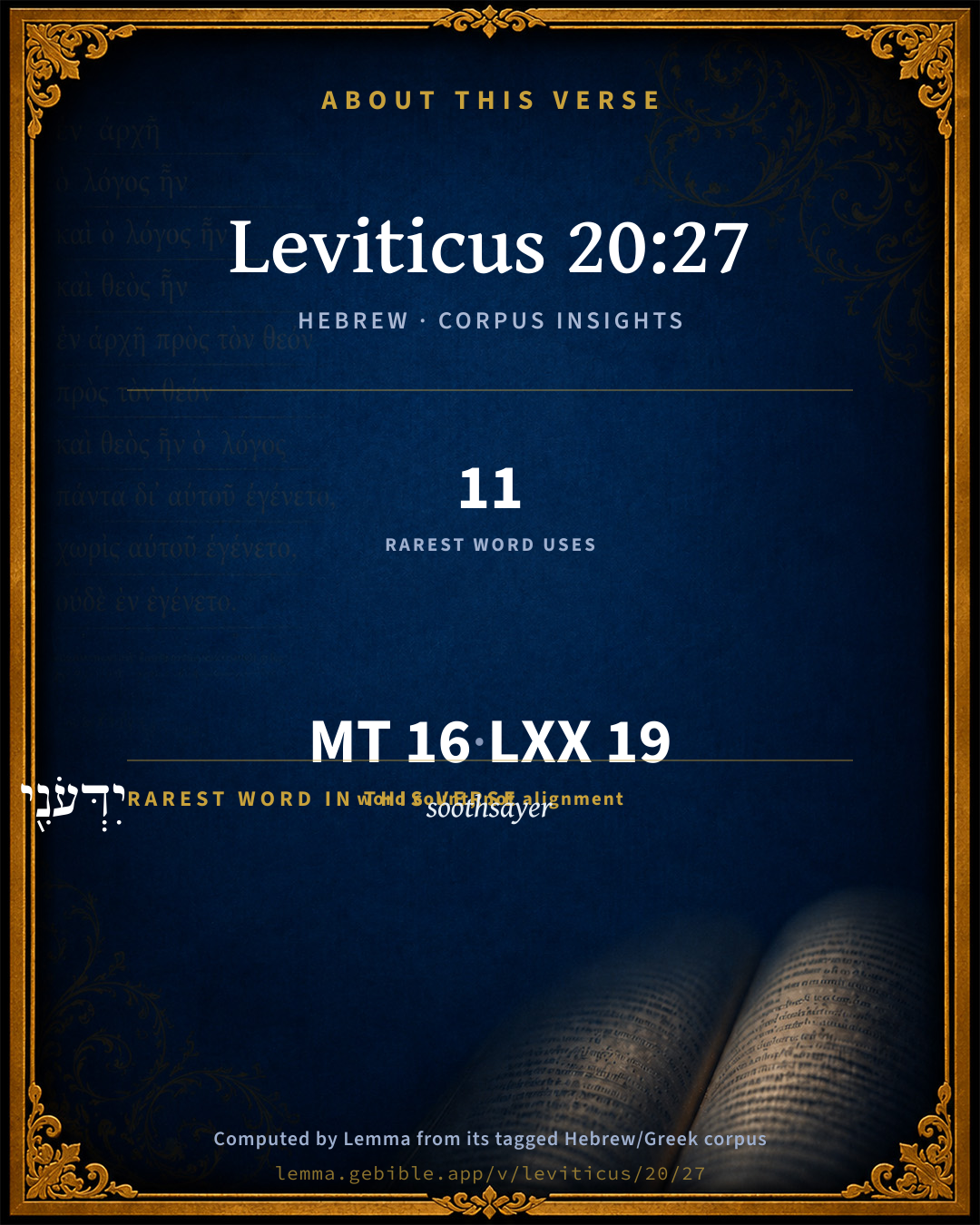
The rarest word here is יִדְּעֹנִ֖י soothsayer H3049 — appearing just 11 times in the whole Hebrew Bible.

Shared distinctive vocabulary

יִדְּעֹנִ֖י soothsayer H3049 occurs in 11 verses of the Hebrew Bible. Also found in:

Grammatical profile

  • 4 verbs
  • 6 nouns
  • 2 prepositions
  • 3 conjunctions
  • 1 particle

Verb forms

  • יִהְיֶ֨ה Qal · Imperfect
  • מ֣וֹת Qal · Infinitive Absolute
  • יוּמָ֑תוּ Hophal · Imperfect
  • יִרְגְּמ֥וּ Qal · Imperfect

Repetition

Words recur within this verse — often emphatic in Hebrew:

  • מ֣וֹת to die H4191 ×2
  • אֽוֹ or H176 ×2

Hebrew & Septuagint length

In English translation the verse runs 31 words from the Hebrew and 36 from the Septuagint (LXX English) — closely comparable.

A rough comparison of the two English renderings, which tokenize alike — not a word-level alignment.

Word counts can differ between the Hebrew and the Greek without any difference in meaning — e.g. the Hebrew direct-object marker אֵת has no separate Greek word, and Greek often adds the article ὁ.

In the original languages it is 16 Hebrew tokens and 19 Greek tokens — but the two are counted differently (Hebrew bundles its prefixes and suffixes into one token; the Greek is in lemma form), so that isn’t a like-for-like length.

Cross-references

5

Topical passages linked to Leviticus 20:27 in the Treasury of Scripture Knowledge — connected by theme and wording, ordered by reader-vote popularity; previews shown in the World English Bible.

  • Leviticus 19:31 "'Don't turn to those who are mediums, nor to the wizards. Don't seek them out, to be defiled by them. I am Yahweh your God.
  • Leviticus 20:6 "'The person that turns to those who are mediums, and to the wizards, to play the prostitute after them, I will even set my face against that person, and will cut him off from among his people.
  • 1 Samuel 28:7–9 Then said Saul to his servants, Seek me a woman who has a familiar spirit, that I may go to her, and inquire of her. His servants said to him, Behold, there is a woman who has a familiar spirit at En-dor.
  • Exodus 22:18 "You shall not allow a sorceress to live.
  • Deuteronomy 18:10–12 There shall not be found with you anyone who makes his son or his daughter to pass through the fire, one who uses divination, one who practices sorcery, or an enchanter, or a sorcerer,

Cross-references courtesy of OpenBible.info (CC BY 4.0).

Hebrew and Greek witnesses Masoretic Hebrew ↔ Greek Septuagint

The same verse in the two great witnesses to the Old Testament, shown verse-for-verse.

These are two independent witnesses, not word-aligned to each other, and the Septuagint is shown in lemma (dictionary) form.

Hebrew Leviticus 20:27 Masoretic · Westminster Leningrad Codex

וְאִ֣ישׁ אֽוֹ אִשָּׁ֗ה כִּֽי יִהְיֶ֨ה בָהֶ֥ם א֛וֹב א֥וֹ יִדְּעֹנִ֖י מ֣וֹת יוּמָ֑תוּ בָּאֶ֛בֶן יִרְגְּמ֥וּ אֹתָ֖ם דְּמֵיהֶ֥ם בָּֽם

"'A man or a woman that is a medium, or is a wizard, shall surely be put to death: they shall stone them with stones; their blood shall be upon them.'"

World English Bible · Public Domain

Greek LXX Leviticus 20:27 Septuagint · lemma form

καί ἀνήρ ἤ γυνή ὅς ἄν γίγνομαι αὐτός ἐγγαστρίμυθος ἤ ἐπαοιδός θάνατος θανατόω ἀμφότεροι λίθος λιθοβολέω αὐτός ἔνοχος εἰμί

And as for a man or woman whoever of them shall have in them a divining spirit, or be an enchanter, let them both die the death: you⌃ shall stone them with stones, they are guilty.

LXX2012 (modern English Septuagint) · Public Domain

Hebrew: Westminster Leningrad Codex (CC BY 4.0). Greek: Septuagint (public domain); English from LXX2012 (modern English Septuagint) (Public Domain). How the Septuagint differs from the Hebrew →

Targum (Aramaic paraphrase)

2

The Targum is the ancient Jewish Aramaic paraphrase of the Hebrew Scriptures — an interpretive translation, not the Hebrew text itself. Onkelos (literal) and Pseudo-Jonathan (expansive) render the Torah, and Jonathan the Prophets. Coverage is partial: where no permissively-licensed English translation exists for a verse, only the Aramaic is shown. This is verse-level text, not a word-by-word alignment to the Hebrew.

  1. Targum Onkelos Torah (Genesis–Deuteronomy)
    וּגְבַר אוֹ אִתְּתָא אֲרֵי יְהֵי בְהוֹן בִּדִין אוֹ דְכוּרוּ אִתְקְטָלָא יִתְקַטְלוּן בְּאַבְנָא יִרְגְמוּן יָתְהוֹן קְטָלָא חַיָבִין

    (no public-domain English translation for this verse)

    Targum Onkelos — Aramaic: “Onkelos Genesis” (public domain); “Onkelos Exodus” (public domain); “Onkelos Leviticus” (public domain); “Onkelos Numbers” (public domain); “Onkelos Deuteronomy” (public domain). English: “Sefaria Community Translation” (CC0 1.0 (public-domain dedication)); “J.W. Etheridge. The Targums of Onkelos and Jonathan Ben Uzziel on the Pentateuch. London: Longmans, Green, 1862” (public domain). Text via Sefaria.

  2. Targum Pseudo-Jonathan Torah (Genesis–Deuteronomy)
    וּגְבַר אוֹ אִתְּתָא אֲרוּם יְהֵי בְּהוֹן בִּידִין אוֹ זְכוּרוּ אִתְקְטָלָא יִתְקַטְלוּן בְּאַבְנָא יְאַטְלוּן יַתְהוֹן קְטָלָא חַיָיבִין

    And the man or the woman who hath in them (the spirit of) divination or necromancy shall die by the casting of stones; for they are guilty of death.

    Targum Pseudo-Jonathan — Aramaic: “Targum Jonathan on Genesis” (public domain); “Targum Jonathan on Exodus” (public domain); “Targum Jonathan on Leviticus” (public domain); “Targum Jonathan on Numbers” (public domain); “Targum Jonathan on Deuteronomy” (public domain). English: “The Targum of Jonathan ben Uzziel, trans. J. W. Etheridge, London, 1862” (public domain). Text via Sefaria.

Commentary

Notes on Leviticus 20:27 from classic Christian and Jewish commentators (each source and its license shown beneath its notes). The classic Christian expositions comment on the surrounding passage and are grouped to its opening verse, so a note may address several verses; the Jewish commentaries on the Tanakh (Rashi and others) are per-verse, so they appear only where the commentator wrote on this verse.

Lemma curates 59 commentaries, every one of them public domain or Creative Commons licensed, each selected and text-cleaned for this edition rather than reprinted as found. About our sources →

Trapp's Complete Commentary

John Trapp

Lev 20:27 A man also or woman that hath a familiar spirit, or that is a wizard, shall surely be put to death: they shall stone them with stones: their blood [shall be] upon them.

Ver. 27. That both a familiar spirit.] As Paracelsus had one confined to the pummel of his sword, or else Erastus belies him.

John Trapp, A Commentary or Exposition upon All the Books of the Old and New Testament (1647–1656) — public domain. Text from a community e-Sword module.

Joseph Benson's Commentary

Lev 20:27. A man or a woman that hath a familiar spirit, shall surely be put to death — They that are in league with the devil have in effect made a covenant with death; and so shall their doom be.

Joseph Benson's Commentary on the Old and New Testaments (1811–1818) — public domain. Text from a community e-Sword module.

Adam Clarke's Commentary

Verse 27. A familiar spirit] A spirit or demon, which, by magical rites, is supposed to be bound to appear at the call of his employer. See Clarke on Ge 41:8; "Ex 7:11"; "Ex 7:22"; And see Clarke's notes "Ex 7:25"; and "Le 19:31".

FROM the accounts we have of the abominations both of Egypt and Canaan, we may blush for human nature; for wherever it is without cultivation, and without the revelation of God, it is every thing that is vile in principle and detestable in practice. Nor would any part of the habitable globe materially differ from Egypt and Canaan, had they not that rule of righteousness, the revealed LAW of God, and had not life and immortality been brought to light by the GOSPEL among them. From these accounts, for which we could easily find parallels in ancient Greece and Italy, we may see the absolute need of a Divine revelation, without which man, even in his best estate, differs little from the brute.

Adam Clarke's Commentary on the Bible (1810–1826) — public domain. Text from a community e-Sword/MySword module.

Ellicott's Commentary for English Readers

(27) A man also or woman.—Better, And a man or a woman. The departure from the literal translation of the conjunction in the Authorised version is both unnecessary and obscures the meaning of the sentence. It ought rather to be translated “but;” that is, but because the Israelites are God’s holy ones, therefore every man or woman who pretends to disclose future events by means of necromancy, thus usurping the functions of God, is to be stoned to death. The case of these necromancers is here repeated, because in Lev_19:31 the consulting them only is forbidden, and in the sixth verse of this chapter the penalty for consulting them is set forth, whilst in the passage before us the penalty is enacted which the persons themselves who are convicted of practising these secret arts are to suffer. The woman is here expressly added, both because this art seems to have been principally followed by women (Exo_22:28; 1Sa_28:7; Act_16:16), and because men would naturally be inclined to treat women more mercifully.

Their blood shall be upon them.—That is, they have brought it upon themselves to be killed. (See Lev_20:9.)

A Bible Commentary for English Readers, edited by Charles John Ellicott (1878–1897) — public domain. Text from a community e-Sword module.

The Cambridge Bible for Schools and Colleges

gen. ed. J. J. S. Perowne

27. See on Lev_19:31. This supplementary precept is not identical with the earlier one. Here the subject is the person within whom the discarnate spirit is supposed to be working (lit. ‘when there is in them an’ ôb or a familiar spirit’), while in Lev_20:6 it is the person who makes application to such for assistance.

The Cambridge Bible for Schools and Colleges (gen. ed. J. J. S. Perowne; Cambridge University Press, 1878–1918) — public domain. Text from a community e-Sword module.

John Gill's Exposition

A man also or a woman that hath a familiar spirit,.... Or the spirit of Python or divination, see Lev 19:31; such as the damsel had in Act 16:16; a woman is here particularly mentioned, though before included in the above law; because, as Aben Ezra says, such sort of practices were more frequently committed by women; to which Maimonides (l) adds another reason, because men have a natural clemency towards the female sex, and are not easily prevailed upon to put them to death; therefore the law says, "thou shall not suffer a witch to live", Exo 22:18,

or that is a wizard; a knowing one, who pretends to a great deal of knowledge of things; as of lost or stolen goods, and even knowledge of things future, and imposes upon persons, and cheats them of their money they give for information: such

shall surely be put to death: and not spared through favour and affection: the death they are to be put to follows:

they shall stone them with stones; until they are dead; of the manner of stoning; see Gill on Act 7:58,

their blood shall be upon them: they are worthy of death, and they shall suffer it: this phrase following upon the former, the Jews (m) gather from hence, that, wherever it is used, it is to be understood of stoning; See Gill on Lev 20:9.

(l) Moreh Nevochim, par. 3. c. 37. (m) Torat Cohanim in Yalcut in loc.

Next: Leviticus Chapter 21

John Gill's Exposition of the Whole Bible (1746–1763) — public domain (CC PDM 1.0). Text via the HelloAO Bible API.

Haydock's Catholic Bible Commentary

Spirit. Hebrew ob, means also a bottle. See chap. xix. 31. If those who consult such people be guilty, the authors of the delusion deserve death still more. (Haydock) --- The spirit of python is no other than the spirit of the devil, or of Apollo, who was called Pythius, on account of his having slain the serpent python. His oracles were in great request, as he was supposed to know the secrets of futurity. (Calmet)

George Leo Haydock (1774–1849), Haydock's Catholic Family Bible and Commentary, 1859 edition — public domain. Excludes Psalms (Douay-Rheims chapter numbering differs from Protestant) and Deuterocanonical books (Catholic canon only).

The Pulpit Commentary

Those that deal in witchcraft are to be stoned.

The Pulpit Commentary (1880–1919), ed. H.D.M. Spence-Jones & Joseph S. Exell — public domain. Text from a community e-Sword module.

John Wesley's Explanatory Notes

A man or a woman that hath a familiar spirit, shall surely be put to death - They that are in league with the devil, have in effect made a covenant with death: and so shall their doom be.

John Wesley, Explanatory Notes Upon the Whole Bible (1754–1765) — public domain. Text via the GEBible commentary corpus.

Keil & Delitzsch

C. F. Keil & F. Delitzsch

But because Israel was called to be the holy nation of Jehovah, every one, ether man or woman, in whom there was a heathenish spirit of soothsaying, was to be put to death, viz., stoned (cf. Lev 19:31), to prevent defilement by idolatrous abominations.

Keil & Delitzsch — Biblical Commentary on the Old Testament (1861–1891) — public domain (CC PDM 1.0). Text via the HelloAO Bible API. (Old Testament only.)

unfoldingWord translationNotes

Door43 World Missions Community

talks with

"attempts to communicate with"

must certainly be put to death

This can be stated in active form. AT: "they must certainly put to death" (See: Active or Passive)

translationWords

die

spirit

people group

stone

guilt

unfoldingWord translationNotes — © Distant Shores Media and the Door43 World Missions Community, licensed CC BY-SA 4.0. Source: git.door43.org/Door43/en_tn.

Rashi

Rabbi Shlomo Yitzchaki (Rashi)

'‎כי יהיה בהם אוב וגו‎ [A MAN ALSO, OR A WOMAN] THAT HATH THE SPIRIT אוב, [OR THAT IS A WIZARD SHALL SURELY BE PUT TO DEATH] — Here the penalty of death by stoning is mentioned for them, and above (Leviticus 20:6) it mentions excision! But the explanation is: If there were witnesses to the offence and the necessary warning had been given them, death by stoning is the punishment. If he acted wittingly but had not been warned, he is punishable with excision and if he breaks the law regarding them (the אוב or ידעוני) inadvertently, he has to bring a sin offering. And the same rules apply in the case of all persons who are subject to the death penalty, where excision is mentioned (i. e. in all such cases “stoning" or a sin offering is the punishment according to the circumstances).

Rashi on the Tanakh — English translations: “The Judaica Press complete Tanach with Rashi, translated by A. J. Rosenberg” (CC BY 4.0); “Pentateuch with Rashi's commentary by M. Rosenbaum and A.M. Silbermann, 1929-1934” (public domain); “The Metsudah Tanach series, Lakewood, N.J” (CC BY 4.0); and “The Book of Joshua, Metsudah Publications, 1997” (CC BY 4.0). Text via Sefaria.

Lesson kit

Teaching starters — assembled from the data on this page, not authored interpretation. Every prompt links to the verse data it draws on. Edit before teaching.

Leviticus, in the Pentateuch, opens this verse with 16 words (12 distinct Hebrew lemmas). Its most distinctive word is yiddᵉʻônîy (“soothsayer”). A historical commentator’s framing appears above. Read the whole chapter for the surrounding context.

Discussion questions

  1. The word yiddᵉʻônîy carries the sense “soothsayer.” How does it shape the verse?
  2. How does Leviticus 19:31, which shares the word «soothsayer», read alongside this verse?
  3. What does the repetition of “to die” (2× in this one verse) do in this verse?
  4. These translations render this verse differently. What is at stake in choosing one wording over another?
  5. «יִהְיֶ֨ה» is a Qal Imperfect verb. How does that grammatical form shape the action described?
  6. Compare how Trapp's Complete Commentary and Joseph Benson's Commentary read this verse. Where do they agree or differ?

Things to notice

Reading settings

Reading text

Shown beneath each verse's original-language words.

Old Testament
Old Testament edition

Read the OT as the Masoretic Hebrew (MT) or the Greek Septuagint (LXX).

English shown for the Greek Septuagint (in the Hebrew ↔ Greek comparison).

Comparing translations? Open the Compare panel on any verse page to stack up to four side by side.