
Deuteronomy 18:16

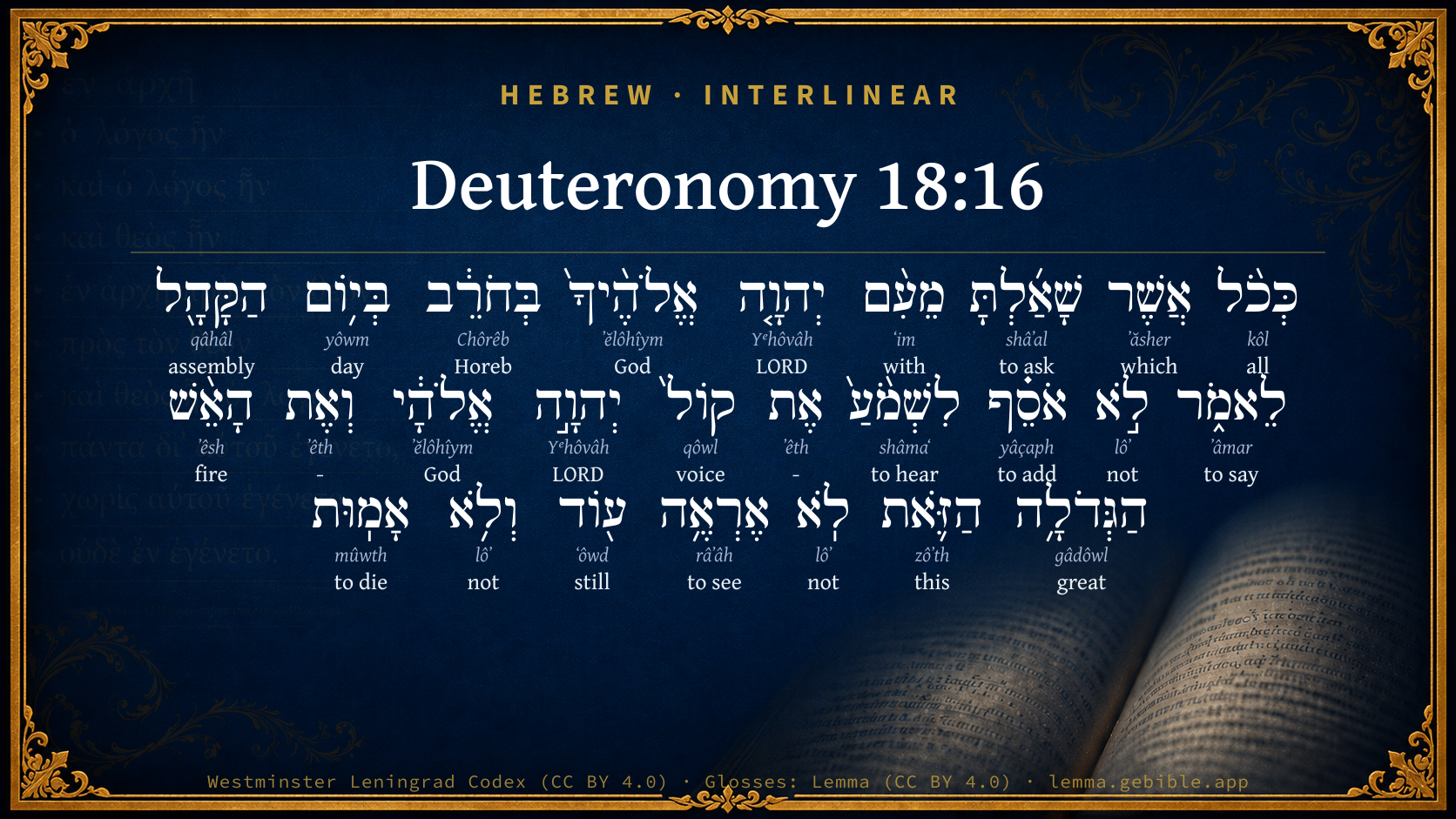
Hebrew (Westminster Leningrad Codex) Deuteronomy 18:16 appears in the Hebrew Old Testament. The text above is from the Westminster Leningrad Codex. Each word links to its Strong’s number, a concise gloss, and parsing drawn from the Open Scriptures Hebrew Bible morphology. Click any word for its full Brown-Driver-Briggs (BDB) entry.
Download image
Cite this verse

Deuteronomy 18:16 (World English Bible). Public Domain. Lemma interlinear Bible study tool, https://lemma.gebible.app/v/deuteronomy/18/16.

Show BibTeX & RIS
BibTeX
RIS
English Translation
according to all that you desired of Yahweh your God in Horeb in the day of the assembly, saying, Let me not hear again the voice of Yahweh my God, neither let me see this great fire any more, that I not die.
World English Bible · Public Domain
Download a study sheet

One document with this verse’s original text, its word-by-word gloss line, the meaning frame, cross-references with their text, attributed commentary, and full source and license credits — printable, and it pastes into notes with its structure intact.

This verse Autodidact and up

Study sheet (.html) Plain text (.txt)

A passage Seminary Student

Up to 50 verses in one chapter. A passage sheet keeps up to 6 commentary sources and 12 cross-references per verse, in the order this page ranks them, and says so on the sheet whenever that leaves anything out. Ask for a single verse and you get the Autodidact verse sheet above.

Everything on this page stays free to read, with no account — the sheet is a download of what is already on screen, not access to it.

Want to remove ads? Support Godless Engineer
Compare translations 3

The same verse in 3 English versions, stacked beneath the original-language interlinear above. Click any original word for its lexicon entry.

Each is an independent rendering of the whole verse — the interlinear is not word-aligned to these translations.

Highlighted words mark where these versions differ — a whole-verse word diff, not a word-by-word alignment.

  • World English Bible Public Domain
    according to all that you desired of Yahweh your God in Horeb in the day of the assembly, saying, Let me not hear again the voice of Yahweh my God, neither let me see this great fire any more, that I not die.
  • King James Version Public Domain
    According to all that thou desiredst of the LORD thy God in Horeb in the day of the assembly, saying, Let me not hear again the voice of the LORD my God, neither let me see this great fire any more, that I die not.
  • unfoldingWord Literal Text CC BY-SA 4.0
    according to all that you asked from Yahweh your God at Horeb on the day of the assembly, saying, ‘We will not continue to hear the voice of Yahweh our God, and we will not see this great fire anymore, or we will die.’

unfoldingWord Literal Text — © unfoldingWord, licensed CC BY-SA 4.0. Word-aligned USFM3 via Door43 (git.door43.org/unfoldingWord/en_ult).

Versions to compare (up to 4)

3 of 4 selected

Show all 18 translations

Every available English version of this verse, each an independent rendering of the whole verse.

  • World English Bible Public Domain
    according to all that you desired of Yahweh your God in Horeb in the day of the assembly, saying, Let me not hear again the voice of Yahweh my God, neither let me see this great fire any more, that I not die.
  • Berean Standard Bible Public Domain
    This is what you asked of the LORD your God at Horeb on the day of the assembly, when you said, “Let us not hear the voice of the LORD our God or see this great fire anymore, so that we will not die!”
  • Majority Standard Bible Public Domain
    This is what you asked of the LORD your God at Horeb on the day of the assembly, when you said, “Let us not hear the voice of the LORD our God or see this great fire anymore, so that we will not die!”
  • King James Version Public Domain
    According to all that thou desiredst of the LORD thy God in Horeb in the day of the assembly, saying, Let me not hear again the voice of the LORD my God, neither let me see this great fire any more, that I die not.
  • American Standard Version (1901) Public Domain
    according to all that thou desiredst of Jehovah thy God in Horeb in the day of the assembly, saying, Let me not hear again the voice of Jehovah my God, neither let me see this great fire any more, that I die not.
  • Revised Version (1885) Public Domain
    according to all that thou desiredst of the LORD thy God in Horeb in the day of the assembly, saying, Let me not hear again the voice of the LORD my God, neither let me see this great fire any more, that I die not.
  • Geneva Bible (1599) Public Domain
    According to al that thou desiredst of the Lord thy God in Horeb, in the day of the assemblie, when thou saidest, Let me heare the voice of my Lord God no more, nor see this great fire any more, that I die not.
  • Douay-Rheims (1899) Public Domain
    As thou desiredst of the Lord thy God in Horeb, when the assembly was gathered together, and saidst: Let me not hear any more the voice of the Lord my God, neither let me see any more this exceeding great fire, lest I die.
  • Young's Literal Translation Public Domain
    according to all that thou didst ask from Jehovah thy God, in Horeb, in the day of the assembly, saying, Let me not add to hear the voice of Jehovah my God, and this great fire let me not see any more, and I die not;
  • Literal Standard Version CC BY-SA 4.0
    according to all that you asked from your God YHWH in Horeb, in the day of the assembly, saying, Do not let me add to hear the voice of my God YHWH, and do not let me see this great fire anymore, and I do not die;
  • Unlocked Literal Bible CC BY-SA 4.0
    This is what you asked from Yahweh your God at Horeb on the day of the assembly, saying, 'Let us not hear again the voice of Yahweh our God, nor see this great fire anymore, or we will die.'
  • unfoldingWord Literal Text CC BY-SA 4.0
    according to all that you asked from Yahweh your God at Horeb on the day of the assembly, saying, ‘We will not continue to hear the voice of Yahweh our God, and we will not see this great fire anymore, or we will die.’
  • Darby Bible Public Domain
    according to all that thou desiredst of Jehovah thy God at Horeb on the day of the assembly, saying, Let me not hear again the voice of Jehovah my God, neither let me see this great fire any more, that I die not.
  • World Messianic Bible Public Domain
    This is according to all that you desired of the LORD your God in Horeb in the day of the assembly, saying, “Let me not hear again the LORD my God’s voice, neither let me see this great fire any more, that I not die.”
  • Webster's Bible Public Domain
    According to all that thou desiredst of the LORD thy God in Horeb in the day of the assembly, saying, Let me not hear again the voice of the LORD my God, neither let me see this great fire any more, that I may not die.
  • Free Bible Version CC BY-SA 4.0
    Remember what you told the Lord your God at Horeb when you were all assembled there. You said, “Please don't let us go on hearing the Lord our God speak to us, or see this terrifying fire anymore! Otherwise we're going to die!”
  • Bible in Basic English Public Domain
    In answer to the request you made to the Lord your God in Horeb on the day of the great meeting, when you said, Let not the voice of the Lord my God come to my ears again, and let me not see this great fire any more, or death will overtake me.
  • JPS Tanakh (1917) Public Domain
    according to all that thou didst desire of the LORD thy God in Horeb in the day of the assembly, saying: 'Let me not hear again the voice of the LORD my God, neither let me see this great fire any more, that I die not.'

Literal Standard Version (2020), Covenant Press — licensed CC BY-SA 4.0. Text via the HelloAO Bible API (eBible.org). Unlocked Literal Bible (unfoldingWord) — licensed CC BY-SA 4.0. Text via the HelloAO Bible API (eBible.org). unfoldingWord Literal Text — © unfoldingWord, licensed CC BY-SA 4.0. Word-aligned USFM3 via Door43 (git.door43.org/unfoldingWord/en_ult). Free Bible Version, Dr. Jonathan Gallagher — licensed CC BY-SA 4.0. Text via the HelloAO Bible API (eBible.org).

Word by word

More ways to search: Search by grammar → Find every occurrence → Compare this word →

Practice this passage: Drill this verse → Learn its vocabulary →

בְּחֹרֵ֔ב
Chôrêb
H2722
“in/at · Horeb”
Preposition + Noun, Proper
Part of Speech
Preposition + Noun
Type
Proper
Full BDB Definition

Origin: from H2717

TWOT: 731c

Horeb = "desert" - another name for Mount Sinai from which God gave the law to Moses and the Israelites
  1. כְּכֹ֨ל kôl H3605 “like/as · all” Preposition + Noun, Common, Masculine, Singular, Absolute
  2. אֲשֶׁר ʼăsher H834 “which” Particle, Relative
  3. שָׁאַ֜לְתָּ shâʼal H7592 “to ask” Verb, Qal, Perfect, 2nd Person, Masculine, Singular
  4. מֵעִ֨ם ʻim H5973 “from · with” Preposition + Preposition
  5. יְהוָ֤ה Yᵉhôvâh H3068 “LORD” Noun, Proper
  6. אֱלֹהֶ֨יךָ֙ ʼĕlôhîym H430 “God(s) · your” Noun, Common, Masculine, Plural, Construct + Suffix, Personal, 2nd Person, Masculine, Singular
  7. בְּי֥וֹם yôwm H3117 “in/at · day of” Preposition + Noun, Common, Masculine, Singular, Construct
  8. הַקָּהָ֖ל qâhâl H6951 “the · assembly” Particle, Definite Article + Noun, Common, Masculine, Singular, Absolute
  9. לֵאמֹ֑ר ʼâmar H559 “to say” Preposition + Verb, Qal, Infinitive Construct
  10. לֹ֣א lôʼ H3808 “not” Particle, Negative
  11. אֹסֵ֗ף yâçaph H3254 “to add” Verb, Hiphil, Imperfect, 1st Person, Common, Singular
  12. לִשְׁמֹ֨עַ֙ shâmaʻ H8085 “to hear” Preposition + Verb, Qal, Infinitive Construct
  13. אֶת ʼêth H853 “-” Particle, Direct Object
  14. קוֹל֙ qôwl H6963 “voice of” Noun, Common, Masculine, Singular, Construct
  15. יְהוָ֣ה Yᵉhôvâh H3068 “LORD” Noun, Proper
  16. אֱלֹהָ֔י ʼĕlôhîym H430 “God(s) · my” Noun, Common, Masculine, Plural, Construct + Suffix, Personal, 1st Person, Common, Singular
  17. וְאֶת ʼêth H853 “and · -” Conjunction + Particle, Direct Object
  18. הָאֵ֨שׁ ʼêsh H784 “the · fire” Particle, Definite Article + Noun, Common, Both, Singular, Absolute
  19. הַגְּדֹלָ֥ה gâdôwl H1419 “the · great” Particle, Definite Article + Adjective, Adjective, Feminine, Singular, Absolute
  20. הַזֹּ֛את zôʼth H2063 “the · this” Particle, Definite Article + Pronoun, Demonstrative, Feminine, Singular
  21. לֹֽא lôʼ H3808 “not” Particle, Negative
  22. אֶרְאֶ֥ה râʼâh H7200 “to see” Verb, Qal, Imperfect, 1st Person, Common, Singular
  23. ע֖וֹד ʻôwd H5750 “still” Adverb
  24. וְלֹ֥א lôʼ H3808 “and · not” Conjunction + Particle, Negative
  25. אָמֽוּת mûwth H4191 “to die” Verb, Qal, Imperfect, 1st Person, Common, Singular

About this verse

These counts appear in no published source. They are computed here, from the morphology-tagged text and Lemma’s own curated glosses. What Lemma adds →

26
words
21
distinct lemmas
Pentateuch
section

Notable vocabulary

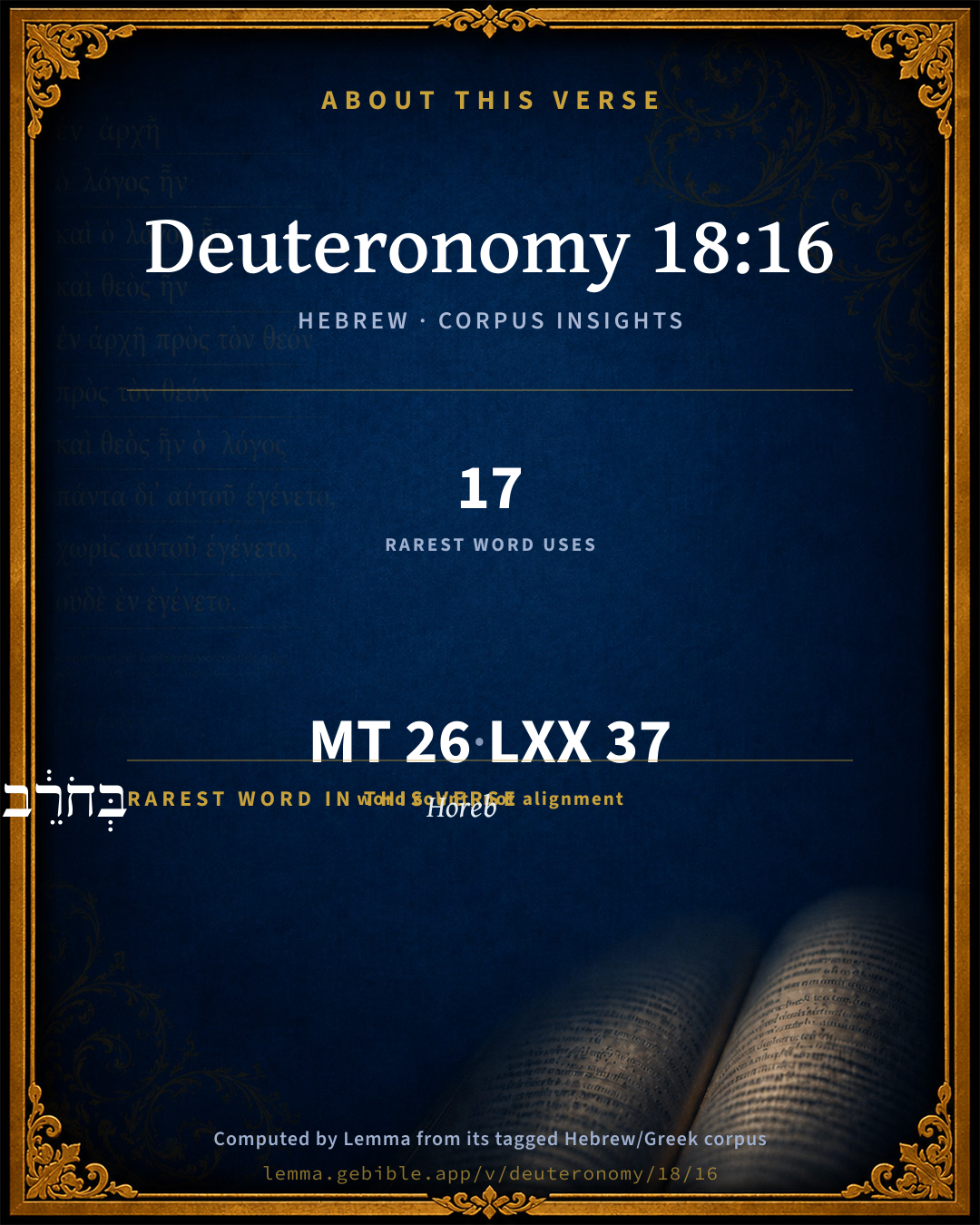
The rarest word here is בְּחֹרֵ֔ב Horeb H2722 — appearing just 17 times in the whole Hebrew Bible.

Shared distinctive vocabulary

בְּחֹרֵ֔ב Horeb H2722 occurs in 17 verses of the Hebrew Bible. Also found in:

Grammatical profile

  • 6 verbs
  • 10 nouns
  • 1 adjective
  • 1 pronoun
  • 1 preposition
  • 1 adverb
  • 6 particles

Verb forms

  • שָׁאַ֜לְתָּ Qal · Perfect
  • לֵאמֹ֑ר Qal · Infinitive Construct
  • אֹסֵ֗ף Hiphil · Imperfect
  • לִשְׁמֹ֨עַ֙ Qal · Infinitive Construct
  • אֶרְאֶ֥ה Qal · Imperfect
  • אָמֽוּת Qal · Imperfect

Repetition

Words recur within this verse — often emphatic in Hebrew:

  • יְהוָ֤ה LORD H3068 ×2
  • אֱלֹהֶ֨יךָ֙ God H430 ×2
  • לֹ֣א not H3808 ×3

Hebrew & Septuagint length

In English translation the verse runs 43 words from the Hebrew and 50 from the Septuagint (LXX English) — closely comparable.

A rough comparison of the two English renderings, which tokenize alike — not a word-level alignment.

Word counts can differ between the Hebrew and the Greek without any difference in meaning — e.g. the Hebrew direct-object marker אֵת has no separate Greek word, and Greek often adds the article ὁ.

In the original languages it is 26 Hebrew tokens and 37 Greek tokens — but the two are counted differently (Hebrew bundles its prefixes and suffixes into one token; the Greek is in lemma form), so that isn’t a like-for-like length.

Cross-references

4

Topical passages linked to Deuteronomy 18:16 in the Treasury of Scripture Knowledge — connected by theme and wording, ordered by reader-vote popularity; previews shown in the World English Bible.

  • Exodus 20:19 They said to Moses, "Speak with us yourself, and we will listen; but don't let God speak with us, lest we die."
  • Deuteronomy 5:23–28 It happened, when you heard the voice out of the midst of the darkness, while the mountain was burning with fire, that you came near to me, even all the heads of your tribes, and your elders;
  • Deuteronomy 9:10 Yahweh delivered to me the two tables of stone written with the finger of God; and on them [was written] according to all the words, which Yahweh spoke with you on the mountain out of the midst of the fire in the day of the assembly.
  • Hebrews 12:19 the sound of a trumpet, and the voice of words; which those who heard it begged that not one more word should be spoken to them,

Cross-references courtesy of OpenBible.info (CC BY 4.0).

Hebrew and Greek witnesses Masoretic Hebrew ↔ Greek Septuagint

The same verse in the two great witnesses to the Old Testament, shown verse-for-verse.

These are two independent witnesses, not word-aligned to each other, and the Septuagint is shown in lemma (dictionary) form.

Hebrew Deuteronomy 18:16 Masoretic · Westminster Leningrad Codex

כְּכֹ֨ל אֲשֶׁר שָׁאַ֜לְתָּ מֵעִ֨ם יְהוָ֤ה אֱלֹהֶ֨יךָ֙ בְּחֹרֵ֔ב בְּי֥וֹם הַקָּהָ֖ל לֵאמֹ֑ר לֹ֣א אֹסֵ֗ף לִשְׁמֹ֨עַ֙ אֶת קוֹל֙ יְהוָ֣ה אֱלֹהָ֔י וְאֶת הָאֵ֨שׁ הַגְּדֹלָ֥ה הַזֹּ֛את לֹֽא אֶרְאֶ֥ה ע֖וֹד וְלֹ֥א אָמֽוּת

according to all that you desired of Yahweh your God in Horeb in the day of the assembly, saying, Let me not hear again the voice of Yahweh my God, neither let me see this great fire any more, that I not die.

World English Bible · Public Domain

Greek LXX Deuteronomy 18:16 Septuagint · lemma form

κατά πᾶς ὅσος αἰτέω παρά κύριος ὁ θεός σύ ἐν χωρηβ ὁ ἡμέρα ὁ ἐκκλησία λέγω οὐ προςτίθημι ἀκούω ὁ φωνή κύριος ὁ θεός ἐγώ καί ὁ πῦρ ὁ μέγας οὗτος οὐ ὁράω ἔτι οὐδέ μή ἀποθνήσκω

according to all things which you did desire of the Lord your God in Choreb in the day of the assembly, saying, We will not again hear the voice of the Lord your God, and we will not any more see this great fire, and so we shall not die.

LXX2012 (modern English Septuagint) · Public Domain

Hebrew: Westminster Leningrad Codex (CC BY 4.0). Greek: Septuagint (public domain); English from LXX2012 (modern English Septuagint) (Public Domain). How the Septuagint differs from the Hebrew →

Targum (Aramaic paraphrase)

2

The Targum is the ancient Jewish Aramaic paraphrase of the Hebrew Scriptures — an interpretive translation, not the Hebrew text itself. Onkelos (literal) and Pseudo-Jonathan (expansive) render the Torah, and Jonathan the Prophets. Coverage is partial: where no permissively-licensed English translation exists for a verse, only the Aramaic is shown. This is verse-level text, not a word-by-word alignment to the Hebrew.

  1. Targum Onkelos Torah (Genesis–Deuteronomy)
    כְּכֹל דִי שְׁאֶלְתָּא מִקֳדָם יְיָ אֱלָהָךְ בְּחֹרֵב בְּיוֹמָא דִקְהָלָא לְמֵימָר לָא אוֹסֵף לְמִשְׁמָע יָת קָל מֵימְרָא דַיְיָ אֱלָהַי וְיָת אֶשָׁתָא רַבְּתָא הָדָא לָא אֶחֱזֵי עוֹד וְלָא אֵמוּת

    (no public-domain English translation for this verse)

    Targum Onkelos — Aramaic: “Onkelos Genesis” (public domain); “Onkelos Exodus” (public domain); “Onkelos Leviticus” (public domain); “Onkelos Numbers” (public domain); “Onkelos Deuteronomy” (public domain). English: “Sefaria Community Translation” (CC0 1.0 (public-domain dedication)); “J.W. Etheridge. The Targums of Onkelos and Jonathan Ben Uzziel on the Pentateuch. London: Longmans, Green, 1862” (public domain). Text via Sefaria.

  2. Targum Pseudo-Jonathan Torah (Genesis–Deuteronomy)
    כְּכל דְּשַׁיִּילְתּוּן מִן קֳדָם יְיָ אֱלָהָכוֹן בְּחוֹרֵב בְּיוֹמָא דְאִתְכַּנָּשׁוּ שִׁבְטַיָא לִמְקַבְּלָא אוֹרַיְיתָא לְמֵימָר לָא נוֹסִיף לְמִשְׁמַע יַת קַל דִּיבּוּרָא מִן קֳדָם יְיָ אֱלָהָנָא וְיַת אֵישָׁתָא רַבְּתָא הֲדָא לָא נֶחֱמֵי תּוּב דְּלָא נְמוּת

    According to all that you begged before the Lord your God in Horeb on the day of the assembling of the tribes to receive the law, saying, Let us not again hear the Great Voice {of the Word - Dibbura} from before the Lord our God, nor behold again that great fire, lest we die:

    Targum Pseudo-Jonathan — Aramaic: “Targum Jonathan on Genesis” (public domain); “Targum Jonathan on Exodus” (public domain); “Targum Jonathan on Leviticus” (public domain); “Targum Jonathan on Numbers” (public domain); “Targum Jonathan on Deuteronomy” (public domain). English: “The Targum of Jonathan ben Uzziel, trans. J. W. Etheridge, London, 1862” (public domain). Text via Sefaria.

Commentary

Notes on Deuteronomy 18:16 from classic Christian and Jewish commentators (each source and its license shown beneath its notes). The classic Christian expositions comment on the surrounding passage and are grouped to its opening verse, so a note may address several verses; the Jewish commentaries on the Tanakh (Rashi and others) are per-verse, so they appear only where the commentator wrote on this verse.

Lemma curates 59 commentaries, every one of them public domain or Creative Commons licensed, each selected and text-cleaned for this edition rather than reprinted as found. About our sources →

The Cambridge Bible for Schools and Colleges

gen. ed. J. J. S. Perowne

16, 17. See on Deu_5:22 (assembly), 25, 27 f. Cullen (pp. 143 ff.) denies the dependence of Deu_18:15-16 on Deu_5:19-28.

The Cambridge Bible for Schools and Colleges (gen. ed. J. J. S. Perowne; Cambridge University Press, 1878–1918) — public domain. Text from a community e-Sword module.

John Gill's Exposition

And the Lord said unto me,.... Unto Moses, who carried the above request to the Lord:

they have well spoken that which they have spoken; see Deu 5:28.

John Gill's Exposition of the Whole Bible (1746–1763) — public domain (CC PDM 1.0). Text via the HelloAO Bible API.

Haydock's Catholic Bible Commentary

Die. This promise is not recorded, Exodus xx. 19. God will send you a mediator, who shall hide the splendour of his divinity (Calmet) under the form of a servant, Philippians ii. 7. (Haydock)

George Leo Haydock (1774–1849), Haydock's Catholic Family Bible and Commentary, 1859 edition — public domain. Excludes Psalms (Douay-Rheims chapter numbering differs from Protestant) and Deuterocanonical books (Catholic canon only).

Matthew Poole's English Annotations

In the day of the assembly, to wit, of that great and general congregation of all the people together.

Matthew Poole's English Annotations on the Holy Bible (1683–1685) — public domain. Text from a community e-Sword/MySword module.

The Pulpit Commentary

In the day of the assembly (cf. Deu_9:14 Deu_10:4)

The Pulpit Commentary (1880–1919), ed. H.D.M. Spence-Jones & Joseph S. Exell — public domain. Text from a community e-Sword module.

Ramban (Nachmanides)

Rabbi Moshe ben Nachman (Ramban / Nachmanides)

TO ALL THAT THOU DIDST DESIRE etc. Scripture here did not mention the full request that the people had made [at Sinai], since by their saying Let me not hear again the voice of the Eternal — they would not have merited [the granting of] prophets. But when they said [to Moses], Go thou near, and hear all that the Eternal our G-d may say; and thou shalt speak unto us all that the Eternal our G-d may speak unto thee; and we will hear it, and do it — then they undertook upon themselves to believe in His prophets and to hear and to do whatever G-d would command through them. Therefore he said here, A prophet will the Eternal thy G-d raise up unto thee, of thy brethren, like unto me, and you will believe in him just as you believe in me, for you requested that G-d’s words with you should be through me and that you would hearken to me. If so, believe in the rest of the prophets who come after me, as well, for I and they are identical. This is the sense of [the words of G-d to Moses], “They have well said all that they have spoken — to believe in My prophets, and so will I do for them throughout their generations.” It is possible that their request [at Sinai] was for future generations and their stated consent to hear from Moses — in saying, and thou shalt speak unto us … and we will hear it, and do it — was also for everlasting generations, and the meaning of the word ‘v’ath’ (and thou) is “you and every prohpet of G-d like you,” as I have explained it there.

Ramban (Nachmanides) on the Tanakh — English translation: “Commentary on the Torah by Ramban (Nachmanides). Translated and annotated by Charles B. Chavel. New York, Shilo Pub. House, 1971-1976” (CC BY 4.0). Text via Sefaria.

Lesson kit

Teaching starters — assembled from the data on this page, not authored interpretation. Every prompt links to the verse data it draws on. Edit before teaching.

Deuteronomy, in the Pentateuch, opens this verse with 26 words (21 distinct Hebrew lemmas). Its most distinctive word is Chôrêb (“Horeb”). A historical commentator’s framing appears above. Read the whole chapter for the surrounding context.

Discussion questions

  1. What does “Horeb” (Chôrêb) contribute to the verse as a whole?
  2. How does Exodus 3:1, which shares the word «Horeb», read alongside this verse?
  3. What does the repetition of “LORD” (2× in this one verse) do in this verse?
  4. These translations render this verse differently; the difference is in the English rendering, not the original. What questions does that raise?
  5. «שָׁאַ֜לְתָּ» is a Qal Perfect verb. How does that grammatical form shape the action described?
  6. Compare how The Cambridge Bible for Schools and Colleges and John Gill's Exposition read this verse. Where do they agree or differ?

Things to notice

Reading settings

Reading text

Shown beneath each verse's original-language words.

Old Testament
Old Testament edition

Read the OT as the Masoretic Hebrew (MT) or the Greek Septuagint (LXX).

English shown for the Greek Septuagint (in the Hebrew ↔ Greek comparison).

Comparing translations? Open the Compare panel on any verse page to stack up to four side by side.