Numbers 16:29

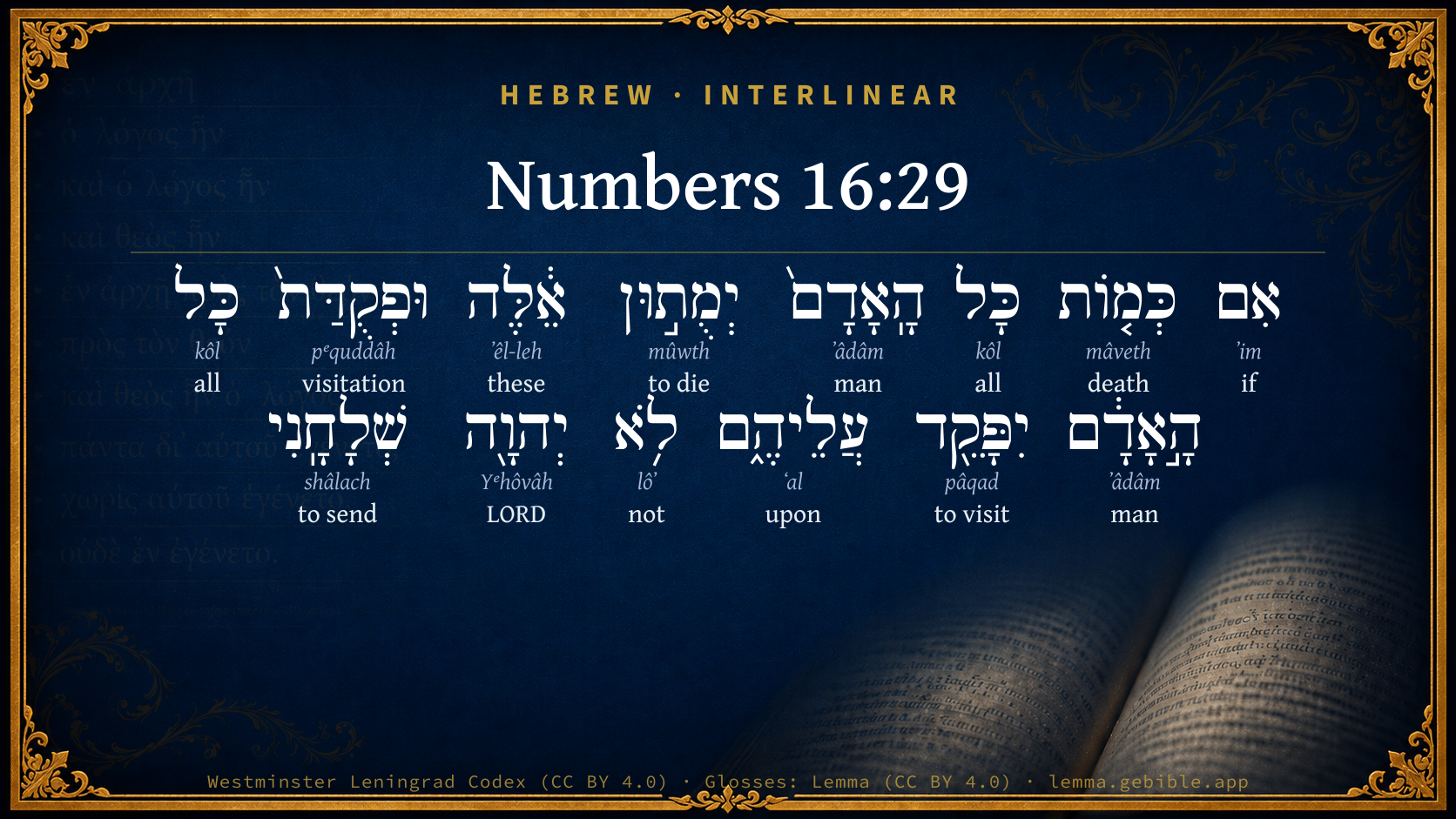
Hebrew (Westminster Leningrad Codex) Numbers 16:29 appears in the Hebrew Old Testament. The text above is from the Westminster Leningrad Codex. Each word links to its Strong’s number, a concise gloss, and parsing drawn from the Open Scriptures Hebrew Bible morphology. Click any word for its full Brown-Driver-Briggs (BDB) entry.
Download image
Cite this verse

Numbers 16:29 (World English Bible). Public Domain. Lemma interlinear Bible study tool, https://lemma.gebible.app/v/numbers/16/29.

Show BibTeX & RIS
BibTeX
RIS
English Translation
If these men die the common death of all men, or if they be visited after the visitation of all men; then Yahweh hasn't sent me.
World English Bible · Public Domain
Download a study sheet

One document with this verse’s original text, its word-by-word gloss line, the meaning frame, cross-references with their text, attributed commentary, and full source and license credits — printable, and it pastes into notes with its structure intact.

This verse Autodidact and up

Study sheet (.html) Plain text (.txt)

A passage Seminary Student

Up to 50 verses in one chapter. A passage sheet keeps up to 6 commentary sources and 12 cross-references per verse, in the order this page ranks them, and says so on the sheet whenever that leaves anything out. Ask for a single verse and you get the Autodidact verse sheet above.

Everything on this page stays free to read, with no account — the sheet is a download of what is already on screen, not access to it.

Want to remove ads? Support Godless Engineer
Compare translations 3

The same verse in 3 English versions, stacked beneath the original-language interlinear above. Click any original word for its lexicon entry.

Each is an independent rendering of the whole verse — the interlinear is not word-aligned to these translations.

Highlighted words mark where these versions differ — a whole-verse word diff, not a word-by-word alignment.

  • World English Bible Public Domain
    If these men die the common death of all men, or if they be visited after the visitation of all men; then Yahweh hasn't sent me.
  • King James Version Public Domain
    If these men die the common death of all men, or if they be visited after the visitation of all men; then the LORD hath not sent me.
  • unfoldingWord Literal Text CC BY-SA 4.0
    If as the death of every man these die, and the oversight of every man is counted upon them, Yahweh did not send me.

unfoldingWord Literal Text — © unfoldingWord, licensed CC BY-SA 4.0. Word-aligned USFM3 via Door43 (git.door43.org/unfoldingWord/en_ult).

Versions to compare (up to 4)

3 of 4 selected

Show all 18 translations

Every available English version of this verse, each an independent rendering of the whole verse.

  • World English Bible Public Domain
    If these men die the common death of all men, or if they be visited after the visitation of all men; then Yahweh hasn't sent me.
  • Berean Standard Bible Public Domain
    If these men die a natural death, or if they suffer the fate of all men, then the LORD has not sent me.
  • Majority Standard Bible Public Domain
    If these men die a natural death, or if they suffer the fate of all men, then the LORD has not sent me.
  • King James Version Public Domain
    If these men die the common death of all men, or if they be visited after the visitation of all men; then the LORD hath not sent me.
  • American Standard Version (1901) Public Domain
    If these men die the common death of all men, or if they be visited after the visitation of all men; then Jehovah hath not sent me.
  • Revised Version (1885) Public Domain
    If these men die the common death of all men, or if they be visited after the visitation of all men; then the LORD hath not sent me.
  • Geneva Bible (1599) Public Domain
    If these men die the common death of all men, or if they be visited after the visitation of all men, the Lord hath not sent me.
  • Douay-Rheims (1899) Public Domain
    If these men die the common death of men, and if they be visited with a plague, wherewith others also are wont to be visited, the Lord did not send me.
  • Young's Literal Translation Public Domain
    if according to the death of all men these die -- or the charge of all men is charged upon them -- Jehovah hath not sent me;
  • Literal Standard Version CC BY-SA 4.0
    if these die according to the death of all men, or the charge of all men is charged on them, YHWH has not sent me;
  • Unlocked Literal Bible CC BY-SA 4.0
    If these men die a natural death such as normally happens, then Yahweh has not sent me.
  • unfoldingWord Literal Text CC BY-SA 4.0
    If as the death of every man these die, and the oversight of every man is counted upon them, Yahweh did not send me.
  • Darby Bible Public Domain
    if these men die as all men die, and are visited with the visitation of all men, Jehovah has not sent me;
  • World Messianic Bible Public Domain
    If these men die the common death of all men, or if they experience what all men experience, then the LORD hasn’t sent me.
  • Webster's Bible Public Domain
    If these men shall die the common death of all men, or if they be visited after the visitation of all men; then the LORD hath not sent me.
  • Free Bible Version CC BY-SA 4.0
    If these men die a natural death, experiencing the destiny of every human being, then the Lord didn't send me.
  • Bible in Basic English Public Domain
    If these men have the common death of men, or if the natural fate of all men overtakes them, then the Lord has not sent me.
  • JPS Tanakh (1917) Public Domain
    If these men die the common death of all men, and be visited after the visitation of all men, then the LORD hath not sent Me.

Literal Standard Version (2020), Covenant Press — licensed CC BY-SA 4.0. Text via the HelloAO Bible API (eBible.org). Unlocked Literal Bible (unfoldingWord) — licensed CC BY-SA 4.0. Text via the HelloAO Bible API (eBible.org). unfoldingWord Literal Text — © unfoldingWord, licensed CC BY-SA 4.0. Word-aligned USFM3 via Door43 (git.door43.org/unfoldingWord/en_ult). Free Bible Version, Dr. Jonathan Gallagher — licensed CC BY-SA 4.0. Text via the HelloAO Bible API (eBible.org).

Word by word

More ways to search: Search by grammar → Find every occurrence → Compare this word →

Practice this passage: Drill this verse → Learn its vocabulary →

וּפְקֻדַּת֙
pᵉquddâh
H6486
“and · visitation of”
Conjunction + Noun, Common, Feminine, Singular, Construct
Part of Speech
Conjunction + Noun
Type
Common
Gender
Feminine
Number
Singular
State
Construct
Full BDB Definition

Origin: pass part of H6485

TWOT: 1802a

oversight, care, custody, mustering, visitation, store - visitation, punishment - oversight, charge, office, overseer, class of officers - mustering - store
  1. אִם ʼim H518 “if” Conjunction
  2. כְּמ֤וֹת mâveth H4194 “like/as · death of” Preposition + Noun, Common, Masculine, Singular, Construct
  3. כָּל kôl H3605 “all of” Noun, Common, Masculine, Singular, Construct
  4. הָֽאָדָם֙ ʼâdâm H120 “the · man” Particle, Definite Article + Noun, Common, Masculine, Singular, Absolute
  5. יְמֻת֣וּן mûwth H4191 “to die” Verb, Qal, Imperfect, 3rd Person, Masculine, Plural + Suffix, n
  6. אֵ֔לֶּה ʼêl-leh H428 “these” Pronoun, Demonstrative, Common, Plural
  7. כָּל kôl H3605 “all of” Noun, Common, Masculine, Singular, Construct
  8. הָ֣אָדָ֔ם ʼâdâm H120 “the · man” Particle, Definite Article + Noun, Common, Masculine, Singular, Absolute
  9. יִפָּקֵ֖ד pâqad H6485 “to visit” Verb, Niphal, Imperfect, 3rd Person, Masculine, Singular
  10. עֲלֵיהֶ֑ם ʻal H5921 “upon · them” Preposition + Suffix, Personal, 3rd Person, Masculine, Plural
  11. לֹ֥א lôʼ H3808 “not” Particle, Negative
  12. יְהוָ֖ה Yᵉhôvâh H3068 “LORD” Noun, Proper
  13. שְׁלָחָֽנִי shâlach H7971 “to send · me” Verb, Qal, Perfect, 3rd Person, Masculine, Singular + Suffix, Personal, 1st Person, Common, Singular

About this verse

These counts appear in no published source. They are computed here, from the morphology-tagged text and Lemma’s own curated glosses. What Lemma adds →

14
words
12
distinct lemmas
Pentateuch
section

Shared distinctive vocabulary

וּפְקֻדַּת֙ visitation H6486 occurs in 31 verses of the Hebrew Bible. Also found in:

Grammatical profile

  • 3 verbs
  • 7 nouns
  • 1 pronoun
  • 1 preposition
  • 1 conjunction
  • 1 particle

Verb forms

  • יְמֻת֣וּן Qal · Imperfect
  • יִפָּקֵ֖ד Niphal · Imperfect
  • שְׁלָחָֽנִי Qal · Perfect

Repetition

Words recur within this verse — often emphatic in Hebrew:

  • כָּל all H3605 ×2
  • הָֽאָדָם֙ man H120 ×2

Hebrew & Septuagint length

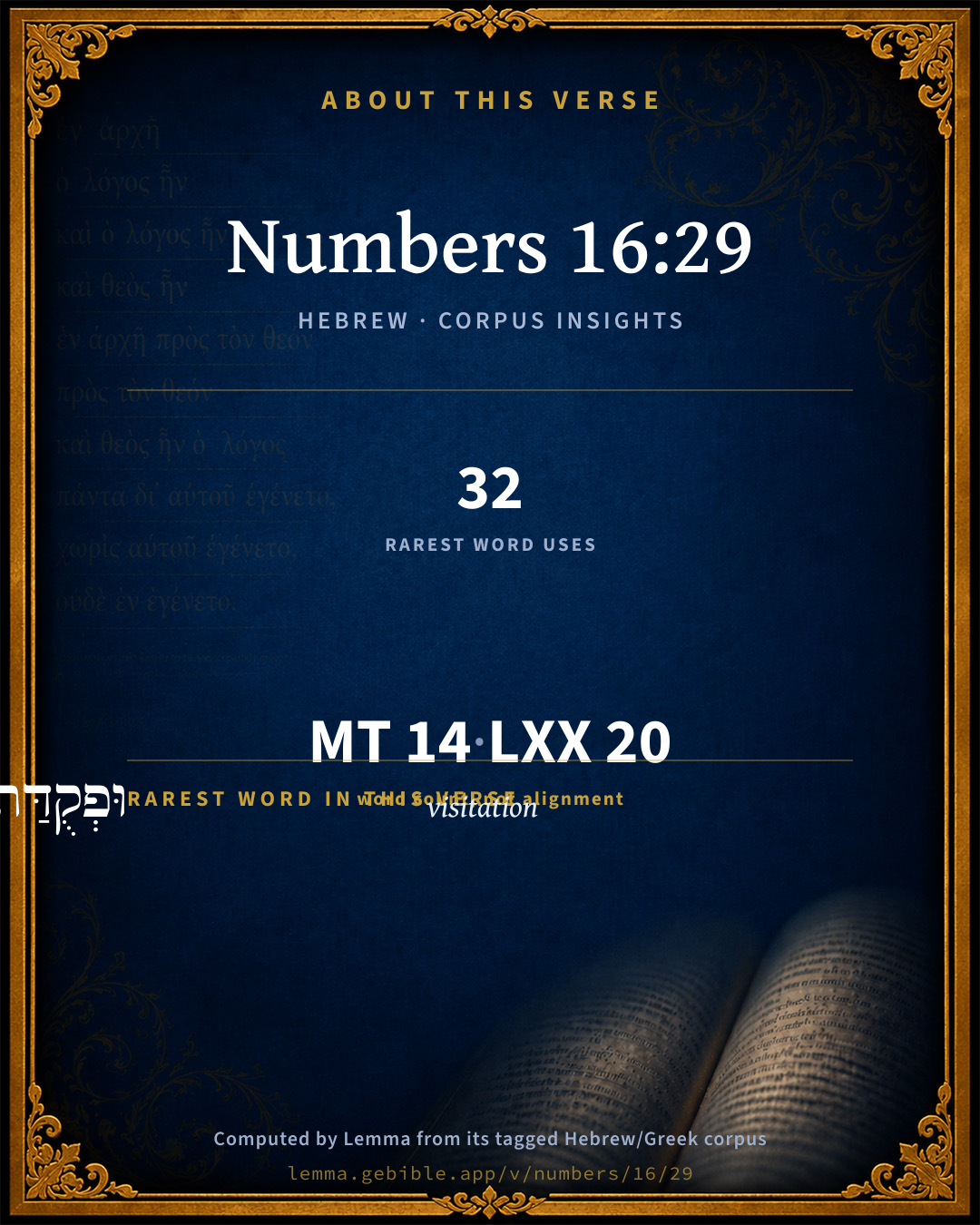
In English translation the verse runs 26 words from the Hebrew and 32 from the Septuagint (LXX English) — closely comparable.

A rough comparison of the two English renderings, which tokenize alike — not a word-level alignment.

Word counts can differ between the Hebrew and the Greek without any difference in meaning — e.g. the Hebrew direct-object marker אֵת has no separate Greek word, and Greek often adds the article ὁ.

In the original languages it is 14 Hebrew tokens and 20 Greek tokens — but the two are counted differently (Hebrew bundles its prefixes and suffixes into one token; the Greek is in lemma form), so that isn’t a like-for-like length.

Cross-references

9

Topical passages linked to Numbers 16:29 in the Treasury of Scripture Knowledge — connected by theme and wording, ordered by reader-vote popularity; previews shown in the World English Bible.

  • 1 Kings 22:28 Micaiah said, If you return at all in peace, Yahweh has not spoken by me. He said, Hear, you peoples, all of you.
  • Lamentations 4:22 The punishment of your iniquity is accomplished, daughter of Zion; he will no more carry you away into captivity: He will visit your iniquity, daughter of Edom; he will uncover your sins.
  • Exodus 32:34 Now go, lead the people to the place of which I have spoken to you. Behold, my angel shall go before you. Nevertheless in the day when I punish, I will punish them for their sin."
  • 2 Chronicles 18:27 Micaiah said, If you return at all in peace, Yahweh has not spoken by me. He said, Hear, you peoples, all of you.
  • Job 35:15 But now, because he has not visited in his anger, Neither does he greatly regard arrogance.
  • Ecclesiastes 3:19 For that which happens to the sons of men happens to animals. Even one thing happens to them. As the one dies, so the other dies. Yes, they have all one breath; and man has no advantage over the animals: for all is vanity.
  • Isaiah 10:3 What will you do in the day of visitation, and in the desolation which shall come from far? to whom will you flee for help? and where will you leave your glory?
  • Jeremiah 5:9 Shall I not visit for these things? says Yahweh; and shall not my soul be avenged on such a nation as this?
  • Exodus 20:5 you shall not bow yourself down to them, nor serve them, for I, Yahweh your God, am a jealous God, visiting the iniquity of the fathers on the children, on the third and on the fourth generation of those who hate me,

Cross-references courtesy of OpenBible.info (CC BY 4.0).

Hebrew and Greek witnesses Masoretic Hebrew ↔ Greek Septuagint

The same verse in the two great witnesses to the Old Testament, shown verse-for-verse.

These are two independent witnesses, not word-aligned to each other, and the Septuagint is shown in lemma (dictionary) form.

Hebrew Numbers 16:29 Masoretic · Westminster Leningrad Codex

אִם כְּמ֤וֹת כָּל הָֽאָדָם֙ יְמֻת֣וּן אֵ֔לֶּה וּפְקֻדַּת֙ כָּל הָ֣אָדָ֔ם יִפָּקֵ֖ד עֲלֵיהֶ֑ם לֹ֥א יְהוָ֖ה שְׁלָחָֽנִי

If these men die the common death of all men, or if they be visited after the visitation of all men; then Yahweh hasn't sent me.

World English Bible · Public Domain

Greek LXX Numbers 16:29 Septuagint · lemma form

εἰ κατά θάνατος πᾶς ἄνθρωπος ἀποθνήσκω οὗτος εἰ καί κατά ἐπίσκεψις πᾶς ἄνθρωπος ἐπισκοπή εἰμί αὐτός οὐ κύριος ἀποστέλλω ἐγώ

If these men shall die according to the death of all men, if also their visitation shall be according to the visitation of all men, then the Lord has not sent me.

LXX2012 (modern English Septuagint) · Public Domain

On this verse, The Pulpit Commentary discusses the Septuagint’s reading. Read the note in Commentary ↓

Hebrew: Westminster Leningrad Codex (CC BY 4.0). Greek: Septuagint (public domain); English from LXX2012 (modern English Septuagint) (Public Domain). How the Septuagint differs from the Hebrew →

Targum (Aramaic paraphrase)

2

The Targum is the ancient Jewish Aramaic paraphrase of the Hebrew Scriptures — an interpretive translation, not the Hebrew text itself. Onkelos (literal) and Pseudo-Jonathan (expansive) render the Torah, and Jonathan the Prophets. Coverage is partial: where no permissively-licensed English translation exists for a verse, only the Aramaic is shown. This is verse-level text, not a word-by-word alignment to the Hebrew.

  1. Targum Onkelos Torah (Genesis–Deuteronomy)
    אִם כְּמוֹתָא דְכָל אֱנָשָׁא יְמוּתוּן אִלֵין וּסְעָרָא דְכָל אֱנָשָׁא יִסְתְּעַר עֲלֵיהוֹן לָא יְיָ שַׁלְחַנִי

    (no public-domain English translation for this verse)

    Targum Onkelos — Aramaic: “Onkelos Genesis” (public domain); “Onkelos Exodus” (public domain); “Onkelos Leviticus” (public domain); “Onkelos Numbers” (public domain); “Onkelos Deuteronomy” (public domain). English: “Sefaria Community Translation” (CC0 1.0 (public-domain dedication)); “J.W. Etheridge. The Targums of Onkelos and Jonathan Ben Uzziel on the Pentateuch. London: Longmans, Green, 1862” (public domain). Text via Sefaria.

  2. Targum Pseudo-Jonathan Torah (Genesis–Deuteronomy)
    אִין כְּמִיתוּתָא דְמַיְיתוּן בָּהּ כָּל בְּנֵי נְּשָׁא יְמוּתוּן אִלְיֵין וּסְכָמוּת כָּל אֱנָשָׁא יִסְתְּכַם עֲלֵיהוֹן לָא יְיָ שְׁדָרַנִי

    If these men die after the manner of dying in which all men die, and the (common) account of all men be accounted upon them, the Lord hath not sent me.

    Targum Pseudo-Jonathan — Aramaic: “Targum Jonathan on Genesis” (public domain); “Targum Jonathan on Exodus” (public domain); “Targum Jonathan on Leviticus” (public domain); “Targum Jonathan on Numbers” (public domain); “Targum Jonathan on Deuteronomy” (public domain). English: “The Targum of Jonathan ben Uzziel, trans. J. W. Etheridge, London, 1862” (public domain). Text via Sefaria.

Commentary

Notes on Numbers 16:29 from classic Christian and Jewish commentators (each source and its license shown beneath its notes). The classic Christian expositions comment on the surrounding passage and are grouped to its opening verse, so a note may address several verses; the Jewish commentaries on the Tanakh (Rashi and others) are per-verse, so they appear only where the commentator wrote on this verse.

Lemma curates 59 commentaries, every one of them public domain or Creative Commons licensed, each selected and text-cleaned for this edition rather than reprinted as found. About our sources →

Trapp's Complete Commentary

John Trapp

Num 16:29 If these men die the common death of all men, or if they be visited after the visitation of all men; [then] the LORD hath not sent me.

Ver. 29. The common death of all men.] Ne quisquam sua morte defunctus est, said Suetonius of Caesar’s murderers. So may we say of our gun powder plotters; Your sin will find you out.

John Trapp, A Commentary or Exposition upon All the Books of the Old and New Testament (1647–1656) — public domain. Text from a community e-Sword module.

Joseph Benson's Commentary

Num 16:29. The death of all men — By a natural death. The visitation of all men — By plague, or sword, or some usual judgment. The Lord hath not sent me — I am content that you take me for an impostor, falsely pretending to be sent of God.

Joseph Benson's Commentary on the Old and New Testaments (1811–1818) — public domain. Text from a community e-Sword module.

John Gill's Exposition

If these men die the common death of all men,.... Or "as every man dies" (r), or the generality of men, who for the most part die of one disease or another, as a fever, and the like, or through old age:

or if they be visited after the visitation of all men; with such visitations as men in all ages for their sins are visited with, meaning public calamities, such as pestilence, famine, and sword:

then the Lord hath not sent me; it may be concluded that I had no mission nor commission from the Lord to do what I have done, but may be reckoned a deceiver and an impostor; and I am content to be accounted so, should either of the above things be the case of these men.

(r) "ut moriuntur omnes homines", Pagninus; "reliqui homines", Junius & Tremellius; "alii homines", Piscator.

John Gill's Exposition of the Whole Bible (1746–1763) — public domain (CC PDM 1.0). Text via the HelloAO Bible API.

Matthew Poole's English Annotations

i.e.

If these men die by a natural death, or by plague, or sword, or some usual judgment, I am content that you take me for an impostor, falsely pretending to be sent of God. This he might well say, because he was inspired by God to say this, and infallibly assured by God that this should be done.

Matthew Poole's English Annotations on the Holy Bible (1683–1685) — public domain. Text from a community e-Sword/MySword module.

Whedon's Commentary on the Bible

Daniel D. Whedon

29. The common death — Hebrew, as every man dies.

Daniel D. Whedon (gen. ed.), Commentary on the Old and New Testaments (1874–1909) — public domain. Text from a community e-Sword module.

The Pulpit Commentary

If they be visited after the visitation of all men. dqp is of somewhat doubtful meaning; it seems to answer to the episkeqiv and episkoph of the Septuagint, and to our "oversight," or "visitation" (German, heimsuchung. Thus it may mean practically the providence of God for good, i.e., in the way of protection, or for evil, i.e., in the way of judgment. In either sense providence showed itself in no ordinary form towards these men.

The Pulpit Commentary (1880–1919), ed. H.D.M. Spence-Jones & Joseph S. Exell — public domain. Text from a community e-Sword module.

John Wesley's Explanatory Notes

The death of all men - By a natural death. The visitation of all men - By plague, or sword, or some usual judgment. The Lord hath not sent me - I am content that you take me for an imposter, falsely pretending to be sent of God.

John Wesley, Explanatory Notes Upon the Whole Bible (1754–1765) — public domain. Text via the GEBible commentary corpus.

Rashi

Rabbi Shlomo Yitzchaki (Rashi)

לא ה' שלחני [IF THESE MEN DIE THE COMMON DEATH OF ALL MEN] … THEN THE LORD HATH NOT SENT ME. but I have done everything of my own accord and he (Korah) is therefore right in rebelling against me.

Rashi on the Tanakh — English translations: “The Judaica Press complete Tanach with Rashi, translated by A. J. Rosenberg” (CC BY 4.0); “Pentateuch with Rashi's commentary by M. Rosenbaum and A.M. Silbermann, 1929-1934” (public domain); “The Metsudah Tanach series, Lakewood, N.J” (CC BY 4.0); and “The Book of Joshua, Metsudah Publications, 1997” (CC BY 4.0). Text via Sefaria.

Ramban (Nachmanides)

Rabbi Moshe ben Nachman (Ramban / Nachmanides)

IF THESE MEN DIE THE COMMON DEATH OF ALL MEN. Now many of the people had said to Moses many times, Why hast thou brought us up out of Egypt? [and yet Moses did not ask for them to be especially punished]. But these people deserved punishment more than all other [previous sinners] because they said that thou wouldst make thyself altogether a prince over us. Thus they committed two evils: they trampled upon the honor due to a teacher, and they denied all the deeds of G-d which He did in Egypt and the wilderness, and even at the Revelation on Mount Sinai, where it is said and they will believe in thee [Moses] forever, by saying that Moses was not worthy to rule over them, and that nothing but evil had befallen them through him. Therefore it is said, and Moses was very wroth. Also Korach said, wherefore then lift ye up yourselves above the assembly of the Eternal? Therefore his tent was swallowed up by the earth together with them. This was the intention of Moses’ words [when he said: if these men die the common death of all men] then the Eternal hath not ‘sent’ me, meaning that He has not sent me at all to take the people out of Egypt, the expression being similar to: which the Eternal ‘sent’ him [Moses] to do in the land of Egypt; and this shall be the token unto thee, that I have ‘sent’ thee. Similarly, [And Moses said]: “Hereby, ye shall know that the Eternal hath ‘sent’ me to do all these works” means the deeds which you have seen with your [own] eyes, and refers to all that he had done from the day G-d told him, Come now therefore, and I will send thee unto Pharaoh; for the beginning of a prophet’s activity is called sh’lichuth (being sent, a commission), similar to the expressions: Whom shall I send, and who will go for us?; And I sent before thee Moses, Aaron, and Miriam. And the meaning of the expression all these works is not, as the commentators have said, the appointment of the Levites instead of the firstborn, and [the appointment of] Aaron to the priesthood, but it refers to the totality of the activities which Moses wrought in the sight of all Israel, as I have explained.

Ramban (Nachmanides) on the Tanakh — English translation: “Commentary on the Torah by Ramban (Nachmanides). Translated and annotated by Charles B. Chavel. New York, Shilo Pub. House, 1971-1976” (CC BY 4.0). Text via Sefaria.

Lesson kit

Teaching starters — assembled from the data on this page, not authored interpretation. Every prompt links to the verse data it draws on. Edit before teaching.

Numbers, in the Pentateuch, opens this verse with 14 words (12 distinct Hebrew lemmas). Its most distinctive word is pᵉquddâh (“visitation”). A historical commentator’s framing appears above. Read the whole chapter for the surrounding context.

Discussion questions

  1. How does “visitation” (pᵉquddâh) shape what this verse is saying?
  2. Numbers 3:32 shares the word «visitation» with this verse. How do the two illuminate each other?
  3. “all” occurs 2× in this one verse. What is the effect of the repetition?
  4. These translations render this verse differently. What is at stake in choosing one wording over another?
  5. The verb «יְמֻת֣וּן» is Qal Imperfect. How does its form color the action?
  6. Reading how Trapp's Complete Commentary and Joseph Benson's Commentary read this verse, where do the two commentators agree and where do they part?

Things to notice

Reading settings

Reading text

Shown beneath each verse's original-language words.

Old Testament
Old Testament edition

Read the OT as the Masoretic Hebrew (MT) or the Greek Septuagint (LXX).

English shown for the Greek Septuagint (in the Hebrew ↔ Greek comparison).

Comparing translations? Open the Compare panel on any verse page to stack up to four side by side.