
Exodus 14:12

Hebrew (Westminster Leningrad Codex) Exodus 14:12 appears in the Hebrew Old Testament. The text above is from the Westminster Leningrad Codex. Each word links to its Strong’s number, a concise gloss, and parsing drawn from the Open Scriptures Hebrew Bible morphology. Click any word for its full Brown-Driver-Briggs (BDB) entry.
Download image
Cite this verse

Exodus 14:12 (World English Bible). Public Domain. Lemma interlinear Bible study tool, https://lemma.gebible.app/v/exodus/14/12.

Show BibTeX & RIS
BibTeX
RIS
English Translation
Isn't this the word that we spoke to you in Egypt, saying, 'Leave us alone, that we may serve the Egyptians?' For it were better for us to serve the Egyptians, than that we should die in the wilderness."
World English Bible · Public Domain
Download a study sheet

One document with this verse’s original text, its word-by-word gloss line, the meaning frame, cross-references with their text, attributed commentary, and full source and license credits — printable, and it pastes into notes with its structure intact.

This verse Autodidact and up

Study sheet (.html) Plain text (.txt)

A passage Seminary Student

Up to 50 verses in one chapter. A passage sheet keeps up to 6 commentary sources and 12 cross-references per verse, in the order this page ranks them, and says so on the sheet whenever that leaves anything out. Ask for a single verse and you get the Autodidact verse sheet above.

Everything on this page stays free to read, with no account — the sheet is a download of what is already on screen, not access to it.

Want to remove ads? Support Godless Engineer
Compare translations 3

The same verse in 3 English versions, stacked beneath the original-language interlinear above. Click any original word for its lexicon entry.

Each is an independent rendering of the whole verse — the interlinear is not word-aligned to these translations.

Highlighted words mark where these versions differ — a whole-verse word diff, not a word-by-word alignment.

  • World English Bible Public Domain
    Isn't this the word that we spoke to you in Egypt, saying, 'Leave us alone, that we may serve the Egyptians?' For it were better for us to serve the Egyptians, than that we should die in the wilderness."
  • King James Version Public Domain
    Is not this the word that we did tell thee in Egypt, saying, Let us alone, that we may serve the Egyptians? For it had been better for us to serve the Egyptians, than that we should die in the wilderness.
  • unfoldingWord Literal Text CC BY-SA 4.0
    Is this not the word that we spoke to you in Egypt, saying, ‘Cease from us and let us serve the Egyptians’? Because serving the Egyptians is better to us than dying in the wilderness.”

unfoldingWord Literal Text — © unfoldingWord, licensed CC BY-SA 4.0. Word-aligned USFM3 via Door43 (git.door43.org/unfoldingWord/en_ult).

Versions to compare (up to 4)

3 of 4 selected

Show all 18 translations

Every available English version of this verse, each an independent rendering of the whole verse.

  • World English Bible Public Domain
    Isn't this the word that we spoke to you in Egypt, saying, 'Leave us alone, that we may serve the Egyptians?' For it were better for us to serve the Egyptians, than that we should die in the wilderness."
  • Berean Standard Bible Public Domain
    Did we not say to you in Egypt, ‘Leave us alone so that we may serve the Egyptians’? For it would have been better for us to serve the Egyptians than to die in the wilderness.”
  • Majority Standard Bible Public Domain
    Did we not say to you in Egypt, ‘Leave us alone so that we may serve the Egyptians’? For it would have been better for us to serve the Egyptians than to die in the wilderness.”
  • King James Version Public Domain
    Is not this the word that we did tell thee in Egypt, saying, Let us alone, that we may serve the Egyptians? For it had been better for us to serve the Egyptians, than that we should die in the wilderness.
  • American Standard Version (1901) Public Domain
    Is not this the word that we spake unto thee in Egypt, saying, Let us alone, that we may serve the Egyptians? For it were better for us to serve the Egyptians, than that we should die in the wilderness.
  • Revised Version (1885) Public Domain
    Is not this the word that we spake unto thee in Egypt, saying, Let us alone, that we may serve the Egyptians? For it were better for us to serve the Egyptians, than that we should die in the wilderness.
  • Geneva Bible (1599) Public Domain
    Did not wee tell thee this thing in Egypt, saying, Let vs be in rest, that we may serue the Egyptians? for it had bene better for vs to serue the Egyptians, then that wee shoulde dye in the wildernesse.
  • Douay-Rheims (1899) Public Domain
    Is not this the word that we spoke to thee in Egypt, saying: Depart from us that we may serve the Egyptians? for it was much better to serve them, than to die in the wilderness.
  • Young's Literal Translation Public Domain
    Is not this the word which we spake unto thee in Egypt, saying, Cease from us, and we serve the Egyptians; for better for us to serve the Egyptians than to die in a wilderness?'
  • Literal Standard Version CC BY-SA 4.0
    Is this not the word which we spoke to you in Egypt, saying, Cease from us, and we serve the Egyptians; for [it is] better for us to serve the Egyptians than to die in a wilderness?”
  • Unlocked Literal Bible CC BY-SA 4.0
    Is this not what we told you in Egypt? We said to you, 'Leave us alone, so we can work for the Egyptians.' It would have been better for us to work for them than to die in the wilderness.”
  • unfoldingWord Literal Text CC BY-SA 4.0
    Is this not the word that we spoke to you in Egypt, saying, ‘Cease from us and let us serve the Egyptians’? Because serving the Egyptians is better to us than dying in the wilderness.”
  • Darby Bible Public Domain
    Is not this what we told thee in Egypt, when we said, Let us alone, and we will serve the Egyptians? For [it had been] better for us to serve the Egyptians than to die in the wilderness.
  • World Messianic Bible Public Domain
    Isn’t this the word that we spoke to you in Egypt, saying, ‘Leave us alone, that we may serve the Egyptians’? For it would have been better for us to serve the Egyptians than to die in the wilderness.”
  • Webster's Bible Public Domain
    Is not this the word that we told thee in Egypt, Saying, Let us alone, that we may serve the Egyptians? For it had been better for us to serve the Egyptians, than that we should die in the wilderness.
  • Free Bible Version CC BY-SA 4.0
    Didn't we tell you back in Egypt, ‘Leave us alone so that we can go on being slaves to the Egyptians’? It would have been better for us to be Egyptian slaves than to die here in the desert!”
  • Bible in Basic English Public Domain
    Did we not say to you in Egypt, Let us be as we are, working for the Egyptians? for it is better to be the servants of the Egyptians than to come to our death in the waste land.
  • JPS Tanakh (1917) Public Domain
    Is not this the word that we spoke unto thee in Egypt, saying: Let us alone, that we may serve the Egyptians? For it were better for us to serve the Egyptians, than that we should die in the wilderness.'

Literal Standard Version (2020), Covenant Press — licensed CC BY-SA 4.0. Text via the HelloAO Bible API (eBible.org). Unlocked Literal Bible (unfoldingWord) — licensed CC BY-SA 4.0. Text via the HelloAO Bible API (eBible.org). unfoldingWord Literal Text — © unfoldingWord, licensed CC BY-SA 4.0. Word-aligned USFM3 via Door43 (git.door43.org/unfoldingWord/en_ult). Free Bible Version, Dr. Jonathan Gallagher — licensed CC BY-SA 4.0. Text via the HelloAO Bible API (eBible.org).

Word by word

More ways to search: Search by grammar → Find every occurrence → Compare this word →

Practice this passage: Drill this verse → Learn its vocabulary →

חֲדַ֥ל
châdal
H2308
“cease”
Verb, Qal, Imperative, 2nd Person, Masculine, Singular
Part of Speech
Verb
Stem
Qal
Form
Imperative
Person
2nd Person
Gender
Masculine
Number
Singular
Full BDB Definition

Origin: a primitive root

TWOT: 609

to stop, cease, desist, forego, cease to be, leave undone, forbear - (Qal) - to cease, come to an end - to cease, leave off
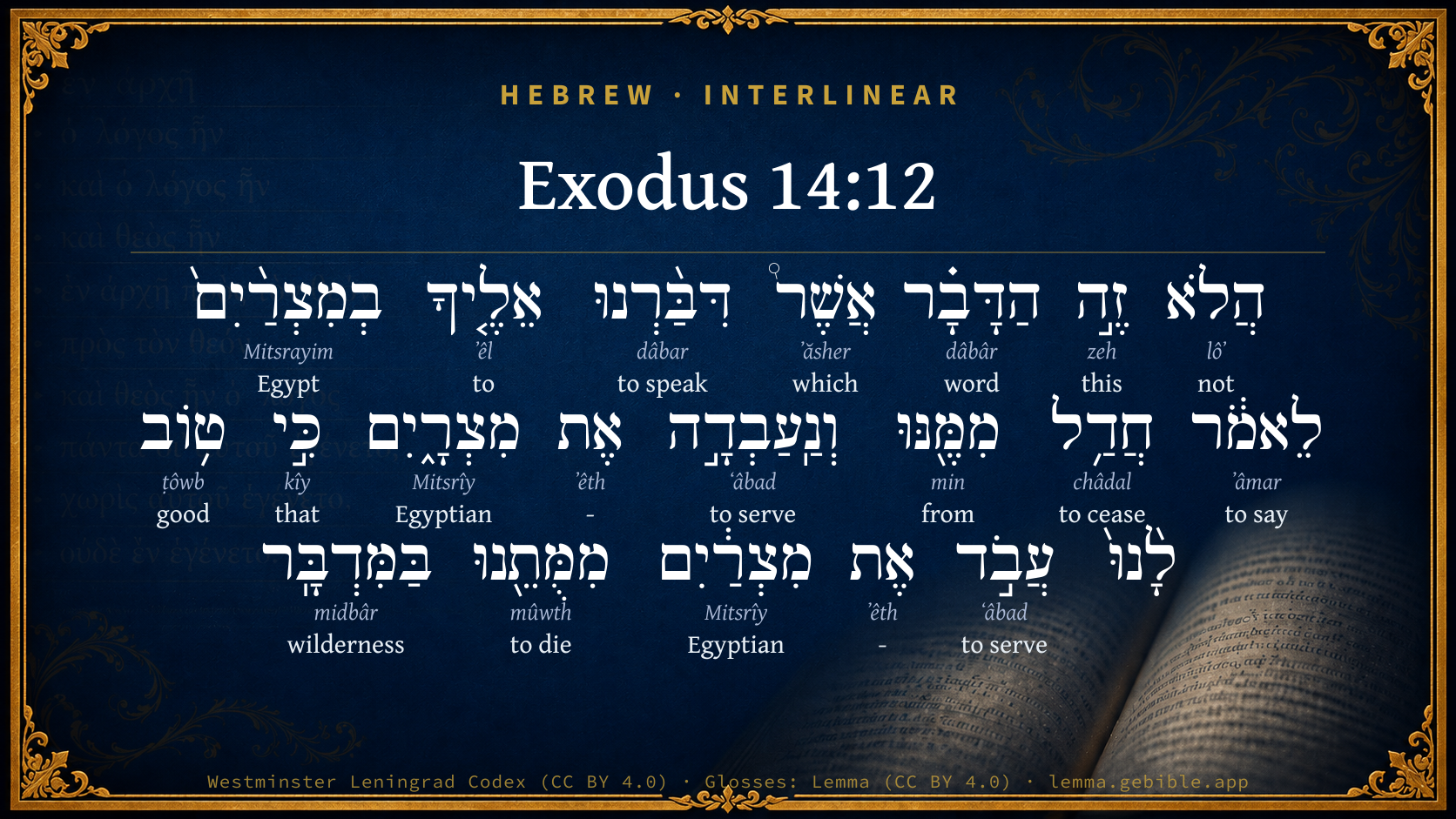
  1. הֲלֹא lôʼ H3808 “not” Particle, Interrogative + Particle, Negative
  2. זֶ֣ה zeh H2088 “this” Pronoun, Demonstrative, Masculine, Singular
  3. הַדָּבָ֗ר dâbâr H1697 “the · word” Particle, Definite Article + Noun, Common, Masculine, Singular, Absolute
  4. אֲשֶׁר֩ ʼăsher H834 “which” Particle, Relative
  5. דִּבַּ֨רְנוּ dâbar H1696 “to speak” Verb, Piel, Perfect, 1st Person, Common, Plural
  6. אֵלֶ֤יךָ ʼêl H413 “to · you” Preposition + Suffix, Personal, 2nd Person, Masculine, Singular
  7. בְמִצְרַ֨יִם֙ Mitsrayim H4714 “in/at · Egypt” Preposition + Noun, Proper
  8. לֵאמֹ֔ר ʼâmar H559 “to say” Preposition + Verb, Qal, Infinitive Construct
  9. מִמֶּ֖נּוּ min H4480 “from · us” Preposition + Suffix, Personal, 1st Person, Common, Plural
  10. וְנַֽעַבְדָ֣ה ʻâbad H5647 “and · to serve” Conjunction + Verb, Qal, Cohortative, 1st Person, Common, Plural
  11. אֶת ʼêth H853 “-” Particle, Direct Object
  12. מִצְרָ֑יִם Mitsrîy H4713 “Egyptian” Noun, Proper
  13. כִּ֣י kîy H3588 “that” Conjunction
  14. ט֥וֹב ṭôwb H2896 “good” Adjective, Adjective, Masculine, Singular, Absolute
  15. עֲבֹ֣ד ʻâbad H5647 “to serve” Verb, Qal, Infinitive Construct
  16. אֶת ʼêth H853 “-” Particle, Direct Object
  17. מִצְרַ֔יִם Mitsrîy H4713 “Egyptian” Noun, Proper
  18. מִמֻּתֵ֖נוּ mûwth H4191 “from · to die · us” Preposition + Verb, Qal, Infinitive Construct + Suffix, Personal, 1st Person, Common, Plural
  19. בַּמִּדְבָּֽר midbâr H4057 “in/at the · wilderness” Preposition, Determined + Noun, Common, Masculine, Singular, Absolute

About this verse

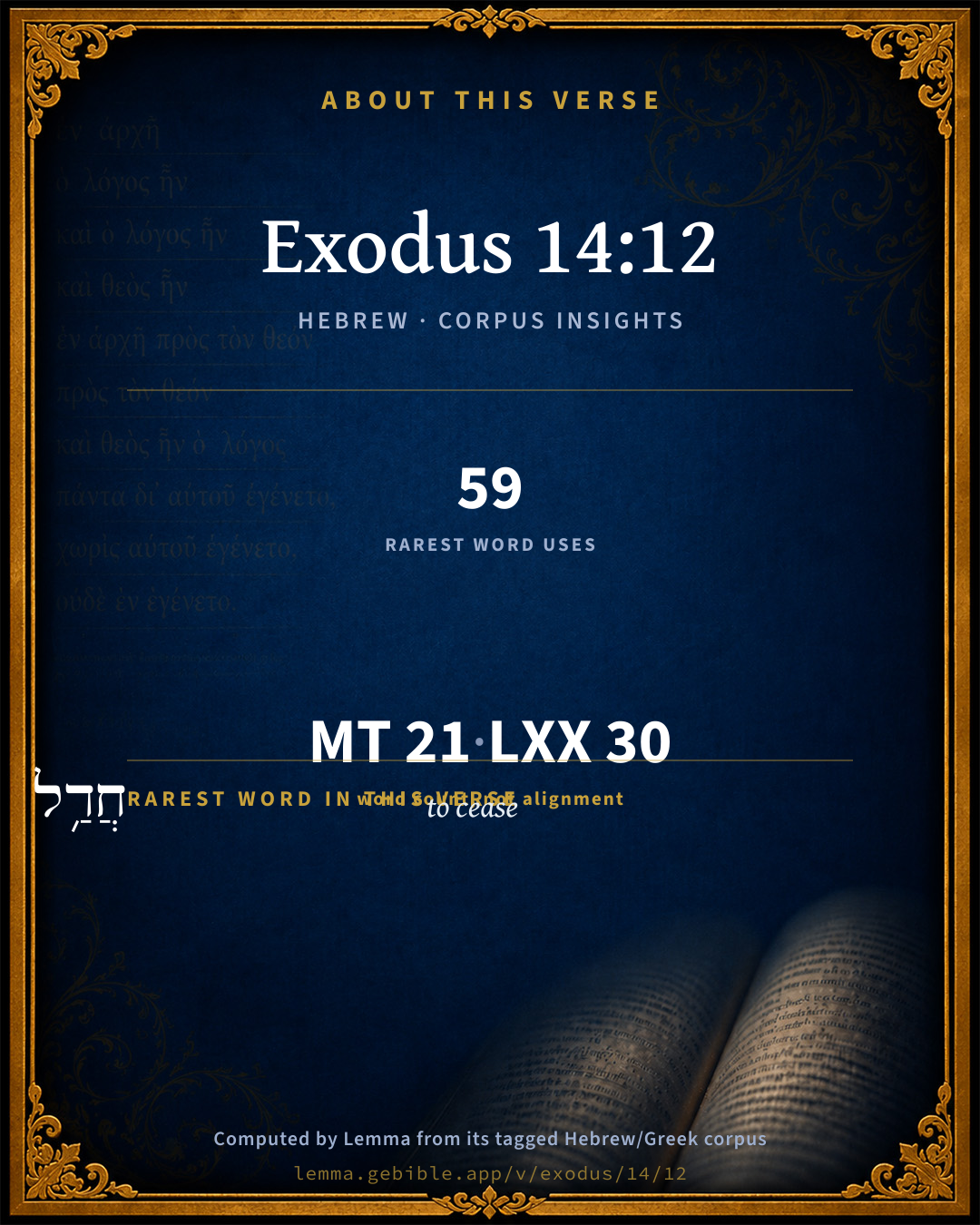
These counts appear in no published source. They are computed here, from the morphology-tagged text and Lemma’s own curated glosses. What Lemma adds →

21
words
17
distinct lemmas
Pentateuch
section

Shared distinctive vocabulary

חֲדַ֥ל to cease H2308 occurs in 56 verses of the Hebrew Bible. Also found in:

Grammatical profile

  • 6 verbs
  • 5 nouns
  • 1 adjective
  • 1 pronoun
  • 3 prepositions
  • 1 conjunction
  • 4 particles

Verb forms

  • דִּבַּ֨רְנוּ Piel · Perfect
  • לֵאמֹ֔ר Qal · Infinitive Construct
  • חֲדַ֥ל Qal · Imperative
  • וְנַֽעַבְדָ֣ה Qal · Cohortative
  • עֲבֹ֣ד Qal · Infinitive Construct
  • מִמֻּתֵ֖נוּ Qal · Infinitive Construct

Repetition

Words recur within this verse — often emphatic in Hebrew:

  • וְנַֽעַבְדָ֣ה to serve H5647 ×2
  • מִצְרָ֑יִם Egyptian H4713 ×2

Hebrew & Septuagint length

In English translation the verse runs 39 words from the Hebrew and 38 from the Septuagint (LXX English) — closely comparable.

A rough comparison of the two English renderings, which tokenize alike — not a word-level alignment.

Word counts can differ between the Hebrew and the Greek without any difference in meaning — e.g. the Hebrew direct-object marker אֵת has no separate Greek word, and Greek often adds the article ὁ.

In the original languages it is 21 Hebrew tokens and 30 Greek tokens — but the two are counted differently (Hebrew bundles its prefixes and suffixes into one token; the Greek is in lemma form), so that isn’t a like-for-like length.

Cross-references

9

Topical passages linked to Exodus 14:12 in the Treasury of Scripture Knowledge — connected by theme and wording, ordered by reader-vote popularity; previews shown in the World English Bible.

  • Exodus 6:9 Moses spoke so to the children of Israel, but they didn't listen to Moses for anguish of spirit, and for cruel bondage.
  • Jonah 4:3 Therefore now, Yahweh, take, I beg you, my life from me; for it is better for me to die than to live."
  • Exodus 3:9 Now, behold, the cry of the children of Israel has come to me. Moreover I have seen the oppression with which the Egyptians oppress them.
  • Exodus 5:21 and they said to them, "May Yahweh look at you, and judge, because you have made us a stench to be abhorred in the eyes of Pharaoh, and in the eyes of his servants, to put a sword in their hand to kill us."
  • Jonah 4:8 It happened, when the sun arose, that God prepared a sultry east wind; and the sun beat on Jonah's head, so that he fainted, and requested for himself that he might die, and said, "It is better for me to die than to live."
  • Hosea 4:17 Ephraim is joined to idols. Leave him alone!
  • Mark 1:24 saying, "Ha! What do we have to do with you, Jesus, you Nazarene? Have you come to destroy us? I know you who you are: the Holy One of God!"
  • Mark 5:7 and crying out with a loud voice, he said, "What have I to do with you, Jesus, you Son of the Most High God? I adjure you by God, don't torment me."

Cross-references courtesy of OpenBible.info (CC BY 4.0).

Hebrew and Greek witnesses Masoretic Hebrew ↔ Greek Septuagint

The same verse in the two great witnesses to the Old Testament, shown verse-for-verse.

These are two independent witnesses, not word-aligned to each other, and the Septuagint is shown in lemma (dictionary) form.

Hebrew Exodus 14:12 Masoretic · Westminster Leningrad Codex

הֲלֹא זֶ֣ה הַדָּבָ֗ר אֲשֶׁר֩ דִּבַּ֨רְנוּ אֵלֶ֤יךָ בְמִצְרַ֨יִם֙ לֵאמֹ֔ר חֲדַ֥ל מִמֶּ֖נּוּ וְנַֽעַבְדָ֣ה אֶת מִצְרָ֑יִם כִּ֣י ט֥וֹב לָ֨נוּ֙ עֲבֹ֣ד אֶת מִצְרַ֔יִם מִמֻּתֵ֖נוּ בַּמִּדְבָּֽר

Isn't this the word that we spoke to you in Egypt, saying, 'Leave us alone, that we may serve the Egyptians?' For it were better for us to serve the Egyptians, than that we should die in the wilderness."

World English Bible · Public Domain

Greek LXX Exodus 14:12 Septuagint · lemma form

οὐ οὗτος εἰμί ὁ ῥῆμα ὅς λαλέω πρός σύ ἐν αἴγυπτος λέγω παραἵημι ἐγώ ὅπως δουλεύω ὁ αἰγύπτιος κρείσσων γάρ ἐγώ δουλεύω ὁ αἰγύπτιος ἤ ἀποθνήσκω ἐν ὁ ἔρημος οὗτος

Is not this the word which we spoke to you in Egypt, saying, Let us alone that we may serve the Egyptians? for it is better for us to serve the Egyptians than to die in this wilderness.

LXX2012 (modern English Septuagint) · Public Domain

Hebrew: Westminster Leningrad Codex (CC BY 4.0). Greek: Septuagint (public domain); English from LXX2012 (modern English Septuagint) (Public Domain). How the Septuagint differs from the Hebrew →

Targum (Aramaic paraphrase)

2

The Targum is the ancient Jewish Aramaic paraphrase of the Hebrew Scriptures — an interpretive translation, not the Hebrew text itself. Onkelos (literal) and Pseudo-Jonathan (expansive) render the Torah, and Jonathan the Prophets. Coverage is partial: where no permissively-licensed English translation exists for a verse, only the Aramaic is shown. This is verse-level text, not a word-by-word alignment to the Hebrew.

  1. Targum Onkelos Torah (Genesis–Deuteronomy)
    הֲלָא דֵין פִּתְגָמָא דִי מַלֵלְנָא עִמָךְ בְמִצְרַיִם לְמֵימַר שְׁבוֹק מִנָנָא וְנִפְלַח יָת מִצְרָאֵי אֲרֵי טַב לָנָא דְנִפְלַח יָת מִצְרָאֵי מִדִנְמוּת בְּמַדְבְּרָא:

    (no public-domain English translation for this verse)

    Targum Onkelos — Aramaic: “Onkelos Genesis” (public domain); “Onkelos Exodus” (public domain); “Onkelos Leviticus” (public domain); “Onkelos Numbers” (public domain); “Onkelos Deuteronomy” (public domain). English: “Sefaria Community Translation” (CC0 1.0 (public-domain dedication)); “J.W. Etheridge. The Targums of Onkelos and Jonathan Ben Uzziel on the Pentateuch. London: Longmans, Green, 1862” (public domain). Text via Sefaria.

  2. Targum Pseudo-Jonathan Torah (Genesis–Deuteronomy)
    הֲלָא דֵין הוּא פִּתְגָמָא דְמַלֵילְנָא עִמָּךְ בְּמִצְרַיִם יִתְגְּלֵי יְיָ עֲלֵיכוֹן וִידוּן לְמֵימַר פְּסַק מִנָנָא וְנִפְלַח יַת מִצְרָאֵי אֲרוּם טַב לָנָא דְּנִפְלַח יַת מִצְרָאֵי מִדְנָמוּת בְּמַדְבְּרָא

    Was as not this the word that we spake to thee in Mizraim, Let the Lord manifest Himself over us and judge, saying, Desist from us, and we will serve the Mizraee? for it is better for us to serve the Mizraee than to perish in the desert.

    Targum Pseudo-Jonathan — Aramaic: “Targum Jonathan on Genesis” (public domain); “Targum Jonathan on Exodus” (public domain); “Targum Jonathan on Leviticus” (public domain); “Targum Jonathan on Numbers” (public domain); “Targum Jonathan on Deuteronomy” (public domain). English: “The Targum of Jonathan ben Uzziel, trans. J. W. Etheridge, London, 1862” (public domain). Text via Sefaria.

Commentary

Notes on Exodus 14:12 from classic Christian and Jewish commentators (each source and its license shown beneath its notes). The classic Christian expositions comment on the surrounding passage and are grouped to its opening verse, so a note may address several verses; the Jewish commentaries on the Tanakh (Rashi and others) are per-verse, so they appear only where the commentator wrote on this verse.

Lemma curates 59 commentaries, every one of them public domain or Creative Commons licensed, each selected and text-cleaned for this edition rather than reprinted as found. About our sources →

Trapp's Complete Commentary

John Trapp

Exo 14:12 [Is] not this the word that we did tell thee in Egypt, saying, Let us alone, that we may serve the Egyptians? For [it had been] better for us to serve the Egyptians, than that we should die in the wilderness.

Ver. 12. Is not this the word?] Invalidum omne natura querulum. {a} Weak spirits are ever quarrelling and contending.

{a} Seneca.

John Trapp, A Commentary or Exposition upon All the Books of the Old and New Testament (1647–1656) — public domain. Text from a community e-Sword module.

Geneva Bible (1599)

Geneva Bible translators

Such is the impatience of the flesh, that it cannot abide God’s appointed time.

Geneva Bible (1599) marginal notes — public domain. Text via Bolls.life.

Ellicott's Commentary for English Readers

(12) Is not this the word that we did tell thee . . .?—At one time they had refused to listen to Moses (Exo_6:9) but in the main they had acquiesced in his proceedings, and allowed him to act in their name. The reproach was therefore unjust and undeserved; but it is in human nature to make such reproaches in times of danger and difficulty.

A Bible Commentary for English Readers, edited by Charles John Ellicott (1878–1897) — public domain. Text from a community e-Sword module.

The Cambridge Bible for Schools and Colleges

gen. ed. J. J. S. Perowne

12. They even declare that while they were still in Egypt they had been unfavourable to Moses’ plan. This is not mentioned before: in Exo_4:31 they listen to Moses gladly; at most, they had blamed Moses when they found increased labour imposed upon them (Exo_5:21). Even in Exo_6:9 (P) nothing like the words here used is placed in their mouth.

The Cambridge Bible for Schools and Colleges (gen. ed. J. J. S. Perowne; Cambridge University Press, 1878–1918) — public domain. Text from a community e-Sword module.

John Gill's Exposition

Is not this the word that we did tell thee in Egypt,.... The thing they suggested to him, and talked with him about while they were in the land of Egypt, before they came out of it, particularly after their service and bondage were made more severe and cruel upon Moses and Aaron's demanding their dismission, see Exo 5:21,

saying, let us alone, that we may serve the Egyptians? peaceably and quietly, as we have been used to do, since there is no likelihood of being freed, and since we are more evilly treated than before:

for it had been better for us to serve the Egyptians, than that we should die in the wilderness: of such mean spirits were they, and had so poor a notion of, and taste for liberty, and so ungrateful were they to their deliverer.

John Gill's Exposition of the Whole Bible (1746–1763) — public domain (CC PDM 1.0). Text via the HelloAO Bible API.

Albert Barnes' Notes on the Bible

Let us alone - This is a gross exaggeration, yet not without a semblance of truth: for although the Israelites welcomed the message of Moses at first, they gave way completely at the first serious trial. See the reference in the margin. The whole passage foreshadows the conduct of the people in the wilderness.

Albert Barnes' Notes on the Bible (1834–1885) — public domain. Text from a community e-Sword/MySword module.

Haydock's Catholic Bible Commentary

Wilderness. This is the language of dastardly souls. They had begun to be almost in love with their chains. Every difficulty gives them occasion to repine at the gracious purposes of God, and the exertions of his servant Moses. But God bears patiently with the defects of a carnal and long-oppressed nation, ver. 13. (Haydock)--- The wiser sort pray to God, while others thus upbraid Moses.

George Leo Haydock (1774–1849), Haydock's Catholic Family Bible and Commentary, 1859 edition — public domain. Excludes Psalms (Douay-Rheims chapter numbering differs from Protestant) and Deuterocanonical books (Catholic canon only).

The Pulpit Commentary

Is not this the word that we did tell thee? The reference was probably to that time of depression, after their burdens had been increased, and before the series of miracles began, when the Israelites had addressed reproaches to Moses and Aaron, (Exo_5:21) and refused to listen to words of encouragement. (Exo_6:9) It was not true that they had uniformly held the same language, and desired Moses and Aaron to cease their efforts. It had been better for us to serve the Egyptians than that we should die. The spirit to prefer death to slavery, where they are the only alternatives, is not a common one; and we must not be surprised that a people which had grown up in servitude and had no traditions of national independence did not rise to the heroic height attained under other circumstances by Greeks, by Switzers. and by Poles. It would have been most extraordinary had they done so.

The Pulpit Commentary (1880–1919), ed. H.D.M. Spence-Jones & Joseph S. Exell — public domain. Text from a community e-Sword module.

Rashi

Rabbi Shlomo Yitzchaki (Rashi)

אשר דברנו אליך במצרים [THE WORD] THAT WE SPOKE UNTO THEE IN EGYPT — And where had they said this? (Exodus 5:21) “The Lord look upon you and judge!” (Mekhilta)

ממתנו means THAN THAT WE SHOULD DIE. If the word had been punctuated with a Melopum (our חולם i. e. מִמּוֹתֵנוּ) it would have to be explained “than our death” (מוֹתֵנוּ our death from the noun מָוֶת) but now that it is punctuated with a שורק (our Kibbutz) it must be explained by “than that we should die”. And similar is, (Exodus 16:3) “Would that מוּתֵנוּ” i. e. “that we should die”; similar is, (II Samuel 19:1) “Would that מוּתִי” in the history of Absalom, which means “that I should die”. It is an infinitive like (Zephaniah 3:8) “Until the day קוּמִי for ever”, and as (II Chronicles 18:26) “Until the day שׁוּבִי in peace” — which signify שאקום “that I shall arise”, and שאשוב “that I shall return”.

Rashi on the Tanakh — English translations: “The Judaica Press complete Tanach with Rashi, translated by A. J. Rosenberg” (CC BY 4.0); “Pentateuch with Rashi's commentary by M. Rosenbaum and A.M. Silbermann, 1929-1934” (public domain); “The Metsudah Tanach series, Lakewood, N.J” (CC BY 4.0); and “The Book of Joshua, Metsudah Publications, 1997” (CC BY 4.0). Text via Sefaria.

Lesson kit

Teaching starters — assembled from the data on this page, not authored interpretation. Every prompt links to the verse data it draws on. Edit before teaching.

Exodus, in the Pentateuch, opens this verse with 21 words (17 distinct Hebrew lemmas). Its most distinctive word is châdal (“to cease”). A historical commentator’s framing appears above. Read the whole chapter for the surrounding context.

Discussion questions

  1. The word châdal carries the sense “to cease.” How does it shape the verse?
  2. Genesis 11:8 shares the word «to cease» with this verse. How do the two illuminate each other?
  3. “to serve” occurs 2× in this one verse. What is the effect of the repetition?
  4. These translations render this verse differently; the difference is in the English rendering, not the original. What questions does that raise?
  5. The verb «דִּבַּ֨רְנוּ» is Piel Perfect. How does its form color the action?
  6. Reading how Trapp's Complete Commentary and Geneva Bible (1599) read this verse, where do the two commentators agree and where do they part?

Things to notice

Reading settings

Reading text

Shown beneath each verse's original-language words.

Old Testament
Old Testament edition

Read the OT as the Masoretic Hebrew (MT) or the Greek Septuagint (LXX).

English shown for the Greek Septuagint (in the Hebrew ↔ Greek comparison).

Comparing translations? Open the Compare panel on any verse page to stack up to four side by side.