
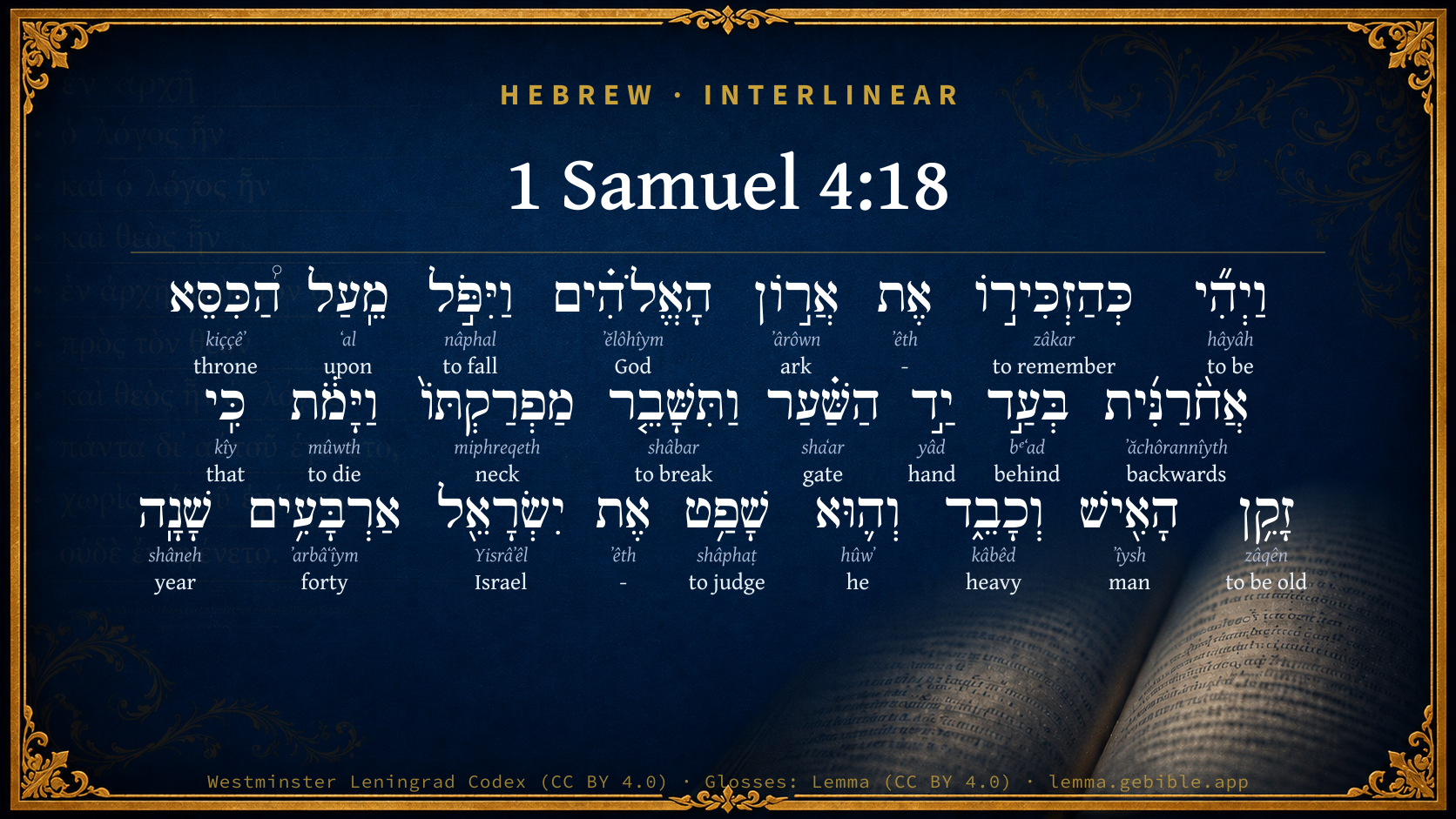
1 Samuel 4:18

Hebrew (Westminster Leningrad Codex) 1 Samuel 4:18 appears in the Hebrew Old Testament. The text above is from the Westminster Leningrad Codex. Each word links to its Strong’s number, a concise gloss, and parsing drawn from the Open Scriptures Hebrew Bible morphology. Click any word for its full Brown-Driver-Briggs (BDB) entry.
Download image
Cite this verse

1 Samuel 4:18 (World English Bible). Public Domain. Lemma interlinear Bible study tool, https://lemma.gebible.app/v/1-samuel/4/18.

Show BibTeX & RIS
BibTeX
RIS
English Translation
It happened, when he made mention of the ark of God, that [Eli] fell from off his seat backward by the side of the gate; and his neck broke, and he died: for he was an old man, and heavy. He had judged Israel forty years.
World English Bible · Public Domain
Highlights
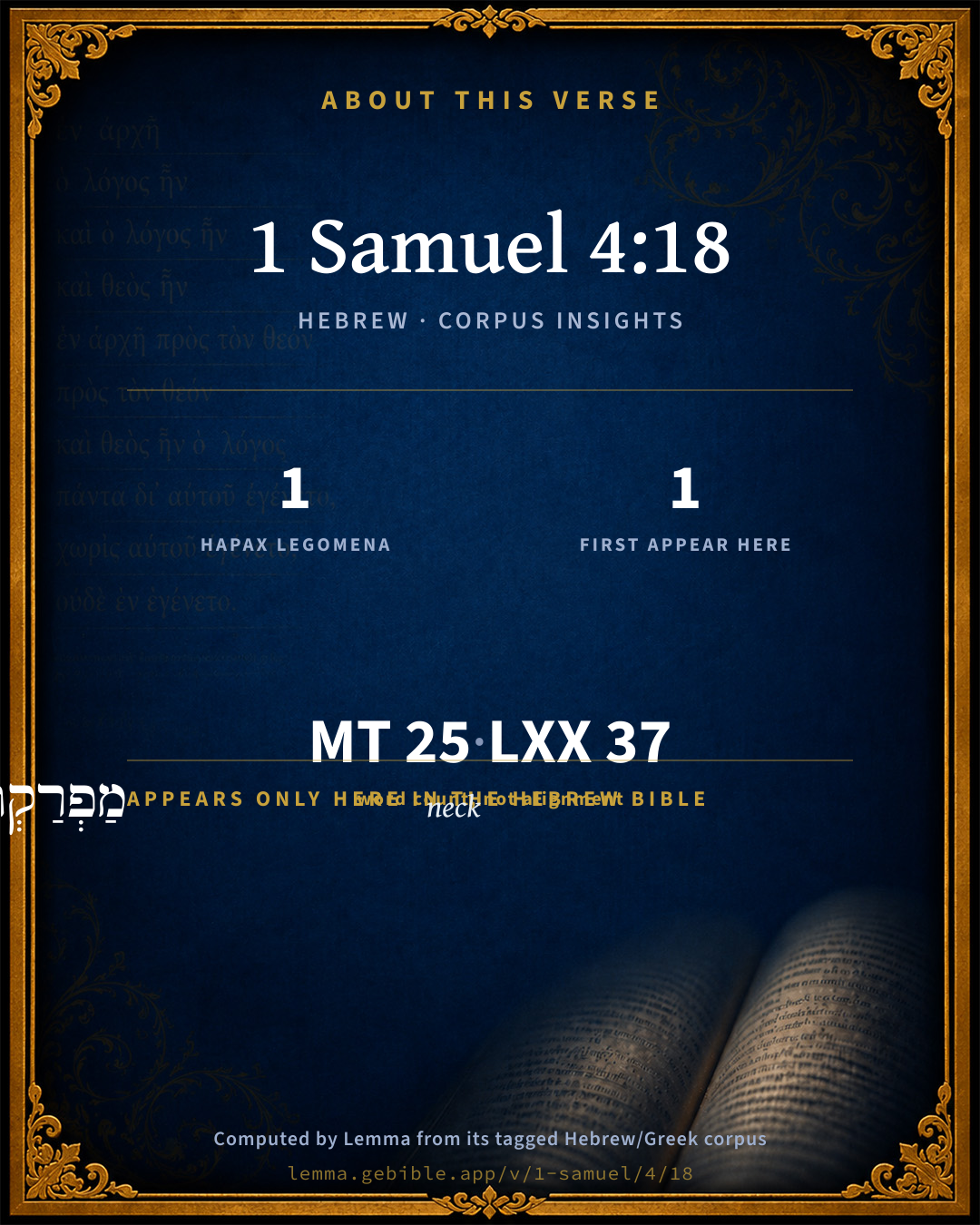
  • 1 hapax legomenon — only here in the Hebrew Bible
  • 1 first appearance in the Hebrew Bible
Full analysis ↓
Download a study sheet

One document with this verse’s original text, its word-by-word gloss line, the meaning frame, cross-references with their text, attributed commentary, and full source and license credits — printable, and it pastes into notes with its structure intact.

This verse Autodidact and up

Study sheet (.html) Plain text (.txt)

A passage Seminary Student

Up to 50 verses in one chapter. A passage sheet keeps up to 6 commentary sources and 12 cross-references per verse, in the order this page ranks them, and says so on the sheet whenever that leaves anything out. Ask for a single verse and you get the Autodidact verse sheet above.

Everything on this page stays free to read, with no account — the sheet is a download of what is already on screen, not access to it.

Want to remove ads? Support Godless Engineer
Compare translations 3

The same verse in 3 English versions, stacked beneath the original-language interlinear above. Click any original word for its lexicon entry.

Each is an independent rendering of the whole verse — the interlinear is not word-aligned to these translations.

Highlighted words mark where these versions differ — a whole-verse word diff, not a word-by-word alignment.

  • World English Bible Public Domain
    It happened, when he made mention of the ark of God, that [Eli] fell from off his seat backward by the side of the gate; and his neck broke, and he died: for he was an old man, and heavy. He had judged Israel forty years.
  • King James Version Public Domain
    And it came to pass, when he made mention of the ark of God, that he fell from off the seat backward by the side of the gate, and his neck brake, and he died: for he was an old man, and heavy. And he had judged Israel forty years.
  • unfoldingWord Literal Text CC BY-SA 4.0
    And it happened, in his mentioning of the Box of God, that he fell backward from upon the seat at the side of the gate. And his neck was broken, and he died, for the man old and heavy. And he had judged Israel 40 years.

unfoldingWord Literal Text — © unfoldingWord, licensed CC BY-SA 4.0. Word-aligned USFM3 via Door43 (git.door43.org/unfoldingWord/en_ult).

Versions to compare (up to 4)

3 of 4 selected

Show all 18 translations

Every available English version of this verse, each an independent rendering of the whole verse.

  • World English Bible Public Domain
    It happened, when he made mention of the ark of God, that [Eli] fell from off his seat backward by the side of the gate; and his neck broke, and he died: for he was an old man, and heavy. He had judged Israel forty years.
  • Berean Standard Bible Public Domain
    As soon as the ark of God was mentioned, Eli fell backward from his chair by the city gate, and being old and heavy, he broke his neck and died. And Eli had judged Israel forty years.
  • Majority Standard Bible Public Domain
    As soon as the ark of God was mentioned, Eli fell backward from his chair by the city gate, and being old and heavy, he broke his neck and died. And Eli had judged Israel forty years.
  • King James Version Public Domain
    And it came to pass, when he made mention of the ark of God, that he fell from off the seat backward by the side of the gate, and his neck brake, and he died: for he was an old man, and heavy. And he had judged Israel forty years.
  • American Standard Version (1901) Public Domain
    And it came to pass, when he made mention of the ark of God, that `Eli' feel from off his seat backward by the side of the gate; and his neck brake, and he died: for he was an old man, and heavy. And he had judged Israel forty years.
  • Revised Version (1885) Public Domain
    And it came to pass, when he made mention of the ark of God, that he fell from off his seat backward by the side of the gate, and his neck brake, and he died: for he was an old man, and heavy. And he had judged Israel forty years.
  • Geneva Bible (1599) Public Domain
    And when he had made mention of the Arke of God, Eli fell from his seate backward by the side of the gate, and his necke was broken, and he dyed: for he was an olde man and heauie: and he had iudged Israel fourtie yeeres.
  • Douay-Rheims (1899) Public Domain
    And when he had named the ark of God, he fell from his stool backwards by the door, and broke his neck, and died. For he was an old man, and far advanced in years: and he judged Israel forty years.
  • Young's Literal Translation Public Domain
    And it cometh to pass, at his mentioning the ark of God, that he falleth from off the throne backward, by the side of the gate, and his neck is broken, and he dieth, for the man `is' old and heavy, and he hath judged Israel forty years.
  • Literal Standard Version CC BY-SA 4.0
    And it comes to pass, at his mentioning the Ark of God, that he falls backward from off the throne, by the side of the gate, and his neck is broken, and he dies, for the man [is] old and heavy, and he has judged Israel [for] forty years.
  • Unlocked Literal Bible CC BY-SA 4.0
    When he mentioned the ark of God, Eli fell over backward from his seat by the side of the gate. His neck was broken, and he died, because he was old and heavy. He had judged Israel for forty years.
  • unfoldingWord Literal Text CC BY-SA 4.0
    And it happened, in his mentioning of the Box of God, that he fell backward from upon the seat at the side of the gate. And his neck was broken, and he died, for the man old and heavy. And he had judged Israel 40 years.
  • Darby Bible Public Domain
    And it came to pass, when he mentioned the ark of God, that he fell from off the seat backward by the side of the gate, and his neck broke, and he died; for the man was old, and heavy. And he had judged Israel forty years.
  • World Messianic Bible Public Domain
    When he made mention of God’s ark, Eli fell from off his seat backward by the side of the gate; and his neck broke, and he died, for he was an old man and heavy. He had judged Israel forty years.
  • Webster's Bible Public Domain
    And it came to pass, when he made mention of the ark of God, that he fell from off the seat backward by the side of the gate, and his neck broke, and he died: for he was an old man, and heavy. And he had judged Israel forty years.
  • Free Bible Version CC BY-SA 4.0
    As soon as the Ark of God was mentioned, Eli fell backward from his chair by the town gate. Since he was old and heavy, he broke his neck and died. Eli had been Israel's leader for forty years.
  • Bible in Basic English Public Domain
    And at these words about the ark of God, Eli, falling back off his seat by the side of the doorway into the town, came down on the earth so that his neck was broken and death overtook him, for he was an old man and of great weight. He had been judging Israel for forty years.
  • JPS Tanakh (1917) Public Domain
    And it came to pass, when he made mention of the ark of God, that he fell from off his seat backward by the side of the gate, and his neck broke, and he died; for he was an old man, and heavy. And he had judged Israel forty years.

Literal Standard Version (2020), Covenant Press — licensed CC BY-SA 4.0. Text via the HelloAO Bible API (eBible.org). Unlocked Literal Bible (unfoldingWord) — licensed CC BY-SA 4.0. Text via the HelloAO Bible API (eBible.org). unfoldingWord Literal Text — © unfoldingWord, licensed CC BY-SA 4.0. Word-aligned USFM3 via Door43 (git.door43.org/unfoldingWord/en_ult). Free Bible Version, Dr. Jonathan Gallagher — licensed CC BY-SA 4.0. Text via the HelloAO Bible API (eBible.org).

Word by word

More ways to search: Search by grammar → Find every occurrence → Compare this word →

Practice this passage: Drill this verse → Learn its vocabulary →

מַפְרַקְתּוֹ֙
miphreqeth
H4665
“neck · his”
Noun, Common, Feminine, Singular, Construct + Suffix, Personal, 3rd Person, Masculine, Singular
Part of Speech
Noun
Type
Common
Gender
Feminine
Number
Singular
State
Construct
Full BDB Definition

Origin: from H6561

TWOT: 1828c

neck
  1. וַיְהִ֞י hâyâh H1961 “and · to be” Conjunction + Verb, Qal, Sequential Imperfect, 3rd Person, Masculine, Singular
  2. כְּהַזְכִּיר֣וֹ zâkar H2142 “like/as · to remember · him” Preposition + Verb, Hiphil, Infinitive Construct + Suffix, Personal, 3rd Person, Masculine, Singular
  3. אֶת ʼêth H853 “-” Particle, Direct Object
  4. אֲר֣וֹן ʼârôwn H727 “ark of” Noun, Common, Both, Singular, Construct
  5. הָאֱלֹהִ֗ים ʼĕlôhîym H430 “the · God(s)” Particle, Definite Article + Noun, Common, Masculine, Plural, Absolute
  6. וַיִּפֹּ֣ל nâphal H5307 “and · to fall” Conjunction + Verb, Qal, Sequential Imperfect, 3rd Person, Masculine, Singular
  7. מֵֽעַל ʻal H5921 “from · upon” Preposition + Preposition
  8. הַ֠כִּסֵּא kiççêʼ H3678 “the · throne” Particle, Definite Article + Noun, Common, Masculine, Singular, Absolute
  9. אֲחֹ֨רַנִּ֜ית ʼăchôrannîyth H322 “backwards” Adverb
  10. בְּעַ֣ד bᵉʻad H1157 “behind” Preposition
  11. יַ֣ד yâd H3027 “hand of” Noun, Common, Both, Singular, Construct
  12. הַשַּׁ֗עַר shaʻar H8179 “the · gate” Particle, Definite Article + Noun, Common, Masculine, Singular, Absolute
  13. וַתִּשָּׁבֵ֤ר shâbar H7665 “and · to break” Conjunction + Verb, Niphal, Sequential Imperfect, 3rd Person, Feminine, Singular
  14. וַיָּמֹ֔ת mûwth H4191 “and · to die” Conjunction + Verb, Qal, Sequential Imperfect, 3rd Person, Masculine, Singular
  15. כִּֽי kîy H3588 “that” Conjunction
  16. זָקֵ֥ן zâqên H2204 “to be old” Verb, Qal, Perfect, 3rd Person, Masculine, Singular
  17. הָאִ֖ישׁ ʼîysh H376 “the · man” Particle, Definite Article + Noun, Common, Masculine, Singular, Absolute
  18. וְכָבֵ֑ד kâbêd H3515 “and · heavy” Conjunction + Adjective, Adjective, Masculine, Singular, Absolute
  19. וְה֛וּא hûwʼ H1931 “and · he” Conjunction + Pronoun, Personal, 3rd Person, Masculine, Singular
  20. שָׁפַ֥ט shâphaṭ H8199 “to judge” Verb, Qal, Perfect, 3rd Person, Masculine, Singular
  21. אֶת ʼêth H853 “-” Particle, Direct Object
  22. יִשְׂרָאֵ֖ל Yisrâʼêl H3478 “Israel” Noun, Proper
  23. אַרְבָּעִ֥ים ʼarbâʻîym H705 “forty” Adjective, Cardinal number, Both, Plural, Absolute
  24. שָׁנָֽה shâneh H8141 “year” Noun, Common, Feminine, Singular, Absolute

About this verse

These counts appear in no published source. They are computed here, from the morphology-tagged text and Lemma’s own curated glosses. What Lemma adds →

25
words
24
distinct lemmas
Historical
section

Notable vocabulary

1 hapax legomenon — a word that appears only here in the entire Hebrew Bible:

  • מַפְרַקְתּוֹ֙ neck H4665

First appearance in Scripture

This word makes its first canonical appearance in the Hebrew Bible here:

  • מַפְרַקְתּוֹ֙ neck H4665

Shared distinctive vocabulary

אֲחֹ֨רַנִּ֜ית backwards H322 occurs in 6 verses of the Hebrew Bible. Also found in:

Grammatical profile

  • 7 verbs
  • 9 nouns
  • 2 adjectives
  • 1 pronoun
  • 2 prepositions
  • 1 conjunction
  • 1 adverb
  • 2 particles

Verb forms

  • וַיְהִ֞י Qal · Sequential Imperfect
  • כְּהַזְכִּיר֣וֹ Hiphil · Infinitive Construct
  • וַיִּפֹּ֣ל Qal · Sequential Imperfect
  • וַתִּשָּׁבֵ֤ר Niphal · Sequential Imperfect
  • וַיָּמֹ֔ת Qal · Sequential Imperfect
  • זָקֵ֥ן Qal · Perfect
  • שָׁפַ֥ט Qal · Perfect

Hebrew & Septuagint length

In English translation the verse runs 46 words from the Hebrew and 44 from the Septuagint (LXX English) — closely comparable.

A rough comparison of the two English renderings, which tokenize alike — not a word-level alignment.

Word counts can differ between the Hebrew and the Greek without any difference in meaning — e.g. the Hebrew direct-object marker אֵת has no separate Greek word, and Greek often adds the article ὁ.

In the original languages it is 25 Hebrew tokens and 37 Greek tokens — but the two are counted differently (Hebrew bundles its prefixes and suffixes into one token; the Greek is in lemma form), so that isn’t a like-for-like length.

Cross-references

12

Topical passages linked to 1 Samuel 4:18 in the Treasury of Scripture Knowledge — connected by theme and wording, ordered by reader-vote popularity; previews shown in the World English Bible.

  • 1 Samuel 4:21–22 She named the child Ichabod, saying, The glory is departed from Israel; because the ark of God was taken, and because of her father-in-law and her husband.
  • 1 Peter 4:17–18 For the time has come for judgment to begin at the house of God. If it begins first with us, what will happen to those who don't obey the Gospel of God?
  • Psalms 69:9 For the zeal of your house consumes me. The reproaches of those who reproach you have fallen on me.
  • Leviticus 10:3 Then Moses said to Aaron, "This is what Yahweh spoke of, saying, "'I will show myself holy to those who come near me, And before all the people I will be glorified.'" Aaron held his peace.
  • 1 Samuel 2:31–32 Behold, the days come, that I will cut off your arm, and the arm of your father's house, that there shall not be an old man in your house.
  • 1 Samuel 3:12–13 In that day I will perform against Eli all that I have spoken concerning his house, from the beginning even to the end.
  • 1 Samuel 4:13 When he came, behold, Eli was sitting on his seat by the road watching; for his heart trembled for the ark of God. When the man came into the city, and told it, all the city cried out.
  • Psalms 26:8 Yahweh, I love the habitation of your house, The place where your glory dwells.
  • Psalms 42:3 My tears have been my food day and night, While they continually ask me, "Where is your God?"
  • Psalms 42:10 As with a sword in my bones, my adversaries reproach me, While they continually ask me, "Where is your God?"
  • Lamentations 2:15–19 All that pass by clap their hands at you; They hiss and wag their head at the daughter of Jerusalem, [saying], Is this the city that men called The perfection of beauty, The joy of the whole earth?
  • 1 Corinthians 11:30–32 For this cause many among you are weak and sickly, and not a few sleep.

Cross-references courtesy of OpenBible.info (CC BY 4.0).

Hebrew and Greek witnesses Masoretic Hebrew ↔ Greek Septuagint

The same verse in the two great witnesses to the Old Testament, shown verse-for-verse.

These are two independent witnesses, not word-aligned to each other, and the Septuagint is shown in lemma (dictionary) form.

Hebrew 1 Samuel 4:18 Masoretic · Westminster Leningrad Codex

וַיְהִ֞י כְּהַזְכִּיר֣וֹ אֶת אֲר֣וֹן הָאֱלֹהִ֗ים וַיִּפֹּ֣ל מֵֽעַל הַ֠כִּסֵּא אֲחֹ֨רַנִּ֜ית בְּעַ֣ד יַ֣ד הַשַּׁ֗עַר וַתִּשָּׁבֵ֤ר מַפְרַקְתּוֹ֙ וַיָּמֹ֔ת כִּֽי זָקֵ֥ן הָאִ֖ישׁ וְכָבֵ֑ד וְה֛וּא שָׁפַ֥ט אֶת יִשְׂרָאֵ֖ל אַרְבָּעִ֥ים שָׁנָֽה

It happened, when he made mention of the ark of God, that [Eli] fell from off his seat backward by the side of the gate; and his neck broke, and he died: for he was an old man, and heavy. He had judged Israel forty years.

World English Bible · Public Domain

Greek LXX 1 Samuel 4:18 Septuagint · lemma form

καί γίγνομαι ὡς μιμνήσκω ὁ κιβωτός ὁ θεός καί πίπτω ἀπό ὁ δίφρος ὀπισθίως ἔχω ὁ πύλη καί συντρίβω ὁ νῶτον αὐτός καί ἀποθνήσκω ὅτι πρεσβύτης ὁ ἄνθρωπος καί βαρύς καί αὐτός κρίνω ὁ ἰσραήλ εἴκοσι ἔτος

And it came to pass, when he mentioned the ark of God, that he fell from the seat backward near the gate, and his back was broken, and he died, for he was an old man and heavy: and he judged Israel twenty years.

LXX2012 (modern English Septuagint) · Public Domain

On this verse, Adam Clarke's Commentary discusses the Septuagint’s reading. Read the note in Commentary ↓

Hebrew: Westminster Leningrad Codex (CC BY 4.0). Greek: Septuagint (public domain); English from LXX2012 (modern English Septuagint) (Public Domain). How the Septuagint differs from the Hebrew →

Targum (Aramaic paraphrase)

1

The Targum is the ancient Jewish Aramaic paraphrase of the Hebrew Scriptures — an interpretive translation, not the Hebrew text itself. Onkelos (literal) and Pseudo-Jonathan (expansive) render the Torah, and Jonathan the Prophets. Coverage is partial: where no permissively-licensed English translation exists for a verse, only the Aramaic is shown. This is verse-level text, not a word-by-word alignment to the Hebrew.

  1. Targum Jonathan Prophets (Joshua–Malachi)
    וַהֲוָה כַּד אַדְכָּרוּתֵיהּ יַת אֲרוֹנָא דַייָ וּנְפַל מֵעַל כּוּרְסָא לַאֲחוֹרוֹהִי עַל כְּבַשׁ אוֹרַח תַּרְעָא וְאִתַּבָּרַת פָּרְקוּתֵיהּ וּמִית אֲרֵי סִיב גַבְרָא וְיַקִיר וְהוּא דָן יַת יִשְׂרָאֵל אַרְבְּעִין שְׁנִין:

    (no public-domain English translation for this verse)

    Targum Jonathan — Aramaic: “Mikraot Gedolot” (public domain). English: “Sefaria Community Translation” (CC0 1.0 (public-domain dedication)); “London "Chaldee Paraphrase," 1871” (public domain). Text via Sefaria.

Commentary

Notes on 1 Samuel 4:18 from classic Christian and Jewish commentators (each source and its license shown beneath its notes). The classic Christian expositions comment on the surrounding passage and are grouped to its opening verse, so a note may address several verses; the Jewish commentaries on the Tanakh (Rashi and others) are per-verse, so they appear only where the commentator wrote on this verse.

Lemma curates 59 commentaries, every one of them public domain or Creative Commons licensed, each selected and text-cleaned for this edition rather than reprinted as found. About our sources →

Trapp's Complete Commentary

John Trapp

1Sa 4:18 And it came to pass, when he made mention of the ark of God, that he fell from off the seat backward by the side of the gate, and his neck brake, and he died: for he was an old man, and heavy. And he had judged Israel forty years.

Ver. 18. When he made mention of the ark.] This word struck him down backward, and killed him in the fall. No sword of a Philistine could have slain him more powerfully; neither can you say whether his neck or heart were first broken.

His neck brake, and he died.] Howbeit he had hope in his death, and might write Resurgam on his grave; whereas the wicked fall like the elephant, which, being down, riseth not again.

John Trapp, A Commentary or Exposition upon All the Books of the Old and New Testament (1647–1656) — public domain. Text from a community e-Sword module.

Joseph Benson's Commentary

1Sa 4:18. He fell from his seat backward — Being so oppressed with grief and astonishment that he had no strength left to support him. Though he was much to be blamed for his too great indulgence and lenity toward his sons, yet it was highly commendable in him that he was not so much affected by their death, and the slaughter of the people, as with the loss of the ark of God. By the side of the gate — At the entrance of the city, where his chair was set; the most convenient place for receiving speedy information of all occurrences. For he was an old man, and heavy — Old, and therefore weak, and apt to fall; heavy, and therefore his fall more dangerous. So fell the high-priest and judge of Israel! So fell his heavy head, when he had lived within two of a hundred years! So fell the crown from his head, when he had judged Israel forty years: thus did his sun set under a cloud. Thus was the wickedness of those sons of his, whom he had indulged, his ruin. Thus does God sometimes set marks of his displeasure on good men, that others may hear and fear. Yet we must observe, it was the loss of the ark that was his death, and not the slaughter of his sons. He says, in effect, Let me fall with the ark! Who can live when the ordinances of God are removed? Farewell all in this world, even life itself, if the ark be gone!

Joseph Benson's Commentary on the Old and New Testaments (1811–1818) — public domain. Text from a community e-Sword module.

Tyndale Open Study Notes

Tyndale Open Resources

4:18 Eli fell backward: Either he was startled or he had a heart attack when he heard the message. Eli’s fatal fall symbolizes his family’s fall from the priesthood and the end of the abomination that his sons began (2:12-17). • Israel’s judge: Priesthood and judgeship were not incompatible (cp. Exod 18:13-26; Deut 17:8-13). Samuel replaced Eli as Israel’s judge and provided leadership that Eli had failed to provide (see 1 Sam 7:12-17). • The phrase for forty years incorporates Eli’s career into the conceptual and temporal framework of the book of Judges (cp. Judg 3:11; 5:31; 8:28; 13:1).

Tyndale Open Study Notes — © Tyndale Open Resources, licensed CC BY-SA 4.0. Text via the HelloAO Bible API.

Geneva Bible (1599)

Geneva Bible translators

Or, governed.

Geneva Bible (1599) marginal notes — public domain. Text via Bolls.life.

Adam Clarke's Commentary

Verse 18. When he made mention of the ark of God] Eli bore all the relation till the messenger came to this solemn word; he had trembled before for the ark, and now, hearing that it was captured, he was transfixed with grief, fell down from his seat, and dislocated his neck! Behold the judgments of God! But shall we say that this man, however remiss in the education of his children, and criminal in his indulgence towards his profligate sons, which arose more from the easiness of his disposition than from a desire to encourage vice, is gone to perdition? God forbid! No man ever died with such benevolent and religious feelings, and yet perished.

He had judged Israel forty years] Instead of forty years, the Septuagint has here εικοσι ετη, twenty years. All the other versions, as well as the Hebrew text, have forty years.

Adam Clarke's Commentary on the Bible (1810–1826) — public domain. Text from a community e-Sword/MySword module.

Ellicott's Commentary for English Readers

(18) He fell from off the seat backward.—The compiler of these books was actuated by no feeling of friendship to the high priest Eli. In composing this history of the events which led to the elevation of Samuel to the judgeship, he simply puts together the materials he possessed of the records of these days, and gives us a vivid picture of the calamities of the rule of Eli. As he never spares his weakness, or attempts to veil his blind nepotism, we feel here the perfect truth of this touching incident which closed the old man’s life. He loved the Ark, because of its close connection with his God, better, after all, than his two sons. We have seen already that he could bear the stern announcement of the ruin and degradation of the fortune of his proud house, for which he toiled only too faithfully; he could bear to see another—the boy Samuel—preferred before him, the high priest and judge of Israel; he could endure to hear of the defeat and ruin of the country over which he had so long ruled, and which he loved so well; even the news of the death of his sons he could listen to with sad resignation; but when his ears caught the words “the ark of God is taken,” the old man s heart broke, and he died. The chronicler of this period, who certainly never favoured Eli, leaves upon us the impression that with all his faults and imperfections he was still a servant of God. Wordsworth quotes here Psa_137:5-6 : “If I forget thee, O Jerusalem, let my right hand forget her cunning. If I do not remember thee, let my tongue cleave to the roof of my mouth: if I prefer not Jerusalem above my chief joy.”—The dying words of Archbishop Whitgift were, “Pro ecclesils Dei,”—“For the church of God.”

And he had judged Israel forty years.—“When I read of Eli the priest, of the sons of Aaron, judging Israel forty years, and of Samuel, certainly a Levite, though not a priest, going circuit as a judge itinerant in Israel (1Sa_7:16), and of others of the families of Levi appointed by King David to be judges and officers, not only in all the business of the Lord, but also for the outward business of Israel (2Sa_15:35; 1Ch_26:29-32)—when I observe in the Church stories, ever since the world had Christian princes, how ecclesiastical persons have been employed by their sovereigns in their weightiest consultations and affairs of state, I cannot but wonder at those who inveigh against courts, power, jurisdiction, and the temporalities of bishops and other ecclesiastical persons. I speak it not to justify abuses of men, but to justify the lawfulness of the tiling.”—Bishop Sanderson, quoted by Wordsworth.

A Bible Commentary for English Readers, edited by Charles John Ellicott (1878–1897) — public domain. Text from a community e-Sword module.

The Cambridge Bible for Schools and Colleges

gen. ed. J. J. S. Perowne

18. the ark of God] National defeat and disgrace, family bereavement, were but trifles compared to the loss of the Ark, which seemed to prove that Jehovah had forsaken the people of his choice. “Wherefore should the heathen say, Where is now their God?”

he had judged Israel forty years] See note on 1Sa_4:1.

The Cambridge Bible for Schools and Colleges (gen. ed. J. J. S. Perowne; Cambridge University Press, 1878–1918) — public domain. Text from a community e-Sword module.

John Gill's Exposition

And it came to pass, when he made mention of the ark of God,.... Of the taking of that, it struck him to the heart, and killed him; the rest he bore tolerably well, the flight of Israel before the Philistines, the great slaughter made of them, the death of his two sons; but the taking of the ark was so dreadful to him, that he could not support under it:

that he fell from off the seat backward, by the side of the gate; which confirms the sense of Sa1 4:13 though whether it was the gate of his own house, or of the tabernacle, or of the city is not certain; the latter is most probable: it seems the seat on which he sat had no back to it, and might be placed only for present convenience:

and his neck brake; the back part of it, the "vertebrae" of it, which has its name in Hebrew from the several joints in it:

and he died; not through the breaking of his neck, for it is very probable he died directly upon hearing the ark was taken, and which was the reason of his falling backward, and that brake his neck:

for he was an old man, and heavy; full of flesh, a very fat man, and so fell heavy, which occasioned the breaking of his neck:

and he had judged Israel forty years; had governed them in the capacity both of an high priest and judge, so that he must enter on his government when fifty eight years of age; the Septuagint version has it very wrongly twenty years. According to the Jews (i), he died on the tenth of Ijar, answering to part of April and May, and his two sons and the ark taken; for which a fast was kept on it.

(i) Schulchan Aruch, par. 1. c. 580. sect. 2.

John Gill's Exposition of the Whole Bible (1746–1763) — public domain (CC PDM 1.0). Text via the HelloAO Bible API.

Albert Barnes' Notes on the Bible

A comparison of 2Sa 18:4, explains exactly the meaning of the “side of the gate,” and Eli’s position. His seat or throne, without a back, stood with the side against the jamb of the gate, leaving the passage through the gate quite clear, but placed so that every one passing through the gate must pass in front of him.

Forty years - This chronological note connects this book with that of Judges. (Compare Jdg 3:11, etc.) It is an interesting question, but one very difficult to answer how near to the death of Phinehas, the son of Eleazar the High Priest, Eli’s forty years of judgeship bring him. It is probable that at least one high priesthood intervened.

Albert Barnes' Notes on the Bible (1834–1885) — public domain. Text from a community e-Sword/MySword module.

Haydock's Catholic Bible Commentary

Named the ark, &c. There is great reason, by all these circumstances, to hope that Heli died in the state of grace; and by his temporal punishments, escaped the eternal. (Challoner) --- But many of the Fathers condemn him, and the Scripture says nothing of his conversion, or of that of his children, so that the matter is doubtful. (Calmet) --- Years. Hebrew, "and heavy." --- Forty. Septuagint, "twenty," in which they are followed by many Fathers. (Eusebius; Sulpitius, &c.) --- Some reconcile the two texts by saying, that Heli and Samson judged together for twenty years. But the Septuagint is probably corrupted, as the other versions agree with the original. (Calmet)

George Leo Haydock (1774–1849), Haydock's Catholic Family Bible and Commentary, 1859 edition — public domain. Excludes Psalms (Douay-Rheims chapter numbering differs from Protestant) and Deuterocanonical books (Catholic canon only).

Matthew Poole's English Annotations

He fell from off the seat backward; being so oppressed with grief and astonishment, that he had no strength left to support him.

By the side of the gate, to wit, the gate of the city, which was most convenient for the speedy understanding of all occurrences.

He was an old man, and heavy; old, and therefore weak, and apt to fall;

heavy, and therefore his fall more dangerous and pernicious.

He had judged Israel; he was their supreme governor, both in civils and spirituals.

Matthew Poole's English Annotations on the Holy Bible (1683–1685) — public domain. Text from a community e-Sword/MySword module.

The Pulpit Commentary

At this last sad news the old man"s spirit failed; and though it was his own want of a firm sense of duty that had prepared the way for this sad ruin of his country, yet we cannot but respect his deep attachment and reverent love for the symbol of his faith. The rest he could have borne; but that the ark of God, especially intrusted to his care, was now captive in heathen hands was a calamity that broke his heart. He had judged Israel forty years. The Septuagint reads twenty, but these differences in numbers occur constantly. In either case he would have been well advanced in years before he reached the judgeship, and probably he attained to it slowly; not by one great act, but by the qualities of a statesman, by which he lightened the yoke of the Philistines, and rendered the people for a long time a match for them in war. His character is not that of a hero, but of a wise, patient, and prudent ruler, but one whose good qualities were spoiled at last by his weak partiality for his unworthy sons.

The Pulpit Commentary (1880–1919), ed. H.D.M. Spence-Jones & Joseph S. Exell — public domain. Text from a community e-Sword module.

John Wesley's Explanatory Notes

He fell - Being so oppressed with grief and astonishment, that he had no strength left to support him. The gate - The gate of the city, which was most convenient for the speedy understanding of all occurrences. Old - Old, and therefore weak and apt to fall; heavy, and therefore his fall more dangerous. So fell the high- priest and judge of Israel! So fell his heavy head, when he had lived within two of an hundred years! So fell the crown from his head, when he had judged Israel forty years: thus did his sun set under a cloud. Thus was the wickedness of those sons of his, whom he had indulged, his ruin. Thus does God sometimes set marks of his displeasure on good men, that others may hear and fear. Yet we must observe, it was the loss of the ark that was his death, and not the slaughter of his sons. He says in effect, Let me fall with the ark! Who can live, when the ordinances of God are removed? Farewell all in this world, even Life itself, if the ark be gone!

John Wesley, Explanatory Notes Upon the Whole Bible (1754–1765) — public domain. Text via the GEBible commentary corpus.

unfoldingWord translationNotes

Door43 World Missions Community

When he mentioned

"When the man of Benjamin mentioned"

mentioned

"spoke of"

His neck was broken

This can be stated in active form. AT: "His neck broke because he fell" or "He broke his neck when he fell" (See: Active or Passive)

translationWords

ark of the covenant

gate

judge, judges

unfoldingWord translationNotes — © Distant Shores Media and the Door43 World Missions Community, licensed CC BY-SA 4.0. Source: git.door43.org/Door43/en_tn.

Rashi

Rabbi Shlomo Yitzchaki (Rashi)

His neck. [Targum renders] אַפַּרְקוּתֵיה, the bone of the neck.

Rashi on the Tanakh — English translations: “The Judaica Press complete Tanach with Rashi, translated by A. J. Rosenberg” (CC BY 4.0); “Pentateuch with Rashi's commentary by M. Rosenbaum and A.M. Silbermann, 1929-1934” (public domain); “The Metsudah Tanach series, Lakewood, N.J” (CC BY 4.0); and “The Book of Joshua, Metsudah Publications, 1997” (CC BY 4.0). Text via Sefaria.

Lesson kit

Teaching starters — assembled from the data on this page, not authored interpretation. Every prompt links to the verse data it draws on. Edit before teaching.

1 Samuel, in the Historical, opens this verse with 25 words (24 distinct Hebrew lemmas). Its most distinctive word is miphreqeth (“neck”). A historical commentator’s framing appears above. Read the whole chapter for the surrounding context.

Discussion questions

  1. How does “neck” (miphreqeth) shape what this verse is saying?
  2. 1 word here appears nowhere else in the Hebrew Bible. Why might the author reach for such rare wording?
  3. This is the first place “neck” appears in Scripture (first appears here). What does its debut here establish?
  4. How does Genesis 9:23, which shares the word «backwards», read alongside this verse?
  5. These translations render this verse differently. What is at stake in choosing one wording over another?
  6. «וַיְהִ֞י» is a Qal Sequential Imperfect verb. How does that grammatical form shape the action described?
  7. Compare how Trapp's Complete Commentary and Joseph Benson's Commentary read this verse. Where do they agree or differ?

Things to notice

Reading settings

Reading text

Shown beneath each verse's original-language words.

Old Testament
Old Testament edition

Read the OT as the Masoretic Hebrew (MT) or the Greek Septuagint (LXX).

English shown for the Greek Septuagint (in the Hebrew ↔ Greek comparison).

Comparing translations? Open the Compare panel on any verse page to stack up to four side by side.