Exodus 28:35

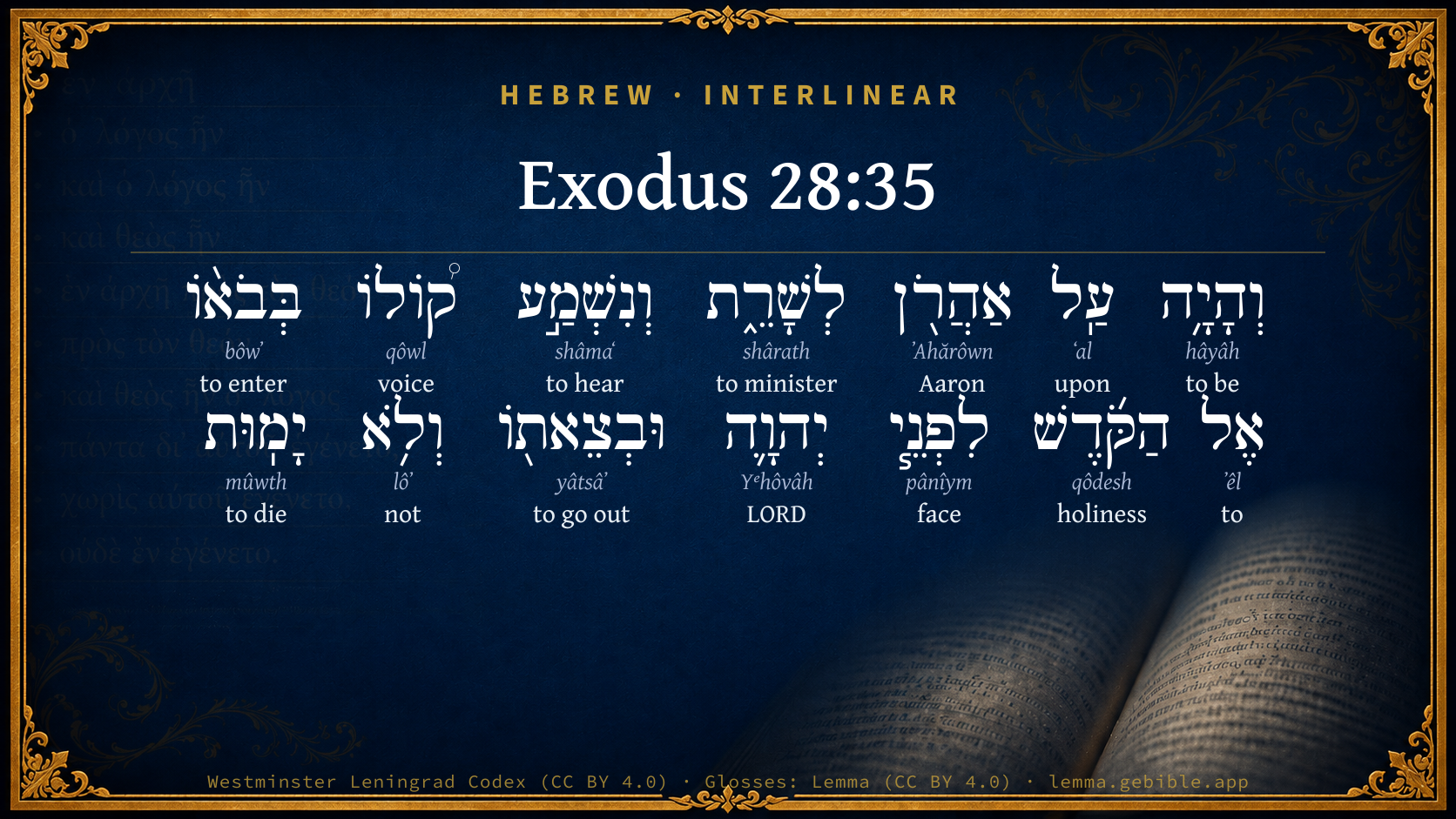
Hebrew (Westminster Leningrad Codex) Exodus 28:35 appears in the Hebrew Old Testament. The text above is from the Westminster Leningrad Codex. Each word links to its Strong’s number, a concise gloss, and parsing drawn from the Open Scriptures Hebrew Bible morphology. Click any word for its full Brown-Driver-Briggs (BDB) entry.
Download image
Cite this verse

Exodus 28:35 (World English Bible). Public Domain. Lemma interlinear Bible study tool, https://lemma.gebible.app/v/exodus/28/35.

Show BibTeX & RIS
BibTeX
RIS
English Translation
It shall be on Aaron to minister: and the sound of it shall be heard when he goes in to the holy place before Yahweh, and when he comes out, that he not die.
World English Bible · Public Domain
Download a study sheet

One document with this verse’s original text, its word-by-word gloss line, the meaning frame, cross-references with their text, attributed commentary, and full source and license credits — printable, and it pastes into notes with its structure intact.

This verse Autodidact and up

Study sheet (.html) Plain text (.txt)

A passage Seminary Student

Up to 50 verses in one chapter. A passage sheet keeps up to 6 commentary sources and 12 cross-references per verse, in the order this page ranks them, and says so on the sheet whenever that leaves anything out. Ask for a single verse and you get the Autodidact verse sheet above.

Everything on this page stays free to read, with no account — the sheet is a download of what is already on screen, not access to it.

Want to remove ads? Support Godless Engineer
Compare translations 3

The same verse in 3 English versions, stacked beneath the original-language interlinear above. Click any original word for its lexicon entry.

Each is an independent rendering of the whole verse — the interlinear is not word-aligned to these translations.

Highlighted words mark where these versions differ — a whole-verse word diff, not a word-by-word alignment.

  • World English Bible Public Domain
    It shall be on Aaron to minister: and the sound of it shall be heard when he goes in to the holy place before Yahweh, and when he comes out, that he not die.
  • King James Version Public Domain
    And it shall be upon Aaron to minister: and his sound shall be heard when he goeth in unto the holy place before the LORD, and when he cometh out, that he die not.
  • unfoldingWord Literal Text CC BY-SA 4.0
    And it shall be on Aaron while serving, and its sound shall be heard at his going into the Holy Place before the face of Yahweh and at his leaving. And he shall not die.

unfoldingWord Literal Text — © unfoldingWord, licensed CC BY-SA 4.0. Word-aligned USFM3 via Door43 (git.door43.org/unfoldingWord/en_ult).

Versions to compare (up to 4)

3 of 4 selected

Show all 18 translations

Every available English version of this verse, each an independent rendering of the whole verse.

  • World English Bible Public Domain
    It shall be on Aaron to minister: and the sound of it shall be heard when he goes in to the holy place before Yahweh, and when he comes out, that he not die.
  • Berean Standard Bible Public Domain
    Aaron must wear the robe whenever he ministers, and its sound will be heard when he enters or exits the sanctuary before the LORD, so that he will not die.
  • Majority Standard Bible Public Domain
    Aaron must wear the robe whenever he ministers, and its sound will be heard when he enters or exits the sanctuary before the LORD, so that he will not die.
  • King James Version Public Domain
    And it shall be upon Aaron to minister: and his sound shall be heard when he goeth in unto the holy place before the LORD, and when he cometh out, that he die not.
  • American Standard Version (1901) Public Domain
    And it shall be upon Aaron to minister: and the sound thereof shall be heard when he goeth in unto the holy place before Jehovah, and when he cometh out, that he die not.
  • Revised Version (1885) Public Domain
    And it shall be upon Aaron to minister: and the sound thereof shall be heard when he goeth in unto the holy place before the LORD, and when he cometh out, that he die not.
  • Geneva Bible (1599) Public Domain
    So it shalbe vpon Aaron, when he ministreth, and his sound shalbe heard, when he goeth into the holy place before the Lord, and when he commeth out, and he shall not dye.
  • Douay-Rheims (1899) Public Domain
    And Aaron shall be vested with it in the office of his ministry, that the sound may be heard, when he goeth in and cometh out of the sanctuary, in the sight of the Lord, and that he may not die.
  • Young's Literal Translation Public Domain
    `And it hath been on Aaron to minister in, and its sound hath been heard in his coming in unto the sanctuary before Jehovah, and in his going out, and he doth not die.
  • Literal Standard Version CC BY-SA 4.0
    And it has been on Aaron to minister in, and its sound has been heard in his coming into the holy place before YHWH, and in his going out, and he does not die.
  • Unlocked Literal Bible CC BY-SA 4.0
    The robe is to be on Aaron when he serves, so that its sound can be heard when he goes into the holy place before Yahweh and when he leaves. This is so that he does not die.
  • unfoldingWord Literal Text CC BY-SA 4.0
    And it shall be on Aaron while serving, and its sound shall be heard at his going into the Holy Place before the face of Yahweh and at his leaving. And he shall not die.
  • Darby Bible Public Domain
    And it shall be on Aaron for service; that his sound may be heard when he goeth into the sanctuary before Jehovah, and when he cometh out, that he may not die.
  • World Messianic Bible Public Domain
    It shall be on Aaron to minister: and its sound shall be heard when he goes in to the holy place before the LORD, and when he comes out, that he not die.
  • Webster's Bible Public Domain
    And it shall be upon Aaron, to minister: and his sound shall be heard when he goeth in to the holy place before the LORD, and when he cometh out; that he may not die.
  • Free Bible Version CC BY-SA 4.0
    Aaron is to wear the robe whenever he serves, and the sound it makes will be heard when he enters or leaves the sanctuary as he goes into the Lord's presence, so that he won't die.
  • Bible in Basic English Public Domain
    Aaron is to put it on for his holy work; and the sound of it will be clear, when he goes into the holy place before the Lord, and when he comes out, keeping him safe from death.
  • JPS Tanakh (1917) Public Domain
    And it shall be upon Aaron to minister; and the sound thereof shall be heard when he goeth in unto the holy place before the LORD, and when he cometh out, that he die not.

Literal Standard Version (2020), Covenant Press — licensed CC BY-SA 4.0. Text via the HelloAO Bible API (eBible.org). Unlocked Literal Bible (unfoldingWord) — licensed CC BY-SA 4.0. Text via the HelloAO Bible API (eBible.org). unfoldingWord Literal Text — © unfoldingWord, licensed CC BY-SA 4.0. Word-aligned USFM3 via Door43 (git.door43.org/unfoldingWord/en_ult). Free Bible Version, Dr. Jonathan Gallagher — licensed CC BY-SA 4.0. Text via the HelloAO Bible API (eBible.org).

Word by word

More ways to search: Search by grammar → Find every occurrence → Compare this word →

Practice this passage: Drill this verse → Learn its vocabulary →

לְשָׁרֵ֑ת
shârath
H8334
“to minister”
Preposition + Verb, Piel, Infinitive Construct
Part of Speech
Preposition + Verb
Stem
Piel
Form
Infinitive Construct
Full BDB Definition

Origin: a primitive root

TWOT: 2472

(Piel) to minister, serve, minister to
  1. וְהָיָ֥ה hâyâh H1961 “and · to be” Conjunction + Verb, Qal, Sequential Perfect, 3rd Person, Masculine, Singular
  2. עַֽל ʻal H5921 “upon” Preposition
  3. אַהֲרֹ֖ן ʼAhărôwn H175 “Aaron” Noun, Proper
  4. וְנִשְׁמַ֣ע shâmaʻ H8085 “and · to hear” Conjunction + Verb, Niphal, Sequential Perfect, 3rd Person, Masculine, Singular
  5. ק֠וֹלוֹ qôwl H6963 “voice · his” Noun, Common, Masculine, Singular, Construct + Suffix, Personal, 3rd Person, Masculine, Singular
  6. בְּבֹא֨וֹ bôwʼ H935 “in/at · to enter · him” Preposition + Verb, Qal, Infinitive Construct + Suffix, Personal, 3rd Person, Masculine, Singular
  7. אֶל ʼêl H413 “to” Preposition
  8. הַקֹּ֜דֶשׁ qôdesh H6944 “the · holiness” Particle, Definite Article + Noun, Common, Masculine, Singular, Absolute
  9. לִפְנֵ֧י pânîym H6440 “to/for · face(s) of” Preposition + Noun, Common, Both, Plural, Construct
  10. יְהוָ֛ה Yᵉhôvâh H3068 “LORD” Noun, Proper
  11. וּבְצֵאת֖וֹ yâtsâʼ H3318 “and · in/at · to go out · him” Conjunction + Preposition + Verb, Qal, Infinitive Construct + Suffix, Personal, 3rd Person, Masculine, Singular
  12. וְלֹ֥א lôʼ H3808 “and · not” Conjunction + Particle, Negative
  13. יָמֽוּת mûwth H4191 “to die” Verb, Qal, Imperfect, 3rd Person, Masculine, Singular

About this verse

These counts appear in no published source. They are computed here, from the morphology-tagged text and Lemma’s own curated glosses. What Lemma adds →

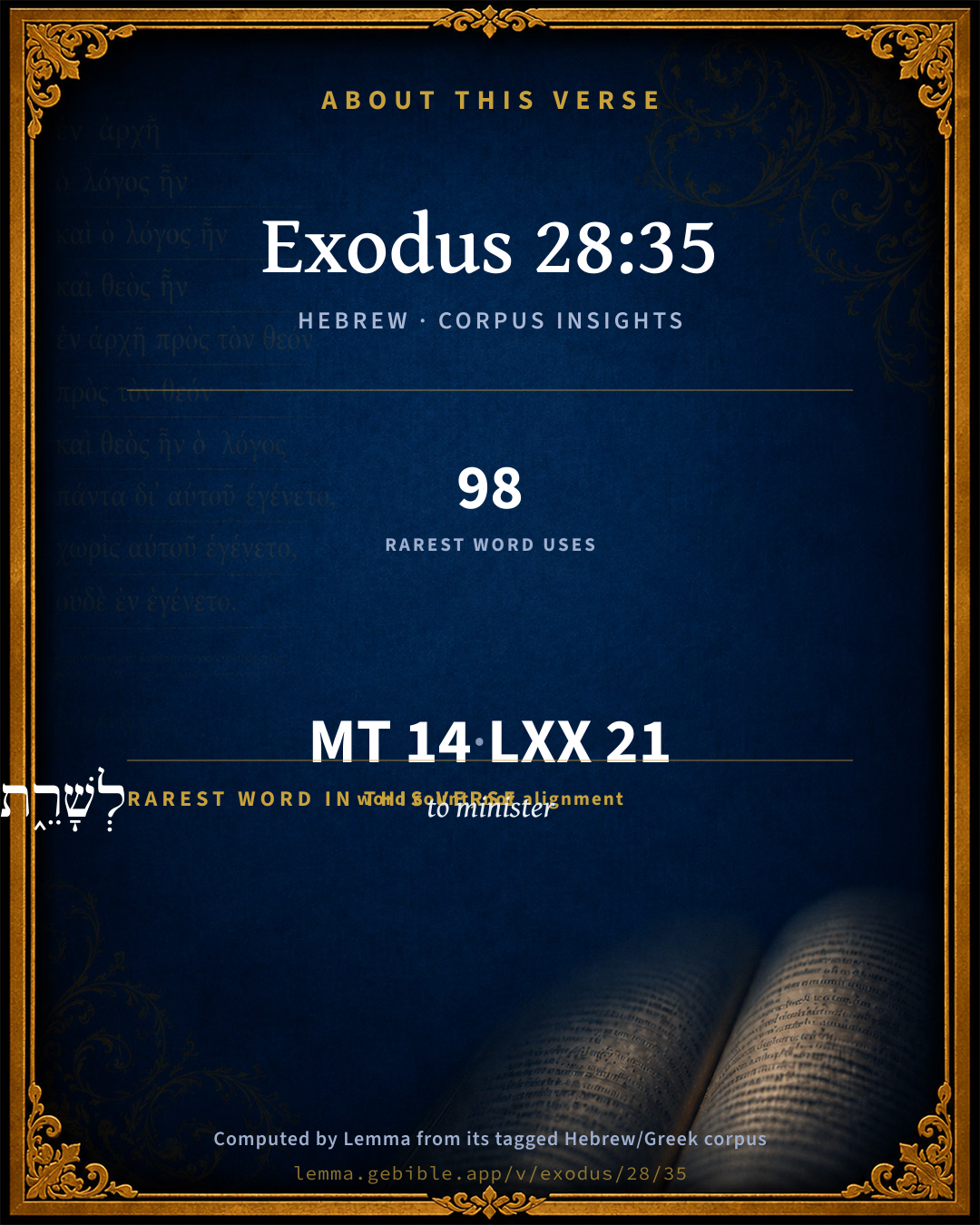
14
words
14
distinct lemmas
Pentateuch
section

Grammatical profile

  • 6 verbs
  • 5 nouns
  • 2 prepositions
  • 1 particle

Verb forms

  • וְהָיָ֥ה Qal · Sequential Perfect
  • לְשָׁרֵ֑ת Piel · Infinitive Construct
  • וְנִשְׁמַ֣ע Niphal · Sequential Perfect
  • בְּבֹא֨וֹ Qal · Infinitive Construct
  • וּבְצֵאת֖וֹ Qal · Infinitive Construct
  • יָמֽוּת Qal · Imperfect

Hebrew & Septuagint length

In English translation the verse runs 34 words from the Hebrew and 31 from the Septuagint (LXX English) — closely comparable.

A rough comparison of the two English renderings, which tokenize alike — not a word-level alignment.

Word counts can differ between the Hebrew and the Greek without any difference in meaning — e.g. the Hebrew direct-object marker אֵת has no separate Greek word, and Greek often adds the article ὁ.

In the original languages it is 14 Hebrew tokens and 21 Greek tokens — but the two are counted differently (Hebrew bundles its prefixes and suffixes into one token; the Greek is in lemma form), so that isn’t a like-for-like length.

Cross-references

2

Topical passages linked to Exodus 28:35 in the Treasury of Scripture Knowledge — connected by theme and wording, ordered by reader-vote popularity; previews shown in the World English Bible.

  • Hebrews 9:12 nor yet through the blood of goats and calves, but through his own blood, entered in once for all into the Holy Place, having obtained eternal redemption.
  • Leviticus 16:2 and Yahweh said to Moses, "Tell Aaron your brother, not to come at all times into the Most Holy Place within the veil, before the mercy seat which is on the ark; lest he die: for I will appear in the cloud on the mercy seat.

Cross-references courtesy of OpenBible.info (CC BY 4.0).

Hebrew and Greek witnesses Masoretic Hebrew ↔ Greek Septuagint

The same verse in the two great witnesses to the Old Testament, shown verse-for-verse.

These are two independent witnesses, not word-aligned to each other, and the Septuagint is shown in lemma (dictionary) form.

Hebrew Exodus 28:35 Masoretic · Westminster Leningrad Codex

וְהָיָ֥ה עַֽל אַהֲרֹ֖ן לְשָׁרֵ֑ת וְנִשְׁמַ֣ע ק֠וֹלוֹ בְּבֹא֨וֹ אֶל הַקֹּ֜דֶשׁ לִפְנֵ֧י יְהוָ֛ה וּבְצֵאת֖וֹ וְלֹ֥א יָמֽוּת

It shall be on Aaron to minister: and the sound of it shall be heard when he goes in to the holy place before Yahweh, and when he comes out, that he not die.

World English Bible · Public Domain

Greek LXX Exodus 28:35 Septuagint · lemma form

καί εἰμί ααρων ἐν ὁ λειτουργέω ἀκουστός ὁ φωνή αὐτός εἰςεἶμι εἰς ὁ ἅγιος ἐναντίον κύριος καί ἐκεἶμι ἵνα μή ἀποθνήσκω

And the fringes of the garments shall be of fine linen; and you shall make a tire of fine linen, and you shall make a girdle, the work of the embroiderer.

LXX2012 (modern English Septuagint) · Public Domain

Hebrew: Westminster Leningrad Codex (CC BY 4.0). Greek: Septuagint (public domain); English from LXX2012 (modern English Septuagint) (Public Domain). How the Septuagint differs from the Hebrew →

Targum (Aramaic paraphrase)

2

The Targum is the ancient Jewish Aramaic paraphrase of the Hebrew Scriptures — an interpretive translation, not the Hebrew text itself. Onkelos (literal) and Pseudo-Jonathan (expansive) render the Torah, and Jonathan the Prophets. Coverage is partial: where no permissively-licensed English translation exists for a verse, only the Aramaic is shown. This is verse-level text, not a word-by-word alignment to the Hebrew.

  1. Targum Onkelos Torah (Genesis–Deuteronomy)
    וִיהֵי עַל אַהֲרֹן לְשַׁמָשָׁא וְיִשְׁתְּמַע קָלֵהּ בְּמֵעֲלֵהּ לְקוּדְשָׁא קֳדָם יְיָ וּבְמִפְקֵהּ וְלָא יְמוּת:

    (no public-domain English translation for this verse)

    Targum Onkelos — Aramaic: “Onkelos Genesis” (public domain); “Onkelos Exodus” (public domain); “Onkelos Leviticus” (public domain); “Onkelos Numbers” (public domain); “Onkelos Deuteronomy” (public domain). English: “Sefaria Community Translation” (CC0 1.0 (public-domain dedication)); “J.W. Etheridge. The Targums of Onkelos and Jonathan Ben Uzziel on the Pentateuch. London: Longmans, Green, 1862” (public domain). Text via Sefaria.

  2. Targum Pseudo-Jonathan Torah (Genesis–Deuteronomy)
    וִיהֵי עָטִיף עַל אַהֲרן לְשַׁמָשָׁא וְיִשְׁתְּמַע קָלֵיהּ בִּזְמַן מֵיעֲלֵיהּ לְקוּדְשָׁא קֳדָם יְיָ וּבִזְמַן מִיפְקֵיהּ וְלָא יְמוּת בְּאֵשָׁא מְצַלְהֲבָא

    And it shall be a vestment upon Aharon to minister, and its voice shall be heard at the time that he hath entered the holy place before the Lord, and at the time that he cometh out, that he die not by the flaming fire.

    Targum Pseudo-Jonathan — Aramaic: “Targum Jonathan on Genesis” (public domain); “Targum Jonathan on Exodus” (public domain); “Targum Jonathan on Leviticus” (public domain); “Targum Jonathan on Numbers” (public domain); “Targum Jonathan on Deuteronomy” (public domain). English: “The Targum of Jonathan ben Uzziel, trans. J. W. Etheridge, London, 1862” (public domain). Text via Sefaria.

Commentary

Notes on Exodus 28:35 from classic Christian and Jewish commentators (each source and its license shown beneath its notes). The classic Christian expositions comment on the surrounding passage and are grouped to its opening verse, so a note may address several verses; the Jewish commentaries on the Tanakh (Rashi and others) are per-verse, so they appear only where the commentator wrote on this verse.

Lemma curates 59 commentaries, every one of them public domain or Creative Commons licensed, each selected and text-cleaned for this edition rather than reprinted as found. About our sources →

Trapp's Complete Commentary

John Trapp

Exo 28:35 And it shall be upon Aaron to minister: and his sound shall be heard when he goeth in unto the holy [place] before the LORD, and when he cometh out, that he die not.

Ver. 35. And his sound shall be heard.] Necesse erat ut Pontifex totus vocalis ingrederetur sanctuarium, ne forte non audito sonitu, morte lueret silentium. A "dumb dog" is a child of death. {Isa 56:10} Ministers must be both able and "apt to teach" upon all occasions.

John Trapp, A Commentary or Exposition upon All the Books of the Old and New Testament (1647–1656) — public domain. Text from a community e-Sword module.

Adam Clarke's Commentary

Verse 35. His sound shall be heard] The bells were doubtless intended to keep up the people's attention to the very solemn and important office which the priest was then performing, that they might all have their hearts engaged in the work; and at the same time to keep Aaron himself in remembrance that he ministered before Jehovah, and should not come into his presence without due reverence.

That he die not.] This seems an allusion to certain ceremonies which still prevail in the eastern countries. Jehovah appeared among his people in the tabernacle as an emperor in his tent among his troops. At the doors of the tents or palaces of grandees was generally placed some sonorous body, either of metal or wood, which was struck to advertise those within that a person prayed for admittance to the presence of the king, &c. As the tabernacle had no door, but a veil, and consequently nothing to prevent any person from going in, Aaron was commanded to put the bells on his robe, that his sound might be heard when he went into the holy place before the Lord.

Adam Clarke's Commentary on the Bible (1810–1826) — public domain. Text from a community e-Sword/MySword module.

Ellicott's Commentary for English Readers

(35) And his sound shall be heard.—Rather, that its sound may he heard. The great object of the bells was to make known to the people, by a sensible manifestation, every movement of their representative, every act that he performed on their behalf. The bells enabled them to follow in their thoughts the entire service that he was engaged in, to join their prayers and praises with his, and offer to God a common worship. So important was this union of priest and people in the worship of God regarded, that death was denounced on the high priest who should minister in the sanctuary without this essential garment.

A Bible Commentary for English Readers, edited by Charles John Ellicott (1878–1897) — public domain. Text from a community e-Sword module.

The Cambridge Bible for Schools and Colleges

gen. ed. J. J. S. Perowne

35. to minister] i.e. in order that he may minister.

that he die not] for not putting it on, and so infringing one of the laws of the sanctuary: cf. v. 43, Exo_30:21, Lev_8:35; Lev_10:7.

Originally, it has been conjectured, the object of the bells was to protect the officiating priest from the spirits which were supposed to haunt the thresholds of sanctuaries. But here their object is that they might be heard when the high-priest entered, and left, the sanctuary,—in order (Di.) that the worshippers outside might know how long to follow him with their devotions (cf. Luk_1:10; Luk_1:21), or (Riehm, HWB. 878,2 646) to remind God (cf. Sir_45:9; ‘memorial,’ as above, vv. 12, 29) that he appeared before Him as the official representative of the people.

36–38 (cf. Exo_39:30-31). The gold plate on the front of the high priest’s turban. The high priest’s turban was of fine white linen (v. 39); and there was to be a blue band tied round it, with a plate of gold attached to it in front, bearing the inscription, Holy to Yahweh.

The Cambridge Bible for Schools and Colleges (gen. ed. J. J. S. Perowne; Cambridge University Press, 1878–1918) — public domain. Text from a community e-Sword module.

John Gill's Exposition

And thou shalt make a plate of pure gold,.... It was, as Jarchi says, two fingers broad, and reached from ear to ear, and so Maimonides (f); it is sometimes called the holy crown, and the plate of the holy crown, Exo 29:6, this was a priestly crown, for priests were very honourable and dignified persons, especially the high priest among the Jews; and even among the Gentiles it was common for their kings to be priests: and though this crown may denote the kingly power of Christ, yet as residing in him who is a priest, for he is a priest on his throne, Zac 6:13, and so may signify the conjunction of the kingly and priestly offices in Christ, who has a crown of pure gold given him by his Father, and put upon him, and by his people, Psa 21:4 and being of pure gold, holy, and on the forehead, as this plate was, may signify the purity and holiness of Christ's kingdom and office, the glory, visibility, and perpetuity of it:

and grave upon it, like the engravings of a signet, HOLINESS TO THE LORD; which words were written either in two lines, or in one. If in two, Maimonides (g) says, the word "holiness" was above, and to "the Lord" below: but it might be written in one line, and that seems most likely: he also says the letters were protuberant, or stood out; but then they would not be graved like the engravings of a signet, in which the letters or figures are engraved within, but like the impressions of a signet made on wax, or other things: in this the high priest was a type of Christ, who is holy in himself, in his person, in both his natures, divine and human, in his offices of prophet, priest, and King; and he is holiness itself, the most holy, essentially, infinitely, and perfectly so, as angels and men are not, and the source and spring of holiness to others: and he is holiness to the Lord for his people; he is so representatively; as their covenant head he has all grace in his hands for them, and they have it in him; this is sanctification in Christ, and is by virtue of union to him, and is complete and perfect, and the cause of holiness in his people; and he is so by imputation. The holiness of his human nature was not a mere qualification for his office, or only exemplary to us, but is with his obedience and sufferings imputed to us for justification. Moreover, Christ has by his blood sanctified his people, or made atonement for them, and procured the cleansing of them from their sins, or the expiation of them; and he is also the efficient cause of their internal holiness by his Spirit, without which there is no seeing God, Co1 6:11.

(f) Cele Hamikdash, c. 9. sect. 1. Vid. T. Bab. Sabbat, fol. 63. 2. & Succah, fol. 5. 1. (g) Cele Hamikdash, c. 9. sect. 1. Vid. T. Bab, Sabbat, fol. 63. 2. & Succah, fol. 5. 1.

John Gill's Exposition of the Whole Bible (1746–1763) — public domain (CC PDM 1.0). Text via the HelloAO Bible API.

Haydock's Catholic Bible Commentary

Die, for coming in disrespectfully, without giving notice. See Judith xiv. 8.

George Leo Haydock (1774–1849), Haydock's Catholic Family Bible and Commentary, 1859 edition — public domain. Excludes Psalms (Douay-Rheims chapter numbering differs from Protestant) and Deuterocanonical books (Catholic canon only).

Matthew Poole's English Annotations

For his disobedience or carelessness. For though the matter might seem small in itself, yet it was an error in God’s worship, wherein God is more severe than in other things; and it was an error of the high priest, who had more knowledge of God’s mind herein, and was obliged to more care and diligence, not only for himself, but for the influences of his bad example upon the people.

Matthew Poole's English Annotations on the Holy Bible (1683–1685) — public domain. Text from a community e-Sword/MySword module.

Rashi

Rabbi Shlomo Yitzchaki (Rashi)

ולא ימות THAT HE DIE NOT — From what is included in this negative statement you may infer the positive: if he has these garments on him he will not incur death; consequently if he enters the Sanctuary lacking one of these garments he incurs death at the hands of God (cf. Sanhedrin 83).

Rashi on the Tanakh — English translations: “The Judaica Press complete Tanach with Rashi, translated by A. J. Rosenberg” (CC BY 4.0); “Pentateuch with Rashi's commentary by M. Rosenbaum and A.M. Silbermann, 1929-1934” (public domain); “The Metsudah Tanach series, Lakewood, N.J” (CC BY 4.0); and “The Book of Joshua, Metsudah Publications, 1997” (CC BY 4.0). Text via Sefaria.

Ramban (Nachmanides)

Rabbi Moshe ben Nachman (Ramban / Nachmanides)

THAT HE DIE NOT. “From this negative statement you infer the positive: if these garments are upon him, he will not incur death, but if he enters [the Sanctuary] lacking one of these garments he is liable to death [by the hand of Heaven].” This is Rashi’s language. But it does not appear to me to be correct, for if so He should have written this verse after having mentioned all eight garments [of the High Priest], and why did He mention it after three garments — the breastplate, the ephod, and the robe — before mentioning the frontplate, the upper garment, the mitre, the belt and the breeches! Furthermore, [the verse reads here,] and when he cometh out [of the Sanctuary], that he die not. But the act of going out [from the Sanctuary] is no function for which he should incur death if lacking the [proper number of] garments!Similarly Rashi commented on the verse: “And they shall be upon Aaron and upon his sons — they means all these garments; upon Aaron and upon his sons, those which are proper to him, and those specified for them. [That they bear not iniquity,] and die — thus you learn that he who ministers [the Divine Service] lacking any of these garments incurs death [by the hand of Heaven].” And so indeed it appears from the simple meaning of Scripture. But according to the conclusion reached on these subjects in the discussions in the Gemara, Note 204. The particular texts here referred to are mentioned further on. it would appear that this does not conform to the opinion of our Rabbis, for to them this commandment applies to all alike, to Aaron and his sons, but it refers only to the breeches, and the punishment [of death by the hand of Heaven for lacking them] likewise applies [only] to them [i.e. the breeches]. For He had commanded that they be made, [as it is said,] And thou shalt make them linen breeches, and then He commanded concerning their being worn [by the priests, saying,] And they shall be upon Aaron, and upon his sons. As to the rest of the garments, He had already given the command above concerning the making of them and wearing them, [as it is said,] And thou shalt put them upon Aaron thy brother, and upon his sons with him. If so, this command [And they shall be upon Aaron, and upon his sons] refers wholly to the breeches, and the punishment likewise refers [only] to them.We learn this from what the Rabbis have said in Tractates Sanhedrin and The Slaughtering of Sacrifices: “Whence do we know that a priest who ministered [the Divine Service] lacking the [proper number of] garments is liable to death [by the hand of Heaven]? Said Rabbi Abohu in the name of Rabbi Yochanan, and they arrived in the chain of tradition up to ‘in the name of Rabbi Eleazar the son of Rabbi Shimon:' And thou shalt gird them with belts, Aaron and his sons, and bind head-tires on them; and they shall have the priesthood by a perpetual statute, the interpretation of which is: ‘So long as they wear their [appointed] garments, they are invested with their priesthood; when they do not wear their garments, they are not invested with their priesthood, and they become laymen, and it has been said that a layman who ministers [in the Sanctuary] incurs the penalty of death [by the hand of Heaven].” Now if this verse [that they bear not iniquity, and die] were held by the Rabbis to apply to all the garments [of the priests], as the Rabbi [Rashi] said, they could have found in it an expressly stated punishment for one who ministers lacking all the garments, [and why did they need to base it upon an inference from another verse]! Rather, this verse refers only to the breeches, and the other verse to the rest of the garments, where the breeches are not mentioned at all. Proof to what the Rabbis have said [that this verse, And they shall be upon Aaron, and upon his sons… that they bear not iniquity, and die, refers only to the breeches], is that further on when the order of putting on the garments is mentioned, Verses 5-9. the breeches are not referred to at all, for having declared here the punishment if they are lacking [when ministering in the Sanctuary], there was no more need to mention them again further on, as it is understood already that he would wear them.And that which He said above [i.e., in Verse 35 before us], and the sound thereof shall be heard when he goeth in unto the holy place before the Eternal, and when he goeth out, that he die not, is [not as Rashi has it that from here we learn that if he enters the Sanctuary lacking one of these garments he incurs death at the hand of Heaven, but is] in my opinion an explanation for the commandment of the bells [upon the robe], since there was no need to wear them, nor are they customary amongst dignitaries. Therefore He said that He commanded that they be made in order that the sound thereof be heard in the Sanctuary, that the priest enter before his Master as if with permission. For he who comes into the king’s palace suddenly, incurs the penalty of death according to the court ceremonial, just as we find in the case of Ahasuerus.. It thus alludes to what the Rabbis have said in Yerushalmi Tractate Yoma:, Note 204. “And there shall be no man in the Tent of Meeting when he goeth in to make atonement in the holy place — even those [heavenly beings] of whom it is written, As for the likeness of their faces they had the face of a man, they too are not to be then in the Tent of Meeting.” Therefore He commanded that [the ministering High Priest] make a sound be heard, as if crying out, ‘Cause everyone to go out from before me,’ so that he can come to minister before the King alone. Similarly, when going out from the Sanctuary his sound is heard in order to leave with permission, and that the matter be known so that the King’s ministers can go out before Him. In the Chapters of the Palaces this subject is known. Thus the reason [for the bells upon the robe of the High Priest] is that he should not be encountered by the angels of G-d. He gave this warning concerning the High Priest on account of his high position. This is Scripture’s intent in saying, when he goeth in unto the holy place before the Eternal, for it is the High Priest who passes before Him so that He cause His Divine Glory to rest upon his service, for he is the messenger of the Eternal of hosts, even though the common priests also enter the Sanctuary to burn the incense and to kindle [the lamps]. Now I have seen in the Midrash Shemoth Rabbah with reference to the stones upon the breastplate: “For what reason were the stones? It was in order that the Holy One, blessed be He, observe them in the garments of the priest when he enters on the Day of Atonement, and He be gracious to the tribes [whose names were inscribed upon the stones in the breastplate]. Rabbi Yehoshua in the name of Rabbi Levi says: This may be compared to a king’s son, whose tutor came before the king to speak in his defense, but was afraid of those standing there lest they strike him. What did the king do? He dressed him in his purple cloak in order that they see it and be afraid of him. In the same way Aaron entered at all times the Holy of Holies, and were it not for the many merits that entered with him and helped him, he could not have entered. Why? Because of the ministering angels who were there. What did the Holy One, blessed be He, do? He gave him a likeness of His sacred garment, as it is said, And He put on righteousness as a coat of mail.” Thus far is the language of this Agadah. Now even though the High Priest did not enter into the innermost part of the Sanctuary [i.e., the Holy of Holies] with these garments, yet on the Day of Atonement he needed these [garments] even in the Tent of Meeting, for it is written, And there shall be no man in the Tent of Meeting.

Ramban (Nachmanides) on the Tanakh — English translation: “Commentary on the Torah by Ramban (Nachmanides). Translated and annotated by Charles B. Chavel. New York, Shilo Pub. House, 1971-1976” (CC BY 4.0). Text via Sefaria.

Lesson kit

Teaching starters — assembled from the data on this page, not authored interpretation. Every prompt links to the verse data it draws on. Edit before teaching.

Exodus, in the Pentateuch, opens this verse with 14 words (14 distinct Hebrew lemmas). Its most distinctive word is shârath (“to minister”). A historical commentator’s framing appears above. Read the whole chapter for the surrounding context.

Discussion questions

  1. What does “to minister” (shârath) contribute to the verse as a whole?
  2. Hebrews 9:12 shares this passage’s theme. How do the two illuminate each other?
  3. These translations render this verse differently. What is at stake in choosing one wording over another?
  4. The verb «וְהָיָ֥ה» is Qal Sequential Perfect. How does its form color the action?
  5. Reading how Trapp's Complete Commentary and Adam Clarke's Commentary read this verse, where do the two commentators agree and where do they part?

Things to notice

Reading settings

Reading text

Shown beneath each verse's original-language words.

Old Testament
Old Testament edition

Read the OT as the Masoretic Hebrew (MT) or the Greek Septuagint (LXX).

English shown for the Greek Septuagint (in the Hebrew ↔ Greek comparison).

Comparing translations? Open the Compare panel on any verse page to stack up to four side by side.