
Numbers 19:18

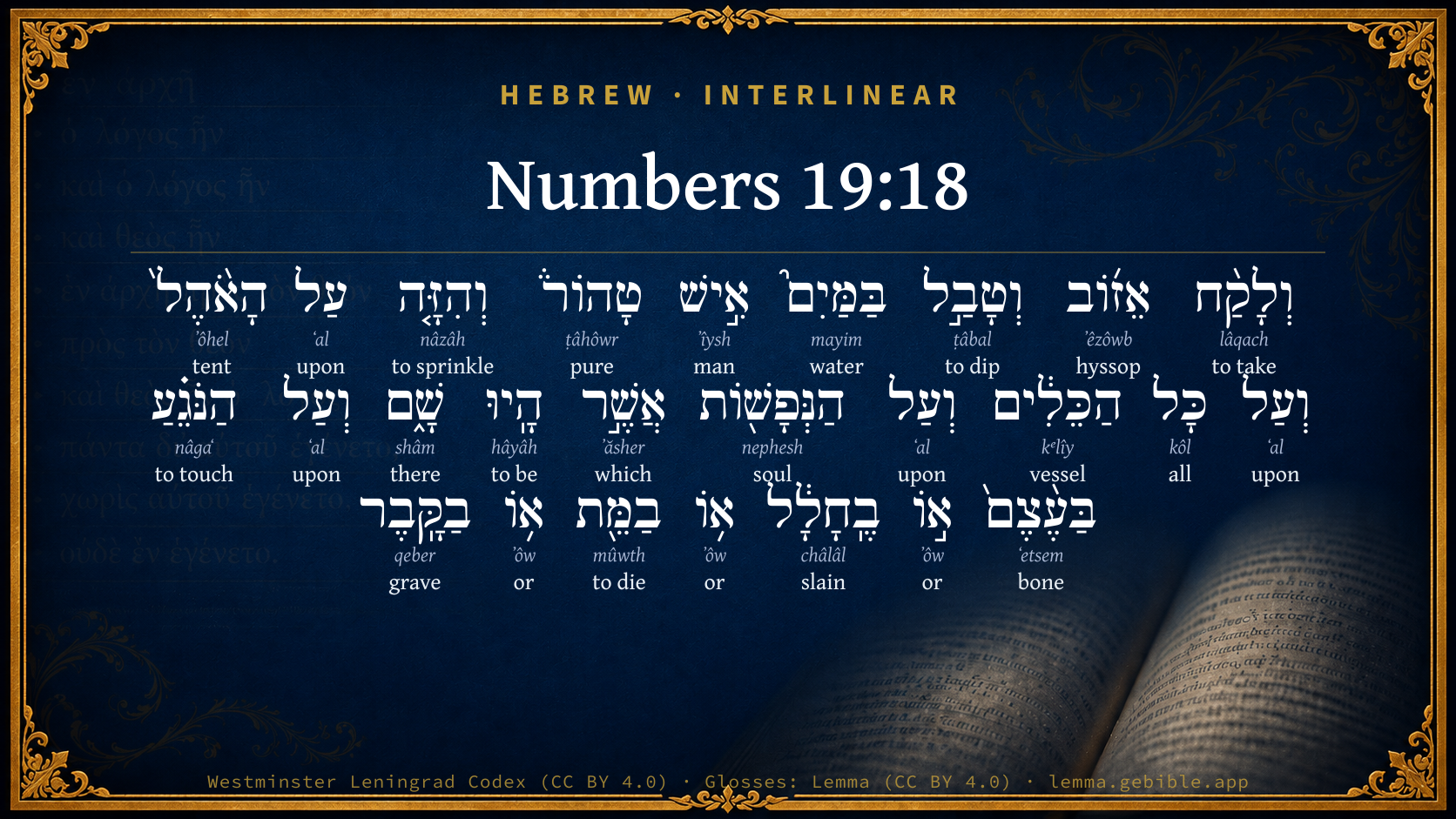
Hebrew (Westminster Leningrad Codex) Numbers 19:18 appears in the Hebrew Old Testament. The text above is from the Westminster Leningrad Codex. Each word links to its Strong’s number, a concise gloss, and parsing drawn from the Open Scriptures Hebrew Bible morphology. Click any word for its full Brown-Driver-Briggs (BDB) entry.
Download image
Cite this verse

Numbers 19:18 (World English Bible). Public Domain. Lemma interlinear Bible study tool, https://lemma.gebible.app/v/numbers/19/18.

Show BibTeX & RIS
BibTeX
RIS
English Translation
and a clean person shall take hyssop, and dip it in the water, and sprinkle it on the tent, and on all the vessels, and on the persons who were there, and on him who touched the bone, or the slain, or the dead, or the grave:
World English Bible · Public Domain
Download a study sheet

One document with this verse’s original text, its word-by-word gloss line, the meaning frame, cross-references with their text, attributed commentary, and full source and license credits — printable, and it pastes into notes with its structure intact.

This verse Autodidact and up

Study sheet (.html) Plain text (.txt)

A passage Seminary Student

Up to 50 verses in one chapter. A passage sheet keeps up to 6 commentary sources and 12 cross-references per verse, in the order this page ranks them, and says so on the sheet whenever that leaves anything out. Ask for a single verse and you get the Autodidact verse sheet above.

Everything on this page stays free to read, with no account — the sheet is a download of what is already on screen, not access to it.

Want to remove ads? Support Godless Engineer
Compare translations 3

The same verse in 3 English versions, stacked beneath the original-language interlinear above. Click any original word for its lexicon entry.

Each is an independent rendering of the whole verse — the interlinear is not word-aligned to these translations.

Highlighted words mark where these versions differ — a whole-verse word diff, not a word-by-word alignment.

  • World English Bible Public Domain
    and a clean person shall take hyssop, and dip it in the water, and sprinkle it on the tent, and on all the vessels, and on the persons who were there, and on him who touched the bone, or the slain, or the dead, or the grave:
  • King James Version Public Domain
    And a clean person shall take hyssop, and dip it in the water, and sprinkle it upon the tent, and upon all the vessels, and upon the persons that were there, and upon him that touched a bone, or one slain, or one dead, or a grave:
  • unfoldingWord Literal Text CC BY-SA 4.0
    And a clean man shall take hyssop and dip in the water, and he shall sprinkle on the tent and on all the vessels and on the persons who were there, and on the one touching the bone or the slain one or the dead or the grave.

unfoldingWord Literal Text — © unfoldingWord, licensed CC BY-SA 4.0. Word-aligned USFM3 via Door43 (git.door43.org/unfoldingWord/en_ult).

Versions to compare (up to 4)

3 of 4 selected

Show all 18 translations

Every available English version of this verse, each an independent rendering of the whole verse.

  • World English Bible Public Domain
    and a clean person shall take hyssop, and dip it in the water, and sprinkle it on the tent, and on all the vessels, and on the persons who were there, and on him who touched the bone, or the slain, or the dead, or the grave:
  • Berean Standard Bible Public Domain
    Then a man who is ceremonially clean is to take some hyssop, dip it in the water, and sprinkle the tent, all the furnishings, and the people who were there. He is also to sprinkle the one who touched a bone, a grave, or a person who has died or been slain.
  • Majority Standard Bible Public Domain
    Then a man who is ceremonially clean is to take some hyssop, dip it in the water, and sprinkle the tent, all the furnishings, and the people who were there. He is also to sprinkle the one who touched a bone, a grave, or a person who has died or been slain.
  • King James Version Public Domain
    And a clean person shall take hyssop, and dip it in the water, and sprinkle it upon the tent, and upon all the vessels, and upon the persons that were there, and upon him that touched a bone, or one slain, or one dead, or a grave:
  • American Standard Version (1901) Public Domain
    and a clean person shall take hyssop, and dip it in the water, and sprinkle it upon the tent, and upon all the vessels, and upon the persons that were there, and upon him that touched the bone, or the slain, or the dead, or the grave:
  • Revised Version (1885) Public Domain
    and a clean person shall take hyssop, and dip it in the water, and sprinkle it upon the tent, and upon all the vessels, and upon the persons that were there, and upon him that touched the bone, or the slain, or the dead, or the grave:
  • Geneva Bible (1599) Public Domain
    And a cleane person shall take hyssope and dip it in the water, and sprinkle it vpon the tent, and vpon all the vessels, and on the persons that were therein, and vpon him that touched ye bone, or the slayne, or the dead, or the graue.
  • Douay-Rheims (1899) Public Domain
    And a man that is clean shall dip hyssop in them, and shall sprinkle therewith all the tent, and all the furniture, and the men that are defiled with touching any such thing:
  • Young's Literal Translation Public Domain
    and a clean person hath taken hyssop, and hath dipped `it' in water, and hath sprinkled on the tent, and on all the vessels, and on the persons who have been there, and on him who is coming against a bone, or against one pierced, or against the dead, or against a grave.
  • Literal Standard Version CC BY-SA 4.0
    and a clean person has taken hyssop, and has dipped [it] in water, and has sprinkled [it] on the tent, and on all the vessels, and on the persons who have been there, and on him who is coming against a bone, or against one pierced, or against the dead, or against a grave.
  • Unlocked Literal Bible CC BY-SA 4.0
    Someone who is clean must then take hyssop, dip it in the water, and sprinkle it on the tent, on all the containers inside the tent, on the persons who were there, and on anyone who touched the bone, the one who was killed, the one who died, or the grave.
  • unfoldingWord Literal Text CC BY-SA 4.0
    And a clean man shall take hyssop and dip in the water, and he shall sprinkle on the tent and on all the vessels and on the persons who were there, and on the one touching the bone or the slain one or the dead or the grave.
  • Darby Bible Public Domain
    and a clean man shall take hyssop, and dip it in the water, and sprinkle it on the tent, and upon all the utensils, and upon the persons that were there, and upon him that hath touched the bone, or the one slain, or the dead person, or the grave;
  • World Messianic Bible Public Domain
    A clean person shall take hyssop, dip it in the water, and sprinkle it on the tent, on all the vessels, on the persons who were there, and on him who touched the bone, or the slain, or the dead, or the grave.
  • Webster's Bible Public Domain
    And a clean person shall take hyssop, and dip it in the water, and sprinkle it upon the tent, and upon all the vessels, and upon the persons that were there, and upon him that touched a bone, or one slain, or one dead, or a grave:
  • Free Bible Version CC BY-SA 4.0
    A man who is clean shall take some hyssop and dip it in the water. Then sprinkle the tent and everything inside it, and everybody who was there. He would also need to sprinkle you if you touched a bone, or a grave, or someone who has died or has been killed.
  • Bible in Basic English Public Domain
    And a clean person is to take hyssop and put it in the water, shaking it over the tent, and all the vessels, and the people who were there, and over him by whom the bone, or the body of one who has been put to death with the sword, or the body of one who has come to his end by a natural death, or the resting-place was touched.
  • JPS Tanakh (1917) Public Domain
    And a clean person shall take hyssop, and dip it in the water, and sprinkle it upon the tent, and upon all the vessels, and upon the persons that were there, and upon him that touched the bone, or the slain, or the dead, or the grave.

Literal Standard Version (2020), Covenant Press — licensed CC BY-SA 4.0. Text via the HelloAO Bible API (eBible.org). Unlocked Literal Bible (unfoldingWord) — licensed CC BY-SA 4.0. Text via the HelloAO Bible API (eBible.org). unfoldingWord Literal Text — © unfoldingWord, licensed CC BY-SA 4.0. Word-aligned USFM3 via Door43 (git.door43.org/unfoldingWord/en_ult). Free Bible Version, Dr. Jonathan Gallagher — licensed CC BY-SA 4.0. Text via the HelloAO Bible API (eBible.org).

Word by word

More ways to search: Search by grammar → Find every occurrence → Compare this word →

Practice this passage: Drill this verse → Learn its vocabulary →

אֵז֜וֹב
ʼêzôwb
H231
“hyssop”
Noun, Common, Masculine, Singular, Absolute
Part of Speech
Noun
Type
Common
Gender
Masculine
Number
Singular
State
Absolute
Full BDB Definition

Origin: probably of foreign derivation

TWOT: 55

hyssop, a plant used for medicinal and religious purposes
  1. וְלָקַ֨ח lâqach H3947 “and · to take” Conjunction + Verb, Qal, Sequential Perfect, 3rd Person, Masculine, Singular
  2. וְטָבַ֣ל ṭâbal H2881 “and · to dip” Conjunction + Verb, Qal, Sequential Perfect, 3rd Person, Masculine, Singular
  3. בַּמַּיִם֮ mayim H4325 “in/at the · water(s)” Preposition, Determined + Noun, Common, Masculine, Plural, Absolute
  4. אִ֣ישׁ ʼîysh H376 “man” Noun, Common, Masculine, Singular, Absolute
  5. טָהוֹר֒ ṭâhôwr H2889 “pure” Adjective, Adjective, Masculine, Singular, Absolute
  6. וְהִזָּ֤ה nâzâh H5137 “and · to sprinkle” Conjunction + Verb, Hiphil, Sequential Perfect, 3rd Person, Masculine, Singular
  7. עַל ʻal H5921 “upon” Preposition
  8. הָאֹ֨הֶל֙ ʼôhel H168 “the · tent” Particle, Definite Article + Noun, Common, Masculine, Singular, Absolute
  9. וְעַל ʻal H5921 “and · upon” Conjunction + Preposition
  10. כָּל kôl H3605 “all of” Noun, Common, Masculine, Singular, Construct
  11. הַכֵּלִ֔ים kᵉlîy H3627 “the · vessels” Particle, Definite Article + Noun, Common, Masculine, Plural, Absolute
  12. וְעַל ʻal H5921 “and · upon” Conjunction + Preposition
  13. הַנְּפָשׁ֖וֹת nephesh H5315 “the · souls” Particle, Definite Article + Noun, Common, Both, Plural, Absolute
  14. אֲשֶׁ֣ר ʼăsher H834 “which” Particle, Relative
  15. הָֽיוּ hâyâh H1961 “to be” Verb, Qal, Perfect, 3rd Person, Common, Plural
  16. שָׁ֑ם shâm H8033 “there” Adverb
  17. וְעַל ʻal H5921 “and · upon” Conjunction + Preposition
  18. הַנֹּגֵ֗עַ nâgaʻ H5060 “the · touching” Particle, Definite Article + Verb, Qal, Participle Active, Masculine, Singular, Absolute
  19. בַּעֶ֨צֶם֙ ʻetsem H6106 “in/at the · bone” Preposition, Determined + Noun, Common, Feminine, Singular, Absolute
  20. א֣וֹ ʼôw H176 “or” Conjunction
  21. בֶֽחָלָ֔ל châlâl H2491 “in/at the · slain” Preposition, Determined + Adjective, Adjective, Masculine, Singular, Absolute
  22. א֥וֹ ʼôw H176 “or” Conjunction
  23. בַמֵּ֖ת mûwth H4191 “in/at the · dying” Preposition, Determined + Verb, Qal, Participle Active, Masculine, Singular, Absolute
  24. א֥וֹ ʼôw H176 “or” Conjunction
  25. בַקָּֽבֶר qeber H6913 “in/at the · grave” Preposition, Determined + Noun, Common, Masculine, Singular, Absolute

About this verse

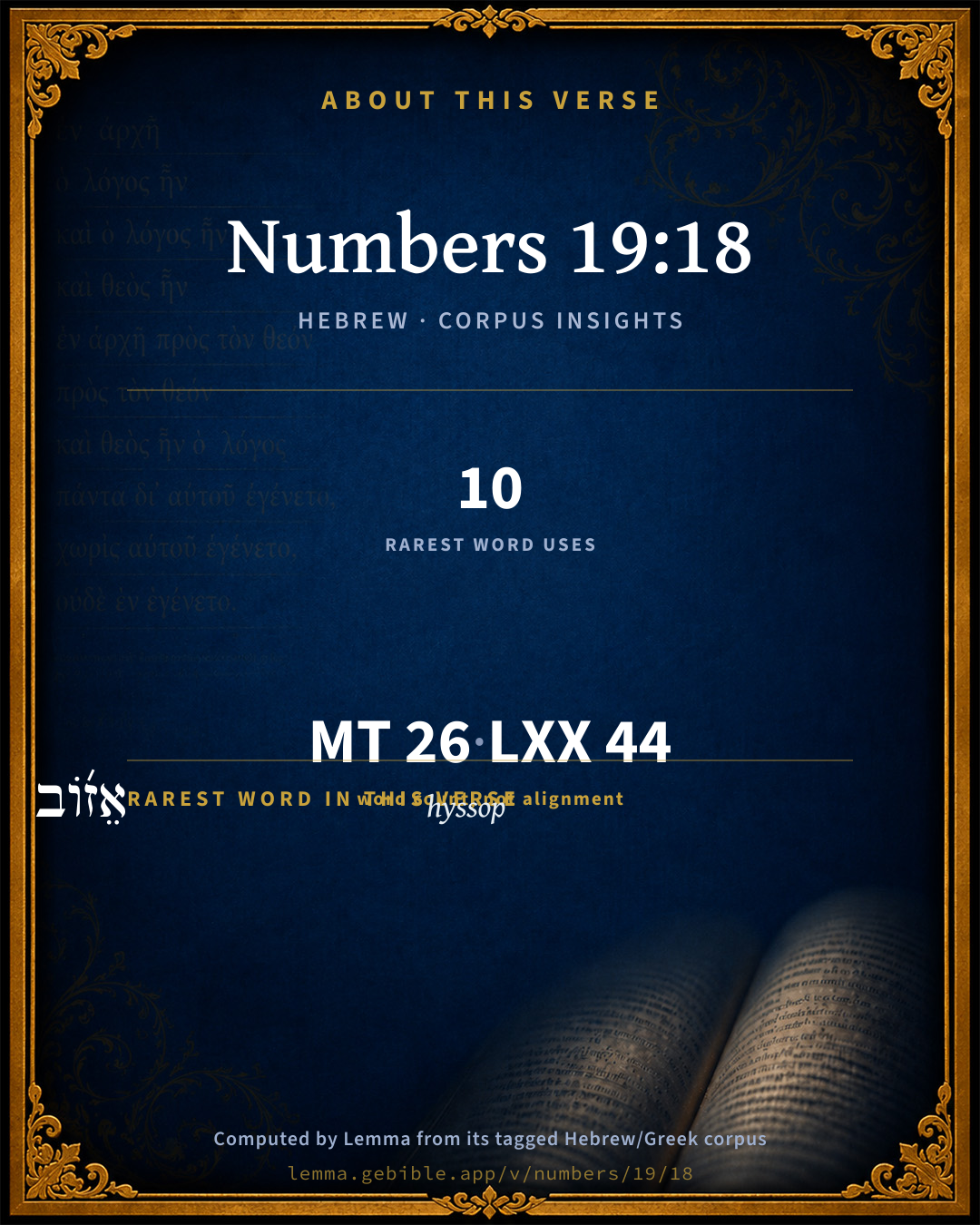
These counts appear in no published source. They are computed here, from the morphology-tagged text and Lemma’s own curated glosses. What Lemma adds →

26
words
21
distinct lemmas
Pentateuch
section

Notable vocabulary

The rarest word here is אֵז֜וֹב hyssop H231 — appearing just 10 times in the whole Hebrew Bible.

Shared distinctive vocabulary

אֵז֜וֹב hyssop H231 occurs in 10 verses of the Hebrew Bible. Also found in:

Grammatical profile

  • 6 verbs
  • 9 nouns
  • 2 adjectives
  • 4 prepositions
  • 3 conjunctions
  • 1 adverb
  • 1 particle

Verb forms

  • וְלָקַ֨ח Qal · Sequential Perfect
  • וְטָבַ֣ל Qal · Sequential Perfect
  • וְהִזָּ֤ה Hiphil · Sequential Perfect
  • הָֽיוּ Qal · Perfect
  • הַנֹּגֵ֗עַ Qal · Participle Active
  • בַמֵּ֖ת Qal · Participle Active

Repetition

Words recur within this verse — often emphatic in Hebrew:

Hebrew & Septuagint length

In English translation the verse runs 47 words from the Hebrew and 47 from the Septuagint (LXX English) — the same length.

A rough comparison of the two English renderings, which tokenize alike — not a word-level alignment.

Word counts can differ between the Hebrew and the Greek without any difference in meaning — e.g. the Hebrew direct-object marker אֵת has no separate Greek word, and Greek often adds the article ὁ.

In the original languages it is 26 Hebrew tokens and 44 Greek tokens — but the two are counted differently (Hebrew bundles its prefixes and suffixes into one token; the Greek is in lemma form), so that isn’t a like-for-like length.

Cross-references

8

Topical passages linked to Numbers 19:18 in the Treasury of Scripture Knowledge — connected by theme and wording, ordered by reader-vote popularity; previews shown in the World English Bible.

  • Ezekiel 36:25–27 I will sprinkle clean water on you, and you shall be clean: from all your filthiness, and from all your idols, will I cleanse you.
  • Hebrews 9:14 how much more will the blood of Christ, who through the eternal Spirit offered himself without blemish to God, cleanse your conscience from dead works to serve the living God?
  • Numbers 19:9 A man who is clean shall gather up the ashes of the heifer, and lay them up outside of the camp in a clean place; and it shall be kept for the congregation of the children of Israel for a water for impurity: it is a sin-offering.
  • Psalms 51:7 Purify me with hyssop, and I will be clean. Wash me, and I will be whiter than snow.
  • John 15:2–3 Every branch in me that doesn't bear fruit, he takes away. Every branch that bears fruit, he prunes, that it may bear more fruit.
  • John 17:17 Sanctify them in your truth. Your word is truth.
  • 1 Corinthians 1:30 But of him, you are in Christ Jesus, who was made to us wisdom from God, and righteousness and sanctification, and redemption:
  • John 17:19 For their sakes I sanctify myself, that they themselves also may be sanctified in truth.

Cross-references courtesy of OpenBible.info (CC BY 4.0).

Hebrew and Greek witnesses Masoretic Hebrew ↔ Greek Septuagint

The same verse in the two great witnesses to the Old Testament, shown verse-for-verse.

These are two independent witnesses, not word-aligned to each other, and the Septuagint is shown in lemma (dictionary) form.

Hebrew Numbers 19:18 Masoretic · Westminster Leningrad Codex

וְלָקַ֨ח אֵז֜וֹב וְטָבַ֣ל בַּמַּיִם֮ אִ֣ישׁ טָהוֹר֒ וְהִזָּ֤ה עַל הָאֹ֨הֶל֙ וְעַל כָּל הַכֵּלִ֔ים וְעַל הַנְּפָשׁ֖וֹת אֲשֶׁ֣ר הָֽיוּ שָׁ֑ם וְעַל הַנֹּגֵ֗עַ בַּעֶ֨צֶם֙ א֣וֹ בֶֽחָלָ֔ל א֥וֹ בַמֵּ֖ת א֥וֹ בַקָּֽבֶר

and a clean person shall take hyssop, and dip it in the water, and sprinkle it on the tent, and on all the vessels, and on the persons who were there, and on him who touched the bone, or the slain, or the dead, or the grave:

World English Bible · Public Domain

Greek LXX Numbers 19:18 Septuagint · lemma form

καί λαμβάνω ὕσσοπος καί βάπτω εἰς ὁ ὕδωρ ἀνήρ καθαρός καί περιῥαίνω ἐπί ὁ οἶκος καί ἐπί ὁ σκεῦος καί ἐπί ὁ ψυχή ὅσος ἐάν εἰμί ἐκεῖ καί ἐπί ὁ ἅπτομαι ὁ ὀστέον ὁ ἀνθρώπινος ἤ ὁ τραυματίας ἤ ὁ θνήσκω ἤ ὁ μνῆμα

And a clean man shall take hyssop, and dip it into the water, and sprinkle it upon the house, and the furniture, and all the souls that are therein, and upon him that touched the human bone, or the slain man, or the corpse, or the tomb.

LXX2012 (modern English Septuagint) · Public Domain

Hebrew: Westminster Leningrad Codex (CC BY 4.0). Greek: Septuagint (public domain); English from LXX2012 (modern English Septuagint) (Public Domain). How the Septuagint differs from the Hebrew →

Targum (Aramaic paraphrase)

2

The Targum is the ancient Jewish Aramaic paraphrase of the Hebrew Scriptures — an interpretive translation, not the Hebrew text itself. Onkelos (literal) and Pseudo-Jonathan (expansive) render the Torah, and Jonathan the Prophets. Coverage is partial: where no permissively-licensed English translation exists for a verse, only the Aramaic is shown. This is verse-level text, not a word-by-word alignment to the Hebrew.

  1. Targum Onkelos Torah (Genesis–Deuteronomy)
    וְיִסַב אֵזוֹבָא וְיִטְבּוֹל בְּמַיָא גְבַר דְכֵי וְיַדֵי עַל מַשְׁכְּנָא וְעַל כָּל מָנַיָא וְעַל נַפְשָׁתָא דִי הֲווֹ תַמָן וְעַל דְיִקְרַב בְּגַרְמָא אוֹ בְקָטִילָא אוֹ בְמִיתָא אוֹ בְקִבְרָא

    (no public-domain English translation for this verse)

    Targum Onkelos — Aramaic: “Onkelos Genesis” (public domain); “Onkelos Exodus” (public domain); “Onkelos Leviticus” (public domain); “Onkelos Numbers” (public domain); “Onkelos Deuteronomy” (public domain). English: “Sefaria Community Translation” (CC0 1.0 (public-domain dedication)); “J.W. Etheridge. The Targums of Onkelos and Jonathan Ben Uzziel on the Pentateuch. London: Longmans, Green, 1862” (public domain). Text via Sefaria.

  2. Targum Pseudo-Jonathan Torah (Genesis–Deuteronomy)
    וְיִסַב אֵזוֹבָא תְּלָתָא קִילְחִין בְּאִיסְרָא חֲדָא וְיִטְמוֹשׁ בְּמַיָא הָאִינוּן בְּעִידַן קִבּוּל סוּבְתָּא גְבַר כָּהֵן דְכֵי וְיַדֵי עַל מַשְׁכְּנָא וְעַל כָּל מָנַיָא וְעַל בְּנֵי נַשׁ דַהֲווֹ תַמָן וְעַל דְמִקְרַב בְּגַרְמָא דְחַיָא דְפָרֵישׁ מִנֵיהּ וְנָפַל אוֹ בִּקְטוֹל חַרְבָּא אוֹ בִּשְׁכִיבָא בְּמוֹתָנָא אוֹ בְּבֵית קְבוּרְתָּא וְגוֹלְלָא וְדוֹפְקָא

    And let a man, a priest, who is clean, take three branches of hyssop bound. together, and dip (them) in the water at the time of receiving the uncleanness, and sprinkle the tent and all its vessels, and the men who are in it, or upon him who hath touched the bone of a living man that hath been severed from him, and hath fallen, or him who hath. been slain with the sword, or hath died by the plague, or a grave, or a wrapper, or a bier.

    Targum Pseudo-Jonathan — Aramaic: “Targum Jonathan on Genesis” (public domain); “Targum Jonathan on Exodus” (public domain); “Targum Jonathan on Leviticus” (public domain); “Targum Jonathan on Numbers” (public domain); “Targum Jonathan on Deuteronomy” (public domain). English: “The Targum of Jonathan ben Uzziel, trans. J. W. Etheridge, London, 1862” (public domain). Text via Sefaria.

Commentary

Notes on Numbers 19:18 from classic Christian and Jewish commentators (each source and its license shown beneath its notes). The classic Christian expositions comment on the surrounding passage and are grouped to its opening verse, so a note may address several verses; the Jewish commentaries on the Tanakh (Rashi and others) are per-verse, so they appear only where the commentator wrote on this verse.

Lemma curates 59 commentaries, every one of them public domain or Creative Commons licensed, each selected and text-cleaned for this edition rather than reprinted as found. About our sources →

Trapp's Complete Commentary

John Trapp

Num 19:18 And a clean person shall take hyssop, and dip [it] in the water, and sprinkle [it] upon the tent, and upon all the vessels, and upon the persons that were there, and upon him that touched a bone, or one slain, or one dead, or a grave:

Ver. 18. Shall take hyssop.] No benefit by Christ, without mortification of sin.

John Trapp, A Commentary or Exposition upon All the Books of the Old and New Testament (1647–1656) — public domain. Text from a community e-Sword module.

Joseph Benson's Commentary

Num 19:18. A clean person shall take hyssop — In allusion to this David prays, Purge me with hyssop. Faith is the bunch of hyssop, wherewith the conscience is sprinkled and the heart purified. And the blood of Christ, being applied by faith, is termed, (Heb 12:24,) the blood of sprinkling, and with it we are said to be sprinkled from an evil conscience, (Heb 10:22,) that is, we are freed from the burden of distress, which arises from a sense of our guilt. And it is foretold that Christ should sprinkle many nations, Isa 52:15.

Joseph Benson's Commentary on the Old and New Testaments (1811–1818) — public domain. Text from a community e-Sword module.

Geneva Bible (1599)

Geneva Bible translators

One of the priests which is clean.

Geneva Bible (1599) marginal notes — public domain. Text via Bolls.life.

The Cambridge Bible for Schools and Colleges

gen. ed. J. J. S. Perowne

18. The ’çzôbh (‘hyssop’) is not mentioned in this section as being burnt; it is here used as an instrument for sprinkling: see Num_19:6.

The Cambridge Bible for Schools and Colleges (gen. ed. J. J. S. Perowne; Cambridge University Press, 1878–1918) — public domain. Text from a community e-Sword module.

John Gill's Exposition

And a clean person shall take hyssop, and dip it in the water,.... Three stalks of hyssop bound together, as the Targum of Jonathan, and this man was to be a clean priest, according to the same; but it does not seem necessary that he should be a priest, but that anyone free from ceremonial pollution might do it:

and sprinkle it upon the tent; where there was a dead body: but this, we are told, is to be understood not of a tent made of wood, or stone, or clay, but made of anything woven, as linen: or of skins (u):

and upon all the vessels; in such a tent, that is, open ones, as before observed:

and upon the persons that were there: when the man died in it, or came into it since, and while the dead body was in it:

and upon him that touched a bone; of a dead man, or, as the Targum of Jonathan, the bone of a living man that is separated from him:

or one slain, or one dead; slain with a sword, or dead of the pestilence, as the same Targum, or of any other disease, or in any other way:

or a grave; or the covering or side of one, as the same Targum adds.

(u) Maimon. in Misn. Sabbat, c. 2. sect. 3.

John Gill's Exposition of the Whole Bible (1746–1763) — public domain (CC PDM 1.0). Text via the HelloAO Bible API.

Matthew Poole's English Annotations

A clean person, to wit, a priest; for to such the work of cleansing was appropriated. See Le 13.

Upon all the vessels; even those which were in part purified by the fire. See Num 31:23.

Matthew Poole's English Annotations on the Holy Bible (1683–1685) — public domain. Text from a community e-Sword/MySword module.

Whedon's Commentary on the Bible

Daniel D. Whedon

18. A clean person — This symbolizes the sinner’s need of a sinless high priest. Heb_7:26; 1Jn_2:1.

Hyssop — See Lev_14:4, note.

And sprinkle — Lustration was prevalent among heathen nations, especially in warm climates, such as Egypt, India, Greece, and Rome.

Daniel D. Whedon (gen. ed.), Commentary on the Old and New Testaments (1874–1909) — public domain. Text from a community e-Sword module.

The Pulpit Commentary

Shall take hyssop. See Exo_12:22, and cf. Psa_51:7.

The Pulpit Commentary (1880–1919), ed. H.D.M. Spence-Jones & Joseph S. Exell — public domain. Text from a community e-Sword module.

Lesson kit

Teaching starters — assembled from the data on this page, not authored interpretation. Every prompt links to the verse data it draws on. Edit before teaching.

Numbers, in the Pentateuch, opens this verse with 26 words (21 distinct Hebrew lemmas). Its most distinctive word is ʼêzôwb (“hyssop”). A historical commentator’s framing appears above. Read the whole chapter for the surrounding context.

Discussion questions

  1. What does “hyssop” (ʼêzôwb) contribute to the verse as a whole?
  2. How does Exodus 12:22, which shares the word «hyssop», read alongside this verse?
  3. What does the repetition of “upon” (4× in this one verse) do in this verse?
  4. The translations on this page render this verse differently — a whole-verse word diff, not a word-by-word alignment. What might account for the different wordings?
  5. «וְלָקַ֨ח» is a Qal Sequential Perfect verb. How does that grammatical form shape the action described?
  6. Compare how Trapp's Complete Commentary and Joseph Benson's Commentary read this verse. Where do they agree or differ?

Things to notice

Reading settings

Reading text

Shown beneath each verse's original-language words.

Old Testament
Old Testament edition

Read the OT as the Masoretic Hebrew (MT) or the Greek Septuagint (LXX).

English shown for the Greek Septuagint (in the Hebrew ↔ Greek comparison).

Comparing translations? Open the Compare panel on any verse page to stack up to four side by side.