
Numbers 6:9

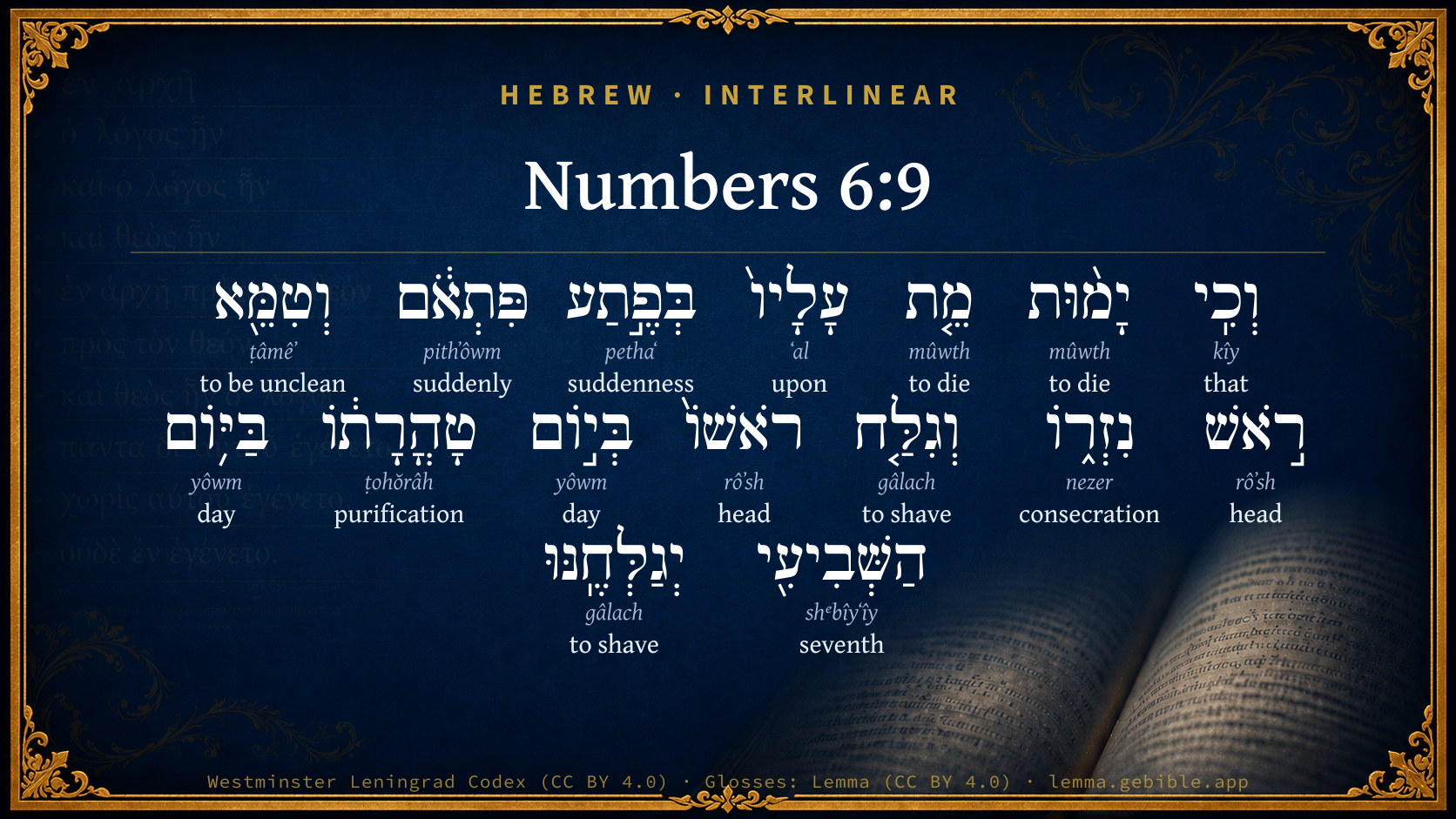
Hebrew (Westminster Leningrad Codex) Numbers 6:9 appears in the Hebrew Old Testament. The text above is from the Westminster Leningrad Codex. Each word links to its Strong’s number, a concise gloss, and parsing drawn from the Open Scriptures Hebrew Bible morphology. Click any word for its full Brown-Driver-Briggs (BDB) entry.
Download image
Cite this verse

Numbers 6:9 (World English Bible). Public Domain. Lemma interlinear Bible study tool, https://lemma.gebible.app/v/numbers/6/9.

Show BibTeX & RIS
BibTeX
RIS
English Translation
"If any man dies very suddenly beside him, and he defiles the head of his separation; then he shall shave his head in the day of his cleansing. On the seventh day he shall shave it.
World English Bible · Public Domain
Highlights
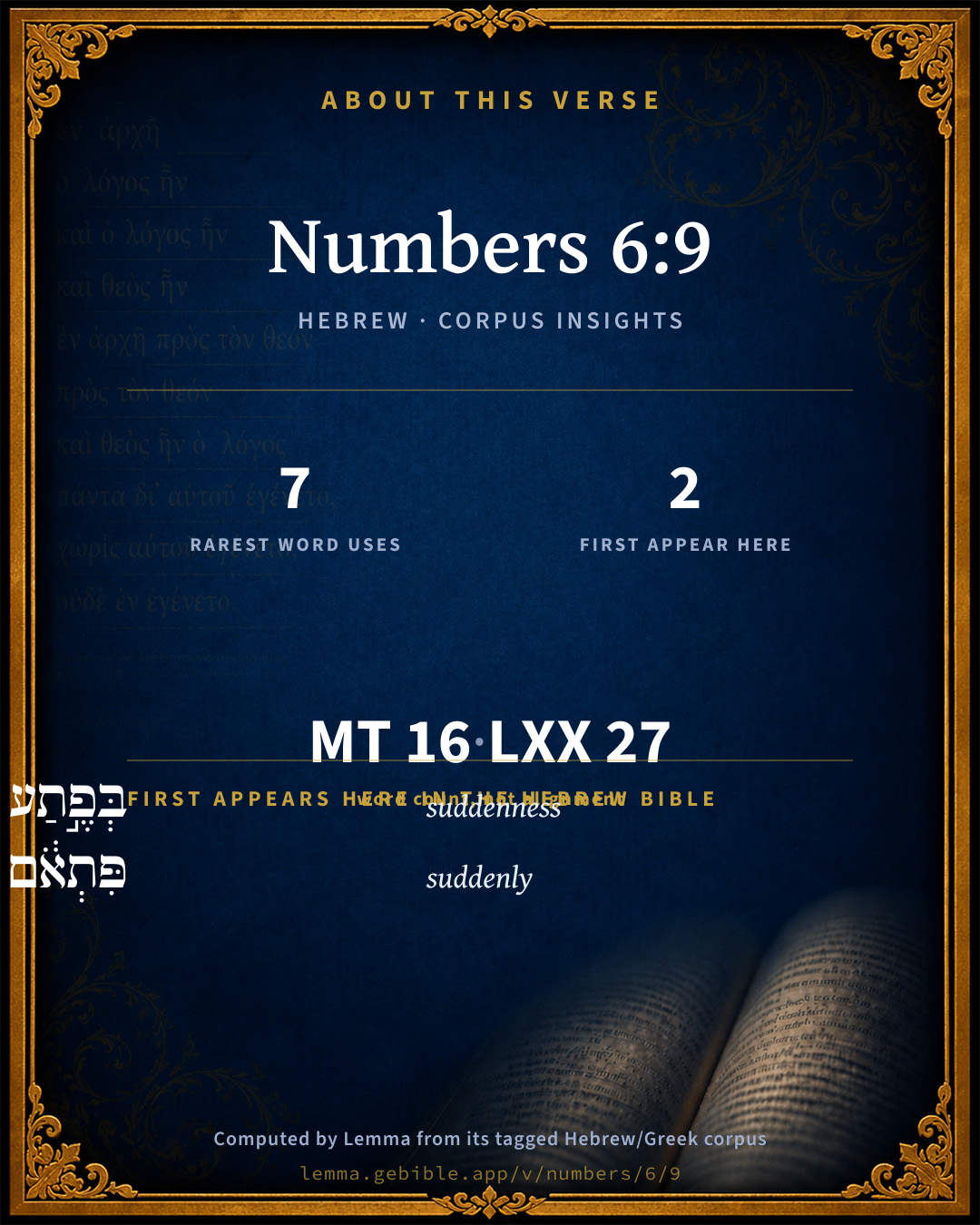
  • 2 first appearances in the Hebrew Bible
Full analysis ↓
Download a study sheet

One document with this verse’s original text, its word-by-word gloss line, the meaning frame, cross-references with their text, attributed commentary, and full source and license credits — printable, and it pastes into notes with its structure intact.

This verse Autodidact and up

Study sheet (.html) Plain text (.txt)

A passage Seminary Student

Up to 50 verses in one chapter. A passage sheet keeps up to 6 commentary sources and 12 cross-references per verse, in the order this page ranks them, and says so on the sheet whenever that leaves anything out. Ask for a single verse and you get the Autodidact verse sheet above.

Everything on this page stays free to read, with no account — the sheet is a download of what is already on screen, not access to it.

Want to remove ads? Support Godless Engineer
Compare translations 3

The same verse in 3 English versions, stacked beneath the original-language interlinear above. Click any original word for its lexicon entry.

Each is an independent rendering of the whole verse — the interlinear is not word-aligned to these translations.

Highlighted words mark where these versions differ — a whole-verse word diff, not a word-by-word alignment.

  • World English Bible Public Domain
    "If any man dies very suddenly beside him, and he defiles the head of his separation; then he shall shave his head in the day of his cleansing. On the seventh day he shall shave it.
  • King James Version Public Domain
    And if any man die very suddenly by him, and he hath defiled the head of his consecration; then he shall shave his head in the day of his cleansing, on the seventh day shall he shave it.
  • unfoldingWord Literal Text CC BY-SA 4.0
    And if a dying one dies upon him in suddenness suddenly, and he makes the head of his separation unclean, then he shall shave his head on the day of his purification; on the seventh day he shall shave it.

unfoldingWord Literal Text — © unfoldingWord, licensed CC BY-SA 4.0. Word-aligned USFM3 via Door43 (git.door43.org/unfoldingWord/en_ult).

Versions to compare (up to 4)

3 of 4 selected

Show all 18 translations

Every available English version of this verse, each an independent rendering of the whole verse.

  • World English Bible Public Domain
    "If any man dies very suddenly beside him, and he defiles the head of his separation; then he shall shave his head in the day of his cleansing. On the seventh day he shall shave it.
  • Berean Standard Bible Public Domain
    If someone suddenly dies in his presence and defiles his consecrated head of hair, he must shave his head on the day of his cleansing—the seventh day.
  • Majority Standard Bible Public Domain
    If someone suddenly dies in his presence and defiles his consecrated head of hair, he must shave his head on the day of his cleansing—the seventh day.
  • King James Version Public Domain
    And if any man die very suddenly by him, and he hath defiled the head of his consecration; then he shall shave his head in the day of his cleansing, on the seventh day shall he shave it.
  • American Standard Version (1901) Public Domain
    And if any man die very suddenly beside him, and he defile the head of his separation; then he shall shave his head in the day of his cleansing, on the seventh day shall he shave it.
  • Revised Version (1885) Public Domain
    And if any man die very suddenly beside him, and he defile the head of his separation; then he shall shave his head in the day of his cleansing, on the seventh day shall he shave it.
  • Geneva Bible (1599) Public Domain
    And if any dye suddenly by him, or hee beware, then the head of his consecration shall be defiled, and he shall shaue his head in the day of his clensing: in the seuenth day he shall shaue it.
  • Douay-Rheims (1899) Public Domain
    But if any man die suddenly before him: the head of his consecration shall be defiled: and he shall shave it forthwith on the same day of his purification, and again on the seventh day.
  • Young's Literal Translation Public Domain
    `And when the dead dieth beside him in an instant, suddenly, and he hath defiled the head of his separation, then he hath shaved his head in the day of his cleansing; on the seventh day he doth shave it,
  • Literal Standard Version CC BY-SA 4.0
    And when the dead dies beside him in an instant, suddenly, and he has defiled the head of his separation, then he has shaved his head in the day of his cleansing; on the seventh day he shaves it,
  • Unlocked Literal Bible CC BY-SA 4.0
    If someone very suddenly dies beside him and defiles his consecrated head, then he must shave his head on the day of his purification—on the seventh day he must shave it.
  • unfoldingWord Literal Text CC BY-SA 4.0
    And if a dying one dies upon him in suddenness suddenly, and he makes the head of his separation unclean, then he shall shave his head on the day of his purification; on the seventh day he shall shave it.
  • Darby Bible Public Domain
    And if any one die unexpectedly by him suddenly, and he hath defiled the head of his consecration, then he shall shave his head on the day of his cleansing; on the seventh day shall he shave it.
  • World Messianic Bible Public Domain
    “‘If any man dies very suddenly beside him, and he defiles the head of his separation, then he shall shave his head in the day of his cleansing. On the seventh day he shall shave it.
  • Webster's Bible Public Domain
    And if any man shall die very suddenly by him, and he hath defiled the head of his consecration; then he shall shave his head in the day of his cleansing, on the seventh day shall he shave it.
  • Free Bible Version CC BY-SA 4.0
    However, if someone dies suddenly close to them, making them unclean, they must wait seven days, and on the seventh day when they are made clean again they are to shave their heads.
  • Bible in Basic English Public Domain
    If death comes suddenly to a man at his side, so that he becomes unclean, let his hair be cut off on the day when he is made clean, on the seventh day.
  • JPS Tanakh (1917) Public Domain
    And if any man die very suddenly beside him, and he defile his consecrated head, then he shall shave his head in the day of his cleansing, on the seventh day shall he shave it.

Literal Standard Version (2020), Covenant Press — licensed CC BY-SA 4.0. Text via the HelloAO Bible API (eBible.org). Unlocked Literal Bible (unfoldingWord) — licensed CC BY-SA 4.0. Text via the HelloAO Bible API (eBible.org). unfoldingWord Literal Text — © unfoldingWord, licensed CC BY-SA 4.0. Word-aligned USFM3 via Door43 (git.door43.org/unfoldingWord/en_ult). Free Bible Version, Dr. Jonathan Gallagher — licensed CC BY-SA 4.0. Text via the HelloAO Bible API (eBible.org).

Word by word

More ways to search: Search by grammar → Find every occurrence → Compare this word →

Practice this passage: Drill this verse → Learn its vocabulary →

בְּפֶ֣תַע
pethaʻ
H6621
“in/at · suddenness”
Preposition + Noun, Common, Masculine, Singular, Absolute
Part of Speech
Preposition + Noun
Type
Common
Gender
Masculine
Number
Singular
State
Absolute
Full BDB Definition

Origin: from an unused root meaning to open (the eyes)

TWOT: 1859

suddenness, in an instant
  1. וְכִֽי kîy H3588 “and · that” Conjunction + Conjunction
  2. יָמ֨וּת mûwth H4191 “to die” Verb, Qal, Imperfect, 3rd Person, Masculine, Singular
  3. מֵ֤ת mûwth H4191 “dying” Verb, Qal, Participle Active, Masculine, Singular, Absolute
  4. עָלָיו֙ ʻal H5921 “upon · him” Preposition + Suffix, Personal, 3rd Person, Masculine, Singular
  5. פִּתְאֹ֔ם pithʼôwm H6597 “suddenly” Adverb
  6. וְטִמֵּ֖א ṭâmêʼ H2930 “and · to be unclean” Conjunction + Verb, Piel, Sequential Perfect, 3rd Person, Masculine, Singular
  7. רֹ֣אשׁ rôʼsh H7218 “head of” Noun, Common, Masculine, Singular, Construct
  8. נִזְר֑וֹ nezer H5145 “consecration · his” Noun, Common, Masculine, Singular, Construct + Suffix, Personal, 3rd Person, Masculine, Singular
  9. וְגִלַּ֤ח gâlach H1548 “and · to shave” Conjunction + Verb, Piel, Sequential Perfect, 3rd Person, Masculine, Singular
  10. רֹאשׁוֹ֙ rôʼsh H7218 “head · his” Noun, Common, Masculine, Singular, Construct + Suffix, Personal, 3rd Person, Masculine, Singular
  11. בְּי֣וֹם yôwm H3117 “in/at · day of” Preposition + Noun, Common, Masculine, Singular, Construct
  12. טָהֳרָת֔וֹ ṭohŏrâh H2893 “purification · his” Noun, Common, Both, Singular, Construct + Suffix, Personal, 3rd Person, Masculine, Singular
  13. בַּיּ֥וֹם yôwm H3117 “in/at the · day” Preposition, Determined + Noun, Common, Masculine, Singular, Absolute
  14. הַשְּׁבִיעִ֖י shᵉbîyʻîy H7637 “the · seventh” Particle, Definite Article + Adjective, Ordinal number, Masculine, Singular, Absolute
  15. יְגַלְּחֶֽנּוּ gâlach H1548 “to shave · him” Verb, Piel, Imperfect, 3rd Person, Masculine, Singular + Suffix, Personal, 3rd Person, Masculine, Singular

About this verse

These counts appear in no published source. They are computed here, from the morphology-tagged text and Lemma’s own curated glosses. What Lemma adds →

16
words
12
distinct lemmas
Pentateuch
section

Notable vocabulary

The rarest word here is בְּפֶ֣תַע suddenness H6621 — appearing just 7 times in the whole Hebrew Bible.

First appearance in Scripture

These words make their first canonical appearance in the Hebrew Bible here:

  • בְּפֶ֣תַע suddenness H6621
  • פִּתְאֹ֔ם suddenly H6597

Shared distinctive vocabulary

בְּפֶ֣תַע suddenness H6621 occurs in 7 verses of the Hebrew Bible. Also found in:

Grammatical profile

  • 5 verbs
  • 7 nouns
  • 1 adjective
  • 1 preposition
  • 1 conjunction
  • 1 adverb

Verb forms

  • יָמ֨וּת Qal · Imperfect
  • מֵ֤ת Qal · Participle Active
  • וְטִמֵּ֖א Piel · Sequential Perfect
  • וְגִלַּ֤ח Piel · Sequential Perfect
  • יְגַלְּחֶֽנּוּ Piel · Imperfect

Repetition

Words recur within this verse — often emphatic in Hebrew:

  • יָמ֨וּת to die H4191 ×2
  • רֹ֣אשׁ head H7218 ×2
  • וְגִלַּ֤ח to shave H1548 ×2
  • בְּי֣וֹם day H3117 ×2

Hebrew & Septuagint length

In English translation the verse runs 36 words from the Hebrew and 39 from the Septuagint (LXX English) — closely comparable.

A rough comparison of the two English renderings, which tokenize alike — not a word-level alignment.

Word counts can differ between the Hebrew and the Greek without any difference in meaning — e.g. the Hebrew direct-object marker אֵת has no separate Greek word, and Greek often adds the article ὁ.

In the original languages it is 16 Hebrew tokens and 27 Greek tokens — but the two are counted differently (Hebrew bundles its prefixes and suffixes into one token; the Greek is in lemma form), so that isn’t a like-for-like length.

Cross-references

6

Topical passages linked to Numbers 6:9 in the Treasury of Scripture Knowledge — connected by theme and wording, ordered by reader-vote popularity; previews shown in the World English Bible.

  • Numbers 6:18 The Nazirite shall shave the head of his separation at the door of the Tent of Meeting, and shall take the hair of the head of his separation, and put it on the fire which is under the sacrifice of peace offerings.
  • Leviticus 14:9 It shall be on the seventh day, that he shall shave all his hair off his head and his beard and his eyebrows, even all his hair he shall shave off. He shall wash his clothes, and he shall bathe his body in water, then he shall be clean.
  • Acts 18:18 Paul, having stayed after this many more days, took his leave of the brothers, and sailed from there for Syria, together with Priscilla and Aquila. He shaved his head in Cenchreae, for he had a vow.
  • Numbers 19:14–19 This is the law when a man dies in a tent: everyone who comes into the tent, and everyone who is in the tent, shall be unclean seven days.
  • Acts 21:23–24 Therefore do what we tell you. We have four men who have taken a vow.
  • Philippians 3:8–9 Yes most assuredly, and I count all things to be loss for the excellency of the knowledge of Christ Jesus, my Lord, for whom I suffered the loss of all things, and count them nothing but refuse, that I may gain Christ

Cross-references courtesy of OpenBible.info (CC BY 4.0).

Hebrew and Greek witnesses Masoretic Hebrew ↔ Greek Septuagint

The same verse in the two great witnesses to the Old Testament, shown verse-for-verse.

These are two independent witnesses, not word-aligned to each other, and the Septuagint is shown in lemma (dictionary) form.

Hebrew Numbers 6:9 Masoretic · Westminster Leningrad Codex

וְכִֽי יָמ֨וּת מֵ֤ת עָלָיו֙ בְּפֶ֣תַע פִּתְאֹ֔ם וְטִמֵּ֖א רֹ֣אשׁ נִזְר֑וֹ וְגִלַּ֤ח רֹאשׁוֹ֙ בְּי֣וֹם טָהֳרָת֔וֹ בַּיּ֥וֹם הַשְּׁבִיעִ֖י יְגַלְּחֶֽנּוּ

"If any man dies very suddenly beside him, and he defiles the head of his separation; then he shall shave his head in the day of his cleansing. On the seventh day he shall shave it.

World English Bible · Public Domain

Greek LXX Numbers 6:9 Septuagint · lemma form

ἐάν δέ τις ἀποθνήσκω ἐξάπινα ἐπί αὐτός παραχρῆμα μιαίνω ὁ κεφαλή εὐχή αὐτός καί ξυράω ὁ κεφαλή αὐτός ὅς ἄν ἡμέρα καθαρίζω ὁ ἡμέρα ὁ ἕβδομος ξυράω

And if any one should die suddenly by him, immediately the head of his vow shall be defiled; and he shall shave his head in whatever day he shall be purified: on the seventh day he shall be shaved.

LXX2012 (modern English Septuagint) · Public Domain

Hebrew: Westminster Leningrad Codex (CC BY 4.0). Greek: Septuagint (public domain); English from LXX2012 (modern English Septuagint) (Public Domain). How the Septuagint differs from the Hebrew →

Targum (Aramaic paraphrase)

2

The Targum is the ancient Jewish Aramaic paraphrase of the Hebrew Scriptures — an interpretive translation, not the Hebrew text itself. Onkelos (literal) and Pseudo-Jonathan (expansive) render the Torah, and Jonathan the Prophets. Coverage is partial: where no permissively-licensed English translation exists for a verse, only the Aramaic is shown. This is verse-level text, not a word-by-word alignment to the Hebrew.

  1. Targum Onkelos Torah (Genesis–Deuteronomy)
    וַאֲרֵי יְמוּת מֵתָא עֲלוֹהִי בִּתְכֵּף שָׁלוּ וִיסָאֵב רֵישׁ נִזְרֵהּ וִיגַלַח רֵישֵׁהּ בְּיוֹמָא דִדְכוּתֵהּ בְּיוֹמָא שְׁבִיעָאָה יְגַלְחִנֵהּ

    (no public-domain English translation for this verse)

    Targum Onkelos — Aramaic: “Onkelos Genesis” (public domain); “Onkelos Exodus” (public domain); “Onkelos Leviticus” (public domain); “Onkelos Numbers” (public domain); “Onkelos Deuteronomy” (public domain). English: “Sefaria Community Translation” (CC0 1.0 (public-domain dedication)); “J.W. Etheridge. The Targums of Onkelos and Jonathan Ben Uzziel on the Pentateuch. London: Longmans, Green, 1862” (public domain). Text via Sefaria.

  2. Targum Pseudo-Jonathan Torah (Genesis–Deuteronomy)
    וַאֲרוּם יְמוּת מִיתָא עֲלוֹי בִּתְכּוֹף שְׁלוּ וְיִסְאָב רֵישׁ נִזְרֵיהּ וִיגַלַח רֵישֵׁיהּ בְּיוֹם דְכוּתֵיהּ בְּיוֹמָא שְׁבִיעָאָה יְגַלְחִינֵיהּ

    But if a person die near him suddenly, and he unawares defile the head of his vow, let him shave his head on the day of his purification; on the seventh day let him shave it.

    Targum Pseudo-Jonathan — Aramaic: “Targum Jonathan on Genesis” (public domain); “Targum Jonathan on Exodus” (public domain); “Targum Jonathan on Leviticus” (public domain); “Targum Jonathan on Numbers” (public domain); “Targum Jonathan on Deuteronomy” (public domain). English: “The Targum of Jonathan ben Uzziel, trans. J. W. Etheridge, London, 1862” (public domain). Text via Sefaria.

Commentary

Notes on Numbers 6:9 from classic Christian and Jewish commentators (each source and its license shown beneath its notes). The classic Christian expositions comment on the surrounding passage and are grouped to its opening verse, so a note may address several verses; the Jewish commentaries on the Tanakh (Rashi and others) are per-verse, so they appear only where the commentator wrote on this verse.

Lemma curates 59 commentaries, every one of them public domain or Creative Commons licensed, each selected and text-cleaned for this edition rather than reprinted as found. About our sources →

Trapp's Complete Commentary

John Trapp

Num 6:9 And if any man die very suddenly by him, and he hath defiled the head of his consecration; then he shall shave his head in the day of his cleansing, on the seventh day shall he shave it.

Ver. 9. And If any man die.] A figure of the involuntary and unavoidable infirmity of the saints, which must be bewailed, as direct fruits of the flesh; and for which there is, through Christ, a pardon of course.

John Trapp, A Commentary or Exposition upon All the Books of the Old and New Testament (1647–1656) — public domain. Text from a community e-Sword module.

Joseph Benson's Commentary

Num 6:9. He shall shave his head — Because his whole body, and especially his hair, was defiled by such an accident, which was to be imputed either to his own heedlessness, or to God’s providence so ordering the matter; possibly for the punishment of his other sins, or for the quickening him to more purity and detestation of all dead works, whereby he would be defiled.

Joseph Benson's Commentary on the Old and New Testaments (1811–1818) — public domain. Text from a community e-Sword module.

Tyndale Open Study Notes

Tyndale Open Resources

6:9-21 Provisions were made for restoring purity in cases of unavoidable contact with a corpse. Special procedures and offerings brought the period of the Nazirite vow to a conclusion. A stern warning is added about actually fulfilling the vow (6:21).

Tyndale Open Study Notes — © Tyndale Open Resources, licensed CC BY-SA 4.0. Text via the HelloAO Bible API.

Geneva Bible (1599)

Geneva Bible translators

Which long hair is a sign that he is dedicated to God.

Geneva Bible (1599) marginal notes — public domain. Text via Bolls.life.

Jamieson, Fausset & Brown

Robert Jamieson, A. R. Fausset & David Brown

If any man die very suddenly by him, and he hath defiled the head of his consecration--Cases of sudden death might occur to make him contract pollution; and in such circumstances he was required, after shaving his head, to make the prescribed offerings necessary for the removal of ceremonial defilement (Lev 15:13; Num 19:11). But by the terms of this law an accidental defilement vitiated the whole of his previous observances, and he was required to begin the period of his Nazaritism afresh. But even this full completion did not supersede the necessity of a sin offering at the close. Sin mingles with our best and holiest performances, and the blood of sprinkling is necessary to procure acceptance to us and our services.

Jamieson, Fausset & Brown — Commentary Critical and Explanatory on the Whole Bible (1871) — public domain (CC PDM 1.0). Text via the HelloAO Bible API.

The Cambridge Bible for Schools and Colleges

gen. ed. J. J. S. Perowne

9. the head of his separation] i.e. his head with the long hair, the symbol of his consecration.

in the day of his cleansing] Better of his cleanness, i.e. in the day when he became clean.

shall he shave it] The hair, being polluted, must be got rid of in some way that would prevent it defiling other objects. The present law does not mention this; but in accordance with ancient practice it would probably be buried (W. R. Smith, Rel. Sem. 2 369 ff.); and this is laid down in the Mishnah.

9–12. The third regulation might be unavoidably infringed if a sudden death occurred in the Nazirite’s presence. He was then unclean for seven days. At the end of that period he shaved close his polluted hair, and on the next day brought an offering. He was now considered free from pollution, and he began the whole period of his vow afresh.

The Cambridge Bible for Schools and Colleges (gen. ed. J. J. S. Perowne; Cambridge University Press, 1878–1918) — public domain. Text from a community e-Sword module.

John Gill's Exposition

And on the eighth day he shall bring two turtles or two young pigeons to the priest,.... Not a turtledove and a young pigeon, as Ben Gersom observes, but two of one of the sorts, which was the offering of the poorer sort of childbearing women at their purification, and of profluvious persons, men or women, Lev 12:8; and this case of the Nazarite's being an uncleanness, could not be purged away but by sacrifice; which was typical of the sacrifice of Christ, by which that unclean thing sin is put away for ever; even the sins of holy things can be moved in no other way; these were to be brought to the priest to be offered by him:

to the door of the tabernacle of the congregation; for being defiled, the Nazarite might not go into the tabernacle, and therefore was to bring his offering to the door of it, where the priest received it of him.

John Gill's Exposition of the Whole Bible (1746–1763) — public domain (CC PDM 1.0). Text via the HelloAO Bible API.

Haydock's Catholic Bible Commentary

Day. That none might escape; (Theodoret, q. 11) though the Hebrew may imply that the hair was only shaved on the ninth day, when he was to be purified, chap. xix. 12. Then the Nazarite had to begin again, as if he had done nothing, (Calmet) if his vow were only for a time. Those who had taken a vow for life never shaved.

George Leo Haydock (1774–1849), Haydock's Catholic Family Bible and Commentary, 1859 edition — public domain. Excludes Psalms (Douay-Rheims chapter numbering differs from Protestant) and Deuterocanonical books (Catholic canon only).

Matthew Poole's English Annotations

He shall shave his head, because his whole body, and especially his hair, was defiled by such an accident, which he ought to impute either to his own heedlessness, or at least to God’s providence, so ordering the matter possibly for the punishment of his other sins, or for the quickening of him to more caution and purity, and detestation of all dead works whereby he would be defiled.

On the seventh day, to be reckoned from the time of his pollution; for uncleanness contracted by the dead continued for seven days, and the seventh day was the day of cleansing for it, Lev 15:13; Num 19:11,12.

Matthew Poole's English Annotations on the Holy Bible (1683–1685) — public domain. Text from a community e-Sword/MySword module.

Whedon's Commentary on the Bible

Daniel D. Whedon

9. Defiled the head of his consecration — Or, his consecrated head. Involuntary defilement by actual contact with a corpse was a violation of the Nazarite’s sanctity during seven days. “Cleanse thou me from secret” (unconsciously committed) “faults.” See Leviticus iv, concluding notes. If we may believe Hebrew writers, the subject of this vow could not even so much as wear mourning for his nearest relatives.

Shall shave his head — Not because his hair is the special seat of the defilement, but because it was the conspicuous exponent of his entire consecration to Jehovah.

Daniel D. Whedon (gen. ed.), Commentary on the Old and New Testaments (1874–1909) — public domain. Text from a community e-Sword module.

The Pulpit Commentary

If any man die very suddenly by him. wyl, in his presence, or neighbourhood, so that, having hastened to his assistance, lie found himself in contact with a corpse. This ease is mentioned particularly, because it was the only one in which simple humanity or mere accident would be likely to infringe upon the vow. In the day of his cleansing, on the seventh day. This appears to be an anticipation of the law given below; (Num_19:11) but that law may have only sanctioned the existing custom. Shall he shave it. Because "the consecration of his God upon his head" was desecrated by the pollution of death, it must, therefore, be made away with and begun over again.

The Pulpit Commentary (1880–1919), ed. H.D.M. Spence-Jones & Joseph S. Exell — public domain. Text from a community e-Sword module.

John Wesley's Explanatory Notes

He shall shave his head - Because his whole body, and especially his hair was defiled by such an accident, which he ought to impute either to his own heedlessness, or to God's providence so ordering the matter, possibly for the punishment of his other sins, or for the quickening him to more purity and detestation of all dead works, whereby he would be defiled.

John Wesley, Explanatory Notes Upon the Whole Bible (1754–1765) — public domain. Text via the GEBible commentary corpus.

unfoldingWord translationNotes

Door43 World Missions Community

defiles his consecrated head

Here "head" represents the Nazirite man's hair, which symbolizes his vow. AT: "defiles his long hair which shows everyone he is separated to God" or "he becomes defiled" (See: Metonymy)

on the day of his purification

The abstract noun "purification" can be stated as the verbal phrase. AT: "on the day when he makes himself acceptable to God" (See: Abstract Nouns)

the seventh day

"day 7" (See: Ordinal Numbers)

translationWords

defile

clean

unfoldingWord translationNotes — © Distant Shores Media and the Door43 World Missions Community, licensed CC BY-SA 4.0. Source: git.door43.org/Door43/en_tn.

Rashi

Rabbi Shlomo Yitzchaki (Rashi)

בפתע — This refers to a Nazarite who defiles himself thus by accident.

פתאם — This refers to one who does so inadvertently (Sifrei Bamidbar 28:1; cf. Onkelos). — But there are some who say that פתע פתאום denotes one thing, viz., an occurrence of suddenness (by a sudden occurrence, suddenly).

וכי ימות מת עליו AND IF A MAN DIES עליו — i.e., in the tent where he (the נזיר) happens to be.

ביום טהרתו [THEN HE SHALL CLIP THE HAIR OF HIS HEAD] IN THE DAY OF HIS CLEANSING — i.e., on the day when he is being sprinkled with the מי חטאת, (the water containing the ashes of the Red Heifer; cf. Numbers 19:17). Or perhaps this is not so, but it means, on the eighth day when he is perfectly clean! It, however, continues: “on the seventh day [he shall clip it]”. But if it had written only “on the seventh day [he shall clip it]” I might have thought that he must clip his hair even if one had not sprinkled him for some reason or other! Scripture therefore also states “on the day of his cleansing [he shall clip the hair of his head]” (Sifrei Bamidbar 28:2).

Rashi on the Tanakh — English translations: “The Judaica Press complete Tanach with Rashi, translated by A. J. Rosenberg” (CC BY 4.0); “Pentateuch with Rashi's commentary by M. Rosenbaum and A.M. Silbermann, 1929-1934” (public domain); “The Metsudah Tanach series, Lakewood, N.J” (CC BY 4.0); and “The Book of Joshua, Metsudah Publications, 1997” (CC BY 4.0). Text via Sefaria.

Lesson kit

Teaching starters — assembled from the data on this page, not authored interpretation. Every prompt links to the verse data it draws on. Edit before teaching.

Numbers, in the Pentateuch, opens this verse with 16 words (12 distinct Hebrew lemmas). Its most distinctive word is pethaʻ (“suddenness”). A historical commentator’s framing appears above. Read the whole chapter for the surrounding context.

Discussion questions

  1. How does “suddenness” (pethaʻ) shape what this verse is saying?
  2. 2 words make their first appearance in Scripture here. What does this debut establish?
  3. How does Numbers 35:22, which shares the word «suddenness», read alongside this verse?
  4. What does the repetition of “to die” (2× in this one verse) do in this verse?
  5. The translations on this page render this verse differently — a whole-verse word diff, not a word-by-word alignment. What might account for the different wordings?
  6. «יָמ֨וּת» is a Qal Imperfect verb. How does that grammatical form shape the action described?
  7. Compare how Trapp's Complete Commentary and Joseph Benson's Commentary read this verse. Where do they agree or differ?

Things to notice

Reading settings

Reading text

Shown beneath each verse's original-language words.

Old Testament
Old Testament edition

Read the OT as the Masoretic Hebrew (MT) or the Greek Septuagint (LXX).

English shown for the Greek Septuagint (in the Hebrew ↔ Greek comparison).

Comparing translations? Open the Compare panel on any verse page to stack up to four side by side.