
Zechariah 11:9

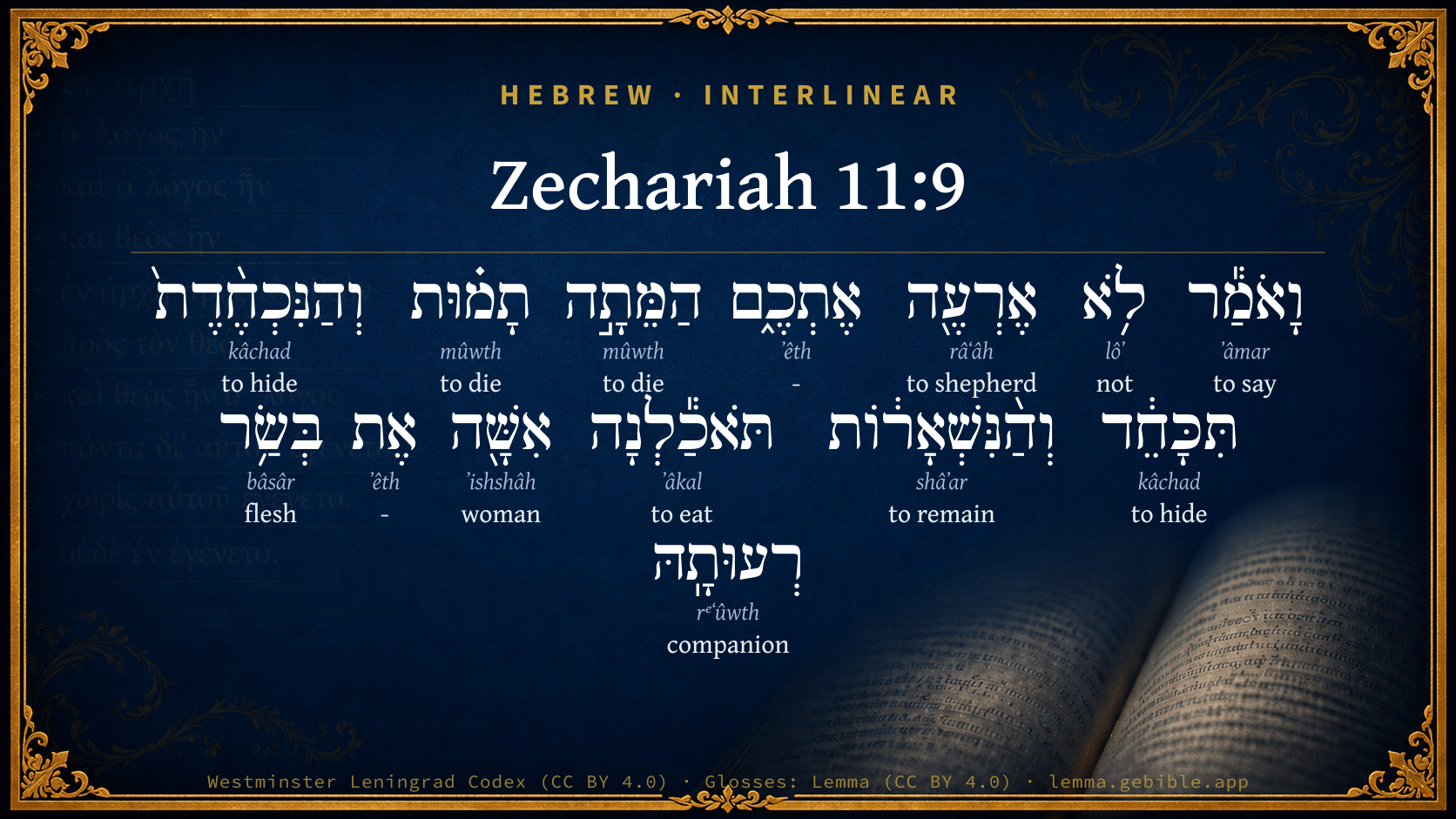
Hebrew (Westminster Leningrad Codex) Zechariah 11:9 appears in the Hebrew Old Testament. The text above is from the Westminster Leningrad Codex. Each word links to its Strong’s number, a concise gloss, and parsing drawn from the Open Scriptures Hebrew Bible morphology. Click any word for its full Brown-Driver-Briggs (BDB) entry.
Download image
Cite this verse

Zechariah 11:9 (World English Bible). Public Domain. Lemma interlinear Bible study tool, https://lemma.gebible.app/v/zechariah/11/9.

Show BibTeX & RIS
BibTeX
RIS
English Translation
Then I said, "I will not feed you. That which dies, let it die; and that which is to be cut off, let it be cut off; and let those who are left eat each other's flesh."
World English Bible · Public Domain
Download a study sheet

One document with this verse’s original text, its word-by-word gloss line, the meaning frame, cross-references with their text, attributed commentary, and full source and license credits — printable, and it pastes into notes with its structure intact.

This verse Autodidact and up

Study sheet (.html) Plain text (.txt)

A passage Seminary Student

Up to 50 verses in one chapter. A passage sheet keeps up to 6 commentary sources and 12 cross-references per verse, in the order this page ranks them, and says so on the sheet whenever that leaves anything out. Ask for a single verse and you get the Autodidact verse sheet above.

Everything on this page stays free to read, with no account — the sheet is a download of what is already on screen, not access to it.

Want to remove ads? Support Godless Engineer
Compare translations 3

The same verse in 3 English versions, stacked beneath the original-language interlinear above. Click any original word for its lexicon entry.

Each is an independent rendering of the whole verse — the interlinear is not word-aligned to these translations.

Highlighted words mark where these versions differ — a whole-verse word diff, not a word-by-word alignment.

  • World English Bible Public Domain
    Then I said, "I will not feed you. That which dies, let it die; and that which is to be cut off, let it be cut off; and let those who are left eat each other's flesh."
  • King James Version Public Domain
    Then said I, I will not feed you: that that dieth, let it die; and that that is to be cut off, let it be cut off; and let the rest eat every one the flesh of another.
  • unfoldingWord Literal Text CC BY-SA 4.0
    Then I said to the owners, “I will not work as a shepherd for you any longer. The sheep that are dying—let them die; the sheep that are being destroyed—let them be destroyed. Let the sheep that remain each eat the flesh of its neighbor.”

unfoldingWord Literal Text — © unfoldingWord, licensed CC BY-SA 4.0. Word-aligned USFM3 via Door43 (git.door43.org/unfoldingWord/en_ult).

Versions to compare (up to 4)

3 of 4 selected

Show all 18 translations

Every available English version of this verse, each an independent rendering of the whole verse.

  • World English Bible Public Domain
    Then I said, "I will not feed you. That which dies, let it die; and that which is to be cut off, let it be cut off; and let those who are left eat each other's flesh."
  • Berean Standard Bible Public Domain
    Then I said, “I will no longer shepherd you. Let the dying die, and the perishing perish; and let those who remain devour one another’s flesh.”
  • Majority Standard Bible Public Domain
    Then I said, “I will no longer shepherd you. Let the dying die, and the perishing perish; and let those who remain devour one another’s flesh.”
  • King James Version Public Domain
    Then said I, I will not feed you: that that dieth, let it die; and that that is to be cut off, let it be cut off; and let the rest eat every one the flesh of another.
  • American Standard Version (1901) Public Domain
    Then said I, I will not feed you: that which dieth, let it die; and that which is to be cut off, let it be cut off; and let them that are left eat every one the flesh of another.
  • Revised Version (1885) Public Domain
    Then said I, I will not feed you: that that dieth, let it die; and that that is to be cut off, let it be cut off; and let them which are left eat every one the flesh of another.
  • Geneva Bible (1599) Public Domain
    Then said I, I will not feede you: that that dyeth, let it dye: and that that perisheth, let it perish: and let the remnant eate, euery one the flesh of his neighbour.
  • Douay-Rheims (1899) Public Domain
    And I said: I will not feed you: that which dieth, let it die: and that which is cut off, let it be cut off: and let the rest devour every one the flesh of his neighbour.
  • Young's Literal Translation Public Domain
    And I say, `I do not feed you, the dying, let die; and the cut off, let be cut off; and the remaining ones, let each eat the flesh of its neighbour.'
  • Literal Standard Version CC BY-SA 4.0
    And I say, “I do not feed you, the dying, let die; and the cut off, let be cut off; and the remaining ones, let each eat the flesh of its neighbor.”
  • Unlocked Literal Bible CC BY-SA 4.0
    Then I said to the owners, “I will not work as a shepherd for you any longer. The sheep that are dying—let them die; the sheep that are being destroyed—let them be destroyed. Let the sheep that remain each eat the flesh of its neighbor.”
  • unfoldingWord Literal Text CC BY-SA 4.0
    Then I said to the owners, “I will not work as a shepherd for you any longer. The sheep that are dying—let them die; the sheep that are being destroyed—let them be destroyed. Let the sheep that remain each eat the flesh of its neighbor.”
  • Darby Bible Public Domain
    And I said, I will not feed you: that which dieth, let it die; and that which perisheth let it perish; and let them which are left eat every one the flesh of another.
  • World Messianic Bible Public Domain
    Then I said, “I will not feed you. That which dies, let it die; and that which is to be cut off, let it be cut off; and let those who are left eat each other’s flesh.”
  • Webster's Bible Public Domain
    Then said I, I will not feed you: that which dieth, let it die; and that which is to be cut off, let it be cut off; and let the rest eat, every one the flesh of another.
  • Free Bible Version CC BY-SA 4.0
    Then I said, “I will not be your shepherd. If the sheep die, they die. Let those that are to perish, perish. Let those who are left eat each other!”
  • Bible in Basic English Public Domain
    And I said, I will not take care of you: If death comes to any, let death be its fate; if any is cut off, let it be cut off; and let the rest take one another's flesh for food.
  • JPS Tanakh (1917) Public Domain
    Then said I: 'I will not feed you; that which dieth, let it die; and that which is to be cut off, let it be cut off; and let them that are left eat every one the flesh of another.'

Literal Standard Version (2020), Covenant Press — licensed CC BY-SA 4.0. Text via the HelloAO Bible API (eBible.org). Unlocked Literal Bible (unfoldingWord) — licensed CC BY-SA 4.0. Text via the HelloAO Bible API (eBible.org). unfoldingWord Literal Text — © unfoldingWord, licensed CC BY-SA 4.0. Word-aligned USFM3 via Door43 (git.door43.org/unfoldingWord/en_ult). Free Bible Version, Dr. Jonathan Gallagher — licensed CC BY-SA 4.0. Text via the HelloAO Bible API (eBible.org).

Word by word

More ways to search: Search by grammar → Find every occurrence → Compare this word →

Practice this passage: Drill this verse → Learn its vocabulary →

רְעוּתָֽהּ
rᵉʻûwth
H7468
“companion · her”
Noun, Common, Feminine, Singular, Construct + Suffix, Personal, 3rd Person, Feminine, Singular
Part of Speech
Noun
Type
Common
Gender
Feminine
Number
Singular
State
Construct
Full BDB Definition

Origin: from H7462 in the sense of H7453

TWOT: 2186e

female companion, mate, neighbour woman
  1. וָאֹמַ֕ר ʼâmar H559 “and · to say” Conjunction + Verb, Qal, Sequential Imperfect, 1st Person, Common, Singular
  2. לֹ֥א lôʼ H3808 “not” Particle, Negative
  3. אֶרְעֶ֖ה râʻâh H7462 “to shepherd” Verb, Qal, Imperfect, 1st Person, Common, Singular
  4. אֶתְכֶ֑ם ʼêth H853 “- · you” Particle, Direct Object + Suffix, Personal, 2nd Person, Masculine, Plural
  5. הַמֵּתָ֣ה mûwth H4191 “the · dying” Particle, Definite Article + Verb, Qal, Participle Active, Feminine, Singular, Absolute
  6. תָמ֗וּת mûwth H4191 “to die” Verb, Qal, Imperfect, 3rd Person, Feminine, Singular
  7. וְהַנִּכְחֶ֨דֶת֙ kâchad H3582 “and · the · hidden” Conjunction + Particle, Definite Article + Verb, Niphal, Participle Passive, Feminine, Singular, Absolute
  8. תִּכָּחֵ֔ד kâchad H3582 “to hide” Verb, Niphal, Imperfect, 3rd Person, Feminine, Singular
  9. וְהַ֨נִּשְׁאָר֔וֹת shâʼar H7604 “and · the · remained” Conjunction + Particle, Definite Article + Verb, Niphal, Participle Passive, Feminine, Plural, Absolute
  10. תֹּאכַ֕לְנָה ʼâkal H398 “to eat” Verb, Qal, Imperfect, 3rd Person, Feminine, Plural
  11. אִשָּׁ֖ה ʼishshâh H802 “woman” Noun, Common, Feminine, Singular, Absolute
  12. אֶת ʼêth H853 “-” Particle, Direct Object
  13. בְּשַׂ֥ר bâsâr H1320 “flesh of” Noun, Common, Masculine, Singular, Construct

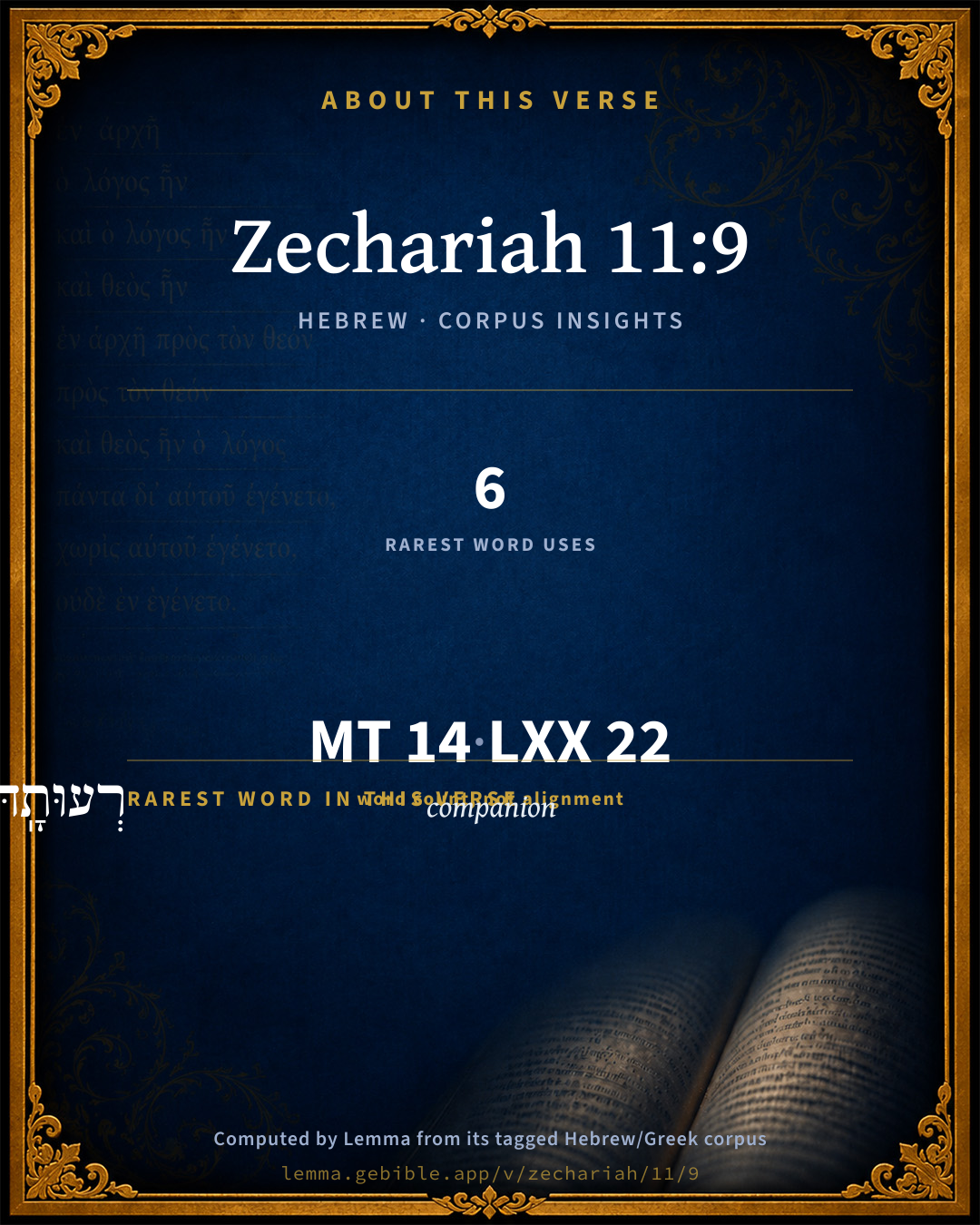
About this verse

These counts appear in no published source. They are computed here, from the morphology-tagged text and Lemma’s own curated glosses. What Lemma adds →

14
words
11
distinct lemmas
Prophets
section

Notable vocabulary

The rarest word here is רְעוּתָֽהּ companion H7468 — appearing just 6 times in the whole Hebrew Bible.

Shared distinctive vocabulary

רְעוּתָֽהּ companion H7468 occurs in 6 verses of the Hebrew Bible. Also found in:

Grammatical profile

  • 8 verbs
  • 3 nouns
  • 3 particles

Verb forms

  • וָאֹמַ֕ר Qal · Sequential Imperfect
  • אֶרְעֶ֖ה Qal · Imperfect
  • הַמֵּתָ֣ה Qal · Participle Active
  • תָמ֗וּת Qal · Imperfect
  • וְהַנִּכְחֶ֨דֶת֙ Niphal · Participle Passive
  • תִּכָּחֵ֔ד Niphal · Imperfect
  • וְהַ֨נִּשְׁאָר֔וֹת Niphal · Participle Passive
  • תֹּאכַ֕לְנָה Qal · Imperfect

Repetition

Words recur within this verse — often emphatic in Hebrew:

  • הַמֵּתָ֣ה to die H4191 ×2
  • וְהַנִּכְחֶ֨דֶת֙ to hide H3582 ×2

Hebrew & Septuagint length

In English translation the verse runs 37 words from the Hebrew and 35 from the Septuagint (LXX English) — closely comparable.

A rough comparison of the two English renderings, which tokenize alike — not a word-level alignment.

Word counts can differ between the Hebrew and the Greek without any difference in meaning — e.g. the Hebrew direct-object marker אֵת has no separate Greek word, and Greek often adds the article ὁ.

In the original languages it is 14 Hebrew tokens and 22 Greek tokens — but the two are counted differently (Hebrew bundles its prefixes and suffixes into one token; the Greek is in lemma form), so that isn’t a like-for-like length.

Cross-references

20

Topical passages linked to Zechariah 11:9 in the Treasury of Scripture Knowledge — connected by theme and wording, ordered by reader-vote popularity; previews shown in the World English Bible.

  • Jeremiah 43:11 He shall come, and shall strike the land of Egypt; such as are for death [shall be given] to death, and such as are for captivity to captivity, and such as are for the sword to the sword.
  • Matthew 13:10–11 The disciples came, and said to him, "Why do you speak to them in parables?"
  • Revelation 22:11 He who acts unjustly, let him act unjustly still. He who is filthy, let him be filthy still. He who is righteous, let him do righteousness still. He who is holy, let him be holy still."
  • Deuteronomy 28:53–56 You shall eat the fruit of your own body, the flesh of your sons and of your daughters, whom Yahweh your God has given you, in the siege and in the distress with which your enemies shall distress you.
  • Psalms 69:22–28 Let their table before them become a snare. May it become a retribution and a trap.
  • Isaiah 9:19–21 Through the wrath of Yahweh of hosts is the land burnt up; and the people are as the fuel of fire: no man spares his brother.
  • Jeremiah 15:2–3 It shall happen, when they tell you, Where shall we go forth? then you shall tell them, Thus says Yahweh: Such as are for death, to death; and such as are for the sword, to the sword; and such as are for the famine, to the famine; and such as are for captivity, to captivity.
  • Jeremiah 19:9 I will cause them to eat the flesh of their sons and the flesh of their daughters; and they shall eat everyone the flesh of his friend, in the siege and in the distress, with which their enemies, and those who seek their life, shall distress them.
  • Jeremiah 23:33 When this people, or the prophet, or a priest, shall ask you, saying, What is the burden of Yahweh? then shall you tell them, What burden! I will cast you off, says Yahweh.
  • Jeremiah 23:39 therefore, behold, I will utterly forget you, and I will cast you off, and the city that I gave to you and to your fathers, away from my presence:
  • Ezekiel 5:10 Therefore the fathers shall eat the sons in the midst of you, and the sons shall eat their fathers; and I will execute judgments on you; and the whole remnant of you will I scatter to all the winds.
  • Matthew 15:14 Leave them alone. They are blind guides of the blind. If the blind guide the blind, both will fall into a pit."
  • Matthew 21:19 Seeing a fig tree by the road, he came to it, and found nothing on it but leaves. He said to it, "Let there be no fruit from you forever!" Immediately the fig tree withered away.
  • Matthew 21:43 "Therefore I tell you, the Kingdom of God will be taken away from you, and will be given to a nation bringing forth its fruits.
  • Matthew 23:38–39 Behold, your house is left to you desolate.
  • John 8:21 Jesus said therefore again to them, "I am going away, and you will seek me, and you will die in your sins. Where I go, you can't come."
  • John 8:24 I said therefore to you that you will die in your sins; for unless you believe that I am he, you will die in your sins."
  • John 12:35 Jesus therefore said to them, "Yet a little while the light is with you. Walk while you have the light, that darkness doesn't overtake you. He who walks in the darkness doesn't know where he is going.
  • Acts 13:46–47 Paul and Barnabas spoke out boldly, and said, "It was necessary that God's word should be spoken to you first. Since indeed you thrust it from you, and judge yourselves unworthy of eternal life, behold, we turn to the Gentiles.
  • Acts 28:26–28 saying, 'Go to this people, and say, In hearing, you will hear, But will in no way understand. In seeing, you will see, But will in no way perceive.

Cross-references courtesy of OpenBible.info (CC BY 4.0).

Hebrew and Greek witnesses Masoretic Hebrew ↔ Greek Septuagint

The same verse in the two great witnesses to the Old Testament, shown verse-for-verse.

These are two independent witnesses, not word-aligned to each other, and the Septuagint is shown in lemma (dictionary) form.

Hebrew Zechariah 11:9 Masoretic · Westminster Leningrad Codex

וָאֹמַ֕ר לֹ֥א אֶרְעֶ֖ה אֶתְכֶ֑ם הַמֵּתָ֣ה תָמ֗וּת וְהַנִּכְחֶ֨דֶת֙ תִּכָּחֵ֔ד וְהַ֨נִּשְׁאָר֔וֹת תֹּאכַ֕לְנָה אִשָּׁ֖ה אֶת בְּשַׂ֥ר רְעוּתָֽהּ

Then I said, "I will not feed you. That which dies, let it die; and that which is to be cut off, let it be cut off; and let those who are left eat each other's flesh."

World English Bible · Public Domain

Greek LXX Zechariah 11:9 Septuagint · lemma form

καί εἶπον οὐ ποιμαίνω σύ ὁ ἀποθνήσκω ἀποθνήσκω καί ὁ ἐκλείπω ἐκλείπω καί ὁ κατάλοιπος καταἐσθίω ἕκαστος ὁ σάρξ ὁ πλησίον αὐτός

And I said, I will not tend you: that which dies, let it die; and that which falls off, let it fall off; and let the rest eat every one the flesh of his neighbor.

LXX2012 (modern English Septuagint) · Public Domain

Hebrew: Westminster Leningrad Codex (CC BY 4.0). Greek: Septuagint (public domain); English from LXX2012 (modern English Septuagint) (Public Domain). How the Septuagint differs from the Hebrew →

Targum (Aramaic paraphrase)

1

The Targum is the ancient Jewish Aramaic paraphrase of the Hebrew Scriptures — an interpretive translation, not the Hebrew text itself. Onkelos (literal) and Pseudo-Jonathan (expansive) render the Torah, and Jonathan the Prophets. Coverage is partial: where no permissively-licensed English translation exists for a verse, only the Aramaic is shown. This is verse-level text, not a word-by-word alignment to the Hebrew.

  1. Targum Jonathan Prophets (Joshua–Malachi)
    וַאֲמָרֵית דְלָא לְמַנָאָה עֲלֵיכוֹן פַּרְנַס דְמַיְתִין יְמוּתוּן וּדְמִשְׁתֵּיצַן יִשְׁתֵּיצוּן וּדְיִשְׁתָּאֲרוּן יִבְזוּן גְבַר יַת נִכְסֵי קְרִיבֵיהּ:

    (no public-domain English translation for this verse)

    Targum Jonathan — Aramaic: “Mikraot Gedolot” (public domain). English: “Sefaria Community Translation” (CC0 1.0 (public-domain dedication)); “London "Chaldee Paraphrase," 1871” (public domain). Text via Sefaria.

Commentary

Notes on Zechariah 11:9 from classic Christian and Jewish commentators (each source and its license shown beneath its notes). The classic Christian expositions comment on the surrounding passage and are grouped to its opening verse, so a note may address several verses; the Jewish commentaries on the Tanakh (Rashi and others) are per-verse, so they appear only where the commentator wrote on this verse.

Lemma curates 59 commentaries, every one of them public domain or Creative Commons licensed, each selected and text-cleaned for this edition rather than reprinted as found. About our sources →

Trapp's Complete Commentary

John Trapp

Zec 11:9 Then said I, I will not feed you: that that dieth, let it die; and that that is to be cut off, let it be cut off; and let the rest eat every one the flesh of another.

Ver. 9. Then said I, I will not feed you] Now the wrath of the Lord arose against his people, so that there was no remedy, as 2Ch 36:16. Now his decree brought forth, Zep 2:2. Now he grows implacable, inexorable, peremptory. Wherein nevertheless the Lord might very well break forth into that speech of the heathen emperor, when he was to pass sentence upon a malefactor, Non nisi coactus, I would not do this if I could do otherwise. Christ could not tell Jerusalem without tears that her day of grace was expired, that her destruction was determined. As a woman brings not forth without pain; as a bee stings not till provoked; so neither doth God proceed against a sinful people or person till there be an absolute necessity; lest his truth and justice should be questioned and slighted. See Eze 12:22-25. Fury is not in God, till our sins put thunderbolts into his hands; and then, "who knoweth the power of his anger?" Psa 90:11 "who can abide with everlasting burnings?" Isa 33:14. If he but cast a man off, as here, and relinquish the care of him, he is utterly undone. Saul found it so, and complains dolefully (but without pity) that God had forsaken him, and the Philistines were upon him, 1Sa 28:15; all miseries and mischief came rushing in to him, as by a sluice. Let us so carry matters that God may not abandon us; that he may not refuse to feed us, and take the charge of us as a shepherd. He yet offereth us this mercy, as Alexander did those he warred against, while the lamp burned.

That that dieth, let it die] viz. Of the murrain, or pestilence, for man being in honour, if God but blow upon him, abideth not, but is like the beasts that perish, pecoribus morticinis, saith Tremellius, the beasts that die of the murrain. Vatablus thinks pestilence, sword, and famine are here threatened under the names of death, of cutting off, and of devouring one another. All which befell the refractory Jews in the last siege; the history whereof will make any man’s heart bleed within him that hath but the least spark of grace or good nature. It went hard with them, when the rest, that the pestilence and sword had left, fell to eating the flesh one of another; when the mother killed and boiled the dead body of her harmless suckling, and, eating the one half, reserved the other for another time. "Behold, O Lord, and consider to whom thou hast done this?" saith the prophet: "Shall the women eat their fruit, and children of a span long?" Lam 2:20. Oh the misery, or rather mock of man’s life! And oh the venomous nature of sin, that moves God (who is not μισανθρωπος, a man hater, but delights in mercy) to deal so severely with his poor creature.

John Trapp, A Commentary or Exposition upon All the Books of the Old and New Testament (1647–1656) — public domain. Text from a community e-Sword module.

Joseph Benson's Commentary

Zec 11:9. Then said I, will not feed you — I will no longer exercise a tender paternal care over you; that that dieth, let it die — Or rather, the dying let it die; that which has a deadly disease, let it perish by that disease. Or, that which is ready to die, and will not be cured, but hath rejected the shepherd’s love and skill, let it die. Thus Jesus said, If ye believe not, ye shall die in your sins. For this seems to be spoken of the miseries to which the Jewish people were delivered up for their manifold sins, and in particular for their rejection of Christ, which filled up the measure of their iniquity. And that that is to be cut off — Namely, by the sword of the enemy; let it be cut off; and let the rest eat every one the flesh of another — Either live to be besieged till hunger and famine make the living eat the dead, or cruelly kill their children and others, that they may eat their flesh; a calamity threatened, Deu 28:52-58; or else, by seditious and bloody intestine quarrels, destroy each other; all which happened to them in the siege of Jerusalem by the Romans.

Joseph Benson's Commentary on the Old and New Testaments (1811–1818) — public domain. Text from a community e-Sword module.

Whedon's Commentary on the Bible

Daniel D. Whedon

Withdrawal of the good shepherd, 9-14.

9, 10. As a result of the flock’s ingratitude, the shepherd decided to discontinue the shepherding care. It is difficult to differentiate in these verses between the voice of the shepherd and that of Jehovah; sometimes Jehovah, sometimes the shepherd, seems to be the speaker. Only the former could authorize the sentence of doom implied in Zec_11:9 or break the covenant (Zec_11:10). The shepherd will leave the flock to its hopeless fate, to die, or to be cut off by the oppressors mentioned in Zec_11:5, or to be devoured by one another.

10. As an indication of his determination he breaks his staff.

Beauty — See on Zec_11:7. The breaking of this staff symbolized the withdrawal of the divine favor.

Break my covenant… made with all the people — Better, R.V., “with all the peoples”; the nations surrounding the Jewish community. While the divine favor endured it prevented the hostile nations from doing injury to the flock (Hos_2:18). Since Jehovah’s will would be supreme in this matter, his resolve amounted practically to a covenant with these peoples, binding them to refrain from hurting the flock of Jehovah; with the covenant broken they would be at liberty to do as they pleased.

The staff was broken and the covenant dissolved, and Zec_11:11 implies that the results became apparent at once.

And so the poor of the flock — As in Zec_11:7; better, the traffickers of the flock (compare Zec_11:5).

That waited upon me — R.V., “that gave heed unto me.” Not that were obedient to me, but in a general sense that observed me; that is, that took notice of the acts of the shepherd. The words do not imply that they were influenced for the better. The events which immediately followed the breaking of the staff were evidence that the shepherd was indeed the representative of Jehovah.

12. This recognition on the part of the traffickers would seem to offer an opportunity for further tests, (1) whether they had been led to a better appreciation of his services, (2) whether there was any desire on their part to have his services continued. One staff was still whole, an indication that he had not finally forsaken them.

Unto them — If the emendation suggested in Zec_11:11 is correct, this can refer only to the traffickers; it is only natural that they should pay the wages, since they had derived the most benefit from the flock (Zec_11:5). The shepherd makes no demands; he asks them to decide whether or not his services merit compensation, and, if so, how much. They reply by offering him wages.

Thirty pieces of silver — A piece or shekel of silver is equivalent to about 60 cents; thirty pieces to about $18. This seems to have been the price of a slave (Exo_21:32), and the offer showed how little they appreciated the services of a divinely appointed shepherd (compare Mat_26:15).

The offer was an insult to the shepherd as well as to Jehovah, and Zec_11:13 describes the displeasure of the latter. He orders the shepherd to throw the money away.

Cast it unto the potter — A much-discussed phrase. Limited space makes impossible the enumeration of all the different interpretations given. On the assumption that the present Hebrew text is correct, the fewest difficulties are offered by the interpretation of Keil, who suggests that cast it to the potter may be a “proverbial expression for contemptuous treatment,” though, as he says, “we have no means of tracing the origin of the phrase satisfactorily.” Exception has been taken to the present text on the ground that there was no potter in the temple (compare last clause of Zec_11:13), but if the phrase is a proverbial saying it is not necessary to assume the presence of a potter in the temple, be it for the purpose of repairing or selling dishes or for the purpose of worship, for the money might be treated contemptuously without a potter being present. The addition “in the house of Jehovah” calls attention to the seriousness and solemnity of the transaction. The action was symbolical as much as the breaking of the staff (Zec_11:10; Zec_11:14); for it signified the cessation of the care of the shepherd and of Jehovah. Jehovah and the people were the persons chiefly interested in this; the temple was the dwelling place of Jehovah, and to it flocked the people; hence all transactions requiring the presence of both parties could best be performed there. Such was the act performed by the shepherd, and it is for this reason that he selected the house of Jehovah as the place where he would give expression to Jehovah’s displeasure. With this interpretation the nature of the “contemptuous treatment” remains undefined; the shepherd may have cast the money away, or may have trampled upon it, or may have done anything else that would indicate how lightly he and Jehovah valued the sum. Many recent scholars prefer the reading of Targum and Peshitto,” “to the treasurer” or “treasury” in the place of “to the potter.” This would remove the obscurity of the present expression, but the objection raised by Keil is not without weight: “God could not possibly say to the prophet, The wages paid for my service are indeed a miserable amount, yet put it in the temple treasury, for it is at any rate better than nothing.”

Goodly price — Meant ironically.

I was prized at — Jehovah identifies himself here with the shepherd; the insult offered to the latter was in reality an insult to Jehovah.

14. In consequence of the lack of appreciation on the part of the flock the shepherd decides to abandon it entirely; as a sign of this he breaks the second staff, for which he has no further use.

Bands — See on Zec_11:7.

That I might break the brotherhood between Judah and Israel — This does not imply the existence of the two kingdoms, nor does it point to a period before the division; it refers rather to the future reunion of the north and south, which is expected by many prophets to take place in the Messianic age. The breaking of the staff implies the destruction of the prospects of such reunion, but with these prospects gone there will be dashed to pieces any hope of a final triumph over the enemies, which will lead to the exaltation and glorification of the victors. On the teaching of the allegory see Introduction, p. 603. If the prophecy comes from the Maccabean period (see on Zec_11:8), the good shepherd represents a high priest who occupied the office about 170 B.C. Who he was cannot be determined; Marti thinks of Onias IV.

Daniel D. Whedon (gen. ed.), Commentary on the Old and New Testaments (1874–1909) — public domain. Text from a community e-Sword module.

The Preacher's Complete Homiletical Commentary

Joseph S. Exell (gen. ed.)

CRITICAL NOTES.

Zec_11:9. Let it] Perish those who are doomed to perish. All kindly control is withdrawn, and the flock is left to the consequences of its fatal rejection of deliverance. The fulfilment in the history of Jerusalem.

Zec_11:10. Break] Symbolic action of taking away the good received by the flock in form of covenant. “That is to say, the covenant which God has made with all nations is to be repealed or destroyed” [Keil].

Zec_11:11. Broken] The covenant annulled as the staff was broken. This not observed by the flock at large, only by the poor] who recognized the fulfilment of a Divine word (Jer_32:8).

HOMILETICS

GOD WITHDRAWN, AND MAN GIVEN UP TO HIS OWN DESTRUCTION.—Zec_11:9-11

The treatment which the Shepherd received leads him to give up feeding the flock, and leave it to its fate. Israel rejected Jehovah, and was in turn rejected. The staves were broken, and the miserable flock have experienced the weight of the words, “Woe unto them when I depart from them!” Learn—

I. That God may withdraw himself from men on account of their sins. “Then said I, I will not feed you.” God woos and awes men; instructs and chastises them; loads them with benefits and corrects them in evil; uses all possible means to keep them in his ways: but they despise his long-suffering, and provoke his wrath. The greatest favours of God often draw forth the worst manifestation of conduct. Men persist in rebellion, refuse when God calls, and are ultimately left to their folly. “My Spirit shall not always strive with man.”

II. That when God withdraws himself from men fearful punishment falls upon them for their sins. How awful the picture given here.

1. Destruction most effectual. “It was broken in that day.” If not suddenly, the Jewish nation suffered eventually. God has power to execute judgments, and nothing escapes his notice.

2. Destruction in manifold ways.

(1) By pestilence. “That that dieth, let it die.”

(2) By the sword. “And that that is to be cut off, let it be cut off.”

(3) By famine. “Let the rest eat every one the flesh of another.”

(4) By intestine feuds. God withdrew, and ceased to be “a wall of fire round about them.” The staff Beauty, the covenant, was broken, and fearful was the fulfilment. When the Romans forced admission into their city, famine and pestilence, feuds and mutual hatred, had done their work. Josephus tells us that every law of nature and humanity was broken; that even the very letter was fulfilled: “The left over shall eat every one of the flesh of his neighbour.”

THE OBSERVANT FEW.—Zec_11:11

When the staff was broken, and calamities were threatened, this was not observed by all. Only a small number gave heed to Jehovah, and recognized the fulfilment of the Divine word. Their character, attitude, and experience are described.

I. Their character is described. “The poor of the flock.” Poor in condition and poor in spirit. The nation was gone astray, but God had “a seed to serve him.” The people were doomed, but Jesus had a “little flock.” However low the condition of the world, God has always a “remnant according to the election of grace.”

II. Their attitude is described. They “waited upon me.” They prayed to God for mercy; observed God in the warnings and actions of the prophet. They discerned the hand of God in the signs of the times, just as the disciples saw coming judgments in the siege of Jerusalem, and fled to Pella. “Whoso readeth, let him understand (mark, consider, 2Ti_2:7) it” (Mat_24:15).

III. Their experience is described. They knew that it was “the word of the Lord.” They understood the word of God, however perplexing it was to others; were sensible of God’s displeasure, and cherished a humble spirit. Events which are common occurrences, chances of war to some, are warnings of God to others. Let faithful pastors be encouraged from these words. Prophets before them have shared their lot—ministered to a flock, despised by the world, but distinguished by the mark that they know the Lord. Jesus himself thought it not beneath him to shepherd “a little flock,” whom he will own at the great day.

ILLUSTRATIONS TO CHAPTER 11

Zec_11:9. I will not. God’s decrees are not the result of deliberation, or the Almighty’s debating matters within himself, reasoning in his own mind about the expediency of things, as creatures do; nor are they merely ideas of things future, but settled determinations founded on his sovereign will and pleasure [Buck].

Zec_11:10. Beauty.

“In his favour life is found,

All bliss beside—a shadow or a sound” [Cowper].

The Preacher's Complete Homiletical Commentary (gen. ed. Joseph S. Exell; Funk & Wagnalls, c. 1892) — public domain (pre-1929). A full-Bible homiletical/sermon-outline anthology covering 65 of 66 books (2 John is absent from the source module). Text from a community e-Sword module.

Tyndale Open Study Notes

Tyndale Open Resources

11:9 devour each other! This might refer literally to the cannibalism that resulted from famine during the siege of Jerusalem in 588–586 BC (see Lam 4:10) and later in AD 70 (see Josephus, War 7.4.4). The expression may also be a metaphor for various forms of exploitation and oppression (see Mic 3:3; Gal 5:15).

Tyndale Open Study Notes — © Tyndale Open Resources, licensed CC BY-SA 4.0. Text via the HelloAO Bible API.

Jamieson, Fausset & Brown

Robert Jamieson, A. R. Fausset & David Brown

Then said I--at last when all means of saving the nation had been used in vain (Joh 8:24).

I will not--that is, no more feed you. The last rejection of the Jews is foretold, of which the former under Nebuchadnezzar, similarly described, was the type (Jer 15:1-3; Jer 34:17; Jer 43:11; Eze 6:12). Perish those who are doomed to perish, since they reject Him who would have saved them! Let them rush on to their own ruin, since they will have it so.

eat . . . flesh of another--Let them madly perish by mutual discords. JOSEPHUS attests the fulfilment of this prophecy of threefold calamity: pestilence and famine ("dieth . . . die"), war ("cut off . . . cut off"), intestine discord ("eat . . . one . . . another").

Jamieson, Fausset & Brown — Commentary Critical and Explanatory on the Whole Bible (1871) — public domain (CC PDM 1.0). Text via the HelloAO Bible API.

Adam Clarke's Commentary

Verse 9. I will not feed you] I shall instruct you no longer: some of you are appointed to death by famine; others, to be cut off by the sword; and others of you, to such desparation that ye shall destroy one another.

Adam Clarke's Commentary on the Bible (1810–1826) — public domain. Text from a community e-Sword/MySword module.

John Calvin's Commentaries

God now declares what had been briefly mentioned before, — that his judgment could not be deemed cruel, for the people had been extremely wicked, and their wickedness deserved extreme punishment. It seems indeed to be a simple narrative; but God here defends his own cause, for he had tried all means in ruling the people, before he had recourse to extreme rigor. Who indeed could now murmur against God? for he had been ever ready to undertake the office of a shepherd, and had so humbled himself as to take care of that people as his own flock, and had, in short, omitted no kind of attention; and yet he had been despised by that people, and even treated with derision. It was therefore an extreme indignity when they hated God, who had yet dealt with them with so much kindness. We hence see that God’s judgment is here vindicated from every calumny; for the wickedness of the people was altogether inexcusable before God had renounced his care of them.

I said: the time must be noticed, for he intimates that he had not been too hasty in taking vengeance; but that as there was no longer any remedy, he had been constrained, as it were by necessity, to give up his office of a shepherd. I said then, I will not feed you; what is to die, let it die; what is to be cut off, let it be cut off He here resigns his office of a shepherd, and intimates that he was innocent and free from all blame, whatever might happen. A shepherd is set over a flock for this purpose, — that he may defend it, even every sheep, both against the depredations of robbers, and the rapacity of wolves: but when he gives up his office, he is exempt from all blame, though afterwards the flock may be stolen or devoured by wolves and wild beasts. God then here openly declares, that it was not to be imputed to him, if the Jews perished a hundred times, for they refused to be ruled by him, and thus he was freed from the pastoral charge. What then is to perish, let it perish; that is, “Since they are not healable, and allow no remedy to be applied to their evils, I leave them; they shall find out what it is to be without a good shepherd.”

We now see more clearly what I before stated, — that the wickedness and ingratitude of the people are here reproved, because they had rejected God, who was ready to be their shepherd, — and that the cause of the ruin which was nigh at hand, was in the Jews themselves, though they anxiously tried, but in vain, to transfer it to another.

He concludes with these words, And those which remain, even those who shall escape external attacks, let them eat one another, since they are not now sheep, but savage wild beasts. And this we know has been fulfilled; for the Jews at length perished through mutual discords, and no one spared his own brother; nay, the nearer the relationship, the more cruelly each raged against the other. Hence God’s judgment, denounced by the Prophet, then appeared most openly, when the Jews perished through intestine broils and even slaughters. It then follows —

John Calvin's Commentaries (1540-1563) — public domain. Text from the Calvin Translation Society English edition (1840s-50s) via the Christian Classics Ethereal Library (ccel.org). Calvin's coverage is partial (roughly two-thirds of the Bible); uncommented books and verses are honest gaps, never fabricated. The 19th-century editor's footnotes and remarks are omitted so the notes are faithfully Calvin's own voice.

Ellicott's Commentary for English Readers

(9) Comp. Jer_15:1-2; Isa_9:20.

A Bible Commentary for English Readers, edited by Charles John Ellicott (1878–1897) — public domain. Text from a community e-Sword module.

John Gill's Exposition

Then said I, I will not feed you,.... That is, any longer; either personally, or by his apostles; he fed them himself, during his public ministry; and afterwards by his apostles, whom he ordered to preach the Gospel to the Jews first; but that being contradicted, blasphemed, and despised by them, they were ordered to turn away from them, and go to the Gentiles: this shows that not the shepherds only, but the body of the people, abhorred Christ and his Gospel: and therefore it was taken away from them:

that that dieth, let it die; literally, by the pestilence, that going by the name of death in Scripture; and spiritually, they that are dead in sin, let them continue so; let them die through famine of the word they have despised; let them die in their sins, and die the second death, they justly deserve:

and that that is to be cut off, let it be cut off; literally, by the sword; spiritually, the meaning is, that whereas some were in righteous judgment appointed to ruin, vessels of wrath fitted to destruction; let them be left to themselves, to a judicial blindness, and hardness of heart, and be cut off as unfruitful branches, and be no more in a church state here, and hereafter cast into everlasting burnings:

and let the rest eat everyone the flesh of another; through famine; or destroy each other in their internal divisions, which was the case of the Jews, when Jerusalem was besieged; see Gal 5:15.

John Gill's Exposition of the Whole Bible (1746–1763) — public domain (CC PDM 1.0). Text via the HelloAO Bible API.

Albert Barnes' Notes on the Bible

And I said, I will not feed you - God, at last, leaves the rebellious soul or people to itself, as He says by Moses, “Then My anger shall be kindled against them in that day, and I will forsake them, and will hide My Face from them, and they shall be devoured, and many evils and troubles shall find them” Deu 31:17 : and our Lord tells the captious Jews; “I go My way, and ye shall seek Me and shall die in your sins” Joh 8:21.

That which dieth, let it die - Zechariah seems to condense, but to repeat the abandonment in Jeremiah; “Cast them out of My sight, and let them go forth. And it shall be, if they shall say unto thee, Where shall we go forth? then thou shalt tell them, Thus saith the Lord, Such as are for death, to death; and such as are for the sword, to the sword; and such as are for the captivity, to the captivity” o. First, God gives over to death without violence, by famine or pestilence, those whose lot it should be; another portion to violent death by the sword; “that which is cut off shall be cut off; and the rest,” the flock of slaughter, would be turned into wolves; and, as in the awful and horrible siege of Jerusalem, those who had escaped these deaths, “the left-over, shall eat every one of the flesh of his neighbor,” every law of humanity and of nature broken. Osorius: “So should they understand at last, how evil and bitter a thing it is for all who lived by My help to be despoiled of that help?”

Albert Barnes' Notes on the Bible (1834–1885) — public domain. Text from a community e-Sword/MySword module.

Haydock's Catholic Bible Commentary

Not feed. This is the final sentence. God allowed them thirty-seven years to repent, after the death of Christ.

George Leo Haydock (1774–1849), Haydock's Catholic Family Bible and Commentary, 1859 edition — public domain. Excludes Psalms (Douay-Rheims chapter numbering differs from Protestant) and Deuterocanonical books (Catholic canon only).

Matthew Poole's English Annotations

Then; after that time of his patient and vigilant feeding the flock, and after his cutting off the three unfaithful shepherds, and after the ill resentment he met with for it; when he deserved love and thanks for it, he is repaid with disdain and hatred by the people, as well as by the shepherds; when he saw all this, then, &c. Thus they rejected Christ, the true Shepherd.

I will not feed you; next he rejecteth them, he will no more take care of them, or provide for them.

That that dieth, let it die; that which is ready to die, and will not be cured, but hath rejected the Shepherd’s love and skill, let it die; it is like that.

If ye believe not, ye shall die in your sins. That that is to be cut off, let it be cut off; either the same repeated, to confirm and affect them more, or else it intends to leave them naked and unguarded to their enemy, to cut them off by the sword or famine, &c.

Let the rest eat every one the flesh of another; either live to be besieged till hunger and famine make the living eat the dead, or cruelly kill that they may eat, as threatened, Deu 28:52-58; or else by seditions and bloody intestine quarrels destroy each other: all which happened to them in the siege of Jerusalem by the Romans.

Matthew Poole's English Annotations on the Holy Bible (1683–1685) — public domain. Text from a community e-Sword/MySword module.

The Pulpit Commentary

I will not feed you. In consequence of their contumacy, the shepherd abandons the flock to their fate, as God threatened. (Deu_31:17; comp. the very similar passage in Jer_15:1-3) Three scourges are intimated in the succeeding words plague, war, famine, combined with civil strife. Eat every one the flesh of another. (comp. Isa_9:20) Many see here a reference to the awful scenes enacted when Jerusalem was besieged by the Romans, and intestine feuds filled the city with bloodshed and added to the horrors of famine.

The Pulpit Commentary (1880–1919), ed. H.D.M. Spence-Jones & Joseph S. Exell — public domain. Text from a community e-Sword module.

John Wesley's Explanatory Notes

Then - After that time of his patient feeding the flock, and cutting off the unfaithful shepherds. Cut off - By the sword or famine. The flesh - Either live to be besieged, 'till hunger makes the living eat the dead, or by seditions and bloody intestine quarrels, destroy each other.

John Wesley, Explanatory Notes Upon the Whole Bible (1754–1765) — public domain. Text via the GEBible commentary corpus.

Rashi

Rabbi Shlomo Yitzchaki (Rashi)

And I said, “I will not tend you...” I said in those days, “I will cast them from before Me,” and they shall be free and subject to spoil.

Rashi on the Tanakh — English translations: “The Judaica Press complete Tanach with Rashi, translated by A. J. Rosenberg” (CC BY 4.0); “Pentateuch with Rashi's commentary by M. Rosenbaum and A.M. Silbermann, 1929-1934” (public domain); “The Metsudah Tanach series, Lakewood, N.J” (CC BY 4.0); and “The Book of Joshua, Metsudah Publications, 1997” (CC BY 4.0). Text via Sefaria.

Lesson kit

Teaching starters — assembled from the data on this page, not authored interpretation. Every prompt links to the verse data it draws on. Edit before teaching.

Zechariah, in the Prophets, opens this verse with 14 words (11 distinct Hebrew lemmas). Its most distinctive word is rᵉʻûwth (“companion”). A historical commentator’s framing appears above. Read the whole chapter for the surrounding context.

Discussion questions

  1. How does “companion” (rᵉʻûwth) shape what this verse is saying?
  2. Exodus 11:2 shares the word «companion» with this verse. How do the two illuminate each other?
  3. “to die” occurs 2× in this one verse. What is the effect of the repetition?
  4. These translations render this verse differently. What is at stake in choosing one wording over another?
  5. The verb «וָאֹמַ֕ר» is Qal Sequential Imperfect. How does its form color the action?
  6. Reading how Trapp's Complete Commentary and Joseph Benson's Commentary read this verse, where do the two commentators agree and where do they part?

Things to notice

Reading settings

Reading text

Shown beneath each verse's original-language words.

Old Testament
Old Testament edition

Read the OT as the Masoretic Hebrew (MT) or the Greek Septuagint (LXX).

English shown for the Greek Septuagint (in the Hebrew ↔ Greek comparison).

Comparing translations? Open the Compare panel on any verse page to stack up to four side by side.