
Numbers 18:7

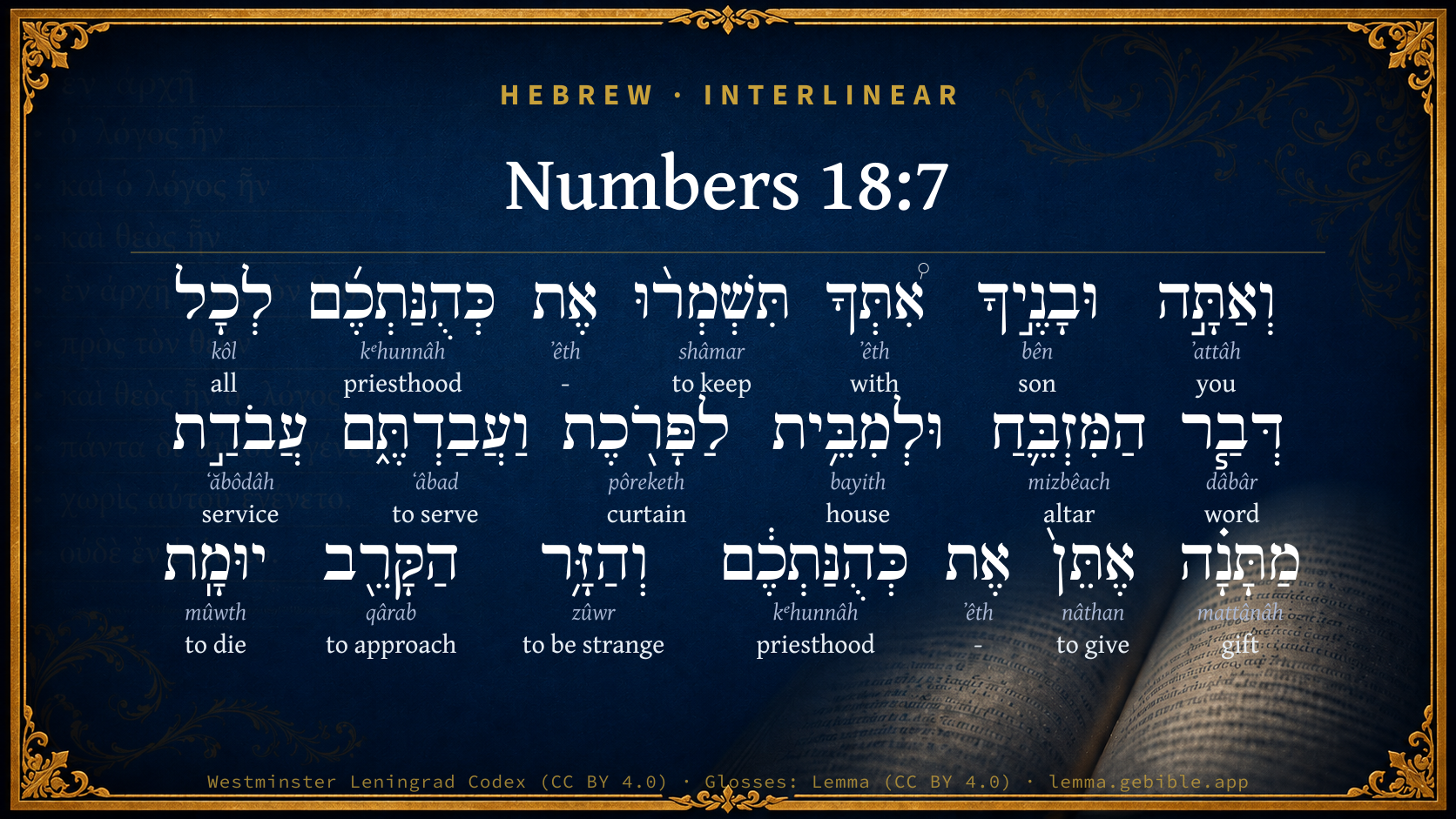
Hebrew (Westminster Leningrad Codex) Numbers 18:7 appears in the Hebrew Old Testament. The text above is from the Westminster Leningrad Codex. Each word links to its Strong’s number, a concise gloss, and parsing drawn from the Open Scriptures Hebrew Bible morphology. Click any word for its full Brown-Driver-Briggs (BDB) entry.
Download image
Cite this verse

Numbers 18:7 (World English Bible). Public Domain. Lemma interlinear Bible study tool, https://lemma.gebible.app/v/numbers/18/7.

Show BibTeX & RIS
BibTeX
RIS
English Translation
You and your sons with you shall keep your priesthood for everything of the altar, and for that within the veil; and you shall serve: I give you the priesthood as a service of gift: and the stranger who comes near shall be put to death.
World English Bible · Public Domain
Download a study sheet

One document with this verse’s original text, its word-by-word gloss line, the meaning frame, cross-references with their text, attributed commentary, and full source and license credits — printable, and it pastes into notes with its structure intact.

This verse Autodidact and up

Study sheet (.html) Plain text (.txt)

A passage Seminary Student

Up to 50 verses in one chapter. A passage sheet keeps up to 6 commentary sources and 12 cross-references per verse, in the order this page ranks them, and says so on the sheet whenever that leaves anything out. Ask for a single verse and you get the Autodidact verse sheet above.

Everything on this page stays free to read, with no account — the sheet is a download of what is already on screen, not access to it.

Want to remove ads? Support Godless Engineer
Compare translations 3

The same verse in 3 English versions, stacked beneath the original-language interlinear above. Click any original word for its lexicon entry.

Each is an independent rendering of the whole verse — the interlinear is not word-aligned to these translations.

Highlighted words mark where these versions differ — a whole-verse word diff, not a word-by-word alignment.

  • World English Bible Public Domain
    You and your sons with you shall keep your priesthood for everything of the altar, and for that within the veil; and you shall serve: I give you the priesthood as a service of gift: and the stranger who comes near shall be put to death.
  • King James Version Public Domain
    Therefore thou and thy sons with thee shall keep your priest's office for everything of the altar, and within the vail; and ye shall serve: I have given your priest's office unto you as a service of gift: and the stranger that cometh nigh shall be put to death.
  • unfoldingWord Literal Text CC BY-SA 4.0
    And you and your sons with you shall keep your priesthood for every matter of the altar and for inside the veil, and you shall serve. I give your priesthood a service of a gift. And the stranger who comes near shall be put to death.”

unfoldingWord Literal Text — © unfoldingWord, licensed CC BY-SA 4.0. Word-aligned USFM3 via Door43 (git.door43.org/unfoldingWord/en_ult).

Versions to compare (up to 4)

3 of 4 selected

Show all 18 translations

Every available English version of this verse, each an independent rendering of the whole verse.

  • World English Bible Public Domain
    You and your sons with you shall keep your priesthood for everything of the altar, and for that within the veil; and you shall serve: I give you the priesthood as a service of gift: and the stranger who comes near shall be put to death.
  • Berean Standard Bible Public Domain
    But only you and your sons shall attend to your priesthood for everything concerning the altar and what is inside the veil, and you are to perform that service. I am giving you the work of the priesthood as a gift, but any outsider who comes near the sanctuary must be put to death.”
  • Majority Standard Bible Public Domain
    But only you and your sons shall attend to your priesthood for everything concerning the altar and what is inside the veil, and you are to perform that service. I am giving you the work of the priesthood as a gift, but any outsider who comes near the sanctuary must be put to death.”
  • King James Version Public Domain
    Therefore thou and thy sons with thee shall keep your priest's office for everything of the altar, and within the vail; and ye shall serve: I have given your priest's office unto you as a service of gift: and the stranger that cometh nigh shall be put to death.
  • American Standard Version (1901) Public Domain
    And thou and thy sons with thee shall keep your priesthood for everything of the altar, and for that within the veil; and ye shall serve: I give you the priesthood as a service of gift: and the stranger that cometh nigh shall be put to death.
  • Revised Version (1885) Public Domain
    And thou and thy sons with thee shall keep your priesthood for every thing of the altar, and for that within the veil; and ye shall serve: I give you the priesthood as a service of gift: and the stranger that cometh nigh shall be put to death.
  • Geneva Bible (1599) Public Domain
    But thou, and thy sonnes with thee shall keepe your Priestes office for all things of the altar, and within the vaile: therefore shall ye serue: for I haue made your Priestes office an office of seruice: therefore the stranger that cometh neere, shalbe slayne.
  • Douay-Rheims (1899) Public Domain
    But thou and thy sons look ye to the priesthood: and all things that pertain to the service of the altar, and that are within the veil, shall be executed by the priests. If any stranger shall approach, he shall be slain.
  • Young's Literal Translation Public Domain
    and thou, and thy sons with thee, do keep your priesthood, for everything of the altar, and within the vail, and ye have served; a service of gift I make your priesthood; and the stranger who is coming near is put to death.'
  • Literal Standard Version CC BY-SA 4.0
    and you and your sons with you keep your priesthood for everything of the altar and within the veil, and you have served; I make your priesthood a gift [for] service; and the stranger who is coming near is put to death.”
  • Unlocked Literal Bible CC BY-SA 4.0
    But only you and your sons may exercise the priesthood regarding everything connected with the altar and everything inside the curtain. You yourselves must fulfill those responsibilities. I am giving you the priesthood as a gift. Any foreigner who approaches must be put to death.”
  • unfoldingWord Literal Text CC BY-SA 4.0
    And you and your sons with you shall keep your priesthood for every matter of the altar and for inside the veil, and you shall serve. I give your priesthood a service of a gift. And the stranger who comes near shall be put to death.”
  • Darby Bible Public Domain
    But thou and thy sons with thee shall attend to your priesthood for all that concerneth the altar, and for that which is inside the veil; and ye shall perform the service: I give you your priesthood as a service of gift, and the stranger that cometh near shall be put to death.
  • World Messianic Bible Public Domain
    You and your sons with you shall keep your priesthood for everything of the altar, and for that within the veil. You shall serve. I give you the service of the priesthood as a gift. The stranger who comes near shall be put to death.”
  • Webster's Bible Public Domain
    Therefore thou and thy sons with thee shall keep your priest's office for every thing of the altar, and within the vail; and ye shall serve: I have given your priest's office to you as a service of gift: and the stranger that cometh nigh shall be put to death.
  • Free Bible Version CC BY-SA 4.0
    But only you and your sons are responsible for your priesthood, doing all that concerns the altar and is behind the veil. Only you are to perform that service. I am giving you the gift of your priesthood, but anyone else who approaches the sanctuary must be executed.”
  • Bible in Basic English Public Domain
    And you and your sons with you are to be responsible as priests for the altar and everything on it, and everything inside the veil; you are to do the work of priests; I have given you your position as priests; and any other man who comes near will be put to death.
  • JPS Tanakh (1917) Public Domain
    And thou and thy sons with thee shall keep your priesthood in everything that pertaineth to the altar, and to that within the veil; and ye shall serve; I give you the priesthood as a service of gift; and the common man that draweth nigh shall be put to death.'

Literal Standard Version (2020), Covenant Press — licensed CC BY-SA 4.0. Text via the HelloAO Bible API (eBible.org). Unlocked Literal Bible (unfoldingWord) — licensed CC BY-SA 4.0. Text via the HelloAO Bible API (eBible.org). unfoldingWord Literal Text — © unfoldingWord, licensed CC BY-SA 4.0. Word-aligned USFM3 via Door43 (git.door43.org/unfoldingWord/en_ult). Free Bible Version, Dr. Jonathan Gallagher — licensed CC BY-SA 4.0. Text via the HelloAO Bible API (eBible.org).

Word by word

More ways to search: Search by grammar → Find every occurrence → Compare this word →

Practice this passage: Drill this verse → Learn its vocabulary →

כְּהֻנַּתְכֶ֜ם
kᵉhunnâh
H3550
“priesthood · your”
Noun, Common, Feminine, Singular, Construct + Suffix, Personal, 2nd Person, Masculine, Plural
Part of Speech
Noun
Type
Common
Gender
Feminine
Number
Singular
State
Construct
Full BDB Definition

Origin: from H3547

TWOT: 959b

priesthood
  1. וְאַתָּ֣ה ʼattâh H859 “and · you” Conjunction + Pronoun, Personal, 2nd Person, Masculine, Singular
  2. וּבָנֶ֣יךָ bên H1121 “and · sons · your” Conjunction + Noun, Common, Masculine, Plural, Construct + Suffix, Personal, 2nd Person, Masculine, Singular
  3. אִ֠תְּךָ ʼêth H854 “with · you” Preposition + Suffix, Personal, 2nd Person, Masculine, Singular
  4. תִּשְׁמְר֨וּ shâmar H8104 “to keep” Verb, Qal, Imperfect, 2nd Person, Masculine, Plural
  5. אֶת ʼêth H853 “-” Particle, Direct Object
  6. לְכָל kôl H3605 “to/for · all of” Preposition + Noun, Common, Masculine, Singular, Construct
  7. דְּבַ֧ר dâbâr H1697 “word of” Noun, Common, Masculine, Singular, Construct
  8. הַמִּזְבֵּ֛חַ mizbêach H4196 “the · altar” Particle, Definite Article + Noun, Common, Masculine, Singular, Absolute
  9. וּלְמִבֵּ֥ית bayith H1004 “and · to/for · from · house of” Conjunction + Preposition + Preposition + Noun, Common, Masculine, Singular, Construct
  10. לַפָּרֹ֖כֶת pôreketh H6532 “to/for the · curtain” Preposition, Determined + Noun, Common, Feminine, Singular, Absolute
  11. וַעֲבַדְתֶּ֑ם ʻâbad H5647 “and · to serve” Conjunction + Verb, Qal, Sequential Perfect, 2nd Person, Masculine, Plural
  12. עֲבֹדַ֣ת ʻăbôdâh H5656 “service of” Noun, Common, Feminine, Singular, Construct
  13. מַתָּנָ֗ה mattânâh H4979 “gift” Noun, Common, Feminine, Singular, Absolute
  14. אֶתֵּן֙ nâthan H5414 “to give” Verb, Qal, Imperfect, 1st Person, Common, Singular
  15. אֶת ʼêth H853 “-” Particle, Direct Object
  16. כְּהֻנַּתְכֶ֔ם kᵉhunnâh H3550 “priesthood · your” Noun, Common, Feminine, Singular, Construct + Suffix, Personal, 2nd Person, Masculine, Plural
  17. וְהַזָּ֥ר zûwr H2114 “and · the · strange” Conjunction + Particle, Definite Article + Adjective, Adjective, Masculine, Singular, Absolute
  18. הַקָּרֵ֖ב qârab H7126 “the · approaching” Particle, Definite Article + Adjective, Adjective, Masculine, Singular, Absolute
  19. יוּמָֽת mûwth H4191 “to die” Verb, Hophal, Imperfect, 3rd Person, Masculine, Singular

About this verse

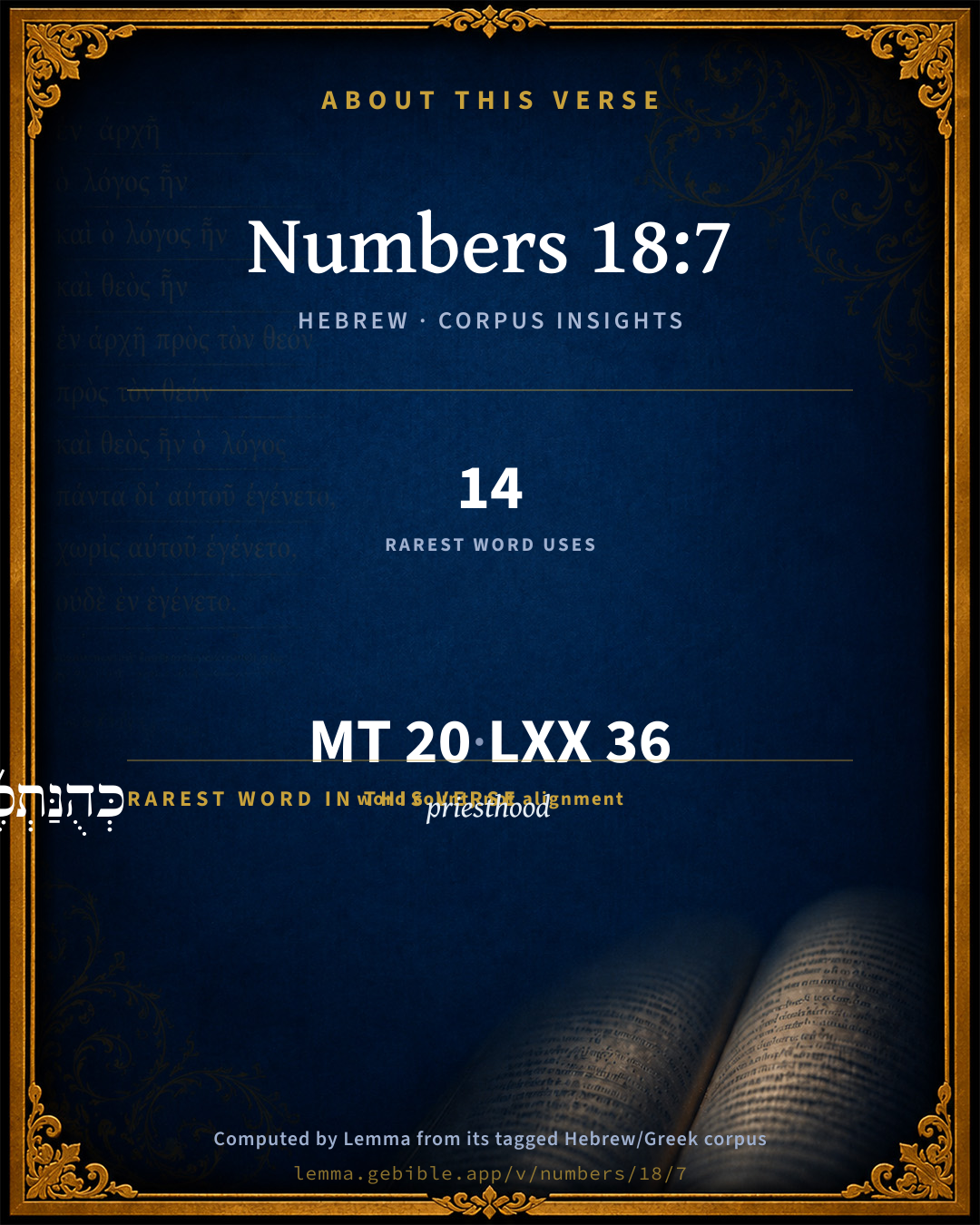
These counts appear in no published source. They are computed here, from the morphology-tagged text and Lemma’s own curated glosses. What Lemma adds →

20
words
18
distinct lemmas
Pentateuch
section

Notable vocabulary

The rarest word here is כְּהֻנַּתְכֶ֜ם priesthood H3550 — appearing just 14 times in the whole Hebrew Bible.

Shared distinctive vocabulary

כְּהֻנַּתְכֶ֜ם priesthood H3550 occurs in 12 verses of the Hebrew Bible. Also found in:

Grammatical profile

  • 4 verbs
  • 10 nouns
  • 2 adjectives
  • 1 pronoun
  • 1 preposition
  • 2 particles

Verb forms

  • תִּשְׁמְר֨וּ Qal · Imperfect
  • וַעֲבַדְתֶּ֑ם Qal · Sequential Perfect
  • אֶתֵּן֙ Qal · Imperfect
  • יוּמָֽת Hophal · Imperfect

Repetition

A word recurs within this verse — often emphatic in Hebrew:

  • כְּהֻנַּתְכֶ֜ם priesthood H3550 ×2

Hebrew & Septuagint length

In English translation the verse runs 46 words from the Hebrew and 49 from the Septuagint (LXX English) — closely comparable.

A rough comparison of the two English renderings, which tokenize alike — not a word-level alignment.

Word counts can differ between the Hebrew and the Greek without any difference in meaning — e.g. the Hebrew direct-object marker אֵת has no separate Greek word, and Greek often adds the article ὁ.

In the original languages it is 20 Hebrew tokens and 36 Greek tokens — but the two are counted differently (Hebrew bundles its prefixes and suffixes into one token; the Greek is in lemma form), so that isn’t a like-for-like length.

Cross-references

16

Topical passages linked to Numbers 18:7 in the Treasury of Scripture Knowledge — connected by theme and wording, ordered by reader-vote popularity; previews shown in the World English Bible.

  • Numbers 3:10 You shall appoint Aaron and his sons, and they shall keep their priesthood. The stranger who comes near shall be put to death."
  • John 3:27 John answered, "A man can receive nothing, unless it has been given him from heaven.
  • Romans 15:15–16 But I write the more boldly to you in part, as reminding you, because of the grace that was given to me by God,
  • Numbers 16:5–7 and he spoke to Korah and to all his company, saying, In the morning Yahweh will show who are his, and who is holy, and will cause him to come near to him: even him whom he shall choose will he cause to come near to him.
  • Numbers 16:40 to be a memorial to the children of Israel, to the end that no stranger, who isn't of the seed of Aaron, comes near to burn incense before Yahweh; that he not be as Korah, and as his company: as Yahweh spoke to him by Moses.
  • Numbers 18:4–5 They shall be joined to you, and keep the charge of the tent of meeting, for all the service of the Tent: and a stranger shall not come near to you.
  • Numbers 18:20 Yahweh said to Aaron, You shall have no inheritance in their land, neither shall you have any portion among them: I am your portion and your inheritance among the children of Israel.
  • Exodus 29:9 You shall dress them with belts, Aaron and his sons, and bind headbands on them: and they shall have the priesthood by a perpetual statute: and you shall consecrate Aaron and his sons.
  • Leviticus 16:2 and Yahweh said to Moses, "Tell Aaron your brother, not to come at all times into the Most Holy Place within the veil, before the mercy seat which is on the ark; lest he die: for I will appear in the cloud on the mercy seat.
  • Leviticus 16:12–14 He shall take a censer full of coals of fire from off the altar before Yahweh, and two handfuls of sweet incense beaten small, and bring it within the veil:
  • Numbers 1:51 When the tabernacle is to move, the Levites shall take it down; and when the tabernacle is to be set up, the Levites shall set it up. The stranger who comes near shall be put to death.
  • Numbers 3:38 Those who encamp before the tabernacle eastward, in front of the Tent of Meeting toward the sunrise, shall be Moses, and Aaron and his sons, keeping the charge of the sanctuary for the charge of the children of Israel. The stranger who comes near shall be put to death.
  • 1 Samuel 2:28 and did I choose him out of all the tribes of Israel to be my priest, to go up to my altar, to burn incense, to wear an ephod before me? and did I give to the house of your father all the offerings of the children of Israel made by fire?
  • Ephesians 3:8 To me, the very least of all saints, was this grace given, to preach to the Gentiles the unsearchable riches of Christ,
  • Hebrews 5:4 Nobody takes this honor on himself, but he is called by God, just like Aaron was.
  • Hebrews 9:3–6 After the second veil was the tabernacle which is called the Holy of Holies,

Cross-references courtesy of OpenBible.info (CC BY 4.0).

Hebrew and Greek witnesses Masoretic Hebrew ↔ Greek Septuagint

The same verse in the two great witnesses to the Old Testament, shown verse-for-verse.

These are two independent witnesses, not word-aligned to each other, and the Septuagint is shown in lemma (dictionary) form.

Hebrew Numbers 18:7 Masoretic · Westminster Leningrad Codex

וְאַתָּ֣ה וּבָנֶ֣יךָ אִ֠תְּךָ תִּשְׁמְר֨וּ אֶת כְּהֻנַּתְכֶ֜ם לְכָל דְּבַ֧ר הַמִּזְבֵּ֛חַ וּלְמִבֵּ֥ית לַפָּרֹ֖כֶת וַעֲבַדְתֶּ֑ם עֲבֹדַ֣ת מַתָּנָ֗ה אֶתֵּן֙ אֶת כְּהֻנַּתְכֶ֔ם וְהַזָּ֥ר הַקָּרֵ֖ב יוּמָֽת

You and your sons with you shall keep your priesthood for everything of the altar, and for that within the veil; and you shall serve: I give you the priesthood as a service of gift: and the stranger who comes near shall be put to death.

World English Bible · Public Domain

Greek LXX Numbers 18:7 Septuagint · lemma form

καί σύ καί ὁ υἱός σύ μετά σύ διατηρέω ὁ ἱερατεία σύ κατά πᾶς τρόπος ὁ θυσιαστήριον καί ὁ ἔνδοθεν ὁ καταπέτασμα καί λειτουργέω ὁ λειτουργία δόμα ὁ ἱερατεία σύ καί ὁ ἀλλογενής ὁ προςπορεύομαι ἀποθνήσκω

And you and your sons after you shall keep up your priestly ministration, according to the whole manner of the altar, and that which is within the veil; and you⌃ shall minister in the services as the office of your priesthood; and the stranger that comes near shall die.

LXX2012 (modern English Septuagint) · Public Domain

On this verse, The Cambridge Bible for Schools and Colleges discusses the Septuagint’s reading. Read the note in Commentary ↓

Hebrew: Westminster Leningrad Codex (CC BY 4.0). Greek: Septuagint (public domain); English from LXX2012 (modern English Septuagint) (Public Domain). How the Septuagint differs from the Hebrew →

Targum (Aramaic paraphrase)

2

The Targum is the ancient Jewish Aramaic paraphrase of the Hebrew Scriptures — an interpretive translation, not the Hebrew text itself. Onkelos (literal) and Pseudo-Jonathan (expansive) render the Torah, and Jonathan the Prophets. Coverage is partial: where no permissively-licensed English translation exists for a verse, only the Aramaic is shown. This is verse-level text, not a word-by-word alignment to the Hebrew.

  1. Targum Onkelos Torah (Genesis–Deuteronomy)
    וְאַתְּ וּבְנָךְ עִמָךְ תִּטְרוּן יָת כְּהוּנַתְכוֹן לְכָל פִּתְגַם מַדְבְּחָא וּלְמִגָיו לְפָרוּכְתָּא וְתִפְלְחוּן פוּלְחַן מַתְּנָא אֵיהַב יָת כְּהוּנַתְכוֹן וְחִילוֹנֵי דְיִקְרַב יִתְקְטֵיל

    (no public-domain English translation for this verse)

    Targum Onkelos — Aramaic: “Onkelos Genesis” (public domain); “Onkelos Exodus” (public domain); “Onkelos Leviticus” (public domain); “Onkelos Numbers” (public domain); “Onkelos Deuteronomy” (public domain). English: “Sefaria Community Translation” (CC0 1.0 (public-domain dedication)); “J.W. Etheridge. The Targums of Onkelos and Jonathan Ben Uzziel on the Pentateuch. London: Longmans, Green, 1862” (public domain). Text via Sefaria.

  2. Targum Pseudo-Jonathan Torah (Genesis–Deuteronomy)
    וְאַנְתְּ וּבְנָךְ עִמָךְ תִּנְטְרוּן יַת כְּהוּנַתְכוֹן לְכָל פִּתְגַם מַדְבְּחָא וּלְמִגֵיו לְפַרְגוֹדָא וְתִפְלְחוּן לְפוּם עַדְבַיָא כְּפוּלְחָנָא כֵּן מֵיכַל מַתָּנָה אֶתֵּן בִּרְבוּתָא יַת כְּהוּנַתְכוֹן וְחִילוֹנֵי דְיִקְרַב יִתְקְטֵיל

    But thou, and thy sons with thee, shall keep the charge of your priesthood in all things that pertain to the altar, and (those) within the veil, and shall minister by lots, according to the service. So, provision of food have I given you, on account of the anointing of your priesthood; and the stranger who cometh near shall die.

    Targum Pseudo-Jonathan — Aramaic: “Targum Jonathan on Genesis” (public domain); “Targum Jonathan on Exodus” (public domain); “Targum Jonathan on Leviticus” (public domain); “Targum Jonathan on Numbers” (public domain); “Targum Jonathan on Deuteronomy” (public domain). English: “The Targum of Jonathan ben Uzziel, trans. J. W. Etheridge, London, 1862” (public domain). Text via Sefaria.

Commentary

Notes on Numbers 18:7 from classic Christian and Jewish commentators (each source and its license shown beneath its notes). The classic Christian expositions comment on the surrounding passage and are grouped to its opening verse, so a note may address several verses; the Jewish commentaries on the Tanakh (Rashi and others) are per-verse, so they appear only where the commentator wrote on this verse.

Lemma curates 59 commentaries, every one of them public domain or Creative Commons licensed, each selected and text-cleaned for this edition rather than reprinted as found. About our sources →

Trapp's Complete Commentary

John Trapp

Num 18:7 Therefore thou and thy sons with thee shall keep your priest’s office for every thing of the altar, and within the vail; and ye shall serve: I have given your priest’s office [unto you] as a service of gift: and the stranger that cometh nigh shall be put to death.

Ver. 7. As a service of gift.] So our Saviour counts and calls his work a gift; "I have finished the work which thou gavest me to do." {Joh 17:4} Any employment for, and about God, is a special favour, a high honour.

John Trapp, A Commentary or Exposition upon All the Books of the Old and New Testament (1647–1656) — public domain. Text from a community e-Sword module.

MacLaren's Expositions of Holy Scripture

Alexander MacLaren

Numbers

SERVICE A GIFT

Num 18:7.

All Christians are priests-to offer sacrifices, alms, especially prayers; to make God known to men.

I. Our priesthood is a gift of God’s love.

We are apt to think of our duties as burdensome. They are an honour and a mark of God’s grace.

1. They are His gift-

{a} The power to do. All capacities and possessions from Him.

{b} The wish to do. ‘Worketh in you to will.’

{c} The right to do, through Christ.

2. They are a blessing.

{a} Note the good effects on ourselves-the increase of fellowship with Him, the strengthening of all holy desires.

{b} The future benefits. Apply this to prayer and to effort on behalf of our fellow-men.

II. Our priesthood is to be done as a service-under a sense of obligation to a master, with diligence {an [Greek: ergon], not a [Greek: parergon]}.

III. Our priesthood is to be done as a gift to God-to be done joyfully, giving ourselves back to Him: ‘Yield yourselves unto God’-’your reasonable service.’

Then only do we really possess ourselves, and ‘all things are ours, for we are Christ’s, and Christ is God’s.’

Alexander MacLaren, Expositions of Holy Scripture (1904–1910) — public domain. Text from a community e-Sword module.

Tyndale Open Study Notes

Tyndale Open Resources

18:7 Any unauthorized person . . . will be put to death: This verse warned Israelites at all levels in the sacred hierarchy to avoid areas where they were not allowed. Certain sacred places were off limits to those not qualified in a technical religious sense. Access to the most sacred areas was restricted, set apart for the holiest members of the religious community. Those who broke that taboo violated God’s holiness at the cost of their lives (see also 1:51, 53; 3:10, 29-38; 4:1-20).

Tyndale Open Study Notes — © Tyndale Open Resources, licensed CC BY-SA 4.0. Text via the HelloAO Bible API.

Geneva Bible (1599)

Geneva Bible translators

Or, gift.

Geneva Bible (1599) marginal notes — public domain. Text via Bolls.life.

Ellicott's Commentary for English Readers

(7) And within the vail.—i.e., the vail which separated the holy place from the most holy. The word which is employed in this place (parocheth) is used only of the second vail. (See Lev_16:12.) When the outer vail or hanging is designed to be understood, the word used is masak. The reference appears to be to the whole of the priestly duties which were discharged by Aaron and his sons, from those connected with the altar of burnt offering to those which were performed in the most holy place.

A Bible Commentary for English Readers, edited by Charles John Ellicott (1878–1897) — public domain. Text from a community e-Sword module.

The Cambridge Bible for Schools and Colleges

gen. ed. J. J. S. Perowne

7. shall keep your priesthood] i.e. perform its distinctive duties.

within the veil] viz. the first hanging, at the entrance to the Holy Place. The Levites were debarred from entering any part of the tent, and from contact with the altar of burnt-offering in the court.

as a service of gift] The expression (if the text be correct) emphasizes the fact that the priests had done nothing to deserve these privileges; they were a free gift. The LXX. suggest a different reading—‘Ye shall perform the acts of service (as a) gift of your priesthood’; but the meaning is substantially the same. S. Paul gives similar teaching with regard to Christian privileges, 1Co_4:7.

The Cambridge Bible for Schools and Colleges (gen. ed. J. J. S. Perowne; Cambridge University Press, 1878–1918) — public domain. Text from a community e-Sword module.

John Gill's Exposition

Therefore thou and thy sons with thee shall keep your priest's office,.... Observe all the duties of it, and keep out others from intruding into it:

for everything of the altar: both of incense and of burnt offering with respect to burning incense on the one, and offering sacrifices on the other; both were to be done by priests, and by no other:

and within the vail; in the most holy place, where the high priest entered but once a year, and he only with incense, and the blood of sacrifices, see Heb 9:7,

and ye shall serve; do all the business that is to be done at either altar, whether in the court, or in the holy place, and whatsoever is to be done in the most holy place within the vail:

I have given your priest's office unto you as a service of gift; it was not what they had taken to themselves of their own will, or had thrust themselves into, but what the Lord had called them to, and had freely invested them with, see Heb 5:4,

and the stranger that cometh nigh shall be put to death; any common person, as the Targums of Onkelos and Jonathan; any Israelite, one that is a stranger from the priests, though a Levite, as Aben Ezra; such an one might not come either to the altar of burnt offering to offer any sacrifice upon it, or the altar of incense, to burn incense on that, or trim the lamps, or put the shewbread in order, or to do anything peculiar to the priest's office.

John Gill's Exposition of the Whole Bible (1746–1763) — public domain (CC PDM 1.0). Text via the HelloAO Bible API.

Haydock's Catholic Bible Commentary

Priests. Hebrew, "you shall serve in the ministry of priests which I have given you." The office was not due to them on account of any superior merit. (Haydock)

George Leo Haydock (1774–1849), Haydock's Catholic Family Bible and Commentary, 1859 edition — public domain. Excludes Psalms (Douay-Rheims chapter numbering differs from Protestant) and Deuterocanonical books (Catholic canon only).

Matthew Poole's English Annotations

The altar, to wit, of burnt-offering, as appears from the following words.

Within the veil. This phrase elsewhere signifies the inward or second veil, but here it signifies either the outward veil only, or rather both the veils, the singular number being put for the plural, as when the altar is put for both the altars, as hath been noted; and so this phrase comprehends both the holy and the most holy place.

As a service of gift; as a gift which I have freely conferred upon you, and upon you alone; and therefore let no man henceforth dare either to charge you with arrogance and usurpation in appropriating this to yourselves, or to invade your office.

Matthew Poole's English Annotations on the Holy Bible (1683–1685) — public domain. Text from a community e-Sword/MySword module.

Whedon's Commentary on the Bible

Daniel D. Whedon

7. Every thing of the altar — That is, in the first or priests’ court.

Within the vail — The holy of holies, accessible only to the high priest on the day of atonement. Lev_16:12, note.

As a service of gift — The office of the priest was not to be discharged from constraint as a duty, but freely and gladly as an avenue through which the loving soul might pour its gratitude to the Giver. Thus Paul deemed himself the recipient of undeserved “grace,” that he might preach, not among his kinsmen, whom he loved better than his own life, but among the despised Gentiles, “the unsearchable riches of Christ.” The highest Christian experience has not been reached when the opportunity of the humblest service to Christ is not joyfully received as a gracious privilege. When the wife begins to care for the household from mere duty, and not from love to her husband, her home becomes a prison.

The stranger — All persons except the sons of Aaron. See Num_1:51, note.

Shall be put to death — Not by the verdict of a human tribunal, but by the judgment of God. See Num_4:18, note. In the days of Ezekiel God complains of the flagrant violation of this law, when strangers and people uncircumcised in heart and in flesh polluted the sanctuary. Eze_44:7.

Daniel D. Whedon (gen. ed.), Commentary on the Old and New Testaments (1874–1909) — public domain. Text from a community e-Sword module.

The Pulpit Commentary

Shall keep your priests" office for everything of the altar, and within the vail. That the Levites were made over to Aaron and his sons to relieve them of a great part of the mere routine and drudgery of their service was to be with them an additional and powerful motive for doing their priestly work so reverently and watchfully as to leave no excuse for sacrilegious intrusion. The altar (of burnt offering) and "that within the vail (of. Heb_6:19) were the two points between which the exclusive duties of the priesthood lay, including the service of the holy place. A service of gift. A service which was not to be regarded as a burden, or a misfortune, or as a natural heritage and accident of birth, but to be received and cherished as a favour accorded to them by the goodness of God.

The Pulpit Commentary (1880–1919), ed. H.D.M. Spence-Jones & Joseph S. Exell — public domain. Text from a community e-Sword module.

John Wesley's Explanatory Notes

The altar - Of burnt-offering. Within the veil - This phrase here comprehends both the holy and the most holy place. As a gift which I have freely conferred upon you, and upon you alone; and therefore let no man henceforth dare either to charge you with arrogance in appropriating this to yourselves, or to invade your office.

John Wesley, Explanatory Notes Upon the Whole Bible (1754–1765) — public domain. Text via the GEBible commentary corpus.

Rashi

Rabbi Shlomo Yitzchaki (Rashi)

עבדת מתנה [I HAVE GIVEN YOUR PRIESTHOOD UNTO YOU] AS A SERVICE OF GIFT — This means as a gift have I given it to you, [and the stranger that comes near shall die].

Rashi on the Tanakh — English translations: “The Judaica Press complete Tanach with Rashi, translated by A. J. Rosenberg” (CC BY 4.0); “Pentateuch with Rashi's commentary by M. Rosenbaum and A.M. Silbermann, 1929-1934” (public domain); “The Metsudah Tanach series, Lakewood, N.J” (CC BY 4.0); and “The Book of Joshua, Metsudah Publications, 1997” (CC BY 4.0). Text via Sefaria.

Ramban (Nachmanides)

Rabbi Moshe ben Nachman (Ramban / Nachmanides)

I GIVE YOU THE PRIESTHOOD AS A SERVICE OF GIFT. “[This means that] it shall be to you as a gift.” This is Rashi’s language, and his intention thereby is to state that it is given to you as a complete gift, [to such an extent] that [as the verse continues], a non-priest who draws near [to do the service] will be liable to be put to death [by the hand of Heaven]. The correct interpretation appears to me to be that He is saying: “and you shall perform the service of the priesthood, but it is not to be regarded by you as a burdensome task, like that imposed upon the servants of kings, but I have given you the service of a great gift through it, for glory and for splendor, 28:2. from Me.” This is similar to the interpretation of the Rabbis: “L’moshchah — as a distinction, [so that gifts given to the priests from the offerings are to be eaten by them] in the way that kings eat.”

Ramban (Nachmanides) on the Tanakh — English translation: “Commentary on the Torah by Ramban (Nachmanides). Translated and annotated by Charles B. Chavel. New York, Shilo Pub. House, 1971-1976” (CC BY 4.0). Text via Sefaria.

Lesson kit

Teaching starters — assembled from the data on this page, not authored interpretation. Every prompt links to the verse data it draws on. Edit before teaching.

Numbers, in the Pentateuch, opens this verse with 20 words (18 distinct Hebrew lemmas). Its most distinctive word is kᵉhunnâh (“priesthood”). A historical commentator’s framing appears above. Read the whole chapter for the surrounding context.

Discussion questions

  1. The word kᵉhunnâh carries the sense “priesthood.” How does it shape the verse?
  2. Exodus 29:9 shares the word «priesthood» with this verse. How do the two illuminate each other?
  3. “priesthood” occurs 2× in this one verse. What is the effect of the repetition?
  4. The translations on this page render this verse differently — a whole-verse word diff, not a word-by-word alignment. What might account for the different wordings?
  5. The verb «תִּשְׁמְר֨וּ» is Qal Imperfect. How does its form color the action?
  6. Reading how Trapp's Complete Commentary and MacLaren's Expositions of Holy Scripture read this verse, where do the two commentators agree and where do they part?

Things to notice

Reading settings

Reading text

Shown beneath each verse's original-language words.

Old Testament
Old Testament edition

Read the OT as the Masoretic Hebrew (MT) or the Greek Septuagint (LXX).

English shown for the Greek Septuagint (in the Hebrew ↔ Greek comparison).

Comparing translations? Open the Compare panel on any verse page to stack up to four side by side.