Genesis 35:8

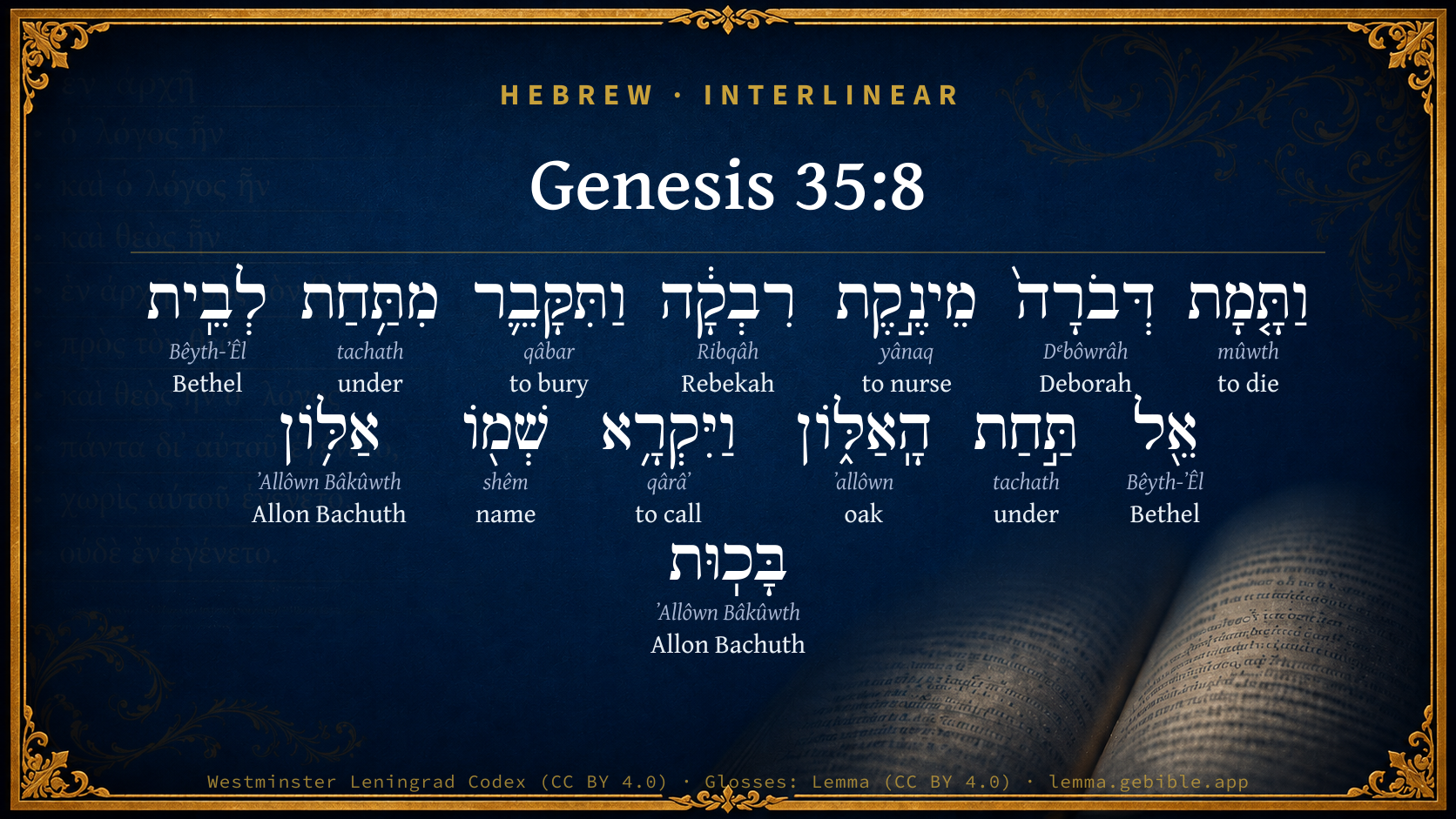
Hebrew (Westminster Leningrad Codex) Genesis 35:8 appears in the Hebrew Old Testament. The text above is from the Westminster Leningrad Codex. Each word links to its Strong’s number, a concise gloss, and parsing drawn from the Open Scriptures Hebrew Bible morphology. Click any word for its full Brown-Driver-Briggs (BDB) entry.
Download image
Cite this verse

Genesis 35:8 (World English Bible). Public Domain. Lemma interlinear Bible study tool, https://lemma.gebible.app/v/genesis/35/8.

Show BibTeX & RIS
BibTeX
RIS
English Translation
Deborah, Rebekah's nurse, died, and she was buried below Bethel under the oak; and the name of it was called Allon Bacuth.
World English Bible · Public Domain
Highlights
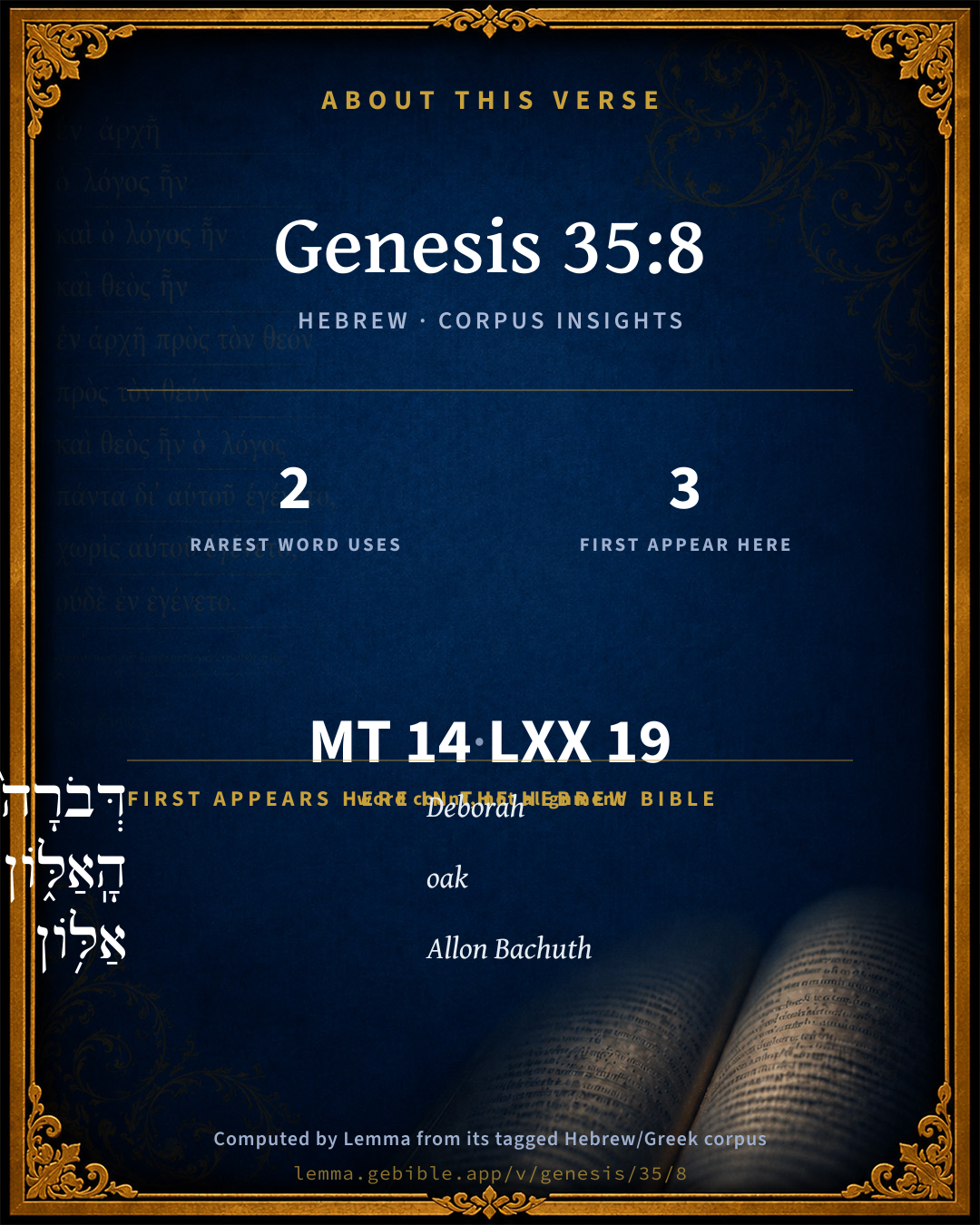
  • 3 first appearances in the Hebrew Bible
Full analysis ↓
Download a study sheet

One document with this verse’s original text, its word-by-word gloss line, the meaning frame, cross-references with their text, attributed commentary, and full source and license credits — printable, and it pastes into notes with its structure intact.

This verse Autodidact and up

Study sheet (.html) Plain text (.txt)

A passage Seminary Student

Up to 50 verses in one chapter. A passage sheet keeps up to 6 commentary sources and 12 cross-references per verse, in the order this page ranks them, and says so on the sheet whenever that leaves anything out. Ask for a single verse and you get the Autodidact verse sheet above.

Everything on this page stays free to read, with no account — the sheet is a download of what is already on screen, not access to it.

Want to remove ads? Support Godless Engineer
Compare translations 3

The same verse in 3 English versions, stacked beneath the original-language interlinear above. Click any original word for its lexicon entry.

Each is an independent rendering of the whole verse — the interlinear is not word-aligned to these translations.

Highlighted words mark where these versions differ — a whole-verse word diff, not a word-by-word alignment.

  • World English Bible Public Domain
    Deborah, Rebekah's nurse, died, and she was buried below Bethel under the oak; and the name of it was called Allon Bacuth.
  • King James Version Public Domain
    But Deborah Rebekah's nurse died, and she was buried beneath Bethel under an oak: and the name of it was called Allonbachuth.
  • unfoldingWord Literal Text CC BY-SA 4.0
    Then Deborah, the nurse of Rebekah, died and was buried below Bethel, under the oak tree. So he called its name Allon Bacuth.

unfoldingWord Literal Text — © unfoldingWord, licensed CC BY-SA 4.0. Word-aligned USFM3 via Door43 (git.door43.org/unfoldingWord/en_ult).

Versions to compare (up to 4)

3 of 4 selected

Show all 18 translations

Every available English version of this verse, each an independent rendering of the whole verse.

  • World English Bible Public Domain
    Deborah, Rebekah's nurse, died, and she was buried below Bethel under the oak; and the name of it was called Allon Bacuth.
  • Berean Standard Bible Public Domain
    Now Deborah, Rebekah’s nurse, died and was buried under the oak below Bethel. So Jacob named it Allon-bachuth.
  • Majority Standard Bible Public Domain
    Now Deborah, Rebekah’s nurse, died and was buried under the oak below Bethel. So Jacob named it Allon-bacuth.
  • King James Version Public Domain
    But Deborah Rebekah's nurse died, and she was buried beneath Bethel under an oak: and the name of it was called Allonbachuth.
  • American Standard Version (1901) Public Domain
    And Deborah Rebekah's nurse died, and she was buried below Beth-el under the oak: and the name of it was called Allon-bacuth.
  • Revised Version (1885) Public Domain
    And Deborah Rebekah’s nurse died, and she was buried below Beth-el under the oak: and the name of it was called Allon-bacuth.
  • Geneva Bible (1599) Public Domain
    Then Deborah Rebekahs nourse dyed, and was buried beneath Beth-el vnder an oke: and he called the name of it Allon Bachuth.
  • Douay-Rheims (1899) Public Domain
    At the same time Debora the nurse of Rebecca died, and was buried at the foot of Bethel under an oak: and the name of that place was called, The oak of weeping.
  • Young's Literal Translation Public Domain
    And Deborah, Rebekah's nurse, dieth, and she is buried at the lower part of Bethel, under the oak, and he calleth its name `Oak of weeping.'
  • Literal Standard Version CC BY-SA 4.0
    And Deborah, Rebekah’s nurse, dies, and she is buried at the lower part of Bethel, under the oak, and he calls its name “Oak of Weeping.”
  • Unlocked Literal Bible CC BY-SA 4.0
    Deborah, Rebekah's nurse, died. She was buried down from Bethel under the oak tree, so it was called Allon Bakuth.
  • unfoldingWord Literal Text CC BY-SA 4.0
    Then Deborah, the nurse of Rebekah, died and was buried below Bethel, under the oak tree. So he called its name Allon Bacuth.
  • Darby Bible Public Domain
    And Deborah, Rebecca's nurse, died; and she was buried beneath Bethel, under the oak; and the name of it was called Allon-bachuth.
  • World Messianic Bible Public Domain
    Deborah, Rebekah’s nurse, died, and she was buried below Bethel under the oak; and its name was called Allon Bacuth.
  • Webster's Bible Public Domain
    But Deborah, Rebekah's nurse, died, and she was buried beneath Beth-el, under an oak: and the name of it was called Allon-bachuth.
  • Free Bible Version CC BY-SA 4.0
    Deborah, Rebekah's nurse, died and was buried under the oak near Bethel. So it was named “the oak of weeping.”
  • Bible in Basic English Public Domain
    And Deborah, the servant who had taken care of Rebekah from her birth, came to her end, and was put to rest near Beth-el, under the holy tree: and they gave it the name of Allon-bacuth.
  • JPS Tanakh (1917) Public Domain
    And Deborah Rebekah's nurse died, and she was buried below Beth-el under the oak; and the name of it was called Allon-bacuth.

Literal Standard Version (2020), Covenant Press — licensed CC BY-SA 4.0. Text via the HelloAO Bible API (eBible.org). Unlocked Literal Bible (unfoldingWord) — licensed CC BY-SA 4.0. Text via the HelloAO Bible API (eBible.org). unfoldingWord Literal Text — © unfoldingWord, licensed CC BY-SA 4.0. Word-aligned USFM3 via Door43 (git.door43.org/unfoldingWord/en_ult). Free Bible Version, Dr. Jonathan Gallagher — licensed CC BY-SA 4.0. Text via the HelloAO Bible API (eBible.org).

Word by word

More ways to search: Search by grammar → Find every occurrence → Compare this word →

Practice this passage: Drill this verse → Learn its vocabulary →

אַלּ֥וֹן
ʼAllôwn Bâkûwth
H439
“Allon Bachuth”
Noun, Proper
Part of Speech
Noun
Type
Proper
Full BDB Definition

Origin: from H437 and a variation of H1068

TWOT: None

Allon Bachuth = "oak of weeping" - site of Deborah's (Rebekah's nurse) grave near Bethel
  1. וַתָּ֤מָת mûwth H4191 “and · to die” Conjunction + Verb, Qal, Sequential Imperfect, 3rd Person, Feminine, Singular
  2. דְּבֹרָה֙ Dᵉbôwrâh H1683 “Deborah” Noun, Proper
  3. מֵינֶ֣קֶת yânaq H3243 “nurse of” Noun, Common, Feminine, Singular, Construct
  4. רִבְקָ֔ה Ribqâh H7259 “Rebekah” Noun, Proper
  5. וַתִּקָּבֵ֛ר qâbar H6912 “and · to bury” Conjunction + Verb, Niphal, Sequential Imperfect, 3rd Person, Feminine, Singular
  6. מִתַּ֥חַת tachath H8478 “from · under” Preposition + Preposition
  7. לְבֵֽית Bêyth-ʼÊl H1008 “to/for · Bethel” Preposition + Noun, Proper
  8. אֵ֖ל Bêyth-ʼÊl H1008 “Bethel” Noun, Proper
  9. תַּ֣חַת tachath H8478 “under” Preposition
  10. הָֽאַלּ֑וֹן ʼallôwn H437 “the · oak” Particle, Definite Article + Noun, Common, Masculine, Singular, Absolute
  11. וַיִּקְרָ֥א qârâʼ H7121 “and · to call” Conjunction + Verb, Qal, Sequential Imperfect, 3rd Person, Masculine, Singular
  12. שְׁמ֖וֹ shêm H8034 “name · his” Noun, Common, Masculine, Singular, Construct + Suffix, Personal, 3rd Person, Masculine, Singular
  13. בָּכֽוּת ʼAllôwn Bâkûwth H439 “Allon Bachuth” Noun, Proper

About this verse

These counts appear in no published source. They are computed here, from the morphology-tagged text and Lemma’s own curated glosses. What Lemma adds →

14
words
11
distinct lemmas
Pentateuch
section

Notable vocabulary

The rarest word here is אַלּ֥וֹן Allon Bachuth H439 — appearing just 2 times in the whole Hebrew Bible.

First appearance in Scripture

These words make their first canonical appearance in the Hebrew Bible here:

  • דְּבֹרָה֙ Deborah H1683
  • הָֽאַלּ֑וֹן oak H437
  • אַלּ֥וֹן Allon Bachuth H439

Grammatical profile

  • 3 verbs
  • 9 nouns
  • 2 prepositions

Verb forms

  • וַתָּ֤מָת Qal · Sequential Imperfect
  • וַתִּקָּבֵ֛ר Niphal · Sequential Imperfect
  • וַיִּקְרָ֥א Qal · Sequential Imperfect

Repetition

Words recur within this verse — often emphatic in Hebrew:

  • מִתַּ֥חַת under H8478 ×2
  • לְבֵֽית Bethel H1008 ×2
  • אַלּ֥וֹן Allon Bachuth H439 ×2

Hebrew & Septuagint length

In English translation the verse runs 22 words from the Hebrew and 22 from the Septuagint (LXX English) — the same length.

A rough comparison of the two English renderings, which tokenize alike — not a word-level alignment.

Word counts can differ between the Hebrew and the Greek without any difference in meaning — e.g. the Hebrew direct-object marker אֵת has no separate Greek word, and Greek often adds the article ὁ.

In the original languages it is 14 Hebrew tokens and 19 Greek tokens — but the two are counted differently (Hebrew bundles its prefixes and suffixes into one token; the Greek is in lemma form), so that isn’t a like-for-like length.

Cross-references

4

Topical passages linked to Genesis 35:8 in the Treasury of Scripture Knowledge — connected by theme and wording, ordered by reader-vote popularity; previews shown in the World English Bible.

  • Genesis 24:59 They sent away Rebekah, their sister, with her nurse, Abraham's servant, and his men.
  • 1 Samuel 31:13 They took their bones, and buried them under the tamarisk tree in Jabesh, and fasted seven days.
  • Judges 2:1 The angel of Yahweh came up from Gilgal to Bochim. He said, I made you to go up out of Egypt, and have brought you to the land which I swore to your fathers; and I said, I will never break my covenant with you:
  • Judges 2:5 They called the name of that place Bochim: and they sacrificed there to Yahweh.

Cross-references courtesy of OpenBible.info (CC BY 4.0).

Hebrew and Greek witnesses Masoretic Hebrew ↔ Greek Septuagint

The same verse in the two great witnesses to the Old Testament, shown verse-for-verse.

These are two independent witnesses, not word-aligned to each other, and the Septuagint is shown in lemma (dictionary) form.

Hebrew Genesis 35:8 Masoretic · Westminster Leningrad Codex

וַתָּ֤מָת דְּבֹרָה֙ מֵינֶ֣קֶת רִבְקָ֔ה וַתִּקָּבֵ֛ר מִתַּ֥חַת לְבֵֽית אֵ֖ל תַּ֣חַת הָֽאַלּ֑וֹן וַיִּקְרָ֥א שְׁמ֖וֹ אַלּ֥וֹן בָּכֽוּת

Deborah, Rebekah's nurse, died, and she was buried below Bethel under the oak; and the name of it was called Allon Bacuth.

World English Bible · Public Domain

Greek LXX Genesis 35:8 Septuagint · lemma form

ἀποθνήσκω δέ δεββωρα ὁ τροφός ρεβεκκα κατώ βαιθηλ ὑπό ὁ βάλανος καί καλέω ἰακώβ ὁ ὄνομα αὐτός βάλανος πένθος

And Deborrha, Rebecca's nurse, died, and was buried below Baethel under the oak; and Jacob called its name, The Oak of Mourning.

LXX2012 (modern English Septuagint) · Public Domain

Hebrew: Westminster Leningrad Codex (CC BY 4.0). Greek: Septuagint (public domain); English from LXX2012 (modern English Septuagint) (Public Domain). How the Septuagint differs from the Hebrew →

Targum (Aramaic paraphrase)

2

The Targum is the ancient Jewish Aramaic paraphrase of the Hebrew Scriptures — an interpretive translation, not the Hebrew text itself. Onkelos (literal) and Pseudo-Jonathan (expansive) render the Torah, and Jonathan the Prophets. Coverage is partial: where no permissively-licensed English translation exists for a verse, only the Aramaic is shown. This is verse-level text, not a word-by-word alignment to the Hebrew.

  1. Targum Onkelos Torah (Genesis–Deuteronomy)
    וּמִיתַת דְּבוֹרָה מֵנִקְתָּא דְרִבְקָה וְאִתְקְבָרַת מִלְרַע לְבֵית אֵל בְּשִׁפּוֹלֵי מֵישְׁרָא וּקְרָא שְׁמֵּהּ מֵישַׁר בָּכִיתָא

    (no public-domain English translation for this verse)

    Targum Onkelos — Aramaic: “Onkelos Genesis” (public domain); “Onkelos Exodus” (public domain); “Onkelos Leviticus” (public domain); “Onkelos Numbers” (public domain); “Onkelos Deuteronomy” (public domain). English: “Sefaria Community Translation” (CC0 1.0 (public-domain dedication)); “J.W. Etheridge. The Targums of Onkelos and Jonathan Ben Uzziel on the Pentateuch. London: Longmans, Green, 1862” (public domain). Text via Sefaria.

  2. Targum Pseudo-Jonathan Torah (Genesis–Deuteronomy)
    וּמִיתַת דְבוֹרָה פִּידְגוּגְתָא דְרִבְקָה וְאִתְקְבָרַת מִן לְרַע לְבֵית אֵל בְּשִׁיפּוּלֵי מֵישְׁרָא וּבְרַם תַּמָן אִתְבַּשַר יַעֲקב עַל מִיתַת רִבְקָה אִימֵיהּ וּקְרָא שְׁמֵיהּ אוֹחֲרָן בִּכְיוּתָא

    And Deborah, the nurse of Rivekah, died, and was buried below Bethel, in the field of the plain. And there it was told Jakob concerning the death of Rivekah his mother; and he called the name of it, The other weeping.

    Targum Pseudo-Jonathan — Aramaic: “Targum Jonathan on Genesis” (public domain); “Targum Jonathan on Exodus” (public domain); “Targum Jonathan on Leviticus” (public domain); “Targum Jonathan on Numbers” (public domain); “Targum Jonathan on Deuteronomy” (public domain). English: “The Targum of Jonathan ben Uzziel, trans. J. W. Etheridge, London, 1862” (public domain). Text via Sefaria.

Commentary

Notes on Genesis 35:8 from classic Christian and Jewish commentators (each source and its license shown beneath its notes). The classic Christian expositions comment on the surrounding passage and are grouped to its opening verse, so a note may address several verses; the Jewish commentaries on the Tanakh (Rashi and others) are per-verse, so they appear only where the commentator wrote on this verse.

Lemma curates 59 commentaries, every one of them public domain or Creative Commons licensed, each selected and text-cleaned for this edition rather than reprinted as found. About our sources →

Trapp's Complete Commentary

John Trapp

Gen 35:8 But Deborah Rebekah’s nurse died, and she was buried beneath Bethel under an oak: and the name of it was called Allonbachuth.

Ver. 8. But Deborah, Rebekah’s nurse, died.] A grave matron she was; of great use while she lived, and much missed when she died. This is not every man’s case. Some have their souls, as swine, for no other use, than, as salt, to keep their bodies from putrefaction. {a} And when they die, they are no more missed than the sweepings of the house, or parings of the nails.

{a} Suillo pecori anima pro sale.

John Trapp, A Commentary or Exposition upon All the Books of the Old and New Testament (1647–1656) — public domain. Text from a community e-Sword module.

The Biblical Illustrator

Joseph S. Exell

Gen_35:8

Deborah, Rebekahs nurse, died

Lessons

1.

Sad providences in the loss of dearest friends may befall the saints when they are in duty with God.

2. Parents friends should be dear unto, and accepted with their children also, especially gracious ones (Pro_27:10).

3. Death and burial are the events of providence unto the holiest and the oldest and dearest friends.

4. Burial places are of natural and not religious consideration, any fit place pointed out by providence.

5. Old gracious friends, as they live desired, so they die lamented.

6. Lamentations for good old friends, deceased, is a duty beseeming Gods church, yet not without hope.

7. Saints mourn for the loss of friends for goodness sake, not for gain. Jacob had no gain by Deborah.

8. Monuments of said providences, and lamentations over them, are not unbeseeming saints to make. (G. Hughes, B. D.)

Death of Deborah

But, continues the narrative, but Deborah, Rebekahs nurse, died; that is, although Jacob and his house were now living in the fear of God, that did not exempt them from the ordinary distresses of family life. And among these, one that falls on us with a chastening and mild sadness all its own, occurs when there passes from the family one of its oldest members, and one who has by the delicate tact of love gained influence over all, and has by the common consent become the arbiter and mediator, the confident and counsellor of the family. They, indeed, are the true salt of the earth whose own peace is so deep and abiding, and whose purity is so thorough and energetic, that into their ear we can disburden the troubled heart or the guilty conscience, as the wildest brook disturbs not and the most polluted fouls not the settled depths of the all-cleansing ocean. Such must Deborah have been, for the oak under which she was buried was afterwards known as the oak of weeping. Specially must Jacob himself have mourned the death of her whose face was the oldest in his remembrance, and with whom his mother and his happy early days were associated. Very dear to Jacob, as to most men, were those who had been connected with and could tell him of his parents, and remind him of his early years. Deborah, by treating him still as a little boy, perhaps the only one who now called him by the pet name of childhood, gave him the pleasantest relief from the cares of manhood and the obsequious deportment of the other members of his household towards him. So that when she went a great blank was made to him: no longer was the wise and happy old face seen in her tent door to greet him of an evening; no longer could he take refuge in the peacefulness of her old age from the troubles of his lot; she being gone, a whole generation was gone, and a new stage of life was entered on. (M. Dods, D. D.)

Rebekah and her nurse; or, friendly counsels to employers and employed

Here is a servant remaining in the same family through four generations, leaving Labans house with Rebekah, when a young bride, going with her into a distant country, living and serving in that family till one after another are conveyed to the grave. First, the elements of character in servants; second, the elements of character in the employer that would help to form and lead to the appreciation and honour of such a character in the employed.

I. I will begin by detailing SOME OF THE MORE IMPORTANT ELEMENTS OF CHARACTER IN SERVANTS.

1. There must be in the servant a sense of responsibility to God.

2. Then you have another characteristic, that of willingly and cheerfully doing her work.

3. Then servants must be truthful.

4. Then faithfulness--just let us look at this. Faithfulness is to action what truthfulness is to word.

5. Faithfulness also implies frugality.

6. Then with regard to the influence on little children; as, you know, nursery rhymes and nursery talk cling to the child, when it has forgotten things that he had acquired in maturer life.

7. Then another thing is obedience.

II. Now, a few remarks in regard to THE CHARACTER OF EMPLOYERS.

1. He too must have the fear of God in his heart, as the ground of all his obligations, not only to God, but to his fellow-creatures.

2. Then there must be justice done by the employer to the employed.

3. In the next place, there must be order on the part of the employer.

4. Then next there must be right example before the servants on the part of the master and mistress.

5. Benevolence should be another part of the masters character. Finally, I would direct the employer and employed to that world where the faithful servant of God will receive an inheritance that will never pass away, and a crown that will never perish, and where both masters and servants, who have followed the Lord in their lives, will become priests and kings unto God for ever. (T. Thomas.)

The Biblical Illustrator, edited by Joseph S. Exell (c. 1880s–1900s) — public domain. Text from a community e-Sword module.

Joseph Benson's Commentary

Gen 35:8. Deborah, Rebekah’s nurse, died — It appears, on computation, that this event took place not less than a hundred and twenty-five years after Rebekah’s marriage with Isaac. No doubt Rebekah was now dead, and this old nurse, who had come with her into Canaan, (Gen 24:59,) and had tarried with her while she lived, was, after her death, taken into Jacob’s family, in which, as she was a person of great prudence and piety, her presence and advice must have been very useful. Hence her death is recorded in Jacob’s history, rather than in Isaac’s. Now, while they were at Beth-el, she died, and died so much lamented, that the oak, under which she was buried was called Allon-bachuth, the oak of weeping.

Joseph Benson's Commentary on the Old and New Testaments (1811–1818) — public domain. Text from a community e-Sword module.

Geneva Bible (1599)

Geneva Bible translators

Or, oak of lamentations.

Geneva Bible (1599) marginal notes — public domain. Text via Bolls.life.

Jamieson, Fausset & Brown

Robert Jamieson, A. R. Fausset & David Brown

Deborah, Rebekah's nurse, died--This event seems to have taken place before the solemnities were commenced. Deborah (Hebrew, a "bee"), supposing her to have been fifty years on coming to Canaan, had attained the great age of a hundred eighty. When she was removed from Isaac's household to Jacob's, is unknown. But it probably was on his return from Mesopotamia; and she would have been of invaluable service to his young family. Old nurses, like her, were not only honored, but loved as mothers; and, accordingly, her death was the occasion of great lamentation. She was buried under the oak--hence called "the terebinth of tears" (compare Kg1 13:14). God was pleased to make a new appearance to him after the solemn rites of devotion were over. By this manifestation of His presence, God testified His acceptance of Jacob's sacrifice and renewed the promise of the blessings guaranteed to Abraham and Isaac [Gen 35:11-12]; and the patriarch observed the ceremony with which he had formerly consecrated the place, comprising a sacramental cup, along with the oil that he poured on the pillar, and reimposing the memorable name [Gen 35:14]. The whole scene was in accordance with the character of the patriarchal dispensation, in which the great truths of religion were exhibited to the senses, and "the world's grey fathers" taught in a manner suited to the weakness of an infantile condition.

Jamieson, Fausset & Brown — Commentary Critical and Explanatory on the Whole Bible (1871) — public domain (CC PDM 1.0). Text via the HelloAO Bible API.

Adam Clarke's Commentary

Verse 8. But Deborah, Rebekah's nurse, died] She was sent with Rebekah when taken by Abraham's servant to be wife to Isaac, Ge 24:59. How she came to be in Jacob's family, expositors are greatly puzzled to find out; but the text does not state that she was in Jacob's family. Her death is mentioned merely because Jacob and his family had now arrived at the place where she was buried, and the name of that place was called Allon-bachuth, "the oak of weeping," as it is likely her death had been greatly regretted, and a general and extraordinary mourning had taken place on the occasion. Of Rebekah's death we know nothing. After her counsel to her son, Ge 27:5-17; Ge 27:42-46, we hear no more of her history from the sacred writings, except of her burial in Ge 49:31. Her name is written in the dust. And is not this designed as a mark of the disapprobation of God? It seems strange that such an inconsiderable person as a nurse should be mentioned, when even the person she brought up is passed by unnoticed! It has been observed that the nurse of AEneas is mentioned nearly in the same way by the poet Virgil; and in the circumstances, in both cases, there is a striking resemblance.

"Tu quoque littoribus nostris, AEneia nutrix,

AEternam moriens famam, Caleta, dedisti:

Eet nunc servat honos sedem tunus; ossaque nomen,

Hesperia in magna, (si qua est en gloria,) signat.

At pius exequils AEneas rite solutis,

Aggere composito tumuli, postquam alta quierunt

AEquora, tendit iter veils, portumque relinqult."

AEn., lib. vii., ver. 1, c.

"Thou too, Cajeta, whose indulgent cares

Nursed the great chief, and form'd his tender years,

Expiring here (an ever-honour'd name!)

Adorn Hesperia with immortal fame:

Thy name survives, to please thy pensive ghost

Thy sacred relics grace the Latian coast.

Soon as her funeral rites the prince had paid,

And raised a tomb in honour of the dead;

The sea subsiding, and the tempests o'er,

He spreads the flying sails, and leaves the shore."

PITT.

Adam Clarke's Commentary on the Bible (1810–1826) — public domain. Text from a community e-Sword/MySword module.

John Calvin's Commentaries

8. But Deborah, Rebecca’s nurse, died. Here is inserted a short narration of the death of Deborah, whom we may conclude to have been a holy matron, and whom the family of Jacob venerated as a mother; for the name given in perpetuity to the place, testifies that she was buried with peculiar honor, and with no common mourning. Shortly afterwards the death and burial of Rachel are to be recorded: yet Moses does not say that any sign of mourning for Deborah was transmitted to posterity; therefore it is probable that she was held by all in the place of a grandmother: But it may be asked, how she then happened to be in Jacob’s company, seeing that he had not yet come to his father; and the age of a decrepit old woman rendered her unfit for so long a journey. Some interpreters imagine that she had been sent by Rebecca to meet her son Jacob; but I do not see what probability there is in the conjecture; nor yet have I anything certain to affirm, except that, perhaps, she had loved Jacob from a boy, because she had nursed him; and when she knew the cause of his exile, she followed him from her regard for religion. Certainly Moses does not in vain celebrate her death with an eulogy so remarkable.

John Calvin's Commentaries (1540-1563) — public domain. Text from the Calvin Translation Society English edition (1840s-50s) via the Christian Classics Ethereal Library (ccel.org). Calvin's coverage is partial (roughly two-thirds of the Bible); uncommented books and verses are honest gaps, never fabricated. The 19th-century editor's footnotes and remarks are omitted so the notes are faithfully Calvin's own voice.

Ellicott's Commentary for English Readers

(8) Deborah.—As she was at Hebron with Rebekah when Jacob journeyed to Haran, he must have somehow gone thither before this, have seen his father, and told him of his fortunes. Apparently Rebekah was then dead, and Jacob brought back Deborah with him. (See Note on Gen_33:18.) How dear she was to them is shown by their calling the tree under which she was buried the oak of weeping. This oak was “beneath Beth-el,” that is, in the valley below it. Deborah must have died at a great age, for she gave Rebekah suck, and must therefore have been grown up at her birth. Now Jacob, when he returned from Padan-aram, was ninety-seven years of age; and as he was born twenty years after his mother’s marriage—if we allow the shortest possible space for the interval spent at Succoth and Shechem—Deborah must have been nearly one hundred and sixty years of age. This again confirms the conclusion that Dinah’s dishonour occurred very soon after the arrival of Jacob at Shechem. (See Note on Gen_34:1.)

A Bible Commentary for English Readers, edited by Charles John Ellicott (1878–1897) — public domain. Text from a community e-Sword module.

The Cambridge Bible for Schools and Colleges

gen. ed. J. J. S. Perowne

8. Deborah] The mention of Deborah, Rebekah’s nurse, is surprising. She is mentioned, though not by name, in Gen_24:59. Probably her name was well known in other Israelite traditions which have not survived. If we relied on the chronology of P, we should have to call attention to the fact that, according to its statements (Gen_25:20, Gen_35:28), Deborah had left Haran with Rebekah 140 years before.

below Beth-el] On lower ground, probably to the south; cf. 1Sa_7:11, “under Beth-car”; 1Ki_4:12, “beneath Jezreel.”

Allon-bacuth] That is, the oak of weeping. It is a coincidence, but nothing more, that Deborah, the prophetess, dwelt between Ramah and Bethel, under a palm tree, Jdg_4:5. Is this the “oak of Tabor” (1Sa_10:3)?

9–15 (P). This passage contains the account of (1) an appearance of God to Jacob, (2) the change of his name to Israel, and (3) the renewal of the Divine promises granted at Bethel. All this is parallel to the narrative in Gen_28:10-22; it presents P’s explanation of the names Israel and Bethel, both of which have already been accounted for in J and E.

The Cambridge Bible for Schools and Colleges (gen. ed. J. J. S. Perowne; Cambridge University Press, 1878–1918) — public domain. Text from a community e-Sword module.

John Gill's Exposition

But Deborah, Rebekah's nurse, died,.... That is, when, and quickly after they were come to Bethel; a nurse of Rebekah's came with her to Canaan, when she married Isaac, and is generally thought to be this Deborah, which is not improbable, Gen 24:59, though she might have more nurses than one, as great personages sometimes have, and then it will not be so difficult to answer the objection made here; that Rebekah's nurse, whom Jacob is supposed to leave in Canaan when he went to Padanaram, should now be in his family when he returned from hence; since the reply would be, that that nurse and this Deborah were not the same; but supposing them to be the same, which is most likely, this is accounted for several ways: according to Jarchi, who had it from an ancient writer of theirs (u), Rebekah sent her to fetch Jacob home, according to her promise, Gen 27:45; but it is not very probable that she should send a woman, and one so ancient, on such an errand: rather, this nurse of hers, after she had accompanied her to Canaan, and stayed awhile with her there, returned to Haran again, and being very useful in Jacob's large family, and having a great respect for them, returned again with them, and which she might choose in hopes of seeing Rebekah once more, whom she had a strong affection for; or, when Jacob was come into the land of Canaan to Shechem, he might send for her from Hebron to be assisting in his family; or going to visit his parents, which he might do before he went with his whole family to them, might bring her with him to Shechem, who travelling with him to Bethel died there: her name signifies a bee, as Josephus (w) observes:

and she was buried beneath Bethel; at the bottom of the hill or mountain on which Bethel stood:

under an oak; of which there were many about Bethel, Kg1 13:14 Kg2 2:23; and it was not unusual to bury the dead under trees, see Sa1 31:13,

and the name of it was called Allonbachuth; the oak of weeping, because of the weeping and mourning of Jacob's family at her death, she being a good woman, an ancient servant, and in great esteem with them. The Jews have a tradition that the occasion of this weeping, or at least of the increase of it, was, that Jacob at this time had the news of the death of Rebekah his mother; so the Targum of Jonathan,"there tidings were brought to Jacob of the death of Rebekah his mother, and he called the name of it another weeping;''and so Jarchi.

(u) R. Moses Hadarsan. (w) Antiqu. l. 5. c. 5. sect. 2.

John Gill's Exposition of the Whole Bible (1746–1763) — public domain (CC PDM 1.0). Text via the HelloAO Bible API.

Haydock's Catholic Bible Commentary

Debora. The Rabbin say she had been sent to urge Jacob’s return. (Menochius) --- Perhaps she was come to see him and the daughters of Laban, for whom she would naturally have a great regard, as she lived with Laban. --- Weeping. This shews the great respect they had for this good old servant. (Haydock)

George Leo Haydock (1774–1849), Haydock's Catholic Family Bible and Commentary, 1859 edition — public domain. Excludes Psalms (Douay-Rheims chapter numbering differs from Protestant) and Deuterocanonical books (Catholic canon only).

Matthew Poole's English Annotations

She came with Rebekah into Canaan, Gen 24:59, and probably tarried with her whilst she lived, and after her death, as it seems; and, upon Jacob’s desire, after his return from Haran, came into his family; where, being a person of great prudence and piety, her presence and advice was very useful in his numerous and divided family.

Allon-bachuth, from the great lamentation which they made there for the loss of a person of such singular worth.

Matthew Poole's English Annotations on the Holy Bible (1683–1685) — public domain. Text from a community e-Sword/MySword module.

Whedon's Commentary on the Bible

Daniel D. Whedon

8. Deborah — Here suddenly comes the mention of the death of Rebekah’s nurse, without any notice of how she came to be with Jacob, or any apparent reason for its being mentioned in this connexion. Evidently the sacred writers have not attempted to tell us every thing, and the criticism which raises quibbles and difficulties over such stray notices of names as this is unworthy of serious regard. A very natural and probable supposition is that of Lange, that Rebekah was now dead, and after her death, Deborah came to dwell with Jacob. The death of Rebekah is nowhere recorded, but Jacob mentions her burial in Machpelah. Gen_49:31. Perhaps Jacob had gone to his mother’s burial from Shechem, and brought Rebekah home with him; or perhaps Rebekah’s death occurred while Jacob was still with Laban, and the loving mother, who was never able to fulfil the promise of Gen_27:45, desired that after her death the faithful and honoured nurse should go and dwell with Jacob.

Allon-bachuth — Which means oak of weeping. The special mention of Deborah’s death and burial at this time and place, and the name given to her grave, show with what honour and affection she was regarded. She had gone forth in youth with her beautiful mistress, on her bridal journey, (Genesis 34:59,) nearly one hundred and forty years before.

Daniel D. Whedon (gen. ed.), Commentary on the Old and New Testaments (1874–1909) — public domain. Text from a community e-Sword module.

The Pulpit Commentary

But Deborah Bee (Gesenius, Furst) Rebekah"s nurse (vide Gen_24:59) died at a very advanced age, having left Padan-aram for Canaan along with Rebekah, upwards of 150 years ago. That she is now found in Jacob"s household may be accounted for by supposing that Rebekah had sent her, in accordance with the promise of; (Gen_27:45) (Delitzsch) or that Jacob had paid a visit to his father at Hebron, and brought her back with him to Shechem, probably because of Rebekah"s death (Lange); or that on Rebekah"s death she had been transferred to Jacob"s household (Keil, Murphy, Alford); or that Isaac, "who had during the twenty years of his son"s absence wandered in different parts of the land"(?), had "at this period of his migrations come into the neighborhood of Bethel" (Kalisch). And she was buried beneath Bethel which was situated in the hill country, whence Jacob is instructed to "go up" to Bethel (ver. 1) under an oak. More correctly, the oak or terebinth, i.e. the well-known tree, which long after served to mark her last resting-place, which some have without reason identified with the palm tree of Deborah the prophetess, (Jud_1:4:5) and the oak of Tabor mentioned in 1Sa_10:3. (Delitzsch, Kurtz, &c.) ;And the name of it was called not "he," i.e. Jacob, "called it" (Ainsworth), but "one called its name," i.e. its name was called (Kalisch)Allon-bachuth (i.e. the oak of weeping).

The Pulpit Commentary (1880–1919), ed. H.D.M. Spence-Jones & Joseph S. Exell — public domain. Text from a community e-Sword module.

John Wesley's Explanatory Notes

There he buried Deborah, Rebekah's nurse - We have reason to think that Jacob, after he came to Canaan, while his family dwelt near Shechem, went himself to visit his father Isaac at Hebron. Rebekah probably was dead, but her old nurse (of whom mention is made chap. xxiv, 59,) survived her, and Jacob took her to his family. While they were at Beth-el she died, and died lamented, so much lamented, that the oak under which she was buried, was called Allon-bachuth, the oak of weeping.

John Wesley, Explanatory Notes Upon the Whole Bible (1754–1765) — public domain. Text via the GEBible commentary corpus.

Keil & Delitzsch

C. F. Keil & F. Delitzsch

There Deborah, Rebekah's nurse, died, and was buried below Bethel under an oak, which was henceforth called the "oak of weeping," a mourning oak, from the grief of Jacob's house on account of her death. Deborah had either been sent by Rebekah to take care of her daughters-in-law and grandsons, or had gone of her own accord into Jacob's household after the death of her mistress. The mourning at her death, and the perpetuation of her memory, are proofs that she must have been a faithful and highly esteemed servant in Jacob's house.

Keil & Delitzsch — Biblical Commentary on the Old Testament (1861–1891) — public domain (CC PDM 1.0). Text via the HelloAO Bible API. (Old Testament only.)

Rashi

Rabbi Shlomo Yitzchaki (Rashi)

ותמת דבורה AND DEBORAH DIED — How came Deborah to be in Jacob’s house? But the explanation is: because Rebékah had promised Jacob (Gen. 27:45) “then I will send and fetch thee from thence”, she sent Deborah to him to Padan-aram to tell him to leave that place, and she died on the return journey I learnt this from a comment of R. Moses Ha-darshan.

מתחת לבית אל BELOW BETHEL — The city was situated on a mountain and she was buried at the foot of the mountain.

תחת האלון UNDER THE OAK — The Targum renders it by “on the lower part of the plain” because there was some level ground above on the slope of the hill and her grave was beneath this. The plain of Bethel bore the name of Allon (cf. Rashi on Genesis 14:6). An Agada (Genesis Rabbah 81:5) states that he there received news of another mourning for he was informed that his mother had died. — In Greek allon means “another”. — Because the time of her death was kept secret in order that people might not curse the mother who gave birth to Esau, Scripture also does not make open mention of her death (Midrash Tanchuma, Ki Teitzei 4).

Rashi on the Tanakh — English translations: “The Judaica Press complete Tanach with Rashi, translated by A. J. Rosenberg” (CC BY 4.0); “Pentateuch with Rashi's commentary by M. Rosenbaum and A.M. Silbermann, 1929-1934” (public domain); “The Metsudah Tanach series, Lakewood, N.J” (CC BY 4.0); and “The Book of Joshua, Metsudah Publications, 1997” (CC BY 4.0). Text via Sefaria.

Ramban (Nachmanides)

Rabbi Moshe ben Nachman (Ramban / Nachmanides)

AND DEBORAH REBEKAH’s NURSE DIED. I do not know why this verse has been placed between the verse, And he called the place El-beth-el and the following verse, And G-d appeared to Jacob again. Scripture thus interrupts one subject which occurred at one time and in one place for when Jacob came to Luz, that is Beth-el, he built an altar there and he called the place El-beth-el, and G-d appeared to him there and He blessed him. Why then was this verse concerning Deborah’s death placed in the midst of one subject?A feasible answer is that which our Rabbis have said, namely that the verse alludes to the death of Rebekah, and therefore Jacob called the name of that place, Alon-bachut (the oak of weeping), for the weeping and anguish could not have been such for the passing of the old nurse that the place would have been named on account of it. Instead, Jacob wept and mourned for his righteous mother who had loved him and sent him to Paddan-aram and who was not privileged to see him when he returned. Therefore G-d appeared to him and blessed him, in order to comfort him, just as He had done to his father Isaac following the death of Abraham. With reference to both of them the Sages have said that He gave them the blessing of consolation addressed to mourners. Proof for this is that which is said below, And Jacob came unto Isaac his father to Mamre, for had Rebekah been there, Scripture would have mentioned “unto his father and unto his mother” for it was she who sent him. to Paddan-aram and caused him all the good, for Isaac commanded him to go there at her advice.Now Rashi commented: “Because the time of her death was kept secret in order that people might not curse her — the mother who gave birth to Esau — Scripture also does not make mention of her death.” This is a Midrash of the Sages. But neither does Scripture mention the death of Leah! Instead, we must say that the intent of the Sages was to explain why Scripture mentions Rebekah’s death by allusion, connecting the matter with her nurse. Since Scripture did refer to it, they wondered why the matter was hidden and not revealed. And the justification for the curse stated by Rashi is not clear since Scripture mentioned Esau at the death of Isaac, And Esau and Jacob his sons buried him. It is, however, possible to say that Rebekah’s death lacked honor, for Jacob was not there, and Esau hated her and would not attend; Isaac’s eyes were too dim to see, and he did not leave his house. Therefore, Scripture did not want to mention that she was buried by the Hittites.I found a similar explanation in Eileh Hadvarim Rabbah, in the section of Ki Theitzei Lamilchamah, where the Sages say: “You find that when Rebekah died, people said, ‘Who shall go before her? Abraham is dead. Isaac is confined to the house and his eyes are dim. Jacob is gone to Paddan-aram. If wicked Esau shall go before her, people will say, “Cursed be the breast that gave suck to this one.”’ What did they do? They took out her bier at night. Rabbi Yosei bar Chaninah said, ‘Due to the fact that they took out her bier at night the Scriptures mentioned her death only indirectly. It is this which Scripture says, And he called its name Alon-bachut, two weepings, [one for Deborah and one for Rebekah]. Thus Scripture says, And G-d appeared unto Jacob… and blessed him. What blessing did He give him? He gave him the blessing of consolation addressed to mourners.’” Thus far the Midrash. Now because Esau was the only one present at her burial, they feared the curse, and they did not view the burial as an honor to her, this being the significance of the Scriptural hint.Deborah was in Jacob’s company because after accompanying Rebekah to the land of Canaan, she had returned to her country, and now she was coming with Jacob in order to see her mistress. It may be that she was engaged in raising Jacob’s children out of respect for Rebekah and due to her love for her, and thus she resided with him. Now it is possible that she is not “the nurse” of whom it is said, And they sent away Rebekah their sister, and her nurse, but that she was another nurse who remained in the house of Laban and Bethuel, and now Jacob brought her with him to support her in her old age out of respect to his mother, for it was the custom among the notables to have many nurses. It is improbable that the old woman would be the messenger whom his mother had dispatched to Jacob [to have him return to the Land of Israel], as Rabbi Moshe Hadarshan would have it. eleventh century, Rabbi Moshe Hadarshan, compiled a collection of Agadic material on the book of Genesis. The book itself, which had a great influence upon Rashi and other writers, has been lost except for the quotations made by other scholars.

Ramban (Nachmanides) on the Tanakh — English translation: “Commentary on the Torah by Ramban (Nachmanides). Translated and annotated by Charles B. Chavel. New York, Shilo Pub. House, 1971-1976” (CC BY 4.0). Text via Sefaria.

Radak

Rabbi David Kimhi (Radak)

ותמת דבורה, according to Rashi, Rivkah had sent word to Yaakov by means of Devorah in accordance with her promise at the time that as soon as Esau’s anger would subside she would recall him from his exile. (27,45) When Devorah delivered the message at Bet El she died forthwith.

תחת האלון, beneath the oak. This category of tree also appears in Hoseah 4,13 and in Ezekiel 27,6. According to Onkelos the word is the same as אלוני ממרא with the vowel tzeyreh, i.e. it describes a certain valley or a grove of trees. In Bereshit Rabbah 81,5 Rabbi Shemuel bar Nachman understands the meaning of the word alon as derived from the Greek, where it means “double, additional,” The Torah hints that before the mourning for Deborah was over, news reached Yaakov that his mother Rivkah had died.

Radak on the Tanakh — English translations: “Sefaria Community Translation” (CC0 1.0 (public-domain dedication)); “Eliyahu Munk, HaChut Hameshulash” (CC BY 4.0); “Rabbi Mike Feuer, Jerusalem Anthology” (CC BY 4.0); and “R. David Kimhi on the first book of Psalms, Translated by R.G. Finch, London, 1919” (public domain). Text via Sefaria.

Lesson kit

Teaching starters — assembled from the data on this page, not authored interpretation. Every prompt links to the verse data it draws on. Edit before teaching.

Genesis, in the Pentateuch, opens this verse with 14 words (11 distinct Hebrew lemmas). Its most distinctive word is ʼAllôwn Bâkûwth (“Allon Bachuth”). A historical commentator’s framing appears above. Read the whole chapter for the surrounding context.

Discussion questions

  1. The word ʼAllôwn Bâkûwth carries the sense “Allon Bachuth.” How does it shape the verse?
  2. 3 words here appear for the first time in Scripture. What is being introduced at this debut?
  3. Genesis 24:59 shares this passage’s theme. How do the two illuminate each other?
  4. “under” occurs 2× in this one verse. What is the effect of the repetition?
  5. These translations render this verse differently; the difference is in the English rendering, not the original. What questions does that raise?
  6. The verb «וַתָּ֤מָת» is Qal Sequential Imperfect. How does its form color the action?
  7. Reading how Trapp's Complete Commentary and The Biblical Illustrator read this verse, where do the two commentators agree and where do they part?

Things to notice

Reading settings

Reading text

Shown beneath each verse's original-language words.

Old Testament
Old Testament edition

Read the OT as the Masoretic Hebrew (MT) or the Greek Septuagint (LXX).

English shown for the Greek Septuagint (in the Hebrew ↔ Greek comparison).

Comparing translations? Open the Compare panel on any verse page to stack up to four side by side.