
Genesis 44:20

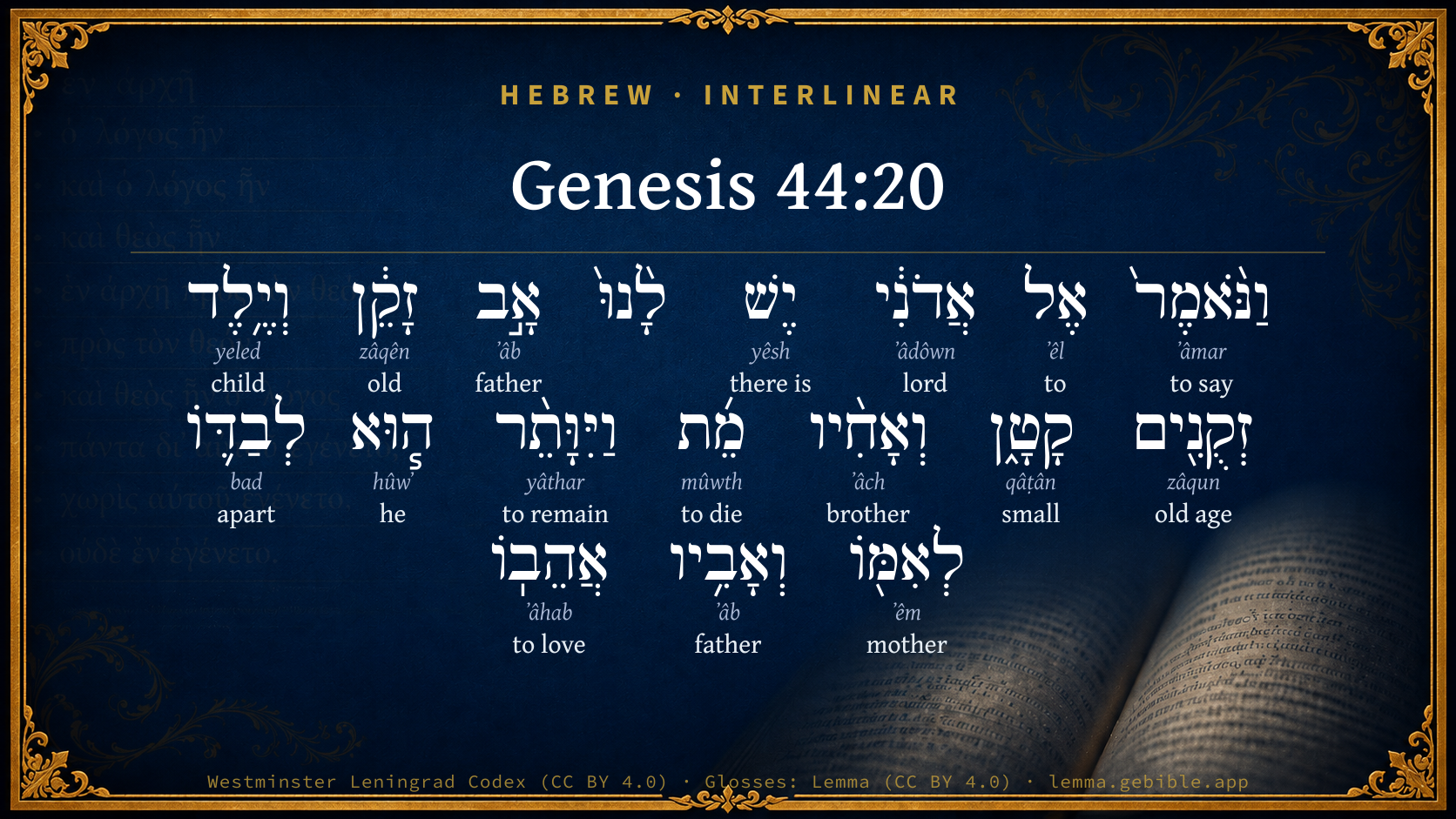
Hebrew (Westminster Leningrad Codex) Genesis 44:20 appears in the Hebrew Old Testament. The text above is from the Westminster Leningrad Codex. Each word links to its Strong’s number, a concise gloss, and parsing drawn from the Open Scriptures Hebrew Bible morphology. Click any word for its full Brown-Driver-Briggs (BDB) entry.
Download image
Cite this verse

Genesis 44:20 (World English Bible). Public Domain. Lemma interlinear Bible study tool, https://lemma.gebible.app/v/genesis/44/20.

Show BibTeX & RIS
BibTeX
RIS
English Translation
We said to my lord, 'We have a father, an old man, and a child of his old age, a little one; and his brother is dead, and he alone is left of his mother; and his father loves him.'
World English Bible · Public Domain
Download a study sheet

One document with this verse’s original text, its word-by-word gloss line, the meaning frame, cross-references with their text, attributed commentary, and full source and license credits — printable, and it pastes into notes with its structure intact.

This verse Autodidact and up

Study sheet (.html) Plain text (.txt)

A passage Seminary Student

Up to 50 verses in one chapter. A passage sheet keeps up to 6 commentary sources and 12 cross-references per verse, in the order this page ranks them, and says so on the sheet whenever that leaves anything out. Ask for a single verse and you get the Autodidact verse sheet above.

Everything on this page stays free to read, with no account — the sheet is a download of what is already on screen, not access to it.

Want to remove ads? Support Godless Engineer
Compare translations 3

The same verse in 3 English versions, stacked beneath the original-language interlinear above. Click any original word for its lexicon entry.

Each is an independent rendering of the whole verse — the interlinear is not word-aligned to these translations.

Highlighted words mark where these versions differ — a whole-verse word diff, not a word-by-word alignment.

  • World English Bible Public Domain
    We said to my lord, 'We have a father, an old man, and a child of his old age, a little one; and his brother is dead, and he alone is left of his mother; and his father loves him.'
  • King James Version Public Domain
    And we said unto my lord, We have a father, an old man, and a child of his old age, a little one; and his brother is dead, and he alone is left of his mother, and his father loveth him.
  • unfoldingWord Literal Text CC BY-SA 4.0
    And we said to my lord, ‘We have an aged father and the youngest son of old age. But his brother is dead, so he is left by himself from his mother, and his father loves him.’

unfoldingWord Literal Text — © unfoldingWord, licensed CC BY-SA 4.0. Word-aligned USFM3 via Door43 (git.door43.org/unfoldingWord/en_ult).

Versions to compare (up to 4)

3 of 4 selected

Show all 18 translations

Every available English version of this verse, each an independent rendering of the whole verse.

  • World English Bible Public Domain
    We said to my lord, 'We have a father, an old man, and a child of his old age, a little one; and his brother is dead, and he alone is left of his mother; and his father loves him.'
  • Berean Standard Bible Public Domain
    And we answered, ‘We have an elderly father and a younger brother, the child of his old age. The boy’s brother is dead. He is the only one of his mother’s sons left, and his father loves him.’
  • Majority Standard Bible Public Domain
    And we answered, ‘We have an elderly father and a younger brother, the child of his old age. The boy’s brother is dead. He is the only one of his mother’s sons left, and his father loves him.’
  • King James Version Public Domain
    And we said unto my lord, We have a father, an old man, and a child of his old age, a little one; and his brother is dead, and he alone is left of his mother, and his father loveth him.
  • American Standard Version (1901) Public Domain
    And we said unto my lord, We have a father, an old man, and a child of his old age, a little one; and his brother is dead, and he alone is left of his mother; and his father loveth him.
  • Revised Version (1885) Public Domain
    And we said unto my lord, We have a father, an old man, and a child of his old age, a little one; and his brother is dead, and he alone is left of his mother, and his father loveth him.
  • Geneva Bible (1599) Public Domain
    And we answered my Lord, We haue a father that is olde, and a young childe, which he begate in his age: and his brother is dead, and he alone is left of his mother, and his father loueth him.
  • Douay-Rheims (1899) Public Domain
    And we answered thee, my lord: We have a father an old man, and a young boy, that was born in his old age; whose brother by the mother is dead: and he alone is left of his mother, and his father loveth him tenderly.
  • Young's Literal Translation Public Domain
    and we say unto my lord, We have a father, an aged one, and a child of old age, a little one; and his brother died, and he is left alone of his mother, and his father hath loved him.
  • Literal Standard Version CC BY-SA 4.0
    And we say to my lord, We have a father, an aged one, and a child of old age, a little one; and his brother died, and he is left alone of his mother, and his father has loved him.
  • Unlocked Literal Bible CC BY-SA 4.0
    We said to my master, 'We have a father, an old man, and a child of his old age, a little one. But his brother is dead, and he alone is left of his mother, and his father loves him.'
  • unfoldingWord Literal Text CC BY-SA 4.0
    And we said to my lord, ‘We have an aged father and the youngest son of old age. But his brother is dead, so he is left by himself from his mother, and his father loves him.’
  • Darby Bible Public Domain
    And we said to my lord, We have an aged father, and a child born to him in his old age, [yet] young; and his brother is dead, and he alone is left of his mother; and his father loves him.
  • World Messianic Bible Public Domain
    We said to my lord, ‘We have a father, an old man, and a child of his old age, a little one; and his brother is dead, and he alone is left of his mother; and his father loves him.’
  • Webster's Bible Public Domain
    And we said to my lord, We have a father, an old man, and a child of his old age, a little one: and his brother is dead, and he alone is left of his mother, and his father loveth him.
  • Free Bible Version CC BY-SA 4.0
    We told you, my lord, ‘We have an elderly father, and a younger brother, born when our father was already old. The boy's brother is dead. He is the only one of his mother's children left, and his father loves him dearly.’
  • Bible in Basic English Public Domain
    And we said to my lord, We have an old father and a young child, whom he had when he was old; his brother is dead and he is the only son of his mother, and is very dear to his father.
  • JPS Tanakh (1917) Public Domain
    And we said unto my lord: We have a father, an old man, and a child of his old age, a little one; and his brother is dead, and he alone is left of his mother, and his father loveth him.

Literal Standard Version (2020), Covenant Press — licensed CC BY-SA 4.0. Text via the HelloAO Bible API (eBible.org). Unlocked Literal Bible (unfoldingWord) — licensed CC BY-SA 4.0. Text via the HelloAO Bible API (eBible.org). unfoldingWord Literal Text — © unfoldingWord, licensed CC BY-SA 4.0. Word-aligned USFM3 via Door43 (git.door43.org/unfoldingWord/en_ult). Free Bible Version, Dr. Jonathan Gallagher — licensed CC BY-SA 4.0. Text via the HelloAO Bible API (eBible.org).

Word by word

More ways to search: Search by grammar → Find every occurrence → Compare this word →

Practice this passage: Drill this verse → Learn its vocabulary →

זְקֻנִ֖ים
zâqun
H2208
“old age”
Noun, Common, Masculine, Plural, Absolute
Part of Speech
Noun
Type
Common
Gender
Masculine
Number
Plural
State
Absolute
Full BDB Definition

Origin: properly, passive participle of H2204 (used only in the plural as a noun)

TWOT: 574e

old age, extreme old age
  1. וַנֹּ֨אמֶר֙ ʼâmar H559 “and · to say” Conjunction + Verb, Qal, Sequential Imperfect, 1st Person, Common, Plural
  2. אֶל ʼêl H413 “to” Preposition
  3. אֲדֹנִ֔י ʼâdôwn H113 “lord · my” Noun, Common, Masculine, Singular, Construct + Suffix, Personal, 1st Person, Common, Singular
  4. יֶשׁ yêsh H3426 “there is” Particle, Demonstrative
  5. אָ֣ב ʼâb H1 “father” Noun, Common, Masculine, Singular, Absolute
  6. זָקֵ֔ן zâqên H2205 “old” Adjective, Adjective, Masculine, Singular, Absolute
  7. וְיֶ֥לֶד yeled H3206 “and · child of” Conjunction + Noun, Common, Masculine, Singular, Construct
  8. קָטָ֑ן qâṭân H6996 “small” Adjective, Adjective, Masculine, Singular, Absolute
  9. וְאָחִ֨יו ʼâch H251 “and · brother · his” Conjunction + Noun, Common, Masculine, Singular, Construct + Suffix, Personal, 3rd Person, Masculine, Singular
  10. מֵ֜ת mûwth H4191 “to die” Verb, Qal, Perfect, 3rd Person, Masculine, Singular
  11. וַיִּוָּתֵ֨ר yâthar H3498 “and · to remain” Conjunction + Verb, Niphal, Sequential Imperfect, 3rd Person, Masculine, Singular
  12. ה֧וּא hûwʼ H1931 “he” Pronoun, Personal, 3rd Person, Masculine, Singular
  13. לְבַדּ֛וֹ bad H905 “to/for · apart · his” Preposition + Noun, Common, Masculine, Singular, Construct + Suffix, Personal, 3rd Person, Masculine, Singular
  14. לְאִמּ֖וֹ ʼêm H517 “to/for · mother · his” Preposition + Noun, Common, Feminine, Singular, Construct + Suffix, Personal, 3rd Person, Masculine, Singular
  15. וְאָבִ֥יו ʼâb H1 “and · father · his” Conjunction + Noun, Common, Masculine, Singular, Construct + Suffix, Personal, 3rd Person, Masculine, Singular
  16. אֲהֵבֽוֹ ʼâhab H157 “to love · him” Verb, Qal, Perfect, 3rd Person, Masculine, Singular + Suffix, Personal, 3rd Person, Masculine, Singular

About this verse

These counts appear in no published source. They are computed here, from the morphology-tagged text and Lemma’s own curated glosses. What Lemma adds →

18
words
16
distinct lemmas
Pentateuch
section

Notable vocabulary

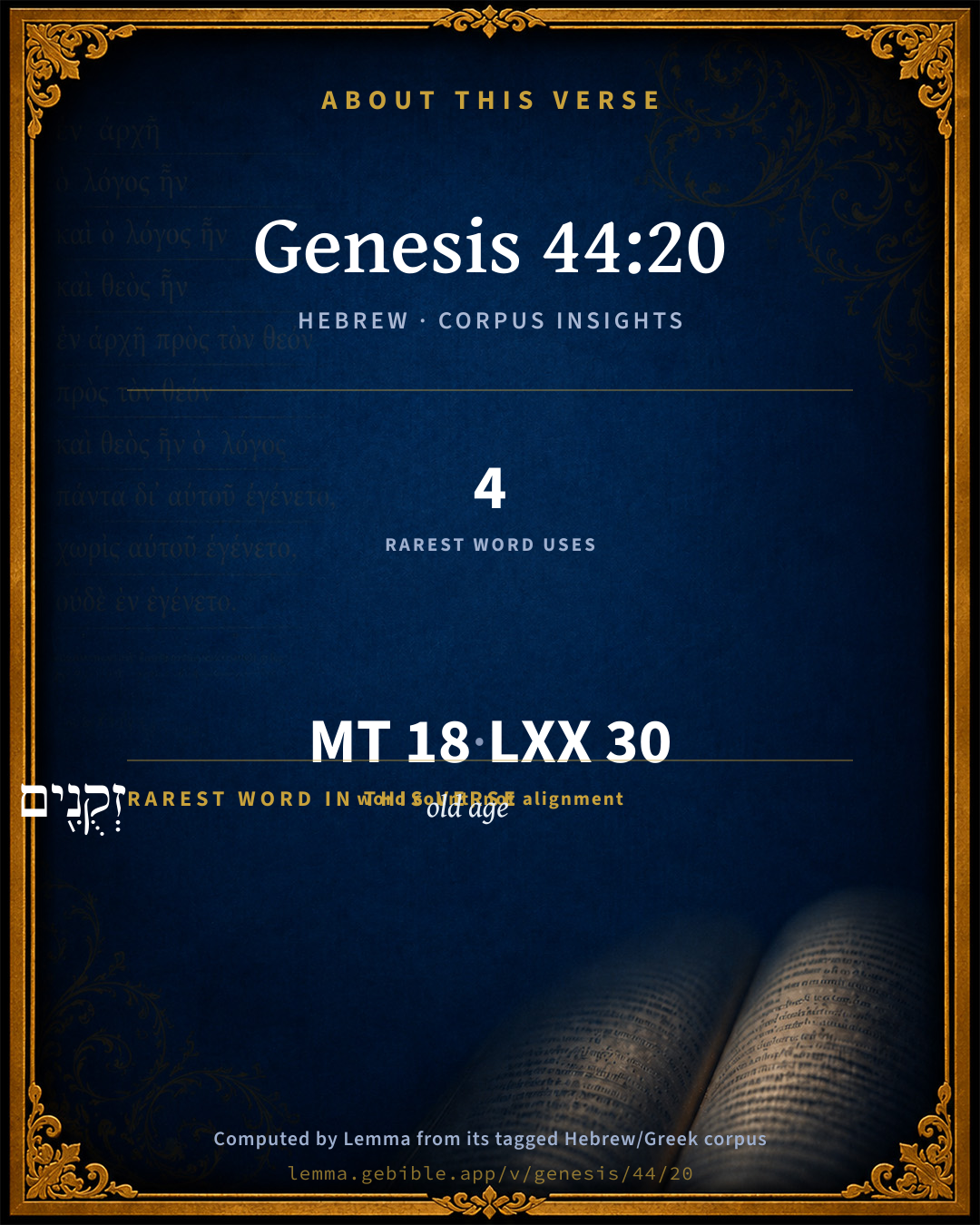
The rarest word here is זְקֻנִ֖ים old age H2208 — appearing just 4 times in the whole Hebrew Bible.

Shared distinctive vocabulary

זְקֻנִ֖ים old age H2208 occurs in 4 verses of the Hebrew Bible. Also found in:

Grammatical profile

  • 4 verbs
  • 8 nouns
  • 2 adjectives
  • 1 pronoun
  • 2 prepositions
  • 1 particle

Verb forms

  • וַנֹּ֨אמֶר֙ Qal · Sequential Imperfect
  • מֵ֜ת Qal · Perfect
  • וַיִּוָּתֵ֨ר Niphal · Sequential Imperfect
  • אֲהֵבֽוֹ Qal · Perfect

Repetition

A word recurs within this verse — often emphatic in Hebrew:

  • אָ֣ב father H1 ×2

Hebrew & Septuagint length

In English translation the verse runs 40 words from the Hebrew and 45 from the Septuagint (LXX English) — closely comparable.

A rough comparison of the two English renderings, which tokenize alike — not a word-level alignment.

Word counts can differ between the Hebrew and the Greek without any difference in meaning — e.g. the Hebrew direct-object marker אֵת has no separate Greek word, and Greek often adds the article ὁ.

In the original languages it is 18 Hebrew tokens and 30 Greek tokens — but the two are counted differently (Hebrew bundles its prefixes and suffixes into one token; the Greek is in lemma form), so that isn’t a like-for-like length.

Cross-references

12

Topical passages linked to Genesis 44:20 in the Treasury of Scripture Knowledge — connected by theme and wording, ordered by reader-vote popularity; previews shown in the World English Bible.

  • Genesis 37:3 Now Israel loved Joseph more than all his children, because he was the son of his old age, and he made him a coat of many colors.
  • Genesis 42:38 He said, "My son shall not go down with you; for his brother is dead, and he only is left. If harm happens to him by the way in which you go, then you will bring down my gray hairs with sorrow to Sheol."
  • Genesis 35:18 It happened, as her soul was departing (for she died), that she named him Ben-oni, but his father named him Benjamin.
  • Genesis 37:19 They said one to another, "Behold, this dreamer comes.
  • Genesis 37:33–35 He recognized it, and said, "It is my son's coat. An evil animal has devoured him. Joseph is without doubt torn in pieces."
  • Genesis 42:13 They said, "We, your servants, are twelve brothers, the sons of one man in the land of Canaan; and, behold, the youngest is this day with our father, and one is no more."
  • Genesis 42:36 Jacob, their father, said to them, "You have bereaved me of my children! Joseph is no more, Simeon is no more, and you want to take Benjamin away. All these things are against me."
  • Genesis 43:7–8 They said, "The man asked directly concerning ourselves, and concerning our relatives, saying, 'Is your father still alive? Have you another brother?' We just answered his questions. Is there any way we could know that he would say, 'Bring your brother down?'"
  • Genesis 44:27–30 Your servant, my father, said to us, 'You know that my wife bore me two sons:
  • Genesis 46:21 The sons of Benjamin: Bela, Becher, Ashbel, Gera, Naaman, Ehi, Rosh, Muppim, Huppim, and Ard.
  • Genesis 49:8 "Judah, your brothers will praise you: Your hand will be on the neck of your enemies; Your father's sons will bow down before you.
  • Luke 7:12 Now when he drew near to the gate of the city, behold, one who was dead was carried out, the only son of his mother, and she was a widow. Many people of the city were with her.

Cross-references courtesy of OpenBible.info (CC BY 4.0).

Hebrew and Greek witnesses Masoretic Hebrew ↔ Greek Septuagint

The same verse in the two great witnesses to the Old Testament, shown verse-for-verse.

These are two independent witnesses, not word-aligned to each other, and the Septuagint is shown in lemma (dictionary) form.

Hebrew Genesis 44:20 Masoretic · Westminster Leningrad Codex

וַנֹּ֨אמֶר֙ אֶל אֲדֹנִ֔י יֶשׁ לָ֨נוּ֙ אָ֣ב זָקֵ֔ן וְיֶ֥לֶד זְקֻנִ֖ים קָטָ֑ן וְאָחִ֨יו מֵ֜ת וַיִּוָּתֵ֨ר ה֧וּא לְבַדּ֛וֹ לְאִמּ֖וֹ וְאָבִ֥יו אֲהֵבֽוֹ

We said to my lord, 'We have a father, an old man, and a child of his old age, a little one; and his brother is dead, and he alone is left of his mother; and his father loves him.'

World English Bible · Public Domain

Greek LXX Genesis 44:20 Septuagint · lemma form

καί εἶπον ὁ κύριος εἰμί ἐγώ πατήρ πρεσβύτερος καί παιδίον γῆρας νέος αὐτός καί ὁ ἀδελφός αὐτός ἀποθνήσκω αὐτός δέ μόνος ὑπολείπω ὁ μήτηρ αὐτός ὁ δέ πατήρ αὐτός ἀγαπάω

And we said to my lord, We have a father, an old man, and he has a son of his old age, a young one, and his brother is dead, and he alone has been left behind to his mother, and his father loves him.

LXX2012 (modern English Septuagint) · Public Domain

Hebrew: Westminster Leningrad Codex (CC BY 4.0). Greek: Septuagint (public domain); English from LXX2012 (modern English Septuagint) (Public Domain). How the Septuagint differs from the Hebrew →

Targum (Aramaic paraphrase)

2

The Targum is the ancient Jewish Aramaic paraphrase of the Hebrew Scriptures — an interpretive translation, not the Hebrew text itself. Onkelos (literal) and Pseudo-Jonathan (expansive) render the Torah, and Jonathan the Prophets. Coverage is partial: where no permissively-licensed English translation exists for a verse, only the Aramaic is shown. This is verse-level text, not a word-by-word alignment to the Hebrew.

  1. Targum Onkelos Torah (Genesis–Deuteronomy)
    וַאֲמַרְנָא לְרִבּוֹנִי אִית לָנָא אַבָּא סָבָא וּבַר סִיבְתִין זְעֵיר וְאָחוּהִי מִית וְאִשְׁתָּאַר הוּא בִלְחוֹדוֹהִי לְאִמֵּהּ וַאֲבוּהִי רְחִים לֵהּ

    (no public-domain English translation for this verse)

    Targum Onkelos — Aramaic: “Onkelos Genesis” (public domain); “Onkelos Exodus” (public domain); “Onkelos Leviticus” (public domain); “Onkelos Numbers” (public domain); “Onkelos Deuteronomy” (public domain). English: “Sefaria Community Translation” (CC0 1.0 (public-domain dedication)); “J.W. Etheridge. The Targums of Onkelos and Jonathan Ben Uzziel on the Pentateuch. London: Longmans, Green, 1862” (public domain). Text via Sefaria.

  2. Targum Pseudo-Jonathan Torah (Genesis–Deuteronomy)
    וַאֲמַרְנָא לְרִיבּוֹנִי אִית לָן אַבָּא סָבָא וּבַר סִיבְתִּין קָלִיל וְאָחוֹי מִית וְאִשְׁתְּאַר הוּא בִּלְחוֹדוֹי מִן אִמֵיהּ וְאָבוֹי בְּגִין כֵּן רָחֵים לֵיהּ

    And we told my lord, We have an aged father, and a son of his old age, a little one, whose brother is dead, and he only remains of his mother; and his father on that account loveth him.

    Targum Pseudo-Jonathan — Aramaic: “Targum Jonathan on Genesis” (public domain); “Targum Jonathan on Exodus” (public domain); “Targum Jonathan on Leviticus” (public domain); “Targum Jonathan on Numbers” (public domain); “Targum Jonathan on Deuteronomy” (public domain). English: “The Targum of Jonathan ben Uzziel, trans. J. W. Etheridge, London, 1862” (public domain). Text via Sefaria.

Commentary

Notes on Genesis 44:20 from classic Christian and Jewish commentators (each source and its license shown beneath its notes). The classic Christian expositions comment on the surrounding passage and are grouped to its opening verse, so a note may address several verses; the Jewish commentaries on the Tanakh (Rashi and others) are per-verse, so they appear only where the commentator wrote on this verse.

Lemma curates 59 commentaries, every one of them public domain or Creative Commons licensed, each selected and text-cleaned for this edition rather than reprinted as found. About our sources →

Trapp's Complete Commentary

John Trapp

Gen 44:20 And we said unto my lord, We have a father, an old man, and a child of his old age, a little one; and his brother is dead, and he alone is left of his mother, and his father loveth him.

Ver. 20. {See Trapp on "Gen 44:19"}

John Trapp, A Commentary or Exposition upon All the Books of the Old and New Testament (1647–1656) — public domain. Text from a community e-Sword module.

Geneva Bible (1599)

Geneva Bible translators

Hebrew, child of his old age.

Geneva Bible (1599) marginal notes — public domain. Text via Bolls.life.

The Cambridge Bible for Schools and Colleges

gen. ed. J. J. S. Perowne

20. a child of his old age] Cf. Gen_37:3, where the words are applied to Joseph.

his brother is dead] See Gen_44:28, Gen_42:38 (J). According to the J narrative, his brothers thought him dead. In Gen_42:13 (E) Joseph’s fate is referred to in vaguer terms, “one is not.” This allusion to the “dead” brother in addressing Joseph adds a most effective touch to the story.

of his mother] Lit. “to his mother,” i.e. of Rachel’s children.

The Cambridge Bible for Schools and Colleges (gen. ed. J. J. S. Perowne; Cambridge University Press, 1878–1918) — public domain. Text from a community e-Sword module.

John Gill's Exposition

And we said unto my lord, we have a father,.... Yet living in the land of Canaan:

an old man; being one hundred and thirty years of age, Gen 47:9,

and a child of his old age; who was born when he was near an hundred years of age: and

a little one; not in stature, but in age, being the youngest son, and much younger than they: so they represented him, on that account, and because he was tenderly brought up with his father, and not inured to business and hardship, and so unfit to travel:

and his brother is dead; meaning Joseph: so they thought him to be, having not heard of him for twenty two years or more, and they had so often said he was dead, or suggested as much, that they at length believed he was:

and he alone is left of his mother; the only child left of his mother Rachel:

and his father loveth him; being his youngest son, and the only child of his beloved Rachel, and therefore most dear unto him.

John Gill's Exposition of the Whole Bible (1746–1763) — public domain (CC PDM 1.0). Text via the HelloAO Bible API.

Haydock's Catholic Bible Commentary

Is left of, (habet mater.) Rachel had been dead about twenty-four years. (Haydock)

George Leo Haydock (1774–1849), Haydock's Catholic Family Bible and Commentary, 1859 edition — public domain. Excludes Psalms (Douay-Rheims chapter numbering differs from Protestant) and Deuterocanonical books (Catholic canon only).

Matthew Poole's English Annotations

A little one; so they call him comparatively to themselves, who were much elder; and withal, to signify the reason why he came, not with them, because he was young and tender, and unfit for such a journey.

Matthew Poole's English Annotations on the Holy Bible (1683–1685) — public domain. Text from a community e-Sword/MySword module.

unfoldingWord translationNotes

Door43 World Missions Community

General Information:

Judah continues to speak before Joseph

We said to my master, 'We have a father ... his father loves him.'

This is a quotation within a quotation. It can be stated as an indirect quotation. AT: "And we said to my master that we have a father ... his father loves him" (See: Quotes Within Quotes and Direct and Indirect Quotations)

we said to my master

Judah refers to Joseph as "my master." This is a formal way of speaking to someone with greater authority. AT: "we said to you, my master" (See: First, Second, or Third Person)

his father loves him

This refers to love for a friend or family member.

Then you said to your servants, 'Bring him down to me that I may see him.'

This is a quotation within a quotation. It can be stated as an indirect quotation. AT: "And you said to your servants that we should bring our youngest brother to you so that you may see him" (See: Quotes Within Quotes and Direct and Indirect Quotations)

Then you said to your servants

Judah refers to himself and his brothers as "your servants." AT: "Then you said to us, your servants" (See: First, Second, or Third Person)

Bring him down to me

It was common to use the word "down" when speaking of traveling from Canaan to Egypt. AT: "Bring him to me" (See: Assumed Knowledge and Implicit Information)

After that, we said to my master, 'The boy cannot ... father would die.'

This is a quotation within a quotation. It can be stated as an indirect quotation. AT: "In response, we said to my master that the boy cannot ... father would die" (See: Quotes Within Quotes and Direct and Indirect Quotations)

his father would die

It is implied that their father would die from sorrow. (See: Assumed Knowledge and Implicit Information)

translationWords

love

servant

unfoldingWord translationNotes — © Distant Shores Media and the Door43 World Missions Community, licensed CC BY-SA 4.0. Source: git.door43.org/Door43/en_tn.

Rashi

Rabbi Shlomo Yitzchaki (Rashi)

ונאמר אל אדני WE SAID TO MY LORD — we kept nothing back from you (Genesis Rabbah 93:8).

ואחיו מת AND HIS BROTHER IS DEAD — He uttered this untruth out of fear. He thought: if I tell him that he is alive he may say “Bring him to me”.

לבדו לאמו [HE] ALONE [IS LEFT] OF HIS MOTHER — of that mother he has no other brother.

Rashi on the Tanakh — English translations: “The Judaica Press complete Tanach with Rashi, translated by A. J. Rosenberg” (CC BY 4.0); “Pentateuch with Rashi's commentary by M. Rosenbaum and A.M. Silbermann, 1929-1934” (public domain); “The Metsudah Tanach series, Lakewood, N.J” (CC BY 4.0); and “The Book of Joshua, Metsudah Publications, 1997” (CC BY 4.0). Text via Sefaria.

Ibn Ezra

Rabbi Abraham ibn Ezra

A father who is old. Since the oldest brother was only 45 it was not self-evident that their father was very old.

Ibn Ezra on the Tanakh — English translations: “Sefaria Community Translation” (CC0 1.0 (public-domain dedication)); “Yalkut, Sifsei Chachomim Chumash, Metsudah Publications, 2009” (CC BY 4.0); and “Commentary of Ibn Ezra on Isaiah - trans. by M. Friedlander, 1873” (public domain). Text via Sefaria.

Lesson kit

Teaching starters — assembled from the data on this page, not authored interpretation. Every prompt links to the verse data it draws on. Edit before teaching.

Genesis, in the Pentateuch, opens this verse with 18 words (16 distinct Hebrew lemmas). Its most distinctive word is zâqun (“old age”). A historical commentator’s framing appears above. Read the whole chapter for the surrounding context.

Discussion questions

  1. How does “old age” (zâqun) shape what this verse is saying?
  2. Genesis 21:2 shares the word «old age» with this verse. How do the two illuminate each other?
  3. “father” occurs 2× in this one verse. What is the effect of the repetition?
  4. These translations render this verse differently; the difference is in the English rendering, not the original. What questions does that raise?
  5. The verb «וַנֹּ֨אמֶר֙» is Qal Sequential Imperfect. How does its form color the action?
  6. Reading how Trapp's Complete Commentary and Geneva Bible (1599) read this verse, where do the two commentators agree and where do they part?

Things to notice

Reading settings

Reading text

Shown beneath each verse's original-language words.

Old Testament
Old Testament edition

Read the OT as the Masoretic Hebrew (MT) or the Greek Septuagint (LXX).

English shown for the Greek Septuagint (in the Hebrew ↔ Greek comparison).

Comparing translations? Open the Compare panel on any verse page to stack up to four side by side.