
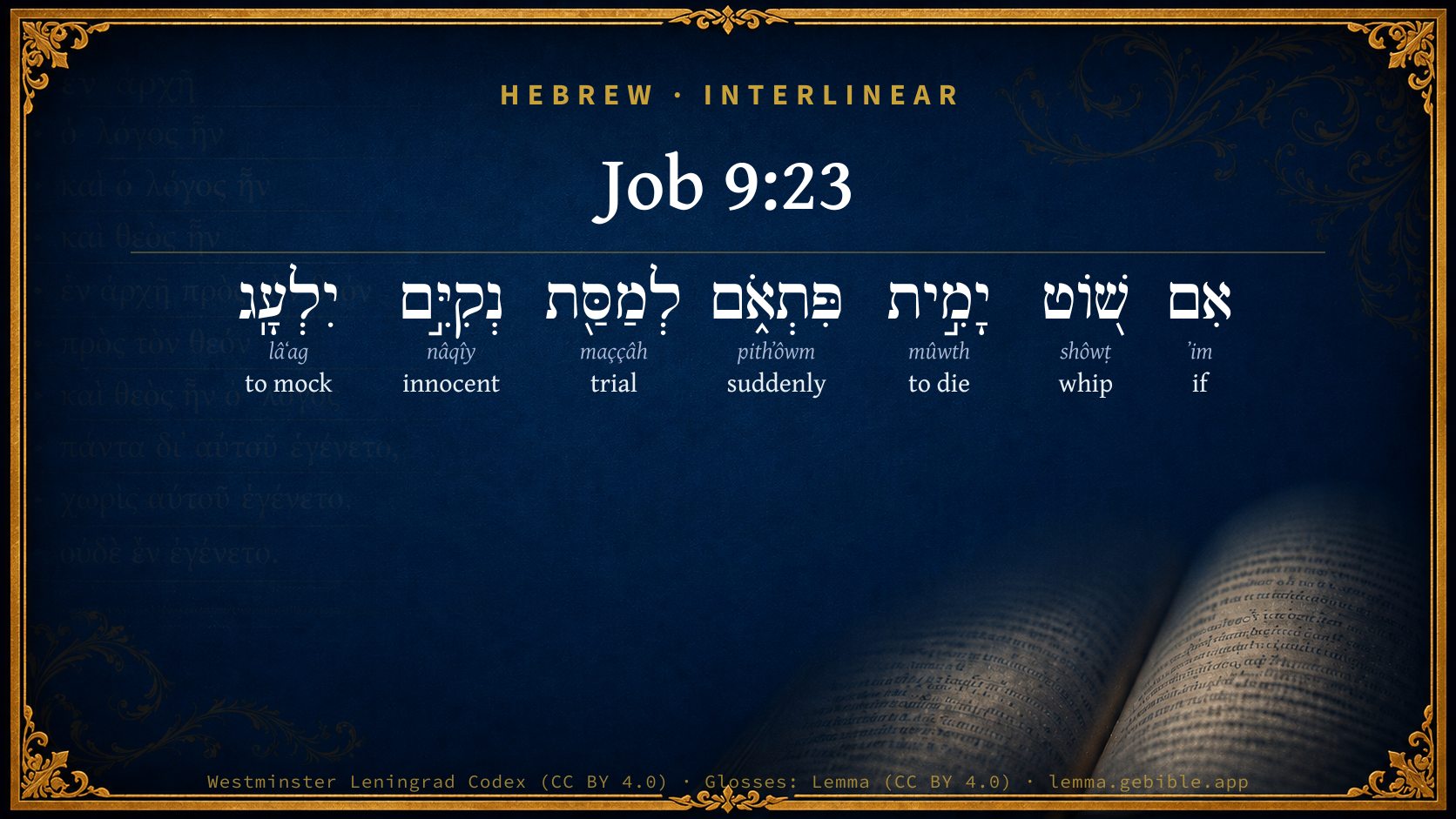
Job 9:23

Hebrew (Westminster Leningrad Codex) Job 9:23 appears in the Hebrew Old Testament. The text above is from the Westminster Leningrad Codex. Each word links to its Strong’s number, a concise gloss, and parsing drawn from the Open Scriptures Hebrew Bible morphology. Click any word for its full Brown-Driver-Briggs (BDB) entry.
Download image
Cite this verse

Job 9:23 (World English Bible). Public Domain. Lemma interlinear Bible study tool, https://lemma.gebible.app/v/job/9/23.

Show BibTeX & RIS
BibTeX
RIS
English Translation
If the scourge kills suddenly, He will mock at the trial of the innocent.
World English Bible · Public Domain
Download a study sheet

One document with this verse’s original text, its word-by-word gloss line, the meaning frame, cross-references with their text, attributed commentary, and full source and license credits — printable, and it pastes into notes with its structure intact.

This verse Autodidact and up

Study sheet (.html) Plain text (.txt)

A passage Seminary Student

Up to 50 verses in one chapter. A passage sheet keeps up to 6 commentary sources and 12 cross-references per verse, in the order this page ranks them, and says so on the sheet whenever that leaves anything out. Ask for a single verse and you get the Autodidact verse sheet above.

Everything on this page stays free to read, with no account — the sheet is a download of what is already on screen, not access to it.

Want to remove ads? Support Godless Engineer
Compare translations 3

The same verse in 3 English versions, stacked beneath the original-language interlinear above. Click any original word for its lexicon entry.

Each is an independent rendering of the whole verse — the interlinear is not word-aligned to these translations.

Highlighted words mark where these versions differ — a whole-verse word diff, not a word-by-word alignment.

  • World English Bible Public Domain
    If the scourge kills suddenly, He will mock at the trial of the innocent.
  • King James Version Public Domain
    If the scourge slay suddenly, he will laugh at the trial of the innocent.
  • unfoldingWord Literal Text CC BY-SA 4.0
    When a scourge suddenly kills, he mocks the despair of the innocent.

unfoldingWord Literal Text — © unfoldingWord, licensed CC BY-SA 4.0. Word-aligned USFM3 via Door43 (git.door43.org/unfoldingWord/en_ult).

Versions to compare (up to 4)

3 of 4 selected

Show all 18 translations

Every available English version of this verse, each an independent rendering of the whole verse.

  • World English Bible Public Domain
    If the scourge kills suddenly, He will mock at the trial of the innocent.
  • Berean Standard Bible Public Domain
    When the scourge brings sudden death, He mocks the despair of the innocent.
  • Majority Standard Bible Public Domain
    When the scourge brings sudden death, He mocks the despair of the innocent.
  • King James Version Public Domain
    If the scourge slay suddenly, he will laugh at the trial of the innocent.
  • American Standard Version (1901) Public Domain
    If the scourge slay suddenly, He will mock at the trial of the innocent.
  • Revised Version (1885) Public Domain
    If the scourge slay suddenly, he will mock at the trial of the innocent.
  • Geneva Bible (1599) Public Domain
    If the scourge should suddenly slay, should God laugh at the punishment of the innocent?
  • Douay-Rheims (1899) Public Domain
    If he scourge, let him kill at once, and not laugh at the pains of the innocent.
  • Young's Literal Translation Public Domain
    If a scourge doth put to death suddenly, At the trial of the innocent He laugheth.
  • Literal Standard Version CC BY-SA 4.0
    If a scourge puts to death suddenly, He laughs at the trial of the innocent.
  • Unlocked Literal Bible CC BY-SA 4.0
    When a whip suddenly kills, he mocks the despair of the innocent.
  • unfoldingWord Literal Text CC BY-SA 4.0
    When a scourge suddenly kills, he mocks the despair of the innocent.
  • Darby Bible Public Domain
    If the scourge kill suddenly, he mocketh at the trial of the innocent.
  • World Messianic Bible Public Domain
    If the scourge kills suddenly, he will mock at the trial of the innocent.
  • Webster's Bible Public Domain
    If the scourge shall slay suddenly, he will laugh at the trial of the innocent.
  • Free Bible Version CC BY-SA 4.0
    When disaster strikes suddenly he mocks the despair of the innocent.
  • Bible in Basic English Public Domain
    If death comes suddenly through disease, he makes sport of the fate of those who have done no wrong.
  • JPS Tanakh (1917) Public Domain
    If the scourge slay suddenly, He will mock at the calamity of the guiltless.

Literal Standard Version (2020), Covenant Press — licensed CC BY-SA 4.0. Text via the HelloAO Bible API (eBible.org). Unlocked Literal Bible (unfoldingWord) — licensed CC BY-SA 4.0. Text via the HelloAO Bible API (eBible.org). unfoldingWord Literal Text — © unfoldingWord, licensed CC BY-SA 4.0. Word-aligned USFM3 via Door43 (git.door43.org/unfoldingWord/en_ult). Free Bible Version, Dr. Jonathan Gallagher — licensed CC BY-SA 4.0. Text via the HelloAO Bible API (eBible.org).

Word by word

More ways to search: Search by grammar → Find every occurrence → Compare this word →

Practice this passage: Drill this verse → Learn its vocabulary →

About this verse

These counts appear in no published source. They are computed here, from the morphology-tagged text and Lemma’s own curated glosses. What Lemma adds →

7
words
7
distinct lemmas
Wisdom
section

Notable vocabulary

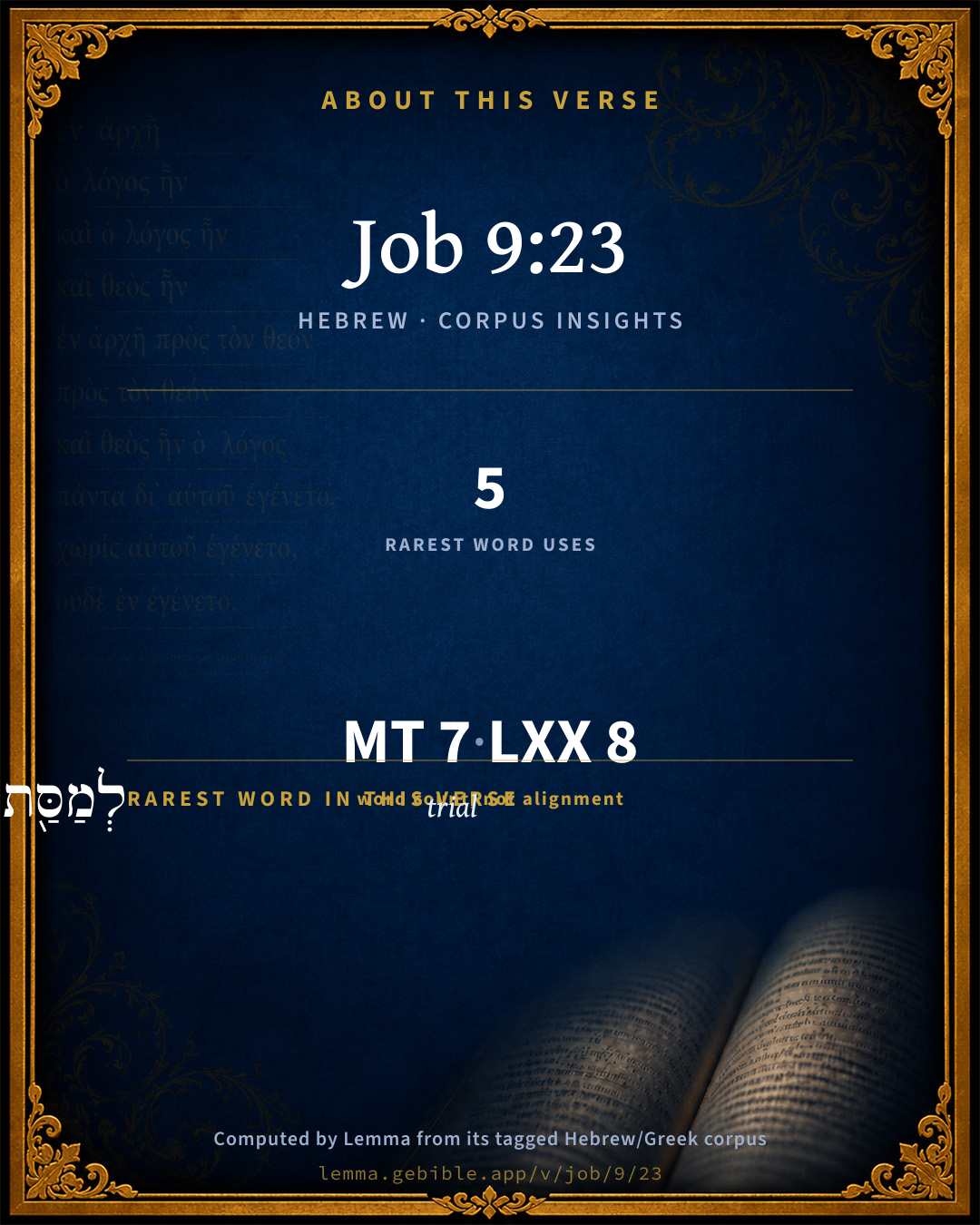
The rarest word here is לְמַסַּ֖ת trial H4531 — appearing just 5 times in the whole Hebrew Bible.

Shared distinctive vocabulary

לְמַסַּ֖ת trial H4531 occurs in 5 verses of the Hebrew Bible. Also found in:

Grammatical profile

  • 2 verbs
  • 2 nouns
  • 1 adjective
  • 1 conjunction
  • 1 adverb

Verb forms

  • יָמִ֣ית Hiphil · Imperfect
  • יִלְעָֽג Qal · Imperfect

Hebrew & Septuagint length

In English translation the verse runs 14 words from the Hebrew and 11 from the Septuagint (LXX English) — closely comparable.

A rough comparison of the two English renderings, which tokenize alike — not a word-level alignment.

Word counts can differ between the Hebrew and the Greek without any difference in meaning — e.g. the Hebrew direct-object marker אֵת has no separate Greek word, and Greek often adds the article ὁ.

In the original languages it is 7 Hebrew tokens and 8 Greek tokens — but the two are counted differently (Hebrew bundles its prefixes and suffixes into one token; the Greek is in lemma form), so that isn’t a like-for-like length.

Cross-references

11

Topical passages linked to Job 9:23 in the Treasury of Scripture Knowledge — connected by theme and wording, ordered by reader-vote popularity; previews shown in the World English Bible.

  • Job 24:12 From out of the populous city, men groan. The soul of the wounded cries out, Yet God doesn't regard the folly.
  • 2 Samuel 14:15 Now therefore seeing that I have come to speak this word to my lord the king, it is because the people have made me afraid: and your handmaid said, I will now speak to the king; it may be that the king will perform the request of his servant.
  • 2 Samuel 14:17 Then your handmaid said, Please let the word of my lord the king be comfortable; for as an angel of God, so is my lord the king to discern good and bad: and Yahweh your God be with you.
  • Job 1:13–19 It fell on a day when his sons and his daughters were eating and drinking wine in their eldest brother's house,
  • Job 2:7 So Satan went forth from the presence of Yahweh, and struck Job with painful sores from the sole of his foot to his head.
  • Job 4:7 "Remember, now, whoever perished, being innocent? Or where were the upright cut off?
  • Job 8:20 "Behold, God will not cast away a blameless man, Neither will he uphold the evil-doers.
  • Psalms 44:22 Yes, for your sake we are killed all day long. We are regarded as sheep for the slaughter.
  • Ezekiel 14:19–21 Or if I send a pestilence into that land, and pour out my wrath on it in blood, to cut off from it man and animal;
  • Ezekiel 21:13 For there is a trial; and what if even the rod that condemns shall be no more? says the Lord Yahweh.
  • Hebrews 11:36–37 Others were tried by mocking and scourging, yes, moreover by bonds and imprisonment.

Cross-references courtesy of OpenBible.info (CC BY 4.0).

Hebrew and Greek witnesses Masoretic Hebrew ↔ Greek Septuagint

The same verse in the two great witnesses to the Old Testament, shown verse-for-verse.

These are two independent witnesses, not word-aligned to each other, and the Septuagint is shown in lemma (dictionary) form.

Hebrew Job 9:23 Masoretic · Westminster Leningrad Codex

אִם שׁ֭וֹט יָמִ֣ית פִּתְאֹ֑ם לְמַסַּ֖ת נְקִיִּ֣ם יִלְעָֽג

If the scourge kills suddenly, He will mock at the trial of the innocent.

World English Bible · Public Domain

Greek LXX Job 9:23 Septuagint · lemma form

ὅτι φαῦλος ἐν θάνατος ἐξαίσιος ἀλλά δίκαιος καταγελάω

For the worthless die, but the righteous are laughed to scorn.

LXX2012 (modern English Septuagint) · Public Domain

Hebrew: Westminster Leningrad Codex (CC BY 4.0). Greek: Septuagint (public domain); English from LXX2012 (modern English Septuagint) (Public Domain). How the Septuagint differs from the Hebrew →

Commentary

Notes on Job 9:23 from classic Christian and Jewish commentators (each source and its license shown beneath its notes). The classic Christian expositions comment on the surrounding passage and are grouped to its opening verse, so a note may address several verses; the Jewish commentaries on the Tanakh (Rashi and others) are per-verse, so they appear only where the commentator wrote on this verse.

Lemma curates 59 commentaries, every one of them public domain or Creative Commons licensed, each selected and text-cleaned for this edition rather than reprinted as found. About our sources →

John Gill's Exposition

The earth is given into the hands of the wicked,.... Either the wicked one, Satan, as Jarchi and Bar Tzemach, who is the god of this world; or some wicked tyrant, as Nimrod, or some other known by Job in his time, to whom he may have respect; or wicked men in general, who for the most part have the greatest share of the earth, and earthly things, and of power, dominion, and authority in it; and this they have of God, the powers that be are ordained by him, and therefore to be obeyed; and what any have of the earth, and the fulness of it, they have it from him, whose it is, and who has a right to dispose of it, and therefore being given by him, they have a proper right unto it; but then it is only the things of this world which are given them; they have their portion here, and that is their all; wherefore, as the giving of these is no proof of a man's goodness, so the taking of them away is no evidence of his wickedness; love or hatred are not to be known by these things; this is Job's scope and drift in this and Job 9:23,

he covereth the face of the judges thereof; not Satan, who blinds the minds of such, that they should not understand justice, and do it, as the above Jewish writers interpret it; nor the wicked man that is possessed of riches and wealth, power and authority, who by his substance bribes the judges, and blinds their eyes, or by his power and authority awes them, keeps them from executing true judgment, or discourages persons fit for such an office, and will not advance them, but lets them lie in, and covers them with, obscurity; or such who are honest and faithful, and are not to be bribed and browbeaten, these he either removes from their post, and covers their faces with shame, or takes them away by death, condemns and executes them as malefactors; it being usual in former times, as well as in ours, to cover the faces of such as are executed: but rather this is to be understood of God, who delivers the earth into the hands of the wicked, suffers them to have the rule over it, and permits such things to be done, as already observed; and besides, gives up the judges of the earth to judicial blindness, so that they cannot discern what is right and just, and do it, see Isa 29:10,

if not, where and who is he? if it is not so as I say, where is the man, and who is he, that can disprove me, and make me a liar? as Aben Ezra; let him come forth and appear, and confute me, and teach me otherwise if he can; or name the place of his abode, and say who he is; or if God does not do this, give the earth into the hands of wicked men, and cover the faces of the judges of it, and suffer wicked men to prevail, and the causes of good men to be subverted, the one to flourish, and the other to be crushed; who does do it? where is the man that has done or can do it? certain it is, that it is done; and who but that God that superintends all things, sits in the heavens, and does whatsoever he pleases, can do such things as these? or could they be done without his will and permission? by such mediums Job proves his assertion, that God destroys the perfect and the wicked; and therefore, by the face of things in providence, no judgment is to be had of a man's character, good or bad, and then instances in himself in the following verses.

John Gill's Exposition of the Whole Bible (1746–1763) — public domain (CC PDM 1.0). Text via the HelloAO Bible API.

Trapp's Complete Commentary

John Trapp

Job 9:23 If the scourge slay suddenly, he will laugh at the trial of the innocent.

Ver. 23. If the scourge slay suddenly] By scourge here is meant a common calamity, such as rides circuit, compassing a country as a scourge doth a man’s body round about. Any sweeping judgment is a swinging scourge in God’s hands; such as is the sword, Isa 10:26, which when it rides circuit (as a judge) it is in commission, Eze 14:17 Jer 47:6-7, devouring flesh and drinking blood. Thus Attila, the Hun, styled himself God’s scourge. Tamerlane was commonly called the wrath of God, the terror of the world. Think the same of famine, pestilence, wild beasts, Eze 14:12, &c., these oft slay suddenly, Isa 30:13 Jer 18:22, as did the sweating sickness here in England, the massacre of France, and that later of Ireland, that scourge, if ever any, slew suddenly the perfect and the wicked. When an overflowing storm sweeps away the wicked, the tail of it may dash their best neighbours.

He laugheth at the trial of the innocent] The Vulgate readeth, He will not laugh at the trial of the innocent; but it is not there in the original. Others thus, will he laugh at the trial of the innocent? q.d. no, he will not. God may seem to slight his own in affliction, as Psa 77:2-3. The lion lets her whelps roar sometimes, till they do almost kill themselves with roaring. The truth is (and I think the true sense of this Scripture), God scorneth the allegation of innocence, or the justification and plea of the most upright man breathing, in the way of exemption or prevention of his just and wise dispensations, when he pleaseth to inflict them, involving good and bad in the same common calamity (Mr Abbot).

John Trapp, A Commentary or Exposition upon All the Books of the Old and New Testament (1647–1656) — public domain. Text from a community e-Sword module.

Geneva Bible (1599)

Geneva Bible translators

This is spoken according to our apprehension, as though he would say, If God destroy but the wicked, as Job 5:3, why should he suffer the innocent to be so long tormented by them?

To wit, the wicked.

Geneva Bible (1599) marginal notes — public domain. Text via Bolls.life.

Jamieson, Fausset & Brown

Robert Jamieson, A. R. Fausset & David Brown

If--Rather, "While (His) scourge slays suddenly (the wicked, Job 9:22), He laughs at (disregards; not derides) the pining away of the innocent." The only difference, says Job, between the innocent and guilty is, the latter are slain by a sudden stroke, the former pine away gradually. The translation, "trial," does not express the antithesis to "slay suddenly," as "pining away" does [UMBREIT].

Jamieson, Fausset & Brown — Commentary Critical and Explanatory on the Whole Bible (1871) — public domain (CC PDM 1.0). Text via the HelloAO Bible API.

Ellicott's Commentary for English Readers

(23) The scourge slay suddenly.—Probably meaning that in the case of hidden calamity overtaking an innocent man, He, God, will laugh at it: that is to say, take no more notice of it than if it furnished Him with sport. The very fact of such calamity befalling, as it often does, the innocent is at all events, in one view, a proof of His indifference to it who, by the exercise of His providence, could easily interpose to prevent it, and so looks as if He verily winked at it. Job’s argument is the argument of a man who wilfully shuts out faith in his estimate of God’s dealings; not that Job is devoid of faith, but in the course of arguing with his friends, who maintain the strict, rigid justice of God, he confronts them with the severe logic of facts, which they can neither contradict nor explain. Of course, for the very requirements of argument, he takes the pessimist view of the Divine providence, and declares even that the earth is given over into the hands of the wicked man. “He covereth the face of the judges thereof; and if it is not He that doeth this, who is it? there can be none other. He either doeth the evil Himself, or He permits it to be done; and what is the difference, supposing Him able to prevent it?” When we review the disorders of the earth—and how much more in Job’s days was it so—all must admit that faith is sorely tried; and even faith can render but a very partial explanation of them, so that such a line as this is fully justified, when the adversary is determined to maintain that all is rose-coloured, happy, and equal as Job’s friends did. They had before them an instance of inequality in the Divine conduct, and they must either make it square with the Divine justice or give up the contest. They could not do the one, and were unwilling to do the other; it only remained, therefore, for Job to assert the inequality of the Divine dealings, and he puts the case as strongly as he can, all the time, it must never be forgotten, holding fast his faith in God, so that at the last he is even justified by God, who says to his friends, “Ye have not spoken of me that which is right, like my servant” (Job_42:8).

A Bible Commentary for English Readers, edited by Charles John Ellicott (1878–1897) — public domain. Text from a community e-Sword module.

The Cambridge Bible for Schools and Colleges

gen. ed. J. J. S. Perowne

23. Further illustration of this character of God.

the scourge] i. e. the plague, as pestilence, famine, war, and the like, Isa_28:15.

will laugh at the trial] Or, mocks at the despair, cf. Job_6:14.

The Cambridge Bible for Schools and Colleges (gen. ed. J. J. S. Perowne; Cambridge University Press, 1878–1918) — public domain. Text from a community e-Sword module.

Albert Barnes' Notes on the Bible

If the scourge slay suddenly - If calamity comes in a sudden and unexpected manner. Dr. Good, following Reiske, translates this,” if he suddenly slay the oppressor,” understanding the word scourge שׁוט shôṭ as meaning an oppressor, or one whom God employs as a scourge of nations. But this is contrary to all the ancient versions. The word שׁוט shôṭ means properly a whip, a scourge (compare the notes at Job 5:21), and then calamity or affliction sent by God upon men. Such is clearly the case here.

He will laugh at the trial of the innocent - That is, he seems to disregard or to be pleased with their trials. He does not interpose to rescue them. He seems to look calmly on, and suffers them to be overwhelmed with others. This is a poetic expression, and cannot mean that God derides the trials of the innocent, or mocks their sufferings. It means that he seems to be inattentive to them; he suffers the righteous and the wicked to be swept away together as if he were regardless of character.

Albert Barnes' Notes on the Bible (1834–1885) — public domain. Text from a community e-Sword/MySword module.

Haydock's Catholic Bible Commentary

Innocent. Having expressed his sentiments clearly, now he mentions what he could desire under the pressure of misery. (Menochius) --- Seeing the danger of falling, to which he was exposed, he begged to be delivered by death. We are taught by our Saviour to pray, Lead us not into temptation, Matthew vi. 13. God does not laugh at our sufferings, but he acts like a surgeon, and cuts without minding our complaints. Ridere Dei est humanæ nolle afflictioni misereri. (St. Gregory) (Calmet) --- Hebrew, "If the scourge slay suddenly, he will laugh at the trial of the innocent." (Protestants) (Haydock)

George Leo Haydock (1774–1849), Haydock's Catholic Family Bible and Commentary, 1859 edition — public domain. Excludes Psalms (Douay-Rheims chapter numbering differs from Protestant) and Deuterocanonical books (Catholic canon only).

Matthew Poole's English Annotations

If the scourge slay suddenly; either,

1. If some common and deadly judgment come upon a people, which destroys both good and bad. Or,

2. If God inflicts some grievous and unexpected stroke upon an innocent person, as it follows. He will laugh at the trial of the innocent; as he doth at the destruction of the wicked, Psa 2:4. His outward carriage is the same to both; he neglects the innocent, and seems not to answer their prayers, and suffers them to perish with others, as if be took pleasure in their ruin also. But withal, he intimates the matter and cause of his laughter or complacency which God takes in their afflictions, because to them they are but trials of their faith, and patience, and perseverance, which tends to God’s honour, and their own eternal advantage.

Matthew Poole's English Annotations on the Holy Bible (1683–1685) — public domain. Text from a community e-Sword/MySword module.

Whedon's Commentary on the Bible

Daniel D. Whedon

23. Jerome remarks that “in the whole book Job says nothing more bitter than this” — a volcanic outbreak of unspeakable misery.

He will laugh — Schultens and others read, it will laugh, referring to the scourge. Though the figure be not too bold for poetry, the text is better.

Daniel D. Whedon (gen. ed.), Commentary on the Old and New Testaments (1874–1909) — public domain. Text from a community e-Sword module.

The Pulpit Commentary

If the scourge slay suddenly. Such a "scourge" as war, or pestilence, or famine, is probably meant. If one of these be let loose upon a land, and slay, as it always does slay, indifferently the good and the bad, the innocent and the guilty, what is God"s attitude? Does he interpose to save the righteous? By no means. He looks on passively, indifferently. Job even goes further, and says, with an audacity that borders on irreverence, if it does not even overstep the border, He will laugh at the trial of the innocent. St. Jerome says, "There is nothing in the whole book harsher than this." It may, perhaps, be excused, partly as rhetorical, partly as needful for the full expansion of Job"s argument. But it is a fearful utterance. (Professor Lee"s attempt to explain the whole passage differently is scarcely a successful one.)

The Pulpit Commentary (1880–1919), ed. H.D.M. Spence-Jones & Joseph S. Exell — public domain. Text from a community e-Sword module.

John Wesley's Explanatory Notes

Suddenly - If some common judgment come upon a people. Laugh - God will be well pleased, to see how the same scourge, which is the perdition of the wicked, is the trial of the innocent, and of their faith, which will be found unto praise and honour and glory.

John Wesley, Explanatory Notes Upon the Whole Bible (1754–1765) — public domain. Text via the GEBible commentary corpus.

Rashi

Rabbi Shlomo Yitzchaki (Rashi)

If the scourge of the Adversary’s tongue suddenly puts the righteous to death.

at the calamity of the innocent that he put to death he will mock.

Rashi on the Tanakh — English translations: “The Judaica Press complete Tanach with Rashi, translated by A. J. Rosenberg” (CC BY 4.0); “Pentateuch with Rashi's commentary by M. Rosenbaum and A.M. Silbermann, 1929-1934” (public domain); “The Metsudah Tanach series, Lakewood, N.J” (CC BY 4.0); and “The Book of Joshua, Metsudah Publications, 1997” (CC BY 4.0). Text via Sefaria.

Lesson kit

Teaching starters — assembled from the data on this page, not authored interpretation. Every prompt links to the verse data it draws on. Edit before teaching.

Job, in the Wisdom, opens this verse with 7 words (7 distinct Hebrew lemmas). Its most distinctive word is maççâh (“trial”). A historical commentator’s framing appears above. Read the whole chapter for the surrounding context.

Discussion questions

  1. How does “trial” (maççâh) shape what this verse is saying?
  2. How does Deuteronomy 4:34, which shares the word «trial», read alongside this verse?
  3. These translations render this verse differently; the difference is in the English rendering, not the original. What questions does that raise?
  4. «יָמִ֣ית» is a Hiphil Imperfect verb. How does that grammatical form shape the action described?
  5. Compare how John Gill's Exposition and Trapp's Complete Commentary read this verse. Where do they agree or differ?

Things to notice

Reading settings

Reading text

Shown beneath each verse's original-language words.

Old Testament
Old Testament edition

Read the OT as the Masoretic Hebrew (MT) or the Greek Septuagint (LXX).

English shown for the Greek Septuagint (in the Hebrew ↔ Greek comparison).

Comparing translations? Open the Compare panel on any verse page to stack up to four side by side.