
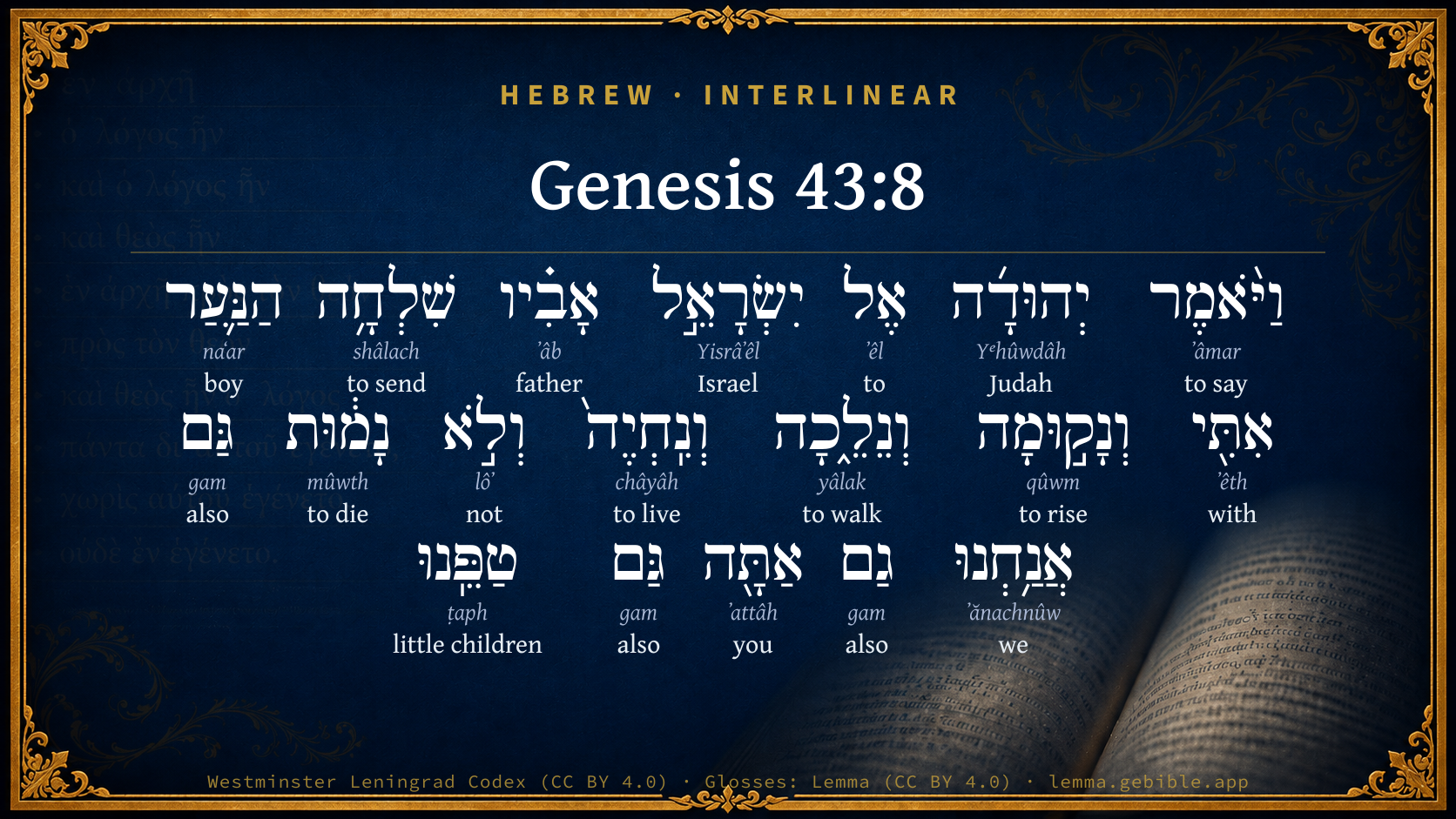
Genesis 43:8

Hebrew (Westminster Leningrad Codex) Genesis 43:8 appears in the Hebrew Old Testament. The text above is from the Westminster Leningrad Codex. Each word links to its Strong’s number, a concise gloss, and parsing drawn from the Open Scriptures Hebrew Bible morphology. Click any word for its full Brown-Driver-Briggs (BDB) entry.
Download image
Cite this verse

Genesis 43:8 (World English Bible). Public Domain. Lemma interlinear Bible study tool, https://lemma.gebible.app/v/genesis/43/8.

Show BibTeX & RIS
BibTeX
RIS
English Translation
Judah said to Israel, his father, "Send the boy with me, and we will arise and go, so that we may live, and not die, both we, and you, and also our little ones.
World English Bible · Public Domain
Download a study sheet

One document with this verse’s original text, its word-by-word gloss line, the meaning frame, cross-references with their text, attributed commentary, and full source and license credits — printable, and it pastes into notes with its structure intact.

This verse Autodidact and up

Study sheet (.html) Plain text (.txt)

A passage Seminary Student

Up to 50 verses in one chapter. A passage sheet keeps up to 6 commentary sources and 12 cross-references per verse, in the order this page ranks them, and says so on the sheet whenever that leaves anything out. Ask for a single verse and you get the Autodidact verse sheet above.

Everything on this page stays free to read, with no account — the sheet is a download of what is already on screen, not access to it.

Want to remove ads? Support Godless Engineer
Compare translations 3

The same verse in 3 English versions, stacked beneath the original-language interlinear above. Click any original word for its lexicon entry.

Each is an independent rendering of the whole verse — the interlinear is not word-aligned to these translations.

Highlighted words mark where these versions differ — a whole-verse word diff, not a word-by-word alignment.

  • World English Bible Public Domain
    Judah said to Israel, his father, "Send the boy with me, and we will arise and go, so that we may live, and not die, both we, and you, and also our little ones.
  • King James Version Public Domain
    And Judah said unto Israel his father, Send the lad with me, and we will arise and go; that we may live, and not die, both we, and thou, and also our little ones.
  • unfoldingWord Literal Text CC BY-SA 4.0
    Then Judah said to Israel his father, “Send the young man with me, and we will get up and go so that both we and you and our little ones will live and not die.

unfoldingWord Literal Text — © unfoldingWord, licensed CC BY-SA 4.0. Word-aligned USFM3 via Door43 (git.door43.org/unfoldingWord/en_ult).

Versions to compare (up to 4)

3 of 4 selected

Show all 18 translations

Every available English version of this verse, each an independent rendering of the whole verse.

  • World English Bible Public Domain
    Judah said to Israel, his father, "Send the boy with me, and we will arise and go, so that we may live, and not die, both we, and you, and also our little ones.
  • Berean Standard Bible Public Domain
    And Judah said to his father Israel, “Send the boy with me, and we will go at once, so that we may live and not die—neither we, nor you, nor our children.
  • Majority Standard Bible Public Domain
    And Judah said to his father Israel, “Send the boy with me, and we will go at once, so that we may live and not die—neither we, nor you, nor our children.
  • King James Version Public Domain
    And Judah said unto Israel his father, Send the lad with me, and we will arise and go; that we may live, and not die, both we, and thou, and also our little ones.
  • American Standard Version (1901) Public Domain
    And Judah said unto Israel his father, Send the lad with me, and we will arise and go; that we may live, and not die, both we, and thou, and also our little ones.
  • Revised Version (1885) Public Domain
    And Judah said unto Israel his father, Send the lad with me, and we will arise and go; that we may live, and not die, both we, and thou, and also our little ones.
  • Geneva Bible (1599) Public Domain
    Then sayde Iudah to Israel his father, Send the boy with mee, that we may rise and goe, and that we may liue and not dye, both we, and thou, and our children.
  • Douay-Rheims (1899) Public Domain
    And Juda said to his father: Send the bou with me, that we may set forward, and may live: lest both we and our children perish.
  • Young's Literal Translation Public Domain
    And Judah saith unto Israel his father, `Send the youth with me, and we arise, and go, and live, and do not die, both we, and thou, and our infants.
  • Literal Standard Version CC BY-SA 4.0
    And Judah says to his father Israel, “Send the youth with me, and we arise, and go, and live, and do not die, both we, and you, and our infants.
  • Unlocked Literal Bible CC BY-SA 4.0
    Judah said to Israel his father, “Send the boy with me. We will rise and go that we may live and not die, both we, you, and also our children.
  • unfoldingWord Literal Text CC BY-SA 4.0
    Then Judah said to Israel his father, “Send the young man with me, and we will get up and go so that both we and you and our little ones will live and not die.
  • Darby Bible Public Domain
    And Judah said to Israel his father, Send the lad with me, and we will arise and go, that we may live, and not die, both we and thou and our little ones.
  • World Messianic Bible Public Domain
    Judah said to Israel, his father, “Send the boy with me, and we’ll get up and go, so that we may live, and not die, both we, and you, and also our little ones.
  • Webster's Bible Public Domain
    \\43:9\\I will be surety for him; of my hand shalt thou require him: if I bring him not to thee, and set him before thee, then let me bear the blame for ever:
  • Free Bible Version CC BY-SA 4.0
    Judah said to his father Israel, “Send the boy in my care, and we'll leave immediately, so that we can stay alive and not die—and that includes you and us and our children!
  • Bible in Basic English Public Domain
    Put him into my care and make me responsible for him: if I do not give him safely back to you, let mine be the sin for ever.
  • JPS Tanakh (1917) Public Domain
    And Judah said unto Israel his father: 'Send the lad with me, and we will arise and go, that we may live, and not die, both we, and thou, and also our little ones.

Literal Standard Version (2020), Covenant Press — licensed CC BY-SA 4.0. Text via the HelloAO Bible API (eBible.org). Unlocked Literal Bible (unfoldingWord) — licensed CC BY-SA 4.0. Text via the HelloAO Bible API (eBible.org). unfoldingWord Literal Text — © unfoldingWord, licensed CC BY-SA 4.0. Word-aligned USFM3 via Door43 (git.door43.org/unfoldingWord/en_ult). Free Bible Version, Dr. Jonathan Gallagher — licensed CC BY-SA 4.0. Text via the HelloAO Bible API (eBible.org).

Word by word

More ways to search: Search by grammar → Find every occurrence → Compare this word →

Practice this passage: Drill this verse → Learn its vocabulary →

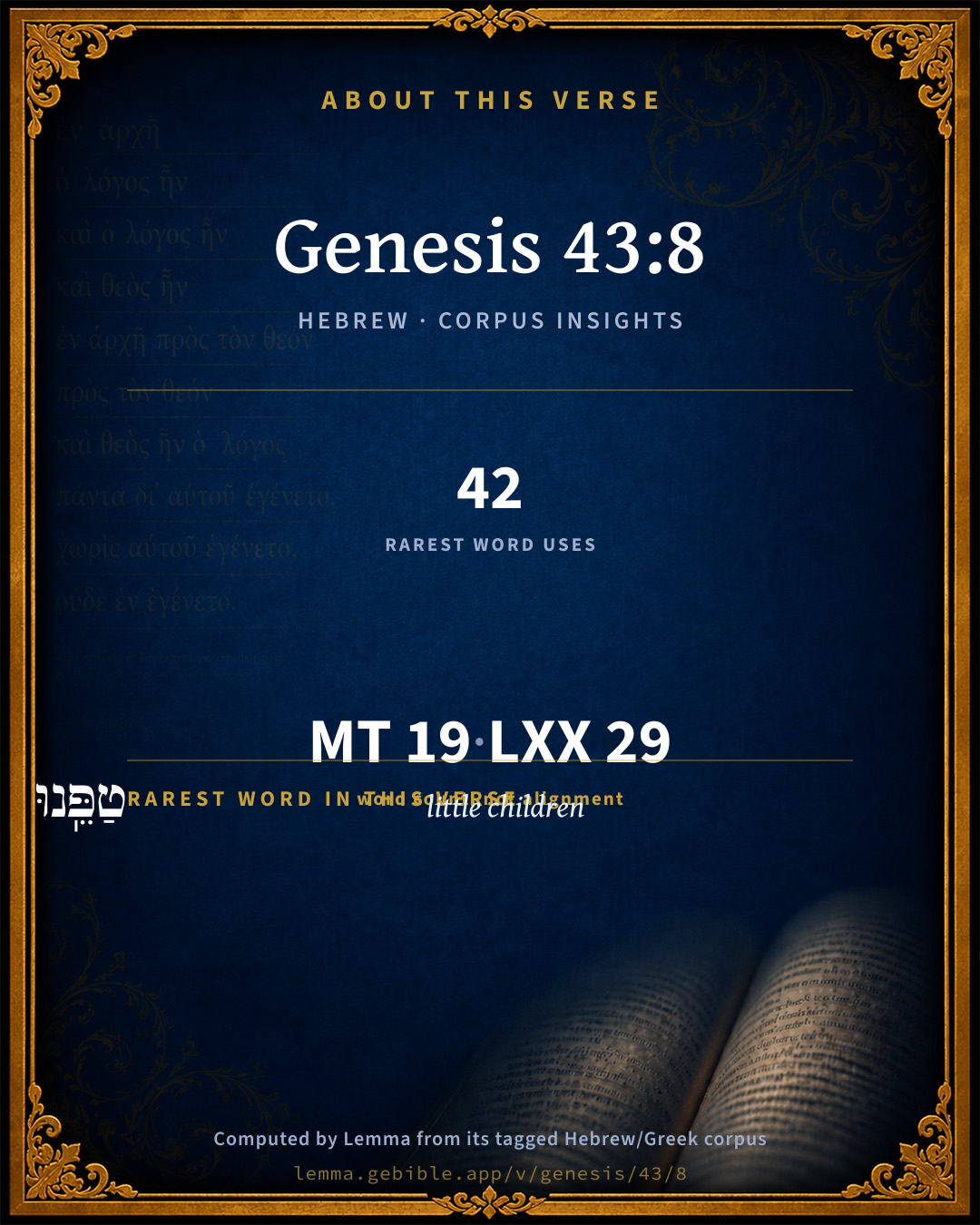
טַפֵּֽנוּ
ṭaph
H2945
“little children · our”
Noun, Common, Masculine, Singular, Construct + Suffix, Personal, 1st Person, Common, Plural
Part of Speech
Noun
Type
Common
Gender
Masculine
Number
Singular
State
Construct
Full BDB Definition

Origin: from H2952 (perhaps referring to the tripping gait of children)

TWOT: 821a

children, little children, little ones
  1. וַיֹּ֨אמֶר ʼâmar H559 “and · to say” Conjunction + Verb, Qal, Sequential Imperfect, 3rd Person, Masculine, Singular
  2. יְהוּדָ֜ה Yᵉhûwdâh H3063 “Judah” Noun, Proper
  3. אֶל ʼêl H413 “to” Preposition
  4. יִשְׂרָאֵ֣ל Yisrâʼêl H3478 “Israel” Noun, Proper
  5. אָבִ֗יו ʼâb H1 “father · his” Noun, Common, Masculine, Singular, Construct + Suffix, Personal, 3rd Person, Masculine, Singular
  6. שִׁלְחָ֥ה shâlach H7971 “send” Verb, Qal, Imperative, 2nd Person, Masculine, Singular + Suffix, h
  7. הַנַּ֛עַר naʻar H5288 “the · boy” Particle, Definite Article + Noun, Common, Masculine, Singular, Absolute
  8. אִתִּ֖י ʼêth H854 “with · me” Preposition + Suffix, Personal, 1st Person, Common, Singular
  9. וְנָק֣וּמָה qûwm H6965 “and · to rise” Conjunction + Verb, Qal, Cohortative, 1st Person, Common, Plural
  10. וְנֵלֵ֑כָה yâlak H3212 “and · to walk” Conjunction + Verb, Qal, Cohortative, 1st Person, Common, Plural
  11. וְנִֽחְיֶה֙ châyâh H2421 “and · to live” Conjunction + Verb, Qal, Imperfect, 1st Person, Common, Plural
  12. וְלֹ֣א lôʼ H3808 “and · not” Conjunction + Particle, Negative
  13. נָמ֔וּת mûwth H4191 “to die” Verb, Qal, Imperfect, 1st Person, Common, Plural
  14. גַּם gam H1571 “also” Particle, Accusative
  15. אֲנַ֥חְנוּ ʼănachnûw H587 “we” Pronoun, Personal, 1st Person, Common, Plural
  16. גַם gam H1571 “also” Adverb
  17. אַתָּ֖ה ʼattâh H859 “you” Pronoun, Personal, 2nd Person, Masculine, Singular
  18. גַּם gam H1571 “also” Particle, Accusative

About this verse

These counts appear in no published source. They are computed here, from the morphology-tagged text and Lemma’s own curated glosses. What Lemma adds →

19
words
17
distinct lemmas
Pentateuch
section

Shared distinctive vocabulary

טַפֵּֽנוּ little children H2945 occurs in 42 verses of the Hebrew Bible. Also found in:

Grammatical profile

  • 6 verbs
  • 5 nouns
  • 2 pronouns
  • 2 prepositions
  • 1 adverb
  • 3 particles

Verb forms

  • וַיֹּ֨אמֶר Qal · Sequential Imperfect
  • שִׁלְחָ֥ה Qal · Imperative
  • וְנָק֣וּמָה Qal · Cohortative
  • וְנֵלֵ֑כָה Qal · Cohortative
  • וְנִֽחְיֶה֙ Qal · Imperfect
  • נָמ֔וּת Qal · Imperfect

Repetition

A word recurs within this verse — often emphatic in Hebrew:

  • גַּם also H1571 ×3

Hebrew & Septuagint length

In English translation the verse runs 34 words from the Hebrew and 32 from the Septuagint (LXX English) — closely comparable.

A rough comparison of the two English renderings, which tokenize alike — not a word-level alignment.

Word counts can differ between the Hebrew and the Greek without any difference in meaning — e.g. the Hebrew direct-object marker אֵת has no separate Greek word, and Greek often adds the article ὁ.

In the original languages it is 19 Hebrew tokens and 29 Greek tokens — but the two are counted differently (Hebrew bundles its prefixes and suffixes into one token; the Greek is in lemma form), so that isn’t a like-for-like length.

Cross-references

13

Topical passages linked to Genesis 43:8 in the Treasury of Scripture Knowledge — connected by theme and wording, ordered by reader-vote popularity; previews shown in the World English Bible.

  • Genesis 42:2 He said, "Behold, I have heard that there is grain in Egypt. Go down there, and buy for us from there, so that we may live, and not die."
  • Deuteronomy 33:6 Let Reuben live, and not die; Nor let his men be few.
  • Genesis 42:38 He said, "My son shall not go down with you; for his brother is dead, and he only is left. If harm happens to him by the way in which you go, then you will bring down my gray hairs with sorrow to Sheol."
  • Genesis 44:26 We said, 'We can't go down. If our youngest brother is with us, then will we go down: for we may not see the man's face, unless our youngest brother is with us.'
  • Genesis 45:19 Now you are commanded: do this. Take wagons out of the land of Egypt for your little ones, and for your wives, and bring your father, and come.
  • Genesis 50:8 all the house of Joseph, his brothers, and his father's house. Only their little ones, their flocks, and their herds, they left in the land of Goshen.
  • Genesis 50:21 Now therefore don't be afraid. I will nourish you and your little ones." He comforted them, and spoke kindly to them.
  • Exodus 20:12 "Honor your father and your mother, that your days may be long in the land which Yahweh your God gives you.
  • Numbers 14:31 But your little ones, that you said should be a prey, them will I bring in, and they shall know the land which you have rejected.
  • 2 Kings 7:4 If we say, We will enter into the city, then the famine is in the city, and we shall die there; and if we sit still here, we die also. Now therefore come, and let us fall to the host of the Syrians: if they save us alive, we shall live; and if they kill us, we shall but die.
  • 2 Kings 7:13 One of his servants answered, Please let some take five of the horses that remain, which are left in the city (behold, they are as all the multitude of Israel who are left in it; behold, they are as all the multitude of Israel who are consumed); and let us send and see.
  • Ezra 8:21 Then I proclaimed a fast there, at the river Ahava, that we might humble ourselves before our God, to seek of him a straight way for us, and for our little ones, and for all our substance.
  • Psalms 118:17 I will not die, but live, And declare Yah's works.

Cross-references courtesy of OpenBible.info (CC BY 4.0).

Hebrew and Greek witnesses Masoretic Hebrew ↔ Greek Septuagint

The same verse in the two great witnesses to the Old Testament, shown verse-for-verse.

These are two independent witnesses, not word-aligned to each other, and the Septuagint is shown in lemma (dictionary) form.

Hebrew Genesis 43:8 Masoretic · Westminster Leningrad Codex

וַיֹּ֨אמֶר יְהוּדָ֜ה אֶל יִשְׂרָאֵ֣ל אָבִ֗יו שִׁלְחָ֥ה הַנַּ֛עַר אִתִּ֖י וְנָק֣וּמָה וְנֵלֵ֑כָה וְנִֽחְיֶה֙ וְלֹ֣א נָמ֔וּת גַּם אֲנַ֥חְנוּ גַם אַתָּ֖ה גַּם טַפֵּֽנוּ

Judah said to Israel, his father, "Send the boy with me, and we will arise and go, so that we may live, and not die, both we, and you, and also our little ones.

World English Bible · Public Domain

Greek LXX Genesis 43:8 Septuagint · lemma form

εἶπον δέ ἰούδας πρός ἰσραήλ ὁ πατήρ αὐτός ἀποστέλλω ὁ παιδάριον μετά ἐγώ καί ἀναἵστημι πορεύομαι ἵνα ζάω καί μή ἀποθνήσκω καί ἐγώ καί σύ καί ὁ ἀποσκευή ἐγώ

And Judas said to his father Israel, Send the boy with me, and we will arise and go, that we may live and not die, both we and you, and our store.

LXX2012 (modern English Septuagint) · Public Domain

Hebrew: Westminster Leningrad Codex (CC BY 4.0). Greek: Septuagint (public domain); English from LXX2012 (modern English Septuagint) (Public Domain). How the Septuagint differs from the Hebrew →

Targum (Aramaic paraphrase)

2

The Targum is the ancient Jewish Aramaic paraphrase of the Hebrew Scriptures — an interpretive translation, not the Hebrew text itself. Onkelos (literal) and Pseudo-Jonathan (expansive) render the Torah, and Jonathan the Prophets. Coverage is partial: where no permissively-licensed English translation exists for a verse, only the Aramaic is shown. This is verse-level text, not a word-by-word alignment to the Hebrew.

  1. Targum Onkelos Torah (Genesis–Deuteronomy)
    וַאֲמַר יְהוּדָה לְיִשְׂרָאֵל אֲבוּהִי שְׁלַח עוּלֵימָא עִמִּי וְנֵקוּם וְנֵזֵיל וְנֵיחֵי וְלָא נְמוּת אַף אֲנַחְנָא אַף אַתְּ אַף טַפְלָנָא

    (no public-domain English translation for this verse)

    Targum Onkelos — Aramaic: “Onkelos Genesis” (public domain); “Onkelos Exodus” (public domain); “Onkelos Leviticus” (public domain); “Onkelos Numbers” (public domain); “Onkelos Deuteronomy” (public domain). English: “Sefaria Community Translation” (CC0 1.0 (public-domain dedication)); “J.W. Etheridge. The Targums of Onkelos and Jonathan Ben Uzziel on the Pentateuch. London: Longmans, Green, 1862” (public domain). Text via Sefaria.

  2. Targum Pseudo-Jonathan Torah (Genesis–Deuteronomy)
    וַאֲמַר יְהוּדָה לְיִשְרָאֵל אָבוֹי שָׁדַר טַלְיָא עִמִי וְנֵיקוֹם וְנֵיזֵיל וְנֵיחֵי וְלָא נְמוּת אוּף אֲנַן אוּף אַנְתְּ אוּף טַפְלָנָא

    And Jehuda said to Israel his father, Send the youth with me, that we may arise and go; and that we may live and not die, both we, and you, and our little ones.

    Targum Pseudo-Jonathan — Aramaic: “Targum Jonathan on Genesis” (public domain); “Targum Jonathan on Exodus” (public domain); “Targum Jonathan on Leviticus” (public domain); “Targum Jonathan on Numbers” (public domain); “Targum Jonathan on Deuteronomy” (public domain). English: “The Targum of Jonathan ben Uzziel, trans. J. W. Etheridge, London, 1862” (public domain). Text via Sefaria.

Commentary

Notes on Genesis 43:8 from classic Christian and Jewish commentators (each source and its license shown beneath its notes). The classic Christian expositions comment on the surrounding passage and are grouped to its opening verse, so a note may address several verses; the Jewish commentaries on the Tanakh (Rashi and others) are per-verse, so they appear only where the commentator wrote on this verse.

Lemma curates 59 commentaries, every one of them public domain or Creative Commons licensed, each selected and text-cleaned for this edition rather than reprinted as found. About our sources →

Trapp's Complete Commentary

John Trapp

Gen 43:8 And Judah said unto Israel his father, Send the lad with me, and we will arise and go; that we may live, and not die, both we, and thou, [and] also our little ones.

Ver. 8. Send the lad.] A large lad, that was thirty years old, and had ten children. But he is so called, because the youngest son of them, and the father’s darling.

John Trapp, A Commentary or Exposition upon All the Books of the Old and New Testament (1647–1656) — public domain. Text from a community e-Sword module.

Joseph Benson's Commentary

Gen 43:8. Judah said unto his father — He, on account of his age, prudence, and penitent carriage for his youthful follies, was much beloved and regarded by his father, and, on this occasion, was likely to have the greatest influence in persuading him. Send the lad with me — So he terms him, because he was the youngest of all, though he was now thirty years old, and a father of divers children.

Joseph Benson's Commentary on the Old and New Testaments (1811–1818) — public domain. Text from a community e-Sword module.

Tyndale Open Study Notes

Tyndale Open Resources

43:8-10 Judah broke the deadlock by taking responsibility for Benjamin’s well-being, thus succeeding where Reuben failed. His action was fitting, since it had been his idea to sell Joseph to the Ishmaelites (37:26-27) instead of killing him. Now he would secure Benjamin’s safety with his own life (see 44:18-34).

Tyndale Open Study Notes — © Tyndale Open Resources, licensed CC BY-SA 4.0. Text via the HelloAO Bible API.

Adam Clarke's Commentary

Verse 8. Send the lad with me] As the original is not ילד yeled, from which we have derived our word lad, but נער naar, it would have been better had our translators rendered it by some other term, such as the youth, or the young man, and thus the distinction in the Hebrew would have been better kept up. Benjamin was at this time at least twenty-four years of age, some think thirty, and had a family of his own. See Ge 46:21.

That we may live, and not die] An argument drawn from self-preservation, what some have termed the first law of nature. By your keeping Benjamin we are prevented from going to Egypt; if we go not to Egypt we shall get no corn; if we get no corn we shall all perish by famine; and Benjamin himself, who otherwise might live, must, with thee and the whole family, infallibly die.

Adam Clarke's Commentary on the Bible (1810–1826) — public domain. Text from a community e-Sword/MySword module.

Ellicott's Commentary for English Readers

(8) The lad.—Benjamin was now between twenty and thirty years of age. The term “lad” in Judah’s mouth is one of affection, but even in itself it suits very well to a youth of this age. Rebekah (in Gen_24:16) is called in the Hebrew a lad (see Note there), and so is Shechem in Gen_34:19. The assertion, therefore, that Benjamin is here represented as a mere boy, is disproved by the use of the word in the Hebrew.

Our little ones.—Heb., our “tafs” that is, our households. (See Note on Gen_34:29.)

A Bible Commentary for English Readers, edited by Charles John Ellicott (1878–1897) — public domain. Text from a community e-Sword module.

John Gill's Exposition

I will be surety for him,.... Engage for his safe return:

of my hand shall thou require him; I will be answerable for him:

if I bring him not to thee, and set him before thee: do not return him from Egypt, and bring him to Canaan, into his father's house and presence safe, and sound:

then let me bear the blame for ever; of persuading his father to let him go with him; all this he said, to show what care he would take of him, and what confidence he had that no evil would befall him, that he would be returned with them in safety; which he might ground upon the assurance that Joseph had given, that they should not die if they brought their brother with them, Gen 42:20; and perhaps Judah, as Schmidt thinks, might be under a special instinct of divine Providence, which directed him to say these things: and it may be added, that Jacob also might be under a divine impulse, which influenced him to regard what Judah said, or otherwise his suretyship was but a poor security, and of little avail.

John Gill's Exposition of the Whole Bible (1746–1763) — public domain (CC PDM 1.0). Text via the HelloAO Bible API.

Haydock's Catholic Bible Commentary

The boy; now 24 years old, (Calmet) and the father of a family, chap. xlvi. 21. (Haydock)

George Leo Haydock (1774–1849), Haydock's Catholic Family Bible and Commentary, 1859 edition — public domain. Excludes Psalms (Douay-Rheims chapter numbering differs from Protestant) and Deuterocanonical books (Catholic canon only).

Matthew Poole's English Annotations

Judah, for his age and prudence, and penitent carriage for his youthful follies, was most beloved and regarded by his father.

The lad; so he calls him, because he was the youngest of all, though he was now thirty years old, and a father of divers children. See Gen 30:22; 35:18; 41:46; 46:21.

Matthew Poole's English Annotations on the Holy Bible (1683–1685) — public domain. Text from a community e-Sword/MySword module.

Whedon's Commentary on the Bible

Daniel D. Whedon

8. Judah said — The eloquent plea of Judah seems to have had more weight with Jacob than the expressed wishes of all his other sons.

Daniel D. Whedon (gen. ed.), Commentary on the Old and New Testaments (1874–1909) — public domain. Text from a community e-Sword module.

The Pulpit Commentary

Vers. 8-10. And Judah said unto Israel his father, Send the lad with me (Benjamin, though styled a lad, must have been at this time upwards of twenty years of age), and we will arise and go; that we may (literally, and we shall) live, and not die, both we, and thou, and also our little ones. I will be surety for him (the verb conveys the idea of changing places with another); of my hand shalt thou require him: (vide Gen_9:5) if I bring him not unto thee, and set him before thee, the words are even more emphatic than those of Reuben (Gen_42:37) then let me bear the blame for ever literally, and I shall be a sinner (i.e. liable to punishment as a sinner) against the& all the gays; (sc. of my life). The thought is elliptical. Judah means that if he does not return with Benjamin he shall both have failed in his promise and be guilty of a dire transgression against his father (cf. 1Ki_1:21) For except we had lingered, surely now we had returned this second time literally, these two times. The nobility of character which shines out so conspicuously in Judah"s language is afterwards signally illustrated in his pathetic pleading before Joseph, and goes far to countenance the suggestion that a change must have taken place in his inner life since the incidents recorded of him in Ge 37, and Ge 38.

The Pulpit Commentary (1880–1919), ed. H.D.M. Spence-Jones & Joseph S. Exell — public domain. Text from a community e-Sword module.

Keil & Delitzsch

C. F. Keil & F. Delitzsch

He then repeated the only condition on which they would go to Egypt again, referring to the death by famine which threatened them, their father, and their children, and promising that he would himself be surety for the youth (הנּער, Benjamin was twenty-three years old), and saying, that if he did not restore him, he would bear the blame (חטא to be guilty of a sin and stone for it, as in Kg1 1:21) his whole life long. He then concluded with the deciding words, "for if we had not delayed, surely we should already have returned a second time."

Keil & Delitzsch — Biblical Commentary on the Old Testament (1861–1891) — public domain (CC PDM 1.0). Text via the HelloAO Bible API. (Old Testament only.)

unfoldingWord translationNotes

Door43 World Missions Community

We will rise and go that we may live and not die, both we, you, and also our children

The phrases "we may live" and "not die" mean the same thing. Judah is emphasizing that they have to buy food in Egypt in order to survive. AT: "We will go now to Egypt and get grain so our whole family will live" (See: Parallelism)

We will rise

Here "We" refers to the brothers who will travel to Egypt. (See: Exclusive and Inclusive "We")

we may live

Here "we" refers to the brothers, Israel, and the whole family. (See: Inclusive "We")

both we

Here "we" refers to the brothers. (See: Exclusive and Inclusive "We")

we, you

Here "you" is singular and refers to Israel. (See: Forms of You)

also our children

Here "our" refers to the brothers. This refers to the small children who were most likely to die during a famine. (See: Exclusive and Inclusive "We")

I will be a guarantee for him

The abstract noun "guarantee" can be stated as the verb "promise." AT: "I will promise to bring him back" (See: Abstract Nouns)

You will hold me responsible

How Jacob will hold Judah responsible can be stated clearly. AT: "You will make me answer to you about what happens to Benjamin" (See: Assumed Knowledge and Implicit Information)

let me bear the blame

This speaks about "blame" as if it were an object that a person has to carry. AT: "you may blame me" (See: Metaphor)

For if we had not delayed

Judah is describing something that could have happened in the past but did not. Judah is scolding his father for waiting so long to send his sons to Egypt to get more food. (See: Hypothetical Situations)

we would have come back here a second time

"we would have returned twice"

translationWords

Judah

Jacob

eternity

unfoldingWord translationNotes — © Distant Shores Media and the Door43 World Missions Community, licensed CC BY-SA 4.0. Source: git.door43.org/Door43/en_tn.

Rashi

Rabbi Shlomo Yitzchaki (Rashi)

ונחיה THAT WE MAY LIVE — (literally, and we shall live). The spirit of prophecy was enkindled within him. He said: owing to this journey your spirit will live again, which indeed happened, as it is said, (Genesis 45:27) “And the spirit of Jacob, their father, revived”.

ולא נמות AND THAT WE MAY NOT DIE of hunger. As for Benjamin it is doubtful whether he will be seized or whether he will not be seized, but as for us, we shall certainly all die of hunger if we do not go. It is better that you should let go what is doubtful and snatch at what is certain (Genesis Rabbah 91:6).

Rashi on the Tanakh — English translations: “The Judaica Press complete Tanach with Rashi, translated by A. J. Rosenberg” (CC BY 4.0); “Pentateuch with Rashi's commentary by M. Rosenbaum and A.M. Silbermann, 1929-1934” (public domain); “The Metsudah Tanach series, Lakewood, N.J” (CC BY 4.0); and “The Book of Joshua, Metsudah Publications, 1997” (CC BY 4.0). Text via Sefaria.

Radak

Rabbi David Kimhi (Radak)

גם אנחנו גן אתה גם טפנו, each one in addition to the one already mentioned. What Yehudah meant was it was better that one Binyamin should come along with them although his safe return was subject to some doubt, than they should all die, something which would be a certainty.

Radak on the Tanakh — English translations: “Sefaria Community Translation” (CC0 1.0 (public-domain dedication)); “Eliyahu Munk, HaChut Hameshulash” (CC BY 4.0); “Rabbi Mike Feuer, Jerusalem Anthology” (CC BY 4.0); and “R. David Kimhi on the first book of Psalms, Translated by R.G. Finch, London, 1919” (public domain). Text via Sefaria.

Lesson kit

Teaching starters — assembled from the data on this page, not authored interpretation. Every prompt links to the verse data it draws on. Edit before teaching.

Genesis, in the Pentateuch, opens this verse with 19 words (17 distinct Hebrew lemmas). Its most distinctive word is ṭaph (“little children”). A historical commentator’s framing appears above. Read the whole chapter for the surrounding context.

Discussion questions

  1. The word ṭaph carries the sense “little children.” How does it shape the verse?
  2. How does Genesis 34:29, which shares the word «little children», read alongside this verse?
  3. What does the repetition of “also” (3× in this one verse) do in this verse?
  4. These translations render this verse differently; the difference is in the English rendering, not the original. What questions does that raise?
  5. «וַיֹּ֨אמֶר» is a Qal Sequential Imperfect verb. How does that grammatical form shape the action described?
  6. Compare how Trapp's Complete Commentary and Joseph Benson's Commentary read this verse. Where do they agree or differ?

Things to notice

Reading settings

Reading text

Shown beneath each verse's original-language words.

Old Testament
Old Testament edition

Read the OT as the Masoretic Hebrew (MT) or the Greek Septuagint (LXX).

English shown for the Greek Septuagint (in the Hebrew ↔ Greek comparison).

Comparing translations? Open the Compare panel on any verse page to stack up to four side by side.