
1 Samuel 2:6

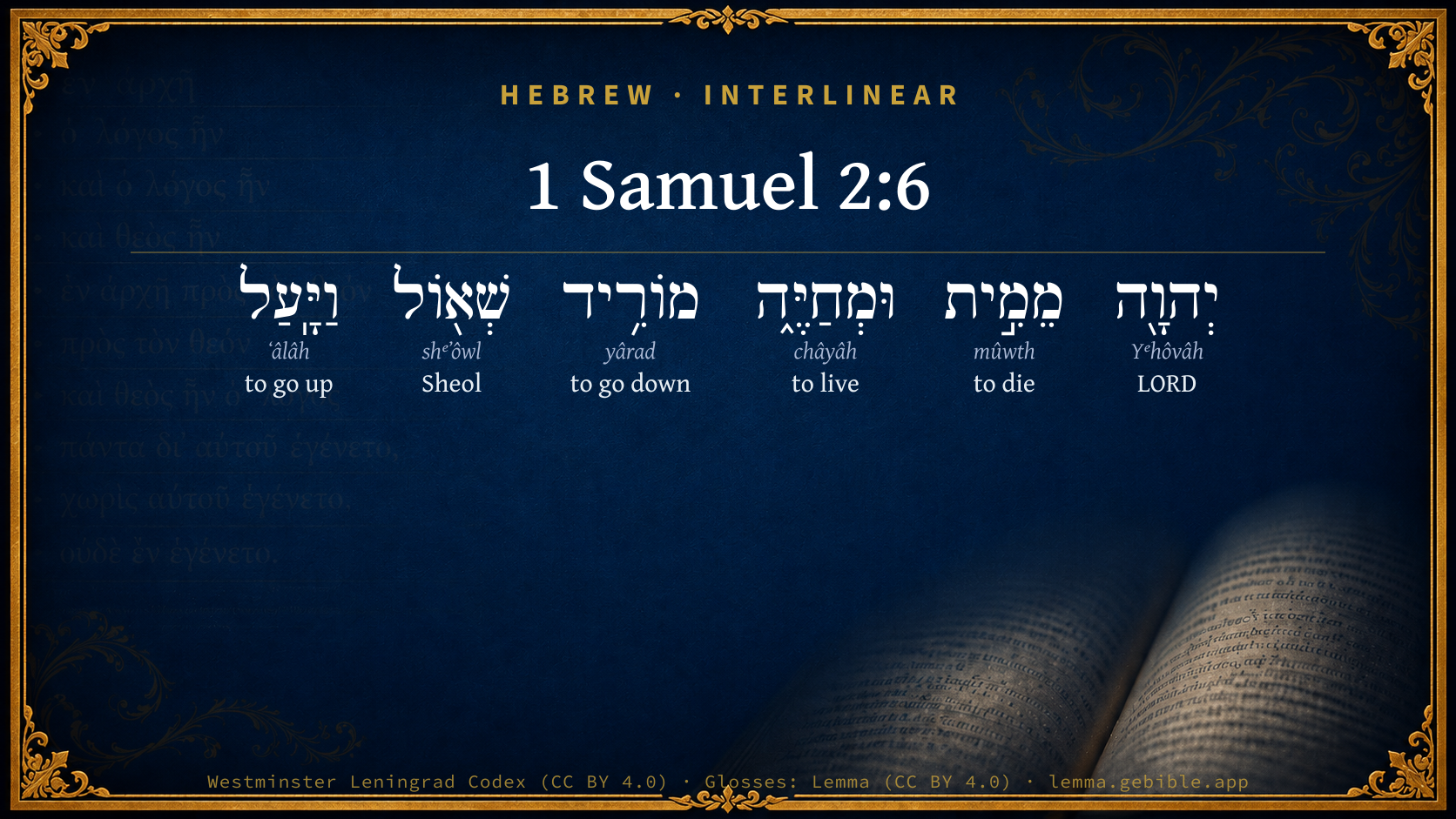
Hebrew (Westminster Leningrad Codex) 1 Samuel 2:6 appears in the Hebrew Old Testament. The text above is from the Westminster Leningrad Codex. Each word links to its Strong’s number, a concise gloss, and parsing drawn from the Open Scriptures Hebrew Bible morphology. Click any word for its full Brown-Driver-Briggs (BDB) entry.
Download image
Cite this verse

1 Samuel 2:6 (World English Bible). Public Domain. Lemma interlinear Bible study tool, https://lemma.gebible.app/v/1-samuel/2/6.

Show BibTeX & RIS
BibTeX
RIS
English Translation
Yahweh kills, and makes alive: He brings down to Sheol, and brings up.
World English Bible · Public Domain
Download a study sheet

One document with this verse’s original text, its word-by-word gloss line, the meaning frame, cross-references with their text, attributed commentary, and full source and license credits — printable, and it pastes into notes with its structure intact.

This verse Autodidact and up

Study sheet (.html) Plain text (.txt)

A passage Seminary Student

Up to 50 verses in one chapter. A passage sheet keeps up to 6 commentary sources and 12 cross-references per verse, in the order this page ranks them, and says so on the sheet whenever that leaves anything out. Ask for a single verse and you get the Autodidact verse sheet above.

Everything on this page stays free to read, with no account — the sheet is a download of what is already on screen, not access to it.

Want to remove ads? Support Godless Engineer
Compare translations 3

The same verse in 3 English versions, stacked beneath the original-language interlinear above. Click any original word for its lexicon entry.

Each is an independent rendering of the whole verse — the interlinear is not word-aligned to these translations.

Highlighted words mark where these versions differ — a whole-verse word diff, not a word-by-word alignment.

  • World English Bible Public Domain
    Yahweh kills, and makes alive: He brings down to Sheol, and brings up.
  • King James Version Public Domain
    The LORD killeth, and maketh alive: he bringeth down to the grave, and bringeth up.
  • unfoldingWord Literal Text CC BY-SA 4.0
    Yahweh makes die and makes alive, causing to go down to Sheol and causing to come up.

unfoldingWord Literal Text — © unfoldingWord, licensed CC BY-SA 4.0. Word-aligned USFM3 via Door43 (git.door43.org/unfoldingWord/en_ult).

Versions to compare (up to 4)

3 of 4 selected

Show all 18 translations

Every available English version of this verse, each an independent rendering of the whole verse.

  • World English Bible Public Domain
    Yahweh kills, and makes alive: He brings down to Sheol, and brings up.
  • Berean Standard Bible Public Domain
    The LORD brings death and gives life; He brings down to Sheol and raises up.
  • Majority Standard Bible Public Domain
    The LORD brings death and gives life; He brings down to Sheol and raises up.
  • King James Version Public Domain
    The LORD killeth, and maketh alive: he bringeth down to the grave, and bringeth up.
  • American Standard Version (1901) Public Domain
    Jehovah killeth, and maketh alive: He bringeth down to Sheol, and bringeth up.
  • Revised Version (1885) Public Domain
    The LORD killeth, and maketh alive: he bringeth down to the grave, and bringeth up.
  • Geneva Bible (1599) Public Domain
    The Lord killeth and maketh aliue: bringeth downe to the graue and raiseth vp.
  • Douay-Rheims (1899) Public Domain
    The Lord killeth and maketh alive, he bringeth down to hell and bringeth back again.
  • Young's Literal Translation Public Domain
    Jehovah putteth to death, and keepeth alive, He bringeth down to Sheol, and bringeth up.
  • Literal Standard Version CC BY-SA 4.0
    YHWH puts to death, and keeps alive, || He brings down to Sheol, and brings up.
  • Unlocked Literal Bible CC BY-SA 4.0
    Yahweh kills and brings to life. He brings down to Sheol and raises up.
  • unfoldingWord Literal Text CC BY-SA 4.0
    Yahweh makes die and makes alive, causing to go down to Sheol and causing to come up.
  • Darby Bible Public Domain
    Jehovah killeth, and maketh alive; he bringeth down to Sheol, and bringeth up.
  • World Messianic Bible Public Domain
    “The LORD kills and makes alive. He brings down to Sheol and brings up.
  • Webster's Bible Public Domain
    The LORD killeth, and maketh alive: he bringeth down to the grave, and bringeth up.
  • Free Bible Version CC BY-SA 4.0
    The Lord kills and he revives; he sends some down to the grave, but he raises others up.
  • Bible in Basic English Public Domain
    The Lord is the giver of death and life: sending men down to the underworld and lifting them up.
  • JPS Tanakh (1917) Public Domain
    The LORD killeth, and maketh alive; He bringeth down to the grave, and bringeth up.

Literal Standard Version (2020), Covenant Press — licensed CC BY-SA 4.0. Text via the HelloAO Bible API (eBible.org). Unlocked Literal Bible (unfoldingWord) — licensed CC BY-SA 4.0. Text via the HelloAO Bible API (eBible.org). unfoldingWord Literal Text — © unfoldingWord, licensed CC BY-SA 4.0. Word-aligned USFM3 via Door43 (git.door43.org/unfoldingWord/en_ult). Free Bible Version, Dr. Jonathan Gallagher — licensed CC BY-SA 4.0. Text via the HelloAO Bible API (eBible.org).

Word by word

More ways to search: Search by grammar → Find every occurrence → Compare this word →

Practice this passage: Drill this verse → Learn its vocabulary →

About this verse

These counts appear in no published source. They are computed here, from the morphology-tagged text and Lemma’s own curated glosses. What Lemma adds →

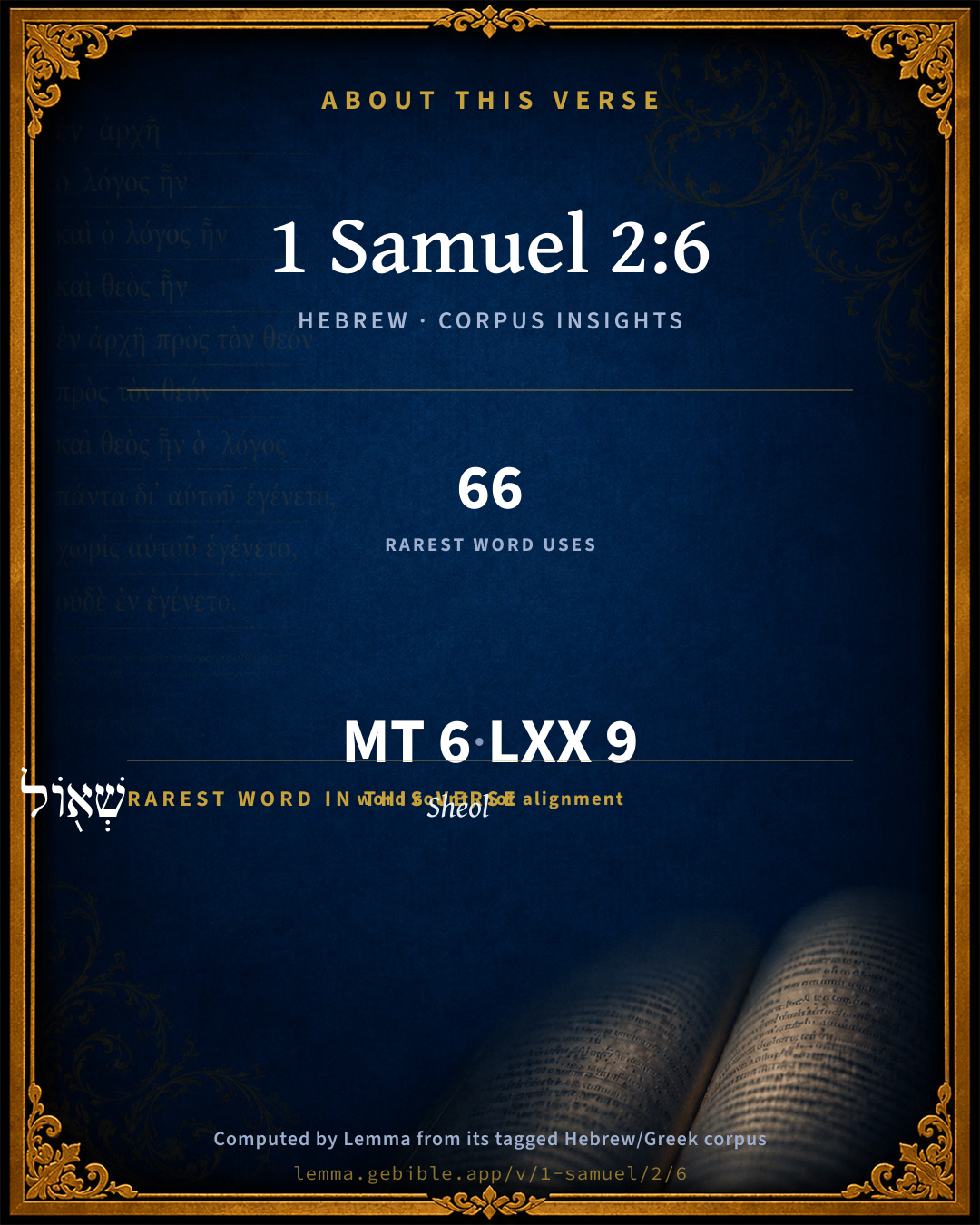
6
words
6
distinct lemmas
Historical
section

Grammatical profile

  • 4 verbs
  • 2 nouns

Verb forms

  • מֵמִ֣ית Hiphil · Participle Active
  • וּמְחַיֶּ֑ה Piel · Participle Active
  • מוֹרִ֥יד Hiphil · Participle Active
  • וַיָּֽעַל Hiphil · Sequential Imperfect

Hebrew & Septuagint length

In English translation the verse runs 13 words from the Hebrew and 15 from the Septuagint (LXX English) — closely comparable.

A rough comparison of the two English renderings, which tokenize alike — not a word-level alignment.

Word counts can differ between the Hebrew and the Greek without any difference in meaning — e.g. the Hebrew direct-object marker אֵת has no separate Greek word, and Greek often adds the article ὁ.

In the original languages it is 6 Hebrew tokens and 9 Greek tokens — but the two are counted differently (Hebrew bundles its prefixes and suffixes into one token; the Greek is in lemma form), so that isn’t a like-for-like length.

Cross-references

14

Topical passages linked to 1 Samuel 2:6 in the Treasury of Scripture Knowledge — connected by theme and wording, ordered by reader-vote popularity; previews shown in the World English Bible.

  • Deuteronomy 32:39 See now that I, even I, am he, There is no god with me: I kill, and I make alive; I wound, and I heal; There is none who can deliver out of my hand.
  • Isaiah 26:19 Your dead shall live; my dead bodies shall arise. Awake and sing, you who dwell in the dust; for your dew is [as] the dew of herbs, and the earth shall cast forth the dead.
  • 2 Kings 5:7 It happened, when the king of Israel had read the letter, that he tore his clothes, and said, Am I God, to kill and to make alive, that this man does send to me to recover a man of his leprosy? but consider, I pray you, and see how he seeks a quarrel against me.
  • Job 5:18 For he wounds, and binds up; He injures, and his hands make whole.
  • Jonah 2:2–6 He said, "I called because of my affliction to Yahweh. He answered me. Out of the belly of Sheol I cried. You heard my voice.
  • Revelation 1:18 and the Living one. I was dead, and behold, I am alive forevermore. Amen. I have the keys of Death and of Hades.
  • John 5:25–29 Most assuredly, I tell you, the hour comes, and now is, when the dead will hear the Son of God's voice; and those who hear will live.
  • Hosea 6:1–2 "Come, and let us return to Yahweh; For he has torn us to pieces, And he will heal us; He has injured us, And he will bind up our wounds.
  • John 11:25 Jesus said to her, "I am the resurrection and the life. He who believes in me, though he die, yet will he live.
  • 1 Samuel 20:3 David swore moreover, and said, Your father knows well that I have found favor in your eyes; and he says, Don't let Jonathan know this, lest he be grieved: but truly as Yahweh lives, and as your soul lives, there is but a step between me and death.
  • Psalms 116:3 The cords of death surrounded me, The pains of Sheol got a hold of me. I found trouble and sorrow.
  • Matthew 12:40 For as Jonah was three days and three nights in the belly of the whale, so will the Son of Man be three days and three nights in the heart of the earth.
  • 2 Corinthians 1:9–10 Yes, we ourselves have had the sentence of death within ourselves, that we should not trust in ourselves, but in God who raises the dead,
  • Psalms 68:20 God is to us a God of deliverance. To Yahweh, the Lord, belongs escape from death.

Cross-references courtesy of OpenBible.info (CC BY 4.0).

Hebrew and Greek witnesses Masoretic Hebrew ↔ Greek Septuagint

The same verse in the two great witnesses to the Old Testament, shown verse-for-verse.

These are two independent witnesses, not word-aligned to each other, and the Septuagint is shown in lemma (dictionary) form.

Hebrew 1 Samuel 2:6 Masoretic · Westminster Leningrad Codex

יְהוָ֖ה מֵמִ֣ית וּמְחַיֶּ֑ה מוֹרִ֥יד שְׁא֖וֹל וַיָּֽעַל

Yahweh kills, and makes alive: He brings down to Sheol, and brings up.

World English Bible · Public Domain

Greek LXX 1 Samuel 2:6 Septuagint · lemma form

κύριος θανατόω καί ζωογονέω καταἄγω εἰς ᾅδης καί ἀναἄγω

The Lord kills and makes alive; he brings down to the grave, and brings up.

LXX2012 (modern English Septuagint) · Public Domain

On this verse, Adam Clarke's Commentary discusses the Septuagint’s reading. Read the note in Commentary ↓

Hebrew: Westminster Leningrad Codex (CC BY 4.0). Greek: Septuagint (public domain); English from LXX2012 (modern English Septuagint) (Public Domain). How the Septuagint differs from the Hebrew →

Targum (Aramaic paraphrase)

1

The Targum is the ancient Jewish Aramaic paraphrase of the Hebrew Scriptures — an interpretive translation, not the Hebrew text itself. Onkelos (literal) and Pseudo-Jonathan (expansive) render the Torah, and Jonathan the Prophets. Coverage is partial: where no permissively-licensed English translation exists for a verse, only the Aramaic is shown. This is verse-level text, not a word-by-word alignment to the Hebrew.

  1. Targum Jonathan Prophets (Joshua–Malachi)
    כָּל אִלֵין גְבוּרָתָא דַייָ דְהוּא שַׁלִיט בְעַלְמָא מֵמִית וַאֲמַר לְאַחָאָה וּמָחִית לִשְׁאוֹל וְאַף עֲתִיד לְאַסָקָא בְּחַיֵי עַלְמָא:

    (no public-domain English translation for this verse)

    Targum Jonathan — Aramaic: “Mikraot Gedolot” (public domain). English: “Sefaria Community Translation” (CC0 1.0 (public-domain dedication)); “London "Chaldee Paraphrase," 1871” (public domain). Text via Sefaria.

Commentary

Notes on 1 Samuel 2:6 from classic Christian and Jewish commentators (each source and its license shown beneath its notes). The classic Christian expositions comment on the surrounding passage and are grouped to its opening verse, so a note may address several verses; the Jewish commentaries on the Tanakh (Rashi and others) are per-verse, so they appear only where the commentator wrote on this verse.

Lemma curates 59 commentaries, every one of them public domain or Creative Commons licensed, each selected and text-cleaned for this edition rather than reprinted as found. About our sources →

Ellicott's Commentary for English Readers

(6) The Lord killeth, and maketh alive.—Death too and life come from this same omnipotent Lord: nothing in the affairs of men is the sport of blind chance. The reign of a Divine law administered by the God to whom Hannah prayed is universal, and guides with a strict unerring justice what are commonly called the ups and downs, the changes and chances, of this mortal life. The following lines of the 7th, 8th, and 9th verses enforce by varied instances the same solemn truth.

The Babylonian Talmud on these words has a curious and interesting tradition:—“Three classes appear on the day of judgment: the perfectly righteous, who are at once written and sealed for eternal life; the thoroughly bad, who are at once written and sealed for hell: as it is written (Dan_12:2), ‘And many of them that sleep in the dust of the earth shall awake, some to everlasting life, and some to shame and everlasting contempt;’ and those in the intermediate state, who go down into hell, where they cry and howl for a time, whence they ascend again: as it is written (Zec_13:9), ‘And I will bring the third part through the fire, and will refine them as silver is refined, and will try them as gold is tried; they shall call on my name, and I will hear them.’ It is of them Hannah said (1Sa_2:6), ‘The Lord killeth, and maketh alive: he bringeth down to hell, and bringeth up.’”—Treatise Bosh Hashanah, fol. 16, Colossians 2.

A Bible Commentary for English Readers, edited by Charles John Ellicott (1878–1897) — public domain. Text from a community e-Sword module.

Trapp's Complete Commentary

John Trapp

1Sa 2:6 The LORD killeth, and maketh alive: he bringeth down to the grave, and bringeth up.

Ver. 6. The Lord killeth, and maketh alive.] He layeth men for dead, and then reviveth them, as 2Co 1:9-10. That great apostle was "in death often"; and those ancient confessors cry out, "For thy sake are we killed all the day long." {Rom 8:36} The Hebrews say that Peninnah’s children died all but two, and that those were saved alive by Hannah’s prayer for them, at their mother’s request.

John Trapp, A Commentary or Exposition upon All the Books of the Old and New Testament (1647–1656) — public domain. Text from a community e-Sword module.

The Biblical Illustrator

Joseph S. Exell

1Sa_2:6

The Lord killeth, and maketh alive: he bringeth down to the grave, and bringeth up.

Killed, then made alive

We must be emptied of self before we can be filled with grace; we must be stripped of our rags before we can be clothed with righteousness; we must be unclothed that we may be clothed; wounded, that we may be healed; killed, that we may be made alive; buried in disgrace, that we may rise in holy glory. These words, Sown in corruption, that we may be raised in incorruption; sown in dishonour, that we may be raised in glory; sown in weakness, that we may be raised in power, are as true of the soul as of the body. To borrow an illustration from the surgeons art: the bone that is set wrong must be broken again, in order that it may be set aright. I press this truth on your attention. It is certain that a soul filled with self has no room for God; and like the inn at Bethlehem, crowded with meaner guests, a heart preoccupied by pride and her godless train, has no chamber within which Christ may be born in us the hope of glory. (T. Guthrie, D. D.)

From death to life

This sentence has its own plain and natural meaning, which lies upon its surface like dust of gold; it has, moreover, a spiritual meaning, which needs to be digged for like silver in the mine.

I. In reference to its first and most manifest meaning, The Lord bringeth down to the grave, and bringeth up. Here the agency of God, in life and death, is clearly revealed to us. How well it is to discern the Lords hand in everything. We ascribe events to second causes, to the laws of nature and I know not what. I think it were better far, if we could go back to the good old way of talking and speaking of the Lord as being in everything. While we donor deny the laws of nature, nor decry the discoveries of science, we will suffer none of these to be hung up as a veil before our present God.

1. First of all, it should awaken gratitude. What a mercy it is that we are here this evening!

2. While it causes gratitude, it should compel consideration. The Lord bringeth down to the grave, and it is his rule never to do anything without a purpose. He doth not afflict willingly nor grieve the children of men for nought. There is always a needs be.

3. The Lords bringing us law and raising us up again, should cause great searching of heart. Suppose I had died when last I was sick: was I then prepared to die?

4. To those of us who are believers in Christ, restoration from sickness, and the privilege of again coming up to Gods house after an absence from it thorough illness, should suggest renewed activity. Haste thee! for behind thee are the flying wheels of the chariot of death, and the ashes thereof are growing red hot with speed. Fly, man, if thou wouldst accomplish thy life work, for thou hast not a moment to sparer Be watchful, brethren, for tits Lord bringeth down to the grave, and from that grave he bringeth us not up again to work, though he will bring us up to the reward and to the rest which remain foe the people of God.

II. Our text seems to indicate a state of heart through which those pass who are brought to God. I shall speak new experimentally, for if there breathes one soul on earth that can speak experimentally here, I am that man.

1. The sinner is led, first of all, to hear his own sentence pronounced.

2. Further than this: the convinced sinner is often made to feel, not only the sentence and the justice of it, but the very horror of death itself. You may have read in the narrative of the old American war, of the execution of deserters. They were brought out one bright morning, while yet the dew was on the grass, and were bidden to kneel down each man upon his coffin, and then a file of soldiers stepped forth; the word was given, and each man fell upon his coffin in which he was to be buried. Such things as the punishment of deserters are common in every war, but what must he the horror of the man who stands there, knowing that the bullet is waiting to reach his heart? In the old wars, they used to have a black heart sewn on the mans breast, and all the soldiers were to take aim and fire at that. Why, the man must suffer a thousand deaths white he stood waiting for the word of command. I have stood there, spiritually; and there are hundreds here who have thus faced their eternal doom.

3. Then there is a yet further death which the convinced sinner is made to feel, and that is the death of inability. He feels himself brought into a perfect state of death, as if a stupor had gone through every nerve, and frozen every muscle rigidly in its place, so that even the lifting of his little finger to help himself appears to be beyond his power. The climax of your disease is just the dawn of my hopes; your direst poverty is the time when I expect to see you enriched, for when you are completely emptied and have nothing, then Jesus Christ win be your strength and your salvation.

4. No doubt, the man now sees death written upon all his hopes. There was a door through which I had hoped to enter eternal life. I had spent much time in painting it, and making it comely to look upon. It seemed to me to have a golden knocker, a marble threshold, and posts and lintels of mahogany, and I thought it was the door of life for me. But now what do I see? I see a great black cross adown it, and over it there is written, Lord, have mercy upon us. This door is the door to heaven by my own good works, which I thought full sure would always be open to me; but lo, I see that all my best works are bad, and Lord, have mercy upon us, is the highest thing my works can produce for me. The death of legal hope is the salvation of the soul. I like to see legal hope swung up like a traitor. There let him hang to rot before the sun, more cursed than any other that was ever hanged on a tree. No more, then, concerning this death--The Lord bringeth down. But now a word or two of comfort for any of you who are brought down to this spiritual grave. There are many precious promises for such. Awake, thou that sleepest, and arise from the dead, and Christ shall give thee light. Though ye have lien among the pots, yet shall ye be as the wings of a dove covered with silver, and her feathers with yellow gold. Remember the experience of Jonah. Let the hope of Jeremiah be your consolation: But though he cause grief, yet will he have compassion according to the multitude o(his mercies. For he doth not afflict willingly nor grieve the children of men. And now notice that where God has thus killed and brought down, we may rest assured He will certainly bring up again. (C. H. Spurgeon.)

The Biblical Illustrator, edited by Joseph S. Exell (c. 1880s–1900s) — public domain. Text from a community e-Sword module.

Joseph Benson's Commentary

1Sa 2:6-7. The Lord killeth and maketh alive — The power of life and death is in the hands of God; whom he pleaseth he takes out of the world, and whom he pleaseth, he preserves in it; raising men even from the brink of the grave, when they are ready to drop into it. The Lord maketh poor, &c. — Here she acknowledges the power of God, in frequently changing the conditions of men, reducing the rich to extreme poverty, and exalting the poor to great riches.

Joseph Benson's Commentary on the Old and New Testaments (1811–1818) — public domain. Text from a community e-Sword module.

Jamieson, Fausset & Brown

Robert Jamieson, A. R. Fausset & David Brown

he bringeth down to the grave, and bringeth up--that is, He reduces to the lowest state of degradation and misery, and restores to prosperity and happiness.

Jamieson, Fausset & Brown — Commentary Critical and Explanatory on the Whole Bible (1871) — public domain (CC PDM 1.0). Text via the HelloAO Bible API.

Adam Clarke's Commentary

Verse 6. The Lord killeth] God is the arbiter of life and death; he only can give life, and he only has a right to take it away.

He bringeth down to the grave] The Hebrew word שאול sheol, which we translate grave, seems to have the same meaning in the Old Testament with αδης, hades in the New, which is the word generally used by the Septuagint for the other. It means the grave, the state of the dead, and the invisible place, or place of separate spirits. Sometimes we translate it hell, which now means the state of perdition, or place of eternal torments; but as this comes from the Saxon [Anglo-Saxon], to cover or conceal, it means only the covered place. In some parts of England the word helling is used for the covers of a book, the slating of a house, c. The Targum seems to understand it of death and the resurrection. "He kills and commands to give life he causes to descend into Sheol, that in the time to come he may bring them into the lives of eternity," i.e., the life of shame and everlasting contempt, and the life of glory.

Adam Clarke's Commentary on the Bible (1810–1826) — public domain. Text from a community e-Sword/MySword module.

The Cambridge Bible for Schools and Colleges

gen. ed. J. J. S. Perowne

6. the grave] The Heb. word Sheol, variously rendered in the E. V. grave, hell, pit, denotes the mysterious unseen world, the abode of all departed spirits, righteous and wicked alike. Hell, from A. S. helan, to cover, hide, would be a fair rendering if we could strip the word of all the associations with which it has been invested; but as we cannot do this, it is best to retain the Heb. word Sheol, or take its N. T. equivalent Hades.

There is no direct allusion here to the resurrection: death and Sheol are figuratively used for the depths of adversity and peril: life for deliverance and prosperity. See Psa_71:20; Psa_86:13.

6–8. In Jehovah’s hand are the issues of life and death, prosperity and adversity. All history illustrates this truth. Hezekiah is recalled from the gates of the grave: Job is tried by affliction: David is taken from the sheepfolds to be king: Nebuchadnezzar sinks to the level of a beast: Haman is degraded, Mordecai honoured: and chiefest example of all, He who “was despised and rejected of men,” was “highly exalted, and given a name that is above every name.”

The Cambridge Bible for Schools and Colleges (gen. ed. J. J. S. Perowne; Cambridge University Press, 1878–1918) — public domain. Text from a community e-Sword module.

John Gill's Exposition

The Lord killeth, and maketh alive,.... Which is true of different persons; some he takes away by death, and others he preserves and continues in life; and of the same persons, whom God removes by death, and restores them to life again, of which there are instances both in the Old and New Testament; and be they which they will, both are of God, he is the great Disposer of life and death. Death is of him; it is by his appointment; it is sent by his order; and when it has a commission from him, there is no resisting it; and let it be brought about by what means it will, still it is of God: and life is of him; it is first given by him, and it is preserved by him; and though taken away, it shall be restored at the resurrection of the dead; of which some interpret this clause, as Kimchi and Ben Gersom observe: and what is here said is true, in a spiritual sense; the Lord kills by the law, or shows men that they are dead in sin, and in a legal sense; and he makes alive by his Spirit, through the Gospel, quickening such who were dead in trespasses and sins; which is his own work, and the effect of divine power and grace; See Gill on Deu 32:39.

he bringeth down to the grave, and bringeth up; he bringeth some very near to the grave, to the very brink of it; so that in their own apprehensions, and in the opinion of their friends, they are just dropping into it, and no hope of recovery left; when he says to them "Return", and brings them back from the pit, and delivers them from going into it, Job 33:22 and even when they are laid in it, he brings up out of it again, as in the case of Lazarus, and which will be the case in the resurrection, Joh 5:28.

John Gill's Exposition of the Whole Bible (1746–1763) — public domain (CC PDM 1.0). Text via the HelloAO Bible API.

Haydock's Catholic Bible Commentary

Hell, (infernos,) "the lower regions." God calls us out of this world, or restores the dead to life, as he thinks proper. (Haydock) --- He easily makes the greatest prosperity succeed extreme distress, which is often denoted by death, hell, &c. So Seneca says, Mortis habet vices---Lentis cum trahitur vita gemitibus. The prodigal son is said to have come to life again, when his father received him, contrary to his expectations, Luke xv. 24., and Psalm xxix. 4., &c. (Calmet)

George Leo Haydock (1774–1849), Haydock's Catholic Family Bible and Commentary, 1859 edition — public domain. Excludes Psalms (Douay-Rheims chapter numbering differs from Protestant) and Deuterocanonical books (Catholic canon only).

Matthew Poole's English Annotations

Killeth, and maketh alive; either,

1. Diverse persons; he killeth one, and maketh another alive. Or,

2. The same person whom he first killeth, or bringeth very nigh unto death, he afterwards raiseth to life. Me, who was almost overwhelmed and consumed with grief, he hath revived. The name of death, both in sacred Scripture and profane writers, is oft given to great calamities; as Isa 26:19; Eze 37:11; Rom 8:36.

Matthew Poole's English Annotations on the Holy Bible (1683–1685) — public domain. Text from a community e-Sword/MySword module.

Whedon's Commentary on the Bible

Daniel D. Whedon

6. Kills and makes alive — In his hand is the power of life and death. Sheol here evidently means the grave, as in Gen_37:35; Gen_42:38; but with the word is ever associated a dim and shadowy idea of a separate disembodied existence, the under-world, into which all the dead have gone.

Daniel D. Whedon (gen. ed.), Commentary on the Old and New Testaments (1874–1909) — public domain. Text from a community e-Sword module.

John Wesley's Explanatory Notes

Killeth - The same person whom he first killeth, or bringeth nigh unto death, he afterwards raiseth to life. Me, who was almost consumed with grief, he hath revived. The name of death both in sacred scripture, and profane writers, is often given to great Calamities.

John Wesley, Explanatory Notes Upon the Whole Bible (1754–1765) — public domain. Text via the GEBible commentary corpus.

Scofield Reference Notes

C. I. Scofield

grave

Heb. "Sheol," (See Scofield "Hab 2:5").

The Scofield Reference Bible (1917 edition), notes by C. I. Scofield — public domain. Text from a community e-Sword module.

unfoldingWord translationNotes

Door43 World Missions Community

Connecting Statement:

Hannah continues to recite a song to Yahweh. (See: Parallelism)

Yahweh kills ... brings to life ... brings down ... raises up ... makes some people poor ... some rich ... humbles ... lifts up

Yahweh is in control of everything. (See: Merism)

translationWords

Yahweh

life

Hades

raise

humble

unfoldingWord translationNotes — © Distant Shores Media and the Door43 World Missions Community, licensed CC BY-SA 4.0. Source: git.door43.org/Door43/en_tn.

Radak

Rabbi David Kimhi (Radak)

The Lord kills, and gives life to a man. It first stated, "kills," and afterwards, "gives life," the opposite of a living being, who He set up to live and extends his life when He wants. And likewise (Isaiah 38:16), "and heal me and give me life"; and those that are similar to it - the explanation of which is the preservation of life in a person. And "He brings down to the grave and raises up," is likewise like (Psalms 30:4), "You raised my soul from the grave, You gave me life out of those that descended to the pit"; and also (Psalms 49:16), "from the grave, since You took me, Selah." And the understanding of, "from," is above from it and below from it; or it is a hint to troubles and respites. And likewise (Deuteronomy 32:39), "I kill and I give life." Or "He kills, and gives life" - I kill and give life is a hint to the reward of the righteous and to the punishment of the wicked, to their souls. Or it stated this verse in the way of prophecy or in the way of tradition about the revival of the dead in the future to come.

Radak on the Tanakh — English translations: “Sefaria Community Translation” (CC0 1.0 (public-domain dedication)); “Eliyahu Munk, HaChut Hameshulash” (CC BY 4.0); “Rabbi Mike Feuer, Jerusalem Anthology” (CC BY 4.0); and “R. David Kimhi on the first book of Psalms, Translated by R.G. Finch, London, 1919” (public domain). Text via Sefaria.

Lesson kit

Teaching starters — assembled from the data on this page, not authored interpretation. Every prompt links to the verse data it draws on. Edit before teaching.

1 Samuel, in the Historical, opens this verse with 6 words (6 distinct Hebrew lemmas). Its most distinctive word is shᵉʼôwl (“Sheol”). A historical commentator’s framing appears above. Read the whole chapter for the surrounding context.

Discussion questions

  1. What does “Sheol” (shᵉʼôwl) contribute to the verse as a whole?
  2. Deuteronomy 32:39 shares this passage’s theme. How do the two illuminate each other?
  3. These translations render this verse differently. What is at stake in choosing one wording over another?
  4. The verb «מֵמִ֣ית» is Hiphil Participle Active. How does its form color the action?
  5. Reading how Ellicott's Commentary for English Readers and Trapp's Complete Commentary read this verse, where do the two commentators agree and where do they part?

Things to notice

Reading settings

Reading text

Shown beneath each verse's original-language words.

Old Testament
Old Testament edition

Read the OT as the Masoretic Hebrew (MT) or the Greek Septuagint (LXX).

English shown for the Greek Septuagint (in the Hebrew ↔ Greek comparison).

Comparing translations? Open the Compare panel on any verse page to stack up to four side by side.