
Exodus 1:16

Hebrew (Westminster Leningrad Codex) Exodus 1:16 appears in the Hebrew Old Testament. The text above is from the Westminster Leningrad Codex. Each word links to its Strong’s number, a concise gloss, and parsing drawn from the Open Scriptures Hebrew Bible morphology. Click any word for its full Brown-Driver-Briggs (BDB) entry.
Download image
Cite this verse

Exodus 1:16 (World English Bible). Public Domain. Lemma interlinear Bible study tool, https://lemma.gebible.app/v/exodus/1/16.

Show BibTeX & RIS
BibTeX
RIS
English Translation
and he said, "When you perform the duty of a midwife to the Hebrew women, and see them on the birth stool; if it is a son, then you shall kill him; but if it is a daughter, then she shall live."
World English Bible · Public Domain
Highlights
  • 1 first appearance in the Hebrew Bible
Full analysis ↓
Download a study sheet

One document with this verse’s original text, its word-by-word gloss line, the meaning frame, cross-references with their text, attributed commentary, and full source and license credits — printable, and it pastes into notes with its structure intact.

This verse Autodidact and up

Study sheet (.html) Plain text (.txt)

A passage Seminary Student

Up to 50 verses in one chapter. A passage sheet keeps up to 6 commentary sources and 12 cross-references per verse, in the order this page ranks them, and says so on the sheet whenever that leaves anything out. Ask for a single verse and you get the Autodidact verse sheet above.

Everything on this page stays free to read, with no account — the sheet is a download of what is already on screen, not access to it.

Want to remove ads? Support Godless Engineer
Compare translations 3

The same verse in 3 English versions, stacked beneath the original-language interlinear above. Click any original word for its lexicon entry.

Each is an independent rendering of the whole verse — the interlinear is not word-aligned to these translations.

Highlighted words mark where these versions differ — a whole-verse word diff, not a word-by-word alignment.

  • World English Bible Public Domain
    and he said, "When you perform the duty of a midwife to the Hebrew women, and see them on the birth stool; if it is a son, then you shall kill him; but if it is a daughter, then she shall live."
  • King James Version Public Domain
    And he said, When ye do the office of a midwife to the Hebrew women, and see them upon the stools; if it be a son, then ye shall kill him: but if it be a daughter, then she shall live.
  • unfoldingWord Literal Text CC BY-SA 4.0
    And he said, “When you assist the Hebrew women as midwives and you see on the birth stool, if he is a son, then you shall cause him to die, but if she is a daughter, then she shall live.”

unfoldingWord Literal Text — © unfoldingWord, licensed CC BY-SA 4.0. Word-aligned USFM3 via Door43 (git.door43.org/unfoldingWord/en_ult).

Versions to compare (up to 4)

3 of 4 selected

Show all 18 translations

Every available English version of this verse, each an independent rendering of the whole verse.

  • World English Bible Public Domain
    and he said, "When you perform the duty of a midwife to the Hebrew women, and see them on the birth stool; if it is a son, then you shall kill him; but if it is a daughter, then she shall live."
  • Berean Standard Bible Public Domain
    “When you help the Hebrew women give birth, observe them on the birthstools. If the child is a son, kill him; but if it is a daughter, let her live.”
  • Majority Standard Bible Public Domain
    “When you help the Hebrew women give birth, observe them on the birthstools. If the child is a son, kill him; but if it is a daughter, let her live.”
  • King James Version Public Domain
    And he said, When ye do the office of a midwife to the Hebrew women, and see them upon the stools; if it be a son, then ye shall kill him: but if it be a daughter, then she shall live.
  • American Standard Version (1901) Public Domain
    and he said, When ye do the office of a midwife to the Hebrew women, and see them upon the birth-stool; if it be a son, then ye shall kill him; but if it be a daughter, then she shall live.
  • Revised Version (1885) Public Domain
    and he said, When ye do the office of a midwife to the Hebrew women, and see them upon the birthstool; if it be a son, then ye shall kill him; but if it be a daughter, then she shall live.
  • Geneva Bible (1599) Public Domain
    And sayde, When ye doe the office of a midwife to the women of the Ebrewes, and see them on their stooles, if it be a sonne, then yee shall kill him: but if it be a daughter, then let her liue.
  • Douay-Rheims (1899) Public Domain
    Commanding them: When you shall do the office of midwives to the Hebrew women, and the time of delivery is come: if it be a man child, kill it: if a woman, keep it alive.
  • Young's Literal Translation Public Domain
    and saith, `When ye cause the Hebrew women to bear, and have looked on the children; if it `is' a son -- then ye have put him to death; and if it `is' a daughter -- then she hath lived.'
  • Literal Standard Version CC BY-SA 4.0
    and says, “When you cause the Hebrew women to bear, and have looked on the children, if it [is] a son, then you have put him to death; and if it [is] a daughter, then she has lived.”
  • Unlocked Literal Bible CC BY-SA 4.0
    He said, “When you assist the Hebrew women on the birthstool, observe when they give birth. If it is a son, then you must kill him; but if it is a daughter, then she may live.”
  • unfoldingWord Literal Text CC BY-SA 4.0
    And he said, “When you assist the Hebrew women as midwives and you see on the birth stool, if he is a son, then you shall cause him to die, but if she is a daughter, then she shall live.”
  • Darby Bible Public Domain
    and he said, When ye help the Hebrew women in bearing, and see [them] on the stool, if it be a son, then ye shall kill him, but if a daughter, then she shall live.
  • World Messianic Bible Public Domain
    and he said, “When you perform the duty of a midwife to the Hebrew women, and see them on the birth stool, if it is a son, then you shall kill him; but if it is a daughter, then she shall live.”
  • Webster's Bible Public Domain
    And he said, When ye do the office of a midwife to the Hebrew women, and see them upon the stools; if it shall be a son, then ye shall kill him; but if it shall be a daughter, then she shall live.
  • Free Bible Version CC BY-SA 4.0
    He told them, “When you assist the Hebrew women during childbirth, if you see it's a boy, kill him; but if it's a girl, let her live.”
  • Bible in Basic English Public Domain
    When you are looking after the Hebrew women in childbirth, if it is a son you are to put him to death; but if it is a daughter, she may go on living.
  • JPS Tanakh (1917) Public Domain
    and he said: 'When ye do the office of a midwife to the Hebrew women, ye shall look upon the birthstool: if it be a son, then ye shall kill him; but if it be a daughter, then she shall live.'

Literal Standard Version (2020), Covenant Press — licensed CC BY-SA 4.0. Text via the HelloAO Bible API (eBible.org). Unlocked Literal Bible (unfoldingWord) — licensed CC BY-SA 4.0. Text via the HelloAO Bible API (eBible.org). unfoldingWord Literal Text — © unfoldingWord, licensed CC BY-SA 4.0. Word-aligned USFM3 via Door43 (git.door43.org/unfoldingWord/en_ult). Free Bible Version, Dr. Jonathan Gallagher — licensed CC BY-SA 4.0. Text via the HelloAO Bible API (eBible.org).

Word by word

More ways to search: Search by grammar → Find every occurrence → Compare this word →

Practice this passage: Drill this verse → Learn its vocabulary →

הָאָבְנָ֑יִם
ʼôben
H70
“the · wheels”
Particle, Definite Article + Noun, Common, Masculine, Dual, Absolute
Part of Speech
Particle + Noun
Type
Common
Gender
Masculine
Number
Dual
State
Absolute
Full BDB Definition

Origin: from the same as H68

TWOT: 9a

wheel, disc - potter's wheel - bearing-stool, midwife's stool
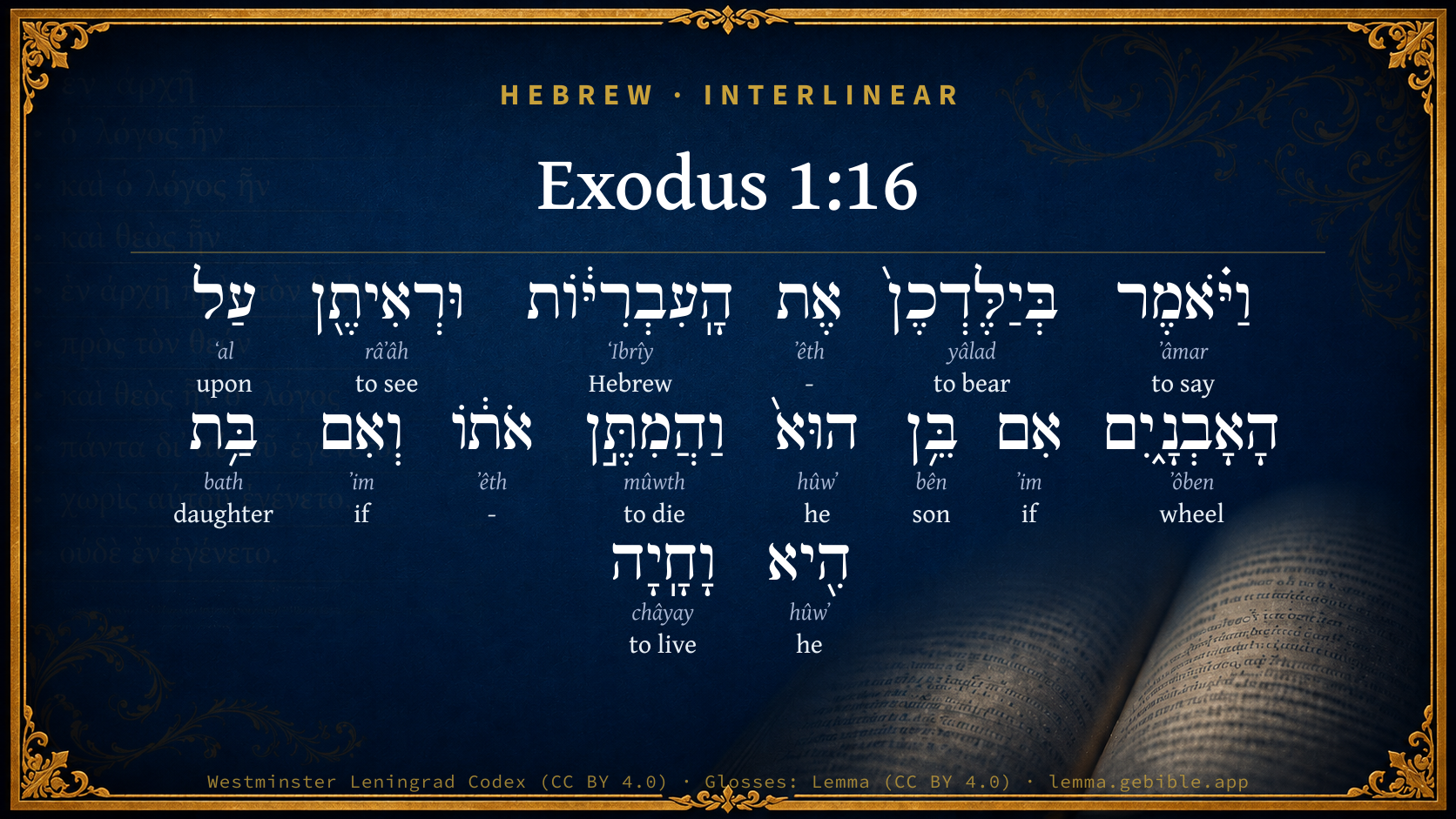
  1. וַיֹּ֗אמֶר ʼâmar H559 “and · to say” Conjunction + Verb, Qal, Sequential Imperfect, 3rd Person, Masculine, Singular
  2. בְּיַלֶּדְכֶן֙ yâlad H3205 “in/at · to bear · you” Preposition + Verb, Piel, Infinitive Construct + Suffix, Personal, 2nd Person, Feminine, Plural
  3. אֶת ʼêth H853 “-” Particle, Direct Object
  4. הָֽעִבְרִיּ֔וֹת ʻIbrîy H5680 “the · Hebrews” Particle, Definite Article + Noun, Gentilic, Feminine, Plural, Absolute
  5. וּרְאִיתֶ֖ן râʼâh H7200 “and · to see” Conjunction + Verb, Qal, Sequential Perfect, 2nd Person, Feminine, Plural
  6. עַל ʻal H5921 “upon” Preposition
  7. אִם ʼim H518 “if” Conjunction
  8. בֵּ֥ן bên H1121 “son” Noun, Common, Masculine, Singular, Absolute
  9. הוּא֙ hûwʼ H1931 “he” Pronoun, Personal, 3rd Person, Masculine, Singular
  10. וַהֲמִתֶּ֣ן mûwth H4191 “and · to die” Conjunction + Verb, Hiphil, Sequential Perfect, 2nd Person, Feminine, Plural
  11. אֹת֔וֹ ʼêth H853 “- · him” Particle, Direct Object + Suffix, Personal, 3rd Person, Masculine, Singular
  12. וְאִם ʼim H518 “and · if” Conjunction + Conjunction
  13. בַּ֥ת bath H1323 “daughter” Noun, Common, Feminine, Singular, Absolute
  14. הִ֖יא hûwʼ H1931 “he” Pronoun, Personal, 3rd Person, Feminine, Singular
  15. וָחָֽיָה châyay H2425 “and · to live” Conjunction + Verb, Qal, Sequential Perfect, 3rd Person, Feminine, Singular

About this verse

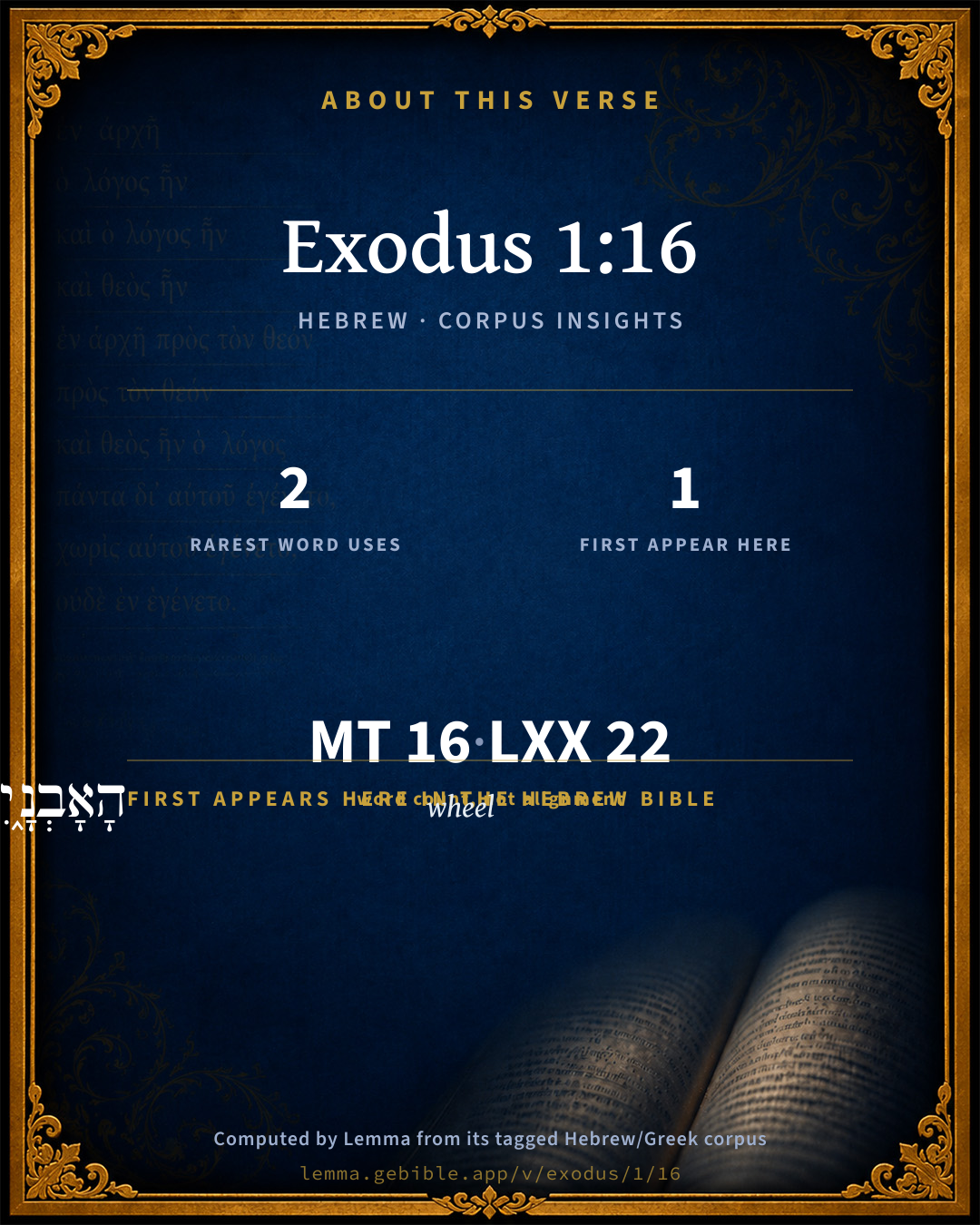
These counts appear in no published source. They are computed here, from the morphology-tagged text and Lemma’s own curated glosses. What Lemma adds →

16
words
13
distinct lemmas
Pentateuch
section

Notable vocabulary

The rarest word here is הָאָבְנָ֑יִם wheel H70 — appearing just 2 times in the whole Hebrew Bible.

First appearance in Scripture

This word makes its first canonical appearance in the Hebrew Bible here:

  • הָאָבְנָ֑יִם wheel H70

Shared distinctive vocabulary

הָאָבְנָ֑יִם wheel H70 occurs in 2 verses of the Hebrew Bible. Also found in:

Grammatical profile

  • 5 verbs
  • 4 nouns
  • 2 pronouns
  • 1 preposition
  • 2 conjunctions
  • 2 particles

Verb forms

  • וַיֹּ֗אמֶר Qal · Sequential Imperfect
  • בְּיַלֶּדְכֶן֙ Piel · Infinitive Construct
  • וּרְאִיתֶ֖ן Qal · Sequential Perfect
  • וַהֲמִתֶּ֣ן Hiphil · Sequential Perfect
  • וָחָֽיָה Qal · Sequential Perfect

Repetition

Words recur within this verse — often emphatic in Hebrew:

Hebrew & Septuagint length

In English translation the verse runs 42 words from the Hebrew and 34 from the Septuagint (LXX English) — closely comparable.

A rough comparison of the two English renderings, which tokenize alike — not a word-level alignment.

Word counts can differ between the Hebrew and the Greek without any difference in meaning — e.g. the Hebrew direct-object marker אֵת has no separate Greek word, and Greek often adds the article ὁ.

In the original languages it is 16 Hebrew tokens and 22 Greek tokens — but the two are counted differently (Hebrew bundles its prefixes and suffixes into one token; the Greek is in lemma form), so that isn’t a like-for-like length.

Cross-references

2

Topical passages linked to Exodus 1:16 in the Treasury of Scripture Knowledge — connected by theme and wording, ordered by reader-vote popularity; previews shown in the World English Bible.

  • Exodus 1:22 Pharaoh charged all his people, saying, "You shall cast every son who is born into the river, and every daughter you shall save alive."
  • Matthew 21:38 But the farmers, when they saw the son, said among themselves, 'This is the heir. Come, let's kill him, and seize his inheritance.'

Cross-references courtesy of OpenBible.info (CC BY 4.0).

Hebrew and Greek witnesses Masoretic Hebrew ↔ Greek Septuagint

The same verse in the two great witnesses to the Old Testament, shown verse-for-verse.

These are two independent witnesses, not word-aligned to each other, and the Septuagint is shown in lemma (dictionary) form.

Hebrew Exodus 1:16 Masoretic · Westminster Leningrad Codex

וַיֹּ֗אמֶר בְּיַלֶּדְכֶן֙ אֶת הָֽעִבְרִיּ֔וֹת וּרְאִיתֶ֖ן עַל הָאָבְנָ֑יִם אִם בֵּ֥ן הוּא֙ וַהֲמִתֶּ֣ן אֹת֔וֹ וְאִם בַּ֥ת הִ֖יא וָחָֽיָה

and he said, "When you perform the duty of a midwife to the Hebrew women, and see them on the birth stool; if it is a son, then you shall kill him; but if it is a daughter, then she shall live."

World English Bible · Public Domain

Greek LXX Exodus 1:16 Septuagint · lemma form

καί εἶπον ὅταν μαιόομαι ὁ εβραῖα καί εἰμί πρός ὁ τίκτω ἐάν μέν ἄρσην εἰμί ἀποκτείνω αὐτός ἐάν δέ θῆλυς περιποιέω αὐτός

And he said, When you⌃ do the office of midwives to the Hebrew women, and they are about to be delivered, if it be a male, kill it; but if a female, save it.

LXX2012 (modern English Septuagint) · Public Domain

Hebrew: Westminster Leningrad Codex (CC BY 4.0). Greek: Septuagint (public domain); English from LXX2012 (modern English Septuagint) (Public Domain). How the Septuagint differs from the Hebrew →

Targum (Aramaic paraphrase)

2

The Targum is the ancient Jewish Aramaic paraphrase of the Hebrew Scriptures — an interpretive translation, not the Hebrew text itself. Onkelos (literal) and Pseudo-Jonathan (expansive) render the Torah, and Jonathan the Prophets. Coverage is partial: where no permissively-licensed English translation exists for a verse, only the Aramaic is shown. This is verse-level text, not a word-by-word alignment to the Hebrew.

  1. Targum Onkelos Torah (Genesis–Deuteronomy)
    וַאֲמַר כַּד תֶּהֶוְיָן מוֹלְדָן יָת יְהוּדַיָתָא וְתֶחְזְיָן עַל מַתְבְּרָא אִם בַּר הוּא תִּקְטְלַן יָתֵהּ וְאִם בְּרַתָּא הִיא ותְקַיְמִנַהּ:

    (no public-domain English translation for this verse)

    Targum Onkelos — Aramaic: “Onkelos Genesis” (public domain); “Onkelos Exodus” (public domain); “Onkelos Leviticus” (public domain); “Onkelos Numbers” (public domain); “Onkelos Deuteronomy” (public domain). English: “Sefaria Community Translation” (CC0 1.0 (public-domain dedication)); “J.W. Etheridge. The Targums of Onkelos and Jonathan Ben Uzziel on the Pentateuch. London: Longmans, Green, 1862” (public domain). Text via Sefaria.

  2. Targum Pseudo-Jonathan Torah (Genesis–Deuteronomy)
    וַאֲמַר כַּד תֶּהֱוְיַין מוֹלְדָן יַת יְהוֹדַיְיתָא וְתִיסְתְּכִין עַלוֹי מַתְבְּרָא אִין בִּיר דְכַר הוּא וְתִקְטְלוּן יָתֵיהּ וְאִין בְּרַתָּא נוּקְבָא הִיא וְתִתְקַיֵים

    And he said, When you attend Jehudith women, and see them bear, if it be a male child, you shall kill him; but if a daughter, you may let her live.

    Targum Pseudo-Jonathan — Aramaic: “Targum Jonathan on Genesis” (public domain); “Targum Jonathan on Exodus” (public domain); “Targum Jonathan on Leviticus” (public domain); “Targum Jonathan on Numbers” (public domain); “Targum Jonathan on Deuteronomy” (public domain). English: “The Targum of Jonathan ben Uzziel, trans. J. W. Etheridge, London, 1862” (public domain). Text via Sefaria.

Commentary

Notes on Exodus 1:16 from classic Christian and Jewish commentators (each source and its license shown beneath its notes). The classic Christian expositions comment on the surrounding passage and are grouped to its opening verse, so a note may address several verses; the Jewish commentaries on the Tanakh (Rashi and others) are per-verse, so they appear only where the commentator wrote on this verse.

Lemma curates 59 commentaries, every one of them public domain or Creative Commons licensed, each selected and text-cleaned for this edition rather than reprinted as found. About our sources →

Trapp's Complete Commentary

John Trapp

Exo 1:16 And he said, When ye do the office of a midwife to the Hebrew women, and see [them] upon the stools; if it [be] a son, then ye shall kill him: but if it [be] a daughter, then she shall live.

Ver. 16. Then ye shall kill him.] No greater argument of an ill cause than a bloody persecution. George Tankerfield, the martyr, was in King Edward’s days a very Papist, till the time Queen Mary came in; and then, perceiving the great cruelty used on the Pope’s side, was brought into a misdoubt of their doing, and began, as he said, in his heart to abhor them. {a} So did Julius Palmer, a martyr in Queen Mary’s days, who had been a stiff Papist all King Edward VI’s days, and was therefore expelled out of Magdalen College, whereof he had been Fellow; till beholding the martyrdom of the three bishops burnt in Oxford, he said to his friends, "Oh, raging cruelty! Oh, tyranny tragical, and more than barbarous!" and so became a zealous Protestant.

{a} Act. and Mon., fol. 1535.

John Trapp, A Commentary or Exposition upon All the Books of the Old and New Testament (1647–1656) — public domain. Text from a community e-Sword module.

Joseph Benson's Commentary

Exo 1:16-19. The stools — Seats used on that occasion. But the midwives feared God — Dreaded his wrath more than Pharaoh’s, and therefore saved the men-children alive. The Hebrew women are lively — We have no reason to doubt the truth of this; it is plain they were now under an extraordinary blessing of increase, which may well be supposed to have had this effect, that the women had quick and easy labour, and the mothers and children being both lively, they seldom needed the help of midwives: this these midwives took notice of, and concluding it to be the finger of God, were thereby imboldened to disobey the king, and with this justify themselves before Pharaoh when he called them to an account for it.

Joseph Benson's Commentary on the Old and New Testaments (1811–1818) — public domain. Text from a community e-Sword module.

Tyndale Open Study Notes

Tyndale Open Resources

1:16 watch as they deliver (literally look upon the two stones): The Hebrew might refer to a birthstool or genitalia. • If the baby is a boy, kill him; if it is a girl, let her live: Such selective genocide would not completely deprive the Egyptians of a free labor source. When grown, the girls would be married to slaves from other people groups, effectively destroying Hebrew cohesion while keeping the supply of slaves as high as possible.

Tyndale Open Study Notes — © Tyndale Open Resources, licensed CC BY-SA 4.0. Text via the HelloAO Bible API.

Geneva Bible (1599)

Geneva Bible translators

Or, seats whereupon they sat in travail.

Geneva Bible (1599) marginal notes — public domain. Text via Bolls.life.

Jamieson, Fausset & Brown

Robert Jamieson, A. R. Fausset & David Brown

if it be a son, then ye shall kill him--Opinions are divided, however, what was the method of destruction which the king did recommend. Some think that the "stools" were low seats on which these obstetric practitioners sat by the bedside of the Hebrew women; and that, as they might easily discover the sex, so, whenever a boy appeared, they were to strangle it, unknown to its parents; while others are of opinion that the "stools" were stone troughs, by the river side--into which, when the infants were washed, they were to be, as it were, accidentally dropped.

Jamieson, Fausset & Brown — Commentary Critical and Explanatory on the Whole Bible (1871) — public domain (CC PDM 1.0). Text via the HelloAO Bible API.

Adam Clarke's Commentary

Verse 16. Upon the stools] על האבנים al haobnayim. This is a difficult word, and occurs nowhere else in the Hebrew Bible but in Jer 18:3, where we translate it the potter's wheels. As אכי signifies a stone, the obnayim has been supposed to signify a stone trough, in which they received and washed the infant as soon as born. Jarchi, in his book of Hebrew roots, gives a very different interpretation of it; he derives it from בן ben, a son, or בנים banim, children; his words must not be literally translated, but this is the sense: "When ye do the office of a midwife to the Hebrew women, and ye see that the birth is broken forth, if it be a son, then ye shall kill him." Jonathan ben Uzziel gives us a curious reason for the command given by Pharaoh to the Egyptian women: "Pharaoh slept, and saw in his sleep a balance, and behold the whole land of Egypt stood in one scale, and a lamb in the other; and the scale in which the lamb was outweighed that in which was the land of Egypt. Immediately he sent and called all the chief magicians, and told them his dream. And Janes and Jimbres, (see 2Ti 3:8). who were chief of the magicians, opened their mouths and said to Pharaoh, 'A child is shortly to be born in the congregation of the Israelites, whose hand shall destroy the whole land of Egypt.' Therefore Pharaoh spake to the midwives, &c."

Adam Clarke's Commentary on the Bible (1810–1826) — public domain. Text from a community e-Sword/MySword module.

Ellicott's Commentary for English Readers

(16) Upon the stools.—Literally, upon the two stones. It has been suggested that a seat corresponding to the modern hursee elwilâdeh is meant. This is a “chair of a peculiar form,” upon which in modern Egypt the woman is seated during parturition. (See Lane, Modern Egyptians, vol. iii. p. 142.) But it does not appear that this seat is composed of “two stones;” nor is there any distinct evidence of its employment at the time of child-birth in Ancient Egypt. The emendation of Hirsch—banim for âbnaim, is very tempting. This will give the sense, “When ye look upon the children.”

A Bible Commentary for English Readers, edited by Charles John Ellicott (1878–1897) — public domain. Text from a community e-Sword module.

The Cambridge Bible for Schools and Colleges

gen. ed. J. J. S. Perowne

16. upon the two stones] This is the lit. rend. of the Heb.: the same word is used of the two circular stones, fixed horizontally on a vertical axle, to form the potter’s ‘wheel’ (see ill. in EB. iii. 3820). The allusion is in all probability to the two stones upon which the Hebrew women, in accordance with a custom attested for other nations, either knelt or sat at the time of their delivery: Ploss, Das Weib in der Natur u. Völkerkunde, 1887, ii. 174 f., 177 f., Schapiro, Revue des Études Juives, xl. (1900), p. 45 f. Spiegelberg (Aeg. Randglossen zum AT., 1904, p. 19 ff.) cites from old Egyptian and Coptic texts the expressions, to sit on the brick, and (once) on the two bricks, in the same connexion.

The Cambridge Bible for Schools and Colleges (gen. ed. J. J. S. Perowne; Cambridge University Press, 1878–1918) — public domain. Text from a community e-Sword module.

John Gill's Exposition

And he said, when ye do the office of a midwife to the Hebrew women,.... Deliver them of their children:

and see them upon the stools; seats for women in labour to sit upon, and so contrived, that the midwives might do their office the more readily; but while they sat there, and before the birth, they could not tell whether the child was a son or a daughter; wherefore Kimchi (h) thinks the word here used signifies the place to which the infant falls down from its mother's belly, at the time of labour, and is called the place of the breaking forth of children, and takes it to be the "uterus" itself; and says it is called "Abanim", because "Banim", the children, are there, and supposes "A" or "Aleph" to be an additional letter; and so the sense then is, not when ye see the women on the seats, but the children in the place of coming forth; but then he asks, if it be so, why does he say, "and see them" there? could they see them before they were entirely out of the womb? to which he answers, they know by this rule, if a son, its face was downwards, and if a daughter, its face was upwards; how true this is, must be left to those that know better; the Jewish masters (i) constantly and positively affirm it: he further observes, that the word is of the dual number, because of the two valves of the womb, through which the infant passes:

if it be a son, then ye shall kill him; give it a private pinch as it comes forth, while under their hands, that its death might seem to be owing to the difficulty of its birth, or to something that happened in it. This was ordered, because what the king had to fear from the Israelites was only from the males, and they only could multiply their people; and because of the above information of his magicians, if there is any truth in that:

but if it be a daughter, then she shall live, be kept alive, and preserved, and brought up to woman's estate; and this the king chose to have done, having nothing to fear from them, being of the feeble sex, and that they might serve to gratify the lust of the Egyptians, who might be fond of Hebrew women, being more beautiful than theirs; or that they might be married and incorporated into Egyptian families, there being no males of their own, if this scheme took place, to match with them, and so by degrees the whole Israelitish nation would be mixed with, and swallowed up in the Egyptian nation, which was what was aimed at.

(h) Sepher Shorash. rad. (i) T. Bab. Sotah, fol. 11. 1. Niddah, fol. 31. 2.

John Gill's Exposition of the Whole Bible (1746–1763) — public domain (CC PDM 1.0). Text via the HelloAO Bible API.

Albert Barnes' Notes on the Bible

Upon the stools - Literally, “two stones.” The word denotes a special seat, such as is represented on monuments of the 18th Dynasty, and is still used by Egyptian midwives.

Albert Barnes' Notes on the Bible (1834–1885) — public domain. Text from a community e-Sword/MySword module.

Haydock's Catholic Bible Commentary

The time, &c. Hebrew, "and you shall see them upon the two stones." Abenaim. Jeremias (xviii. 3,) uses the same expression, speaking of a potter hard at work. (Calmet) --- A woman, from whom nothing could be feared, to be reserved for service and for pleasure. (Menochius) --- We must not obey princes in their unjust commands. (Acts iv. and v., and Matthew x. 28.) (Worthington)

George Leo Haydock (1774–1849), Haydock's Catholic Family Bible and Commentary, 1859 edition — public domain. Excludes Psalms (Douay-Rheims chapter numbering differs from Protestant) and Deuterocanonical books (Catholic canon only).

Matthew Poole's English Annotations

The stools; a seat used by women when ready to be delivered, conveniently framed for the midwife’s better discharge of her office.

Ye shall kill him, which it was not difficult for them to do without much observation.

If it be a daughter, then she shall live; either,

1. Because he feared not them, but the males only; and some add, that he was advised by one of their magicians, that a male child should be born of the Israelites, who should be a dreadful scourge to the Egyptians. Or,

2. They reserved them for their lust, or for service, or for the increase of their people, and the raising of a fairer breed by them.

Matthew Poole's English Annotations on the Holy Bible (1683–1685) — public domain. Text from a community e-Sword/MySword module.

The Pulpit Commentary

The stools. The explanation furnished by a remark of Mr. Lane ("Modem Egyptians," vol. 3. p. 142) is more satisfactory than any other. In modern Egypt, he says, "two or three days before the expected time of delivery, the midwife conveys to the house the kursee elwiladeh, a chair of a peculiar form, upon which the patient is to be seated during the birth." A chair of the form intended is represented on the Egyptian monuments.

The Pulpit Commentary (1880–1919), ed. H.D.M. Spence-Jones & Joseph S. Exell — public domain. Text from a community e-Sword module.

John Wesley's Explanatory Notes

The stools - Seats used on that occasion.

John Wesley, Explanatory Notes Upon the Whole Bible (1754–1765) — public domain. Text via the GEBible commentary corpus.

Rashi

Rabbi Shlomo Yitzchaki (Rashi)

בילדכן WHEN YE DO THE OFFICE OF A MIDWIFE — This word (the Piel) has the same force as בהולידכן (the Hiphil): when you assist them to give birth.

על האבנים UPON THE STOOLS — the seat for the woman in the act of childbirth; in another passage (Isaiah 37:3) Scripture terms it מַשְׁבֵּר. Similar is, (Jeremiah 18:3) “He was at work on the אבנים" — the place of the vessels of (being produced by) the craftsmanship of the potter.

אם בן הוא וגו IF IT BE A SON etc. — He was particular only about the male children because his astrologers had told him that there was to be born to a Hebrew woman a son who would become their deliverer (Exodus Rabbah 1:18).

וחיה has the same meaning as ותחיה THEN SHE SHALL LIVE.

Rashi on the Tanakh — English translations: “The Judaica Press complete Tanach with Rashi, translated by A. J. Rosenberg” (CC BY 4.0); “Pentateuch with Rashi's commentary by M. Rosenbaum and A.M. Silbermann, 1929-1934” (public domain); “The Metsudah Tanach series, Lakewood, N.J” (CC BY 4.0); and “The Book of Joshua, Metsudah Publications, 1997” (CC BY 4.0). Text via Sefaria.

Ibn Ezra

Rabbi Abraham ibn Ezra

The Hebrew women. Anyone from the family of Ever is called a Hebrew, and because of his faith he is called a Hebrew. In the same way, it is said (Bereishis 10:21): “And to Shem were also born children; he was the father of all the people of Ever,” meaning, the father of all the people who came from the other side of (m’ever) the river.

Ibn Ezra on the Tanakh — English translations: “Sefaria Community Translation” (CC0 1.0 (public-domain dedication)); “Yalkut, Sifsei Chachomim Chumash, Metsudah Publications, 2009” (CC BY 4.0); and “Commentary of Ibn Ezra on Isaiah - trans. by M. Friedlander, 1873” (public domain). Text via Sefaria.

Lesson kit

Teaching starters — assembled from the data on this page, not authored interpretation. Every prompt links to the verse data it draws on. Edit before teaching.

Exodus, in the Pentateuch, opens this verse with 16 words (13 distinct Hebrew lemmas). Its most distinctive word is ʼôben (“wheel”). A historical commentator’s framing appears above. Read the whole chapter for the surrounding context.

Discussion questions

  1. How does “wheel” (ʼôben) shape what this verse is saying?
  2. The word “wheel” first appears here in Scripture. What is being introduced at this debut?
  3. Jeremiah 18:3 shares the word «wheel» with this verse. How do the two illuminate each other?
  4. “if” occurs 2× in this one verse. What is the effect of the repetition?
  5. The translations on this page render this verse differently — a whole-verse word diff, not a word-by-word alignment. What might account for the different wordings?
  6. The verb «וַיֹּ֗אמֶר» is Qal Sequential Imperfect. How does its form color the action?
  7. Reading how Trapp's Complete Commentary and Joseph Benson's Commentary read this verse, where do the two commentators agree and where do they part?

Things to notice

Reading settings

Reading text

Shown beneath each verse's original-language words.

Old Testament
Old Testament edition

Read the OT as the Masoretic Hebrew (MT) or the Greek Septuagint (LXX).

English shown for the Greek Septuagint (in the Hebrew ↔ Greek comparison).

Comparing translations? Open the Compare panel on any verse page to stack up to four side by side.