Leviticus 11:39

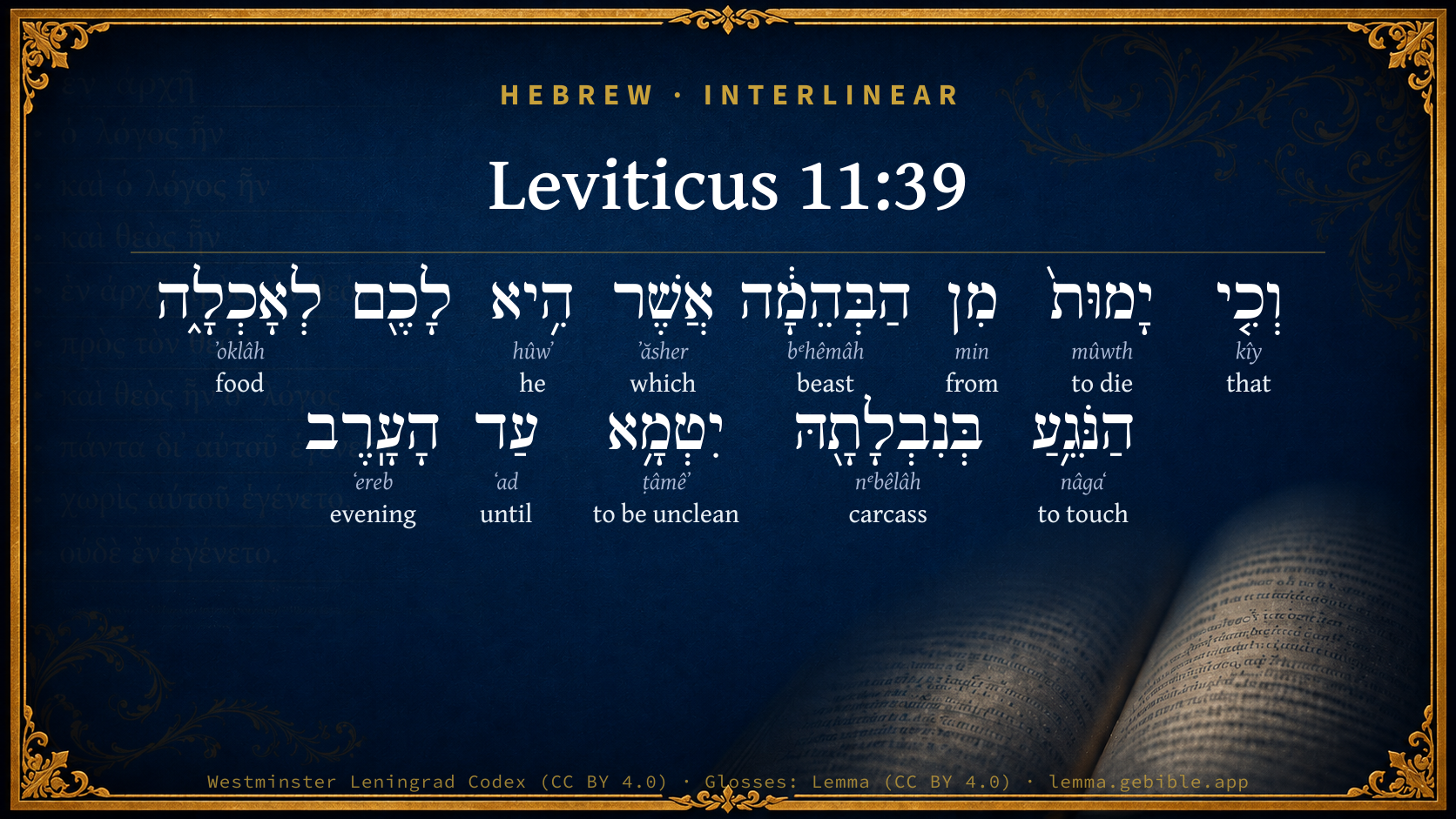
Hebrew (Westminster Leningrad Codex) Leviticus 11:39 appears in the Hebrew Old Testament. The text above is from the Westminster Leningrad Codex. Each word links to its Strong’s number, a concise gloss, and parsing drawn from the Open Scriptures Hebrew Bible morphology. Click any word for its full Brown-Driver-Briggs (BDB) entry.
Download image
Cite this verse

Leviticus 11:39 (World English Bible). Public Domain. Lemma interlinear Bible study tool, https://lemma.gebible.app/v/leviticus/11/39.

Show BibTeX & RIS
BibTeX
RIS
English Translation
"'If any animal, of which you may eat, dies; he who touches its carcass shall be unclean until the evening.
World English Bible · Public Domain
Download a study sheet

One document with this verse’s original text, its word-by-word gloss line, the meaning frame, cross-references with their text, attributed commentary, and full source and license credits — printable, and it pastes into notes with its structure intact.

This verse Autodidact and up

Study sheet (.html) Plain text (.txt)

A passage Seminary Student

Up to 50 verses in one chapter. A passage sheet keeps up to 6 commentary sources and 12 cross-references per verse, in the order this page ranks them, and says so on the sheet whenever that leaves anything out. Ask for a single verse and you get the Autodidact verse sheet above.

Everything on this page stays free to read, with no account — the sheet is a download of what is already on screen, not access to it.

Want to remove ads? Support Godless Engineer
Compare translations 3

The same verse in 3 English versions, stacked beneath the original-language interlinear above. Click any original word for its lexicon entry.

Each is an independent rendering of the whole verse — the interlinear is not word-aligned to these translations.

Highlighted words mark where these versions differ — a whole-verse word diff, not a word-by-word alignment.

  • World English Bible Public Domain
    "'If any animal, of which you may eat, dies; he who touches its carcass shall be unclean until the evening.
  • King James Version Public Domain
    And if any beast, of which ye may eat, die; he that toucheth the carcass thereof shall be unclean until the even.
  • unfoldingWord Literal Text CC BY-SA 4.0
    But when from the livestock that it to you to eat dies, the one touching its carcass will become unclean until the evening.

unfoldingWord Literal Text — © unfoldingWord, licensed CC BY-SA 4.0. Word-aligned USFM3 via Door43 (git.door43.org/unfoldingWord/en_ult).

Versions to compare (up to 4)

3 of 4 selected

Show all 18 translations

Every available English version of this verse, each an independent rendering of the whole verse.

  • World English Bible Public Domain
    "'If any animal, of which you may eat, dies; he who touches its carcass shall be unclean until the evening.
  • Berean Standard Bible Public Domain
    If an animal that you may eat dies, anyone who touches the carcass will be unclean until evening.
  • Majority Standard Bible Public Domain
    If an animal that you may eat dies, anyone who touches the carcass will be unclean until evening.
  • King James Version Public Domain
    And if any beast, of which ye may eat, die; he that toucheth the carcass thereof shall be unclean until the even.
  • American Standard Version (1901) Public Domain
    And if any beast, of which ye may eat, die; he that toucheth the carcass thereof shall be unclean until the even.
  • Revised Version (1885) Public Domain
    And if any beast, of which ye may eat, die; he that toucheth the carcase thereof shall be unclean until the even.
  • Geneva Bible (1599) Public Domain
    If also any beast, whereof ye may eate, die, he that toucheth the carkeis thereof shall be vncleane vntil the euen.
  • Douay-Rheims (1899) Public Domain
    If any beast die, of which it is lawful for you to eat, he that toucheth the carcass thereof, shall be unclean until the evening:
  • Young's Literal Translation Public Domain
    `And when any of the beasts which are to you for food dieth, he who is coming against its carcase is unclean till the evening;
  • Literal Standard Version CC BY-SA 4.0
    And when any of the beasts which are for food for you dies, he who is coming against its carcass is unclean until the evening;
  • Unlocked Literal Bible CC BY-SA 4.0
    If any animal that you may eat dies, then he who touches the carcass will be unclean until evening.
  • unfoldingWord Literal Text CC BY-SA 4.0
    But when from the livestock that it to you to eat dies, the one touching its carcass will become unclean until the evening.
  • Darby Bible Public Domain
    And if any beast which is to you for food die, he that toucheth the carcase thereof shall be unclean until the even.
  • World Messianic Bible Public Domain
    “‘If any animal of which you may eat dies, he who touches its carcass shall be unclean until the evening.
  • Webster's Bible Public Domain
    And if any beast, of which ye may eat, shall die; he that toucheth its carcass shall be unclean until the evening.
  • Free Bible Version CC BY-SA 4.0
    If an animal that you are allowed to eat dies, anyone who touches the dead body will be unclean until the evening.
  • Bible in Basic English Public Domain
    And if any beast which may be used for food comes to a natural death, anyone touching its dead body will be unclean till evening.
  • JPS Tanakh (1917) Public Domain
    And if any beast, of which ye may eat, die, he that toucheth the carcass thereof shall be unclean until the even.

Literal Standard Version (2020), Covenant Press — licensed CC BY-SA 4.0. Text via the HelloAO Bible API (eBible.org). Unlocked Literal Bible (unfoldingWord) — licensed CC BY-SA 4.0. Text via the HelloAO Bible API (eBible.org). unfoldingWord Literal Text — © unfoldingWord, licensed CC BY-SA 4.0. Word-aligned USFM3 via Door43 (git.door43.org/unfoldingWord/en_ult). Free Bible Version, Dr. Jonathan Gallagher — licensed CC BY-SA 4.0. Text via the HelloAO Bible API (eBible.org).

Word by word

More ways to search: Search by grammar → Find every occurrence → Compare this word →

Practice this passage: Drill this verse → Learn its vocabulary →

לְאָכְלָ֑ה
ʼoklâh
H402
“to/for · food”
Preposition + Noun, Common, Feminine, Singular, Absolute
Part of Speech
Preposition + Noun
Type
Common
Gender
Feminine
Number
Singular
State
Absolute
Full BDB Definition

Origin: from H401

TWOT: 85b

food - food, eating - object of devouring, consuming - by wild beasts (figurative) - in fire - of judgment (figurative)
  1. וְכִ֤י kîy H3588 “and · that” Conjunction + Conjunction
  2. יָמוּת֙ mûwth H4191 “to die” Verb, Qal, Imperfect, 3rd Person, Masculine, Singular
  3. מִן min H4480 “from” Preposition
  4. הַבְּהֵמָ֔ה bᵉhêmâh H929 “the · beast” Particle, Definite Article + Noun, Common, Feminine, Singular, Absolute
  5. אֲשֶׁר ʼăsher H834 “which” Particle, Relative
  6. הִ֥יא hûwʼ H1931 “he” Pronoun, Personal, 3rd Person, Feminine, Singular
  7. הַנֹּגֵ֥עַ nâgaʻ H5060 “the · touching” Particle, Definite Article + Verb, Qal, Participle Active, Masculine, Singular, Absolute
  8. בְּנִבְלָתָ֖הּ nᵉbêlâh H5038 “in/at · carcass · her” Preposition + Noun, Common, Feminine, Singular, Construct + Suffix, Personal, 3rd Person, Feminine, Singular
  9. יִטְמָ֥א ṭâmêʼ H2930 “to be unclean” Verb, Qal, Imperfect, 3rd Person, Masculine, Singular
  10. עַד ʻad H5704 “until” Preposition
  11. הָעָֽרֶב ʻereb H6153 “the · evening” Particle, Definite Article + Noun, Common, Masculine, Singular, Absolute

About this verse

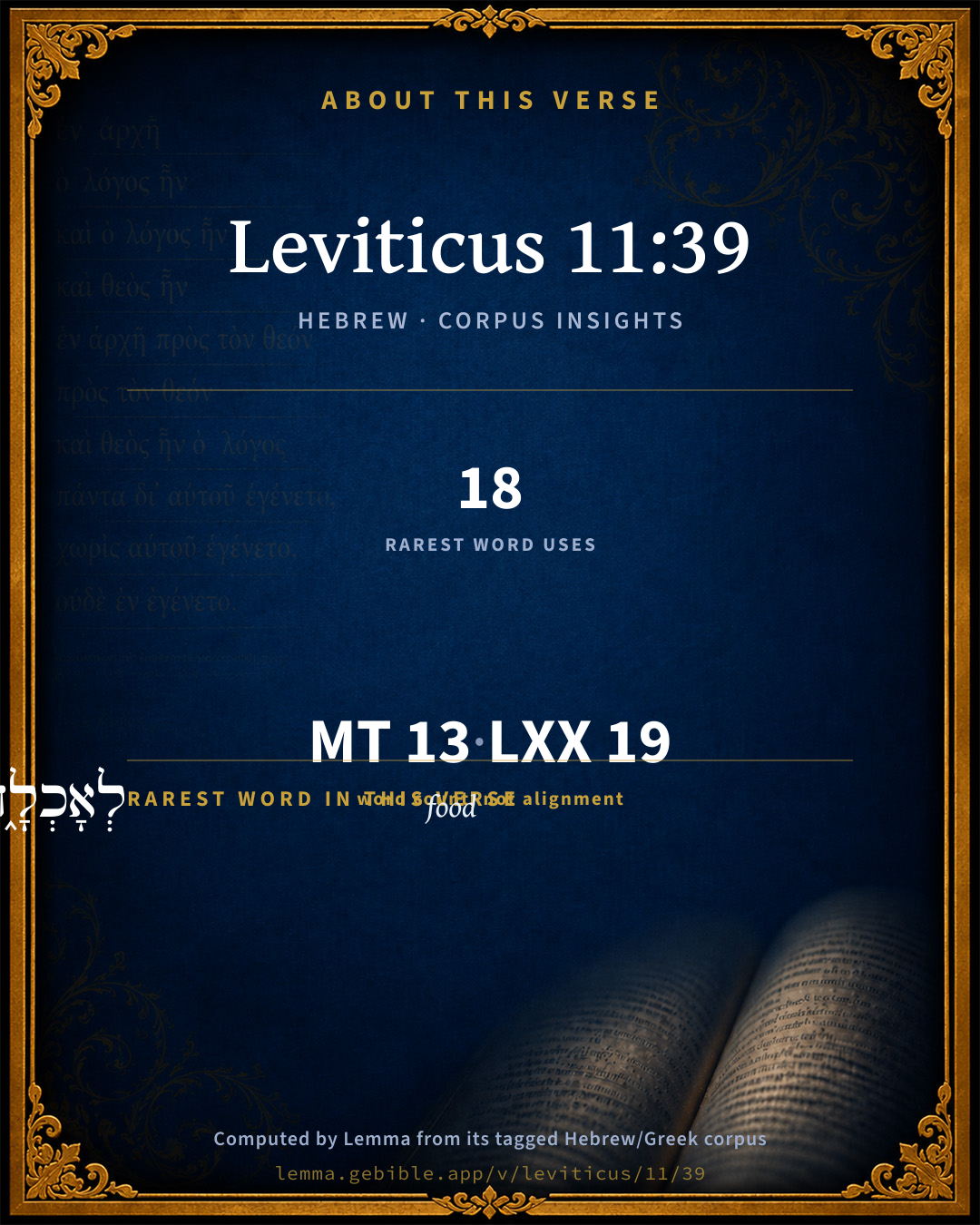
These counts appear in no published source. They are computed here, from the morphology-tagged text and Lemma’s own curated glosses. What Lemma adds →

13
words
12
distinct lemmas
Pentateuch
section

Notable vocabulary

The rarest word here is לְאָכְלָ֑ה food H402 — appearing just 18 times in the whole Hebrew Bible.

Shared distinctive vocabulary

לְאָכְלָ֑ה food H402 occurs in 18 verses of the Hebrew Bible. Also found in:

Grammatical profile

  • 3 verbs
  • 4 nouns
  • 1 pronoun
  • 3 prepositions
  • 1 conjunction
  • 1 particle

Verb forms

  • יָמוּת֙ Qal · Imperfect
  • הַנֹּגֵ֥עַ Qal · Participle Active
  • יִטְמָ֥א Qal · Imperfect

Hebrew & Septuagint length

In English translation the verse runs 20 words from the Hebrew and 25 from the Septuagint (LXX English) — closely comparable.

A rough comparison of the two English renderings, which tokenize alike — not a word-level alignment.

Word counts can differ between the Hebrew and the Greek without any difference in meaning — e.g. the Hebrew direct-object marker אֵת has no separate Greek word, and Greek often adds the article ὁ.

In the original languages it is 13 Hebrew tokens and 19 Greek tokens — but the two are counted differently (Hebrew bundles its prefixes and suffixes into one token; the Greek is in lemma form), so that isn’t a like-for-like length.

Cross-references

8

Topical passages linked to Leviticus 11:39 in the Treasury of Scripture Knowledge — connected by theme and wording, ordered by reader-vote popularity; previews shown in the World English Bible.

  • Leviticus 11:24 "'By these you will become unclean: whoever touches the carcass of them shall be unclean until the evening.
  • Leviticus 11:28 He who carries their carcass shall wash his clothes, and be unclean until the evening. They are unclean to you.
  • Leviticus 11:31 These are they which are unclean to you among all that creep. Whoever touches them when they are dead, shall be unclean until the evening.
  • Leviticus 11:40 He who eats of its carcass shall wash his clothes, and be unclean until the evening. He also who carries its carcass shall wash his clothes, and be unclean until the evening.
  • Leviticus 15:5 Whoever touches his bed shall wash his clothes, and bathe himself in water, and be unclean until the evening.
  • Leviticus 15:7 "'He who touches the body of him who has the discharge shall wash his clothes, and bathe himself in water, and be unclean until the evening.
  • Numbers 19:11 He who touches the dead body of any man shall be unclean seven days:
  • Numbers 19:16 Whoever in the open field touches one who is slain with a sword, or a dead body, or a bone of a man, or a grave, shall be unclean seven days.

Cross-references courtesy of OpenBible.info (CC BY 4.0).

Hebrew and Greek witnesses Masoretic Hebrew ↔ Greek Septuagint

The same verse in the two great witnesses to the Old Testament, shown verse-for-verse.

These are two independent witnesses, not word-aligned to each other, and the Septuagint is shown in lemma (dictionary) form.

Hebrew Leviticus 11:39 Masoretic · Westminster Leningrad Codex

וְכִ֤י יָמוּת֙ מִן הַבְּהֵמָ֔ה אֲשֶׁר הִ֥יא לָכֶ֖ם לְאָכְלָ֑ה הַנֹּגֵ֥עַ בְּנִבְלָתָ֖הּ יִטְמָ֥א עַד הָעָֽרֶב

"'If any animal, of which you may eat, dies; he who touches its carcass shall be unclean until the evening.

World English Bible · Public Domain

Greek LXX Leviticus 11:39 Septuagint · lemma form

ἐάν δέ ἀποθνήσκω ὁ κτῆνος ὅς εἰμί σύ οὗτος ἐσθίω ὁ ἅπτομαι ὁ θνησιμαῖος αὐτός ἀκάθαρτος εἰμί ἕως ἑσπέρα

And if one of the cattle die, which it is lawful for you to eat, he that touches their carcasses shall be unclean till evening.

LXX2012 (modern English Septuagint) · Public Domain

Hebrew: Westminster Leningrad Codex (CC BY 4.0). Greek: Septuagint (public domain); English from LXX2012 (modern English Septuagint) (Public Domain). How the Septuagint differs from the Hebrew →

Targum (Aramaic paraphrase)

2

The Targum is the ancient Jewish Aramaic paraphrase of the Hebrew Scriptures — an interpretive translation, not the Hebrew text itself. Onkelos (literal) and Pseudo-Jonathan (expansive) render the Torah, and Jonathan the Prophets. Coverage is partial: where no permissively-licensed English translation exists for a verse, only the Aramaic is shown. This is verse-level text, not a word-by-word alignment to the Hebrew.

  1. Targum Onkelos Torah (Genesis–Deuteronomy)
    וַאֲרֵי יְמוּת מִן בְּעִירָא דִי הִיא לְכוֹן לְמֵיכָל דְיִקְרַב בִּנְבִלְתַּהּ יְהֵי מְסָאָב עַד רַמְשָׁא

    (no public-domain English translation for this verse)

    Targum Onkelos — Aramaic: “Onkelos Genesis” (public domain); “Onkelos Exodus” (public domain); “Onkelos Leviticus” (public domain); “Onkelos Numbers” (public domain); “Onkelos Deuteronomy” (public domain). English: “Sefaria Community Translation” (CC0 1.0 (public-domain dedication)); “J.W. Etheridge. The Targums of Onkelos and Jonathan Ben Uzziel on the Pentateuch. London: Longmans, Green, 1862” (public domain). Text via Sefaria.

  2. Targum Pseudo-Jonathan Torah (Genesis–Deuteronomy)
    וַאֲרוּם אִין יִתְפְּשַׁח אֵיבְרָא וִימוּת מִן בְּעִירָא דַכְיָא דְחַזְיָא לְכוֹן לְמֵיכוֹל דְיִקְרַב בִּנְבֵילְתָּהּ יְהֵי מְסָאָב עַד רַמְשָׁא

    And if the limb of any clean beast that you may eat be torn and it die, whosoever toucheth its carcase shall be unclean until the evening.

    Targum Pseudo-Jonathan — Aramaic: “Targum Jonathan on Genesis” (public domain); “Targum Jonathan on Exodus” (public domain); “Targum Jonathan on Leviticus” (public domain); “Targum Jonathan on Numbers” (public domain); “Targum Jonathan on Deuteronomy” (public domain). English: “The Targum of Jonathan ben Uzziel, trans. J. W. Etheridge, London, 1862” (public domain). Text via Sefaria.

Commentary

Notes on Leviticus 11:39 from classic Christian and Jewish commentators (each source and its license shown beneath its notes). The classic Christian expositions comment on the surrounding passage and are grouped to its opening verse, so a note may address several verses; the Jewish commentaries on the Tanakh (Rashi and others) are per-verse, so they appear only where the commentator wrote on this verse.

Lemma curates 59 commentaries, every one of them public domain or Creative Commons licensed, each selected and text-cleaned for this edition rather than reprinted as found. About our sources →

Trapp's Complete Commentary

John Trapp

Lev 11:39 And if any beast, of which ye may eat, die; he that toucheth the carcase thereof shall be unclean until the even.

Ver. 39. Of which ye may.] Compare Psa 49:12, pecoribus morticinis. - Tremel.

John Trapp, A Commentary or Exposition upon All the Books of the Old and New Testament (1647–1656) — public domain. Text from a community e-Sword module.

Joseph Benson's Commentary

Lev 11:39-42. If any beast die — Either of itself, or being killed by some wild beast, in which cases the blood was not poured forth, as it was when they were killed by men either for food or sacrifice. He that eateth — Unwittingly, for if he did it knowingly, it was a presumptuous sin against an express law, (Deu 14:21,) and therefore punished as such. Every creeping thing — Except those expressly excepted, Lev 11:29-30. Upon the belly — As worms and snakes. Upon all four — As toads and divers serpents.

Joseph Benson's Commentary on the Old and New Testaments (1811–1818) — public domain. Text from a community e-Sword module.

Keil & Delitzsch

C. F. Keil & F. Delitzsch

Lastly, contact with edible animals, if they had not been slaughtered, but had died a natural death, and had become carrion in consequence, is also said to defile (cf. Lev 11:39, Lev 11:40 with Lev 11:24-28). This was the case, too, with the eating of the swarming land animals, whether they went upon the belly,

(Note: The large ו in גּחון (Lev 11:42) shows that this vav is the middle letter of the Pentateuch.)

as snakes and worms, or upon four feet, as rats, mice, weasels, etc., or upon many feet, like the insects (Lev 11:41-43). Lastly (Lev 11:44, Lev 11:45), the whole law is enforced by an appeal to the calling of the Israelites, as a holy nation, to be holy as Jehovah their God, who had brought them out of Egypt to be a God to them, was holy (Exo 6:7; Exo 29:45-46).

Keil & Delitzsch — Biblical Commentary on the Old Testament (1861–1891) — public domain (CC PDM 1.0). Text via the HelloAO Bible API. (Old Testament only.)

Tyndale Open Study Notes

Tyndale Open Resources

11:39-40 Israelites were not to consume blood (7:26). They could eat an animal only after the blood had been drained and properly disposed of (17:13). The undrained blood of an otherwise clean animal that died of natural causes rendered it unclean. An Israelite was permitted to give or sell such an animal to foreigners (Deut 14:21) but not to eat it.

Tyndale Open Study Notes — © Tyndale Open Resources, licensed CC BY-SA 4.0. Text via the HelloAO Bible API.

Ellicott's Commentary for English Readers

(39) And if any beast.—That is, a clean animal, which is both bisulcous and ruminant, but which has not been properly slaughtered, having died from any disease or accident. During the second Temple, the law here enacted was restricted to quadrupeds, domestic or wild, but was not applicable to birds and fishes.

He that toucheth the carcase.—The carcase, in this case, is to be regarded as the dead body of an unclean animal (see Lev_11:24-28), and defiles by contact. (See also Lev_17:15.) This, however, only applies to the flesh of the quadruped. The skin, the bones, the sinews, the horns, and the claws are clean, the sacred Scriptures even being written on the prepared skins; and the horns used for the trumpets or horns of the sanctuary, according to the canons of the Pharisees, whilst the Samaritans and the Sadducees regarded them as polluting.

A Bible Commentary for English Readers, edited by Charles John Ellicott (1878–1897) — public domain. Text from a community e-Sword module.

The Cambridge Bible for Schools and Colleges

gen. ed. J. J. S. Perowne

39. The carcase even of a clean beast causes uncleanness.

The Cambridge Bible for Schools and Colleges (gen. ed. J. J. S. Perowne; Cambridge University Press, 1878–1918) — public domain. Text from a community e-Sword module.

John Gill's Exposition

And if any beast of which ye may eat die,.... Any clean beast, as the ox, sheep, goat, deer, &c. what, if rightly killed, is very lawful to eat of; but if it died of itself through any distemper, or was torn by the wild beasts, so the Targum of Jonathan:

he that toucheth the carcass thereof shall be unclean until the even; not the bones, nerves, horns, hoofs, or skin, as Jarchi observes; these might be handled, because some of them, at least, were wrought up into one instrument or another, by artificers, for use and service, but the flesh of them might not be touched; whoever did touch it was ceremonially unclean, and might not go into the sanctuary, or have conversation with men, until the evening of the day in which this was done.

John Gill's Exposition of the Whole Bible (1746–1763) — public domain (CC PDM 1.0). Text via the HelloAO Bible API.

Haydock's Catholic Bible Commentary

Beast die a natural death, or be suffocated, or be slain by a wild beast. (Calmet)

George Leo Haydock (1774–1849), Haydock's Catholic Family Bible and Commentary, 1859 edition — public domain. Excludes Psalms (Douay-Rheims chapter numbering differs from Protestant) and Deuterocanonical books (Catholic canon only).

Matthew Poole's English Annotations

If any beast die; either of itself, or being killed by some wild beast, in which cases the blood was not poured forth, as it was when they were killed by men either for food or sacrifice.

Matthew Poole's English Annotations on the Holy Bible (1683–1685) — public domain. Text from a community e-Sword/MySword module.

Whedon's Commentary on the Bible

Daniel D. Whedon

39. If any beast… die — The prohibition of the flesh of clean animals which have died is founded on sanitary grounds. When the blood is not drawn from the veins the flesh becomes corrupt and poisonous.

Daniel D. Whedon (gen. ed.), Commentary on the Old and New Testaments (1874–1909) — public domain. Text from a community e-Sword module.

The Pulpit Commentary

Vers. 39, 40. The loathsomeness of the bodies of even clean animals that have died a natural death, makes them also the means of conveying defilement to any one who touches them.

The Pulpit Commentary (1880–1919), ed. H.D.M. Spence-Jones & Joseph S. Exell — public domain. Text from a community e-Sword module.

John Wesley's Explanatory Notes

If any beast die - Either of itself, or being killed by some wild beast, in which cases the blood was not poured forth, as it was when they were killed by men either for food or sacrifice.

John Wesley, Explanatory Notes Upon the Whole Bible (1754–1765) — public domain. Text via the GEBible commentary corpus.

unfoldingWord translationNotes

Door43 World Missions Community

he who touches the carcass will be unclean until evening

A person who is unacceptable for God's purposes because he touches the body of a dead animal is spoken of as if he were physically unclean. (See: Metaphor)

until evening

"until sunset"

translationWords

die

clean

unfoldingWord translationNotes — © Distant Shores Media and the Door43 World Missions Community, licensed CC BY-SA 4.0. Source: git.door43.org/Door43/en_tn.

Rashi

Rabbi Shlomo Yitzchaki (Rashi)

בנבלתה [HE THAT TOUCHETH] THE CARRION THEREOF [SHALL BE UNCLEAN] — but not if he touches the bones and sinews, nor the horns and claws, and not the hide after these have been removed from the body (Sifra, Shemini, Section 10 5; Chullin 117b).

Rashi on the Tanakh — English translations: “The Judaica Press complete Tanach with Rashi, translated by A. J. Rosenberg” (CC BY 4.0); “Pentateuch with Rashi's commentary by M. Rosenbaum and A.M. Silbermann, 1929-1934” (public domain); “The Metsudah Tanach series, Lakewood, N.J” (CC BY 4.0); and “The Book of Joshua, Metsudah Publications, 1997” (CC BY 4.0). Text via Sefaria.

Lesson kit

Teaching starters — assembled from the data on this page, not authored interpretation. Every prompt links to the verse data it draws on. Edit before teaching.

Leviticus, in the Pentateuch, opens this verse with 13 words (12 distinct Hebrew lemmas). Its most distinctive word is ʼoklâh (“food”). A historical commentator’s framing appears above. Read the whole chapter for the surrounding context.

Discussion questions

  1. What does “food” (ʼoklâh) contribute to the verse as a whole?
  2. Genesis 1:29 shares the word «food» with this verse. How do the two illuminate each other?
  3. The translations on this page render this verse differently — a whole-verse word diff, not a word-by-word alignment. What might account for the different wordings?
  4. The verb «יָמוּת֙» is Qal Imperfect. How does its form color the action?
  5. Reading how Trapp's Complete Commentary and Joseph Benson's Commentary read this verse, where do the two commentators agree and where do they part?

Things to notice

Reading settings

Reading text

Shown beneath each verse's original-language words.

Old Testament
Old Testament edition

Read the OT as the Masoretic Hebrew (MT) or the Greek Septuagint (LXX).

English shown for the Greek Septuagint (in the Hebrew ↔ Greek comparison).

Comparing translations? Open the Compare panel on any verse page to stack up to four side by side.