
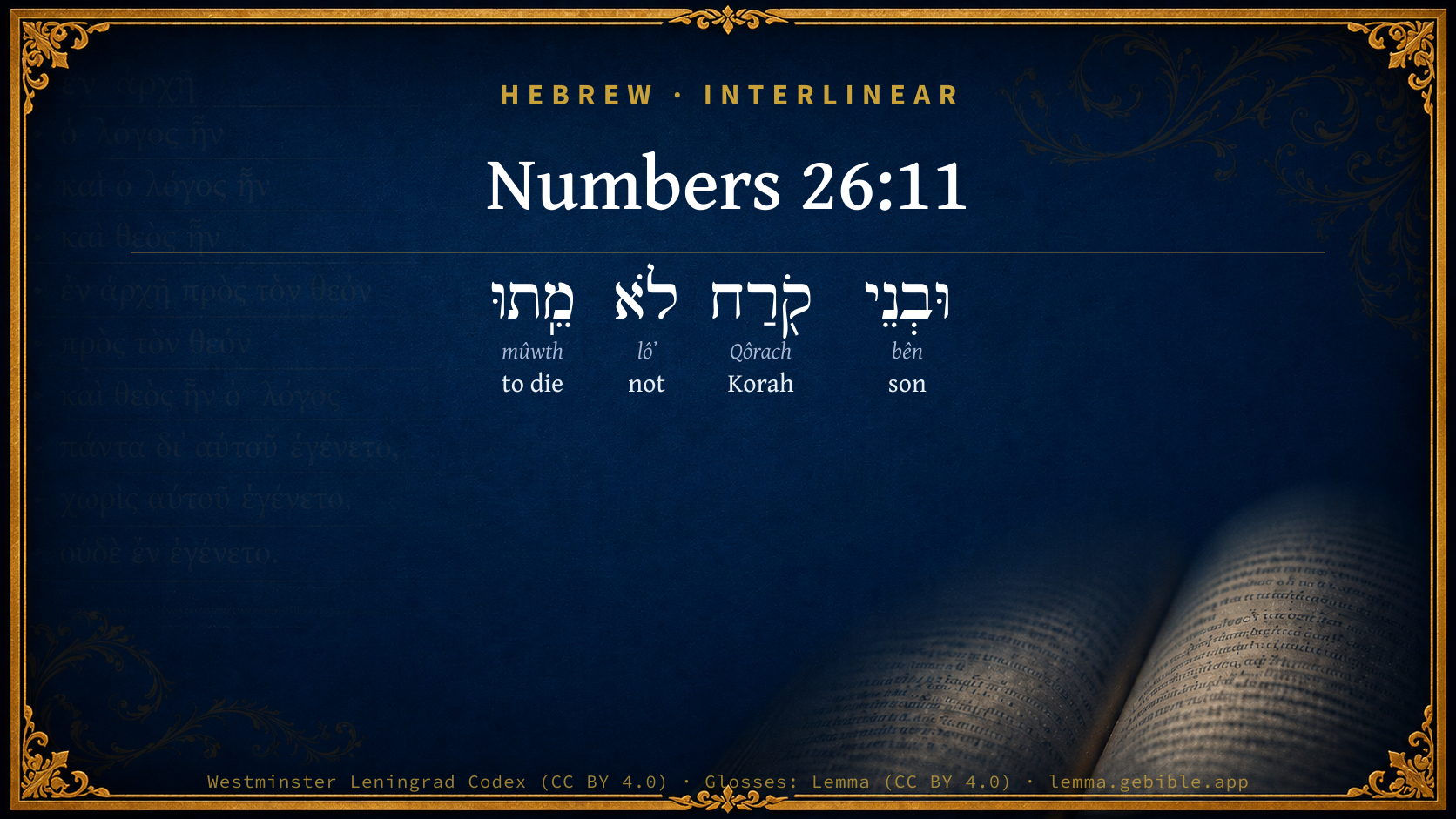
Numbers 26:11

Hebrew (Westminster Leningrad Codex) Numbers 26:11 appears in the Hebrew Old Testament. The text above is from the Westminster Leningrad Codex. Each word links to its Strong’s number, a concise gloss, and parsing drawn from the Open Scriptures Hebrew Bible morphology. Click any word for its full Brown-Driver-Briggs (BDB) entry.
Download image
Cite this verse

Numbers 26:11 (World English Bible). Public Domain. Lemma interlinear Bible study tool, https://lemma.gebible.app/v/numbers/26/11.

Show BibTeX & RIS
BibTeX
RIS
English Translation
Notwithstanding, the sons of Korah didn't die.
World English Bible · Public Domain
Download a study sheet

One document with this verse’s original text, its word-by-word gloss line, the meaning frame, cross-references with their text, attributed commentary, and full source and license credits — printable, and it pastes into notes with its structure intact.

This verse Autodidact and up

Study sheet (.html) Plain text (.txt)

A passage Seminary Student

Up to 50 verses in one chapter. A passage sheet keeps up to 6 commentary sources and 12 cross-references per verse, in the order this page ranks them, and says so on the sheet whenever that leaves anything out. Ask for a single verse and you get the Autodidact verse sheet above.

Everything on this page stays free to read, with no account — the sheet is a download of what is already on screen, not access to it.

Want to remove ads? Support Godless Engineer
Compare translations 3

The same verse in 3 English versions, stacked beneath the original-language interlinear above. Click any original word for its lexicon entry.

Each is an independent rendering of the whole verse — the interlinear is not word-aligned to these translations.

Highlighted words mark where these versions differ — a whole-verse word diff, not a word-by-word alignment.

  • World English Bible Public Domain
    Notwithstanding, the sons of Korah didn't die.
  • King James Version Public Domain
    Notwithstanding the children of Korah died not.
  • unfoldingWord Literal Text CC BY-SA 4.0
    And the sons of Korah did not die.

unfoldingWord Literal Text — © unfoldingWord, licensed CC BY-SA 4.0. Word-aligned USFM3 via Door43 (git.door43.org/unfoldingWord/en_ult).

Versions to compare (up to 4)

3 of 4 selected

Show all 18 translations

Every available English version of this verse, each an independent rendering of the whole verse.

  • World English Bible Public Domain
    Notwithstanding, the sons of Korah didn't die.
  • Berean Standard Bible Public Domain
    However, the line of Korah did not die out.
  • Majority Standard Bible Public Domain
    However, the line of Korah did not die out.
  • King James Version Public Domain
    Notwithstanding the children of Korah died not.
  • American Standard Version (1901) Public Domain
    Notwithstanding, the sons of Korah died not.
  • Revised Version (1885) Public Domain
    Notwithstanding the sons of Korah died not.
  • Geneva Bible (1599) Public Domain
    Notwithstanding, all the sonnes of Korah dyed not.
  • Douay-Rheims (1899) Public Domain
    That when Core perished, his sons did not perish.
  • Young's Literal Translation Public Domain
    and the sons of Korah died not.
  • Literal Standard Version CC BY-SA 4.0
    but the sons of Korah did not die.
  • Unlocked Literal Bible CC BY-SA 4.0
    But Korah's line did not die out.
  • unfoldingWord Literal Text CC BY-SA 4.0
    And the sons of Korah did not die.
  • Darby Bible Public Domain
    But the children of Korah died not.
  • World Messianic Bible Public Domain
    Notwithstanding, the sons of Korah didn’t die.
  • Webster's Bible Public Domain
    Notwithstanding the children of Korah died not.
  • Free Bible Version CC BY-SA 4.0
    But Korah's sons didn't die.)
  • Bible in Basic English Public Domain
    But death did not overtake the sons of Korah.
  • JPS Tanakh (1917) Public Domain
    Notwithstanding the sons of Korah died not.

Literal Standard Version (2020), Covenant Press — licensed CC BY-SA 4.0. Text via the HelloAO Bible API (eBible.org). Unlocked Literal Bible (unfoldingWord) — licensed CC BY-SA 4.0. Text via the HelloAO Bible API (eBible.org). unfoldingWord Literal Text — © unfoldingWord, licensed CC BY-SA 4.0. Word-aligned USFM3 via Door43 (git.door43.org/unfoldingWord/en_ult). Free Bible Version, Dr. Jonathan Gallagher — licensed CC BY-SA 4.0. Text via the HelloAO Bible API (eBible.org).

Word by word

More ways to search: Search by grammar → Find every occurrence → Compare this word →

Practice this passage: Drill this verse → Learn its vocabulary →

קֹ֖רַח
Qôrach
H7141
“Korah”
Noun, Proper
Part of Speech
Noun
Type
Proper
Full BDB Definition

Origin: from H7139

TWOT: None

Korah = "bald" - son of Izhar, grandson of Kohath, great grandson of Levi and leader of the rebellion of the Israelites against Moses and Aaron while in the wilderness; punished and died by an earthquake and flames of fire - the 3rd son of Esau by Aholibamah and one of the dukes of Edom - son of Eliphaz by Adah, duke of Edom, and nephew of 1 - one of the 'sons' of Hebron
  1. וּבְנֵי bên H1121 “and · sons of” Conjunction + Noun, Common, Masculine, Plural, Construct
  2. לֹא lôʼ H3808 “not” Particle, Negative
  3. מֵֽתוּ mûwth H4191 “to die” Verb, Qal, Perfect, 3rd Person, Common, Plural

About this verse

These counts appear in no published source. They are computed here, from the morphology-tagged text and Lemma’s own curated glosses. What Lemma adds →

4
words
4
distinct lemmas
Pentateuch
section

Shared distinctive vocabulary

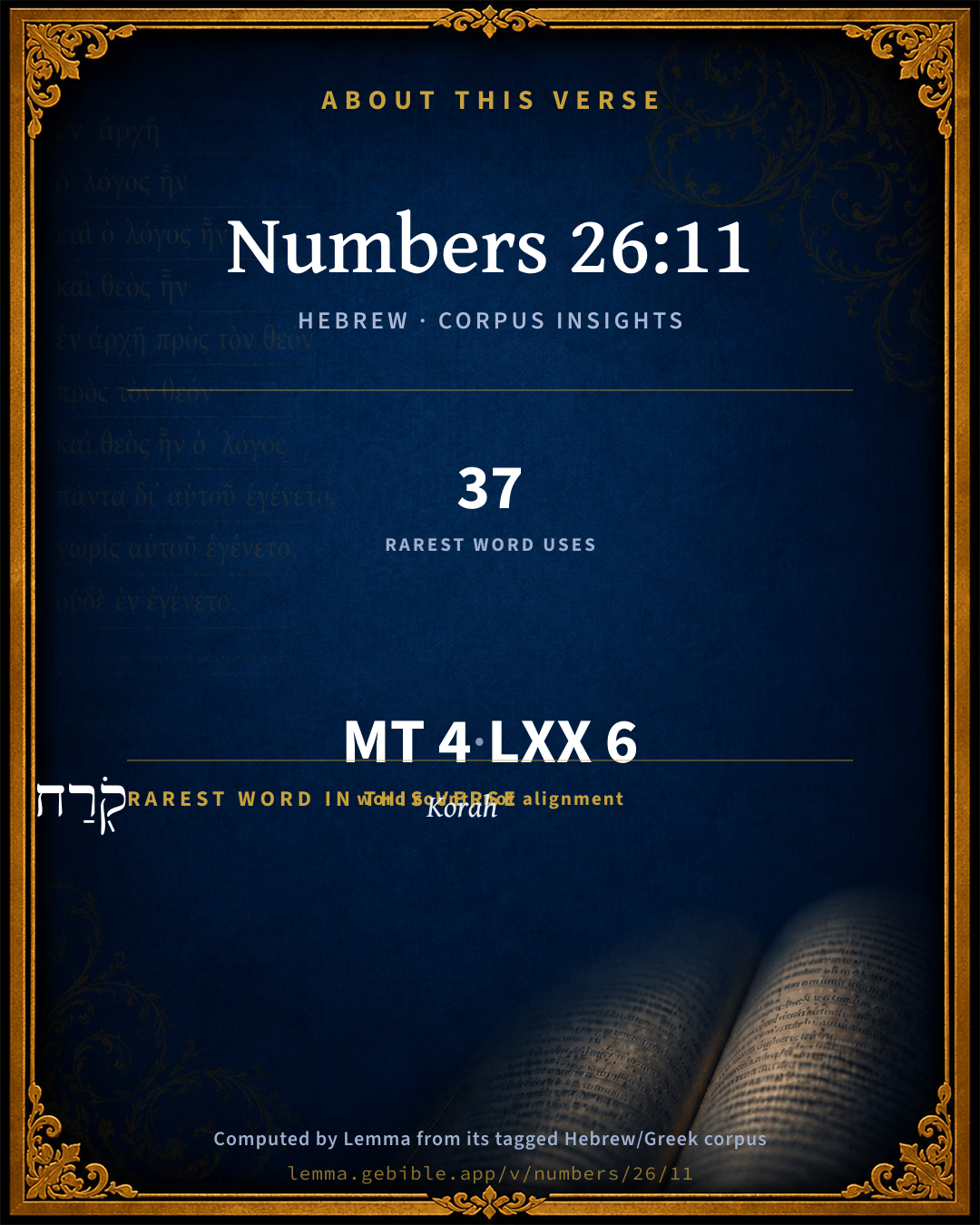
קֹ֖רַח Korah H7141 occurs in 37 verses of the Hebrew Bible. Also found in:

Grammatical profile

  • 1 verb
  • 2 nouns
  • 1 particle

Verb forms

  • מֵֽתוּ Qal · Perfect

Hebrew & Septuagint length

In English translation the verse runs 7 words from the Hebrew and 7 from the Septuagint (LXX English) — the same length.

A rough comparison of the two English renderings, which tokenize alike — not a word-level alignment.

Word counts can differ between the Hebrew and the Greek without any difference in meaning — e.g. the Hebrew direct-object marker אֵת has no separate Greek word, and Greek often adds the article ὁ.

In the original languages it is 4 Hebrew tokens and 6 Greek tokens — but the two are counted differently (Hebrew bundles its prefixes and suffixes into one token; the Greek is in lemma form), so that isn’t a like-for-like length.

Cross-references

13

Topical passages linked to Numbers 26:11 in the Treasury of Scripture Knowledge — connected by theme and wording, ordered by reader-vote popularity; previews shown in the World English Bible.

  • Exodus 6:24 The sons of Korah: Assir, and Elkanah, and Abiasaph; these are the families of the Korahites.
  • Psalms 42:1 As the deer pants for the water brooks, So my soul pants after you, God.
  • Numbers 16:5 and he spoke to Korah and to all his company, saying, In the morning Yahweh will show who are his, and who is holy, and will cause him to come near to him: even him whom he shall choose will he cause to come near to him.
  • Numbers 16:33 So they, and all that appertained to them, went down alive into Sheol: and the earth closed on them, and they perished from among the assembly.
  • Deuteronomy 24:16 The fathers shall not be put to death for the children, neither shall the children be put to death for the fathers: every man shall be put to death for his own sin.
  • 1 Chronicles 6:22–28 The sons of Kohath: Amminadab his son, Korah his son, Assir his son,
  • Psalms 44:1 We have heard with our ears, God; Our fathers have told us, What work you did in their days, In the days of old.
  • Psalms 45:1 My heart overflows with a noble theme. I recite my verses for the king. My tongue is like the pen of a skillful writer.
  • Psalms 46:1 God is our refuge and strength, A very present help in trouble.
  • Psalms 47:1 Oh clap your hands, all you nations. Shout to God with the voice of triumph!
  • Psalms 48:1 Great is Yahweh, and greatly to be praised, In the city of our God, in his holy mountain.
  • Psalms 49:1 Hear this, all you peoples. Listen, all you inhabitants of the world,
  • Psalms 50:1 The Mighty One, God, Yahweh, speaks, And calls the earth from sunrise to sunset.

Cross-references courtesy of OpenBible.info (CC BY 4.0).

Hebrew and Greek witnesses Masoretic Hebrew ↔ Greek Septuagint

The same verse in the two great witnesses to the Old Testament, shown verse-for-verse.

These are two independent witnesses, not word-aligned to each other, and the Septuagint is shown in lemma (dictionary) form.

Hebrew Numbers 26:11 Masoretic · Westminster Leningrad Codex

וּבְנֵי קֹ֖רַח לֹא מֵֽתוּ

Notwithstanding, the sons of Korah didn't die.

World English Bible · Public Domain

Greek LXX Numbers 26:11 Septuagint · lemma form

ὁ δέ υἱός κορε οὐ ἀποθνήσκω

But the sons of Core died not.

LXX2012 (modern English Septuagint) · Public Domain

Hebrew: Westminster Leningrad Codex (CC BY 4.0). Greek: Septuagint (public domain); English from LXX2012 (modern English Septuagint) (Public Domain). How the Septuagint differs from the Hebrew →

Targum (Aramaic paraphrase)

2

The Targum is the ancient Jewish Aramaic paraphrase of the Hebrew Scriptures — an interpretive translation, not the Hebrew text itself. Onkelos (literal) and Pseudo-Jonathan (expansive) render the Torah, and Jonathan the Prophets. Coverage is partial: where no permissively-licensed English translation exists for a verse, only the Aramaic is shown. This is verse-level text, not a word-by-word alignment to the Hebrew.

  1. Targum Onkelos Torah (Genesis–Deuteronomy)
    וּבְנֵי קֹרַח לָא מִיתוּ

    (no public-domain English translation for this verse)

    Targum Onkelos — Aramaic: “Onkelos Genesis” (public domain); “Onkelos Exodus” (public domain); “Onkelos Leviticus” (public domain); “Onkelos Numbers” (public domain); “Onkelos Deuteronomy” (public domain). English: “Sefaria Community Translation” (CC0 1.0 (public-domain dedication)); “J.W. Etheridge. The Targums of Onkelos and Jonathan Ben Uzziel on the Pentateuch. London: Longmans, Green, 1862” (public domain). Text via Sefaria.

  2. Targum Pseudo-Jonathan Torah (Genesis–Deuteronomy)
    וּבְנוֹי דְקרַח לָא הֲווֹ בְּעֵיטָתָא דַאֲבוּהוֹן וַאֲזָלוּ בָּתַר אוּלְפָנָא דְמשֶׁה נְבִיָא לָא מִיתוּ בְּמוֹתָנָא וְלָא לָקוּ בִּיקֵידְתָּא וְלָא טָמְעוּ בִּבְלִיעַת אַרְעָא

    But the sons of Korach were not in the counsel of their father, but followed the doctrine of Mosheh the prophet; and therefore they died not by the plague, nor were smitten by the fire, nor engulphed in the yawning of the earth.

    Targum Pseudo-Jonathan — Aramaic: “Targum Jonathan on Genesis” (public domain); “Targum Jonathan on Exodus” (public domain); “Targum Jonathan on Leviticus” (public domain); “Targum Jonathan on Numbers” (public domain); “Targum Jonathan on Deuteronomy” (public domain). English: “The Targum of Jonathan ben Uzziel, trans. J. W. Etheridge, London, 1862” (public domain). Text via Sefaria.

Commentary

Notes on Numbers 26:11 from classic Christian and Jewish commentators (each source and its license shown beneath its notes). The classic Christian expositions comment on the surrounding passage and are grouped to its opening verse, so a note may address several verses; the Jewish commentaries on the Tanakh (Rashi and others) are per-verse, so they appear only where the commentator wrote on this verse.

Lemma curates 59 commentaries, every one of them public domain or Creative Commons licensed, each selected and text-cleaned for this edition rather than reprinted as found. About our sources →

Trapp's Complete Commentary

John Trapp

Num 26:11 Notwithstanding the children of Korah died not.

Ver. 11. The children of Korah died not.] As being either innocent or penitent; for Aut paenitendum, ant pereundum {Luk 13:3}

John Trapp, A Commentary or Exposition upon All the Books of the Old and New Testament (1647–1656) — public domain. Text from a community e-Sword module.

Joseph Benson's Commentary

Num 26:11. The children of Korah died not — God being pleased to spare them, because they disowned their father’s act, and separated themselves from his tent and company. Hence the sons of Korah are mentioned 1Ch 6:22; 1Ch 6:38, and often in the book of Psalms.

Joseph Benson's Commentary on the Old and New Testaments (1811–1818) — public domain. Text from a community e-Sword module.

Jamieson, Fausset & Brown

Robert Jamieson, A. R. Fausset & David Brown

Notwithstanding the children of Korah died not--Either they were not parties to their father's crime, or they withdrew from it by timely repentance. His descendants became famous in the time of David, and are often mentioned in the Psalms [Psa 42:1; Psa 44:1; Psa 45:1; Psa 46:1; Psa 47:1; Psa 48:1; Psa 49:1; Psa 84:1; Psa 85:1; Psa 87:1; Psa 88:1], also in Ch1 6:22, Ch1 6:38.

Jamieson, Fausset & Brown — Commentary Critical and Explanatory on the Whole Bible (1871) — public domain (CC PDM 1.0). Text via the HelloAO Bible API.

Adam Clarke's Commentary

Verse 11. The children of Korah died not.] It is difficult to reconcile this place with Nu 16:27; Nu 16:31-33, where it seems to be intimated that not only the men, but the wives, and the sons, and the little ones of Korah, Dathan, and Abiram, were swallowed up by the earthquake; see especially Nu 16:27, collated with Nu 16:33. But the text here expressly says, The children of Korah died not; and on a close inspection of Nu 16:27 of the above-mentioned chapter, we shall find that the sons and the little ones of Dathan and Abiram alone are mentioned. So they gat up from the tabernacle of Korah, Dathan, and Abiram, on every side: and Dathan and Abiram came out - and their wives, and their sons, and their little ones. Here is no mention of the children of Korah, they therefore escaped, while it appears those of Dathan and Abiram perished with their fathers. See Clarke on Nu 16:30.

Adam Clarke's Commentary on the Bible (1810–1826) — public domain. Text from a community e-Sword/MySword module.

Ellicott's Commentary for English Readers

(11) Notwithstanding the children of Korah died not.—See Notes on Num_16:27; Num_16:32.

A Bible Commentary for English Readers, edited by Charles John Ellicott (1878–1897) — public domain. Text from a community e-Sword module.

The Cambridge Bible for Schools and Colleges

gen. ed. J. J. S. Perowne

11. and the sons of Korah died not] There is no mention of Korah’s family in ch. 16, but the inference might naturally be drawn from Num_26:32 that they were included in his body of adherents. This inference the writer felt it necessary to check, because in his day ‘sons of Korah’ were found in Jerusalem. They were a subdivision of the Levites, a guild which formed one of the temple choirs. To their hymnbook belonged Psalms 42, 44-49, 84 f., 87 f. In Num_26:58 (below) they are called ‘the family of the Korahites.’

The Cambridge Bible for Schools and Colleges (gen. ed. J. J. S. Perowne; Cambridge University Press, 1878–1918) — public domain. Text from a community e-Sword module.

John Gill's Exposition

The children of Gad, after their families tribe was numbered next to Simeon,.... because it lay encamped with that under the standard of Reuben. There is a little variation in the names of two or three of his sons, from those by which they are called Gen 46:16, instead of Ziphion, here Zephon; and for Haggai, here Haggi; and what is much wider, for Ezbon, here Ozni. Seven families sprang from Gad, whose number now was 40,500; they were diminished since their last numbering 5150; it is probable this tribe, being a warlike tribe, suffered very much in their attempt to enter the land of Canaan contrary to the will of God, and were repulsed and defeated by the Amalekites, Num 16:40.

.

Numbers 26:19

num 26:19

num 26:19

num 26:19And the sons of Judah were Er and Onan,.... And besides these he had Shelah, Pharez, and Zerah, from whom families sprang, but none from the two first: for

Er and Onan died in the land of Canaan; where they were born; and that because of their sins, as the Targum of Jonathan adds, see

Ge 38:7-10 so that there were but three families sprang from Judah, the Shelanites, Pharzites, and Zarhites; only the family of the Pharzites was divided into two families, the Hesronites and the Hamulites, so called from two sons of Pharez; the number of these families amounted to 76,500, so that there was an increase of 1900 since the last muster, which answers to Jacob's blessing, that he should be a praise among his brethren, Gen 49:8.

John Gill's Exposition of the Whole Bible (1746–1763) — public domain (CC PDM 1.0). Text via the HelloAO Bible API.

Albert Barnes' Notes on the Bible

The children of Korah died not - Compare Num 26:58. Samuel the prophet was of this family, and Heman, “the king’s seer” 1Ch 6:22, 1Ch 6:33; 1Ch 25:5. Several of the Psalms appear from the titles to have been composed for the sons of Korah: compare titles of Psa 42:1-11; 44; 45, etc.

Albert Barnes' Notes on the Bible (1834–1885) — public domain. Text from a community e-Sword/MySword module.

Matthew Poole's English Annotations

God being pleased to spare them, either because they disowned their father’s act, and thereupon separated themselves both from his tent and company, or because Moses interceded for them, or because God would glorify his own free mercy in sparing some, while he punished others, according to his declaration in a like case, Exo 33:19. Hence the sons of Korah are mentioned 1Ch 6:22,37, and oft in the book of Psalms.

Matthew Poole's English Annotations on the Holy Bible (1683–1685) — public domain. Text from a community e-Sword/MySword module.

Whedon's Commentary on the Bible

Daniel D. Whedon

11. The children… died not — Num_16:27, note.

Daniel D. Whedon (gen. ed.), Commentary on the Old and New Testaments (1874–1909) — public domain. Text from a community e-Sword module.

The Pulpit Commentary

The children of Korah died not. The confused nature of the narrative in Nu 16 is well exemplified by this statement; we should certainly have supposed from Num_16:32 that Korah"s sons had perished with him, if we were not here told to the contrary. The sons of Korah are frequently mentioned among the Levites, and Samuel himself would seem to have been of them; (see on 1Ch_6:22, 1Ch_6:28, 1Ch_6:33-38, and titles to Ps 42 Ps 88, &c.); it is, however, slightly doubtful whether the Kohathite Korah of 1Ch_6:22, the ancestor of Samuel, is the same as the Izharite Korah, the ancestor of Heman, in 1Ch_6:38.

The Pulpit Commentary (1880–1919), ed. H.D.M. Spence-Jones & Joseph S. Exell — public domain. Text from a community e-Sword module.

John Wesley's Explanatory Notes

Died not - God being pleased to spare them, because they disowned their father's fact, and separated themselves both from his tent and company. Hence the sons of Korah are mentioned, 1 Chron. vi, 22, 38, and often in the book of Psalms.

John Wesley, Explanatory Notes Upon the Whole Bible (1754–1765) — public domain. Text via the GEBible commentary corpus.

Rashi

Rabbi Shlomo Yitzchaki (Rashi)

ובני קרח לא מתו BUT THE SONS OF KORAH DID NOT DIE — They were in the plot originally, but at the moment when the rebellion broke out they had thoughts of repentance in their hearts; therefore a high spot was fenced round for them in Gehinnom and they stayed there (Sanhedrin 110a).

Rashi on the Tanakh — English translations: “The Judaica Press complete Tanach with Rashi, translated by A. J. Rosenberg” (CC BY 4.0); “Pentateuch with Rashi's commentary by M. Rosenbaum and A.M. Silbermann, 1929-1934” (public domain); “The Metsudah Tanach series, Lakewood, N.J” (CC BY 4.0); and “The Book of Joshua, Metsudah Publications, 1997” (CC BY 4.0). Text via Sefaria.

Ibn Ezra

Rabbi Abraham ibn Ezra

But the sons of Korach did not die. The testimony to this is Shmuel and his sons and sons’ sons, who were the singers (see Divrei HaYamim I 6:18-22), and they were called the Korachites (Divrei HaYamim II 20:19), also: “For the conductor, by the sons of Korach, a song” (Tehillim 49:1). Additionally, in the Torah it is written (v. 58) “and the Korachite family” as well. Scripture mentioned the sons of Korach together with the sons of Reuven because all the sons of Dasan and Aviram died, even the minors. Thus, the evil that befell Dasan and Aviram was worse than that of Korach.

Ibn Ezra on the Tanakh — English translations: “Sefaria Community Translation” (CC0 1.0 (public-domain dedication)); “Yalkut, Sifsei Chachomim Chumash, Metsudah Publications, 2009” (CC BY 4.0); and “Commentary of Ibn Ezra on Isaiah - trans. by M. Friedlander, 1873” (public domain). Text via Sefaria.

Lesson kit

Teaching starters — assembled from the data on this page, not authored interpretation. Every prompt links to the verse data it draws on. Edit before teaching.

Numbers, in the Pentateuch, opens this verse with 4 words (4 distinct Hebrew lemmas). Its most distinctive word is Qôrach (“Korah”). A historical commentator’s framing appears above. Read the whole chapter for the surrounding context.

Discussion questions

  1. The word Qôrach carries the sense “Korah.” How does it shape the verse?
  2. Genesis 36:5 shares the word «Korah» with this verse. How do the two illuminate each other?
  3. These translations render this verse differently; the difference is in the English rendering, not the original. What questions does that raise?
  4. The verb «מֵֽתוּ» is Qal Perfect. How does its form color the action?
  5. Reading how Trapp's Complete Commentary and Joseph Benson's Commentary read this verse, where do the two commentators agree and where do they part?

Things to notice

Reading settings

Reading text

Shown beneath each verse's original-language words.

Old Testament
Old Testament edition

Read the OT as the Masoretic Hebrew (MT) or the Greek Septuagint (LXX).

English shown for the Greek Septuagint (in the Hebrew ↔ Greek comparison).

Comparing translations? Open the Compare panel on any verse page to stack up to four side by side.