
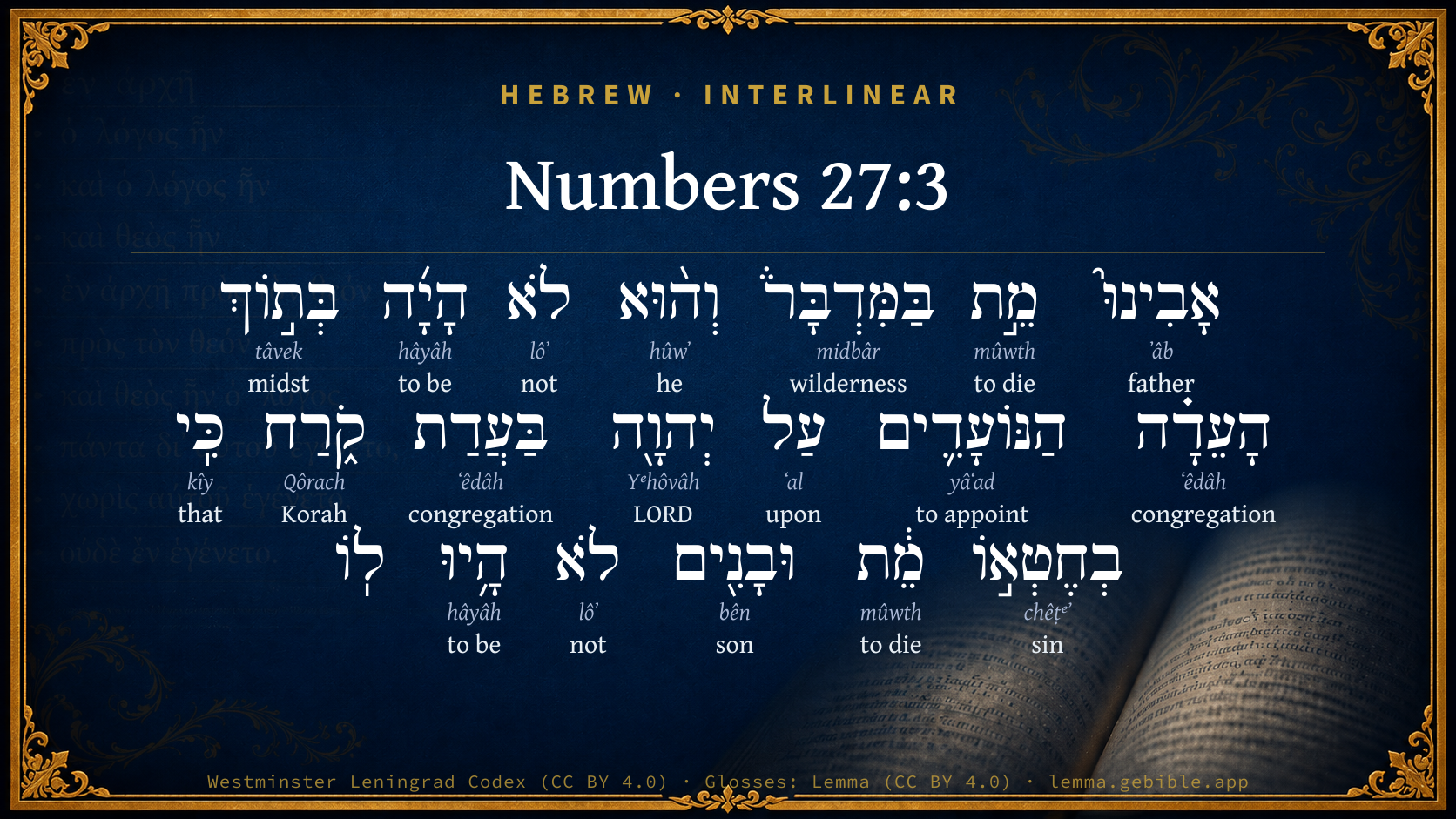
Numbers 27:3

Hebrew (Westminster Leningrad Codex) Numbers 27:3 appears in the Hebrew Old Testament. The text above is from the Westminster Leningrad Codex. Each word links to its Strong’s number, a concise gloss, and parsing drawn from the Open Scriptures Hebrew Bible morphology. Click any word for its full Brown-Driver-Briggs (BDB) entry.
Download image
Cite this verse

Numbers 27:3 (World English Bible). Public Domain. Lemma interlinear Bible study tool, https://lemma.gebible.app/v/numbers/27/3.

Show BibTeX & RIS
BibTeX
RIS
English Translation
Our father died in the wilderness, and he was not among the company of those who gathered themselves together against Yahweh in the company of Korah: but he died in his own sin; and he had no sons.
World English Bible · Public Domain
Download a study sheet

One document with this verse’s original text, its word-by-word gloss line, the meaning frame, cross-references with their text, attributed commentary, and full source and license credits — printable, and it pastes into notes with its structure intact.

This verse Autodidact and up

Study sheet (.html) Plain text (.txt)

A passage Seminary Student

Up to 50 verses in one chapter. A passage sheet keeps up to 6 commentary sources and 12 cross-references per verse, in the order this page ranks them, and says so on the sheet whenever that leaves anything out. Ask for a single verse and you get the Autodidact verse sheet above.

Everything on this page stays free to read, with no account — the sheet is a download of what is already on screen, not access to it.

Want to remove ads? Support Godless Engineer
Compare translations 3

The same verse in 3 English versions, stacked beneath the original-language interlinear above. Click any original word for its lexicon entry.

Each is an independent rendering of the whole verse — the interlinear is not word-aligned to these translations.

Highlighted words mark where these versions differ — a whole-verse word diff, not a word-by-word alignment.

  • World English Bible Public Domain
    Our father died in the wilderness, and he was not among the company of those who gathered themselves together against Yahweh in the company of Korah: but he died in his own sin; and he had no sons.
  • King James Version Public Domain
    Our father died in the wilderness, and he was not in the company of them that gathered themselves together against the LORD in the company of Korah; but died in his own sin, and had no sons.
  • unfoldingWord Literal Text CC BY-SA 4.0
    “Our father died in the wilderness, and he was not in the midst of the congregation who assembled against Yahweh with the congregation of Korah, but he died in his sin, and there were no sons for him.

unfoldingWord Literal Text — © unfoldingWord, licensed CC BY-SA 4.0. Word-aligned USFM3 via Door43 (git.door43.org/unfoldingWord/en_ult).

Versions to compare (up to 4)

3 of 4 selected

Show all 18 translations

Every available English version of this verse, each an independent rendering of the whole verse.

  • World English Bible Public Domain
    Our father died in the wilderness, and he was not among the company of those who gathered themselves together against Yahweh in the company of Korah: but he died in his own sin; and he had no sons.
  • Berean Standard Bible Public Domain
    “Our father died in the wilderness, but he was not among the followers of Korah who gathered together against the LORD. Instead, he died because of his own sin, and he had no sons.
  • Majority Standard Bible Public Domain
    “Our father died in the wilderness, but he was not among the followers of Korah who gathered together against the LORD. Instead, he died because of his own sin, and he had no sons.
  • King James Version Public Domain
    Our father died in the wilderness, and he was not in the company of them that gathered themselves together against the LORD in the company of Korah; but died in his own sin, and had no sons.
  • American Standard Version (1901) Public Domain
    Our father died in the wilderness, and he was not among the company of them that gathered themselves together against Jehovah in the company of Korah: but he died in his own sin; and he had no sons.
  • Revised Version (1885) Public Domain
    Our father died in the wilderness, and he was not among the company of them that gathered themselves together against the LORD in the company of Korah: but he died in his own sin; and he had no sons.
  • Geneva Bible (1599) Public Domain
    Our father dyed in the wildernes, and he was not among the assemblie of them that were assembled against the Lord in the companie of Korah, but died in his sinne, and had no sonnes.
  • Douay-Rheims (1899) Public Domain
    Our father died in the desert, and was not in the sedition, that was raised against the Lord under Core, but he died in his own sin: and he had no male children. Why is his name taken away out of his family, because he had no son? Give us a possession among the kinsmen of our father.
  • Young's Literal Translation Public Domain
    `Our father died in the wilderness, and he -- he was not in the midst of the company who were met together against Jehovah in the company of Korah, but for his own sin he died, and had no sons;
  • Literal Standard Version CC BY-SA 4.0
    “Our father died in the wilderness, and he was not in the midst of the congregation who were gathered together against YHWH in the congregation of Korah, but he died for his own sin, and had no sons;
  • Unlocked Literal Bible CC BY-SA 4.0
    “Our father died in the wilderness. He was not among those who conspired against Yahweh in the company of Korah. He died for his own sin, and he had no sons.
  • unfoldingWord Literal Text CC BY-SA 4.0
    “Our father died in the wilderness, and he was not in the midst of the congregation who assembled against Yahweh with the congregation of Korah, but he died in his sin, and there were no sons for him.
  • Darby Bible Public Domain
    Our father died in the wilderness, and he was not in the band of them that banded themselves together against Jehovah in the band of Korah; but he died in his own sin, and he had no sons.
  • World Messianic Bible Public Domain
    “Our father died in the wilderness. He was not among the company of those who gathered themselves together against the LORD in the company of Korah, but he died in his own sin. He had no sons.
  • Webster's Bible Public Domain
    Our father died in the wilderness, and he was not in the company of them that assembled themselves against the LORD in the company of Korah; but died in his own sin, and had no sons.
  • Free Bible Version CC BY-SA 4.0
    “Our father died in the desert, but he wasn't one of Korah's followers who joined together to rebel against the Lord. No, he died from his own sins, and he didn't have any sons.
  • Bible in Basic English Public Domain
    Death overtook our father in the waste land; he was not among those who were banded together with Korah against the Lord; but death came to him in his sin; and he had no sons.
  • JPS Tanakh (1917) Public Domain
    'Our father died in the wilderness, and he was not among the company of them that gathered themselves together against the LORD in the company of Korah, but he died in his own sin; and he had no sons.

Literal Standard Version (2020), Covenant Press — licensed CC BY-SA 4.0. Text via the HelloAO Bible API (eBible.org). Unlocked Literal Bible (unfoldingWord) — licensed CC BY-SA 4.0. Text via the HelloAO Bible API (eBible.org). unfoldingWord Literal Text — © unfoldingWord, licensed CC BY-SA 4.0. Word-aligned USFM3 via Door43 (git.door43.org/unfoldingWord/en_ult). Free Bible Version, Dr. Jonathan Gallagher — licensed CC BY-SA 4.0. Text via the HelloAO Bible API (eBible.org).

Word by word

More ways to search: Search by grammar → Find every occurrence → Compare this word →

Practice this passage: Drill this verse → Learn its vocabulary →

הַנּוֹעָדִ֛ים
yâʻad
H3259
“the · appointing”
Particle, Definite Article + Verb, Niphal, Participle Active, Masculine, Plural, Absolute
Part of Speech
Particle + Verb
Stem
Niphal
Form
Participle Active
Gender
Masculine
Number
Plural
State
Absolute
Full BDB Definition

Origin: a primitive root

TWOT: 878

to fix, appoint, assemble, meet, set, betroth - (Qal) to appoint, assign, designate - (Niphal) - to meet - to meet by appointment - to gather, assemble by appointment - (Hiphil) to cause to meet - (Hophal) to be set, be placed before, be fixed
  1. אָבִינוּ֮ ʼâb H1 “father · our” Noun, Common, Masculine, Singular, Construct + Suffix, Personal, 1st Person, Common, Plural
  2. מֵ֣ת mûwth H4191 “to die” Verb, Qal, Perfect, 3rd Person, Masculine, Singular
  3. בַּמִּדְבָּר֒ midbâr H4057 “in/at the · wilderness” Preposition, Determined + Noun, Common, Masculine, Singular, Absolute
  4. וְה֨וּא hûwʼ H1931 “and · he” Conjunction + Pronoun, Personal, 3rd Person, Masculine, Singular
  5. לֹא lôʼ H3808 “not” Particle, Negative
  6. הָיָ֜ה hâyâh H1961 “to be” Verb, Qal, Perfect, 3rd Person, Masculine, Singular
  7. בְּת֣וֹךְ tâvek H8432 “in/at · midst of” Preposition + Noun, Common, Masculine, Singular, Construct
  8. הָעֵדָ֗ה ʻêdâh H5712 “the · congregation” Particle, Definite Article + Noun, Common, Feminine, Singular, Absolute
  9. עַל ʻal H5921 “upon” Preposition
  10. יְהוָ֖ה Yᵉhôvâh H3068 “LORD” Noun, Proper
  11. בַּעֲדַת ʻêdâh H5712 “in/at · congregation of” Preposition + Noun, Common, Feminine, Singular, Construct
  12. קֹ֑רַח Qôrach H7141 “Korah” Noun, Proper
  13. כִּֽי kîy H3588 “that” Conjunction
  14. בְחֶטְא֣וֹ chêṭᵉʼ H2399 “in/at · sin · his” Preposition + Noun, Common, Masculine, Singular, Construct + Suffix, Personal, 3rd Person, Masculine, Singular
  15. מֵ֔ת mûwth H4191 “to die” Verb, Qal, Perfect, 3rd Person, Masculine, Singular
  16. וּבָנִ֖ים bên H1121 “and · sons” Conjunction + Noun, Common, Masculine, Plural, Absolute
  17. לֹא lôʼ H3808 “not” Particle, Negative
  18. הָ֥יוּ hâyâh H1961 “to be” Verb, Qal, Perfect, 3rd Person, Common, Plural

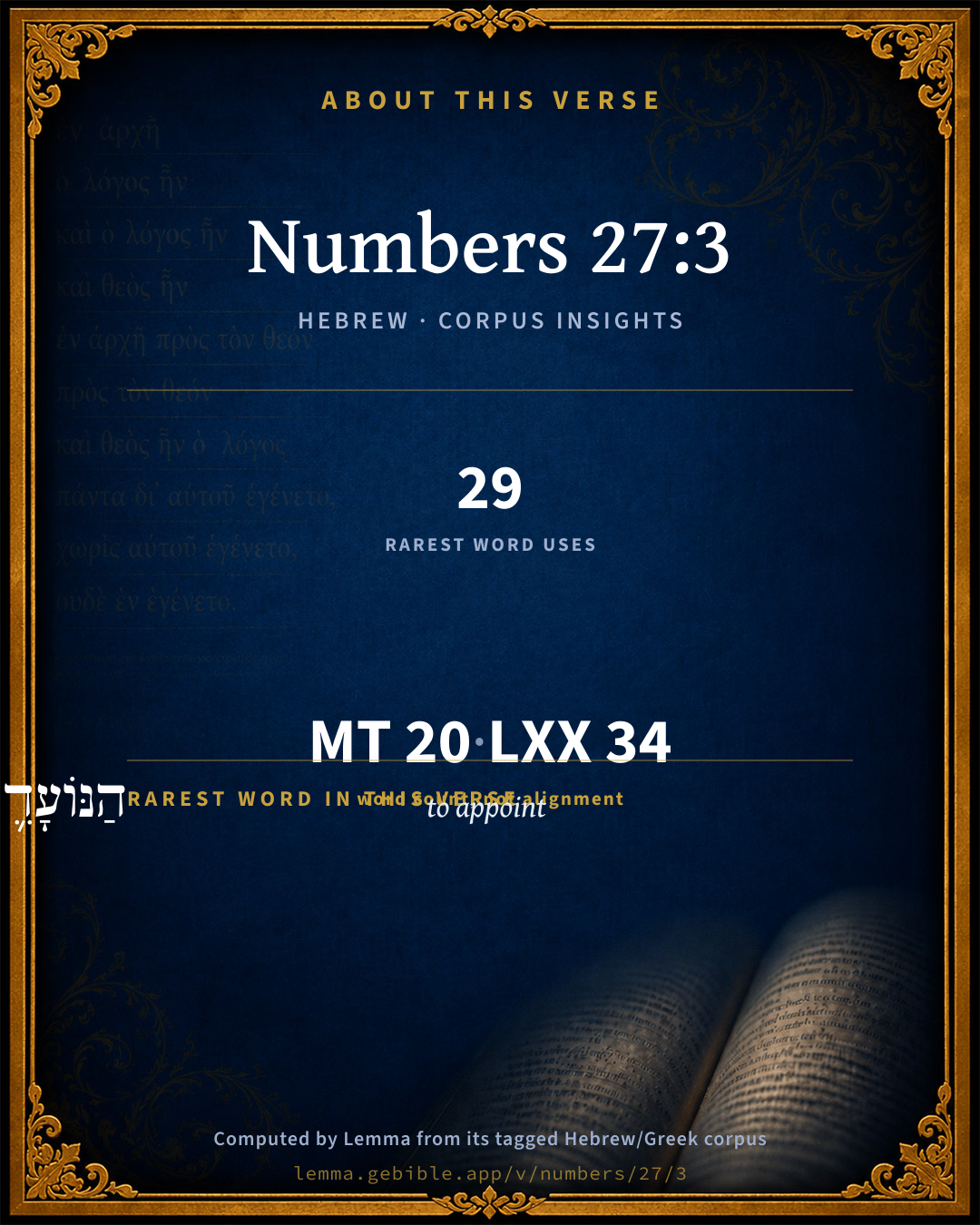
About this verse

These counts appear in no published source. They are computed here, from the morphology-tagged text and Lemma’s own curated glosses. What Lemma adds →

20
words
15
distinct lemmas
Pentateuch
section

Shared distinctive vocabulary

הַנּוֹעָדִ֛ים to appoint H3259 occurs in 29 verses of the Hebrew Bible. Also found in:

Grammatical profile

  • 5 verbs
  • 9 nouns
  • 1 pronoun
  • 2 prepositions
  • 1 conjunction
  • 2 particles

Verb forms

  • מֵ֣ת Qal · Perfect
  • הָיָ֜ה Qal · Perfect
  • הַנּוֹעָדִ֛ים Niphal · Participle Active
  • מֵ֔ת Qal · Perfect
  • הָ֥יוּ Qal · Perfect

Repetition

Words recur within this verse — often emphatic in Hebrew:

  • מֵ֣ת to die H4191 ×2
  • הָיָ֜ה to be H1961 ×2
  • הָעֵדָ֗ה congregation H5712 ×2
  • לֹא not H3808 ×2

Hebrew & Septuagint length

In English translation the verse runs 38 words from the Hebrew and 70 from the Septuagint (LXX English) — the Septuagint runs noticeably longer here. See the side-by-side →

A rough comparison of the two English renderings, which tokenize alike — not a word-level alignment.

Word counts can differ between the Hebrew and the Greek without any difference in meaning — e.g. the Hebrew direct-object marker אֵת has no separate Greek word, and Greek often adds the article ὁ.

In the original languages it is 20 Hebrew tokens and 34 Greek tokens — but the two are counted differently (Hebrew bundles its prefixes and suffixes into one token; the Greek is in lemma form), so that isn’t a like-for-like length.

Cross-references

14

Topical passages linked to Numbers 27:3 in the Treasury of Scripture Knowledge — connected by theme and wording, ordered by reader-vote popularity; previews shown in the World English Bible.

  • Numbers 26:64–65 But among these there was not a man of them who were numbered by Moses and Aaron the priest, who numbered the children of Israel in the wilderness of Sinai.
  • Numbers 14:35 I, Yahweh, have spoken, surely this will I do to all this evil congregation, who are gathered together against me: in this wilderness they shall be consumed, and there they shall die.
  • Ezekiel 18:4 Behold, all souls are mine; as the soul of the father, so also the soul of the son is mine: the soul who sins, he shall die.
  • Numbers 16:1–3 Now Korah, the son of Izhar, the son of Kohath, the son of Levi, with Dathan and Abiram, the sons of Eliab, and On, the son of Peleth, sons of Reuben, took [men]:
  • Numbers 16:19 Korah assembled all the congregation against them to the door of the tent of meeting: and the glory of Yahweh appeared to all the congregation.
  • Numbers 16:32–35 and the earth opened its mouth, and swallowed them up, and their households, and all the men who appertained to Korah, and all their goods.
  • Numbers 16:49 Now those who died by the plague were fourteen thousand and seven hundred, besides those who died about the matter of Korah.
  • Numbers 26:9–10 The sons of Eliab: Nemuel, and Dathan, and Abiram. These are that Dathan and Abiram, who were called of the congregation, who strove against Moses and against Aaron in the company of Korah, when they strove against Yahweh,
  • Numbers 26:33 Zelophehad the son of Hepher had no sons, but daughters: and the names of the daughters of Zelophehad were Mahlah, and Noah, Hoglah, Milcah, and Tirzah.
  • John 8:21 Jesus said therefore again to them, "I am going away, and you will seek me, and you will die in your sins. Where I go, you can't come."
  • John 8:24 I said therefore to you that you will die in your sins; for unless you believe that I am he, you will die in your sins."
  • Romans 5:12 Therefore, as sin entered into the world through one man, and death through sin; and so death passed to all men, because all sinned.
  • Romans 5:21 that as sin reigned in death, even so might grace reign through righteousness to eternal life through Jesus Christ our Lord.
  • Romans 6:23 For the wages of sin is death, but the free gift of God is eternal life in Christ Jesus our Lord.

Cross-references courtesy of OpenBible.info (CC BY 4.0).

Hebrew and Greek witnesses Masoretic Hebrew ↔ Greek Septuagint

The same verse in the two great witnesses to the Old Testament, shown verse-for-verse.

Here the Septuagint runs noticeably longer than the Hebrew — LXX2012 (modern English Septuagint) 70 words vs World English Bible 38. A rough length comparison of the two English translations, not a word-level alignment — read both below.

These are two independent witnesses, not word-aligned to each other, and the Septuagint is shown in lemma (dictionary) form.

Hebrew Numbers 27:3 Masoretic · Westminster Leningrad Codex

אָבִינוּ֮ מֵ֣ת בַּמִּדְבָּר֒ וְה֨וּא לֹא הָיָ֜ה בְּת֣וֹךְ הָעֵדָ֗ה הַנּוֹעָדִ֛ים עַל יְהוָ֖ה בַּעֲדַת קֹ֑רַח כִּֽי בְחֶטְא֣וֹ מֵ֔ת וּבָנִ֖ים לֹא הָ֥יוּ לֽוֹ

Our father died in the wilderness, and he was not among the company of those who gathered themselves together against Yahweh in the company of Korah: but he died in his own sin; and he had no sons.

World English Bible · Public Domain

Greek LXX Numbers 27:3 Septuagint · lemma form

ὁ πατήρ ἐγώ ἀποθνήσκω ἐν ὁ ἔρημος καί αὐτός οὐ εἰμί ἐν μέσος ὁ συναγωγή ὁ ἐπι συνἵστημι ἔναντι κύριος ἐν ὁ συναγωγή κορε ὅτι διά ἁμαρτία αὐτός ἀποθνήσκω καί υἱός οὐ γίγνομαι αὐτός

Our father died in the wilderness, and he was not in the midst of the congregation that rebelled against the Lord in the gathering of Core; for he died for his own sin, and he had no sons. Let not the name of our father be blotted out of the midst of his people, because he has no son: give us an inheritance in the midst of our father's brethren.

LXX2012 (modern English Septuagint) · Public Domain

Hebrew: Westminster Leningrad Codex (CC BY 4.0). Greek: Septuagint (public domain); English from LXX2012 (modern English Septuagint) (Public Domain). How the Septuagint differs from the Hebrew →

Targum (Aramaic paraphrase)

2

The Targum is the ancient Jewish Aramaic paraphrase of the Hebrew Scriptures — an interpretive translation, not the Hebrew text itself. Onkelos (literal) and Pseudo-Jonathan (expansive) render the Torah, and Jonathan the Prophets. Coverage is partial: where no permissively-licensed English translation exists for a verse, only the Aramaic is shown. This is verse-level text, not a word-by-word alignment to the Hebrew.

  1. Targum Onkelos Torah (Genesis–Deuteronomy)
    אָבוּנָא מִית בְּמַדְבְּרָא וְהוּא לָא הֲוָה בְּגוֹ כְנִשְׁתָּא דְאִזְדַמָנוּ עַל יְיָ בְּכְנִשְׁתָּא דְקֹרַח אֲרֵי בְחוֹבֵיהּ מִית וּבְנִין לָא הֲווֹ לֵיהּ

    (no public-domain English translation for this verse)

    Targum Onkelos — Aramaic: “Onkelos Genesis” (public domain); “Onkelos Exodus” (public domain); “Onkelos Leviticus” (public domain); “Onkelos Numbers” (public domain); “Onkelos Deuteronomy” (public domain). English: “Sefaria Community Translation” (CC0 1.0 (public-domain dedication)); “J.W. Etheridge. The Targums of Onkelos and Jonathan Ben Uzziel on the Pentateuch. London: Longmans, Green, 1862” (public domain). Text via Sefaria.

  2. Targum Pseudo-Jonathan Torah (Genesis–Deuteronomy)
    אָבוּנָא מִית בְּמַדְבְּרָא וְהוּא לָא הֲוָה בְּגוֹ כְנִישְׁתָּא דְמִתְרַעֲמוּ וּדְאִזְדַמְנוּ לְמָרָדָא עַל יְיָ בִּכְנִישְׁתָּא דְקרַח אֲרוּם בְּחוֹבֵיהּ מִית וְלָא אַחְטֵי לְחוֹרָנִין וּבְנִין דִכְרִין לָא הֲווֹ לֵיהּ

    Our father died in the wilderness, but he was not among the congregation who murmured and gathered to rebel against the Lord in the congregation of Korach, but died for his own sin; nor made he others to sin; but he had no male children.

    Targum Pseudo-Jonathan — Aramaic: “Targum Jonathan on Genesis” (public domain); “Targum Jonathan on Exodus” (public domain); “Targum Jonathan on Leviticus” (public domain); “Targum Jonathan on Numbers” (public domain); “Targum Jonathan on Deuteronomy” (public domain). English: “The Targum of Jonathan ben Uzziel, trans. J. W. Etheridge, London, 1862” (public domain). Text via Sefaria.

Commentary

Notes on Numbers 27:3 from classic Christian and Jewish commentators (each source and its license shown beneath its notes). The classic Christian expositions comment on the surrounding passage and are grouped to its opening verse, so a note may address several verses; the Jewish commentaries on the Tanakh (Rashi and others) are per-verse, so they appear only where the commentator wrote on this verse.

Lemma curates 59 commentaries, every one of them public domain or Creative Commons licensed, each selected and text-cleaned for this edition rather than reprinted as found. About our sources →

Trapp's Complete Commentary

John Trapp

Num 27:3 Our father died in the wilderness, and he was not in the company of them that gathered themselves together against the LORD in the company of Korah; but died in his own sin, and had no sons.

Ver. 3. But died in his own. sin.] i.e., By a natural and an ordinary death; not by a special plague, as that arch-rebel Korah. Death is the just hire of the least sin. {Rom 6:23} But some evildoers God doth not only put to death, but also hangs them up in gibbets, as it were, for public notice and admonition.

John Trapp, A Commentary or Exposition upon All the Books of the Old and New Testament (1647–1656) — public domain. Text from a community e-Sword module.

Joseph Benson's Commentary

Num 27:3. But died in his own sin — The sin for which he alone was to suffer in his person, and not in his posterity, meaning, as some think, that incredulity for which all that generation was sentenced to die in the wilderness; and which, though, with respect to the rest of the people, it was not merely his own sin, since they were generally alike guilty; yet with respect to his children it was his own sin, a personal guilt, which God himself had declared should not affect his children, Num 14:31.

But, perhaps, by his dying in his own sin, we are only to understand that he died by a common ordinary death, not such a one as they shared who were partakers of the guilt of Korah and his companions.

Joseph Benson's Commentary on the Old and New Testaments (1811–1818) — public domain. Text from a community e-Sword module.

Tyndale Open Study Notes

Tyndale Open Resources

27:3-4 Zelophehad had not been part of Korah’s rebellion (16:1-50); if he had been, his property rights would apparently have been voided (see 15:30; cp. 1 Kgs 21:7-16). Israelite society was patriarchal and patrilineal, tracing ancestry and property through the male line. Zelophehad had no sons, but his daughters wanted his family property rights to continue. Zelophehad’s daughters thus made a reasonable appeal for property rights equal to those of males.

Tyndale Open Study Notes — © Tyndale Open Resources, licensed CC BY-SA 4.0. Text via the HelloAO Bible API.

Geneva Bible (1599)

Geneva Bible translators

According as all men die, for as much as they are sinners.

Geneva Bible (1599) marginal notes — public domain. Text via Bolls.life.

The Cambridge Bible for Schools and Colleges

gen. ed. J. J. S. Perowne

3. he died in his own sin] in the ordinary sinfulness of a man, like the rest of his generation who died during the forty years in the wilderness. They point out that their father had not taken part in the sin of Korah’s company, that is, he had not committed any crime great enough to deserve the alienation of the property from his family after his death.

Notice that the reference to Korah’s company is in agreement with the main part of the P story in ch. 16, in which Korah’s company were laymen and not Levites; for it is implied that Zelophehad, who was a Manassite, might have been one of them.

The Cambridge Bible for Schools and Colleges (gen. ed. J. J. S. Perowne; Cambridge University Press, 1878–1918) — public domain. Text from a community e-Sword module.

John Gill's Exposition

Our father died in the wilderness,.... As all the generation of the children of Israel did, that came out of Egypt, who were twenty years old and upwards, excepting Joshua and Caleb:

and he was not in the company of them that gathered themselves together against the Lord in the company of Korah; which is observed, not so much to obtain the favour and good will of Moses as to clear the memory of their father from any reproach upon it, he dying in the wilderness; and chiefly to show that the claim of his posterity to a share in the land was not forfeited, he not being in that rebellion, nor in any other; so that he and his were never under any attainder:

but died in his own sin; which though common to all men, every man has his own peculiar way of sinning, and is himself only answerable for it, Isa 53:6 he sinned alone, had no partner or confederate, whom he had drawn into any notorious and public sin, as mutiny, &c. to the prejudice of the state, and the rulers in it; so the Targum of Jonathan adds,"and he did not cause others to sin,''so Jarchi; some take him to be the sabbath breaker, Num 15:32, others that he was one of those that went up the hill, Num 14:44, most likely his sin was that of unbelief, disbelieving the spies that brought the good report of the land, and giving credit to those that brought an ill report of it; and so with the rest of the people murmured, for which his carcass, with others, fell in the wilderness, and entered not into the good land, through unbelief: a sin not punished in their children:

and had no sons. which was the reason of this application.

John Gill's Exposition of the Whole Bible (1746–1763) — public domain (CC PDM 1.0). Text via the HelloAO Bible API.

Albert Barnes' Notes on the Bible

But died in his own sin - i. e., perished under the general sentence of exclusion from the land of promise passed on all the older generation, but limited to that generation alone. By virtue of the declaration in Num 14:31 the daughters of Zelophehad claim that their father’s sin should not be visited upon them.

Albert Barnes' Notes on the Bible (1834–1885) — public domain. Text from a community e-Sword/MySword module.

Haydock's Catholic Bible Commentary

Father, the portion which would have been assigned him; that so those whom we may marry, may take the inheritance, under the name of Salphaad, which some of the children may also bear. (Menochius)

George Leo Haydock (1774–1849), Haydock's Catholic Family Bible and Commentary, 1859 edition — public domain. Excludes Psalms (Douay-Rheims chapter numbering differs from Protestant) and Deuterocanonical books (Catholic canon only).

Matthew Poole's English Annotations

He was not in the company of Korah, nor in any other rebellion of the people, which must be understood, because all of them are opposed to

his own sin, in which alone he is said to die. But they mention this only either,

1. Because he might possibly be accused to be guilty of this. Or,

2. Because he, being an eminent person, might be thought guilty of that rather than of any other, because the great and famous men were more concerned in that rebellion than others. Or,

3. To gain the favour of Moses, against whom that rebellion was more particularly directed, and more desperately prosecuted than any other. Or,

4. Because peradventure he died about that time, and therefore might be presumed guilty of that crime. Or rather,

5. Because that sin, and, as it may seem, that only of all the sins committed in the wilderness, was of such a flagitious nature, that God thought fit to extend the punishment not only to the persons of those rebels, but also to their children and families, Num 16:27,32, as was usual in like cases, as Deu 13:15; Jos 7:24; whence it is noted as a singular privilege granted to the children of Korah, that they died not, Num 26:11, whereas the children of their confederates died with them. And this makes their argument here more proper and powerful, that he did not die in that sin for which his posterity were to be cut off, and to lose either their lives or their inheritances, and therefore their claim was more just.

In his own sin; either,

1. For that sin mentioned Num 14, which they call his own sin, in opposition not to the rest of the people, for it was a common sin, but to his children, i.e. the sin for which he alone was to suffer in his person and not in his posterity, as God had appointed, Num 14:33. Or rather,

2. For his own personal sins; for,

1. These were more properly his own sins.

2. It was a truth, and that believed by the Jews, that death was a punishment for men’s own sins.

3. The punishment of that common sin was not directly and properly death, but exclusion from the land of Canaan, and death only by way of consequence upon that.

Matthew Poole's English Annotations on the Holy Bible (1683–1685) — public domain. Text from a community e-Sword/MySword module.

Whedon's Commentary on the Bible

Daniel D. Whedon

3. Not in the company… of Korah — This part of their plea implies that the treason of Korah attainted the blood of the conspirators, and cut off their children from heirship.

Died in his own sin — As other men died in the wilderness, in no special sin nor stroke of judgment, implicating and ruining others with himself.

Daniel D. Whedon (gen. ed.), Commentary on the Old and New Testaments (1874–1909) — public domain. Text from a community e-Sword module.

The Pulpit Commentary

He was not in the company of them that gathered themselves together against the Lord. He had not been amongst the two hundred and fifty who gathered themselves together in support of Korah s pretensions. It does not appear why they should have thought it necessary to make this statement, unless they felt that the fact of his having died without sons might raise suspicion against him as one who had greatly provoked the wrath of God. But died in his own sin. This cannot mean that Zelophehad was one of those who died in the wilderness in consequence of the rebellion at Kadesh (see the next note). Apparently his daughters meant to acknowledge that they had no complaint against the Divine justice because of their father"s death, but only against the law because of the unnecessary hardship which it inflicted upon them.

The man who died in his own sin.

I A PLEA FOR FAVOURABLE CONSIDERATION. The daughters of Zelophehad felt that if he. had been numbered among the conspirators with Korah, it would have been very difficult for them to stand forward and make this claim. It is one of the saddest things in a world of sad things that the innocent children of guilty parents are made to inherit the shame of the parental offence. The parental name, instead of being one of the sweetest sounds to fall upon their ears, becomes one of the most hideous and torturing. Not seldom they are looked upon with suspicion, and though it be admitted they cannot help the parents" crime, yet they begin life with a millstone round their necks. The words of these women, meant only as a plea for themselves, inflicted at the same time a blow, none the less severe because unconsciously given, on any children of Korah (Num_26:11) or of his confederates who might be present. Not that it made any real difference to the principle of the matter in question, whether Zelophehad died in his own sin or as partaker in a huge rebellion, but it did make a difference in the spirit with which these women presented their case. The fact that they were women did not make them afraid to go into the face of the whole congregation, but if they had been children of Korah, the chances are that a sense of shame would have compelled them to suffer wrong. What an admonition to those who stand among temptations to some shameless and heinous deed to ponder well the consequent stain and difficulty that may come to their innocent progeny! That the sins of the fathers are visited on the children is a fact apparent in nature, but society heartily accepts the principle, and only too often works it out in the most unsparing fashion.

II IT WAS THE RIGHT SPIRIT OF APPROACH TO GOD IN THE CIRCUMSTANCES. Zelophehad belonged to the doomed generation. He may indeed have been a better man than most, but a census had just been taken which revealed the fact that there was not a single survivor of the generation; and it was not the time to say more in way of commendation than that Zelophehad died in his own sin. A deferential humble recollection of the holiness of Jehovah we may well believe to have marked the present approach of these women. He would hardly have connected the assertion of a general principle with their request if there had been anything unseemly or insolent in the manner of it. We shall do well not to claim too much for men in the way of commendation, when we are thinking of them in relation to God. We must neither abase them too low nor exalt them too high, but preserve the golden mean of a loving, charitable, and Christian appreciation. How offensive in the hearing of God many eulogies of men must sound, where not only superlative is piled on superlative, but altogether erroneous principles of judgment are adopted. There is a time and a need to praise devoted servants of God, and to maintain their reputation for fidelity, zeal, and spiritual success, but never let it be forgotten that the very best of men, to say the least of him, dies in his own sin. That will be largely his own consciousness. Whatever his services may have been, it is in the grace, wisdom, and ample preparedness of God in Christ Jesus that he will find his only hope. It only needs a little thought to see the impropriety of praising men, because they are laden with the free gifts of God"s grace, and at the very time when the suitability of those gifts is especially made manifest. Any sort of praise of human excellence and service which even for a moment pushes into the background the universal depravity of man and the universal necessity of God" s grace and mercy, is thereby self-condemned.

III THOUGH A MAN DIE IN HIS OWN SIN ONLY, YET THAT IS ENOUGH TO WORK IRREPARABLE MISCHIEF. It was well to be able to say of Zelophehad that he had kept out of Korah"s conspiracy, but it was a poor thing to say, if there was nothing better behind. Out of negations, nothing but negations will ever come. It is of no avail to keep out of ten thousand wrong ways, unless we take the one right way. The sum of human duty is to leave undone all the things which ought to be left undone, and to do all the things which ought to be done. Your own sin, small as it may seem in your present consciousness, is enough to bring death. The mustard seed of inborn alienation from God will grow to a mighty and everlasting curse if you do not stop it in time. Those who have passed through untold agonies because of conviction of sin, once laughed at sin as a little thing. They did not dream it would give them such trouble, and drive them about incessantly till they got the question answered, "What must I do to be saved?" Sin sleeps in most, as far as the peculiar consciousness of it is concerned, but when it wakes it will prove itself a giant. Look at the analogy in physical life. A man says that he is full of health and vigour, and he looks it; he even gets complimented upon it. Suddenly, in the midst of these compliments, he is stricken down with a fierce disease, and a few days number him among the dead. Why? The real disease was in him already, even with all his consciousness of health. There must have been something in his body to give the outward cause a hold. Our present consciousness is no criterion of our spiritual state. The word of God in the Scriptures, humbly apprehended and obeyed, is the only safe guide to follow.

IV THOUGH A MAN MUST NEEDS DIE IN HIS OWN SIN, HE MAY ALSO DIE IN THE FULNESS OF CHRIST"S SALVATION FROM SIN. The end of life, with all its gloom, with all its manifestations of despair, callousness, and self-righteousness in some, is in others an occasion to manifest in great beauty the power of God in the spirits of men. One must die in his own sin, yet he may also experience the cleansing of that blood which takes away all sin. One must die in his own sin, yet this very necessity may also lead to dying in the faith of Jesus, in the hope of glory, and in the arms of infinite love.

V WE SHOULD AIM THAT NOTHING WORSE THAN DYING IN OUR OWN SIN MAY BE SAID OF US. It is bad enough that sin should be dominant, even without compelling us to leave the ordinary paths of life; those reckoned, among men, useful and harmless. It is bad enough to feel that in us there are the possibilities of the most abandoned and reckless, of the worst of tyrants, sensualists, and desperadoes; only lacking such temptations, associations, and opportunities: as may make the possible actual. Be it ours, if we cannot show a spotless record, if we cannot claim a personality that started from innocence, at all events to show as little of harm to the world as possible. We cannot keep out of Zelophehad"s company; let us keep out of Korah"s. There is a medium between being a Pharisee and a profligate. Y.

The Pulpit Commentary (1880–1919), ed. H.D.M. Spence-Jones & Joseph S. Exell — public domain. Text from a community e-Sword module.

John Wesley's Explanatory Notes

In his own sin - For his own personal sins. It was a truth, and that believed by the Jews that death was a punishment for mens own sins.

John Wesley, Explanatory Notes Upon the Whole Bible (1754–1765) — public domain. Text via the GEBible commentary corpus.

Rashi

Rabbi Shlomo Yitzchaki (Rashi)

והוא לא היה וגו׳ AND HE WAS NOT [… IN THE CONGREGATION OF KORAH] — Because they intended to state בחטתו מת, that HE DIED IN HIS OWN SIN they felt compelled to say he had taken no part in the sin of those who murmured, nor had he been in the congregation of Korah who incited the people against the Holy One, blessed be He (cf. Sifrei Bamidbar 133:3, Bava Batra 118b), but he had died through his own sin only, and had not made others to sin with him (Sifrei Bamidbar 133:3). — As regards what this sin was, R. Akiba said that he was the man who gathered sticks on the Sabbath day (Numbers 15:32); R. Simeon said that he was one of those who presumed to disobey God’s command (Numbers 14:44) (Shabbat 96b).

Rashi on the Tanakh — English translations: “The Judaica Press complete Tanach with Rashi, translated by A. J. Rosenberg” (CC BY 4.0); “Pentateuch with Rashi's commentary by M. Rosenbaum and A.M. Silbermann, 1929-1934” (public domain); “The Metsudah Tanach series, Lakewood, N.J” (CC BY 4.0); and “The Book of Joshua, Metsudah Publications, 1997” (CC BY 4.0). Text via Sefaria.

Ramban (Nachmanides)

Rabbi Moshe ben Nachman (Ramban / Nachmanides)

[OUR FATHER DIED IN THE WILDERNESS], AND HE [Zelophehad] WAS NOT [AMONG THE COMPANY OF THEM THAT GATHERED THEMSELVES TOGETHER AGAINST THE ETERNAL IN THE COMPANY OF KORACH]. “Since they came to say, but he died in his own sin, they had to say [that he did] not [die because of participating] in the sin of those who murmured, 11:1. nor [because he was] amongst the company of Korach who incited [the people] against the Holy One, blessed be He; but [he died] in his own sin, and did not cause others to sin with him.” This is Rashi’s language. But he did not explain why they [the daughters of Zelophehad] came to say that he died in his own sin, when they should [only] have said: ‘Our father died in the wilderness, and he had no sons!’ For that was the fitting thing to say [since the cause of his death was not relevant, and it is not right for children to stress their father’s sin]! But in the opinion of our Rabbis they had to say that he was not among the company of Korach, because the company of Korach did not receive a portion in the Land, and likewise the murmurers in the company of Korach, [and the daughters of Zelophehad knew this] because it had become known amongst the people from the court of Moses. And Rabbi Abraham ibn Ezra explained it in a similar manner, saying that the daughters thought that those who had gathered together against the Eternal would not inherit in the Land.In my opinion, according to the simple meaning of Scripture, they spoke in this way because they thought that Moses our teacher hated the company of Korach more than all other sinners who died in the desert, because they had rebelled against him and had denied [the Divine approval of] all his deeds; therefore they thought that perhaps because he hated them [the company of Korach] he would say: Let there be none to extend kindness unto him; neither let there be any to be gracious unto his fatherless children. Therefore they informed him that he [their father] was not one of them, and they furthermore hinted that he was not amongst those who died in one of the plagues [which came as a punishment for the sin of the people], but that he died [a natural death] in the wilderness in his bed. And the meaning of [the expression] but he died in his own sin is that they said that he had died in the wilderness in his sin, because he was not worthy to enter the Land [and this in itself is considered the punishment for a sin]. Or it may be as the poet Rabbi Yehudah Halevi, of blessed memory, explained, that it is connected [in meaning] with [the phrase following it]: and he had no sons, as people say nowadays: “Such-and-such an event happened because of [certain] sins.”

Ramban (Nachmanides) on the Tanakh — English translation: “Commentary on the Torah by Ramban (Nachmanides). Translated and annotated by Charles B. Chavel. New York, Shilo Pub. House, 1971-1976” (CC BY 4.0). Text via Sefaria.

Lesson kit

Teaching starters — assembled from the data on this page, not authored interpretation. Every prompt links to the verse data it draws on. Edit before teaching.

Numbers, in the Pentateuch, opens this verse with 20 words (15 distinct Hebrew lemmas). Its most distinctive word is yâʻad (“to appoint”). The Greek Septuagint runs longer here. A historical commentator’s framing appears above. Read the whole chapter for the surrounding context.

Discussion questions

  1. How does “to appoint” (yâʻad) shape what this verse is saying?
  2. Exodus 21:8 shares the word «to appoint» with this verse. How do the two illuminate each other?
  3. “to die” occurs 2× in this one verse. What is the effect of the repetition?
  4. Compared with the Hebrew, the Septuagint runs longer here. What questions does that raise?
  5. These translations render this verse differently. What is at stake in choosing one wording over another?
  6. The verb «מֵ֣ת» is Qal Perfect. How does its form color the action?
  7. Reading how Trapp's Complete Commentary and Joseph Benson's Commentary read this verse, where do the two commentators agree and where do they part?

Things to notice

Reading settings

Reading text

Shown beneath each verse's original-language words.

Old Testament
Old Testament edition

Read the OT as the Masoretic Hebrew (MT) or the Greek Septuagint (LXX).

English shown for the Greek Septuagint (in the Hebrew ↔ Greek comparison).

Comparing translations? Open the Compare panel on any verse page to stack up to four side by side.