Genesis 48:21

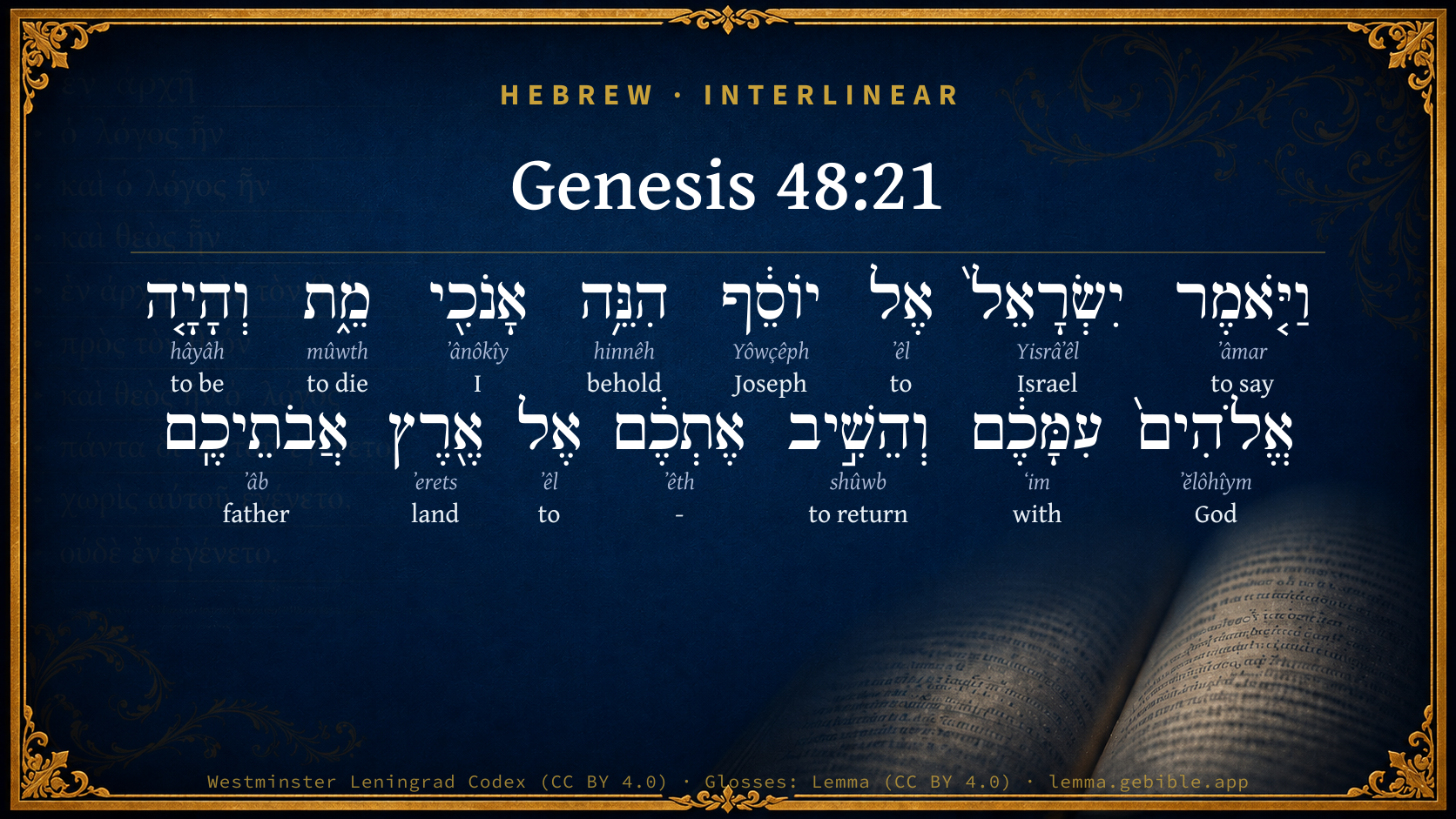
Hebrew (Westminster Leningrad Codex) Genesis 48:21 appears in the Hebrew Old Testament. The text above is from the Westminster Leningrad Codex. Each word links to its Strong’s number, a concise gloss, and parsing drawn from the Open Scriptures Hebrew Bible morphology. Click any word for its full Brown-Driver-Briggs (BDB) entry.
Download image
Cite this verse

Genesis 48:21 (World English Bible). Public Domain. Lemma interlinear Bible study tool, https://lemma.gebible.app/v/genesis/48/21.

Show BibTeX & RIS
BibTeX
RIS
English Translation
Israel said to Joseph, "Behold, I am dying, but God will be with you, and bring you again to the land of your fathers.
World English Bible · Public Domain
Download a study sheet

One document with this verse’s original text, its word-by-word gloss line, the meaning frame, cross-references with their text, attributed commentary, and full source and license credits — printable, and it pastes into notes with its structure intact.

This verse Autodidact and up

Study sheet (.html) Plain text (.txt)

A passage Seminary Student

Up to 50 verses in one chapter. A passage sheet keeps up to 6 commentary sources and 12 cross-references per verse, in the order this page ranks them, and says so on the sheet whenever that leaves anything out. Ask for a single verse and you get the Autodidact verse sheet above.

Everything on this page stays free to read, with no account — the sheet is a download of what is already on screen, not access to it.

Want to remove ads? Support Godless Engineer
Compare translations 3

The same verse in 3 English versions, stacked beneath the original-language interlinear above. Click any original word for its lexicon entry.

Each is an independent rendering of the whole verse — the interlinear is not word-aligned to these translations.

Highlighted words mark where these versions differ — a whole-verse word diff, not a word-by-word alignment.

  • World English Bible Public Domain
    Israel said to Joseph, "Behold, I am dying, but God will be with you, and bring you again to the land of your fathers.
  • King James Version Public Domain
    And Israel said unto Joseph, Behold, I die: but God shall be with you, and bring you again unto the land of your fathers.
  • unfoldingWord Literal Text CC BY-SA 4.0
    Then Israel said to Joseph, “Behold, I am dying, and God will be with you, and he will bring you back to the land of your fathers.

unfoldingWord Literal Text — © unfoldingWord, licensed CC BY-SA 4.0. Word-aligned USFM3 via Door43 (git.door43.org/unfoldingWord/en_ult).

Versions to compare (up to 4)

3 of 4 selected

Show all 18 translations

Every available English version of this verse, each an independent rendering of the whole verse.

  • World English Bible Public Domain
    Israel said to Joseph, "Behold, I am dying, but God will be with you, and bring you again to the land of your fathers.
  • Berean Standard Bible Public Domain
    Then Israel said to Joseph, “Look, I am about to die, but God will be with you and bring you back to the land of your fathers.
  • Majority Standard Bible Public Domain
    Then Israel said to Joseph, “Look, I am about to die, but God will be with you and bring you back to the land of your fathers.
  • King James Version Public Domain
    And Israel said unto Joseph, Behold, I die: but God shall be with you, and bring you again unto the land of your fathers.
  • American Standard Version (1901) Public Domain
    And Israel said unto Joseph, Behold, I die: but God will be with you, and bring you again unto the land of your fathers.
  • Revised Version (1885) Public Domain
    And Israel said unto Joseph, Behold, I die: but God shall be with you, and bring you again unto the land of your fathers.
  • Geneva Bible (1599) Public Domain
    Then Israel said vnto Ioseph, Behold, I die, and God shall be with you, and bring you againe vnto the land of your fathers.
  • Douay-Rheims (1899) Public Domain
    And he said to Joseph his son: Be- hold I die, and God will be with you, and will bring you back into the land of your fathers.
  • Young's Literal Translation Public Domain
    And Israel saith unto Joseph, `Lo, I am dying, and God hath been with you, and hath brought you back unto the land of your fathers;
  • Literal Standard Version CC BY-SA 4.0
    And Israel says to Joseph, “Behold, I am dying, and God has been with you, and has brought you back to the land of your fathers;
  • Unlocked Literal Bible CC BY-SA 4.0
    Israel said to Joseph, “See, I am about to die, but God will be with you, and will bring you back to the land of your fathers.
  • unfoldingWord Literal Text CC BY-SA 4.0
    Then Israel said to Joseph, “Behold, I am dying, and God will be with you, and he will bring you back to the land of your fathers.
  • Darby Bible Public Domain
    And Israel said to Joseph, Behold, I die; and God will be with you, and bring you again to the land of your fathers.
  • World Messianic Bible Public Domain
    Israel said to Joseph, “Behold, I am dying, but God will be with you, and bring you again to the land of your fathers.
  • Webster's Bible Public Domain
    And Israel said to Joseph, Behold, I die; but God shall be with you, and bring you again to the land of your fathers.
  • Free Bible Version CC BY-SA 4.0
    Then Israel said to Joseph, “I'm going to die soon, but God will be with you and bring you back to the land of your fathers.
  • Bible in Basic English Public Domain
    Then Israel said to Joseph, Now my death is near; but God will be with you, guiding you back to the land of your fathers.
  • JPS Tanakh (1917) Public Domain
    And Israel said unto Joseph: 'Behold, I die; but God will be with you, and bring you back unto the land of your fathers.

Literal Standard Version (2020), Covenant Press — licensed CC BY-SA 4.0. Text via the HelloAO Bible API (eBible.org). Unlocked Literal Bible (unfoldingWord) — licensed CC BY-SA 4.0. Text via the HelloAO Bible API (eBible.org). unfoldingWord Literal Text — © unfoldingWord, licensed CC BY-SA 4.0. Word-aligned USFM3 via Door43 (git.door43.org/unfoldingWord/en_ult). Free Bible Version, Dr. Jonathan Gallagher — licensed CC BY-SA 4.0. Text via the HelloAO Bible API (eBible.org).

Word by word

More ways to search: Search by grammar → Find every occurrence → Compare this word →

Practice this passage: Drill this verse → Learn its vocabulary →

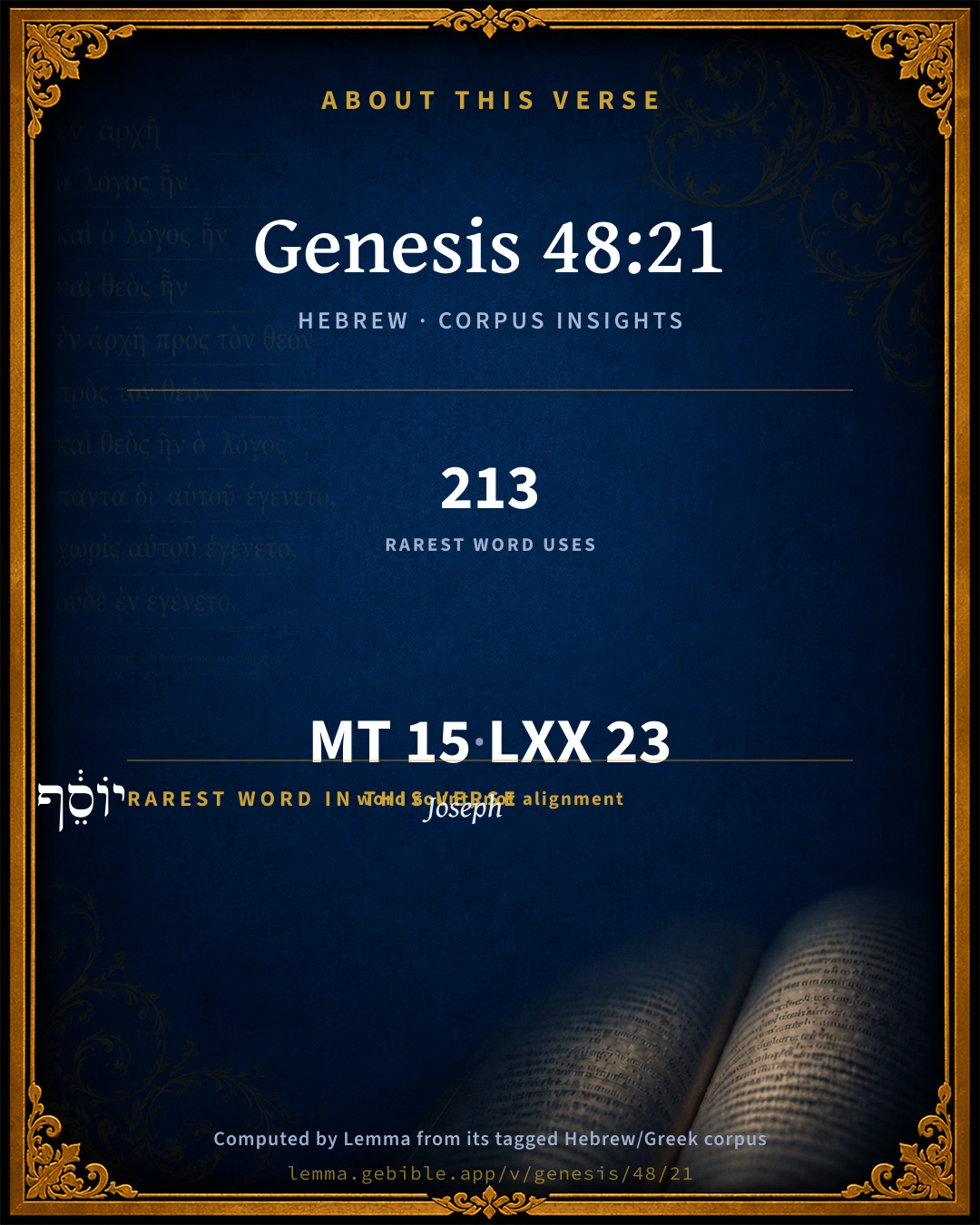
יוֹסֵ֔ף
Yôwçêph
H3130
“Joseph”
Noun, Proper
Part of Speech
Noun
Type
Proper
Full BDB Definition

Origin: future of H3254

TWOT: None

Joseph = "Jehovah has added" - the eldest son of Jacob by Rachel - father of Igal, who represented the tribe of Issachar among the spies - a son of Asaph - a man who took a foreign wife in the time of Ezra - a priest of the family of Shebaniah in the time of Nehemiah
  1. וַיֹּ֤אמֶר ʼâmar H559 “and · to say” Conjunction + Verb, Qal, Sequential Imperfect, 3rd Person, Masculine, Singular
  2. יִשְׂרָאֵל֙ Yisrâʼêl H3478 “Israel” Noun, Proper
  3. אֶל ʼêl H413 “to” Preposition
  4. הִנֵּ֥ה hinnêh H2009 “behold” Particle, Demonstrative
  5. אָנֹכִ֖י ʼânôkîy H595 “I” Pronoun, Personal, 1st Person, Common, Singular
  6. מֵ֑ת mûwth H4191 “dying” Verb, Qal, Participle Active, Masculine, Singular, Absolute
  7. וְהָיָ֤ה hâyâh H1961 “and · to be” Conjunction + Verb, Qal, Sequential Perfect, 3rd Person, Masculine, Singular
  8. אֱלֹהִים֙ ʼĕlôhîym H430 “God(s)” Noun, Common, Masculine, Plural, Absolute
  9. עִמָּכֶ֔ם ʻim H5973 “with · you” Preposition + Suffix, Personal, 2nd Person, Masculine, Plural
  10. וְהֵשִׁ֣יב shûwb H7725 “and · to return” Conjunction + Verb, Hiphil, Sequential Perfect, 3rd Person, Masculine, Singular
  11. אֶתְכֶ֔ם ʼêth H853 “- · you” Particle, Direct Object + Suffix, Personal, 2nd Person, Masculine, Plural
  12. אֶל ʼêl H413 “to” Preposition
  13. אֶ֖רֶץ ʼerets H776 “land of” Noun, Common, Both, Singular, Construct
  14. אֲבֹתֵיכֶֽם ʼâb H1 “fathers · your” Noun, Common, Masculine, Plural, Construct + Suffix, Personal, 2nd Person, Masculine, Plural

About this verse

These counts appear in no published source. They are computed here, from the morphology-tagged text and Lemma’s own curated glosses. What Lemma adds →

15
words
14
distinct lemmas
Pentateuch
section

Grammatical profile

  • 4 verbs
  • 5 nouns
  • 1 pronoun
  • 3 prepositions
  • 2 particles

Verb forms

  • וַיֹּ֤אמֶר Qal · Sequential Imperfect
  • מֵ֑ת Qal · Participle Active
  • וְהָיָ֤ה Qal · Sequential Perfect
  • וְהֵשִׁ֣יב Hiphil · Sequential Perfect

Repetition

A word recurs within this verse — often emphatic in Hebrew:

  • אֶל to H413 ×2

Hebrew & Septuagint length

In English translation the verse runs 24 words from the Hebrew and 23 from the Septuagint (LXX English) — closely comparable.

A rough comparison of the two English renderings, which tokenize alike — not a word-level alignment.

Word counts can differ between the Hebrew and the Greek without any difference in meaning — e.g. the Hebrew direct-object marker אֵת has no separate Greek word, and Greek often adds the article ὁ.

In the original languages it is 15 Hebrew tokens and 23 Greek tokens — but the two are counted differently (Hebrew bundles its prefixes and suffixes into one token; the Greek is in lemma form), so that isn’t a like-for-like length.

Cross-references

25

Topical passages linked to Genesis 48:21 in the Treasury of Scripture Knowledge — connected by theme and wording, ordered by reader-vote popularity; previews shown in the World English Bible.

  • Genesis 46:4 I will go down with you into Egypt. I will also surely bring you up again. Joseph will close your eyes."
  • Genesis 50:24 Joseph said to his brothers, "I am dying, but God will surely visit you, and bring you up out of this land to the land which he swore to Abraham, to Isaac, and to Jacob."
  • Genesis 26:3 Sojourn in this land, and I will be with you, and will bless you. For to you, and to your seed, I will give all these lands, and I will establish the oath which I swore to Abraham your father.
  • Genesis 28:15 Behold, I am with you, and will keep you, wherever you go, and will bring you again into this land. For I will not leave you, until I have done that which I have spoken of to you."
  • Hebrews 7:3 without father, without mother, without genealogy, having neither beginning of days nor end of life, but made like the Son of God), remains a priest continually.
  • Hebrews 7:23–25 Many, indeed, have been made priests, because they are hindered from continuing by death.
  • Genesis 12:5 Abram took Sarai his wife, Lot his brother's son, all their substance that they had gathered, and the souls who they had gotten in Haran; and they went forth to go into the land of Canaan. Into the land of Canaan they came.
  • Genesis 15:14 I will also judge that nation, whom they will serve. Afterward they will come out with great substance.
  • Genesis 37:1 Jacob lived in the land of his father's travels, in the land of Canaan.
  • Deuteronomy 1:1–46 These are the words which Moses spoke to all Israel beyond the Jordan in the wilderness, in the Arabah over against Suph, between Paran, and Tophel, and Laban, and Hazeroth, and Dizahab.
  • Deuteronomy 31:8 Yahweh, he it is who does go before you; he will be with you, he will not fail you, neither forsake you: don't be afraid, neither be dismayed.
  • Joshua 1:5 There shall not any man be able to stand before you all the days of your life. As I was with Moses, so I will be with you; I will not fail you, nor forsake you.
  • Joshua 1:9 Haven't I commanded you? Be strong and of good courage; don't be afraid, neither be dismayed: for Yahweh your God is with you wherever you go.
  • Joshua 3:7 Yahweh said to Joshua, This day will I begin to magnify you in the sight of all Israel, that they may know that, as I was with Moses, so I will be with you.
  • Joshua 23:14 Behold, this day I am going the way of all the earth: and you know in all your hearts and in all your souls, that not one thing has failed of all the good things which Yahweh your God spoke concerning you; all are happen to you, not one thing has failed of it.
  • Joshua 24:1–33 Joshua gathered all the tribes of Israel to Shechem, and called for the elders of Israel, and for their heads, and for their judges, and for their officers; and they presented themselves before God.
  • 1 Kings 2:2–4 I am going the way of all the earth: be you strong therefore, and show yourself a man;
  • Psalms 18:46 Yahweh lives; and blessed be my rock. Exalted be the God of my salvation,
  • Psalms 146:3–4 Don't put your trust in princes, Each a son of man in whom there is no help.
  • Zechariah 1:5–6 Your fathers, where are they? And the prophets, do they live forever?
  • Luke 2:29 "Now you are releasing your servant, Master, According to your word, in peace;
  • Acts 13:36 For David, after he had in his own generation served the counsel of God, fell asleep, and was laid with his fathers, and saw decay.
  • 2 Timothy 4:6 For I am already being offered, and the time of my departure has come.
  • Hebrews 7:8 Here people who die receive tithes, but there one receives tithes of whom it is testified that he lives.
  • 2 Peter 1:14 knowing that the putting off of my tent comes swiftly, even as our Lord Jesus Christ made clear to me.

Cross-references courtesy of OpenBible.info (CC BY 4.0).

Hebrew and Greek witnesses Masoretic Hebrew ↔ Greek Septuagint

The same verse in the two great witnesses to the Old Testament, shown verse-for-verse.

These are two independent witnesses, not word-aligned to each other, and the Septuagint is shown in lemma (dictionary) form.

Hebrew Genesis 48:21 Masoretic · Westminster Leningrad Codex

וַיֹּ֤אמֶר יִשְׂרָאֵל֙ אֶל יוֹסֵ֔ף הִנֵּ֥ה אָנֹכִ֖י מֵ֑ת וְהָיָ֤ה אֱלֹהִים֙ עִמָּכֶ֔ם וְהֵשִׁ֣יב אֶתְכֶ֔ם אֶל אֶ֖רֶץ אֲבֹתֵיכֶֽם

Israel said to Joseph, "Behold, I am dying, but God will be with you, and bring you again to the land of your fathers.

World English Bible · Public Domain

Greek LXX Genesis 48:21 Septuagint · lemma form

εἶπον δέ ἰσραήλ ὁ ιωσηφ ἰδού ἐγώ ἀποθνήσκω καί εἰμί ὁ θεός μετά σύ καί ἀποστρέφω σύ εἰς ὁ γῆ ὁ πατήρ σύ

And Israel said to Joseph, Behold, I die; and God shall be with you, and restore you to the land of your fathers.

LXX2012 (modern English Septuagint) · Public Domain

Hebrew: Westminster Leningrad Codex (CC BY 4.0). Greek: Septuagint (public domain); English from LXX2012 (modern English Septuagint) (Public Domain). How the Septuagint differs from the Hebrew →

Targum (Aramaic paraphrase)

2

The Targum is the ancient Jewish Aramaic paraphrase of the Hebrew Scriptures — an interpretive translation, not the Hebrew text itself. Onkelos (literal) and Pseudo-Jonathan (expansive) render the Torah, and Jonathan the Prophets. Coverage is partial: where no permissively-licensed English translation exists for a verse, only the Aramaic is shown. This is verse-level text, not a word-by-word alignment to the Hebrew.

  1. Targum Onkelos Torah (Genesis–Deuteronomy)
    וַאֲמַר יִשְׂרָאֵל לְיוֹסֵף הָא אֲנָא מָאִית וִיהֵי מֵימְרָא דַיְיָ בְּסַעְדְכוֹן וְיָתֵיב יָתְכוֹן לְאַרְעָא דַאֲבָהַתְכוֹן

    (no public-domain English translation for this verse)

    Targum Onkelos — Aramaic: “Onkelos Genesis” (public domain); “Onkelos Exodus” (public domain); “Onkelos Leviticus” (public domain); “Onkelos Numbers” (public domain); “Onkelos Deuteronomy” (public domain). English: “Sefaria Community Translation” (CC0 1.0 (public-domain dedication)); “J.W. Etheridge. The Targums of Onkelos and Jonathan Ben Uzziel on the Pentateuch. London: Longmans, Green, 1862” (public domain). Text via Sefaria.

  2. Targum Pseudo-Jonathan Torah (Genesis–Deuteronomy)
    וַאֲמַר יִשְרָאֵל לְיוֹסֵף הָא אֲנָא מָטָא סוֹפִי לִמְמָת וִיהֵי מֵימְרָא דַיְיָ בְּסַעֲדְכוֹן וִיתֵיב יַתְכוֹן לְאַרְעָא דַאֲבָהַתְכוֹן

    And Israel said to Joseph, Behold, my end cometh to die. But the Word of the Lord shall be your Helper, and restore you to the land of your fathers;

    Targum Pseudo-Jonathan — Aramaic: “Targum Jonathan on Genesis” (public domain); “Targum Jonathan on Exodus” (public domain); “Targum Jonathan on Leviticus” (public domain); “Targum Jonathan on Numbers” (public domain); “Targum Jonathan on Deuteronomy” (public domain). English: “The Targum of Jonathan ben Uzziel, trans. J. W. Etheridge, London, 1862” (public domain). Text via Sefaria.

Commentary

Notes on Genesis 48:21 from classic Christian and Jewish commentators (each source and its license shown beneath its notes). The classic Christian expositions comment on the surrounding passage and are grouped to its opening verse, so a note may address several verses; the Jewish commentaries on the Tanakh (Rashi and others) are per-verse, so they appear only where the commentator wrote on this verse.

Lemma curates 59 commentaries, every one of them public domain or Creative Commons licensed, each selected and text-cleaned for this edition rather than reprinted as found. About our sources →

Trapp's Complete Commentary

John Trapp

Gen 48:21 And Israel said unto Joseph, Behold, I die: but God shall be with you, and bring you again unto the land of your fathers.

Ver. 21. Behold, I die.] This was a speech of faith, uttered without the least fear, consternation, or dismayment. As it was no more betwixt God and Moses, but "Go up and die"; so betwixt God and Jacob, but "Behold, I die." Death, he knew, to him should neither be total, but of the body only; nor perpetual of the body, but for a season only. See both these set forth by the apostle, Rom 8:10-11. The Chaldee Paraphrast on this text hath: Behold, I die; and the word of the Lord, i.e., Christ, shall be your help.

John Trapp, A Commentary or Exposition upon All the Books of the Old and New Testament (1647–1656) — public domain. Text from a community e-Sword module.

The Biblical Illustrator

Joseph S. Exell

Gen_48:21-22

Behold, I die

Jacob in the prospect of death

We have here a threefold picture.

I. OF STRENGTH IN WEAKNESS.

1. The strength of faith.

2. The strength of godliness.

3. The strength of peace.

II. OF SUCCESS IN FAILURE.

III. OF LIFE IN DEATH. (T. H. Leale.)

Closing days

I. A PERIOD OF UNRUFFLED PEACE AND PROSPERITY.

II. A SEASON OF GRATEFUL RETROSPECT.

III. A SUBLIME DEATH-SCENE. (T. S. Dickson, M. A.)

Death contemplated

I. AN ABSORBING CRISIS.

1. Its nature.

2. Its cause. Result of sin.

3. Its consequences. Everlasting.

II. AN AWAKENING CONSIDERATION. Behold. That word suggests to us suitable preparation. In prospect, then, of that amazing hour we ought--

1. To review our past lives.

2. To realise our dying hour.

3. To think of our future prospects. (C. Clayton, M. A.)

The dying believer

I. LET US CONSIDER THE SPIRIT OF THE WORDS OF THE DYING PATRIARCH IN REFERENCE TO HIMSELF. I die, as if he had said, I die in peace; I die without reluctance; I have lived long enough; I am satisfied with life; I am willing to depart. What may have been the considerations which induced this state of feeling?

1. He was satisfied with the amount of enjoyment which the God of his life had granted him.

2. The patriarch was satisfied with that duration of life which had been allotted him.

3. The dying patriarch was satisfied with the prospect of a better life which was opening before him. Having thus considered the words of the text, in reference to the views entertained by the patriarch as to himself, let us regard them.

II. As SUGGESTIVE OF THE REASONS OF HIS REPOSE IN REFERENCE TO HIS SURVIVING RELATIVES.

1. The manifestations of the Divine mercy to himself, encouraged his hopes as to his surviving relatives.

2. He was persuaded that the paternal benediction he was authorized to pronounce, had an aspect peculiarly favourable to his descendants.

3. The patriarch felt assured that the covenant made with Abraham, and Isaac, and himself, secured the presence and blessing of God to his survivors, even to the remotest age. (H. F. Burder, M. A.)

Premonitions of death

The first symptom of approaching death with some, is the strong presentiment that they are about to die. Oganan, the mathematician, while in apparent health, rejected pupils from the feeling that he was on the eve of resting from his labours; and he expired soon after, of an apoplectic stroke. Fletcher, the divine, had a dream which shadowed out his impending dissolution, and believing it to be the merciful warning of Heaven, he sent for a sculptor and ordered his tomb. Begin your work forthwith, he said at parting; there is no time to lose. And unless the artist had obeyed the admonition, death would have proved the quicker workman of the two. Mozart wrote his Requiem under the conviction that the monument he was raising to his genius, would, by the power of association, prove a universal monument to his remains. When life was fleeting very fast, he called for the score, and musing over it, said, Did I not tell you truly that it was for myself that I composed this death chant. Another great artist in a different department, convinced that his hand was about to lose its cunning, chose a subject emblematical of the coming event. His friends inquired the nature of his next design; and Hogarth replied, The end of all things. In that case, rejoined one, there will be an end of the painter. What was uttered in jest was answered in earnest, with a solemn look and heavy sigh: There will, he said; and the sooner my work is done the better. He commenced next day, laboured upon it with unremitting diligence, and when he had given it the last touch, seized his pallet, broke it in pieces and said: I have finished. The print was published in March under the title of Finis; and in October, the curious eyes which saw the manners in the face were closed in the dust. Our ancestors, who, prone to look in the air for causes which were to be found upon the earth, attributed these intimations to various supernatural agencies. John Hunter solved the mystery, if so it can be called, in a single sentence. We sometimes, he says, feel within ourselves that we shall not live; for the living powers become weak, and the nerves communicate the intelligence to the brain. His own case has often been quoted among the marvels of which he offered this rational explanation. He intimated, on leaving home, that if a discussion which awaited him at the hospital took an angry turn, it would prove his death. A colleague gave him the lie; the coarse word verified the prophecy, and he expired almost immediately, in an adjoining room. There was everything to lament in the circumstance, but nothing at which to wonder, except that any person could show such disrespect to the great genius, a single year of whose existence was worth the united lives of his opponents. Hunter, in uttering the prediction, had only to take counsel in his own experience, without the intervention of invisible spirits. He had long laboured under a disease of the heart, and he felt the disorder had reached the point at which any sharp agitation would bring on the crisis. Circumstances, which at another time would excite no attention, are accepted as an omen when health is failing. The order for the Requiem with Mozart, the dream with Fletcher, turned the current of their thoughts to the grave. Foote, prior to his departure for the continent, stood contemplating the picture of a brother author, and exclaimed, his eyes full of tears, Poor Weston! In the same dejected tone he added, after a pause, soon others shall say, Poor Foote! And to the surprise of his friends, a few days proved the justice of his prognostication. The expectation of the event had a share in producing it, for a slight shock completes the destruction of prostrate energies. The case of Wolsey was singular. The morning before he died, he asked Cavendish the hour, and was answered past eight. Eight of the clock! replied Wolsey, that cannot be; eight of the clock, nay, nay, it cannot be eight of the clock, for by eight of the clock shall you lose your master.

The day he miscalculated, the hour came true; on the following morning, as the clock struck eight, his troubled spirit passed from life. Cavendish and the bystanders, thought he must have had a revelation of the time of his death; and from the way in which the fact had taken possession of his mind, we suspect that he relied on astrological prediction, which had the credit of a revelation in his own esteem. Persons in health have died from the expectation of dying. It was common for those who perished by violence to summon their destroyers to appear, within a stated time, before the tribunal of their God; and we have many perfectly attested instances in which, through fear and remorse, the perpetrators withered under the curse, and died. Pestilence does not kill with the rapidity of terror. The profligate abbess of a convent, the Princess Gonzaga of Cleves, and Guise, the profligate Archbishop of Rheims, took it into their heads, for a jest, to visit one of the nuns by night, and exhort her as a person who was visibly dying. While in the performance of this heartless scheme, they whispered to each other, She is departing. She departed in earnest. Her vigour, instead of detecting the trick, sank beneath the alarm; and the profane pair discovered, in the midst of their sport, that they were making merry with a corpse. (T. Walker.)

Jacobs death bed

This is the nearest approach in the Bible to that which is commonly termed a death-bed scene. There is no sadder phrase than that--a death bed scene; for a man, when he comes to die, has something different to do than mere acting; it is not then his business to show other people how a Christian can die, but prepare himself to meet his God. It is sad also because the dying hour is often unsatisfactory, often far from triumph; in the Book of Ecclesiastes we read, How dieth the wise man, as the fool. For there is stupor, sadness, powerlessness; and spiritual darkness also frequently clouds the last moments of the pious man. This dying hour must however have made an impression on these young men. In death itself there is nothing naturally instructive; but in this death there was simplicity, they saw the sight of an old man gathered ripe unto his fathers, and they would remember in their gaiety and strength what all life at last must come to. Consider too the effect that must have been produced on Joseph. There had been nothing, that we are aware of, with which he had to reproach himself in his conduct to his father; there was therefore no remorse mixed with his sorrow, he was spared the sharpest pang of all. How different must the feeling of the other brethren have been; they would remember that there lay one dying whom they had wronged, one whom they had deceived. (F. W. Robertson, M. A.)

The last days of Jacob

The history is a simple one, yet with wondrous perspective. Seventeen years did Israel dwell in the land of Egypt, in the country of Goshen, and when he was a hundred and forty and seven years old, the time drew nigh that Israel must die. Who can fight the army of the Years? Those silent soldiers never lose a war. They fire no base cannon, they use no vulgar steel, they strike with invisible but irresistible hands. Noisy force loses something by its very noise. The silent years bury the tumultuous throng. We have all to be taken down. The strongest tower amongst us, heaven-reaching in its altitude, must be taken down--a stone at a time, or shaken with one rude shock to the level ground: man must die. Israel had then but one favour to ask. So it comes to us all. We who have spent a life-time in petitioning for assistance have at the last but one request to make. Take me, said one of Englands brightest wits in his dying moments, to the window that I may feel the morning air. Light, more light, said another man greater still, expressing some wondrous necessity best left as a mystery. Bury me not, I pray thee, in Egypt, said dying Jacob to his son Joseph, but bury me in the buryingplace of my fathers. What other heaven had the Old Testament man? The graveyard was a kind of comfort to him. He must be buried in a given place marked off and sacredly guarded. He had not lived up into that universal humanity which says--All places are consecrated, and every point is equally near heaven with every other point, if so be God dig the grave and watch it. By-and-by we shall hear another speech in the tone of Divine revelation; by-and-by we shall get rid of these localities, and limitations, and prisons, for the Lion of the tribe of Judah will open up some wider space of thought, and contemplation, and service. With Josephs oath dying Jacob was satisfied. (J. Parker, D. D.)

Jacobs end

The close of Jacobs career stands in most pleasing contrast with all the previous scenes of his eventful history. It reminds one of a serene evening, after a tempestuous day: the sun, which during the day had been hidden from view by clouds, mists, and fogs, sets in majesty and brightness, gilding with his beams the western sky and holding out the cheering prospect of a bright to-morrow. Thus is it with our aged patriarch. The supplanting, the bargain-making, the cunning, the management, the shifting, the shuffling, the unbelieving selfish fears--all those dark clouds of nature and of earth seem to have passed away, and he comes forth, in all the calm elevation of faith, to bestow blessings, and impart dignities, in that holy skilfulness, which communion with God can alone impart. Though natures eyes are dim, faiths vision is sharp. He is not to be deceived as to the relative positions assigned to Ephraim and Manasseh, in the counsels of God. He has not, like his father Isaac, in chapter 27., to tremble very exceedingly, in view of an almost fatal mistake. Quite the reverse. His intelligent reply to his less instructed son is, I know it, my son, I know it. The power of sense has not, as in Isaacs case, dimmed his spiritual vision. He has been taught, in the school of experience, the importance of keeping close to the Divine purpose, and natures influence cannot move him from thence. In Gen_48:11, we have a very beautiful example of the mode in which our God ever rises above all our thoughts, and proves Himself better than all our fears. And Israel said unto Joseph, I had not thought to see thy face; and, lo, God hath showed me also thy seed. To natures view, Joseph was dead; whereas in Gods view he was alive, and seated in the highest place of authority, next the throne. Eye hath not seen, nor ear heard, neither hath it entered into the heart of man, the things which God hath prepared for them that love 1Co_2:9). Would that our souls could rise higher in their apprehension of God and His ways. (C. H. M.)

Jacob and Israel

It is interesting to notice the way in which the titles Jacob and Israel are introduced in the close of the Book of Genesis; as, for example, One told Jacob, and said, Behold thy son Joseph cometh unto thee: and Israel strengthened himself, and sat upon the bed. Then, it is immediately added, And Jacob said unto Joseph, God Almighty appeared unto me at Luz. Now, we know, there is nothing in Scripture without its specific meaning, and hence this interchange of names contains some instruction. In general, it may be remarked, that Jacob sets forth the depth to which God has descended; Israel, the height to which Jacob was raised. (C. H. M.)

Men die but God remains

When John Owen was dying, he said, I am leaving the ship of the Church in a storm; but whilst the Great Pilot is in it, the loss of a poor under-rower will be inconsiderable. And when a young man whose heart was in the foreign mission work, had to die, he said, God can evangelize the world without me. So when we may lose earthly friends, comforters, guides, and helpers, we may and ought ever to fall back on our all-sufficient and ever-present God and Heavenly Father. All the lamps in a house or in a town may be extinguished when the sun rises; all the pumps may also be demolished or taken away, whilst there is a reservoir ever full, from which every one may have an abundant supply of the best water. So we need not be dismayed when we lose any or all earthly friends and advantages, so long as we have God left. They who have God for their Father, and Friend, and Portion, have all things in Him. He is the best Teacher, Guide, Protector, and Provider. But sometimes God has to deprive us of our earthly friends and possessions in order to lead us to trust Him as we ought.

The folly of anxiety about death

What if the leaves were to fall a-weeping, and say, It will be so painful for us to be pulled from our stalks when autumn comes? Foolish fear! summer goes, and autumn succeeds. The glory of death is upon the leaves; and the gentle breeze that blows takes them softly and silently from the bough, and they float slowly down like fiery sparks upon the moss. It is hard to die when the time is not ripe. When it is, it will be easy, we need not die while we are living. (H. W.Beecher.)

Death, a ferry-boat

Death to Gods people is but a ferry-boat. Every day and every hour the boat pushes off with some of the saints, and returns for more.

Waiting for death

The Christian, at his death, should not be like the child, who is forced by the rod to quit his play, but like one who is wearied of it and willing to go to bed. Neither ought he to be like the mariner, whose vessel is drifted by the violence of the tempest from the shore, tossed to and fro upon the ocean, and at last suffers wreck and destruction; but like one who is ready for the voyage, and, the moment the wind is favourable, cheerfully weighs anchor, and, full of hope and joy, launches forth into the deep. (Gotthold.)

Peace in death

The ship has set sail, and kept on her course many days and nights, with no other incidents than those that are common to all. Suddenly land appears; but what the character the coast may be, the voyagers cannot discern through the tumult. The first effect of a near approach to land is a very great commotion in the waters. It is one of the coral islands of the South Pacific, encircled by a ring of fearful breakers at some little distance from the shore. Forward the ship must go; the waves are higher and angrier than any they have seen in the open sea. Presently through them, partly over them, they are borne at a bound; strained, giddy, and almost senseless, they find themselves within that sentinel ridge of crested waves that guard the shore; and the portion of sea that still lies before them is calm and clear like glass. It seems a lake of paradise, and not an earthly thing at all. It is inexpressibly sweet to lie on its bosom after the long voyage and the barren ridge. All the heavens are mirrored in the waters; and along its edge lies a flowery land. Across the belt of sea the ship glides gently, and gently touches soon that lovely shore. So many a Christian has been thrown into a great tumult when the shore of eternity suddenly appeared before him. A great fear tossed and sickened him for some days; but, when that barrier was passed, he experienced a peace deeper, stiller, sweeter, than any he ever knew before. A little space of lifes voyage remained after the fear of death had sunk into a calm, and before the immortal felt the solace of eternal rest. (W. Arnot.)

.

The Biblical Illustrator, edited by Joseph S. Exell (c. 1880s–1900s) — public domain. Text from a community e-Sword module.

Joseph Benson's Commentary

Gen 48:21. I die, but God shall be with you, and bring you again — This assurance was given them, and carefully preserved among them, that they might neither love Egypt too much when it favoured them, nor fear it too much when it frowned upon them. These words of Jacob furnish us with comfort in reference to the death of our friends: but God shall be with us, and his gracious presence is sufficient to make up the loss. They leave us, but he will never fail us. He will bring us to the land of our fathers, the heavenly Canaan, whither our godly fathers are gone before us. If God be with us while we stay behind in this world, and will receive us shortly to be with them that are gone before to a better world, we ought not to “sorrow as those that have no hope.”

Joseph Benson's Commentary on the Old and New Testaments (1811–1818) — public domain. Text from a community e-Sword module.

The Preacher's Complete Homiletical Commentary

Joseph S. Exell (gen. ed.)

CRITICAL NOTES.—

Gen_48:22. One portion above thy brethren.] He was to have two lots in the land of promise. Which I took out of the hand of the Amorite with my sword and with my bow. “The designation of the land as taken out of the hand of the Amorite by Jacob’s sword and bow is spoken of in the anticipatory spirit of a prophet, assuming as done that which his descendants should do. See the expression repeated in form of expression almost verbatim (Jos_24:12).” (Alford.) The Amorite was a poetical name for the Canaanites generally.

MAIN HOMILETICS OF THE PARAGRAPH.—Gen_48:21-22

JACOB IN THE PROSPECT OF DEATH

The good patriarch had suffered many sore calamities, had been tossed with many a tempest on the waves of this troublesome world. Now the peaceful haven is in sight and he is glad to be at rest. He speaks most simply and calmly of his death. “And Israel said unto Joseph, Behold I die.” We have here a threefold picture:—

I. Of strength in weakness. His bodily powers were failing, his eyes were dim; but yet he showed—

1. The strength of faith. He believed that God would be with his descendants, and bring them up from Egypt; that the Lord would perform that word unto him upon which he had caused him to hope. He describes the portion which he gave to Joseph as that “which I took out of the hand of the Amorite with my sword and with my bow.” As to their form, these words refer to the past; but the terms are prophetical, and speak of future conquest. The land would be wrested by him from the Amorites in the person of his posterity (Gen_15:13-16). With prophetic boldness he uses the past for the future. Here was faith in the word of God which came to him.

2. The strength of Godliness. He wishes to wean his posterity from Egypt. He desires to make all his descendants the servants of that God whom he had served all his life long.

3. The strength of peace. He is calm and peaceful, and to be calm in the prospect of death is to be conscious of the upholding of an infinite strength. All through life, and supremely so in death, the peace of God is the strength of His people (Psa_29:11). And when all fails on earth, they only enter into a deeper and a perpetual peace (Psa_73:26).

II. Of success in failure. He was failing on earth, and the time would soon come when he could be no longer with them. “I die,” he says, “but God shall be with you.” God still lives on; and this was the confidence and stay of his soul. All was failing him now but his God. Helpless on earth, he falls into the “everlasting arms.” (Deu_33:27.) He still has Omnipotent support, and that was true success.

III. Of life in death. He was dying, but the light of immortality shines through the decays of his mortal frame. His faith and love, strong even to the end, surely lasted beyond death. The soul which has once looked up into the face of God cannot die. The spiritual man shows himself amidst the ruins of death. It is remarkable that Jacob says nothing about the long intervening years of bondage which his children would have to endure. He only speaks concerning the end and grand result of all. He sees nothing now but the true life, real blessedness for himself and for them. The light of God’s favour, shining beyond and overwhelming all earthly sorrows, entirely filled his soul.

SUGGESTIVE COMMENTS ON THE VERSES

Gen_48:21-22. As it was no more betwixt God and Moses, but “Go up and die;” so betwixt God and Jacob, but “Behold I die.” Death, he knew, to him should be neither total, but of the body only; nor perpetual of the body, but for a season only. See both these set forth by the Apostle, Rom_8:10-11.—(Trapp.)

The consolation given to survivors. Jacob says, “Behold I die, but God shall be with you,” etc. Thus our Redeemer said to His disciples, “It is expedient for you that I go away,” etc. This then explains to us the principle of bereavement; slowly and by degrees all drops off from us—first our parents, then our companions, till at last we find ourselves alone, with no arm of flesh to support us; and then comes the sense of dependence on the arm Divine: therefore it is emphatically written that He is the God of the fatherless and the widow.—(Robertson.)

As to the manner of their deliverance, neither Jacob nor his sons knew any more on this head than Abraham was enabled to inform them, viz., that God would judge the land where they were oppressed, and would bring them out with great substance. Their business was to believe and embrace the promise, and to leave the manner of its accomplishment to God.—(Bush.)

The Preacher's Complete Homiletical Commentary (gen. ed. Joseph S. Exell; Funk & Wagnalls, c. 1892) — public domain (pre-1929). A full-Bible homiletical/sermon-outline anthology covering 65 of 66 books (2 John is absent from the source module). Text from a community e-Sword module.

Geneva Bible (1599)

Geneva Bible translators

Which they had by faith in the promise.

Geneva Bible (1599) marginal notes — public domain. Text via Bolls.life.

Jamieson, Fausset & Brown

Robert Jamieson, A. R. Fausset & David Brown

Israel said unto Joseph, Behold, I die--The patriarch could speak of death with composure, but he wished to prepare Joseph and the rest of the family for the shock.

but God shall be with you--Jacob, in all probability, was not authorized to speak of their bondage--he dwelt only on the certainty of their restoration to Canaan.

Jamieson, Fausset & Brown — Commentary Critical and Explanatory on the Whole Bible (1871) — public domain (CC PDM 1.0). Text via the HelloAO Bible API.

Adam Clarke's Commentary

Verse 21. Behold, I die] With what composure is this most awful word expressed! Surely of Jacob it might be now said, "He turns his sight undaunted on the tomb;" for though it is not said that he was full of days, as were Abraham and Isaac, yet he is perfectly willing to bid adieu to earthly things, and lay his body in the grave. Could any person act as the patriarchs did in their last moments, who had no hopes of eternal life, no belief in the immortality of the soul? Impossible! With such a conviction of the being of God, with such proofs of his tenderness and regard, with such experience of his providential and miraculous interference in their behalf, could they suppose that they were only creatures of a day, and that God had wasted so much care, attention, providence, grace, and goodness, on creatures who were to be ultimately like the beasts that perish? The supposition that they could have no correct notion of the immortality of the soul is as dishonourable to God as to themselves. But what shall we think of Christians who have formed this hypothesis into a system to prove what? Why, that the patriarchs lived and died in the dark! That either the soul has no immortality, or that God has not thought proper to reveal it. Away with such an opinion! It cannot be said to merit serious refutation.

Adam Clarke's Commentary on the Bible (1810–1826) — public domain. Text from a community e-Sword/MySword module.

John Calvin's Commentaries

21. And Israel said unto Joseph. Jacob repeats what he had said. And truly all his sons, and especially Joseph and his sons, required something more than one simple confirmation, in order that they might not fix their abode in Egypt, but might dwell, in their minds, in the land of Canaan. He mentions his own death, for the purpose of teaching them that the eternal truth of God by no means depended on the life of men: as if he had said, my life, seeing it is short and fading, passes away; but the promise of God, which has no limit, will flourish when I also am dead. No vision had appeared unto his sons, but God had ordained the holy old man as the intermediate sponsor of his covenant. He therefore sedulously fulfills the office enjoined upon him, taking timely precaution that their faith should not be shaken by his death. So when the Lord delivers his word to the world by mortal men, although they die, having finished their course of life according to the flesh; yet the voice of God is not extinguished with them, but quickens us even at the present day. Therefore Peter writes, that he will endeavor, that after his decease, the Church may be mindful of the doctrine committed unto him. (2 Peter 1:15.)

Unto the land of your fathers. It is not without reason that he claims for himself and his fathers, the dominion over that land in which they had always wandered as strangers; for whereas it might seem that the promise of God had failed, he excites his sons to a good hope, and pronounces, with a courageous spirit, that land to be his own, in which, at length, he scarcely obtained a sepulcher, and that only by favor. Whence then was this great confidence, except that he would accustom his sons, by his example, to have faith in the word of God? Now this doctrine is also common to us; because we never rely with sufficient firmness on the word of God, so long as we are led by our own feelings. Nay, until our faith rises to lay hold on those things which are removed afar off, we know not what it is to set our seal to the word of God.

John Calvin's Commentaries (1540-1563) — public domain. Text from the Calvin Translation Society English edition (1840s-50s) via the Christian Classics Ethereal Library (ccel.org). Calvin's coverage is partial (roughly two-thirds of the Bible); uncommented books and verses are honest gaps, never fabricated. The 19th-century editor's footnotes and remarks are omitted so the notes are faithfully Calvin's own voice.

The Cambridge Bible for Schools and Colleges

gen. ed. J. J. S. Perowne

21. bring you again] Jacob predicts the restoration of his descendants to Canaan. This was the Divine promise. Cf. Gen_15:16, Gen_46:4, Gen_50:24.

The Cambridge Bible for Schools and Colleges (gen. ed. J. J. S. Perowne; Cambridge University Press, 1878–1918) — public domain. Text from a community e-Sword module.

John Gill's Exposition

And Israel said unto Joseph, behold, I die,.... Expected to die very shortly; and he not only speaks of it as a certain thing, and what would quickly be, but with pleasure and comfort, having no fear and dread of it on him, but as what was agreeable to him, and he had made himself familiar with:

but God shall be with you; with Joseph and his posterity, and with all his brethren, and theirs, to comfort and support them, to guide and counsel them, to protect and defend them, to carry them through all they had to endure in Egypt, and at length bring them out of it; he signifies he was departing from them, but God would not depart from them, whose presence would be infinitely more to them than his; and which, as it made him the more easy to leave them, so it might make them more easy to part with him:

and bring you again unto the land of your fathers; the land of Canaan, where their fathers, Abraham, Isaac, and Jacob, had dwelt, and which was given to them and theirs for an inheritance, and where Joseph and his brethren had lived, and would be brought thither again, as the bones of Joseph were, and as all of them in their posterity were in Joshua's time.

John Gill's Exposition of the Whole Bible (1746–1763) — public domain (CC PDM 1.0). Text via the HelloAO Bible API.

Matthew Poole's English Annotations

Behold, I die, i.e. I am about to die; the present time for that which will shortly and certainly be, as Gen 19:13; 20:3; Joh 14:2.

The land of your fathers, i.e. Canaan; their land,

1. By habitation, as Nazareth is called Christ’s country because he dwelt in it.

2. By the donation of God, who had promised, and would in his time give the actual possession of it to them, i.e. to their seed.

Matthew Poole's English Annotations on the Holy Bible (1683–1685) — public domain. Text from a community e-Sword/MySword module.

Whedon's Commentary on the Bible

Daniel D. Whedon

21. Behold, I die; but God shall be with you — “Sublime and inspiring faith! Your father dies, but his God, and his father’s God, remains.” — Newhall.

Daniel D. Whedon (gen. ed.), Commentary on the Old and New Testaments (1874–1909) — public domain. Text from a community e-Sword module.

The Pulpit Commentary

And Israel (Jacob) said unto Joseph, Behold, I die: but God (Elohim) shall be with you, and bring you again unto the land of your fathers. "For Joseph and his children a great promise and dispensation" (Lange).

The Pulpit Commentary (1880–1919), ed. H.D.M. Spence-Jones & Joseph S. Exell — public domain. Text from a community e-Sword module.

John Wesley's Explanatory Notes

I die, but God shall be with you, and bring you again - This assurance was given them, and carefully preserved among them, that they might neither love Egypt too much when it favoured them, nor fear it too much when it frowned upon them. These words of Jacob furnish us with comfort in reference to the death of our friends: But God shall be with us, and his gracious presence is sufficient to make up the loss. They leave us, but he will never fail us. He will bring us to the land of our fathers, the heavenly Canaan, whither our godly fathers are gone before us. If God be with us while we stay behind in this world, and will receive us shortly to be with them that are gone before to a better world, we ought not to sorrow as those that have no hope.

John Wesley, Explanatory Notes Upon the Whole Bible (1754–1765) — public domain. Text via the GEBible commentary corpus.

unfoldingWord translationNotes

Door43 World Missions Community

will be with you ... bring you back ... your fathers

Here "you" and "your" are plural and refer to all the people of Israel. (See: Forms of You)

will be with you

This is an idiom that means God will help and bless the people of Israel. AT: "God will help you" or "God will bless you" (See: Idiom)

will bring you back

Here "bring" can be translated as "take." (See: Go and Come)

land of your fathers

"land of your ancestors"

To you, as one who is above your brothers, I give to you the mountain slope

Possible meanings are 1) Joseph having more honor and authority than his brothers is spoken of as if he were physically above them. AT: "To you, who is greater than your brothers, I give the mountain slope" or 2) Jacob means he is giving more land to Joseph than he is giving to Joseph's brothers. AT: "To you, I give one more ridge than I give your brothers. I give to you the mountain slope" (See: Metaphor)

To you

Here "you" is singular and refers to Joseph. (See: Forms of You)

the mountain slope that I took from the Amorites with my sword and my bow

Here "sword" and "bow" stands for fighting in battle. AT: "the portion of land I fought for and took from the Amorites" (See: Metonymy)

translationWords

ancestor

Amorite

sword

bow and arrow

unfoldingWord translationNotes — © Distant Shores Media and the Door43 World Missions Community, licensed CC BY-SA 4.0. Source: git.door43.org/Door43/en_tn.

Radak

Rabbi David Kimhi (Radak)

אנכי מת, I am close to dying, therefore I command you that when the time comes and the Lord will bring you back, the word אתכם referring not to “you,” but to “your descendants,” אל ארץ אבותיכם, that you will have an extra share over and above that allocated to your brothers, i.e. the extra share befitting the firstborn. This was the practical meaning of Yaakov having said that Joseph’s sons would be to him as Reuven and Shimon. They would inherit as if they had been biological sons of their grandfather (not merely grandsons) when it came to the division of that land among the tribes.

Radak on the Tanakh — English translations: “Sefaria Community Translation” (CC0 1.0 (public-domain dedication)); “Eliyahu Munk, HaChut Hameshulash” (CC BY 4.0); “Rabbi Mike Feuer, Jerusalem Anthology” (CC BY 4.0); and “R. David Kimhi on the first book of Psalms, Translated by R.G. Finch, London, 1919” (public domain). Text via Sefaria.

Lesson kit

Teaching starters — assembled from the data on this page, not authored interpretation. Every prompt links to the verse data it draws on. Edit before teaching.

Genesis, in the Pentateuch, opens this verse with 15 words (14 distinct Hebrew lemmas). Its most distinctive word is Yôwçêph (“Joseph”). A historical commentator’s framing appears above. Read the whole chapter for the surrounding context.

Discussion questions

  1. The word Yôwçêph carries the sense “Joseph.” How does it shape the verse?
  2. How does Genesis 46:4, which shares this passage’s theme, read alongside this verse?
  3. What does the repetition of “to” (2× in this one verse) do in this verse?
  4. The translations on this page render this verse differently — a whole-verse word diff, not a word-by-word alignment. What might account for the different wordings?
  5. «וַיֹּ֤אמֶר» is a Qal Sequential Imperfect verb. How does that grammatical form shape the action described?
  6. Compare how Trapp's Complete Commentary and The Biblical Illustrator read this verse. Where do they agree or differ?

Things to notice

Reading settings

Reading text

Shown beneath each verse's original-language words.

Old Testament
Old Testament edition

Read the OT as the Masoretic Hebrew (MT) or the Greek Septuagint (LXX).

English shown for the Greek Septuagint (in the Hebrew ↔ Greek comparison).

Comparing translations? Open the Compare panel on any verse page to stack up to four side by side.